What is Jesús Soto Kinetic Art (Venezuela)?
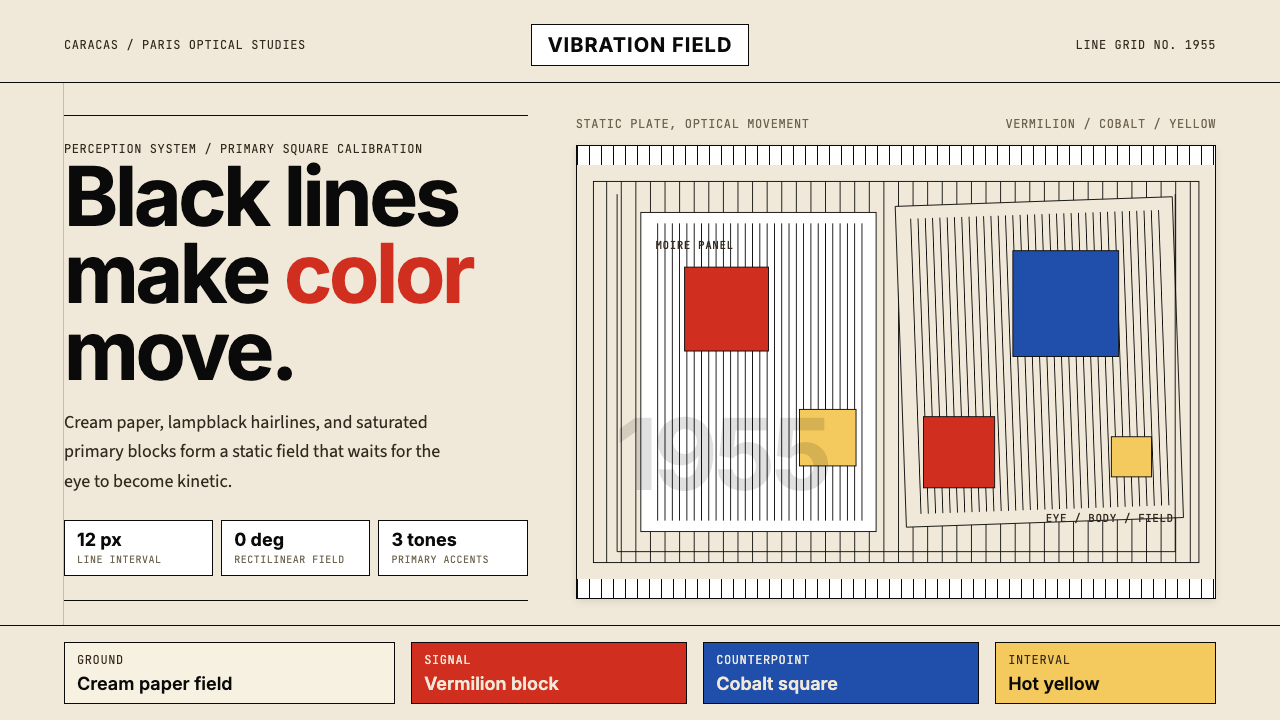
Jesús Rafael Soto discovered that parallel lines and hovering color squares could make a static surface tremble — handing the act of perception itself back to the viewer.
Jesús Soto Kinetic Art (Venezuela) in brief
Jesús Soto Kinetic Art is a visual discipline rooted in the work of Venezuelan artist Jesús Rafael Soto (1923–2005), who spent his career exploring how optical phenomena — moiré shimmer, figure-ground ambiguity, perceptual vibration — could be produced through the disciplined arrangement of simple geometric elements. The system rests on a cream or off-white ground, over which crisp parallel black lines are spaced with mathematical regularity. Against this ruled field, saturated squares or rectangles in vermilion, cobalt, and hot yellow are positioned so that the viewer's slightest movement across the surface generates the sensation of motion in the lines themselves.
The aesthetic language is one of extreme economy. There are no representational images, no illustrative flourishes, and no decorative interruptions to the grid. Color is restricted to the three primary saturated hues plus black and the warm neutral of the ground; every element earns its place through perceptual function rather than compositional embellishment. The result is work that feels simultaneously mathematical and alive — governed by strict rules yet genuinely responsive to the body and eye of whoever stands before it.
As a design system, Soto's kinetic vocabulary translates into layouts that pair fine ruled patterns with bold primary-color accents at calibrated intervals. The effect is modernist and rigorous, evoking the Latin American engagement with European abstraction while remaining visually distinct from both mid-century Swiss typography and the decorative surface of folk-influenced design. It is a style that signals intellectual seriousness, perceptual curiosity, and a distinctly Venezuelan strand of international modernism.

Where does Jesús Soto Kinetic Art (Venezuela) come from?
Jesús Rafael Soto was born in 1923 in Ciudad Bolívar, Venezuela — a provincial river city far removed from the artistic centers of Caracas or Paris. He received his early training at the Escuela de Artes Plásticas y Artes Aplicadas de Caracas in the late 1940s, where he encountered both classical instruction and, crucially, reproductions of European modernism: Mondrian's grids, Malevich's geometric reductions, the Constructivist insistence on the social potential of abstract form. In 1950, awarded a government scholarship, he left for Paris — a city in the early 1950s that functioned as a crossroads of kinetic, optical, and concrete art.
In Paris, Soto encountered Victor Vasarely, whose systematic optical research was already generating the visual phenomena that would later be named Op Art. He became part of a loose community that included Julio Le Parc, Jean Tinguely, and Yves Klein, artists committed to dematerializing the art object and implicating the viewer's body in the work's completion. Soto's particular contribution was to investigate the space between a painted or drawn surface and a layer suspended in front of it — wires, rods, or translucent screens — discovering that this gap, when traversed by the eye, produced vivid perceptual oscillation. His early Superpositions (mid-1950s) were among the first works to demonstrate this principle systematically.
In 1955, Soto participated in the landmark exhibition Le Mouvement at Galerie Denise René in Paris — a show that brought together Vasarely, Calder, Duchamp, Tinguely, and others under the rubric of kinetic art, and that is now regarded as the founding moment of the international kinetic movement. The exhibition established that motion in art need not be mechanical; perceptual motion — the shimmer activated in the viewer's nervous system by optical means — was equally valid and in some ways more radical, because it relocated the seat of the work's animation from the object to the observer.
Through the 1960s and 1970s, Soto's international reputation grew steadily, while his connection to Venezuela deepened. He exhibited at the Venice Biennale and at major museums across Europe and the Americas. In 1973, the Museo Jesús Soto opened in Ciudad Bolívar — designed by Carlos Raúl Villanueva, the architect responsible for the modernist synthesis of the Universidad Central de Venezuela campus — making Soto's hometown a destination for the study of kinetic and abstract art in Latin America. His large-scale Penetrables — room-sized installations of hanging colored rods through which visitors physically walked — brought his perceptual philosophy to its most democratic conclusion: the artwork as an environment that the public body enters, not an object the educated eye contemplates from a respectful distance.
What defines the Jesús Soto Kinetic Art (Venezuela) look?
Ground and Field
The foundation is always a warm neutral — cream, off-white, or a pale ivory — never a cold bright white. Against this ground, fine parallel black lines are drawn at mathematically regular intervals, creating what Soto called a vibrating field. The density of the lines determines the intensity of the optical effect: tighter spacing produces a more agitated shimmer, wider spacing a calmer, more architectural quality. The ruled field is not ornament; it is the perceptual substrate from which all other effects arise.
Primary Color Accents
Saturated squares or rectangles in three primary hues — a hot vermilion, a deep cobalt blue, and a sharp cadmium yellow — are placed at calibrated intervals across the ruled ground. The placement is not decorative but structural: each color block is positioned so that its edges conflict with the underlying line pattern, generating perceptual tension at the boundary. Color is never gradated, blended, or modulated in saturation; it is flat, decisive, and fully committed.
Optical Vibration
The defining quality of the system is the moiré effect — an apparent shimmer or movement that occurs when two regular patterns interfere with each other, or when a viewer's eye moves across a high-contrast ruled surface. In Soto's original works, this was enhanced by physically layering transparent screens or hanging rods in front of a painted panel. In the design system, it is achieved through the juxtaposition of fine-line patterns with high-contrast color blocks, so that even on a static screen or printed surface, the composition registers as perceptually alive.
Strict Rectilinear Geometry
Every element is orthogonal. Color blocks are squares or rectangles with sharp, unrounded corners. Lines are horizontal or vertical, never diagonal or curved. The compositional language admits no organic forms, no fluid curves, and no softened edges. This absolute commitment to the right angle and the parallel line is not stylistic preference but structural necessity: the optical effects the system produces depend on the regularity and precision of its geometric vocabulary.
Modernist Sans-Serif Typography
Text in the system is set in geometric or humanist sans-serif letterforms — typefaces that share the movement's commitment to structural reduction and visual clarity. Type is used with deliberate hierarchy: titles are set at markedly larger scales than body text, with weight and size doing the organizational work rather than decorative rules or ornamental borders. Typographic color — the overall darkness or lightness of a block of text — is kept consistent with the flat, high-contrast visual logic of the rest of the composition.
Mathematical Spacing
Intervals between lines, between color blocks, and between typographic elements are governed by proportional systems rather than intuitive judgment. The spacing is never arbitrary; it is derived from the same underlying module that determines the line density and color block scale. This mathematical regularity is perceptible even when the specific ratios are not consciously analyzed: the composition reads as ordered, disciplined, and internally consistent.
Flatness and Zero Simulation
Despite producing vivid perceptual depth and apparent motion, the system's elements are rigorously flat. There are no soft shadows, no gradients, no textured surfaces, and no simulated three-dimensionality beyond the optical effects inherent in the line-and-color interaction. Apparent depth arises from the optical phenomenon, not from rendering conventions. This distinction is important: the system produces real perceptual effects through genuine structural logic, not through decorative imitation of depth.

Who shaped Jesús Soto Kinetic Art (Venezuela)?
Soto is the originating figure of the entire system. Born in Ciudad Bolívar in 1923, he trained in Caracas before moving to Paris in 1950, where he became a central figure in the international kinetic art movement. His Superpositions series of the mid-1950s established the core principle — layering a transparent ruled screen over a painted ground to produce optical shimmer — that would define his practice for five decades. His large-scale Penetrable installations, begun in the 1960s and continued until his death in 2005, invited the public to walk through fields of hanging colored rods, transforming kinetic perception into a fully embodied social experience. The Museo Jesús Soto, opened in his hometown in 1973, remains the definitive institutional repository of his work.
Cruz-Diez (1923–2019), born in Caracas in the same year as Soto, pursued a parallel investigation into color and perception that became known as Physichromie — the study of how adjacent color strips create autonomous color sensations independent of any fixed pigment. He worked primarily in Paris from the late 1950s onward, and his large-scale public installations — chromatic environments applied to floors, streets, and airport terminals — brought kinetic color principles into everyday civic life. Together with Soto, he established the Latin American kinetic school as a serious international force rather than a regional curiosity.
Gego (1912–1994) was a German-Venezuelan artist who, after fleeing Nazi Germany in 1939, built one of the most distinctive bodies of work in Latin American modernism. Her Reticuláreas — large-scale wire mesh installations suspended from ceilings — created immersive spatial environments whose visual complexity emerged from the interaction of simple repeated elements rather than from decorative intention. Though her vocabulary was more organic than Soto's strict orthogonals, she shared his commitment to the line as a primary constructive element and to the idea that the artwork's meaning is completed in the perceptual encounter between object and viewer.
Alejandro Otero (1921–1990) was a Venezuelan painter and sculptor whose Coloritmos series — vertical canvases divided into bands of alternating colors — investigated the rhythm of color in ways that ran parallel to, and often in dialogue with, Soto's line experiments. A key figure in the Los Disidentes group, which challenged academic art in Venezuela during the late 1940s, Otero subsequently developed monumental polychrome sculptures for Venezuelan public spaces. His career demonstrates the breadth of Venezuelan geometric abstraction beyond kinetic art strictly defined.
Though Hungarian-French rather than Venezuelan, Victor Vasarely (1906–1997) was the central figure in the European context into which Soto inserted himself upon arriving in Paris. Vasarely's systematic optical research — creating illusions of depth, curvature, and movement through flat geometric pattern — provided both inspiration and a point of distinction for Soto, who developed the physically layered dimension that Vasarely's purely painted surfaces could not achieve. Vasarely's 1955 Yellow Manifesto, published to coincide with Le Mouvement exhibition, argued for the public and collective character of kinetic art, a democratic ambition that Soto would carry further with his Penetrables.
How do you use Jesús Soto Kinetic Art (Venezuela) today?
Applying the Soto kinetic vocabulary to designed work requires understanding that its power comes from systematic tension — between the regularity of the line field and the interruption of the color accent, between geometric order and perceptual animation. Simply placing primary-color rectangles over a striped background is not the system; the system is the calibrated relationship between those elements, in which spacing, proportion, and color saturation are all working together to produce a specific perceptual effect. Getting this right demands restraint: fewer color accents placed with more deliberate intent will always outperform a layout saturated with competing elements.
For presentation slides, the system is particularly effective on cover pages and section dividers. A cover benefits from a single dominant color block — occupying a precise fraction of the composition — set against the ruled neutral ground, with the title in a modernist sans-serif at high contrast. Content slides should strip back to the line field alone as background texture, letting data and text occupy clean zones without competing with the optical complexity of multiple color blocks. Data visualization slides — bar charts, comparative matrices, timeline diagrams — work naturally within this vocabulary: geometric chart elements become extensions of the color system, with one primary hue used for the dominant data series and the ground's ruled pattern providing implicit structure.
For web interfaces, the style suits contexts where analytical authority and perceptual engagement are both valued: dashboards, digital exhibition catalogs, portfolio sites for design and architecture practices, and pricing or feature comparison pages. Apply the ruled ground as a subtle interface texture — light enough to read clearly beneath content, strong enough to register as a deliberate design decision. Reserve the primary-color blocks for high-signal interface elements: active states, primary calls to action, or tier-differentiating badges. All type should follow the same orthogonal logic as the visual field: flush-left alignment, consistent hierarchy defined by scale and weight, no centered or decorative typographic arrangements.
For editorial and marketing contexts, the Soto vocabulary supports strong poster-logic layouts where a bold primary accent and a ruled field do the organizational work that photography or illustration might do in other styles. A single large color block anchors the composition; the title sits either within or in high contrast above it; body copy occupies a disciplined column with generous spacing that echoes the regularity of the line intervals. Marketing pages benefit from alternating full-width blocks — cream-ruled and solid-primary — that create rhythm without requiring visual embellishment. The key discipline is color restraint: each composition should commit to one primary color as dominant and use the other two sparingly, if at all.
A common mistake is treating the ruled ground as wallpaper — applying the line pattern everywhere at the same density and then layering content on top without regard for the perceptual effects the lines create. Authentic use of this vocabulary requires treating the line field as an active compositional element, not a passive background. Where the ruled pattern is dense, color accents should be few and deliberate; where color blocks dominate, the line pattern can recede to a subtler interval. Similarly, the system breaks down when rounded corners, soft drop shadows, or gradient fills are introduced — these conventions belong to a different visual logic and will neutralize the optical tension that gives the style its character.

Jesús Soto Kinetic Art (Venezuela) — FAQ
What is the difference between kinetic art and Op Art, and which category does Soto belong to?
Kinetic art refers broadly to art that incorporates actual or apparent movement — this includes both physically moving works (like Calder's mobiles or Tinguely's machines) and works that produce the perceptual sensation of movement through optical means. Op Art (Optical Art) is the latter category specifically: flat, static works that generate apparent movement, depth, or vibration in the viewer's visual system through the systematic use of pattern, contrast, and color. Soto's work belongs to both traditions. His early Superpositions and his Penetrable installations are kinetic in a physical sense — they involve actual spatial layering and viewer movement. His flat painted works, where the shimmer is produced entirely by the optical interaction of lines and colors, are Op Art. The most interesting of his works are those that occupy both categories simultaneously.
Can this style work on dark backgrounds, or does it require a light ground?
The historic Soto palette is fundamentally light-ground — cream and off-white are canonical, and most of his works exploit the warm neutrality of the paper or canvas ground as an active compositional element. A dark-ground inversion is possible but requires significant adjustment. On a black or very dark ground, the optical effects of the ruled line pattern become more aggressive — the shimmer intensifies and can tip into visual discomfort rather than perceptual animation. Primary yellow on black, in particular, creates a contrast so sharp that it dominates all other elements. A successful dark variant usually reduces line density, uses only one primary color as accent, and commits to either a dark-ruled ground or solid dark zones with the ruled pattern appearing only as highlight or border detail.
How does the Soto style differ from Bauhaus and Swiss International Style?
All three share geometric abstraction and a commitment to primary colors, but their logic and purpose differ substantially. Bauhaus is a didactic and ideological system — its visual language emerged from specific pedagogical principles and social ambitions, and its geometry is in service of functionalist arguments about designed objects. Swiss International Style is a typographic and gridding discipline — it systematized geometric principles into a reproducible corporate communication standard with an emphasis on rational information hierarchy. Soto's kinetic vocabulary, by contrast, is perceptual in its primary orientation: the geometry and color are not in service of legibility, communication hierarchy, or ideological argument — they are structured to produce a specific optical and psychological experience in the viewer. This distinction matters practically: Bauhaus and Swiss layouts are primarily about organizing information; a Soto-derived layout is also about creating an experience of visual attention and perceptual aliveness.
Is this an appropriate style for technology or software products?
It is appropriate for specific kinds of technology products, but not universally. The style works well for products that want to signal perceptual intelligence, analytical depth, or a distinctive European-influenced modernist identity — data visualization platforms, computational design tools, digital art infrastructure, or a studio positioning itself at the intersection of art and technology. It is less well suited to general consumer software, mobile applications where the primary interface paradigm is touch and speed, or enterprise software where familiar convention reduces cognitive load. The key test is whether perceptual engagement — the slight friction and fascination that the optical effects produce — is an asset or a liability for the product's use context.
How do I avoid making a Soto-inspired layout look merely like a generic geometric pattern?
The distinction between a Soto-derived composition and a generic geometric background lies in the purposeful calibration of tension. In an authentic application of this vocabulary, the line field and the color accents are in active relationship — the color block is placed where it most effectively disrupts the regularity of the lines, creating a localized zone of intensified optical activity. A generic geometric pattern treats the repeated element as wallpaper; a kinetic composition treats it as a force field whose properties change depending on what is placed within or against it. Practically, this means committing to precise placement decisions, maintaining severe restraint on the number of color accents, and ensuring that every color block earns its position through perceptual effect rather than decorative symmetry.
Related design styles
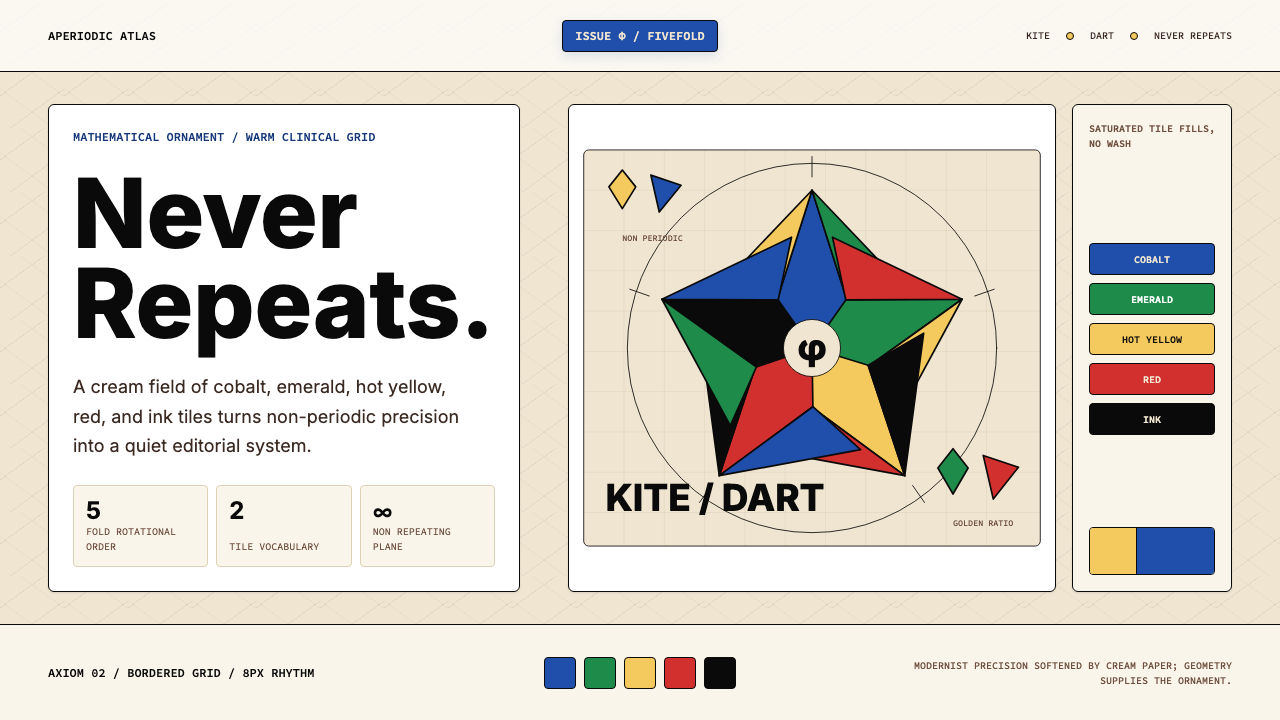 Penrose Aperiodic TilingAperiodic rigor, warmed. Cream grid carries cobalt, emerald and hot-yellow ki…
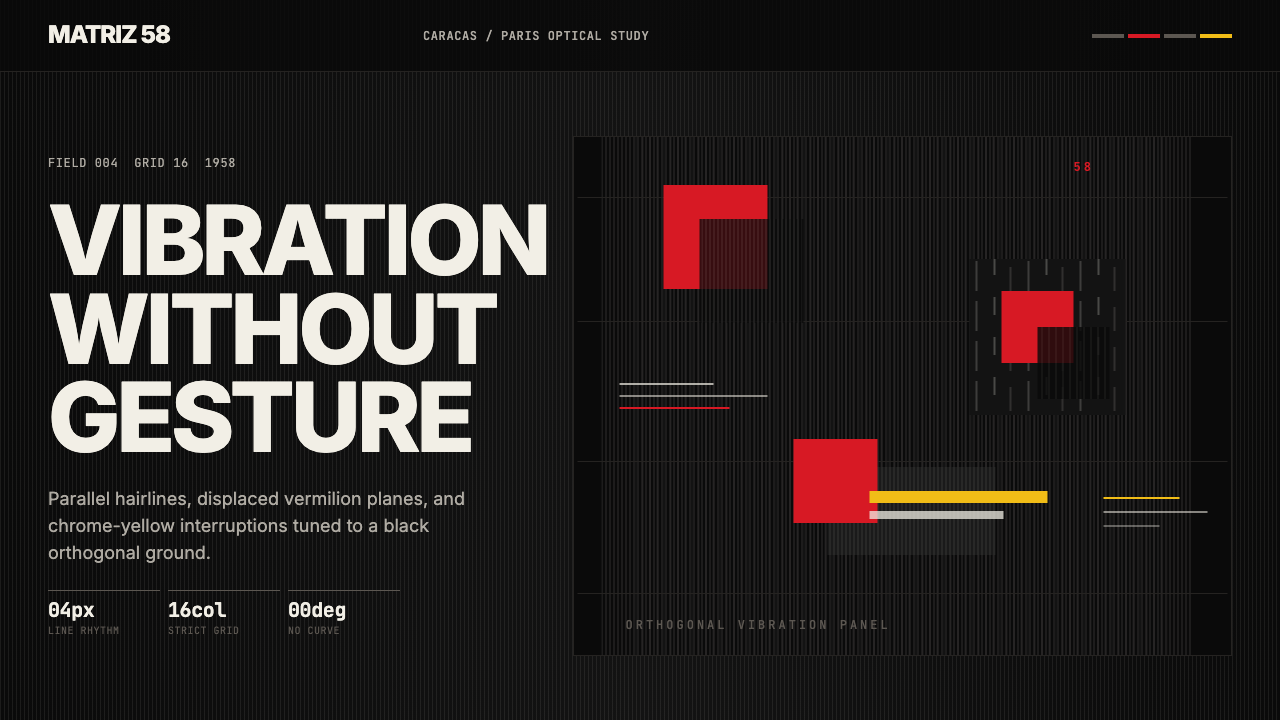 Venezuelan Cinético Soto 1958Optical tension holds still. Matte black, Inter, hairlines, and vermilion off…
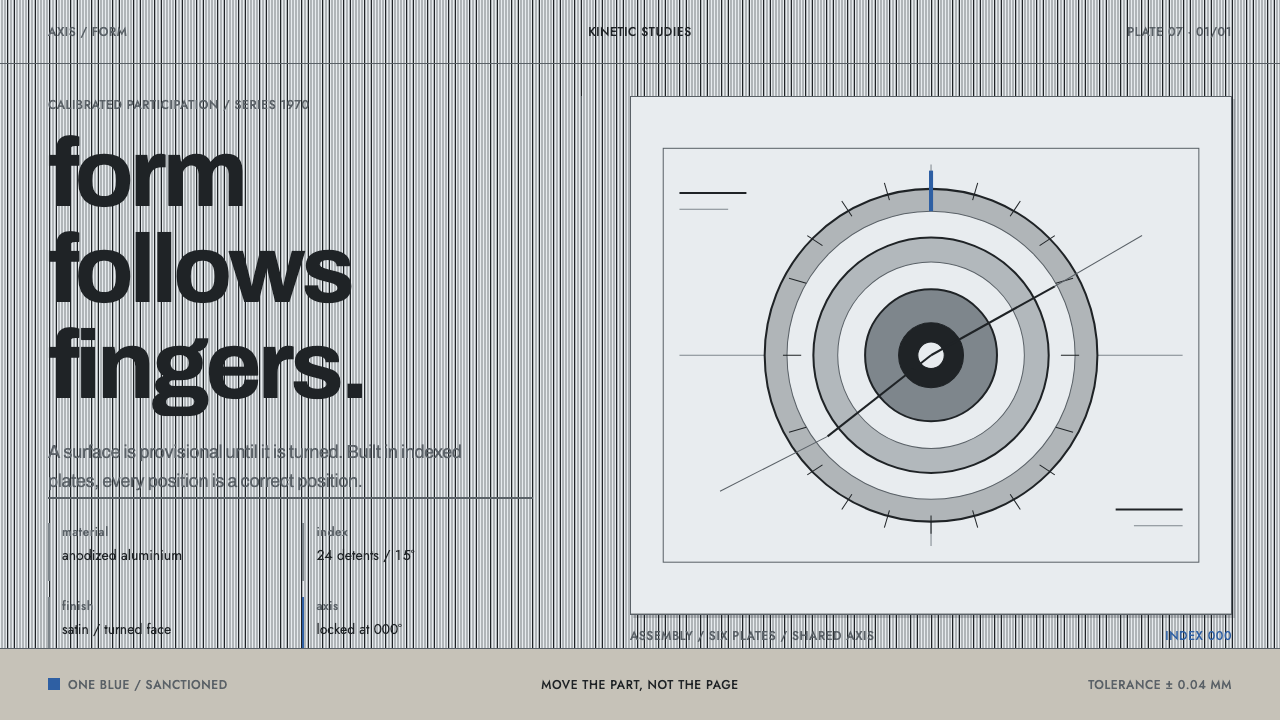 Mary Vieira KineticForm is made by movement. Satin aluminium plates turn on a precise indexed ax…
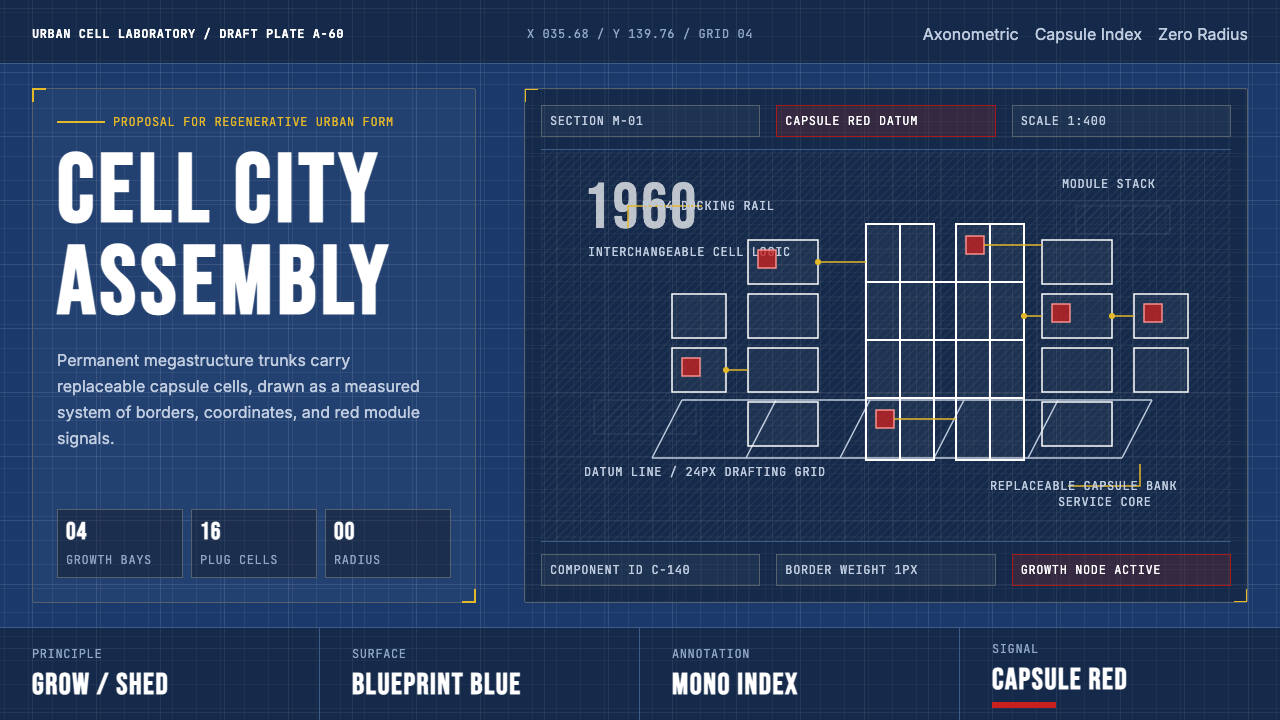 Metabolism Tokyo (1960)Cities become diagrams. Blueprint blue, mono labels, and capsule red mark mod…
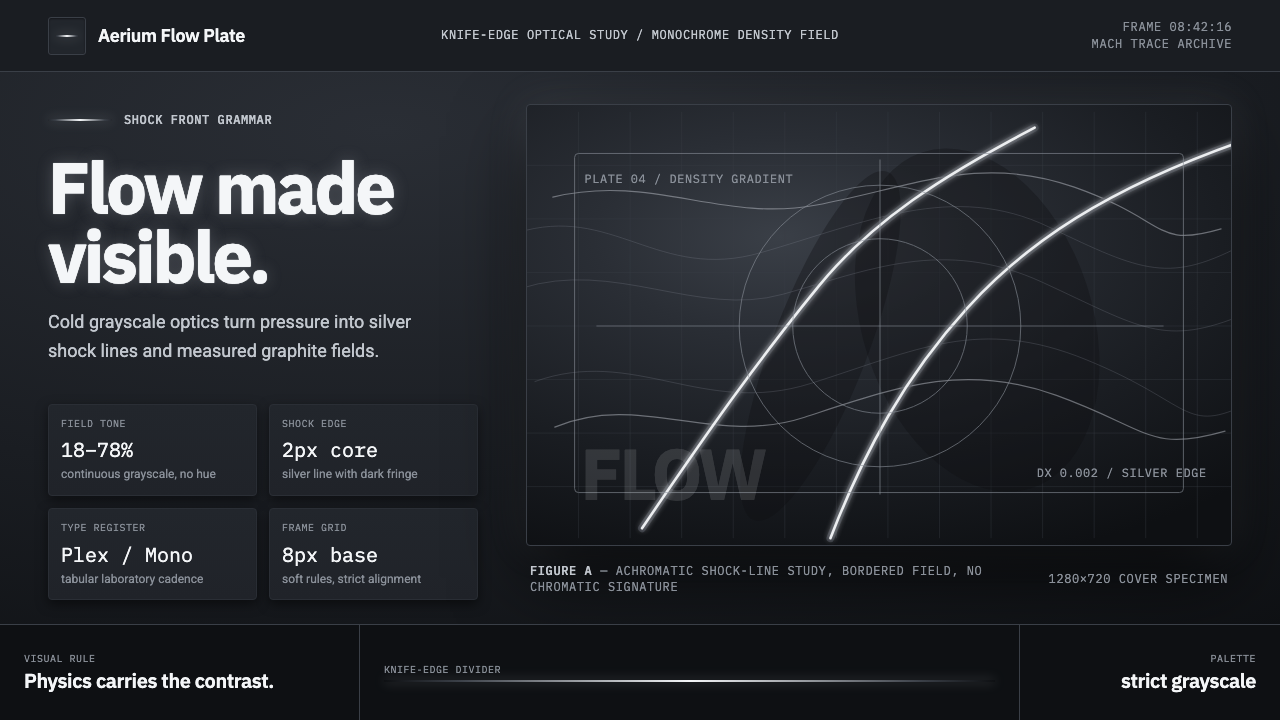 Schlieren ShadowgraphInvisible air becomes silver. Cool grayscale fields cut by precise shock line…
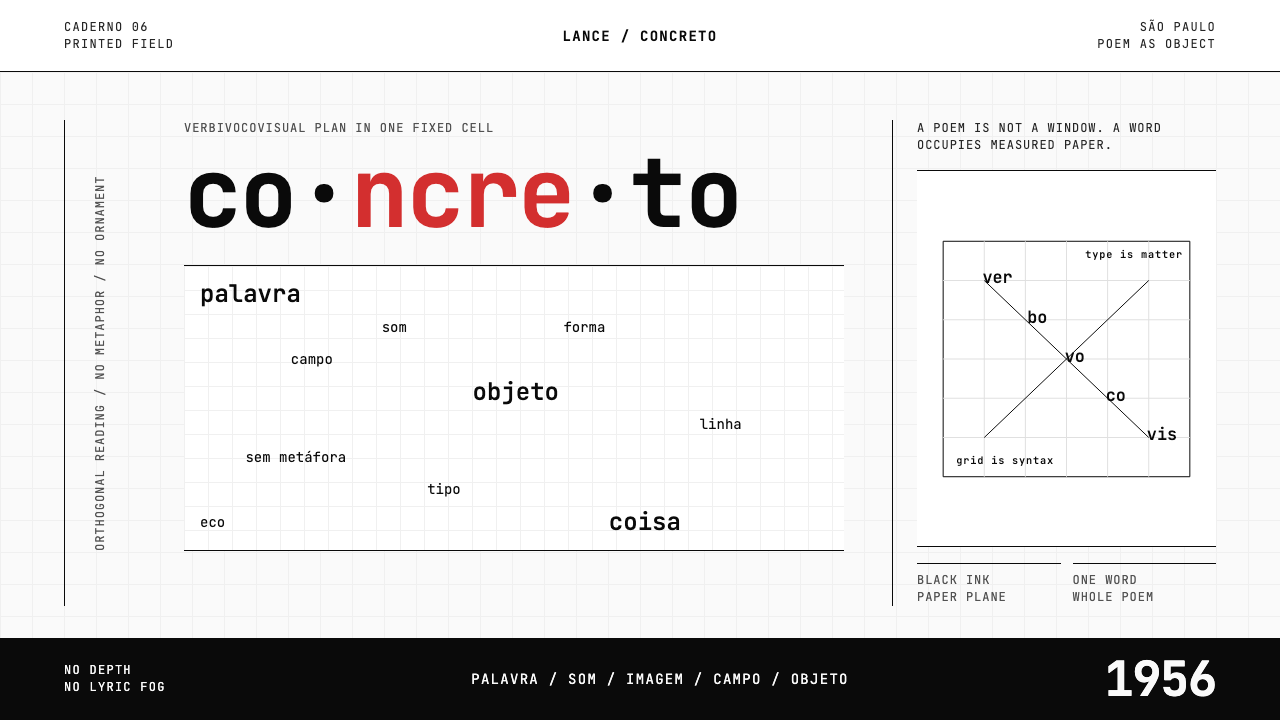 Brazilian Concrete PoetryWords become objects. Monospace cells, black-white paper, one cadmium red rup…