What is Brazilian Concrete Poetry?
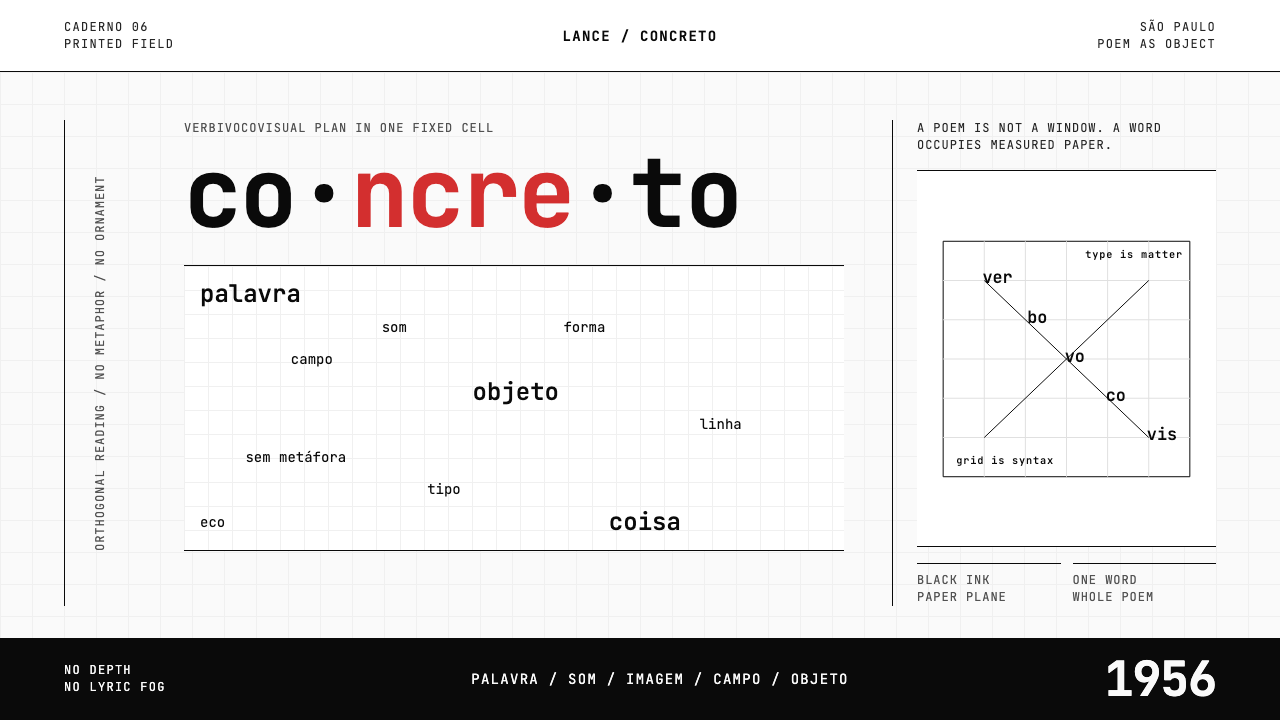
Brazilian Concrete Poetry turned words into visual objects — stripping syntax down to single letters on a grid, replacing metaphor with geometric precision.
Brazilian Concrete Poetry in brief
Brazilian Concrete Poetry is a typographic and poetic movement that emerged in São Paulo in the 1950s, insisting that a word's shape, position, and sound are as meaningful as its dictionary definition. Founded by the Noigandres group — Augusto de Campos, Décio Pignatari, and Haroldo de Campos — it abolished the poetic line and conventional syntax, treating each letter, syllable, or word as a self-sufficient visual object arranged on a strict geometric field. The page became a stage; white space became silence and structure simultaneously.
The movement's central doctrine was the 'verbivocovisual' poem — a work that operates on three registers at once: verbal (the word's meaning), vocal (its sound when spoken or chanted aloud), and visual (its spatial arrangement on the surface). In practice, this produced compositions where a single noun might be repeated in a diagonal scatter, where letters from one word could bleed into another, or where the entire poem consisted of a single word expanded and contracted across a white field. Ornament, narrative, and sentiment were deliberately excluded.
Visually, the aesthetic is stark and uncompromising: pure black letterforms on paper-white grounds, monospace typewriter fonts whose every character occupies the same fixed cell, deep negative space that gives each word or letter room to be perceived as a discrete object, and occasional single-color punctuation — most famously, a single red element deployed as a rupture in an otherwise monochrome composition. The system is less about beauty in the decorative sense and more about precision as a form of argument.

Where does Brazilian Concrete Poetry come from?
The founding moment of Brazilian Concrete Poetry can be traced to 1952, when Augusto de Campos, Haroldo de Campos, and Décio Pignatari began meeting in São Paulo to rethink the possibilities of language. They named their group Noigandres — a word lifted from Provençal troubadour poetry, a fragment whose meaning was disputed even by medieval scholars, chosen precisely for its resistance to transparent meaning. From the start, the movement was interested in language as material rather than language as vehicle.
Brazil in the 1950s was undergoing rapid modernization — Brasília was being built from scratch in the interior, the country was industrializing, and a generation of artists and intellectuals were looking for forms that matched the velocity of contemporary life. The Noigandres group found intellectual allies abroad: they read Stéphane Mallarmé's spatial experiments in 'Un Coup de Dés' (1897), Ezra Pound's ideogrammic method, and the Swiss Concrete poets gathered around Eugen Gomringer, who was working in parallel in Zurich. Gomringer and Décio Pignatari met in 1955, and their exchange formalized the international dimension of the movement.
The watershed year was 1956. The Exposição Nacional de Arte Concreta — held first in São Paulo and then in Rio de Janeiro — placed concrete visual art and concrete poetry on the same platform, establishing the formal connection between the movement's typographic practice and the geometric abstraction being pursued by Brazilian painters and sculptors simultaneously. The exhibition made the movement visible to a Brazilian public for the first time and provoked immediate debate about what counted as art, what counted as poetry, and whether the two could meaningfully be separated.
In 1958, the Noigandres group published the 'Plano-Piloto para Poesia Concreta' — the Pilot Plan for Concrete Poetry — a manifesto that codified the movement's principles with the precision of a design brief. The document declared that the concrete poem is 'an object in and by itself, not an interpreter of exterior objects,' laid out the verbivocovisual doctrine, and traced a lineage from Mallarmé and Joyce through Pound and e.e. cummings. The Pilot Plan circulated internationally, cementing the Noigandres group's position as the theoretical center of a global concrete poetry network that extended to Scotland, Germany, Japan, and Czechoslovakia. Through the 1960s and into the 1970s, the movement's visual logic influenced Brazilian graphic design, music album typography during the Tropicália era, and eventually the visual identity of Brazil's cultural modernization.
What defines the Brazilian Concrete Poetry look?
Monospace Grid
Every character in a concrete poem occupies an identical cell — the spatial logic of the typewriter, where mechanical regularity eliminates any visual hierarchy between letters. This grid is not a background device but the poem's structural skeleton. Words, syllables, and letters are placed, rotated, or scattered within this cellular field, and the regularity of the grid makes every deviation from expected position feel deliberate and charged with meaning. The result is a typography where rhythm is spatial before it is phonetic.
Black on White Austerity
The foundational palette of concrete poetry is pure black letterforms on an unmediated white ground — the page reduced to its most elemental contrast. No tonal gradation, no gray midtones, no textural variation softens the encounter between ink and paper. This austerity is not absence of choice but a deliberate refusal: color would shift attention from the structural relationships between words toward surface affect. The monochrome field forces the reader to perceive each word or letter as a physical object defined entirely by its position and relation to others.
The Red Rupture
When color appears in concrete poetry, it functions as rupture rather than decoration — a single element in cadmium red or a similarly saturated, warm hue breaking the monochrome field at a single precise point. The red does not coordinate or complement; it interrupts. Its rarity is essential: in a composition where every other element is black on white, a single red character or mark carries enormous semantic weight, functioning almost like a spoken exclamation in an otherwise written text. This is the most direct available signal of emphasis within a system that otherwise refuses all emphasis devices.
Deep Negative Space
Concrete poetry treats white space not as the absence of content but as content's equal partner. A poem may consist of a single word placed at the center of an otherwise empty page, or a cluster of letters set at one corner with the remainder of the surface left bare. This negative space is not wasted — it is the silence between words, the duration between utterances, the visual equivalent of rest in musical notation. Reducing the number of words on a page forces each remaining word to bear more perceptual and conceptual weight.
Spatial Syntax
In conventional poetry, syntax — the arrangement of words into grammatical sequence — governs meaning. Concrete poetry replaces grammatical sequence with spatial arrangement: the same set of words laid out in different positions on the page produces different meanings, because position, proximity, and direction carry semantic force. Words placed close together imply relationship; words at opposite corners imply tension or opposition. Reading direction becomes undetermined — the viewer must construct a path, and different paths yield different poems within the same composition.
Word as Atomic Unit
Where traditional poetry works at the level of the line or stanza, concrete poetry works at the level of the individual word — or, in more radical examples, the individual letter or syllable. Each unit is treated as both a linguistic sign and a visual form simultaneously. The concrete poet selects words partly for their phonetic texture (how they sound repeated), partly for their visual shape (how certain letters create visual rhythm when repeated), and partly for their semantic density (words that carry multiple meanings in multiple languages). A single word, geometrically placed, can constitute an entire poem.
Geometric Composition
The placement of words and letters in concrete poetry follows geometric logic rather than decorative intuition — diagonal lines, symmetric grids, spiral arrangements, and cruciform patterns recur because they create relationships between elements that are spatial rather than grammatical. These geometric structures were influenced by the Brazilian concrete art movement occurring simultaneously, which held that visual composition should be governed by measurable, reproducible mathematical relationships rather than subjective expression. The poem and the painting shared a common method.

Who shaped Brazilian Concrete Poetry?
Augusto de Campos was the most visually inventive of the Noigandres founders, responsible for some of the movement's most recognized compositions. His work explored the permutational possibilities of individual words — rearranging letters to reveal embedded meanings, overlaying words in different colors to create simultaneous readings, and designing poems that functioned as visual objects intended to be exhibited rather than simply read on a page. His engagement with popular music and mass media in the 1960s extended concrete poetry's methods into sound and performance, and his critical translations of international avant-garde poetry helped position the Noigandres group within a global modernist lineage.
Pignatari served as the movement's most active international ambassador, whose 1955 meeting with Swiss concrete poet Eugen Gomringer was decisive in establishing concrete poetry as a genuinely international phenomenon rather than a Brazilian curiosity. His own poetry was deeply informed by information theory — he studied with Norbert Wiener's associates and brought the logic of signal, noise, and redundancy directly into his compositional practice. His 1957 poem 'beba coca cola' — a scathing visual transformation of an advertising slogan into an accusation — demonstrated that the concrete method could carry sharp political and cultural critique alongside its formal experiments.
Haroldo de Campos was the movement's primary theorist, whose scholarly reach extended from medieval troubadour poetry to Russian Formalism to Chinese classical poetics. He argued that the concrete poem's spatial and phonetic methods were not a modern invention but the recovery of ancient techniques that linear print culture had suppressed. His practice of 'transcreation' — translation understood as an act of poetic recreation rather than semantic transfer — produced Brazilian versions of Homer, Goethe, Dante, and the biblical Book of Qohelet that were received as major works in their own right. His theoretical writing remained influential in literary studies well beyond the movement's peak years.
Dias-Pino was a Brazilian visual poet and book artist who pushed concrete poetry's material logic into its most physical dimension — the artist's book as a designed object where paper, binding, and page sequence were all part of the poem's meaning. His seminal work 'A Ave' (The Bird, 1956) is a hand-cut, engineered book whose pages reveal a bird built from letters only as they are turned in sequence, making the act of reading into the act of assembling the image. His practice demonstrated that concrete poetry's spatial logic did not end at the printed page but could expand into three-dimensional, time-based objects.
Though Swiss rather than Brazilian, Gomringer is inseparable from the story of Brazilian Concrete Poetry because his independent parallel development of concrete poetic principles in Zurich — and his decisive meeting with Pignatari in 1955 — established the international framework within which the Noigandres group operated. His poem 'silencio' (1954), in which the word 'silencio' is arranged in a rectangular grid with a blank space at its center, is the canonical example of the form worldwide. The exchange between Gomringer and the Noigandres group turned a Brazilian literary experiment into an internationally recognized movement with agreed theoretical foundations.
How do you use Brazilian Concrete Poetry today?
Brazilian Concrete Poetry translates into contemporary design work as a system for giving language structural and visual weight — making words feel like objects rather than labels. Applying it correctly means understanding the logic behind the restraint: the monospace grid, the deep white space, the single-color rupture. These are not stylistic options to be selected individually; they function as an interdependent system where each element's power depends on the discipline of the others.
For presentation slides, the concrete poetry aesthetic works with particular force on cover pages and section dividers. A cover built on this system sets a single word or short phrase — a company name, a report title, an idea — in large monospace type against a full white field, with position determined geometrically rather than intuitively centered. The surrounding silence amplifies the text. Section dividers can use spatial repetition: a key word repeated across the slide in progressively smaller type along a diagonal axis, creating a typographic object rather than a conventional heading. Data slides should be approached as concrete compositions — each chart, number, or callout element placed within a strict grid, with heavy typographic hierarchy and no decorative framing.
For web UI, the style is well matched to interfaces where hierarchy and precision are primary values: developer tools, analytics dashboards, pricing tables, and API documentation pages. The approach requires a fixed grid system with substantial gutter spacing, near-white or pure white backgrounds, and black as the default type color. Reserve any warm accent — the concrete poetry red — for a single interactive state or alert category, never for decoration. Card components should have clear, hard borders rather than soft shadows; empty space within components is a feature, not a failure. Navigation labels should be typographic, unadorned, and hierarchical.
For editorial and marketing work, the style supports layouts that position the brand or product as rigorous, precise, and intellectually serious. A long-form article layout applies the concrete method by isolating key phrases in large-scale monospace type within the body of the page — not as pull-quotes in a decorative sense, but as visual resting points that carry the article's argument forward. Marketing pages work best when they resist the temptation to fill space: a feature announcement built on this system might show a single sentence, typographically expanded across a full-width section, with all supporting detail relegated to smaller type below. The total silence around a key claim makes the claim louder.
A common mistake when working with this aesthetic is adding secondary type treatments — italic variants, decorative weight contrasts, soft-shadow text effects — to compensate for what feels like blankness. The blankness is the system. Every element added to relieve the emptiness dilutes the visual charge of the elements that remain. Similarly, using the accent color more than once per screen or slide destroys its function as rupture; the moment it becomes a palette color, it stops being a signal.

Brazilian Concrete Poetry — FAQ
How does Brazilian Concrete Poetry differ from Swiss Concrete typography?
They share a commitment to geometric structure and the removal of ornament, and their founders were in direct contact — Pignatari met Gomringer in 1955. But the differences are substantial. Swiss Concrete typography, as developed by designers like Gomringer, Max Bill, and the Zurich school, prioritized the mathematical grid as an organizing framework for mass communication: it is rational, systematic, and designed for legibility at scale. Brazilian Concrete Poetry is fundamentally literary and conceptual — its concern is the word as both linguistic and visual event, and it is willing to sacrifice legibility for semantic or visual effect. Swiss typography produces ordered clarity; Brazilian concrete poetry produces structured disruption.
Can this style work for interfaces that handle large amounts of text?
It can, but with significant adaptation. Concrete poetry's native mode is the single word or short phrase deployed with maximal spatial deliberation — it was not designed for sustained reading of dense prose. For text-heavy interfaces, the approach should be applied selectively: use the concrete aesthetic for structural and navigational elements — headings, categories, empty states, section markers — while allowing the body text to follow more conventional legibility standards. The monospace type, the deep margins, and the strict grid can all coexist with readable body text provided the body text is not forced to also be monospace.
Does the accent color have to be red, or can other colors play that role?
The cadmium red accent is historically specific to the original Noigandres compositions, but the structural logic — one saturated, warm accent color against a monochrome field, used once, as rupture — can be executed with other strongly saturated hues provided they retain the same visual shock value against the black-and-white ground. A deep saturated orange or a vivid warm yellow could serve a similar function. What matters is the discipline: the accent must appear no more than once per composition, it must be distinctly warm and saturated against the cool monochrome field, and it must function as interruption rather than accent in the decorative sense.
Is this style appropriate for brands that want to feel warm or approachable?
Not directly. The concrete poetry aesthetic is founded on formal severity — the systematic removal of everything that could create sensory warmth, including rounded forms, soft gradients, natural textures, and the kind of white space that suggests human comfort rather than structural precision. Brands seeking warmth should look to other design systems. That said, the aesthetic can work for brands that want to signal rigor, precision, or intellectual seriousness while still communicating approachability through voice and content — the visual severity can be offset by warm, human editorial copy without compromising the system's structure.
What is the most common misapplication of this style in modern UI design?
The most common failure is importing the monospace font and the white background while retaining all the visual complexity of a conventional UI — multiple type sizes, colored buttons, card shadows, hover animations, gradient backgrounds. Monospace type in a visually busy environment does not produce a concrete poetry aesthetic; it produces a retro-terminal pastiche. The style requires global commitment: reducing the number of elements, colors, and type treatments across the entire composition simultaneously. A partial application almost always fails because the concrete aesthetic depends on the absence of visual noise for its effects to register.
Related design styles
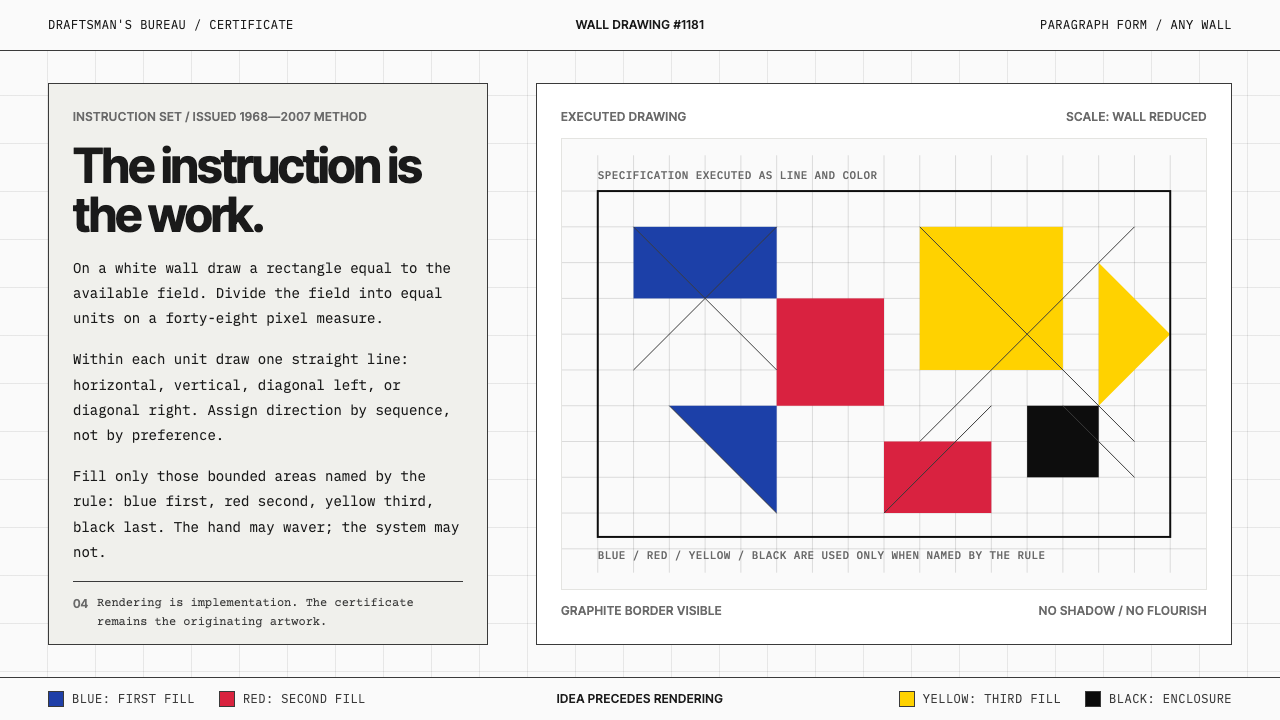 Sol LeWitt ConceptualInstruction becomes art. Mono certificates face wavering graphite grids in fo…
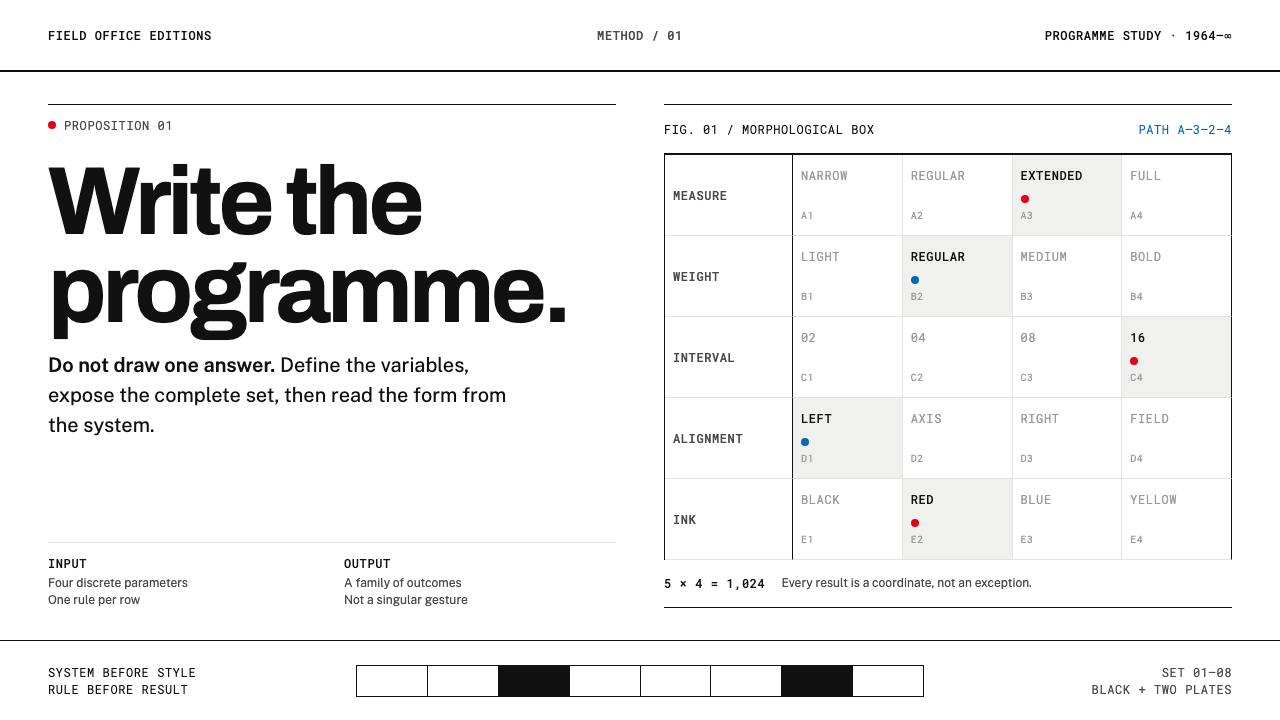 Karl Gerstner ProgrammesDesign becomes a programme. Black hairlines and a strict matrix turn paramete…
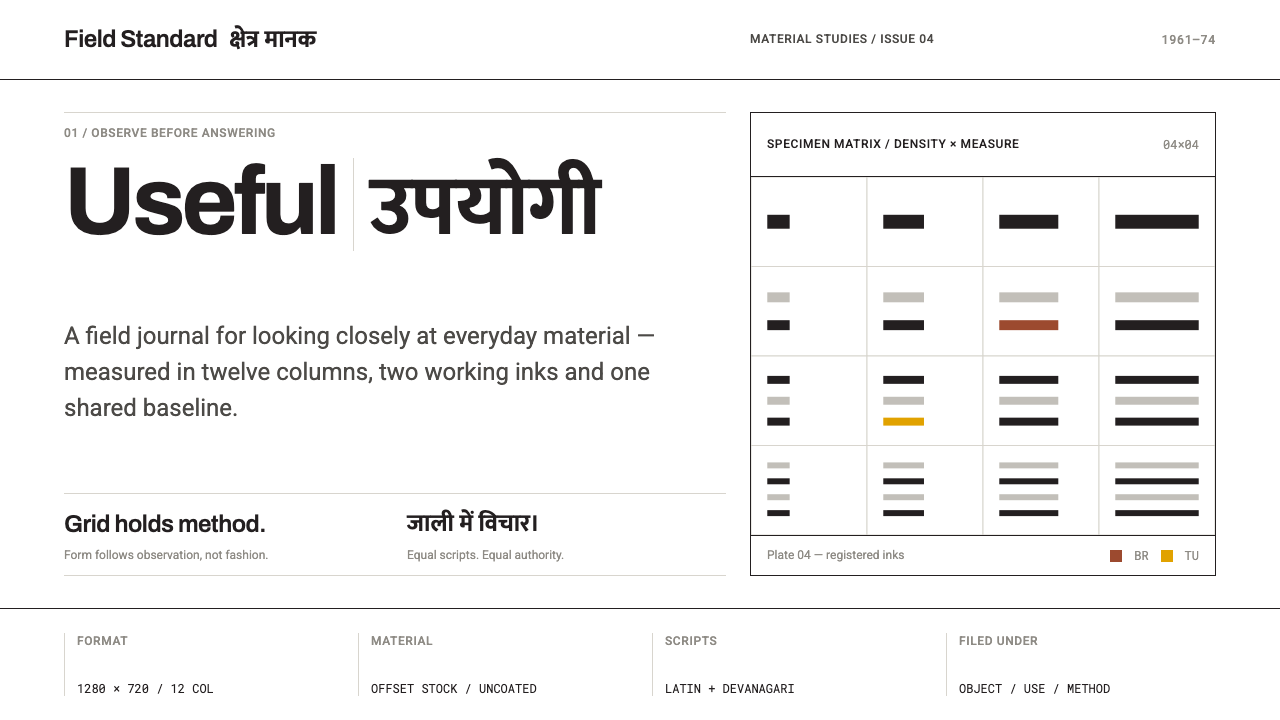 NID Ahmedabad ModernismStructure earns trust. Black rules and equal-weight scripts hold craft color…
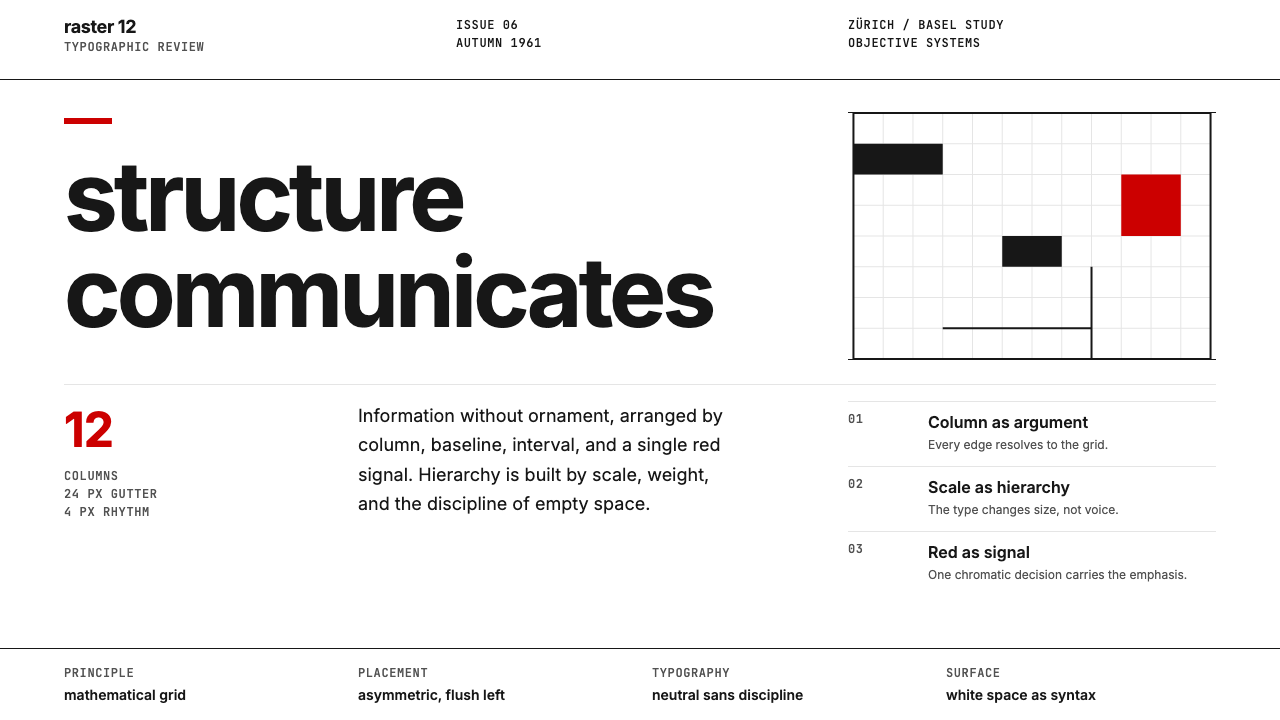 Swiss International StyleObjectivity made visible. Inter scale, white space, and one red block expose…
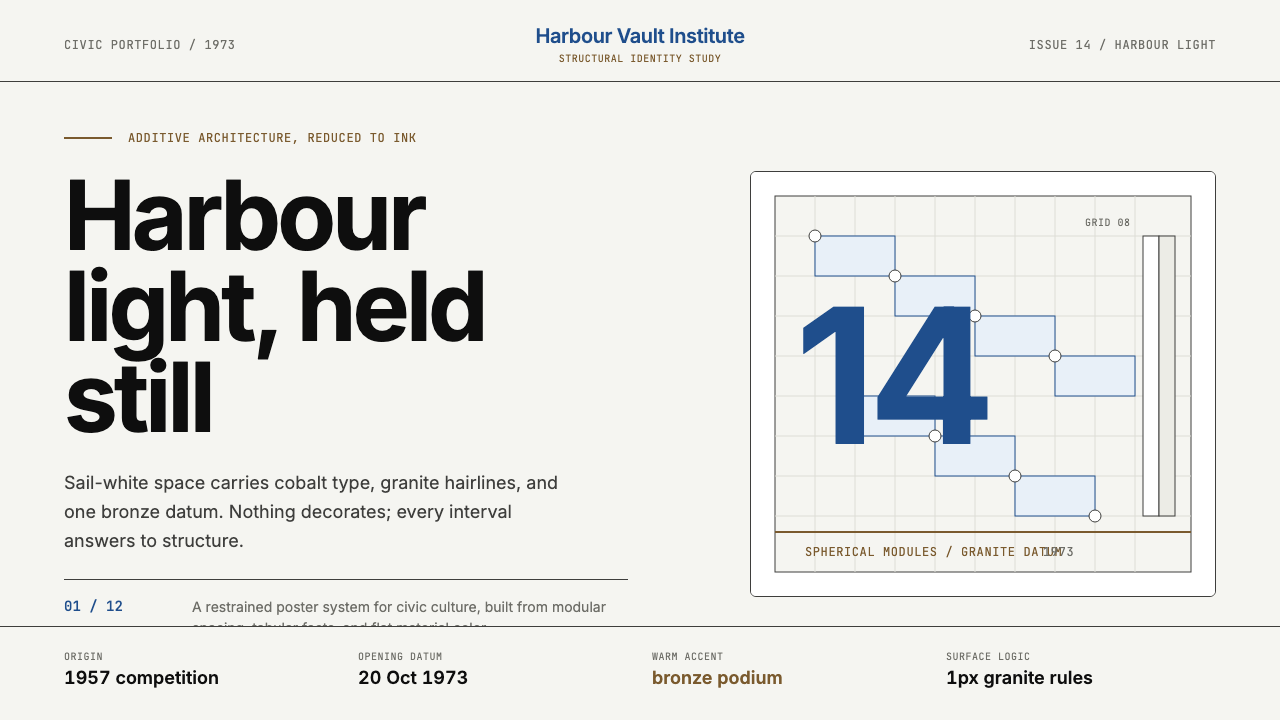 Sydney Opera House (Utzon, 1973)Civic restraint in harbour light. Sail-white space, cobalt type, bronze datum.
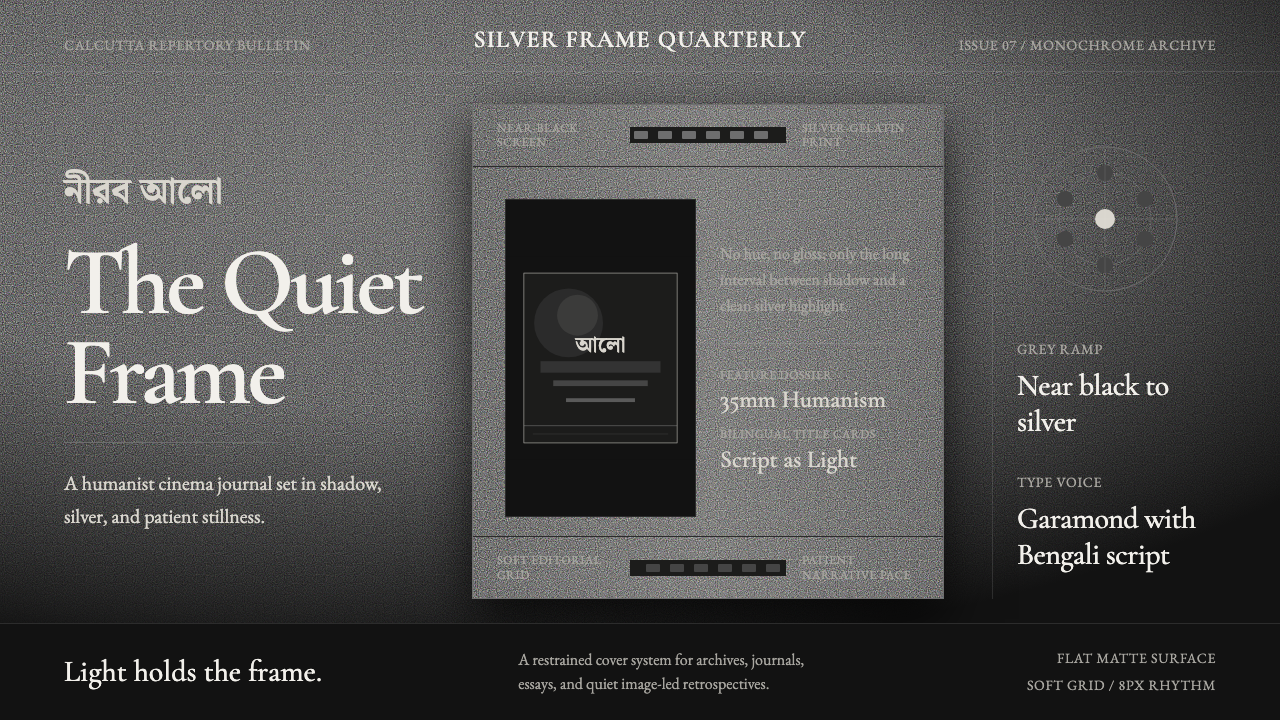 Bengali Art-House CinemaLight becomes restraint. Near-black ground, silver serif, and Bengali script…