What is Korean Dansaekhwa Monochrome?
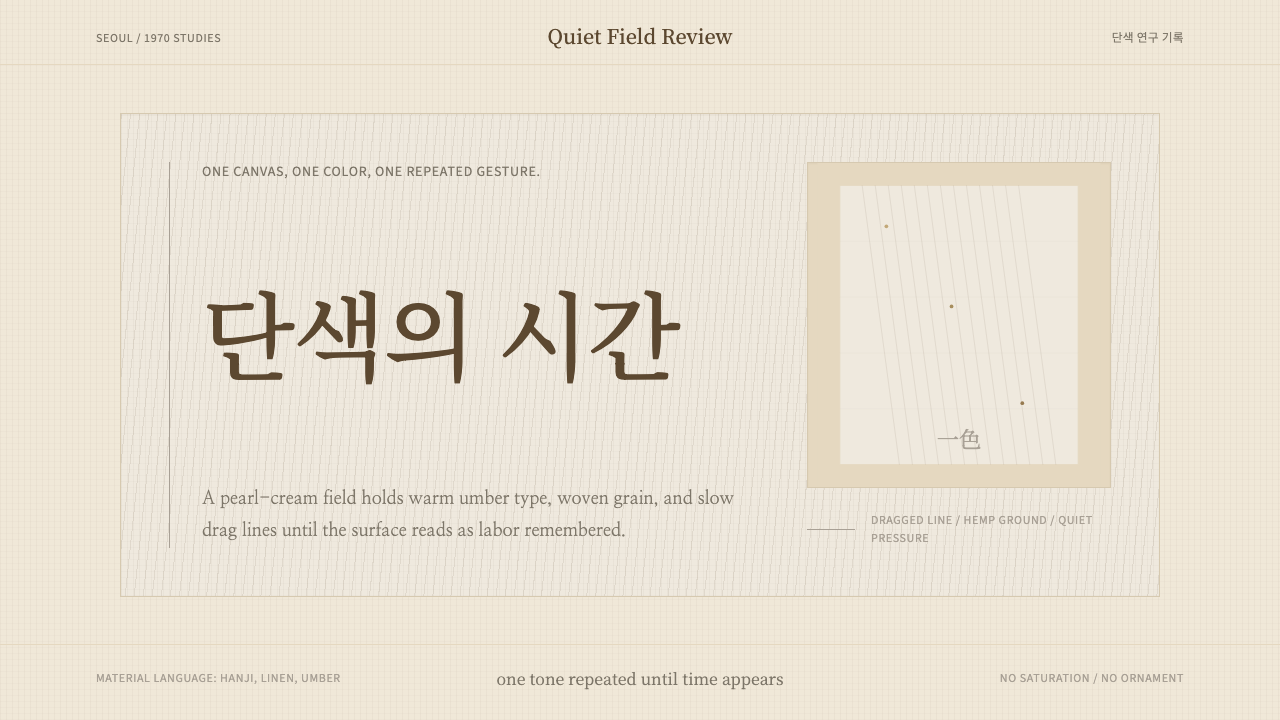
Dansaekhwa turns a single earth tone dragged across raw cloth into an act of meditation — and the quietest possible design system.
Korean Dansaekhwa Monochrome in brief
Dansaekhwa (단색화, literally 'monochrome painting') is the South Korean abstract movement that emerged in the 1970s and produced postwar Asia's most contemplative single-color canvases. Its key practitioners — Park Seo-bo, Lee Ufan, Ha Chong-Hyun, Chung Sang-Hwa, Yun Hyong-keun, and Kwon Young-Woo — worked with raw hemp, linen, and mulberry hanji paper, dragging, pressing, peeling, and knitting a single muted tone across the surface for hours at a time until the canvas became a record of accumulated time and physical labor.
As a design system, Dansaekhwa speaks in a register of extreme restraint. The palette is narrow: warm beige, pearl cream, ash grey, umber, and the dark charcoal of scorched wood. Saturation is nearly absent. Ornament is entirely absent. What fills the surface instead is texture — the visible grain of the material, the trace of repeated gesture, the hairline variation that proves a human hand was present. This is not minimalism in the contemporary sense; it is the visual equivalent of a breathing pause.
The movement was rediscovered internationally in the 2010s through gallery representation at Kukje, Tina Kim, Pace, and Hauser & Wirth, and canonized globally by the 2015 LACMA retrospective that introduced the term 'Dansaekhwa' to international audiences. Today the aesthetic informs a distinctive strand of East Asian visual culture that values quietude, process, and material honesty over novelty or spectacle.

Where does Korean Dansaekhwa Monochrome come from?
The historical context that produced Dansaekhwa was harsh. South Korea in the late 1960s and early 1970s was emerging from the devastation of the Korean War while simultaneously living under the authoritarian modernization program of President Park Chung-hee. The artists who would form the movement had witnessed destruction, displacement, and state-directed industrialization that left little room for the contemplative. Their response was not political protest in any direct sense — it was a turn inward, a recovery of the meditative and the material against the noise of forced modernity.
Park Seo-bo, often credited as the central figure of the movement, began his 'Ecriture' series in the early 1970s: thousands of repeated pencil lines drawn into wet paint on linen until line and ground became inseparable. Ha Chong-Hyun worked against the material itself, forcing paint through the back of burlap so that it bled through the weave in unpredictable patterns — a method he called 'conjunctive.' Chung Sang-Hwa cut grids into the surface of his canvas, peeled them back, then filled and re-painted, leaving a topography of creases and repairs. Each artist's method was a form of sustained physical and mental engagement with a single surface over time.
The movement drew on multiple cultural and intellectual currents simultaneously. From traditional Korean aesthetics — particularly the philosophy of musim (無心, 'no-mind') and the craft traditions of celadon pottery and hanji paper — the artists inherited an understanding that beauty could emerge from disciplined repetition and material attentiveness rather than compositional invention. From the Japanese Mono-ha movement, with which Lee Ufan was directly associated, came a philosophy of placing the artist's gesture in relationship with raw material rather than transforming it entirely. These were not Western-imported ideas thinly applied; they were recognizable continuations of an East Asian philosophical lineage.
International visibility came slowly. Through the 1970s and 1980s, Dansaekhwa was largely known within Korea and among specialists in Asian contemporary art. The global shift came in the 2010s when the art market's renewed interest in process-based abstraction, combined with institutional backing from major international galleries, brought the work to auction houses and museum collections in Europe and the United States. The 2015 LACMA retrospective, the first comprehensive international survey, established the canonical grouping and introduced the term 'Dansaekhwa' as an art-historical category rather than a descriptive phrase. By that point the style had already begun to influence graphic design, interiors, and brand identity — particularly in contexts where cultural seriousness and material restraint were desired values.
What defines the Korean Dansaekhwa Monochrome look?
Palette
The Dansaekhwa palette is built from the earth itself: warm beige, pearl cream, ash grey, warm umber, and a deep charcoal that reads as near-black without being absolute. Saturation is kept at its lowest possible level — these are tones that suggest color rather than assert it. A pearl-cream ground is canonical, carrying the warmth of natural cloth or hanji paper. Accent tones, where they appear, are darker relatives of the ground — umber against cream, charcoal against grey — never complementary contrasts or chromatic surprise.
Texture as Surface
Where most design systems use flat color fields, Dansaekhwa uses textured ones. The visual interest of the surface comes from the trace of process: the directional drag of a palette knife, the visible weave of burlap showing through layers of paint, the hairline crack where dried medium caught the light. In digital or print application, this translates to subtle paper or cloth textures applied to backgrounds — never photographic, always secondary to the tonal field, and always directional rather than random.
Gestural Linearity
A single repeated gesture — a horizontal drag, a diagonal stroke, a grid of pressed marks — is the primary compositional device. Lines are not decorative; they are the record of an action performed many times in the same direction. In design application, this quality appears as ruled hairlines, finely spaced parallel rules, or the grain of a paper texture running consistently across a background. The line does not frame or divide so much as it accumulates — building a surface from iteration.
Typography in Harmony
Type in Dansaekhwa-influenced work is sparse, unhurried, and deferential to the texture beneath it. Serif faces — particularly those with fine strokes — echo the thin lines of the painted surface. Text is set in small quantities: a title, a date, a short statement. Long bodies of text are rare and, when necessary, set in a quiet weight at generous leading. The relationship between type and ground is one of respectful coexistence rather than contrast. Korean characters, with their own structural geometry, integrate naturally into this system.
Temporal Depth
Dansaekhwa communicates the passage of time — the duration of the making — as a visual quality. A canvas covered with ten thousand repeated marks reads differently from one covered with a hundred, even if the surface tones are identical. In design, this translates to compositional patience: generous margins that allow a surface to breathe, single focal points placed without crowding, and the avoidance of multiple simultaneous claims on the viewer's attention. Busyness is the opposite of this aesthetic.
Material Specificity
The original paintings were inseparable from their materials — raw hemp was not just a support but an active participant, absorbing, resisting, and responding to the applied medium. In design application, this principle becomes a commitment to the material qualities of the chosen medium: the particular off-white of uncoated paper stock, the slight tooth of a matte surface, the weight of a card that feels substantial in the hand. Choices are made for material reasons, not purely visual ones.
Zero Saturation, Zero Ornament
Where Bauhaus achieves restraint through the discipline of primary colors, Dansaekhwa achieves it through the near-total elimination of color. There are no accent hues borrowed from outside the earth-tone palette, no gradient transitions, no decorative borders or motifs, no illustrative elements. The surface contains exactly what the process deposited there, nothing more. This is not emptiness — it is completeness achieved through subtraction.

Who shaped Korean Dansaekhwa Monochrome?
Park Seo-bo (born 1931) is the most internationally recognized figure of the movement and the artist most closely associated with its theoretical articulation. His 'Ecriture' series, begun in the early 1970s and continued across his entire career, involves drawing thousands of pencil or crayon lines into layers of wet paint on linen — a process so repetitive and physically demanding that it blurs the boundary between writing and erasure, mark-making and meditation. Park described the practice as a way of emptying the mind through the hand, aligning it explicitly with East Asian philosophical traditions of non-doing. His canvases, particularly those from the canonical 1970s period, are among the most studied objects in contemporary Korean art history.
Lee Ufan (born 1936) occupies a singular position in the movement as the artist most deeply engaged with both Western phenomenology and East Asian philosophy — he studied at Nihon University in Tokyo and was a central voice in the Japanese Mono-ha movement before becoming associated with Dansaekhwa. His paintings typically place a few deliberate brushstrokes of pigment mixed with stone powder on an otherwise bare canvas, insisting that the unpainted area is as significant as the painted one. Lee theorized this relationship extensively in essays that have been widely translated and are considered foundational texts for understanding both Dansaekhwa and Mono-ha. His international gallery presence has been instrumental in bringing Dansaekhwa to audiences in Europe and North America.
Ha Chong-Hyun (born 1935) developed the most materially radical technique within the movement. His 'Conjunction' series, begun in the 1970s, involves forcing oil paint through the back of coarse burlap fabric so that it bleeds through the weave in patterns the artist can guide but not fully control. The resulting surface has a relief quality — the weave of the fabric is both structure and image — and the coloration, typically monochrome in warm or cool greys and ochres, records the precise resistance of the material. Ha's method is perhaps the clearest illustration of Dansaekhwa's insistence that the material itself must be an active participant in the work rather than a passive support.
Yun Hyong-keun (1928–2007) worked almost exclusively with two colors across his entire career: umber and ultramarine blue, heavily diluted and applied to raw linen in thin, absorbed washes that settled into the weave rather than sitting on top of it. The result is a palette of extraordinary quietude — deep warm browns against the natural off-white of undyed cloth — that many critics have associated with the ink-wash tradition of East Asian monochrome painting. Yun's work, consistently overlooked during the canonical Dansaekhwa period, has been substantially reassessed since the 2010s revival, and his canvases are now among the most sought-after by international collectors of the movement.
Chung Sang-Hwa (born 1932) developed a method that introduces structured destruction into the painting process. He applied paint to canvas in multiple layers, then cut the surface into a grid, carefully peeled back the sections, allowed the paint to dry and crack along the folds, and subsequently repainted the exposed areas. The final surface is a record of this cycle of application, rupture, and repair — a topography of healed wounds. Chung's work is among the most architecturally legible within the movement: the grid structure gives it a spatial quality that translates particularly well to large-format print and architectural applications.
How do you use Korean Dansaekhwa Monochrome today?
Dansaekhwa is among the most atmospherically distinct historical styles available to contemporary designers, because its visual logic is rooted in process and material rather than composition or color theory. Applying it well requires understanding what the system is actually communicating: quietude, duration, depth, and a form of dignity that comes from restraint rather than assertion. It is not suited to every context — but where it fits, it fits with unusual precision.
For presentation decks, Dansaekhwa performs at its best on cover and section-break slides rather than dense content pages. A cover built in this system uses a textured warm-cream ground, a single serif title set in a dark umber tone at a generous size, and perhaps a hairline rule or subtle parallel-line texture running beneath or beside the type. Nothing competes with the title. Section-break slides can carry a single word or short phrase and a full-bleed texture field — they function as breathing moments, resetting attention between content blocks. Data slides require more care: charts and graphs should be rendered in the earth-tone palette, avoiding all bright accent colors, with axis labels set small and quiet. The visual vocabulary can feel sparse with complex data, so use it for high-level summary slides rather than detailed tables.
For web UI and dashboards, the aesthetic translates best to products where seriousness, cultural depth, and a non-corporate quality are desired. Gallery and museum sites, cultural institution platforms, high-end craft brand storefronts, editorial platforms, and premium service offerings benefit most. The approach: a near-white or warm cream background, dark umber or near-black for body text and navigation, hairline dividers and fine borders rather than heavy rules, and photography treated in muted tones — desaturated rather than black-and-white, slightly warm in cast. Pricing pages work well with this system if tiers are differentiated by subtle tonal shifts rather than bright color coding; interactive states use the darker earth tones rather than a contrast color.
For editorial layouts and marketing collateral, the style supports long-form content with unusual grace. A Dansaekhwa-influenced editorial layout uses generous margins — approaching or exceeding the column width — as a visual anchor, with body text set at a deliberate pace with ample leading. Pull quotes appear in a slightly larger serif weight, sitting in the margin or breaking the column quietly. Section openers might use a full-bleed textured warm field with a single line of type, recalling the movement's canvas-as-ground principle. Marketing pages can adopt a poster-like gravity: one dominant typographic element, one textured ground tone, and extended silence around both. This system resists the impulse toward dense feature lists or aggressive calls to action.
A common mistake when working in this system is confusing restraint with emptiness and then compensating by adding more elements. Dansaekhwa's surfaces are not empty — they are full of texture, process, and accumulated gesture. The designer's equivalent of that fullness is achieved through quality of material choices, careful typographic spacing, and the deliberate selection of a single strong tonal ground rather than through the addition of graphic elements. A second common error is importing bright accent colors from outside the earth-tone palette — a vivid blue call-to-action button or a saturated red alert state will destroy the system's atmospheric coherence instantly. If interactive or alert states are needed, use the darkest available earth tone or near-black against the warm ground, never a chromatic contrast.

Korean Dansaekhwa Monochrome — FAQ
How is Dansaekhwa different from Japanese wabi-sabi aesthetics?
Both traditions value restraint, imperfection, and the beauty of natural materials, and both draw on East Asian philosophical traditions that see value in incompleteness and transience. The difference lies in intention and visual outcome. Wabi-sabi celebrates the imperfect and aged — the crack in a ceramic glaze, the asymmetry of a hand-thrown vessel — as beautiful in their departure from the ideal. Dansaekhwa is less interested in imperfection than in accumulation: the beauty of ten thousand identical marks, the dignity of sustained repetition. Its surfaces are not accidentally imperfect — they are intentionally complex, built through labor. The mood is closer to contemplative effort than to resigned acceptance of decay.
Can Dansaekhwa be used in digital products with dark backgrounds?
A dark inversion is possible but requires care. The canonical Dansaekhwa palette is warm-light — pearl cream and warm beige grounds are central — and the dark materials (umber, charcoal) appear as mark-making elements against that light ground. Inverting this to a dark ground with lighter type and texture can work, but the warmth of the palette must be maintained: a warm near-black ground rather than a cold one, text and texture in warm cream or pearl rather than pure white, and no introduction of cool or chromatic tones. The risk of dark Dansaekhwa is that it slides toward generic dark mode rather than retaining the specific atmospheric warmth of the original. Use it sparingly — for a single dramatic section rather than an entire product.
How do I incorporate Korean or East Asian typography without it feeling like cultural pastiche?
The key is to treat Korean or Chinese characters as a structural element of the composition, not as decoration or cultural signaling. In authentic Dansaekhwa-influenced design, any language — Korean, Chinese, or Latin — sits quietly on the surface with the same weight and restraint as everything else. Avoid using East Asian characters purely as visual texture or background motif; that reduces them to ornament, which this system explicitly rejects. Instead, use them functionally: if the product speaks to audiences who read those languages, use them for their communicative purpose. If they appear alongside Latin text, treat the typographic systems with equal care and at similar scales. The cultural specificity of the aesthetic comes from the color and texture choices, not from the presence of non-Latin letterforms.
What kinds of imagery or photography work with this system?
Photography in a Dansaekhwa-influenced system should be treated with the same restraint as the rest of the visual field. The ideal is imagery that carries its own quiet texture: close-up material details, surfaces, handcraft processes, still objects against plain grounds, or landscapes in low light. Color photography should be desaturated significantly — toward the warm grey and ochre range of the palette — without going fully monochrome. High-contrast or heavily stylized photography competes with the surface quality of the system and should be avoided. Figurative imagery with strong compositional drama, vibrant colors, or high energy is antithetical to the aesthetic. Where photography is not essential, consider replacing it with material texture fields or carefully composed typographic elements.
Is this aesthetic appropriate for consumer-facing digital products, or mainly for cultural institutions?
Dansaekhwa is well-suited to cultural institutions — galleries, museums, arts foundations, publishers — but its application is not limited to that sector. Any brand or product that positions itself around values of depth, craftsmanship, slowness, and non-mass-market distinctiveness can use this system credibly. High-end lifestyle brands, independent publishing platforms, premium hospitality, specialty food and craft brands, and professional services oriented toward considered clients are natural fits. Consumer-facing mass-market products — apps that need to onboard large numbers of users quickly, e-commerce platforms requiring aggressive conversion, or any context where warmth and friendliness are primary UX goals — are poor fits. The system communicates authority and seriousness rather than accessibility and approachability. Knowing which of those qualities your product needs is the first question to answer.
Related design styles
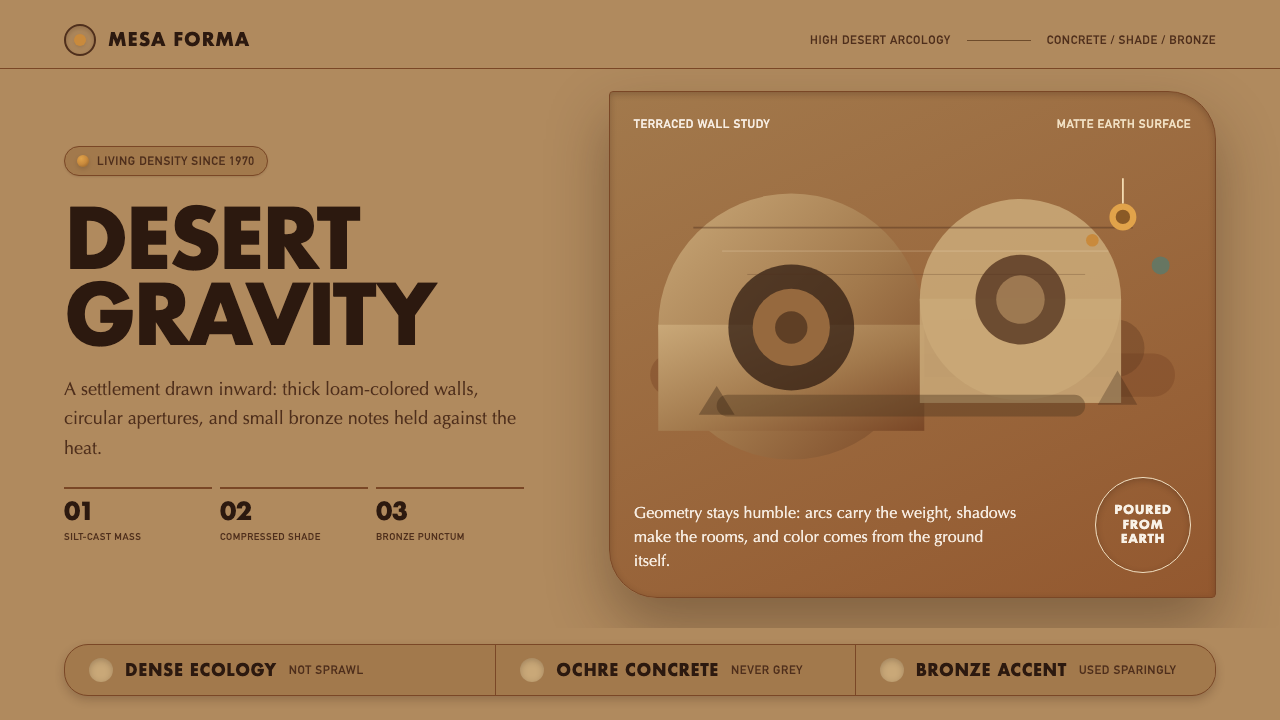 Arcosanti ArcologyArchitecture becomes desert. Ochre concrete, circular apertures, and bronze a…
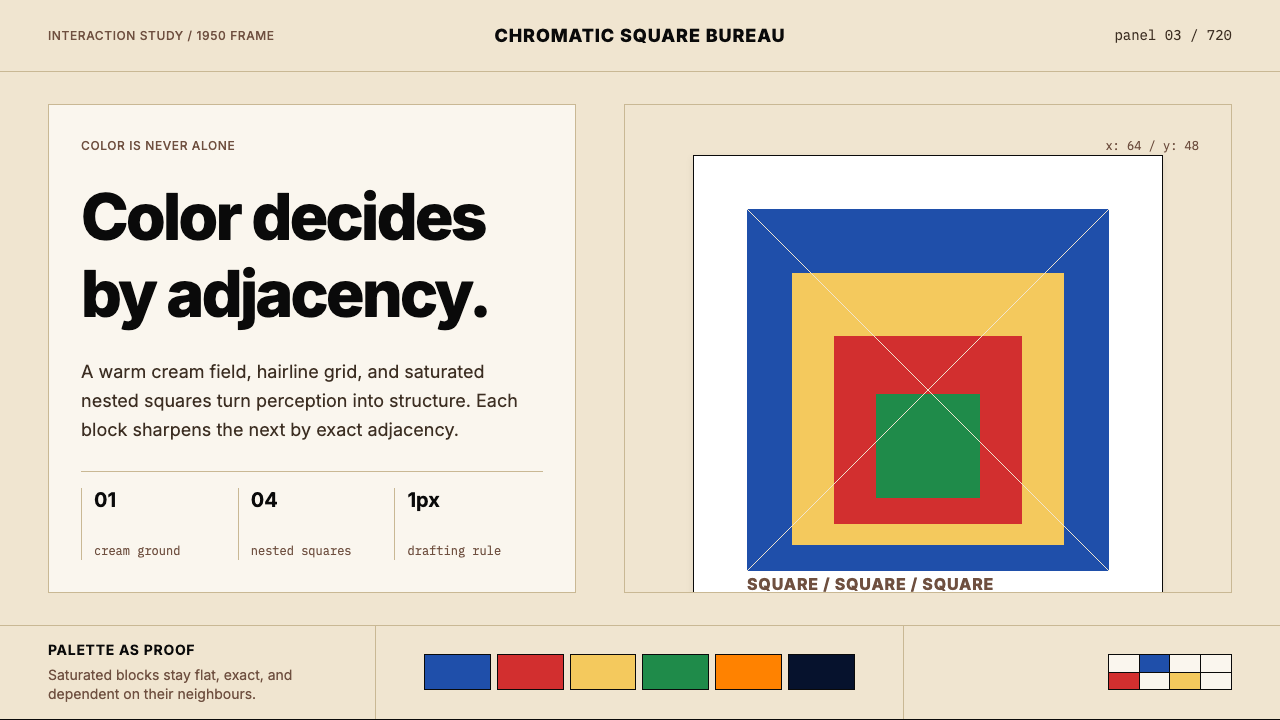 Josef Albers — Homage to the SquareColor becomes event. Warm cream, cobalt-red-yellow nested squares, exact hair…
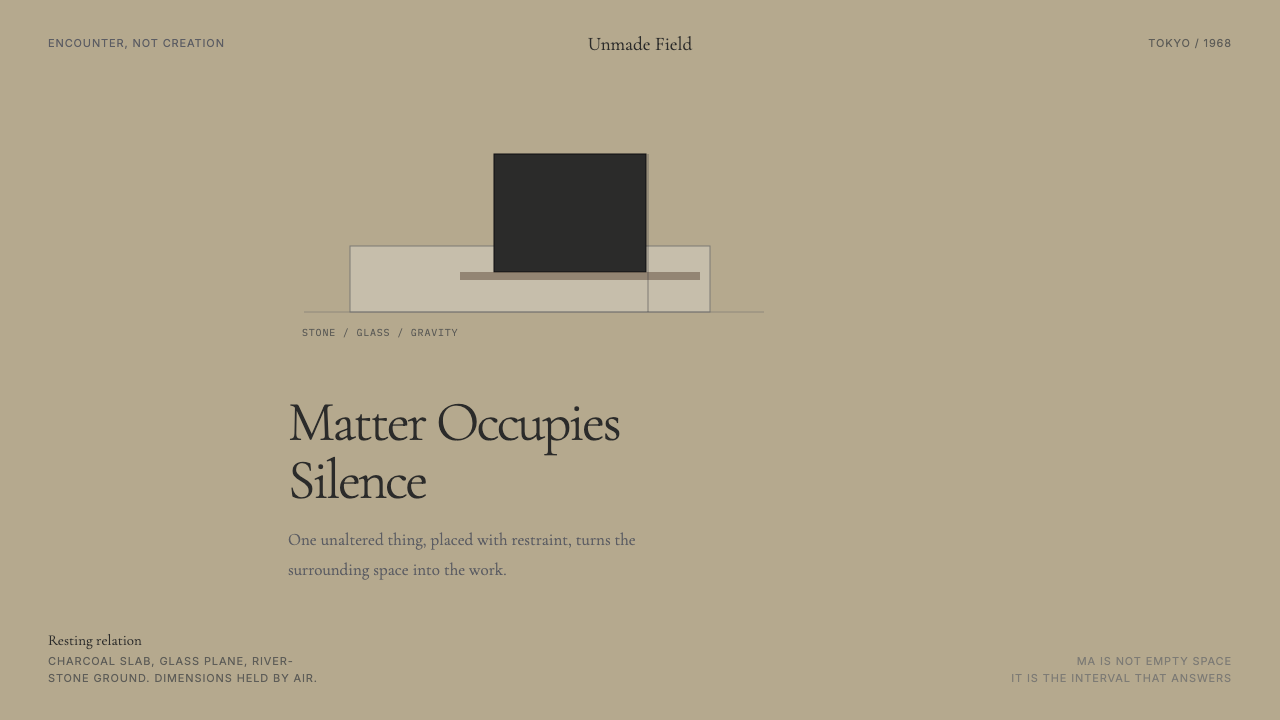 Mono-ha (Lee Ufan, 1968)Silence has weight. River-stone ground, Cormorant type, and one charcoal slab…
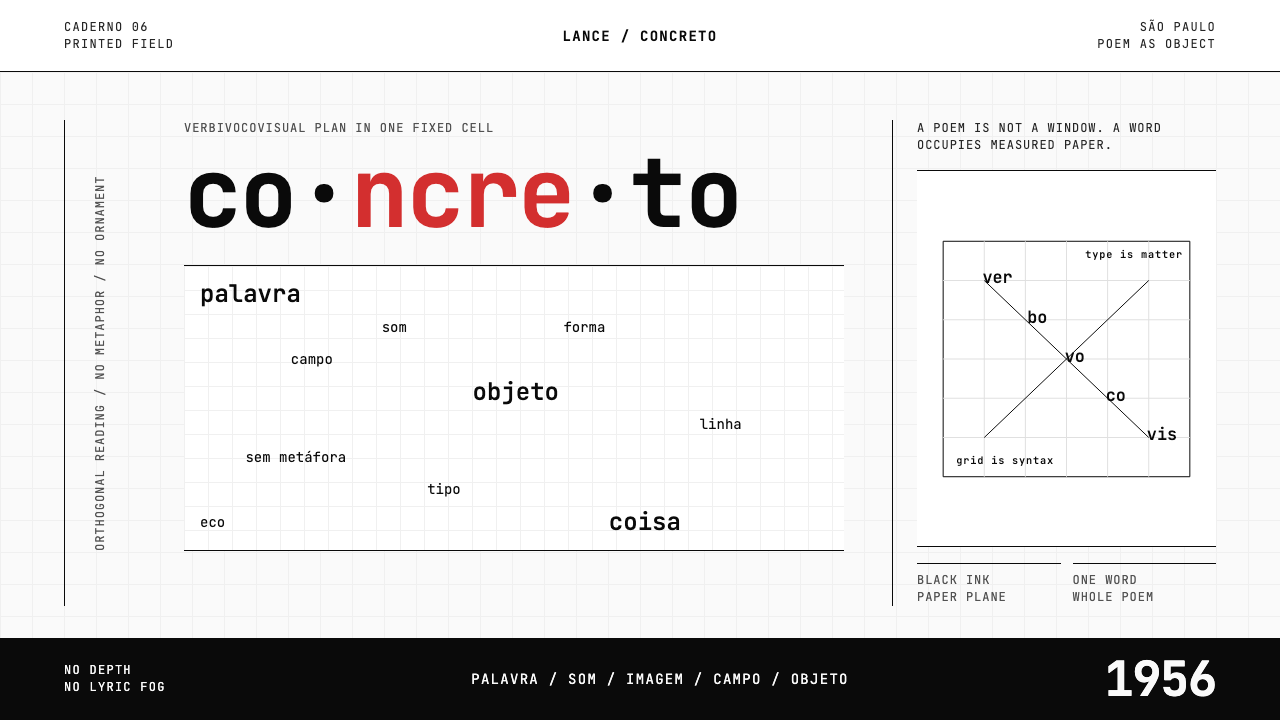 Brazilian Concrete PoetryWords become objects. Monospace cells, black-white paper, one cadmium red rup…
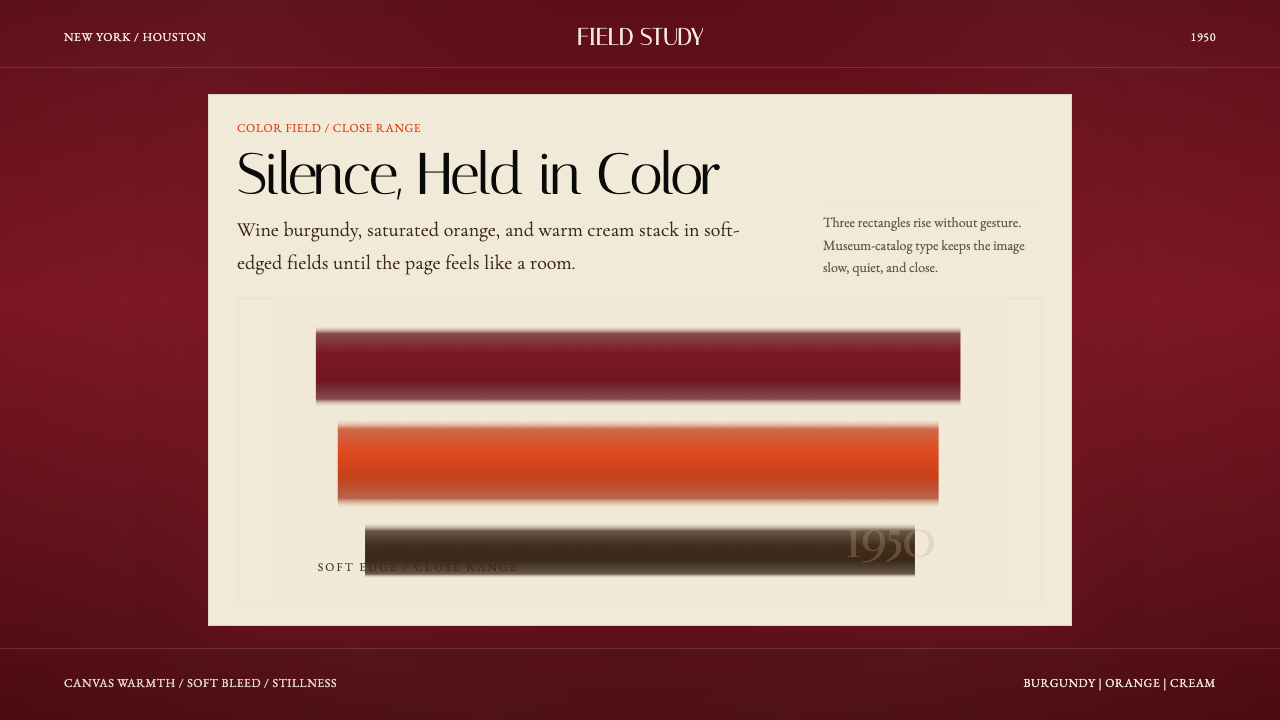 Mark Rothko Color Field (1950)Silence made visible. Burgundy, orange, and cream stack in soft-edged fields.
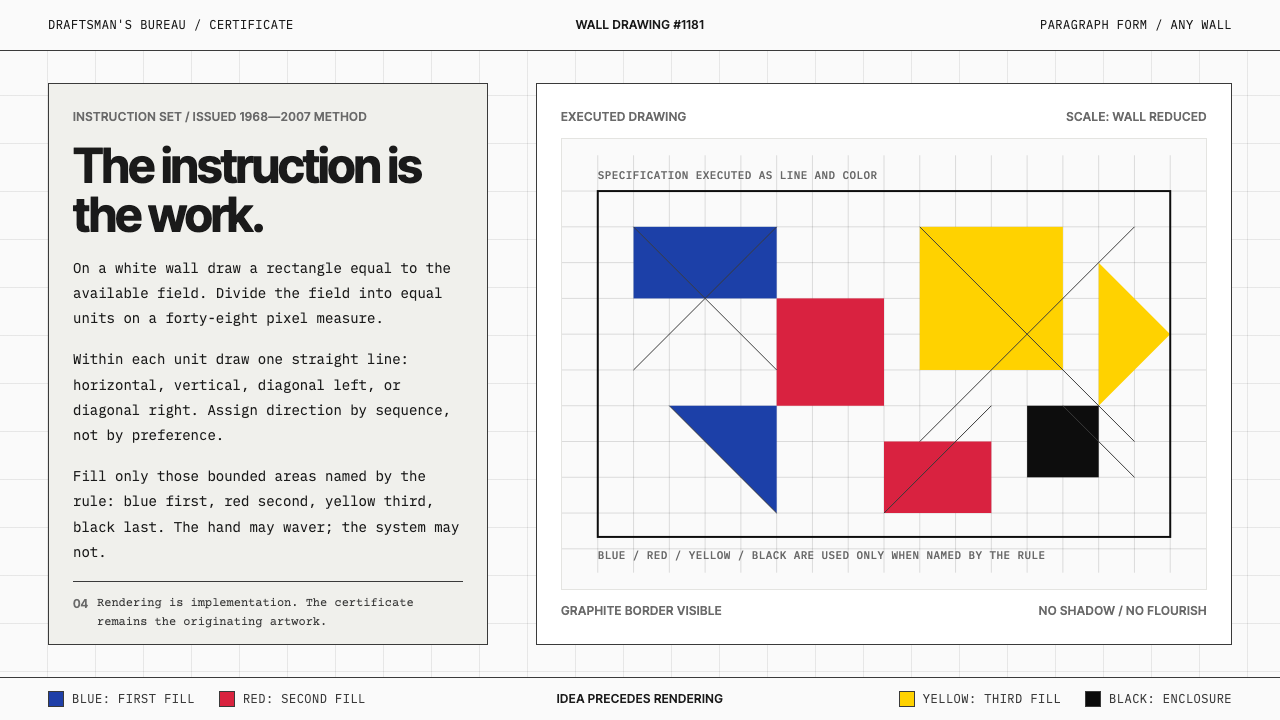 Sol LeWitt ConceptualInstruction becomes art. Mono certificates face wavering graphite grids in fo…