What is Ad Reinhardt Black Painting (1953)?
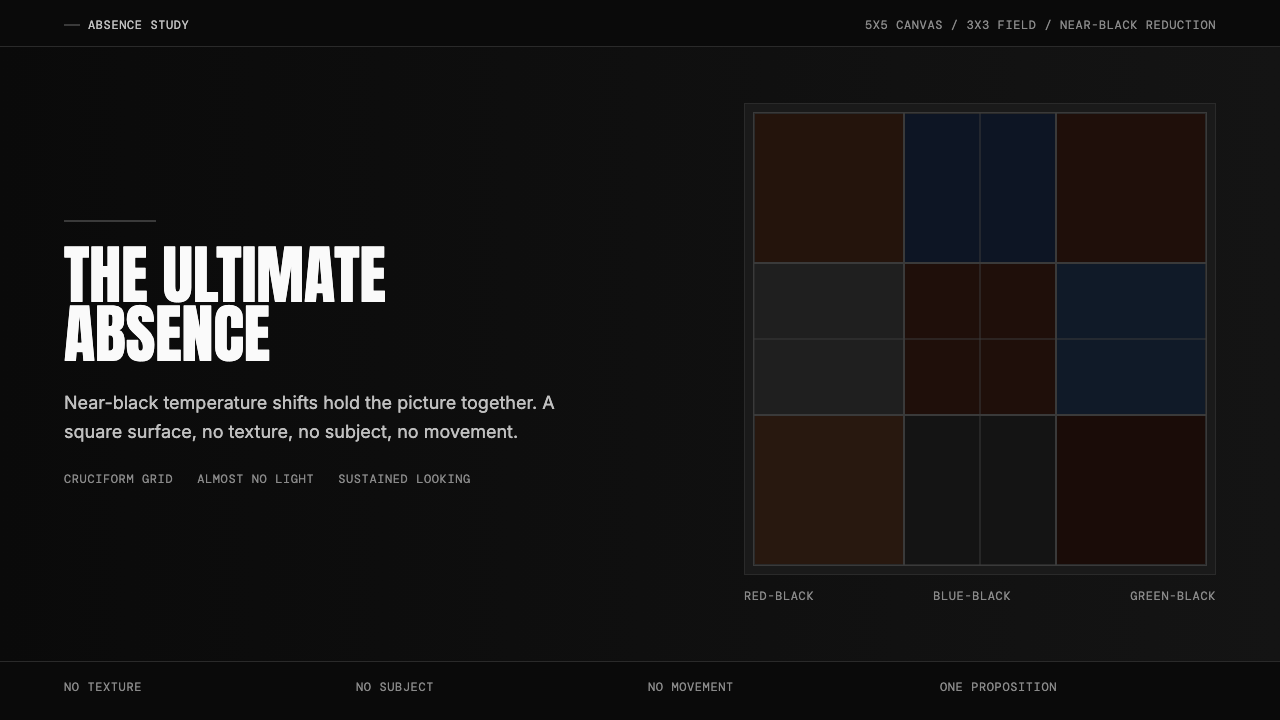
Ad Reinhardt pushed painting to its logical vanishing point — surfaces that appear uniformly black until sustained attention reveals a barely-visible cruciform grid of near-black variations, making absence itself the subject.
Ad Reinhardt Black Painting (1953) in brief
Ad Reinhardt's Black Paintings are the most dogmatically reductionist works in post-war American art. Executed between 1953 and 1967, each canvas is a five-foot square painted with near-black variations — red-blacks, blue-blacks, and green-blacks — arranged in a nine-part cruciform grid. At ordinary viewing distance and in ordinary light the paintings appear to be uniform matte black. Only after prolonged looking, and only in favorable lighting, do the tonal divisions emerge: three rows, three columns, each section a subtly different temperature of dark.
Reinhardt described the Black Paintings not as meditations but as propositions — a series of rules he followed with near-mechanical consistency. The format was always square. The scale was always the same. The palette was always near-black, never pure black. The surface was always matte. No brushstroke was to be legible; no gesture was to be visible; no atmosphere was to accumulate. He called them 'the last paintings anyone can paint' — terminal objects that refused to yield symbolic content, narrative, or expression.
As a design system, the Black Paintings translate into a visual language of near-absolute restraint: surfaces that are almost-but-not-quite uniform, structures revealed only to patient attention, the elimination of every decorative, atmospheric, or expressive element. The system is not minimalism in the contemporary commercial sense — it is a principled philosophical position, and working with it demands a willingness to let structure do all the communicative work that color, imagery, and ornament are ordinarily asked to perform.

Where does Ad Reinhardt Black Painting (1953) come from?
Ad Reinhardt was born in Buffalo in 1913 and moved to New York City as a young man, studying art history at Columbia University under Meyer Schapiro. He became active in the New York art world in the late 1930s, initially as a political cartoonist for PM magazine and other left-leaning publications. His early paintings were Cubist-influenced abstractions; through the 1940s he moved toward progressively flatter, more geometric compositions, influenced by his deep engagement with Asian art — particularly Zen Buddhist calligraphy and the monochrome ink paintings of the Song dynasty — which he encountered through his research into non-Western art history.
By the early 1950s Reinhardt had begun eliminating color from his palette systematically, moving through blue monochromes and red monochromes before arriving at near-black. The first fully resolved Black Paintings appear around 1953. The decision was not sudden but cumulative — a logical extension of his conviction, sharpened through arguments with his contemporaries, that painting had been corrupted by the expressive self-dramatization of Abstract Expressionism. Where artists like Jackson Pollock and Willem de Kooning made the mark and the gesture the subject of painting, Reinhardt wanted to make painting about nothing at all outside of itself — a closed, self-referential object.
Reinhardt was a combative and prolific theorist as well as a painter. His essays and art-world satires, collected in the volume 'Art-as-Art,' lay out his position in deliberately absolutist terms: 'Art is art. Everything else is everything else.' He was particularly hostile to commercial application of fine-art aesthetics, to the idea that paintings could serve decorative or expressive social functions, and to any confusion between the painted object and the world it exists within. This intellectual militancy set him apart from the Abstract Expressionist mainstream even as he participated in many of the same institutional contexts — the same galleries, the same critical conversations.
The cultural context of the Black Paintings includes Thomas Merton, the Trappist monk and writer with whom Reinhardt maintained a long correspondence. Merton's interest in apophatic theology — the idea that the divine can only be approached by negating all positive descriptions — resonated with Reinhardt's aesthetic position. The critic Clement Greenberg, though a supporter of Reinhardt's early work, grew skeptical of the Black Paintings; Donald Judd, by contrast, recognized in them a direct precursor to Minimalism, citing their serial consistency, their refusal of illusionistic depth, and their treatment of the canvas as a literal object rather than a pictorial window. When Reinhardt died in 1967, the Minimalist movement was consolidating around exactly those principles — making the Black Paintings a historical pivot between two major currents of post-war American art.
What defines the Ad Reinhardt Black Painting (1953) look?
Near-Black Palette
The defining visual quality is the use of near-black rather than true black — surfaces rendered in dark red-blacks, blue-blacks, and green-blacks that appear identical at a glance but differ in subtle chromatic temperature. This refusal of absolute black is deliberate: a pure black would be dead and undifferentiated, while near-blacks create an internal structure that rewards sustained attention. The palette communicates that absence is not emptiness — it has gradations, relationships, and a quiet internal logic.
Matte Surface
All surfaces in this system are uniformly matte. Any sheen, gloss, or reflectivity would introduce atmospheric variation — the suggestion of light sources, spatial depth, or environmental context. Matte surfaces absorb attention rather than returning it to the viewer; they create the condition of sustained looking rather than immediate visual reward. In digital application this translates to flat, non-glossy treatments: no specular highlights, no gradient sheen, no glass-like finish on any element.
Cruciform Grid Structure
The underlying structure is always a three-by-three grid organized around a cruciform center. This grid is not decorative — it is the painting's entire architecture, and it is visible only as tonal difference rather than line. In design application the principle translates to rigorous invisible-grid discipline: content should be organized by an underlying structure that is felt rather than seen, with zones differentiated by very subtle tonal or weight variation rather than explicit borders or rules.
Serial Consistency
Every Black Painting follows the same format, the same scale, the same structural logic. This serial consistency is not repetition in the pejorative sense — it is a refusal to treat individual works as expressions of mood or circumstance. In design terms this principle argues against one-off decisions: every screen, every slide, every component should be derivable from the same small set of rules. Variation for its own sake violates the system; only variation that serves a structural purpose is permitted.
Erasure of the Gesture
Reinhardt applied paint in thin, overlapping layers specifically to erase any trace of the brushstroke. The hand of the artist was to be invisible; the surface was to appear as if it had always existed in that state. In design, this principle argues for the elimination of any element that signals the designer's presence — decorative flourishes, expressive typeface choices, atmospheric treatments, or any decision that reads as personal taste rather than structural necessity. The work should appear inevitable, not authored.
Square Format
The square is the format of maximum neutrality — it has no dominant axis, implies no direction, creates no hierarchy between width and height. Reinhardt's insistence on the square was a refusal of compositional drama. In design contexts where the style is applied, this principle argues for centered, symmetrical layouts where the format itself makes no argument — content is organized within a neutral field rather than one whose proportions already perform a visual function.
Radical Exclusion
The logic of the Black Paintings is subtractive: everything that can be removed has been removed, and what remains is only what cannot be removed without destroying the work entirely. This differs from contemporary minimalism, which often adds carefully chosen elements for visual appeal. Reinhardt's exclusion is principled to the point of hostility — there is no concession to the viewer's comfort or desire for visual stimulation. In design application this demands genuine discipline: the absence of decorative elements should not be compensated by clever negative-space arrangements. The emptiness should be allowed to remain empty.

Who shaped Ad Reinhardt Black Painting (1953)?
Reinhardt (1913–1967) was simultaneously a painter, a polemicist, and one of the sharpest satirists of the New York art world. His 'Art Rules' and cartoon series lampooning art-world pretension were widely circulated; his theoretical writings in 'Art-as-Art' remain essential documents of American post-war aesthetics. He taught at Brooklyn College for most of his career, maintaining a position outside the mainstream gallery system while influencing generations of students. His death at fifty-three, just as Minimalism was consolidating, cut short what might have been an extended dialogue between his position and the movement he had helped to make possible.
Judd (1928–1994) was among the first to articulate the historical connection between Reinhardt's Black Paintings and the emerging Minimalist movement. His critical writing in the early 1960s identified Reinhardt's serial consistency, refusal of illusionistic depth, and treatment of the canvas as a literal object as foundational to what Judd called 'specific objects' — artworks that existed in real space rather than creating pictorial illusions. Judd's own stacked and cantilevered metal structures extended Reinhardt's logic from the painted surface into three-dimensional space, making explicit the architectural potential implicit in the Black Paintings.
Merton (1915–1968), the Trappist monk and writer, maintained a long correspondence with Reinhardt that illuminates the non-Western and contemplative dimensions of the Black Paintings. Merton's interest in apophatic theology — the via negativa, the tradition of approaching the divine by systematically negating all positive attributes — provided Reinhardt with a framework for understanding his own reductionism as something other than nihilism. Their exchange suggests that the Black Paintings' refusal of expression was not the absence of meaning but a different kind of meaning-making: one that requires the viewer to bring sustained, patient attention rather than receiving pre-packaged content.
Greenberg (1909–1994) was the dominant American art critic of the post-war period and the primary theorist of Abstract Expressionism. He was an early supporter of Reinhardt's work but grew increasingly skeptical of the Black Paintings, which he found too hermetic and too theoretically self-enclosed to advance the formalist project he championed. The tension between Greenberg and Reinhardt represents a broader fault line in post-war American art: between a formalism that still celebrated visual sensation and a reductionism that sought to eliminate it. Reinhardt's explicit rejection of Greenberg's critical authority — he wrote parody rules mocking the critical establishment — was part of what made him an outsider figure even within the avant-garde.
Rothko (1903–1970) is the artist most often compared to Reinhardt, though the two occupied opposite poles of late Abstract Expressionism. Where Reinhardt systematically eliminated atmosphere, expression, and viewer affect, Rothko cultivated all three — his large color-field paintings were designed to produce intense emotional responses, and he described them explicitly in terms of tragedy and ecstasy. The comparison clarifies what is distinctive about Reinhardt: the Black Paintings are deliberately anti-expressive in a way Rothko's work never was. Both artists arrived at near-monochrome surfaces, but through fundamentally opposed commitments — Rothko by maximizing emotional resonance, Reinhardt by refusing it.
How do you use Ad Reinhardt Black Painting (1953) today?
The Ad Reinhardt Black Painting system is among the most demanding to apply correctly, because its power depends entirely on discipline: the moment any decorative, atmospheric, or expressive element is introduced, the logic collapses. Used well, the system produces interfaces and layouts of extraordinary authority and calm — surfaces that reward the viewer who pays close attention rather than grabbing attention through stimulation. Used carelessly, it produces designs that read as merely gloomy, unfinished, or inaccessible.
For presentation slides, the style is particularly effective on high-stakes cover pages and keynote openers where gravitas is required. A cover in this system uses a near-black ground — not pure black, but a dark surface with subtle internal variation — with the title set in a near-white typeface of generous weight and scale. No imagery, no decorative mark, no background texture. Content slides should be treated as grids of near-black zones differentiated by tonal variation rather than visible lines, with text occupying clearly defined columns at a generous scale. Data slides carry an exceptional quality in this system: charts and tables rendered in near-black variations on a slightly lighter near-black ground read as austere, credible, and authoritative — closer to scientific instrumentation than to commercial infographics.
For web interfaces, the system is best suited to dashboards, financial platforms, and developer tools where precision and authority are primary values. The approach: a single near-black background tone, body text in a near-white of slightly warm temperature, interactive states signaled by a shift from one near-dark to another — never by introducing a bright accent color. Navigation should be purely typographic, set at a scale that communicates confidence. Borders, if they appear at all, should be extremely subtle tonal separations rather than visible lines. The goal is a surface that reads as composed and serious, in which every element appears to have been placed by necessity rather than choice.
For editorial and marketing applications, the system requires careful calibration because its aesthetic can conflict with the warmth and accessibility that consumer-facing communications typically require. Where the system works well in editorial contexts is in academic publishing, high-end cultural institutions, and luxury sectors where restraint and seriousness are brand values. In these contexts, a full-width near-black feature with near-white body text, section breaks marked by a near-invisible tonal shift rather than a rule or ornament, and images treated as flat rectangular zones of near-dark rather than atmospheric photographs, produces a layout of exceptional distinction. Marketing pages benefit from the system's poster-like finality: a single statement, set at scale, on a near-black ground, with no supporting visual noise.
The most common mistake when working with this system is compensating for its austerity by introducing visual complexity elsewhere — adding subtle gradients to the background, using a typeface with expressive character, or placing graphic elements to break the monotony. Each of these interventions violates the logic of the system. The near-black variations in Reinhardt's paintings are almost invisible; they are not a substitute for visual richness but a different kind of rigor. A second common mistake is using pure black rather than near-black: a pure black ground flattens everything on it into sameness, while near-black creates the subtle internal structure that gives the system its peculiar depth. The discipline required is real: working in this system means resisting the designer's instinct to solve problems through addition.

Ad Reinhardt Black Painting (1953) — FAQ
Is this style actually usable for digital design, or is it only appropriate for fine-art contexts?
It is genuinely usable in digital design, but only for specific product types and audience contexts. It works exceptionally well for developer tools, financial data platforms, high-end portfolio sites, and any product where the audience values precision and authority over warmth and approachability. It works poorly for consumer-facing products that require emotional accessibility — onboarding flows, family-oriented applications, products targeting first-time users who need visual guidance rather than visual restraint. The style assumes a viewer willing to bring sustained attention to the interface; many digital contexts cannot make that assumption.
How is this different from simply using a dark theme or dark mode?
The difference is structural and philosophical, not just visual. A conventional dark theme typically inverts a light-mode design — swapping white backgrounds for dark backgrounds while keeping accent colors, gradients, and visual hierarchy intact. The Black Painting system eliminates accent colors entirely, uses only near-black variations rather than a single dark background color, and applies a logic of radical exclusion rather than aesthetic preference. The result reads differently: a dark theme is a legibility solution; the Black Painting system is an epistemological position about what a designed surface is allowed to do.
Can this system accommodate any color at all, or must everything be near-black?
Authentic application of the system uses only near-black variations and near-white for text. Any introduction of chromatic color — even a muted one — shifts the system's identity fundamentally. That said, a disciplined minimal departure is possible: a single near-neutral dark warm tone, or a near-neutral dark cool tone, can be used as a structural accent to mark section boundaries or interactive states without destroying the system's logic. What the system cannot absorb is bright, saturated color — that immediately signals a different visual language and undermines the authority the near-black palette creates through its restraint.
What typographic approach works best within this system?
Typography in this system should be as structurally neutral as the surfaces it sits on — meaning typefaces with minimal expressive character and high legibility at varied scales. Geometric or humanist letterforms with clean construction work well; anything with calligraphic influence, strong personality, or decorative details works against the system. Type scale and weight carry the entire communicative load in the absence of color hierarchy: a generous differential between heading and body scale, with perhaps one intermediate level for subheadings, provides all the structure the system needs. Set in near-white on near-black, type should feel inevitable — present because it must be, not because it was chosen.
How does this style relate to Minimalism as a contemporary design trend?
Contemporary design minimalism and the Reinhardt Black Painting system share an aesthetic surface — both favor restraint, remove decoration, and reduce visual complexity. But their motivations and results diverge significantly. Contemporary minimalism is typically a visual preference that retains the option to introduce carefully selected accents, imagery, and interactive warmth. Reinhardt's reductionism is a philosophical refusal: it does not remove decoration to reveal elegance, it removes everything to refuse the expectation of elegance entirely. The practical difference shows in extremity: contemporary minimalist design can accommodate a hero image, a brand color, a warm interaction animation. The Black Painting system cannot. Understanding this distinction prevents the most common misapplication — using Reinhardt as an aesthetic justification for a design that is actually just understated contemporary minimalism.
Related design styles
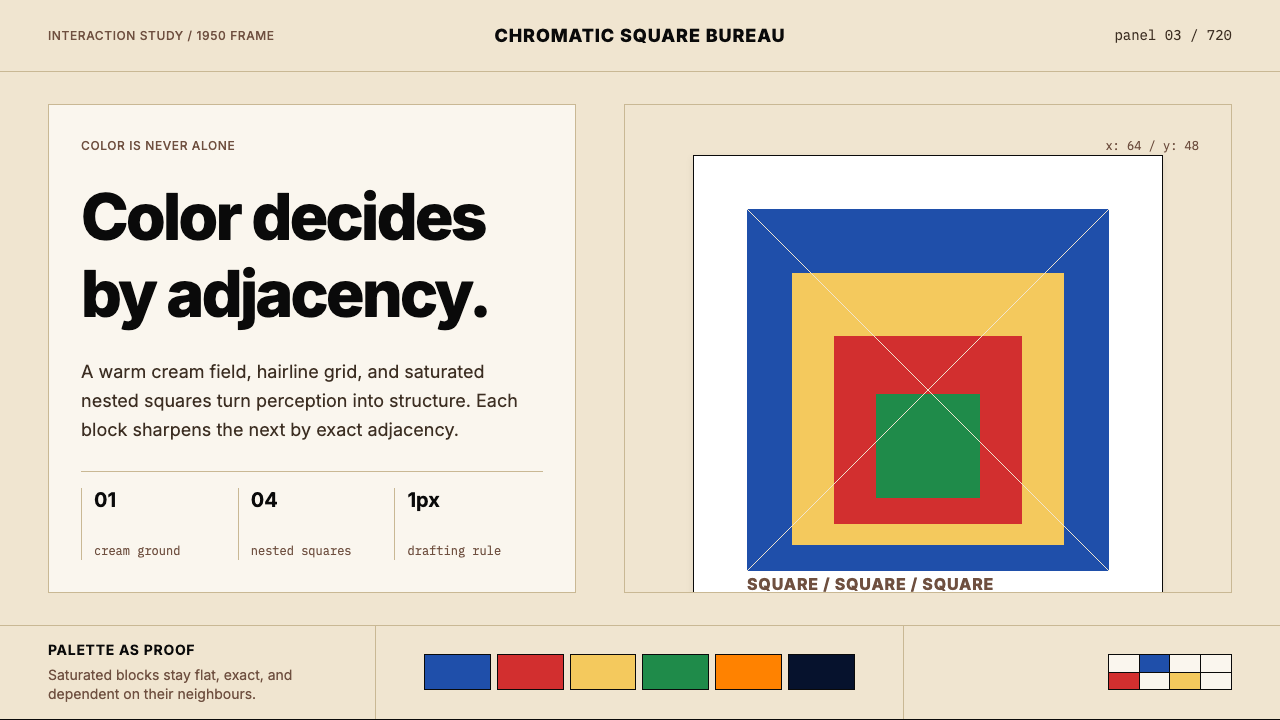 Josef Albers — Homage to the SquareColor becomes event. Warm cream, cobalt-red-yellow nested squares, exact hair…
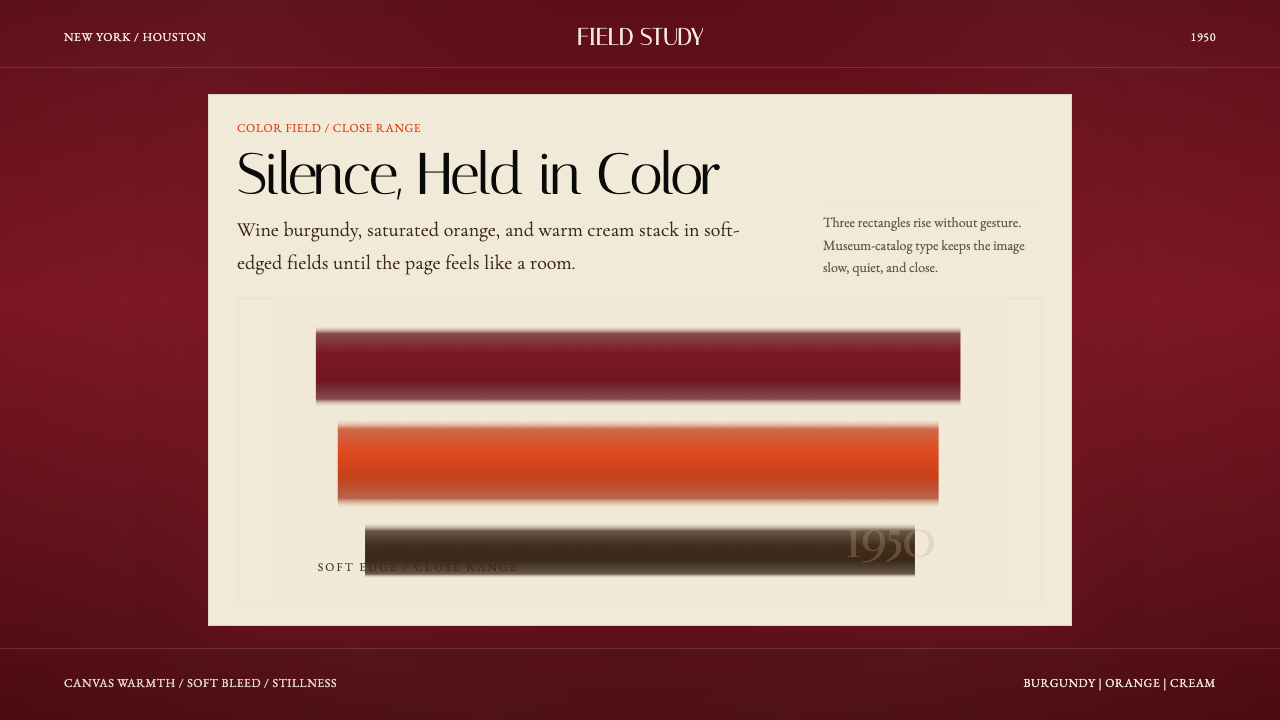 Mark Rothko Color Field (1950)Silence made visible. Burgundy, orange, and cream stack in soft-edged fields.
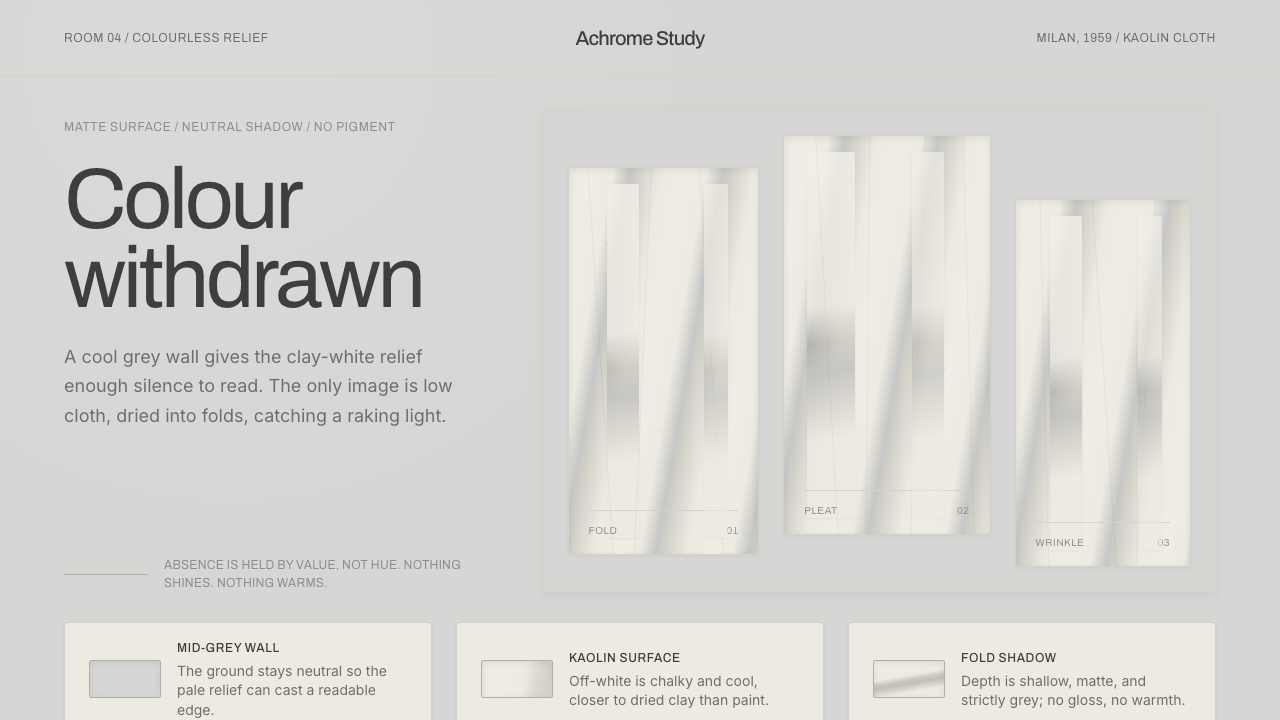 Piero Manzoni AchromeColour withdrawn. Kaolin off-white reliefs on mid-grey cast cool fold-shadows.
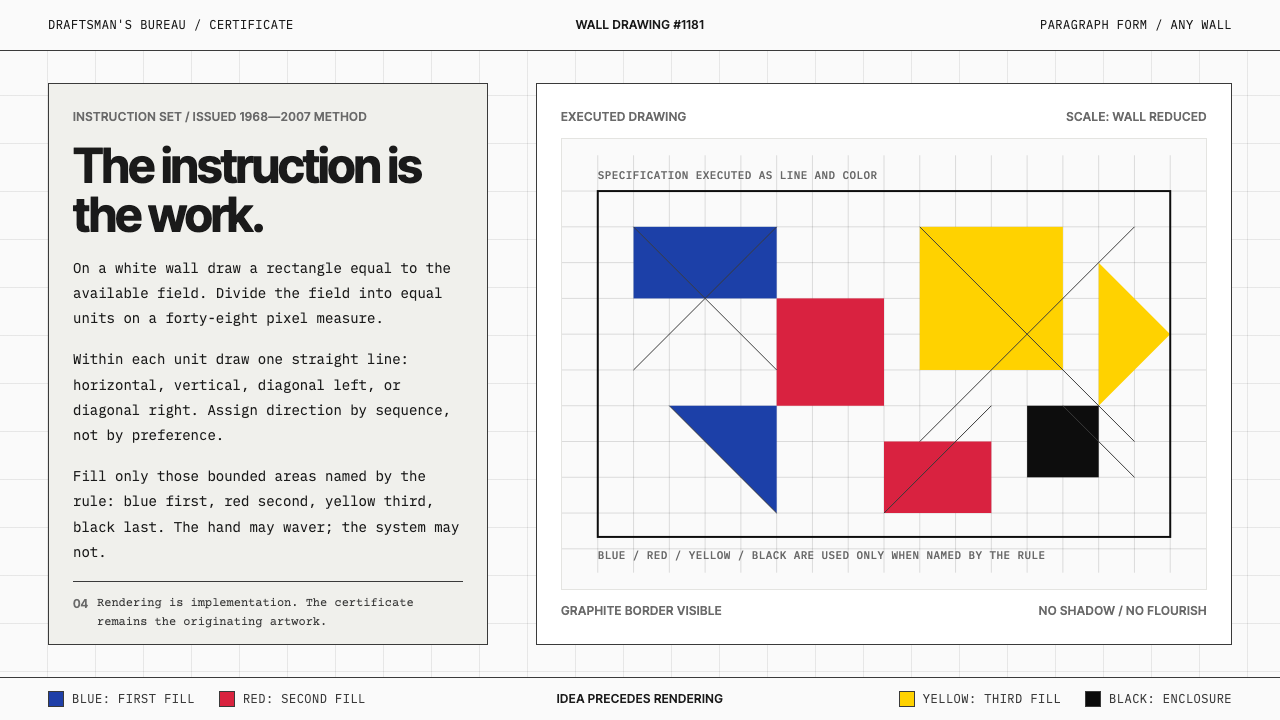 Sol LeWitt ConceptualInstruction becomes art. Mono certificates face wavering graphite grids in fo…
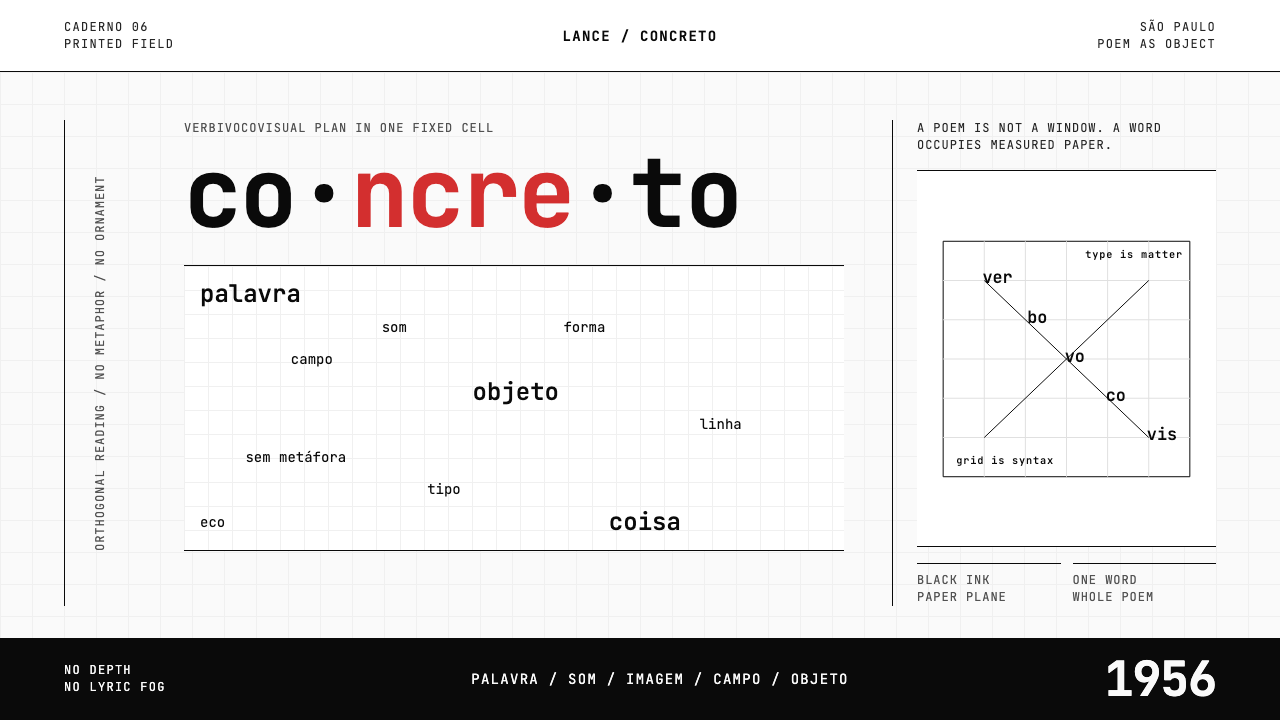 Brazilian Concrete PoetryWords become objects. Monospace cells, black-white paper, one cadmium red rup…
 Korean Dansaekhwa MonochromeLabor becomes stillness. Umber serif type and drag lines on pearl cream.