What is Man Ray Rayograph (1922)?
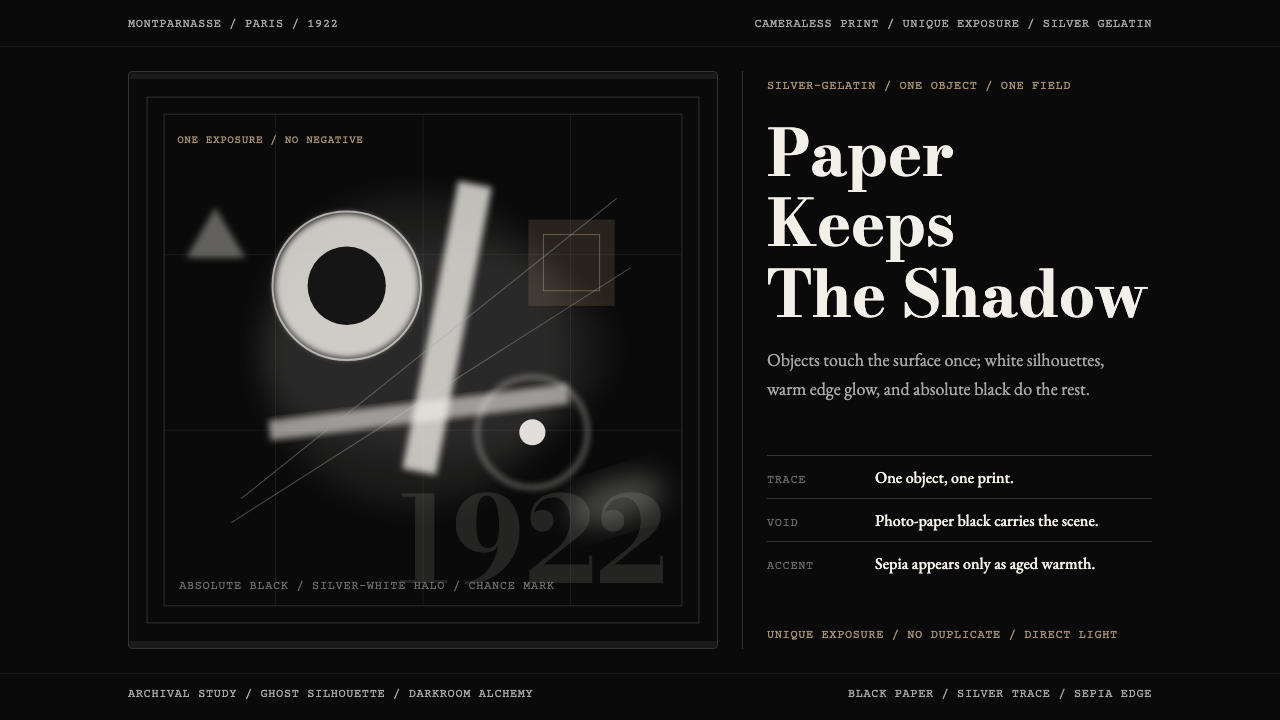
Man Ray discovered that light itself could draw — placing objects on photo-sensitive paper in a Paris darkroom, he made images with no camera and no lens, only shadow, contact, and exposure.
Man Ray Rayograph (1922) in brief
A rayograph is a cameraless photograph: objects are arranged directly on light-sensitive paper, the light is switched on briefly, and the result is a luminous white or silver silhouette floating against an absolute, velvety black. There is no negative, no enlarger, no lens to mediate between the world and the paper. The print is the original — unique, unrepeatable, and touched by the same light that made it.
The visual character of the rayograph is unmistakable. Solid objects cast dense white shapes; translucent ones produce graduated grey halos; objects lifted slightly from the surface create soft penumbra edges rather than hard outlines. The tonal range moves from pure photo-paper black through silver-gelatin white, with occasional warm sepia where the chemistry of the paper and time have left their own mark. Color, in the conventional sense, is absent — this is a world of luminance alone.
As a design aesthetic, the rayograph style translates the darkroom's logic into visual structure. Deep black grounds dominate, standing for the unexposed void. Ghostly white and silver forms hover within that void, defined by their edges and internal gradations rather than by fill or texture. Composition tends toward the sparse and the asymmetric — a few objects, widely separated, each given space to breathe and cast its shadow. The result reads simultaneously as archival and otherworldly: familiar silhouettes made strange by context.

Where does Man Ray Rayograph (1922) come from?
The technique had precedents. William Henry Fox Talbot made photogenic drawings by placing botanical specimens on sensitized paper as early as the 1830s, and the German-Swiss artist Christian Schad independently made what he called Schadographs around 1918. But it was Man Ray — born Emmanuel Radnitzky in Philadelphia in 1890, arrived in Paris in 1921 — who gave the cameraless photograph its name, its Dada pedigree, and its lasting cultural identity.
The discovery is often recounted as accidental. In late 1921 or early 1922, Man Ray was working in his Montparnasse studio-darkroom when unexposed photographic paper found its way into a developing tray. Objects placed on the paper — a funnel, a glass, a length of wire — left their traces when the light was switched on. Man Ray recognized immediately that what the tray had produced was not an accident but a method: a direct, indexical record of the object's relationship to light. He named the technique after himself, as Dada custom practically encouraged.
The social and intellectual milieu was essential. Man Ray moved at the center of Paris Dada and then Surrealism — he was close to Tristan Tzara, Jean Cocteau, and André Breton. The Surrealists were obsessed with the uncanny, with automatic processes that bypassed rational control, and with images that seemed to arise from somewhere below or beyond conscious intention. The rayograph, as a process governed by light and chance rather than by the artist's draftsman's hand, was perfectly suited to Surrealist theory. It produced images that looked like memories, X-rays, dreams — familiar and unrecognizable at once.
László Moholy-Nagy, a few years later at the Bauhaus, developed his own version of the technique — photograms — and theorized them extensively in his 1925 book Painting Photography Film. Moholy-Nagy pushed the technique toward a more constructivist vocabulary: geometric shapes, industrial objects, optical experiments. Where Man Ray's rayographs lean poetic and oneiric, Moholy-Nagy's photograms are structural and analytical. Together, they established cameraless photography as a serious form rather than a parlor trick, and their parallel practices seeded an entire tradition of photographic experimentation that ran through the twentieth century into digital art.
What defines the Man Ray Rayograph (1922) look?
Ground and Void
The dominant field in a rayograph composition is absolute black — the darkroom equivalent of unexposed, developer-saturated paper. This void is not neutral: it is dense, directional, and alive with the potential for form. Silhouettes and halos emerge from it rather than being placed on top of it. The black ground carries a tactile quality that flat digital blacks rarely achieve, evoking the specific chemistry of silver-gelatin photographic paper.
Luminous Silhouette
Where an object has blocked the light completely, the paper remains white or a pale silver — the silhouette is not drawn but withheld from exposure. This reversal of conventional photography's logic (in which dark areas are shadows) gives the rayograph its characteristic ghostly luminosity. Edges glow as if self-lit. Solid forms read as bright presences rather than dark masses, inverting ordinary visual expectation.
Tonal Gradation and Halo
Translucent, curved, or elevated objects produce a characteristic grey gradation rather than a crisp white cutout. A glass object resting on the paper creates an arc of graduated grey that fades toward its outer edge — a halo effect. Wire, mesh, and gauze create intermediate tones. This range of greys — from near-white silver through warm mid-tones to the surrounding black — gives the style its tonal complexity and distinguishes it from a simple silhouette print.
Sepia and Chemical Warmth
Aged silver-gelatin prints develop a warm sepia tone at their edges and in their midtones over time, as the silver particles oxidize. This brownish warmth is not a mistake to be corrected but a characteristic mark of the medium's life in time. In the rayograph aesthetic, sepia serves as the third tonal register — neither the deep black of unexposed ground nor the bright silver of blocked light, but a middle warmth that anchors the composition to its historical and material origins.
Sparse, Asymmetric Composition
Rayographs are rarely crowded. Man Ray typically worked with a small number of objects — three to five — spread across the paper with deliberate separation. Negative space is not left over but structured: the black void between forms is as considered as the forms themselves. Composition is asymmetric, weighted by the visual mass of different silhouettes rather than by any grid or axis. The arrangement has the quality of a tableau — objects staged rather than accumulated.
Material Index and Chance
The rayograph is an index in the semiotic sense: it is not a representation of an object but a direct physical trace of it. The print records what was actually there, in actual contact or proximity to the paper. This indexical quality gives the style a documentary authority that purely constructed images lack, while the role of chance — in the exact placement, the duration of exposure, the chemistry of the developer — keeps results from being entirely predictable. Control and accident are both present.
Reversal of Figure and Ground
In conventional representation, subjects are dark against a light ground. The rayograph inverts this: subjects are light against a dark ground. This reversal produces a perceptual instability — the eye is uncertain whether it is looking at luminous objects in a void or at openings in a dark surface through which light passes. This ambiguity is not a flaw but a structural feature. It gives the style its lingering quality: images that seem to shift the longer one looks at them.

Who shaped Man Ray Rayograph (1922)?
Born Emmanuel Radnitzky in Philadelphia in 1890, Man Ray trained as a painter and draftsman before moving to Paris in 1921, where he became a central figure of Dada and then Surrealism. He coined the term 'rayograph' for his cameraless photographs and produced his most concentrated body of them between 1922 and 1928, publishing a portfolio titled Les Champs délicieux with a preface by Tristan Tzara in 1922. Beyond the rayograph, he made portraits, fashion photographs, and films that placed him among the most versatile image-makers of the twentieth century. He returned to painting in later decades but continued making rayographs until his death in Paris in 1976.
Romanian-born poet and Dada founder Tristan Tzara was Man Ray's close collaborator and intellectual champion in Paris. His preface to the 1922 portfolio Les Champs délicieux articulated the rayograph's connection to automatism and unconscious process, framing it as a Dada anti-art object — a photograph that required no photographer's skill in the traditional sense, only a willingness to let light and chemistry act. Tzara's theoretical framing helped establish the rayograph as a concept, not just a curiosity, and brought it to the attention of the wider European avant-garde.
German-Swiss artist Christian Schad independently discovered the cameraless photograph around 1918, while living in Geneva among Zurich Dada circles. His Schadographs — the name coined by Tzara — used small, lightweight objects: scraps of paper, bits of gauze, hair, tickets. Schad's work predates Man Ray's but remained less well-known, partly because Schad was less assiduous about promotion and publication. The parallel discovery establishes that the technique emerged organically from the materials of Dada practice rather than from any single act of invention.
Hungarian artist László Moholy-Nagy joined the Bauhaus in 1923 and developed his own version of the cameraless photograph, which he called the photogram. Where Man Ray's practice was poetic and associative, Moholy-Nagy's was theoretical and systematic: he used the photogram to explore transparency, light modulation, and the spatial properties of overlapping forms. His 1925 book Painting Photography Film placed the photogram within a broader argument about the future of visual art in an industrial, reproducible world. His teaching at the Bauhaus embedded photogram-making in design education for a generation of students.
American model, photographer, and war correspondent Lee Miller worked as Man Ray's studio assistant and intimate partner in Paris between 1929 and 1932. She is credited with the co-discovery of solarization — the Sabattier effect — which Man Ray subsequently developed into a major technique. Miller also made rayographs of her own, and her presence in Man Ray's studio shaped many of the surrealist compositions from that period. She later became a distinguished photojournalist, but her early Parisian work represents one of the few cases where a collaborator's contribution to the rayograph aesthetic is fully documented.
How do you use Man Ray Rayograph (1922) today?
The rayograph aesthetic is among the most atmospherically distinctive historical styles available to contemporary designers. Its power lies in contrast — deep black voids, luminous white or silver forms, and the occasional sepia warmth of aged chemistry — and in the philosophical framing of light as the active agent rather than the subject. Applying it well means understanding when that atmosphere serves the communication goal and when it overwhelms it.
For presentation slides, the rayograph style excels at establishing mood and authority on cover and section-divider pages. A cover built on this aesthetic places one or two sparse, high-contrast silhouette forms on a near-black ground, with title typography set in a pale, slightly warm tone rather than pure white — evoking the sepia note of aged photo paper. Content slides should be treated with more restraint: white or very light grounds allow body text to remain readable, while the rayograph palette is reserved for headers, accent lines, and any featured imagery. Data slides work well when charts are treated as silhouette-forms — bar charts and area charts drawn in silver-white against a dark ground acquire the same floating, luminous quality as the photographic silhouettes themselves.
For web interfaces and dashboards, the deep-black ground and luminous accent approach translates well to dark-mode UI paradigms. A pricing or feature-comparison page built on this aesthetic uses near-black as the page background, with card components that appear to float — defined by a subtle warm border or inner glow rather than by conventional drop shadows. Interactive elements can use a warm silver or sepia accent to indicate selection or hover state. Navigation and typographic elements should be spare and low-contrast — descriptive labels and structural markers, not decorative elements. The overall effect should feel like looking at an illuminated document rather than a glowing screen.
For editorial and marketing materials, the rayograph style is especially effective for brands or campaigns that want to invoke archival authority, scientific or technical seriousness, or a deliberately uncanny and surrealist atmosphere. A marketing spread built on this visual system contrasts full-bleed dark sections — featuring object silhouettes or photogram-style product shots — with lighter sections for body copy and testimonials. The tonal transition between sections should evoke photographic gradation rather than a hard cut. For social cards and promotional graphics, a single centered or slightly asymmetrically placed silhouette form on a dark ground with sparse, high-contrast type is highly legible at small sizes and immediately distinctive in crowded feeds.
A common mistake when applying this aesthetic is filling too much of the dark ground. The void is not background — it is material. Crowding the composition with too many silhouette elements, or placing a conventional light-background text block inside a dark-framed card, breaks the system's logic entirely. Similarly, using highly saturated color accents — particularly pure blue, green, or red — conflicts with the monochromatic silver-sepia palette that gives the style its period authenticity. If color is introduced, it should be desaturated to a point where it reads as a tonal variation rather than a hue, or used only as a single precise accent on a key interactive element.

Man Ray Rayograph (1922) — FAQ
What is the difference between a rayograph and a photogram?
The terms describe the same basic technique — objects placed on light-sensitive paper and exposed to light — but they carry different artistic lineages and different aesthetic intentions. Rayograph is Man Ray's term for his own works, made in the context of Dada and Surrealism and tending toward poetic, oneiric, or symbolic arrangements. Photogram is the more general technical term, associated especially with László Moholy-Nagy and the Bauhaus, where the technique was used analytically to explore light, transparency, and spatial form. Both are valid descriptions of cameraless photography, but using rayograph specifically evokes the Paris Dada-Surrealist tradition.
Is the rayograph aesthetic appropriate for bright, energetic, or colorful brand contexts?
Generally not without significant adaptation. The rayograph palette is anchored in deep blacks, cool silvers, and warm sepias — a tonal world rather than a chromatic one. Applying this style to a brand that requires warmth, playfulness, or full-spectrum color will likely produce a result that feels either forced or diluted. The style is most at home in contexts where gravitas, mystery, archival authority, or a deliberate surrealist edge are desirable values. For colorful or warm contexts, other historical styles will be more natural fits.
How does the rayograph aesthetic handle typography?
Typography in the rayograph aesthetic should function as another form of light or shadow — set in pale silver or warm off-white against the dark ground, or in deep charcoal against a light section. Letterforms should be chosen for their quietly archaic or photographic quality: slightly wide-set, with generous letter-spacing that allows the dark ground to breathe between characters. Weight contrast is more useful than color contrast — a heavier weight for headlines, a noticeably lighter weight for body text — keeping the overall palette monochromatic. Decorative scripts and ornamental display faces are tonally inconsistent with the style's austerity.
Can this aesthetic work in light-mode or white-background contexts?
Yes, but with a tonal inversion that requires care. A contact print made on light ground — sometimes called a contact print positive — produces dark grey or black silhouettes on a pale paper ground, with sepia accents in the midtones. This light-mode version retains the silhouette logic and the sparse, asymmetric composition but loses the dramatic luminosity that makes the dark-ground version so atmospherically distinctive. For UI contexts where dark mode is impractical, this inverted approach works, though it reads as quieter and less surrealist. Key to making it work: the light ground should be warm — a cream or aged-paper tone rather than pure digital white — to preserve the material, archival feeling of the original medium.
How should imagery be handled when working within this aesthetic?
Photography used within the rayograph aesthetic should be treated as a tonal object rather than a naturalistic window. The most consistent approach is to process photographs to very high contrast — compressing midtones so that the image resolves largely into light and dark — and to place them on dark grounds where their bright regions read as silhouettes or glowing forms. Alternatively, photographs can be duotoned using the warm silver-sepia palette, stripping them of their naturalistic color while retaining tonal complexity. Representational illustration is generally inconsistent with the style's photographic logic; if non-photographic imagery is needed, geometric abstract forms or line-based technical diagrams are more tonally coherent.
Related design styles
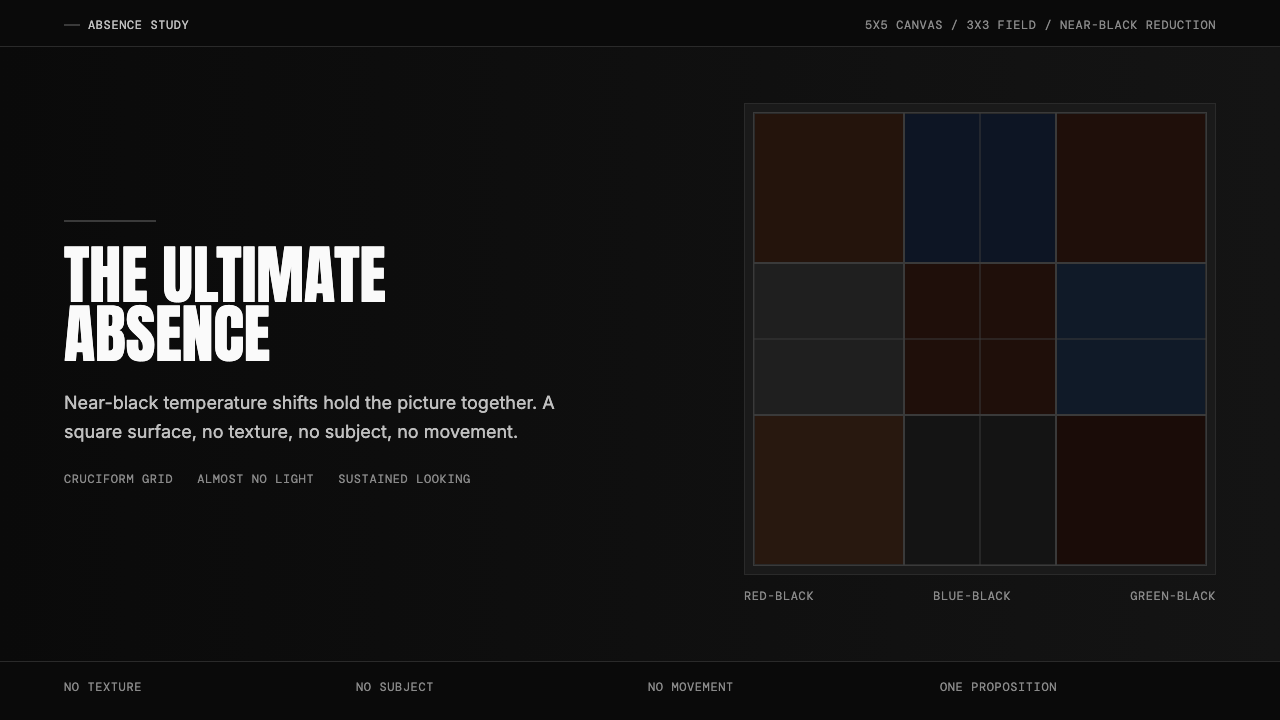 Ad Reinhardt Black Painting (1953)Austere absence. Near-black grid shifts reveal structure on sustained looking.
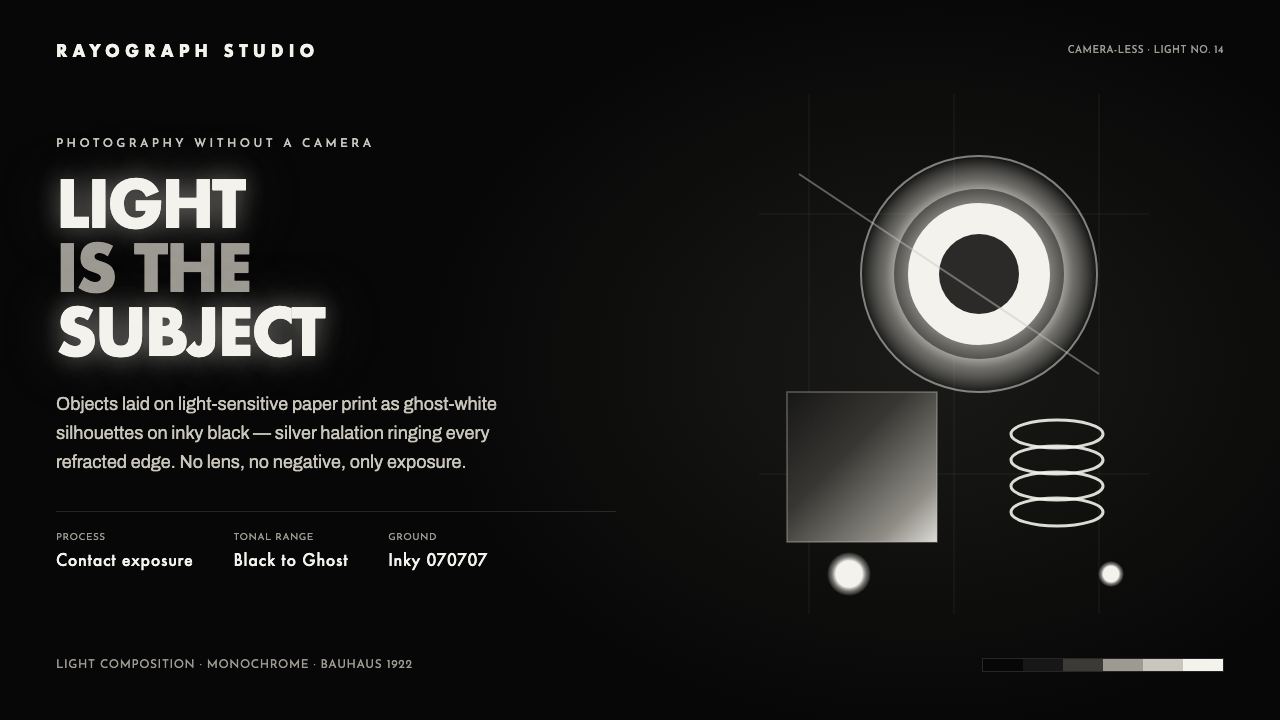 Photogram RayographLight is the subject. Ghost-white silhouettes and silver halation float on in…
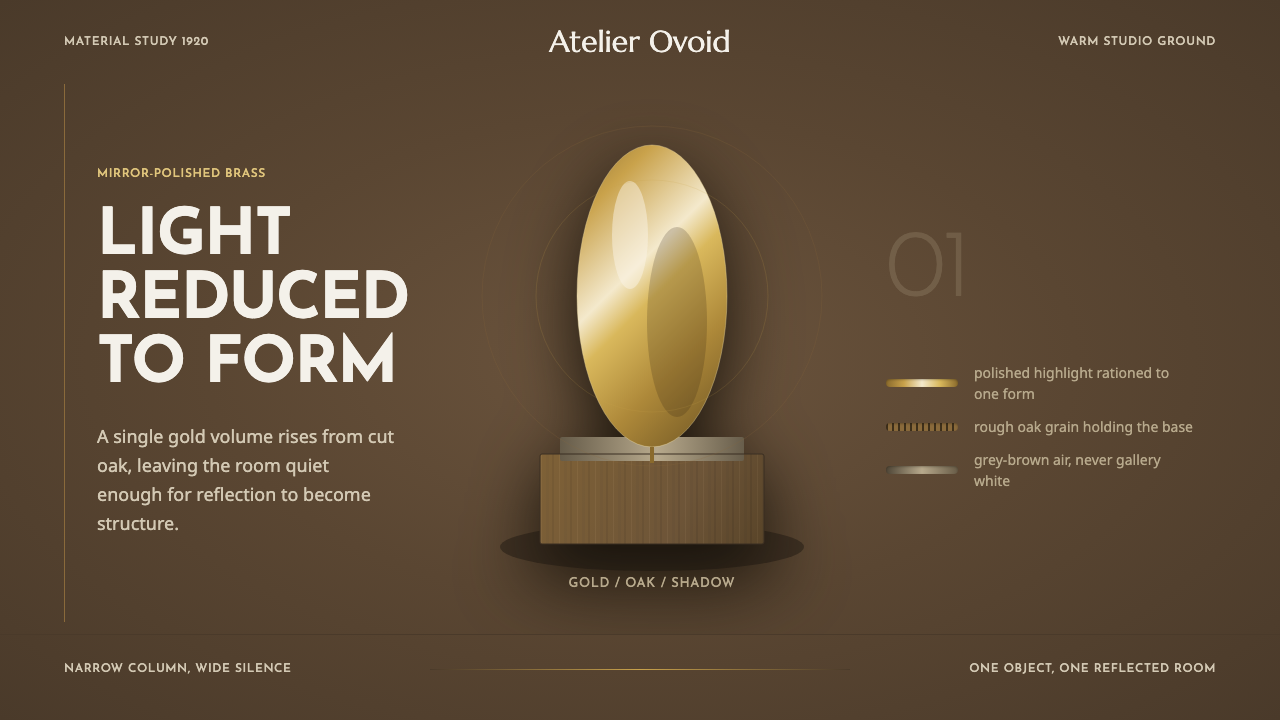 Brâncuși SculptureLight is rationed. Brass ovoids glow against oak-brown space and geometric ty…
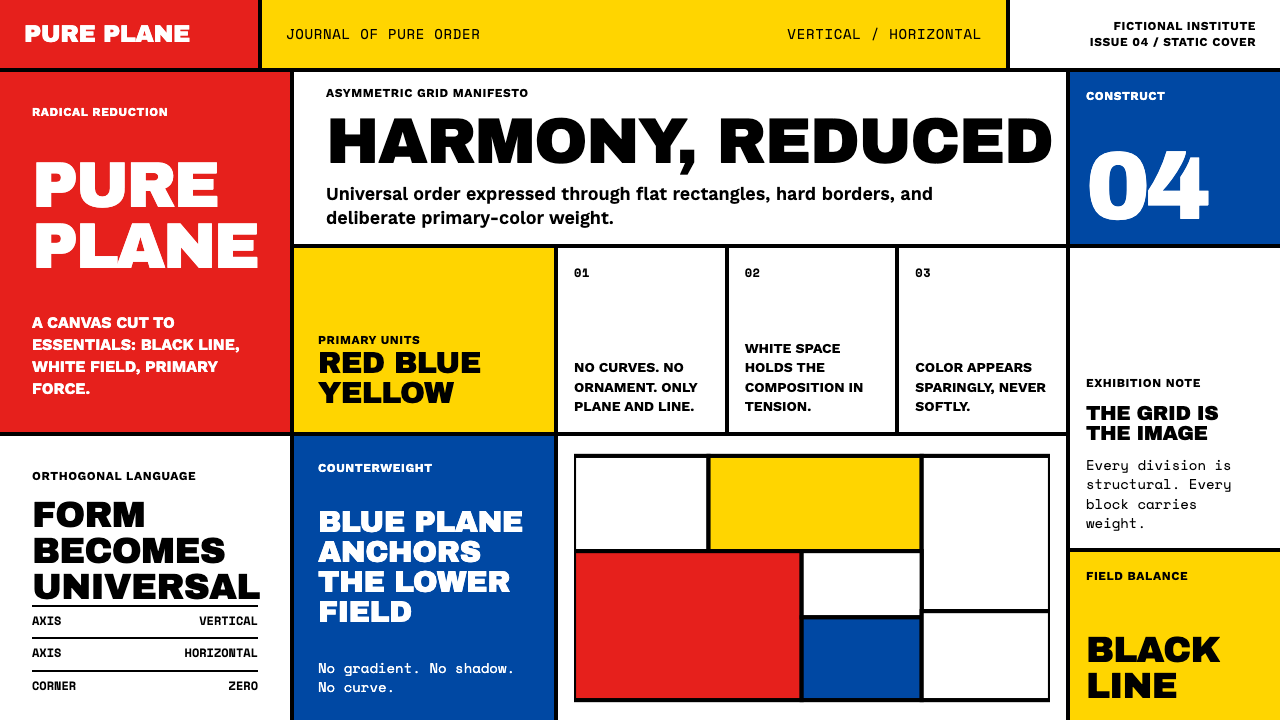 De StijlPrimary colors, locked in a black grid. Mondrian's compositions, in thick bor…
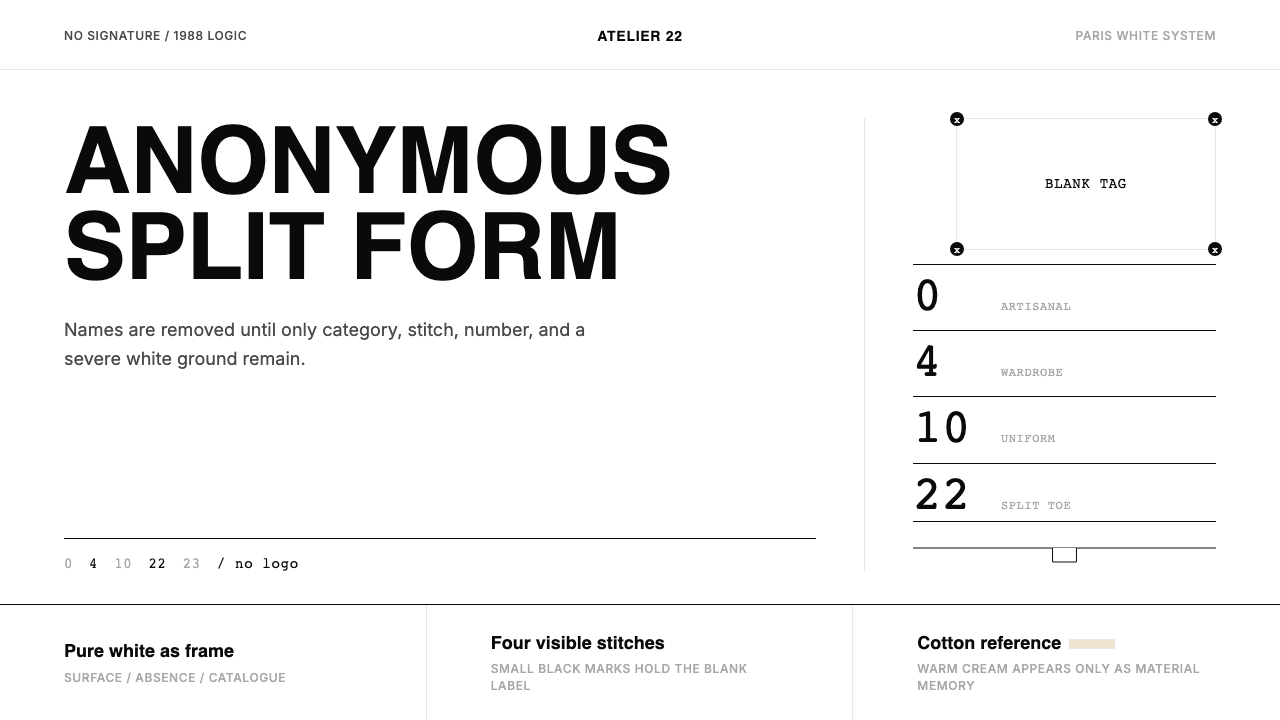 Maison Margiela Tabi-WhiteAnonymity becomes luxury. Pure white, Helvetica mass, numbered lines, four st…
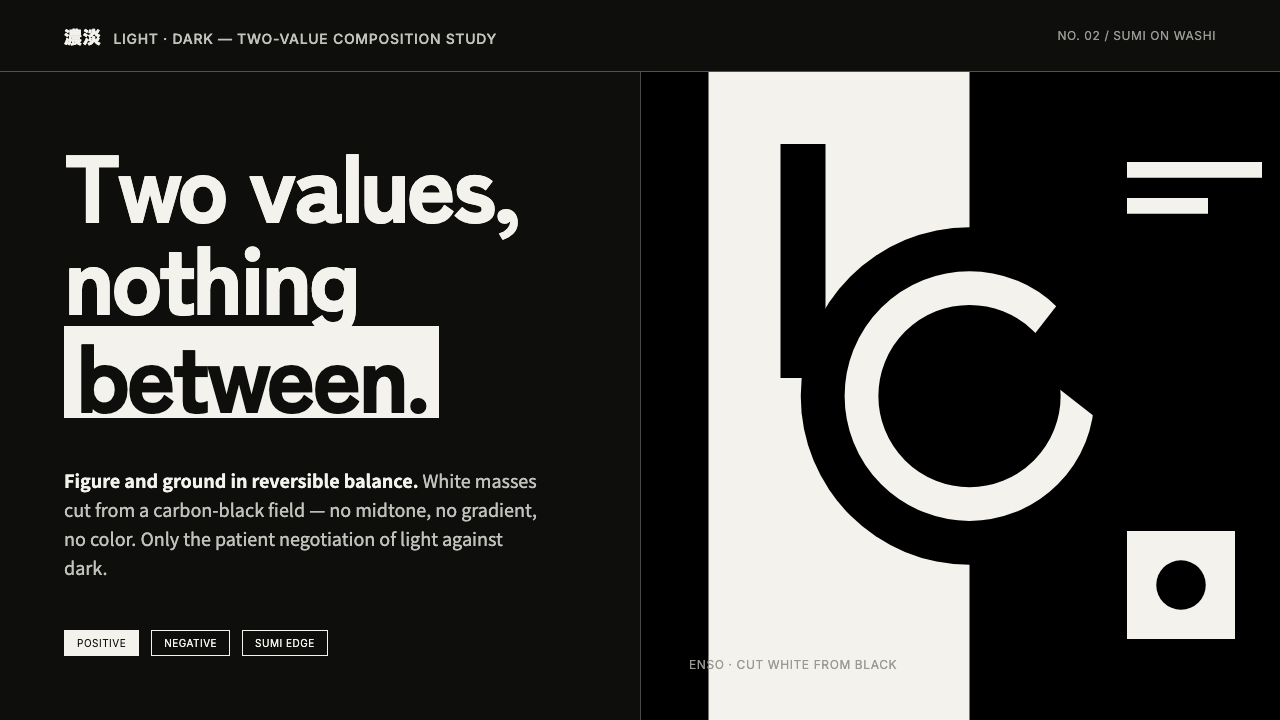 Notan Light-DarkTwo values, nothing between. White masses cut from a carbon-black field, figu…