What is Maison Margiela Tabi-White?
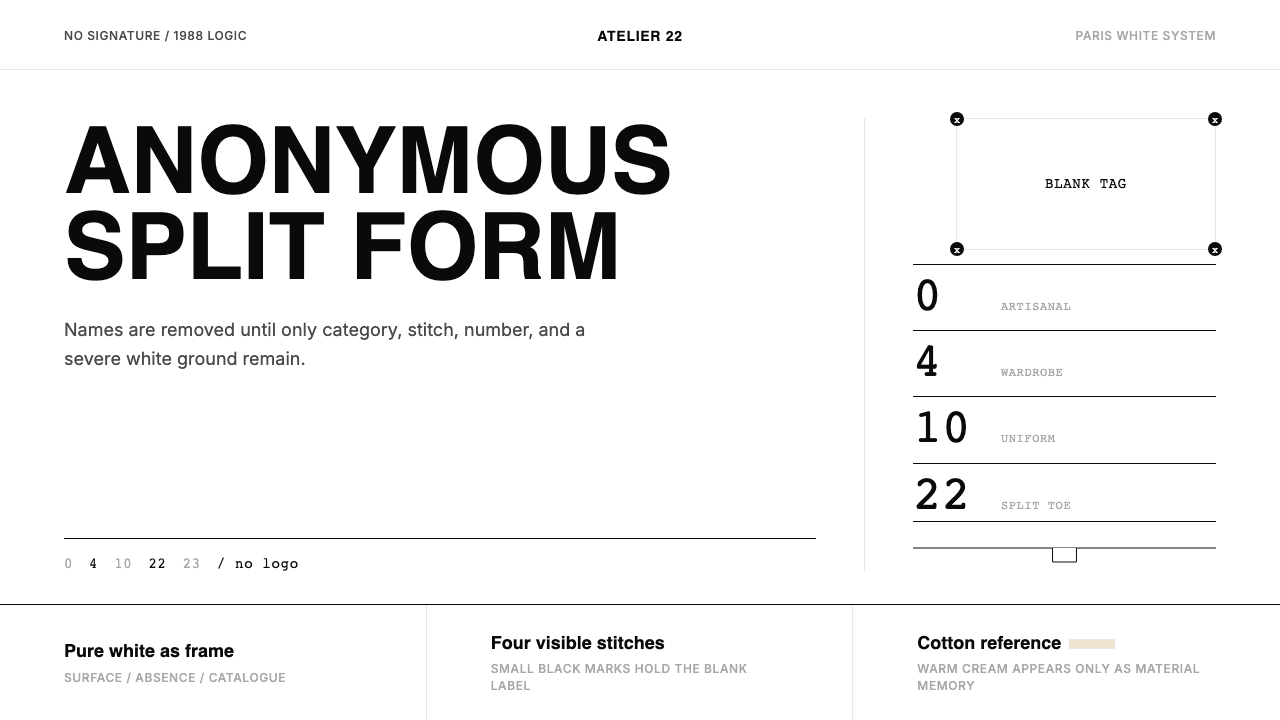
Maison Margiela turned anonymity into the purest luxury — white walls, blank tags, numbered lines, and four stitches that sign nothing but mean everything.
Maison Margiela Tabi-White in brief
Maison Margiela Tabi-White is the visual identity system of Maison Margiela: a Parisian conceptual fashion house whose design language is built entirely on absence. Where other luxury brands accumulate monograms, crest motifs, and proprietary color stories, Margiela strips its surfaces down to pure white, a single industrial typeface, and a four-stitch signature that appears on blank white cotton labels sewn with visible basting thread. The result is a visual system so committed to restraint that restraint itself becomes the statement.
The name references two defining elements of the house: the Tabi split-toe silhouette — a boot form derived from traditional Japanese tabi socks and first introduced in the debut 1989 collection — and the dominant ground color of every surface in the Margiela universe, from showroom walls to product tags to lookbook pages. White is not a background here; it is the primary design element. Everything that appears on it — black Helvetica-weight type, a number from the 0-to-23 line system, the four white stitches — reads as a deliberate incision into that white field.
What distinguishes this system from generic minimalism is its conceptual foundation. The house was structured around the erasure of the conventional luxury brand signature: no founder portrait, no hero logo, no seasonal brand color. In place of identity, Margiela offered a system of categories — numbered lines replacing named collections — and a visual language so austere it functions almost as an anti-brand. For designers and communicators, the style offers a rigorous vocabulary of pure white ground, high-contrast monochrome type, precise corner geometry, and restrained structural detail.

Where does Maison Margiela Tabi-White come from?
Martin Margiela was born in Belgium in 1957 and trained at the Royal Academy of Fine Arts in Antwerp, graduating in 1980 as part of a generation that would become known as the Antwerp Six — a cohort whose collective impact on European fashion in the 1980s was seismic. After graduating, Margiela spent several years assisting Jean Paul Gaultier in Paris, absorbing the mechanics of a working couture house while developing ideas that ran in an entirely opposite direction: away from spectacle and toward structural deconstruction, away from the designer's personality and toward anonymous process.
In 1988, Margiela founded Maison Martin Margiela in Paris with business partner Jenny Meirens. The house's founding position was radical and deliberately paradoxical: it would operate as a luxury fashion brand while systematically dismantling every convention of luxury fashion branding. Margiela himself refused all interviews and public appearances from the beginning, communicating with the press only through fax, always signed with a collective 'we' rather than his name. The blank white tag — sewn into garments by four white stitches of exposed basting thread, with no printed name — became the house's most iconic and widely recognized signature. To know that a blank tag meant Margiela required cultural fluency, making the label itself a form of insider knowledge.
The 1989 debut collection introduced the Tabi boot: a heeled shoe split at the toe in the form of the Japanese tabi sock, an object with no direct precedent in Western fashion. The Tabi became the house's most legible symbol — a shape so specific that its silhouette alone functions as a trademark — and it has continued in production, in varying materials and heel heights, through every subsequent creative directorship. The Tabi's split form also encodes the house's conceptual method: taking a vernacular form from an entirely different cultural context and reframing it as fashion through radical decontextualization.
In 2002, Margiela sold a controlling stake in the house to Renzo Rosso's OTB Group (the parent company of Diesel), and in 2009 Martin Margiela quietly departed the creative director role — an exit so consistent with his philosophy of anonymity that it was not publicly confirmed for years afterward. John Galliano, the former Dior creative director, was appointed in 2014 and brought his own baroque sensibility into a productive tension with the house's strict restraint. Under Galliano, the Tabi-White visual language has been maintained as the house's graphic foundation while the garments themselves have absorbed more overt drama — creating a productive tension between image and object that defines the Margiela visual experience in the current era.
What defines the Maison Margiela Tabi-White look?
White as Primary Element
In Tabi-White, white is not a neutral background — it is the dominant visual element. Every surface, from showroom walls to lookbook pages to product tags, is rendered in the same uncompromised pure white. Marks appear on this white field as deliberate incisions: black type, a four-stitch signature, a numbered line. The whiteness carries weight and presence, functioning the way a primary color functions in a more conventional palette: as the first thing the eye registers and the organizing principle of the whole.
Monochrome with Structural Contrast
The palette is strictly two-tone: pure white ground and pure black mark, with no softening, no grey gradation, and no accent color introduced for warmth or hierarchy. Contrast here is structural rather than decorative — the black of the type against the white of the ground is not a style choice but a statement about what constitutes information. This severe reduction means every element that appears on the page is intentional, because nothing is hidden by complexity or distracted by color.
Industrial Sans-serif Typographic Weight
All text in the Tabi-White system uses a single family of grotesque or neo-grotesque sans-serif letterforms — the kind of industrial, rationalist typeface associated with anonymous mass production rather than designer personality. The type is set with extreme economy: often a single size for a given text block, with hierarchy established through spatial separation and capitalization rather than through multiple sizes or weights. This typographic austerity enforces the house's anti-signature philosophy at the letter level.
Zero-radius Corner Geometry
Where most contemporary luxury brands have adopted rounded corners as a signal of approachability and modernity, Tabi-White insists on absolute sharp corners throughout — in card components, image frames, tag silhouettes, and layout borders. This precision reads not as cold calculation but as intellectual commitment: the corner is where two lines meet, and rounding that meeting is a concession the system refuses to make. Hard corners enforce a sense that every edge is a decision.
The Four-Stitch Signature
The four white stitches on a blank white label — sewn with visible basting thread that connects the tag to the garment at four points — function as the house's entire visual identity compressed into a craft gesture. In digital and print contexts, this detail translates into a use of minimal structural marks: ruled lines that appear at precise intervals, thin structural dividers that carry weight without decoration, and a general preference for marks that look constructed rather than designed. The four-stitch logic is about evidence of process, not evidence of brand.
Numbered System over Named Identity
The house's 0-to-23 line system replaces collection names, seasonal titles, and founder signatures with numeric category codes. In design terms, this translates to a preference for structural labeling over expressive naming: dates rather than season titles, numbers rather than descriptor words, categories rather than narratives. Applied to presentations, editorial layouts, or product systems, this principle produces a system that feels encyclopedic and authoritative rather than promotional — information as primary content, not as frame for an image.
Flatness and Surface Refusal
No gradients, no ambient shadows, no simulated depth or texture appear in the Tabi-White system. The surfaces are entirely flat — not as a contemporary digital trend, but as a conceptual position. Adding depth simulation would import luxury conventions (gloss, warmth, tactile suggestion) that the house's entire aesthetic opposes. Flatness keeps the visual field open and neutral, a white room in which the marked element — number, word, stitch — stands alone.

Who shaped Maison Margiela Tabi-White?
Martin Margiela founded the house in 1988 after training in Antwerp and working under Jean Paul Gaultier. His decision to remain entirely anonymous — never photographed, never interviewed, communicating only by collective fax — was not a marketing posture but a consistent philosophical position: the work should speak, not the person. The blank white tag, the four stitches, the 0-to-23 numbering system, and the Tabi boot silhouette were all established during his tenure and constitute the complete foundational vocabulary of the visual system that bears his name.
John Galliano became creative director in 2014, bringing a background in theatrical spectacle and historical reference that stands in apparent tension with the house's austere identity. Rather than softening the visual system, Galliano has maintained the Tabi-White graphic language with fidelity while pushing the garment designs toward denser conceptual territory — deconstructed tailoring, newspaper-print fabrics, Artisanal reworkings of found objects. The pairing demonstrates that the visual system can hold as a stable container for wildly varied creative content, provided its structural rules are upheld.
Jenny Meirens co-founded Maison Martin Margiela with Martin Margiela in 1988 and served as the business and commercial intelligence behind the house's early years. While Margiela shaped the creative language, Meirens managed the operational and commercial realities that allowed that language to develop without compromise. Her role is often underexamined in accounts of the house's aesthetic development, but the coherence and consistency of the identity system across all touchpoints — retail, press, presentation — reflects the organizational discipline she brought to the enterprise.
Renzo Rosso, founder of Diesel and OTB Group, acquired a controlling stake in the house in 2002, providing the financial infrastructure that allowed Margiela's visual system to scale globally while maintaining its integrity. Rosso's stewardship during the transition from founder-led to post-founder operations — and through the Galliano appointment — preserved the visual identity intact at a moment when many comparable transitions have resulted in brand dilution. The business relationship between radical conceptualism and commercial distribution that the Rosso-era structure represents is itself a case study in identity management.
How do you use Maison Margiela Tabi-White today?
Tabi-White is one of the most exacting styles to apply correctly because its power comes not from any single visual element but from the discipline of the whole system. A pure white background with black type is not Tabi-White; it is simply monochrome. What distinguishes authentic application is the combination of absolute restraint, structural precision, and the refusal of every softening gesture — no rounded corner, no warm tint, no ambient glow, no gradient fill, no decorative border. Each of those refusals must be active and intentional, or the system collapses into generic minimalism.
For presentation slides, Tabi-White works with exceptional clarity on both cover and content pages. A cover should be almost entirely white, with a single typographic element — a date, a category number, a title set in a single weight without variation — positioned with precise spatial tension against the white field. No imagery is necessary on the cover; if imagery appears, it should be a high-contrast black-and-white photograph cropped to a hard geometric frame. Content slides maintain the same logic: a narrow column of text on a pure white ground, structural dividers rendered as thin precise rules, and data presented as diagrammatic flat elements rather than styled chart components. Section breaks should be marked typographically rather than with decorative ornaments.
For web interfaces, the system maps well to contexts that require authority and precision over warmth: editorial platforms, archival databases, portfolio presentations, pricing and specification pages. The approach is to use a pure white or very near-white ground throughout, apply black for all text and structural lines, and introduce no color whatsoever — or, if a single accent is needed for interactive states, use it as sparingly as the house uses its numbered-line system: one function, one application, no decoration. Hard-edged card components, sharp-cornered image containers, and typographically pure navigation replace softened contemporary UI conventions.
For editorial and marketing work, Tabi-White imposes a discipline that can elevate standard content significantly. A Tabi-White editorial layout uses extreme whitespace — margins that feel almost uncomfortably generous — to give each textual element the isolation of an object in a white room. Marketing pages should resist the instinct to fill space; the empty white field is the asset, not a problem to solve. Product or campaign imagery should be photographed or treated to high-contrast monochrome and presented in hard-cornered frames that sit on the white ground without shadow or blur. The typographic voice is factual and categorical — announcements rather than persuasion, numbers and dates rather than evocative adjectives.
A common and fatal error when applying Tabi-White is importing luxury warmth conventions into the system: adding a warm off-white tint, softening corners to feel more approachable, or introducing a secondary color — gold, cream, blush — to suggest premium quality. Each of these moves contradicts the system's foundational logic, which holds that purity of surface is the luxury signal, not the addition of conventional luxury decoration. A second error is reducing the system to its most visible element — the blank tag, the four stitches — without understanding the spatial and typographic discipline that surrounds those marks. Tabi-White borrowed as surface decoration produces results that look ironic or referential rather than authoritative. The system works only when its refusals are taken seriously.

Maison Margiela Tabi-White — FAQ
Is Tabi-White the same as generic white minimalism?
No, and the difference is consequential. Generic white minimalism is a stylistic preference — it uses white space and simple layouts because they look contemporary and clean. Tabi-White is a conceptual system built on specific refusals: no warmth tint, no rounded corners, no accent color, no decorative marks of any kind. More importantly, the whiteness in Tabi-White is not a neutral background — it is the primary element, carrying the meaning that pigment carries in other systems. Generic minimalism produces designs that feel open; Tabi-White produces designs that feel like arguments. The difference is the presence or absence of a governing philosophy behind the surface decisions.
Can Tabi-White work with color imagery or photography?
With careful handling, yes — but the photography must be treated rather than presented naturally. The house itself uses photography extensively but processes it toward high contrast and near-monochrome. If color photography appears in a Tabi-White layout, it should be bounded by a hard-cornered frame, presented on an otherwise untouched white field, and used sparingly — one strong image rather than a grid of many. The risk is that naturalistic color photography imports warmth, texture, and dimensional illusion that the system's flat, white, precise logic cannot absorb without losing coherence. Treating the image as a bounded, isolated object within the white field is the path that preserves the system's logic.
How does this style handle dark mode or dark-background contexts?
A dark inversion of Tabi-White — pure black ground, pure white marks — is conceptually coherent with the house's logic and does appear in some Margiela contexts. However, the inversion changes the system's feel significantly: on a black ground, the marks read as more confrontational and stark rather than quietly authoritative. The structural rules remain the same — no gradients, no rounded corners, no warm tints, no decorative elements — but the hierarchy of presence inverts. A pure black ground is a valid application; mixing black and white grounds in the same layout, or introducing dark grey as a third tone, breaks the system's binary discipline.
What kinds of products or brands is Tabi-White unsuitable for?
Tabi-White's severity and conceptual density make it poorly suited for contexts where emotional warmth, accessibility, or sensory richness are the primary user expectations. Food and beverage brands, children's products, wellness applications, and hospitality brands that rely on welcoming visual cues will find the system actively counterproductive — the white field that reads as sophisticated authority in a fashion context reads as clinical coldness in a consumer or care context. Similarly, brands that depend on color as a primary differentiator in a competitive landscape — retail, consumer electronics, or any category where shelf impact and color recognition drive choice — cannot sustain the system's strict monochrome without significant commercial disadvantage.
How literal should the Tabi boot reference be in design applications?
Not literal at all, in most contexts. The Tabi reference in the style name is conceptual — it points to the house's most recognizable silhouette as a way of naming the aesthetic system, not as a directive to incorporate the boot form into designs. What the Tabi communicates as a concept is instructive: it is a precise, unexpected, culturally specific form that functions as vocabulary rather than ornament. In design terms, this translates as a preference for exact, purposeful shape choices over generic geometric defaults — the decision to use a very specific proportion, an unexpected structural mark, or a particular negative space treatment, rather than defaulting to the safe average. The Tabi's split is not decorative; it is a decision. That is the principle to carry into application.
Related design styles
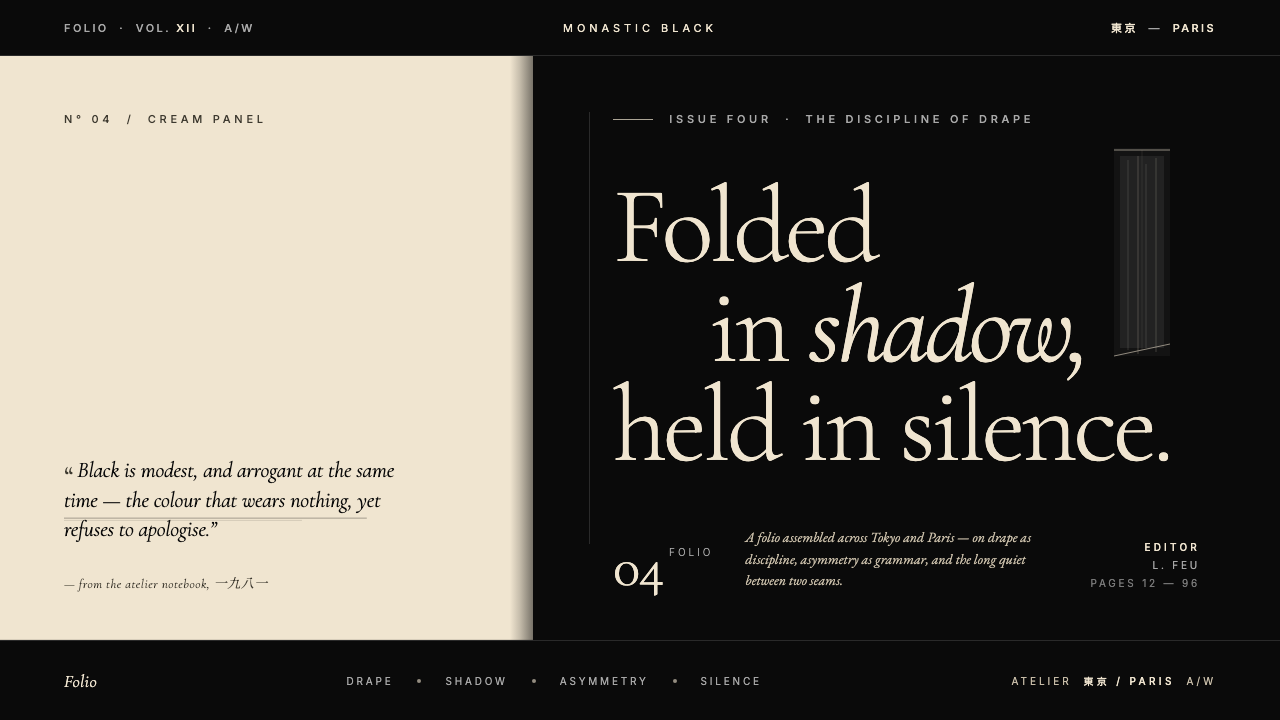 Yohji Yamamoto Monastic BlackBlack as philosophy. Monastic ink ground, warm cream reprieve, low-weight Gar…
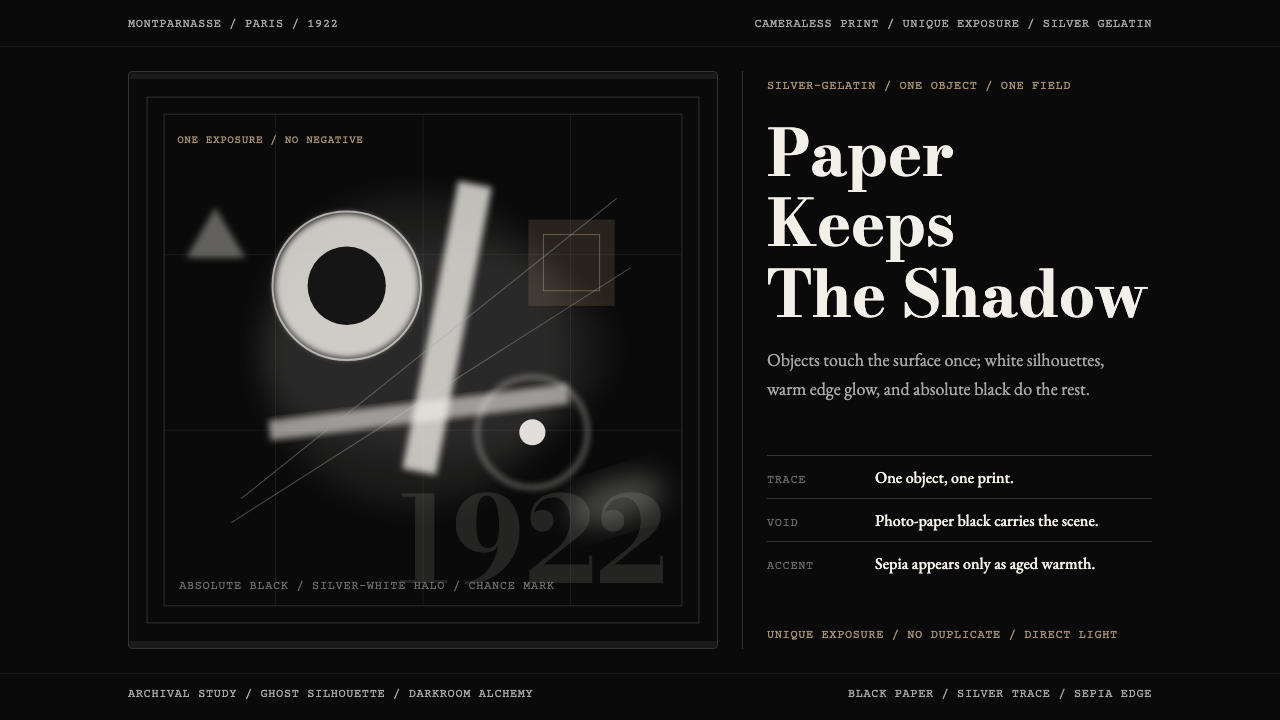 Man Ray Rayograph (1922)Light leaves the trace. Black voids, silver type, and sepia edges stage one g…
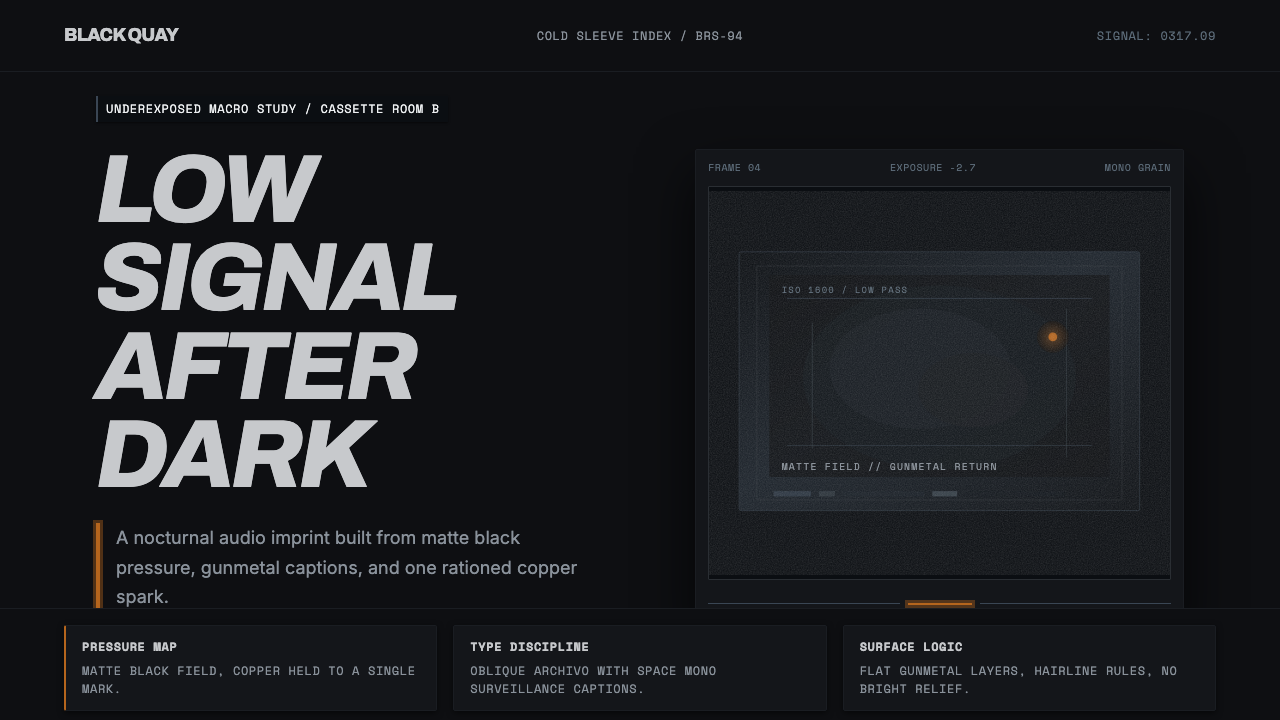 Bristol Trip-HopMenace through minimalism. Near-black grain, gunmetal type, one copper spark.
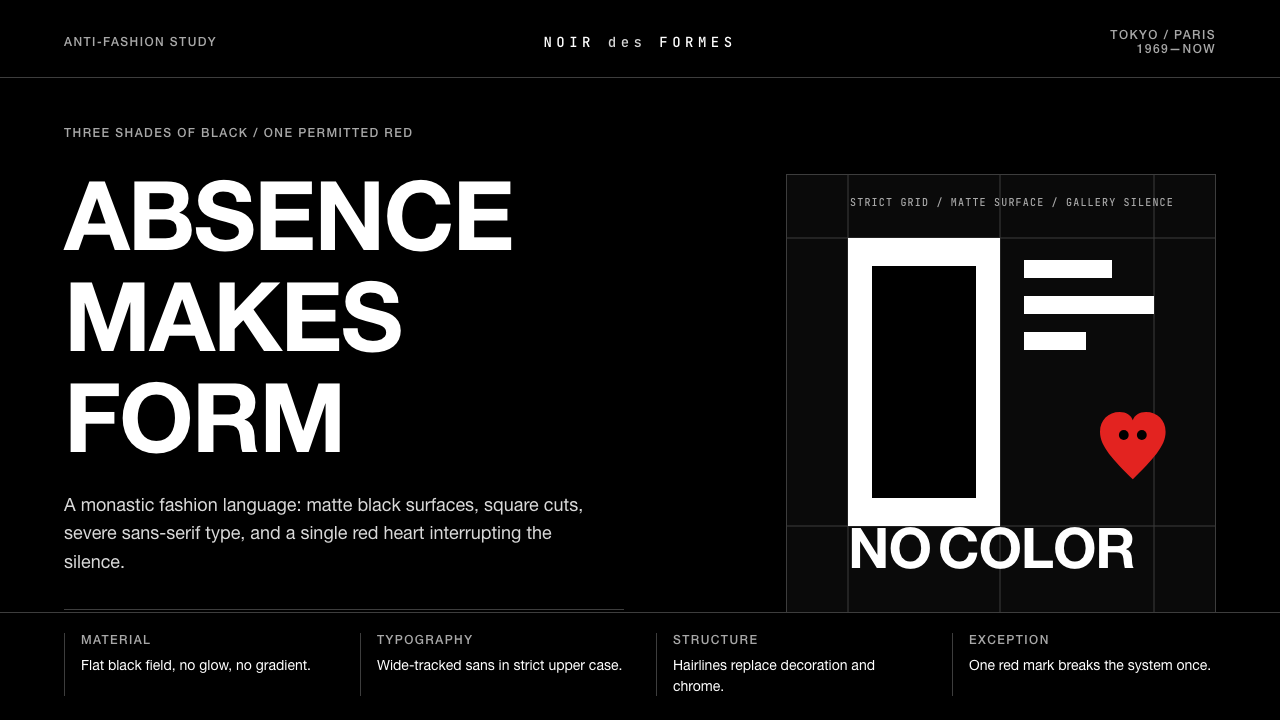 Comme des Garçons (Rei Kawakubo)Austerity becomes the event. Pure black, wide sans type, and one red heart br…
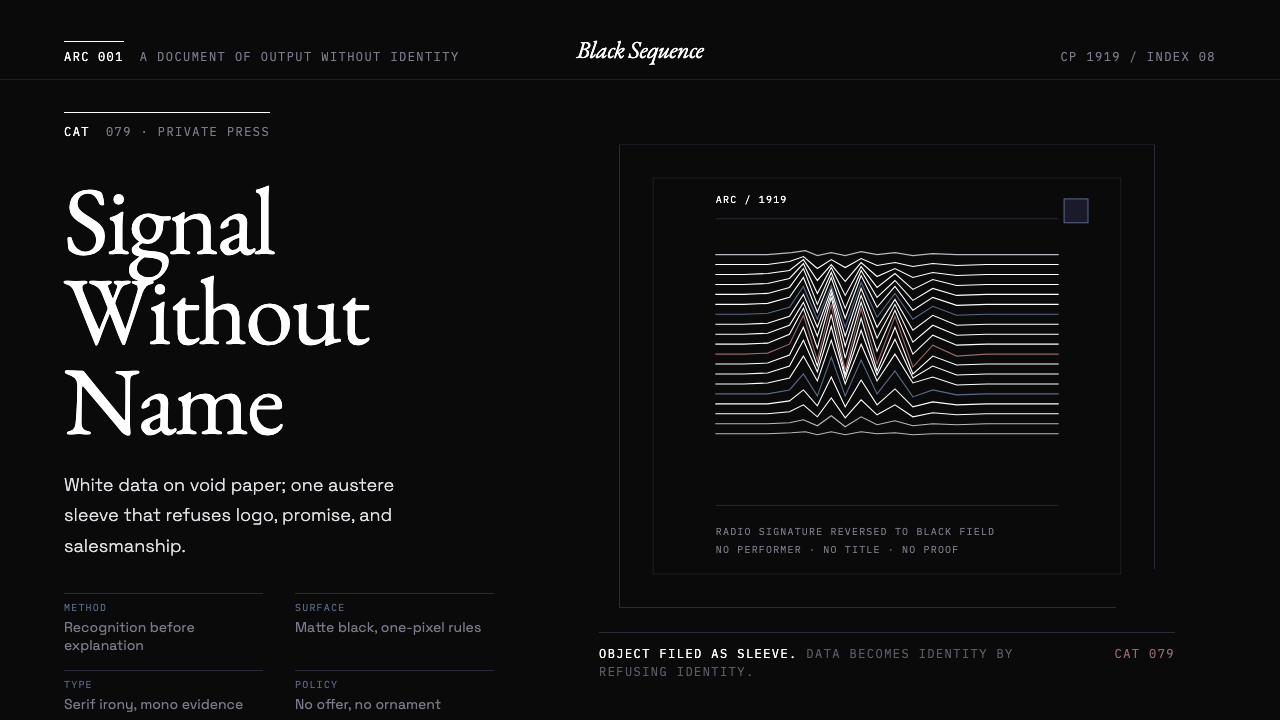 Peter Saville / Factory RecordsAnti-design becomes high art. Void black, white pulsar lines, and FAC mono la…
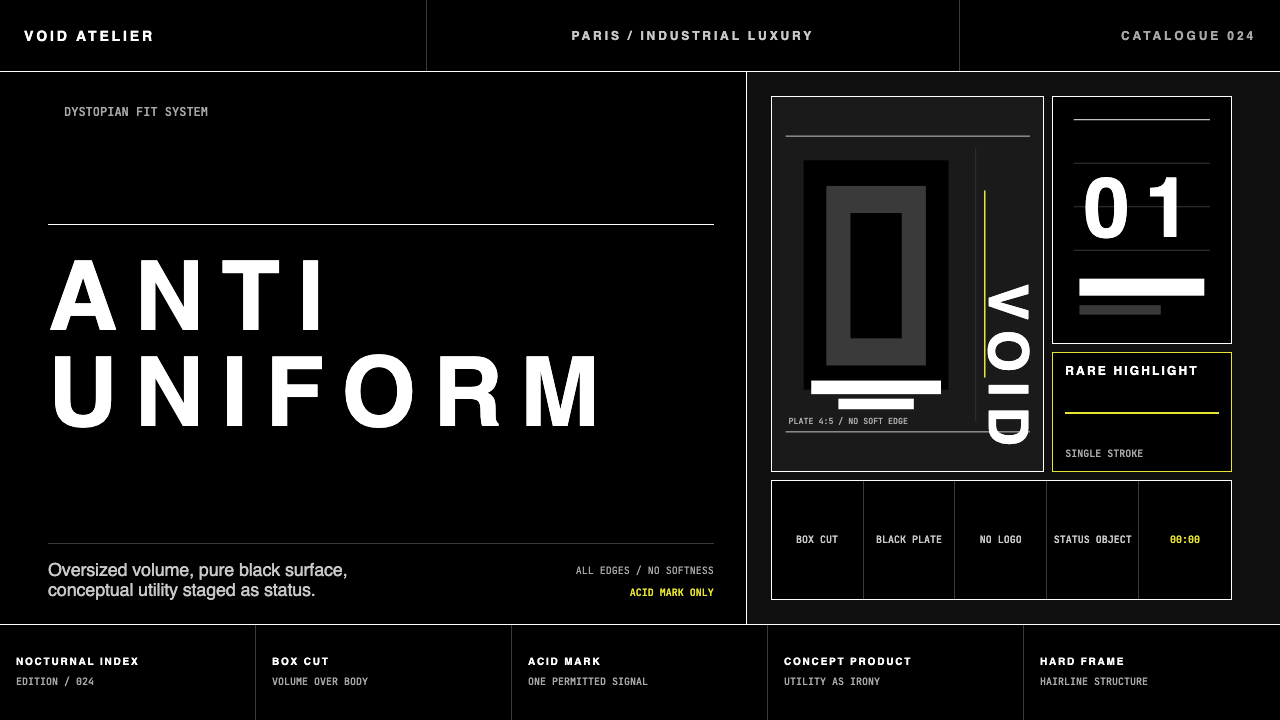 Balenciaga (Demna era)Threatening restraint. Black grids, white hairlines, spaced sans at brutal sc…