What is Balenciaga (Demna era)?
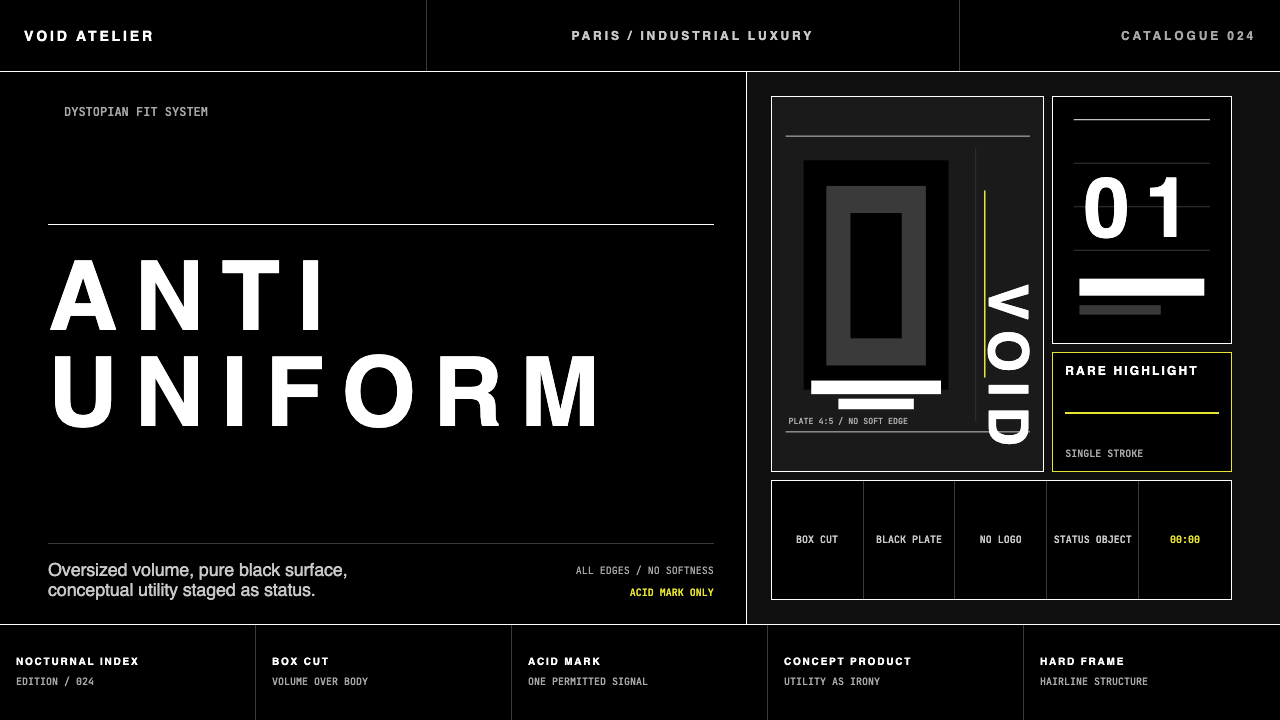
Balenciaga under Demna Gvasalia turned couture restraint into a weapon — deep black grounds, monumental spaced type, and zero ornament deployed as provocation.
Balenciaga (Demna era) in brief
Balenciaga in the Demna era is the defining luxury-streetwear visual language of the late 2010s and 2020s. Its grammar is deliberately severe: deep, near-absolute black grounds host monumental display type set at extreme widths and letter-spacing. Corners are sharp and unrounded. Ornament is entirely absent. The effect is simultaneously architectural and confrontational — less a fashion house identity than a brutalist manifesto dressed in couture.
What separates the Demna visual system from generic dark minimalism is its specific relationship to scale and weight. Type dominates every composition at sizes that feel oppressive, not elegant. A single word — the house name, a season, a city — becomes the entire visual event. Negative space is not used for breathing room but for pressure: the emptiness presses in from all sides, making the central element feel trapped and powerful at the same time.
Beneath the intimidating surface runs a rigorous ironic intelligence. Demna-era Balenciaga consistently stages the language of luxury against deliberately mundane or absurd references — fast-food branding structures, supermarket bag silhouettes, political campaign typography. The visual identity inherits this quality: it is always slightly too serious, too rigid, too industrial to be taken entirely at face value. That dissonance is the point.

Where does Balenciaga (Demna era) come from?
The house of Balenciaga was founded in San Sebastián, Spain in 1917 by Cristóbal Balenciaga, who later relocated to Paris in 1937. Cristóbal was known for architectural couture — sculptural silhouettes that departed radically from the body, constructed with engineering precision. He closed the house in 1968, and for decades after his death in 1972, Balenciaga passed through several creative directors without finding a sustained identity. Nicolas Ghesquière (1997–2012) brought critical acclaim and a forward-looking technical aesthetic, but it was Demna Gvasalia's appointment in 2015 that produced the seismic shift in the house's cultural and visual register.
Demna Gvasalia was born in 1981 in Sukhumi, in the then-Soviet republic of Georgia. His family fled the Georgian-Abkhaz war in 1992, eventually settling in Germany and later Belgium, where Demna studied fashion at the Royal Academy of Fine Arts in Antwerp — the same institution that produced the Antwerp Six. Before Balenciaga, he co-founded Vetements in 2014 with his brother Guram, a collective that became notorious for deconstructed streetwear, ironic branding, and deliberately anti-glamour aesthetics. Vetements established the vocabulary — outsized proportions, Soviet-bloc references, DIY urgency — that Demna then translated into the Balenciaga context at industrial luxury scale.
The visual identity that emerged at Balenciaga from 2015 onward drew on several converging influences. One is the tradition of French haute couture's typographic restraint — the austere logotype and minimal seasonal communication that high houses had used for decades. Another is the brutalist architecture of the post-war Eastern Bloc, which Demna has cited repeatedly as a formative visual environment: unornamented concrete, aggressive scale, the absence of comfort. A third is the vernacular of post-Soviet streetwear and sportswear, where bold, no-frills type and high-contrast colorways carried status without elegance.
The Triple-S sneaker, introduced in 2017, crystallized the Demna aesthetic commercially and visually: a maximalist silhouette that was simultaneously ugly and covetable, sold at luxury price points, branded with the same monumental type as the runway looks. The campaign imagery — shot by Demna himself or by photographers working in a deliberately flat, fashion-reportage register — reinforced the house's rejection of conventional luxury photography. Models in oversized pieces stood against blank or brutalist backgrounds, shot straight-on, lit without glamour. By 2018, the Balenciaga visual system was the most imitated aesthetic in luxury fashion and had migrated far beyond the fashion industry into technology, finance, and independent creative direction.
What defines the Balenciaga (Demna era) look?
Color
The Demna-era palette is anchored by near-absolute black — not warm charcoal, not navy, but the flattest, most compressive black possible. Against it, white or very pale type creates maximum contrast without any intermediate value. Accent color, when it appears, is used sparingly and with calculated shock: a single high-saturation tone dropped into an otherwise monochrome field. The seasonal shows occasionally expand the palette to include faded brights or washed primaries, but the default identity communication strips color to its binary extreme. This black-and-white severity is not minimalism in the softened contemporary sense — it is aggression rendered in two tones.
Typography
Type is the primary visual event in every piece of Demna-era Balenciaga communication. Display type is set at sizes that dominate the frame entirely — a wordmark or season label scaled to an extent that approaches abstraction. Letter-spacing is pushed to extreme widths, creating horizontal tension across the surface. The typeface choices lean toward grotesque or neo-grotesque forms with no personality curve: neutral, blunt, industrial. Uppercase is the default register; lowercase rarely appears in formal brand contexts. Weight contrast within a single composition is minimal — the system trusts scale alone to create hierarchy, not multiple weights competing for attention.
Grid and Layout
Compositions are governed by a strict, often centered or symmetrical grid — in deliberate contrast to the asymmetric dynamism of much contemporary luxury branding. This symmetry, combined with monumental scale, produces a gravitas closer to institutional signage or state typography than to fashion editorial. Margins are generous, functioning as compression rather than relief: the wide empty border presses the central element inward. Information hierarchy within a single layout is flat — one thing is said, at scale, and nothing else competes for attention.
Texture and Surface
There is no surface texture in the Demna visual identity — no grain, no noise, no material warmth. Backgrounds are flat and optically dense. This digital flatness reads as deliberate: in a landscape where luxury brands routinely invoke craft through linen textures and aged paper effects, Balenciaga's refusal of any such signifier is itself a statement. The smoothness is not refinement; it is removal. The only texture acknowledged is that of print production itself — the weight of a paper stock or the solidity of a thick carrier bag — treated as the material baseline, not a designed flourish.
Imagery and Photography
Campaign photography in the Demna era rejects conventional luxury staging. There is no aspiration, no soft light, no implied lifestyle. Images are often shot in flat, overcast light or under harsh artificial sources that flatten the face. Settings alternate between desolate urban environments — brutalist concrete plazas, bleak parking structures, windswept public spaces — and deliberately studio-plain white or black grounds. Models are not styled to perform desire; they stand, often expressionless, in clothes that perform their own logic. This refusal of seduction is the seduction.
Zero Ornament
The Demna identity system contains no graphic flourishes, no seasonal illustrations, no decorative linework, no badge or emblem beyond the wordmark, no icons, no pattern work. Where other luxury houses deploy monograms, toile patterns, or archival motifs as connective tissue, Balenciaga deploys blankness. The absence is structural: every communication is one message, delivered at maximum weight, with nothing around it. This total withdrawal from decoration is what makes the system feel both ascetic and brutal — discipline exercised not as refinement but as refusal.
Irony and Conceptual Edge
Uniquely among luxury visual systems, the Demna identity carries a layer of conceptual irony that separates it from pure severity. The deliberate over-sizing of type, the adoption of political-campaign or bureaucratic-forms layouts, the staging of luxury goods against discount-retail aesthetics — all of these moves signal that the system is aware of its own posturing. It is luxury dressed in anti-luxury's clothing, and the knowing tension between those two positions is part of what the identity communicates. Applying the style without that self-awareness produces something that reads merely as bleak rather than intentional.

Who shaped Balenciaga (Demna era)?
Demna is the Georgian-born creative director who joined Balenciaga in 2015 after co-founding the Vetements collective. His background — the Georgian-Abkhaz war, migration through Europe, Antwerp fashion training — informs every layer of the visual system he built at Balenciaga: the brutalist references, the post-Soviet typography, the anti-seduction photography, the ironic product-as-commentary approach. He has described his design process as autobiography, and the visual identity he produced at Balenciaga is inseparable from that personal history. In 2021 he also became the artistic director of Vetements concurrently, and in 2022 he parted ways with Vetements to concentrate on Balenciaga.
The house's founder, Cristóbal Balenciaga (1895–1972), was born in the Basque Country and trained as a tailor before opening his Paris house in 1937. His couture was radically sculptural — the cocoon coat, the sack dress, the balloon skirt — designed to construct a relationship between garment and body that departed from Parisian norms. He was known for his reclusive perfectionism and his disdain for fashion's social spectacle. Demna has cited Cristóbal as the legitimate inheritance for his own anti-glamour stance: both designers, in their respective eras, refused to make dressing comfortable or aspirational in conventional terms. The severity of the Demna visual identity carries a formal echo of Cristóbal's constructive discipline.
Ghesquière served as creative director of Balenciaga from 1997 to 2012, preceding Demna and establishing a very different but equally influential house aesthetic: futuristic, technically precise, with a strong emphasis on material innovation and a more conventionally fashion-forward visual identity. His tenure is responsible for Balenciaga's re-entry into critical relevance after decades of relative dormancy. Where Ghesquière's visual language was sleek and aspirational, Demna's is deliberately its opposite — the contrast between the two eras is itself part of the house's contemporary narrative. Ghesquière left to become creative director of Louis Vuitton, where he has built a third distinct identity.
As chairman and CEO of Kering — the luxury conglomerate that owns Balenciaga — Pinault provided the institutional framework within which the Demna experiment became possible at scale. The decision to appoint an anti-establishment Georgian streetwear designer to one of Paris's oldest couture houses was a calculated strategic risk, and Pinault's backing was necessary for that risk to be sustained through the controversy-heavy early years. Kering's ownership also enabled the aggressive commercial expansion that turned the Triple-S sneaker and the visual system built around it into a genuinely global cultural phenomenon, rather than a critical fashion-industry moment.
How do you use Balenciaga (Demna era) today?
The Demna-era Balenciaga visual system is one of the most widely imitated aesthetics of the past decade, but also one of the most frequently misapplied. Applying it successfully requires understanding what makes it specific rather than merely dark or minimal: the precise relationship between type scale, negative space compression, and the near-total absence of supporting graphic elements. A layout that simply uses black and large type is not a Balenciaga-style layout — it is missing the pressure, the ironic self-awareness, and the compositional discipline that the actual system deploys.
For presentation slides, the style works with exceptional authority on cover and title pages where a single message must land with maximum weight. A cover in this mode carries one word or short phrase in monumental, widely-spaced display type against a near-black ground, with the presenter or event credit set in a single very small line at the bottom — nothing else. Content slides should be treated as severely as possible: one idea per slide, text set larger than feels comfortable, no decorative dividers, no icon accompaniments, no gradient or shadow on individual elements. Data visualizations take on a starkly diagrammatic quality — charts become geometric slabs in high-contrast tones, with labels set in the same monumental typeface family used throughout, scaled down but never decorated.
For web interfaces, the aesthetic is well-suited to high-concept product pages, waitlist or launch pages, editorial platforms, and any context where projecting authority and cultural seriousness is the primary goal. The approach requires a full-bleed dark ground, type set at sizes that dominate each viewport section, and an almost complete absence of UI chrome — no visible grid lines, no soft-shadow cards, no decorative icons. Navigation is purely typographic. Interactive states are signaled by the most minimal possible change — a weight shift, an underline, a reversal of contrast — without hover animations or transition effects that would soften the surface's rigidity. Pricing or tier pages work well with this approach when the product is a single dominant option rather than a complex matrix.
For editorial and marketing communications, the style supports strong single-message statements: event announcements, product launches, cultural partnership campaigns. A Balenciaga-derived editorial layout places the central claim at overwhelming scale, uses a very controlled secondary information layer in a contrasting small size, and leaves substantial areas deliberately empty — not as passive white space but as active compositional pressure. Print applications benefit especially from the system's directness: a poster in this mode needs only type and ground; nothing else justifies its presence. Email communications using this aesthetic must resist the temptation to add explanatory visual scaffolding — the system works through reduction, not addition.
A consistent and significant mistake when applying this aesthetic is adding softness to ease perceived severity — rounding corners, adding subtle gradients to backgrounds, introducing warm-toned accent colors, or softening the type weight. Each of these moves works against the system's core mechanism. The discomfort the style produces is not a flaw to be corrected but the primary communicative act. Similarly, adding multiple typeface families, mixing in illustrative elements, or deploying the black-ground palette with a casual or playful information hierarchy produces an incoherent result — dark in appearance, but without the conceptual discipline that makes the Balenciaga visual language legible as a system rather than a mood.

Balenciaga (Demna era) — FAQ
Is this style really about Balenciaga's fashion, or is it a general dark-luxury direction?
It is specifically about Balenciaga under Demna and is not interchangeable with generic dark-luxury aesthetics. What makes the Demna system distinctive is its combination of brutalist scale, post-Soviet typographic references, and conceptual irony — none of which are present in, say, the dark aesthetics of Bottega Veneta or Celine. Using a black ground and large sans-serif type does not make something Balenciaga-coded; the system requires the specific register of monumental pressure combined with a deadpan conceptual layer. Generic dark-luxury is aspirational; the Demna system is confrontational. The distinction matters when selecting it as a reference for design work.
Can this aesthetic work for brands outside fashion and luxury?
Yes, but the transfer requires deliberate adaptation. The Demna visual system has already migrated into technology, independent publishing, architecture studios, and financial services — specifically in contexts where the brand wants to communicate seriousness, non-conformity, or cultural authority without conventional luxury signifiers. The adaptation that works is one that retains the core structural principles — compressed negative space, monumental type scale, zero decoration, high-contrast binary palette — while removing any direct fashion references that would make the result feel like a costume rather than a genuine identity. What does not work is applying the palette and type scale to a warm or playful brand voice, or to products that depend on consumer approachability for commercial success.
How does the Demna-era aesthetic relate to the earlier Balenciaga under Nicolas Ghesquière?
The two eras share only the house name and Cristóbal's founding legacy. Ghesquière's Balenciaga was sleek, futuristic, and technically aspirational — the visual identity reflected this with a cleaner, more refinedly editorial aesthetic that aligned with the high-fashion visual conventions of its moment. Demna's Balenciaga deliberately broke from every one of those conventions: where Ghesquière was aspirational, Demna is confrontational; where Ghesquière's imagery was polished, Demna's is flat and anti-glamour; where Ghesquière's typography was elegant, Demna's is industrial. Understanding the contrast is useful because it makes clear that the Demna aesthetic is an active argument against its predecessor, not simply an evolution — and that argumentative stance is part of what gives the system its energy.
What is the biggest risk of using this style incorrectly?
The biggest risk is producing something that reads as bleak or oppressive without being legible as intentional. The Demna system works because every element of its severity is clearly chosen — the scale, the emptiness, the absence of warmth are all decisions, not defaults. When a designer applies the surface features — black ground, large type, no decoration — without the underlying conceptual precision, the result reads not as deliberate but as merely unfinished or uninviting. The style depends on the audience sensing that someone made every choice with full awareness; remove that sense and the severity becomes noise rather than signal. This is why misapplications of the style often feel oppressive where the original feels commanding.
Does the ironic conceptual dimension mean this style cannot be used sincerely?
Not exactly. The irony in the Demna system is structural — it operates through the gap between the signals the visual language sends (institutional authority, brutal permanence) and the contexts it is applied to (seasonal fashion, disposable consumer goods). That gap is always present when the style is used in commercial contexts, and a designer does not need to explicitly flag it or lean into it; the structure creates it automatically. What sincerity requires is precision and commitment: choosing every element deliberately, maintaining the system's internal logic without softening exceptions, and understanding why specific choices read as authoritative rather than simply dark. The style can be used earnestly to communicate genuine institutional weight, genuine severity, or genuine cultural seriousness — the ironic dimension does not require winking at the audience.
Related design styles
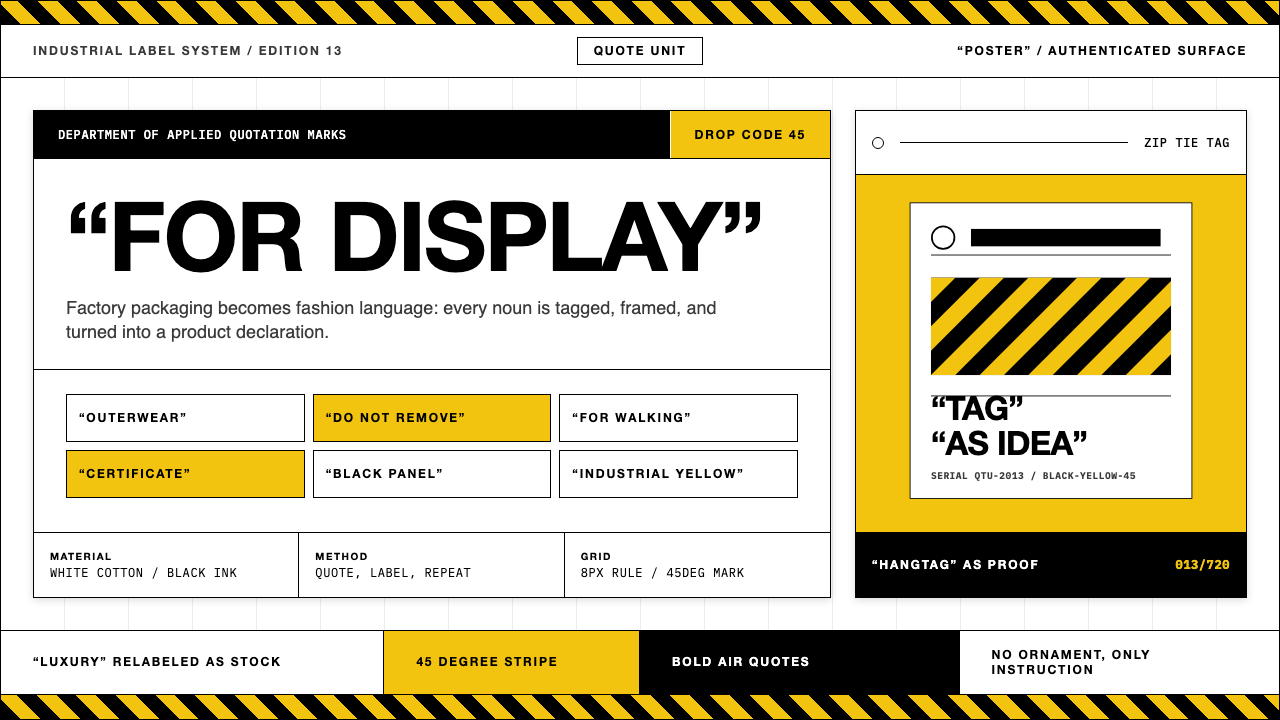 Off-White (Virgil Abloh era)Industrial irony, labeled. Yellow stripes and Helvetica quotes turn luxury in…
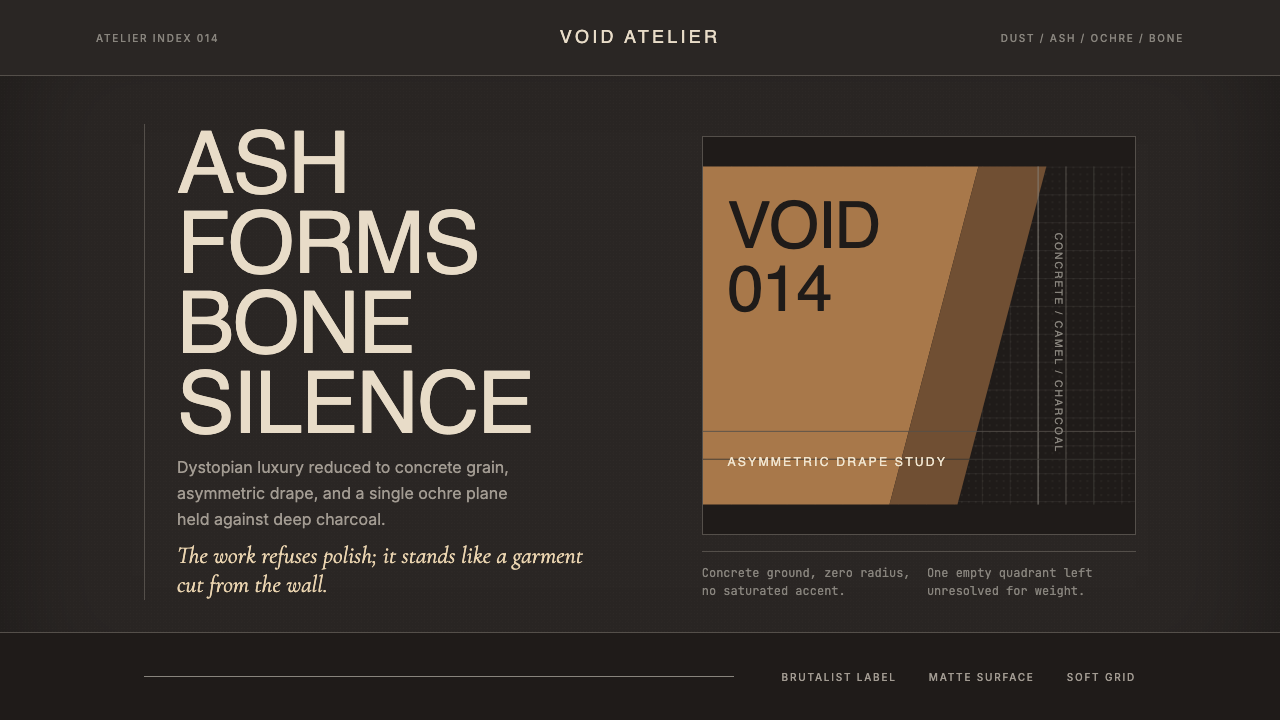 Rick Owens DarkstarRestraint has gravity. Charcoal concrete, bone type, and one ochre drape hold…
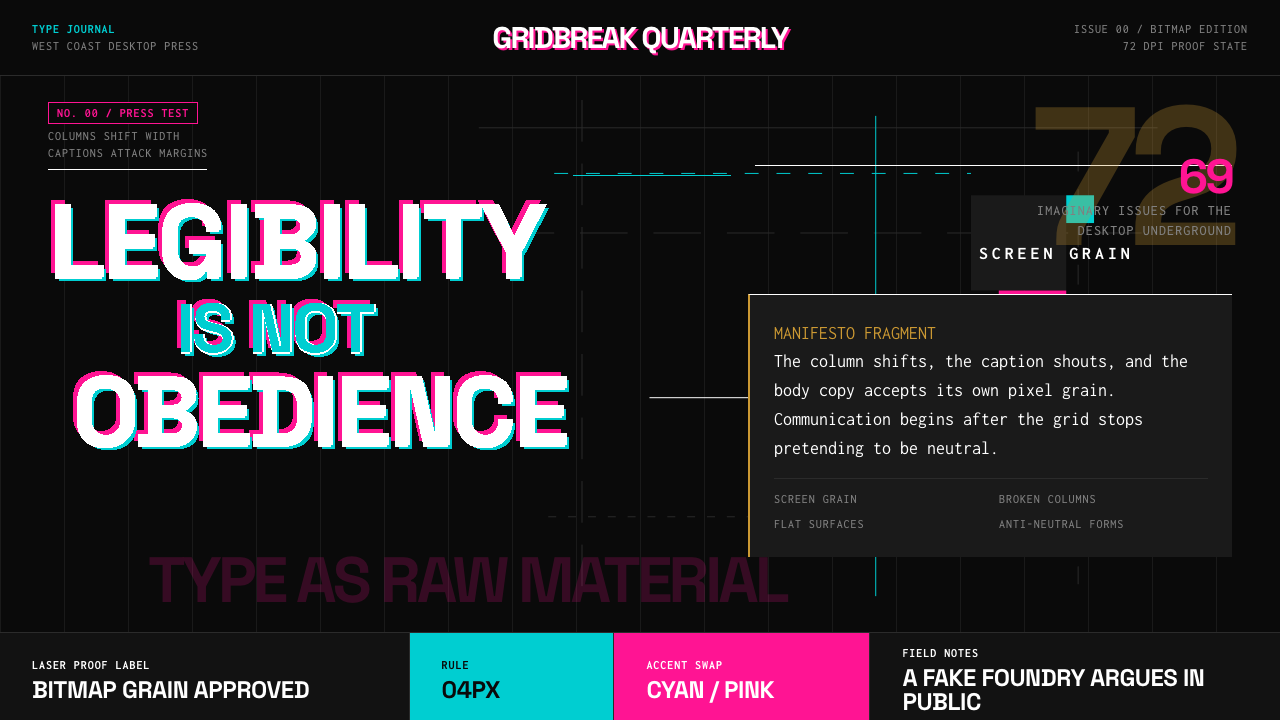 Emigre Magazine (1984–2005)Defies the tidy grid. Cyan, ochre, and hot-pink bitmap type collides on black.
 Gulf FuturismLuxury feels accelerated. Magenta-cyan neon cuts glass grids over purple-blac…
 Klein Blue (IKB)Color becomes the content. Pure ultramarine field, white italic serif, one go…
 SHAFT Monogatari TypographyType becomes cinema. Red cuts, black flats, and monumental kanji steer the fr…