What is SHAFT Monogatari Typography?
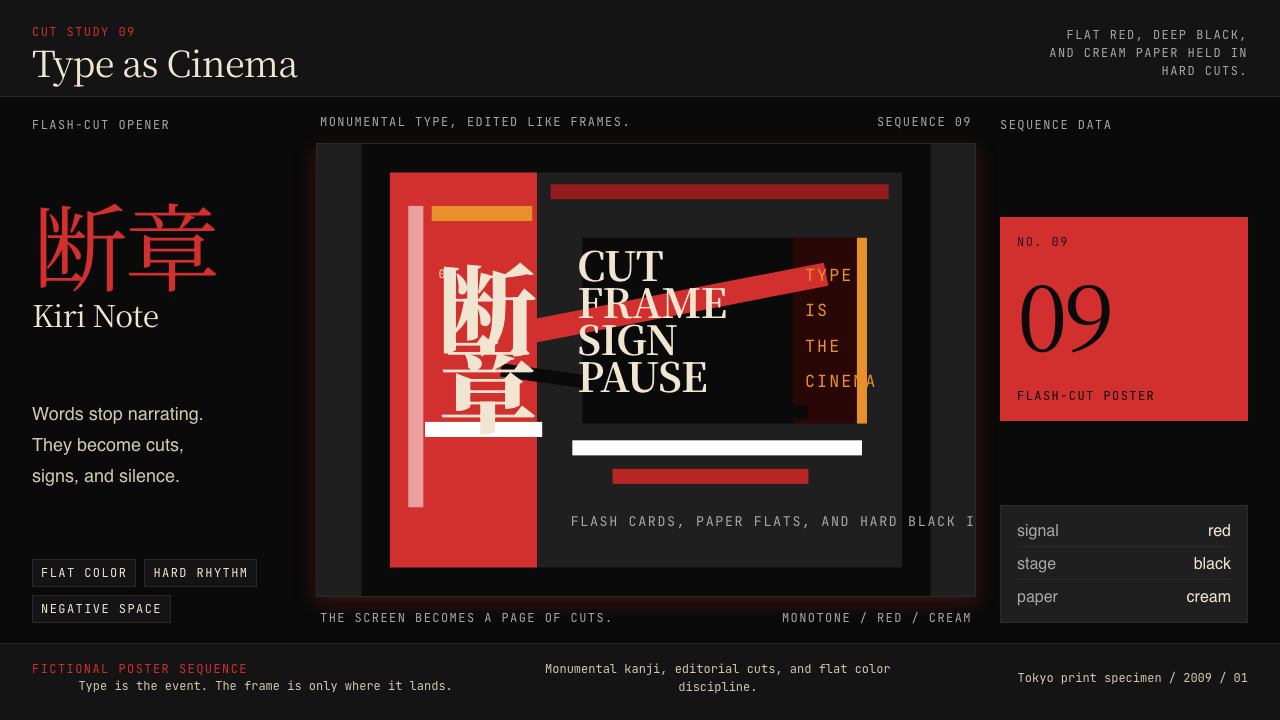
SHAFT's Monogatari series turned anime into a moving typography poster — where kanji slam across black frames and silence is cut by a flash of red.
SHAFT Monogatari Typography in brief
SHAFT Monogatari Typography is the visual grammar that anime studio SHAFT and director Akiyuki Shinbo invented for Bakemonogatari in 2009 and refined across the entire Monogatari franchise through the following decade and beyond. Its signature moves are simple and radical: saturated red against a field of deep black, monumental Japanese kanji slammed across the frame as flash-cuts lasting fractions of a second, and a minimalist flat-color composition that reduces characters and environments to silhouette and solid plane.
The system treats type as cinematic material. In most animation and graphic design, text is information support — labels, captions, dialogue. In the Monogatari visual language, text is architecture. Individual kanji become structural masses the same weight as a character's body or a background wall. Negative space is not emptiness; it is pressure. The ratio of dark ground to glowing red stroke to white blank creates a tension that a fully illustrated frame could not achieve.
Though it emerged from a specific anime production context, the aesthetic has since migrated widely into poster design, title sequences, editorial covers, and digital interface work wherever designers want to communicate intensity, narrative compression, and a Japanese avant-garde sensibility. It is one of the few contemporary design languages that is simultaneously cinematic, literary, and architectural.

Where does SHAFT Monogatari Typography come from?
Studio SHAFT was founded in Tokyo in 1975 as a small subcontracting animation house with no particular visual identity. The transformation that produced the Monogatari aesthetic began in 2004 when director Akiyuki Shinbo joined the studio and began applying his distinctive directorial approach — unconventional camera angles, static compositions that deliberately break the illusion of movement, and aggressive use of flat graphic inserts — to a series of projects that earned the approach the nickname 'Shinbo-cut.' These techniques were not invented wholesale: Shinbo drew on avant-garde animation traditions, manga graphic ambiguity, and the general climate of early-2000s experimental anime.
The decisive moment came with Bakemonogatari in 2009, an adaptation of Nisio Isin's light novel series about supernatural encounters in contemporary Japan. The source material was emphatically literary — long monologues, wordplay, and internal dialogue that resisted conventional anime dramatization. Shinbo and the SHAFT team responded by making the words themselves into images. Rather than animate the novels' verbal texture, they exteriorized it: kanji phrases flash on screen as editorial interruptions, title cards function as full compositional statements, and the visual rhythm of cuts mirrors the staccato syntax of Nisio Isin's prose.
The palette chosen for this system — deep black grounds, saturated red accents, white and off-white negative space, with occasional cream or muted-color environmental passages — was neither arbitrary nor purely aesthetic. Black-and-red is a classical Japanese design pairing with roots in lacquerware, woodblock printing, and theatrical costume. SHAFT's version strips away the craft associations and intensifies the contrast to near-maximum, making the combination feel simultaneously ancient and hypermodern. The flat color approach also answered a production reality: the studio was working under tight schedules and budgets, and abstract typographic compositions with minimal animation were a creative solution that turned constraint into signature.
Bakemonogatari became a critical and commercial success that transformed SHAFT from a mid-tier subcontractor into a flagship creative studio. The sequels — Nisemonogatari, Kabukimonogatari, Owarimonogatari, and more than a dozen other entries — each retained the core visual grammar while expanding its range: more varied color temperatures in some arcs, denser typographic layering in others, and an increasingly confident use of architectural and environmental graphic abstraction. By the 2010s, the Monogatari visual identity was recognized internationally as one of the defining aesthetic contributions of twenty-first-century anime, and its influence had spread well beyond animation into adjacent visual culture.
What defines the SHAFT Monogatari Typography look?
Flash Typography
The defining technique: single kanji or short phrases occupy the entire frame for a fraction of a second before cutting away. These are not subtitles or captions — they are editorial statements, functioning like a film cut that happens to be made of type. The glyphs are set at maximal scale, pushing into the edges of the frame or cropping beyond them, and the flash duration is calibrated to be perceptible but not fully readable on first viewing. Repeated watching reveals additional layers of text.
Restricted Palette
The core palette holds to deep black, saturated red, and near-white, with cream and pale neutrals used in more environmental or interior sequences. Color temperature is deliberately constrained: warm and cool tones rarely coexist in a single composition. Red is structural — it marks titles, emphatic phrases, and alert-level information. Black provides mass and weight. White and near-white supply negative space that makes the other two readable at high contrast. When additional colors appear, they function as location or mood signals rather than graphic decoration.
Silhouette and Flat Plane
Characters and environments are frequently reduced to solid-color silhouettes or flat planes with hard contour edges, eliminating modeling, shading, and the conventional anime vocabulary of highlight and shadow. This is not a cost-cutting shortcut but a compositional decision: the silhouette makes the figure read as shape rather than person, allowing it to function as a graphic element on the same plane as the typographic masses beside it. The human form becomes another geometric event in the composition.
Radical Negative Space
A large proportion of many frames is simply empty — black or near-white ground with nothing in it. This negative space is not a background waiting to be filled; it is load-bearing. It gives the isolated glyph or figure its monumental quality and creates the perceptual compression that makes the flash-cut feel violent. Compositions regularly place a single element at extreme position — far left, far right, top corner — and leave the remainder of the frame deliberately bare. The emptiness is doing structural work.
Architectural Type Scale
When type appears in compositional rather than subtitle function, it is set at a scale that treats the letterform or kanji as an architectural element — as large as a building facade in relation to the frame, often larger than any figure present. The stroke weight of a single character may occupy more visual mass than an entire character's silhouette. This scale inversion — type larger than person — produces the distinctively monumental quality of the style and reinforces the Monogatari franchise's literary premise that language is the primary reality.
Hard Contour, No Ambient Blur
Every element in the system has a hard, precise edge. There are no soft shadows, no glow effects, no out-of-focus backgrounds, no anti-aliased blur between figure and ground. This hardness is perceptually aggressive — it demands that the eye make a binary decision at every boundary. The absence of atmospheric diffusion means that spatial depth, where it exists at all, is created by layering flat planes of different tones rather than by simulating air or distance. The result is a space that feels like edited paper rather than inhabited world.
Editorial Cut Logic
The typography system is inseparable from the editing. Visual statements are made through sequence: a black frame, then a red-on-black kanji flash, then a silhouette, then white title text — each lasting a distinct duration calibrated to cumulative effect. This is design that only makes complete sense in time, understood as a kind of scored sequence rather than a static composition. Translating the style into still media requires preserving this sense of compression and sequence by treating each layout as one frame in a larger edited flow.

Who shaped SHAFT Monogatari Typography?
Shinbo joined SHAFT in 2004 and became the primary architect of the studio's visual identity. His directorial approach — radical camera angles, interruption of conventional animation flow with graphic inserts, and the decisive stripping-away of representational detail — gave the studio's work a confrontational quality that distinguished it sharply from mainstream anime production. His collaboration with SHAFT on the Monogatari franchise beginning in 2009 produced the most internationally recognized expression of this aesthetic. Shinbo's influence extends across nearly every significant SHAFT production, from Puella Magi Madoka Magica to the Monogatari continuations, making him the single most important individual in establishing the studio's global reputation.
Nisio Isin is the novelist and screenwriter whose Monogatari light novel series provided both the narrative material and the literary sensibility that the visual system was invented to serve. His prose style — hyperverbal, self-referential, saturated with wordplay and puns that only function in Japanese — cannot be conventionally dramatized. It was precisely this literary untranslatability that pushed the SHAFT team to make the words themselves visual. Nisio Isin also wrote the scripts for the anime adaptations, maintaining unusually tight authorial control over the transition from page to screen and ensuring that the verbal texture and the typographic system remained in correspondence.
The Monogatari visual language was not the work of any single credited art director but emerged from the collective practice of SHAFT's production teams working under consistent directorial direction. The studio's in-house approach to animation direction — accepting unconventional compositions, treating graphic interruption as a legitimate storytelling tool, and allowing aesthetic risk — created the conditions for the visual grammar to develop and stabilize across multiple productions. The studio culture valued formal experimentation within genre constraints in a way that distinguished SHAFT from studios that prioritized technical polish over visual invention.
Oishi served as series director for Bakemonogatari and was a key creative figure in translating the source material's literary texture into screen grammar. His directorial decisions in the early episodes of the series established the foundational vocabulary — the flash-cut typography, the silhouette compositions, the use of architectural flat color — that subsequent installments built upon. His background in experimental music video and short-form visual work informed his comfort with non-narrative graphic sequences and his willingness to let purely visual rhythm carry scenes where conventional anime direction would deploy dialogue or action.
How do you use SHAFT Monogatari Typography today?
SHAFT Monogatari Typography is a high-intensity style that rewards restraint in application. Its effect depends on contrast — not just the contrast between red and black, but the contrast between density and emptiness, between explosive typographic moments and flat, silent passages. Applying it correctly means accepting that most of the surface should be bare, most of the time, so that the moments of typographic energy register as events rather than as wallpaper.
For presentation slides, the style is most effective when treated as a sequence of poster-like frames. Cover slides benefit from a single monumental typographic element — a word or short phrase in the dominant display weight, positioned asymmetrically, against a black or deep-neutral ground, with a minimal red accent used for a subtitle or year marker. Content slides should be radically simple: one data point or one assertion per frame, with all supporting text reduced to a single tight cluster. Do not fill the slide. Data visualization in this aesthetic works best as isolated graphic objects with hard-edge bars or lines in the primary palette, no chart borders, and a white or near-white ground. The data becomes a typographic object.
For web user interfaces, the style suits dark-mode dashboards, analytics surfaces, media player interfaces, and any context where content is consumed in focused sessions rather than casual browsing. The key structural choices: a near-black or pure-black background as the base layer, body text in near-white or light neutral, interactive accent elements in saturated red, and hard-edge component borders with no shadow softening. Cards and panels should have definite, architectural boundaries. Navigation and labeling should be typographic rather than icon-heavy. On pricing or plan-selection pages, the style's poster-like boldness makes tier differentiation very clear when each plan is treated as a self-contained typographic block.
For editorial work and marketing materials — event posters, journal covers, feature article headers, promotional cards — the Monogatari aesthetic has the most direct fit. An event poster in this style places the event name at architectural scale, positions supporting information in a contrasting weight cluster, and uses the red accent for the single most important call to action: the date, the venue, the ticket link. The composition leaves significant bare area as a deliberate choice. For longer editorial layouts, the style works well as a contrast rhythm device: open sections with a full-bleed typographic title frame, then transition into a more neutral content zone, then punctuate with another flash moment at section breaks.
A persistent mistake in applying this style outside its original context is confusing visual aggression with visual complexity. The Monogatari visual system is aggressive in contrast and pacing but structurally sparse. Designers who try to import the red-black palette and the large kanji but then fill the remaining surface with additional elements, soft textures, or decorative motifs produce work that looks cluttered and confused rather than intense. The style's power is inseparable from its emptiness. A second common error is applying the flash-typography logic to static media without adjusting for the absence of time: in motion, a word needs only a fraction of a second because the cut does the work; in a static composition, the same degree of scale and isolation must be calibrated so the element is legible and compositionally stable rather than simply enormous.

SHAFT Monogatari Typography — FAQ
Is this style only suited to dark backgrounds, or can it work on light grounds?
The canonical Monogatari palette is deep black as the base, and the visual system's most characteristic effects — the sense of a glyph burning through darkness, the near-violence of a red cut — depend on that darkness. A light-ground version is possible but requires significant recalibration. On a white or cream background, the dominant color logic inverts: type must be dark and heavy to achieve the same monumental quality, and red shifts from a blazing accent to a structural marker. The most common light-ground application is a cream field with very dark, near-black type at architectural scale and red used only for a single title element or date marker. The emptiness principle remains essential.
How does this style differ from other Japanese design traditions like the International Japanese style or Muji minimalism?
The Monogatari aesthetic is confrontational where those traditions are serene. International Japanese graphic style — associated with designers like Ikko Tanaka and Yusaku Kamekura — shares some structural elements: the importance of negative space, the willingness to use kanji as a graphic element, the flat-color approach. But that tradition is concerned with balance, harmony, and a quiet authority. Muji minimalism is about reduction to the essential without agitation — warmth through removal. The Monogatari system is deliberately agitating: the flash-cut is a jolt, the scale of the type is confrontational, the palette is high-tension. It draws on avant-garde energy rather than classical restraint, and its effect is cinematic urgency rather than contemplative stillness.
Can this aesthetic work for brands and products outside entertainment and media?
Yes, with careful positioning. The style communicates intensity, narrative depth, and a certain fearlessness that translates beyond anime into any context where those qualities are valued. Security and threat intelligence platforms, performance sports brands, independent music labels, and high-end gaming peripherals have all successfully used the visual grammar of stark contrast, typographic monumentality, and severe negative space. The limitation is warmth and approachability: the style is essentially cold and demanding. Consumer goods that depend on emotional warmth, convenience, or accessibility — family products, health and wellness, food — are poor fits. The test is whether the brand values include intensity or confrontation as desirable qualities.
The flash-cuts are so short they are almost subliminal. Is that an intentional reading experience?
Yes, and this is one of the most distinctive aspects of the Monogatari system's design logic. The flash-cuts are calibrated so that a careful first-time viewer might catch the general shape or emotional tone of the text without reading it word for word. A second or third viewing reveals additional layers. This creates a viewing experience that rewards re-watching — which aligns directly with the franchise's literary source material, which is itself heavily layered and self-referential. In Nisio Isin's novels, information is often buried in parenthetical asides, footnotes, and running commentary that require rereading to fully absorb. The flash-cut system is the visual translation of that reading experience: depth revealed through repetition, not through a single linear pass.
Does the style require Japanese characters, or does it translate to Latin-script typography?
The original system is inseparable from kanji because the visual weight and density of Japanese ideographic characters is fundamental to the compositional logic — a single character can carry the mass and presence of an entire word or phrase in Latin letters. Translating the aesthetic to Latin scripts requires heavier-weight letterforms, condensed or ultra-condensed proportions, and a willingness to treat single words rather than single characters as the base compositional unit. The underlying principles — extreme scale contrast, hard-edge definition, restricted palette, architectural negative space — transfer fully. What changes is the grain: Latin typography at this scale tends to read as shouting in a way that kanji monumentality does not, because Western audiences are conditioned to read large type as emphasis rather than as graphic mass. Awareness of this cultural difference allows for successful adaptation.
Related design styles
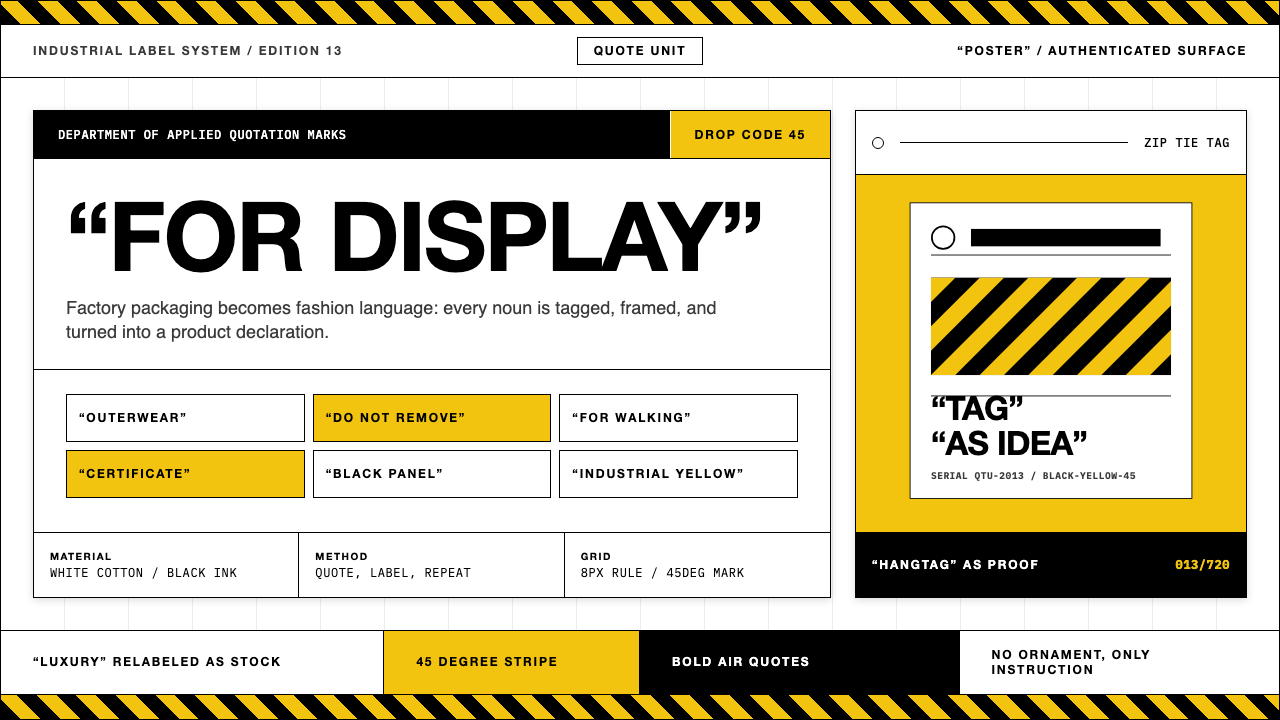 Off-White (Virgil Abloh era)Industrial irony, labeled. Yellow stripes and Helvetica quotes turn luxury in…
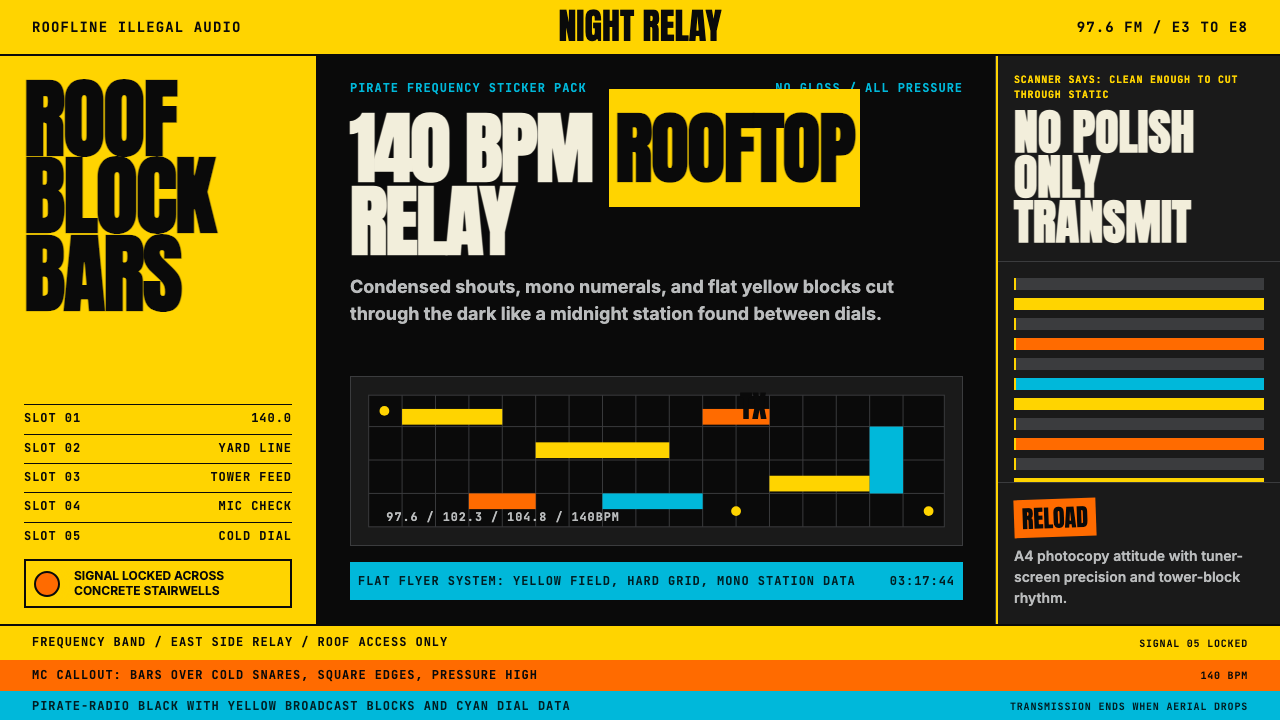 Grime London Pirate Radio (2003)Pirate signal, flat and urgent. Yellow blocks, mono FM numerals, hard flyer g…
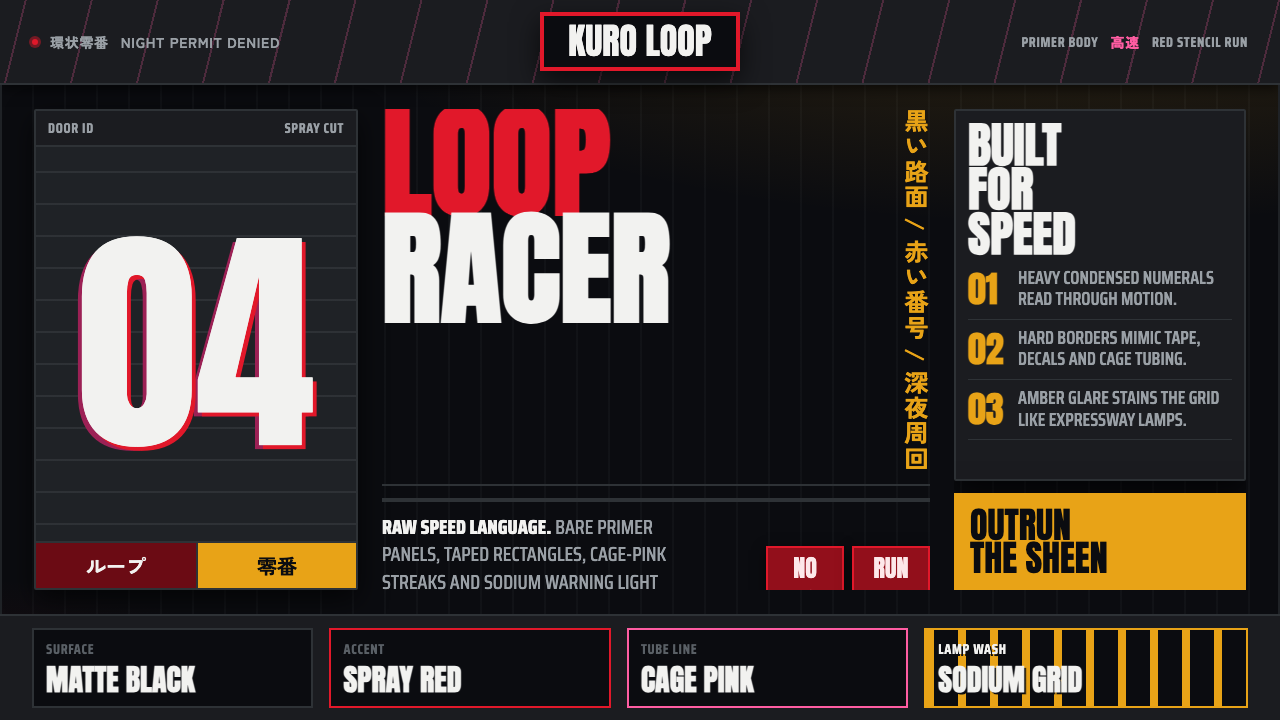 Kanjōzoku Loop RacerSpeed as contraband. Hot red numbers slice black tarmac with amber grid glare.
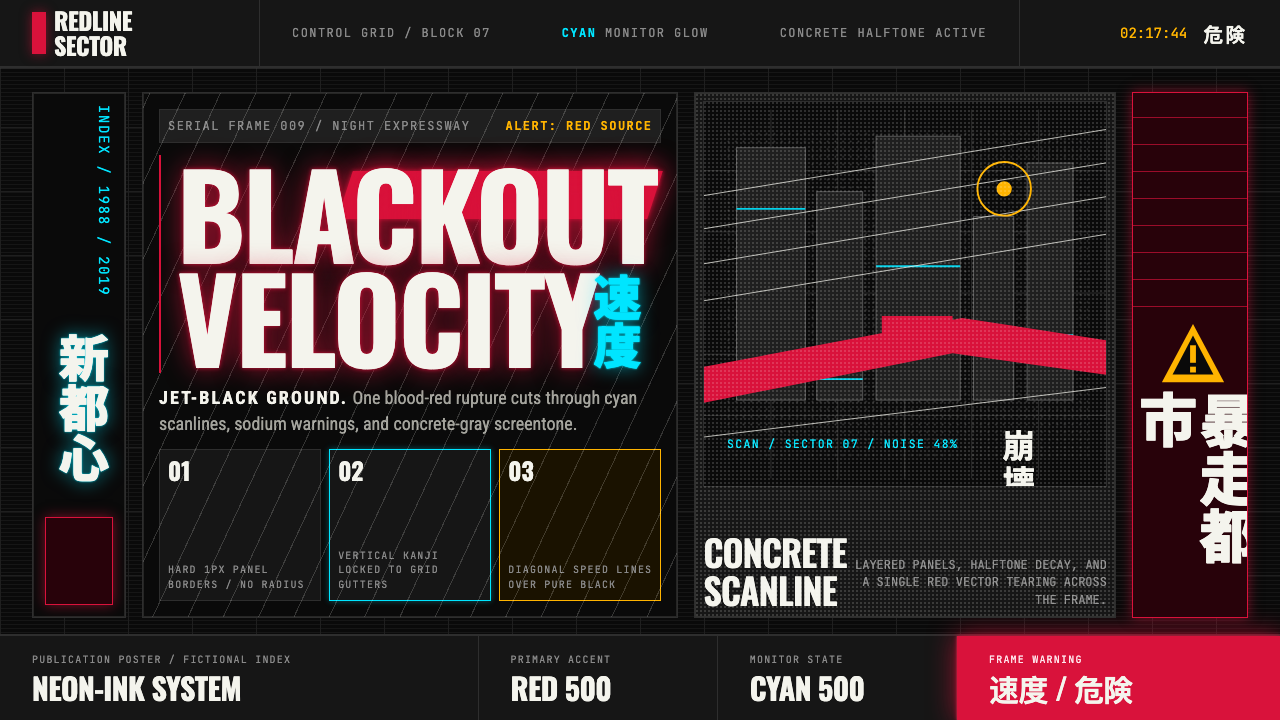 Akira (Otomo)Cyberpunk at impact. Kaneda red, cyan kanji, halftone concrete, and diagonal…
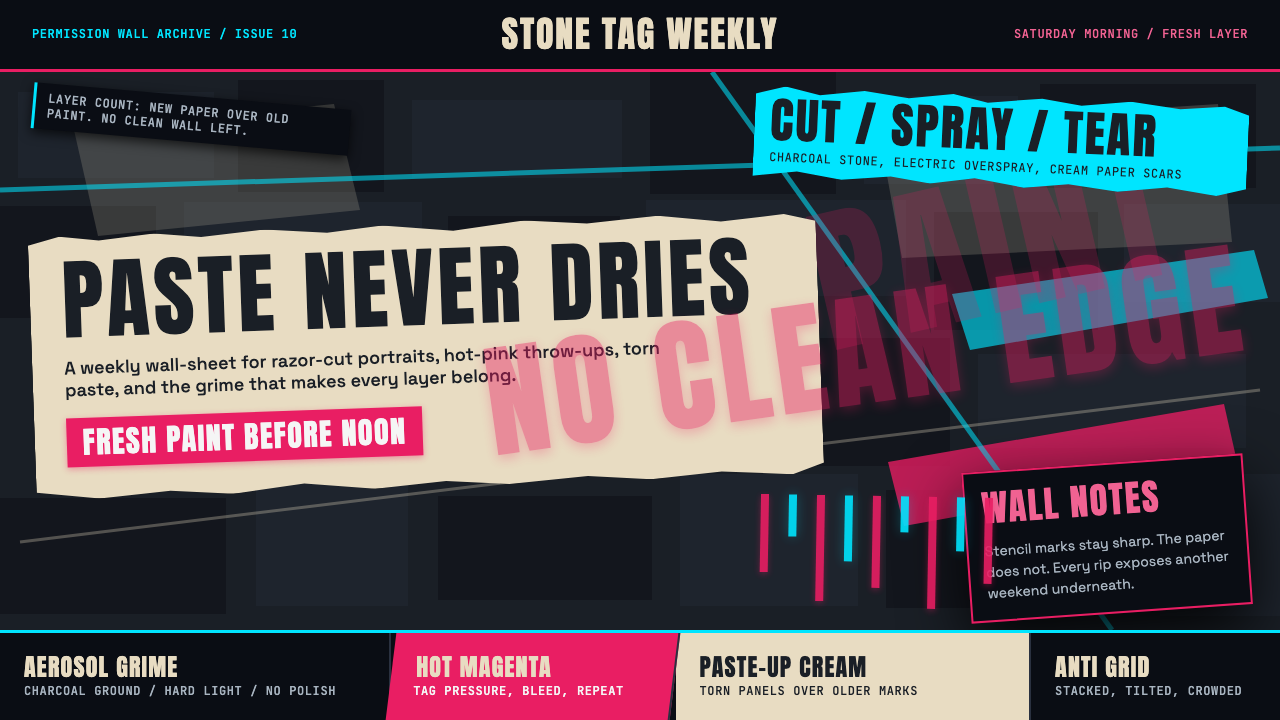 Melbourne Laneway Stencil (Hosier Lane)Permission-wall maximalism. Magenta tags slash charcoal bluestone and cream p…
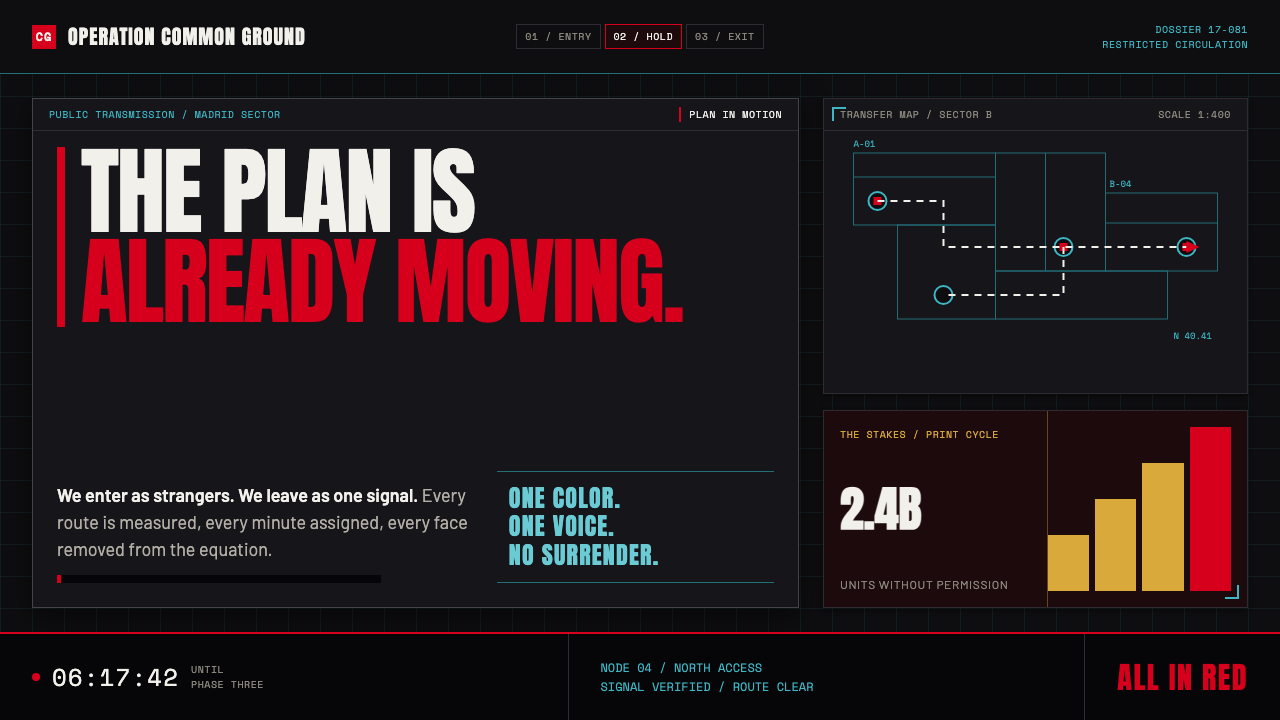 Money Heist (La Casa de Papel)Resistance becomes spectacle. Arterial red cuts through graphite grids and ta…