What is Melbourne Laneway Stencil (Hosier Lane)?
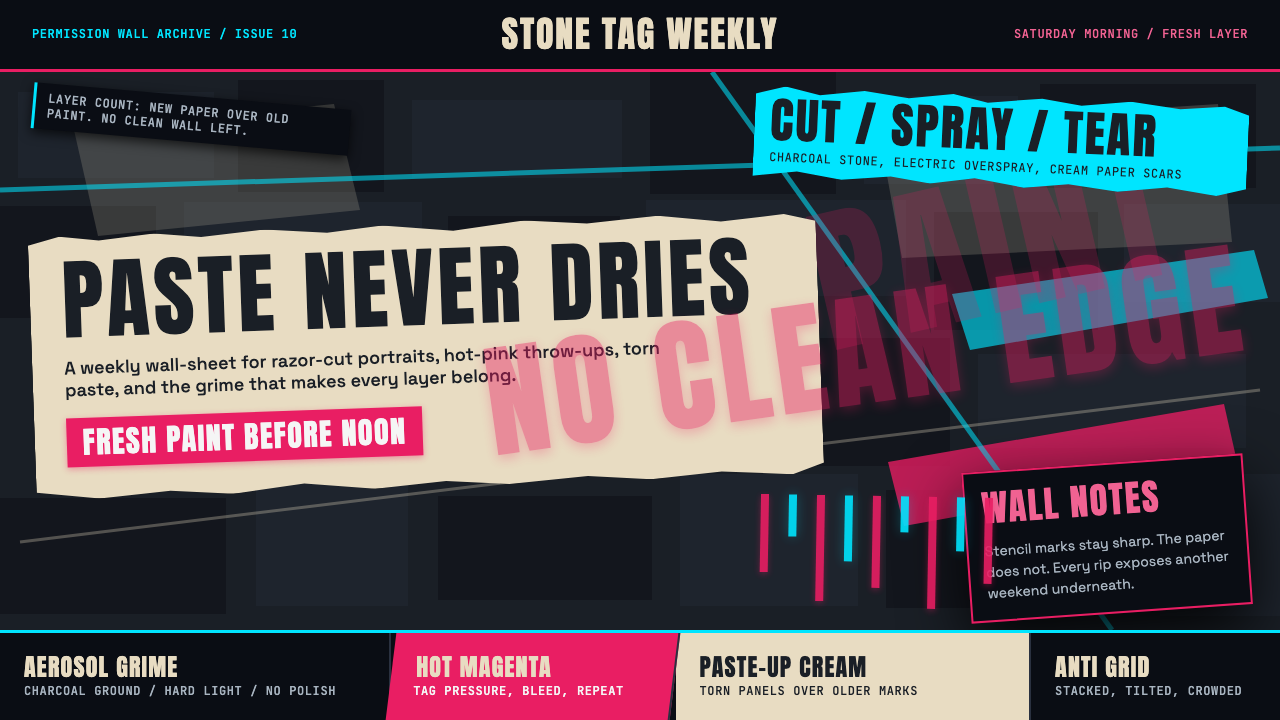
Melbourne's Hosier Lane is where urban stencil culture reached its most layered and legally permissioned peak — a bluestone alley where aerosol, paste-up, and muralism have piled upon themselves every weekend since the early 2000s.
Melbourne Laneway Stencil (Hosier Lane) in brief
Melbourne Laneway Stencil is a visual system born from the walls of Hosier Lane — the world's most densely painted city block, a permission-walled bluestone alley in the heart of Melbourne's CBD. The style is defined by stencil-poster maximalism: hard-edged aerosol portraiture, hot magenta throw-ups bleeding down weathered stone, torn paste-up posters peeling to reveal older layers beneath. Everything sits on a charcoal-dark ground that reads as the wall itself, the accumulated grime of a thousand Saturday-morning sessions soaked into the texture.
The design vocabulary draws from multiple street-art traditions compressed into a single surface. Stencil cutting — the technique of razor-blading precise negative shapes from card or acetate before spraying — gives the portraiture its hard graphic edge. Paste-up adds a collage layer: printed imagery wheat-pasted over raw stone, sometimes overlapping fresh aerosol work. Throw-up lettering, rendered fast and dripping with urgency, contributes the expressive chaos that prevents the whole from reading as curated. The visual tension between precision and accident is the style's defining quality.
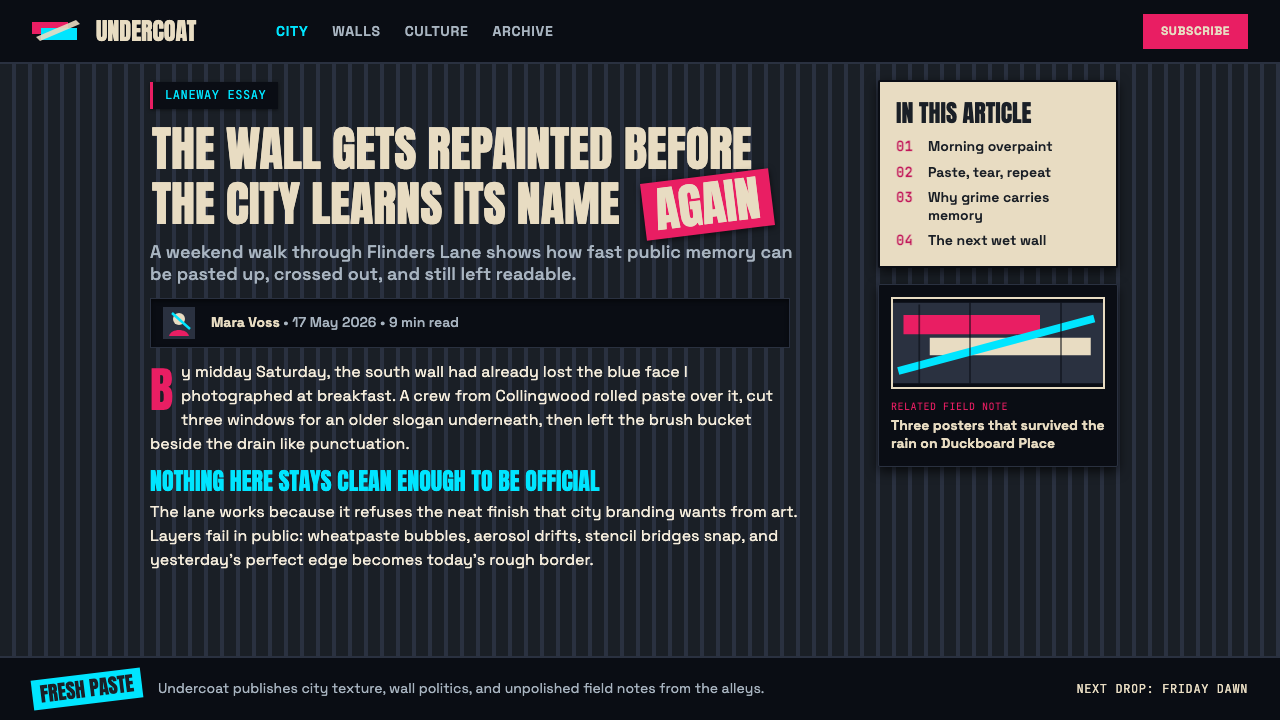
As a design system, Melbourne Laneway Stencil is unapologetically maximalist and dark-ground. Surfaces are never empty. Color is deliberately clashing: acid magenta, chrome yellow, and electric teal cut across deep charcoal and chalky cream — not for harmony, but for visibility and raw energy. The aesthetic assumes accumulation. It is the opposite of a whitespace-led design philosophy: every square centimetre carries intention, even if that intention is to look spontaneous.
See the Melbourne Laneway Stencil (Hosier Lane) design system
Where does Melbourne Laneway Stencil (Hosier Lane) come from?
Hosier Lane's transformation into a sanctioned street-art destination began gradually in the late 1990s, when the City of Melbourne adopted a policy allowing certain laneways to be painted freely without risk of prosecution. The policy was partly pragmatic — paint one alley and perhaps protect the rest — and partly a recognition that Melbourne's CBD laneway network had an irreplaceable urban character worth preserving. By the early 2000s, Hosier Lane had emerged as the focal point, its rough bluestone walls and cobblestone pavement offering an unusually textured canvas.
The cultural context was shaped by the global explosion of stencil art following Banksy's rise in the late 1990s and early 2000s. Banksy's technique of using precisely cut stencils to deploy political imagery quickly and anonymously in public spaces was widely adopted and adapted. Melbourne's scene, however, developed its own distinct character: more painterly in ambition, more willing to abandon anonymity, and increasingly collaborative rather than competitive. Artists working Hosier Lane often left space for others to work over or around their pieces, producing the layered archaeological effect the lane became famous for.
The period from roughly 2008 to 2018 is widely regarded as the peak era for Hosier Lane as a cultural phenomenon. Key figures in the Melbourne stencil scene achieved international recognition during this window. Adnate developed a signature style of large-scale photorealist portraiture — particularly of Indigenous Australian faces — rendered in careful stencil layers that achieved near-photographic depth on rough stone. Rone became known for elegant, melancholic female portraiture at large scale, often combined with typographic elements. Lushsux brought irreverent, meme-aware commentary that sat in deliberate tension with the lane's more earnest art-world aspirations. HAHA contributed a consistently political and text-driven practice that traced roots back to the lane's earliest period.
The 2010 period that gives this style its date reference marks a moment of particular visibility: international art press had begun covering Hosier Lane regularly, tourism to the lane was measurable and growing, and several artists whose careers began there were receiving gallery attention. The visual language that had accumulated by this point — the specific ratio of hard stencil to expressive spray, the palette dominated by magenta and charcoal, the torn-poster collage layering — had stabilized into something recognizable as a coherent aesthetic. This is the moment the style crystallizes: not its beginning, but its definition.
What defines the Melbourne Laneway Stencil (Hosier Lane) look?
Dark Ground
The foundational surface is always dark — raw charcoal stone, aged concrete, or a deep black painted base layer. This is not a stylistic choice so much as a material fact absorbed into the aesthetic: Hosier Lane's bluestone walls are naturally dark, and the accumulated layers of old paint and grime deepen that tone over time. Against a dark ground, every aerosol mark achieves maximum legibility. The darkness is treated as given, not as emptiness to fill.
Clashing Neon Palette
Color is deployed for maximum impact against the dark ground, not for harmony. Hot magenta, acid yellow, and electric cyan appear at high saturation and are allowed to clash deliberately. These are aerosol colors — colors chosen for visibility on a wall fifty metres away at sunrise, not for refinement at close range. Cream and chalky off-white appear in paste-up layers, introducing a third texture. The overall palette reads as both urgent and accumulated: layered, not orchestrated.
Stencil Hard Edge
The stencil technique produces edges of a particular quality: crisp where the card sits flush against the wall, slightly overspray-blurred where it lifts. This is not the clean hard edge of a vector graphic — it is a hard edge with memory of its making. The trace of the physical process (the overspray halo, the occasional paint bleed) is part of the visual vocabulary, not a defect to correct. Portraiture built in stencil layers achieves tonal depth without smooth gradients: dark, mid, light are separated decisions, each a pass of a different card.
Paste-Up Collage Layering
Paste-up — wheatpasting printed imagery onto walls — adds a collage dimension that distinguishes this style from purely spray-based street art. The torn edges of paste-up posters, peeling away from the stone to reveal older images beneath, create an archaeological cross-section effect. Paste-up imagery tends toward photographic rather than graphic: faces, body fragments, typographic elements printed at large scale. When combined with stencil and aerosol work, it introduces a tension between flatness (the printed surface) and physicality (the peeling, the shadows cast by lifted edges).
Intentional Accumulation
In conventional design, layering is either invisible (seamless) or controlled (deliberate arrangement). In the laneway aesthetic, layering is neither invisible nor fully controlled — it is intentionally accumulated. New work goes over old work with knowledge that both will be visible. This produces a palimpsest effect: no single composition fully dominates, and the passage of time becomes a visual element in its own right. Applied as a design system, this means embracing visible seams, overlapping elements, and imperfect registration as aesthetic features rather than errors.
Expressive Lettering
Lettering in this style ranges from highly controlled stencil text — tight, graphic, readable at distance — to expressive throw-up script that drips and bleeds with visible urgency. Both registers coexist on the same surface. Stencil lettering tends toward bold, condensed forms with minimal stroke variation; throw-up lettering allows maximum expressiveness, with thick swells and thin connections that emphasize speed of execution. The coexistence of these registers gives the style its characteristic tension between control and release.
Surface Texture as Participant
The rough, porous surface of bluestone is not background — it is an active element in the image. Paint soaks differently into mortar than into stone, creating uneven saturation. Rough patches catch spray unevenly, producing natural dithering effects. Moss, water staining, and weathering add tonal complexity that no flat surface could replicate. The design system assumes a textured ground; applied digitally, it typically introduces artificial noise, grain, or distress textures to compensate for the absence of the real thing.
See the Melbourne Laneway Stencil (Hosier Lane) design system
Who shaped Melbourne Laneway Stencil (Hosier Lane)?
Adnate is among the most technically accomplished stencil portraitists to have worked Hosier Lane, known for large-scale, photorealist faces — particularly of Indigenous Australian elders — rendered through careful multi-layer stencil work that achieves extraordinary tonal range on raw stone. His practice expanded the visual ambition of the Melbourne stencil scene, demonstrating that the medium was capable of subtlety and emotional weight, not just graphic impact. His Hosier Lane works became among the most photographed in the lane's history.
Rone's large-scale female portraiture — melancholic, elegant, rendered in a palette that bridges photorealist subtlety and graphic impact — became one of the defining visual signatures of Hosier Lane's peak era. His figures, often at building scale, combined stencil precision with freehand spray in ways that blurred the boundary between street art and fine art practice. Later in his career, Rone shifted toward large-scale interior installation work, applying the same layered, time-sensitive aesthetic to abandoned architectural spaces.
Lushsux brought deliberate irreverence and internet-meme sensibility to Hosier Lane, creating works that sat in direct tension with the lane's more earnest artistic aspirations. His works — often featuring celebrities, political figures, or pop-cultural imagery rendered in a style that deliberately undercuts any expectation of high seriousness — generated significant controversy and, in doing so, drew additional international attention to the lane. His practice exemplifies the tension between street art's populist roots and its art-world co-option.
HAHA is among the earliest sustained presences in Melbourne's stencil scene, with a practice rooted in political commentary and text-image combination. Tracing roots back to the 1990s Melbourne scene predating international stencil art's mainstreaming, HAHA's work provided a continuity thread connecting Hosier Lane's earliest period to its peak-era visibility. The practice is consistently politically engaged, using stencil as a tool for public speech rather than aesthetic expression alone.
The City of Melbourne's decision to designate certain laneways as permissioned art spaces — Hosier Lane foremost among them — was a determining factor in shaping the visual culture the style captures. Without the legal protection from prosecution, the sustained collaborative accumulation that defines the aesthetic would have been impossible; artists would have had to work faster and more evasively, and the layered archaeological quality would never have developed. The policy represents an unusual instance of urban governance actively enabling a grassroots aesthetic culture rather than suppressing it.
How do you use Melbourne Laneway Stencil (Hosier Lane) today?
Melbourne Laneway Stencil is a high-impact dark-ground aesthetic that carries strong urban, counterculture, and creative-industry associations. Applying it well requires committing to its foundational logic: dark surfaces, layered rather than clean composition, clashing neon accents, and visible traces of making. It does not translate gracefully to light or neutral grounds — a white background strips the style of its essential character. The first design decision when using this style should be establishing the dark ground.
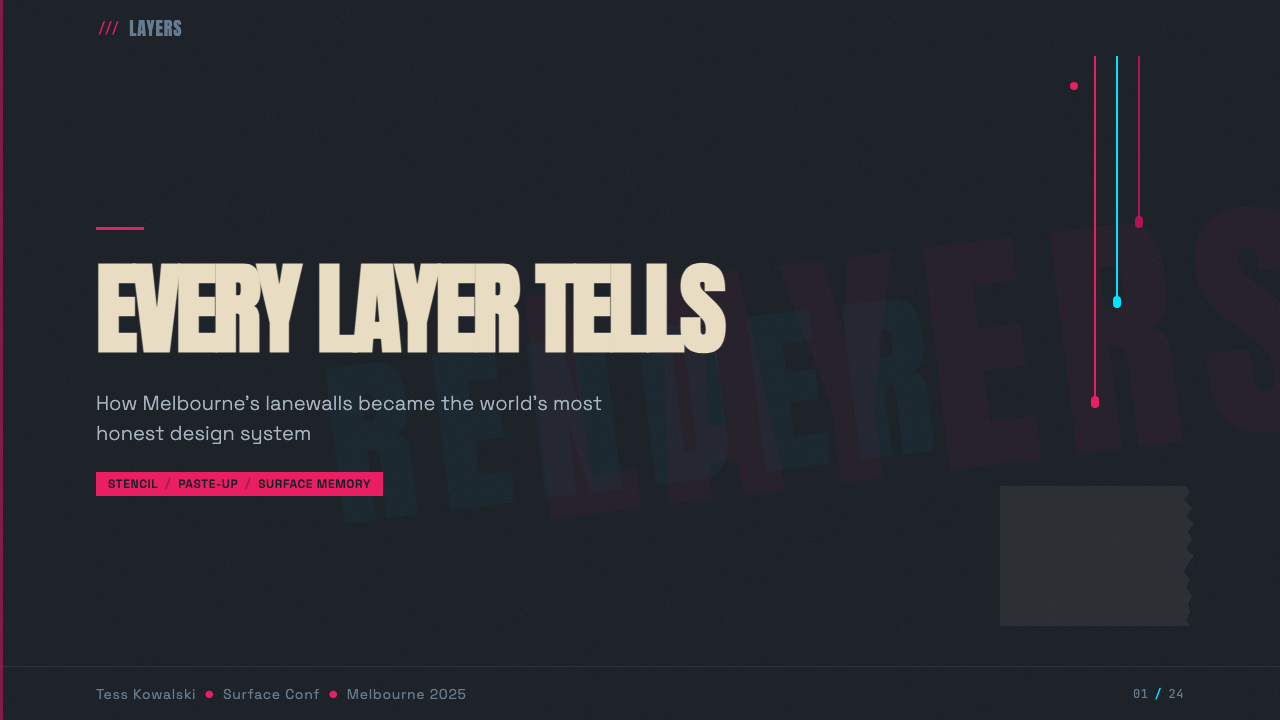
For presentation slides, the style is best suited to covers and section dividers where atmosphere outweighs information density. A cover built on a deep charcoal or near-black ground, with large stencil-style type in a clashing accent color and a paste-up texture layer in the background, establishes the mood immediately. Content slides should be used sparingly in this style — the maximalism works against dense information display. Where data appears, treat charts as graphic objects: thick bars, flat fills in neon accent colors, no soft shadows. The overall deck works best when used selectively, rather than applying the aesthetic uniformly to every slide.
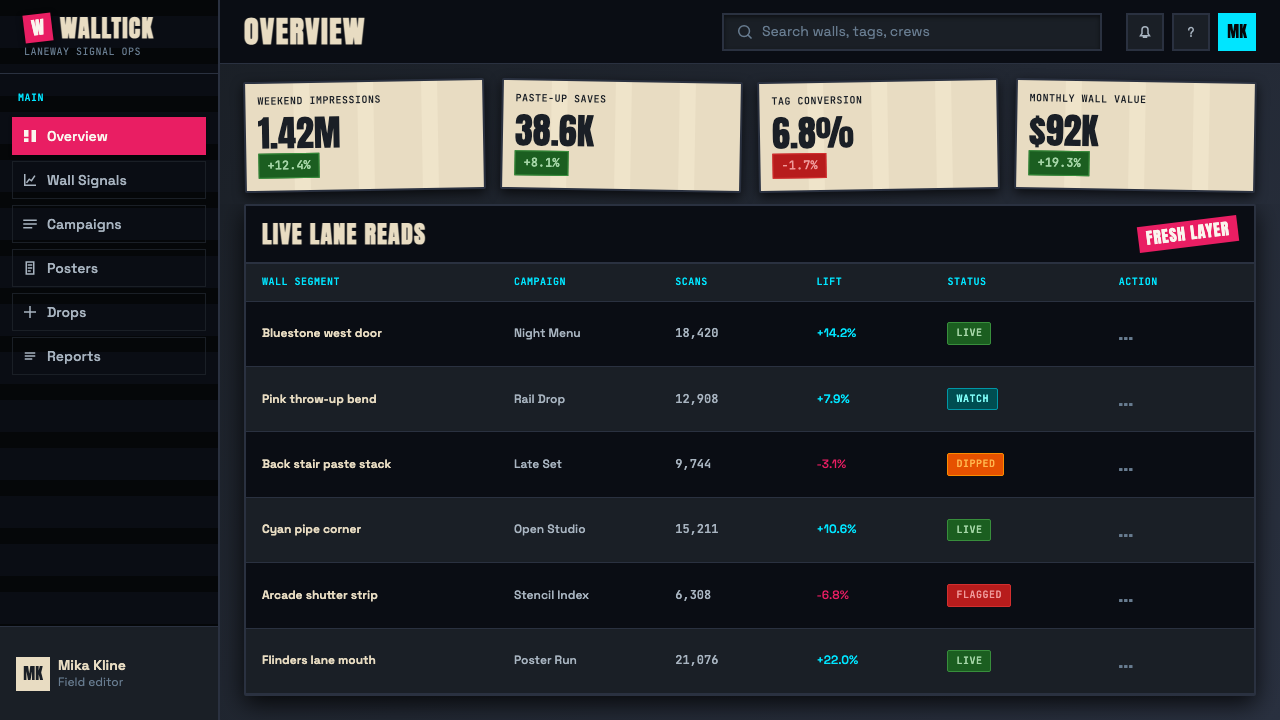
For web interfaces, this style is well-suited to landing pages and marketing pages for creative agencies, music or festival brands, youth culture platforms, or any context where grit and energy are desirable signals. It is less suited to dashboards or data-heavy interfaces where legibility at small sizes is critical. A web implementation might use a textured dark background (subtle noise or grain applied as an overlay), neon accent colors for calls to action and hover states, and stencil-style or condensed bold display type for headlines. Image treatments should include grain or subtle desaturation to integrate photography with the graphic style.
For editorial and marketing work, the style shines in contexts that can support full visual commitment: festival posters, album artwork, brand identity for underground or independent creative ventures, zine design, and urban-culture editorial spreads. The approach: lead with a dark ground, use one dominant neon as the accent, treat typography as a graphic element of equal weight to imagery, and embrace imperfect alignment and visible layering rather than fighting it. The style's legitimacy depends on its rawness — overly refined execution loses the essential quality.
A common mistake when applying this style is treating it as dark theming with some spray-paint texture added. The true system is fundamentally compositional: it is about layering, accumulation, and the coexistence of multiple graphic registers (precise stencil, expressive lettering, flat paste-up, raw surface). Applying a dark background and a single neon accent without the layering complexity produces something that looks more like generic dark UI than laneway art. The style requires commitment to visible depth — elements that overlap, bleed, and show the traces of how they were placed.
See the Melbourne Laneway Stencil (Hosier Lane) design system
Melbourne Laneway Stencil (Hosier Lane) — FAQ
Is Melbourne Laneway Stencil the same as general graffiti or street art?
No — Melbourne Laneway Stencil refers specifically to the aesthetic that developed in Hosier Lane and a handful of other Melbourne laneways under the City of Melbourne's permissioned art policy. General graffiti encompasses a far broader global visual tradition, from wildstyle lettering to tagging to bombing. What distinguishes the Melbourne laneway aesthetic is its permissioned, collaborative, accumulative character, and its particular combination of stencil-cut portraiture, paste-up collage, and aerosol maximalism on bluestone. It is a localized, historically specific crystallization of street-art culture, not a synonym for the broader form.
Can this style work for corporate or professional contexts?
With care, and only for certain types of organizations. The style carries strong counterculture and urban-creative associations that are genuinely suited to creative agencies, music brands, festival identities, architecture firms with urban design practices, and similar contexts. For conventional corporate use — financial services, enterprise software, healthcare — the rawness and grit typically work against professional authority signals. The style is best deployed when an organization genuinely wants to signal creative independence, cultural credibility, or urban relevance, not as a superficial attempt to appear edgy.
How do you apply the layered look without it looking like a mess?
The key is to establish a clear hierarchy within the layering: one element must dominate, and everything else must either recede or act as texture. In Hosier Lane itself, hierarchy emerges naturally — the freshest, most intact work reads as foreground; older, more weathered or partially covered work recedes. In a designed application, this hierarchy must be intentional. Use opacity variation and contrast control to push background elements back. Ensure the primary message — a headline, a face, a call to action — reads clearly even before the viewer processes the layered context. The layering should enrich the experience of the primary element, not compete with it for attention.
What kinds of typography work best in this style?
Two registers work best, used together or independently. First, bold condensed display type — heavy, tight, readable at distance — echoes the stencil lettering tradition and works well for headlines and callouts on dark grounds. Second, expressive display scripts or distressed brush-lettered forms echo the throw-up and tag tradition, working well for secondary typographic elements where expression matters more than legibility. Both registers benefit from being set large; the style does not reward small, refined type. Body text, if required, should be kept minimal and clearly separated from the expressive display elements rather than integrated into the layering.
Does the style have to be dark? Can it work on light grounds?
The dark ground is structurally important to the style, not merely conventional. It is what makes the neon and high-saturation accents legible and impactful; the same colors on white would look garish rather than energetic. A light-ground version of this style tends to lose both the atmosphere and the color logic simultaneously, ending up resembling generic urban illustration rather than the specific laneway aesthetic. If a light background is essential for a given context, it is usually more successful to borrow isolated elements from the style — stencil-style portraiture, condensed bold type, rough texture — rather than attempting to transpose the full system.
Related design styles
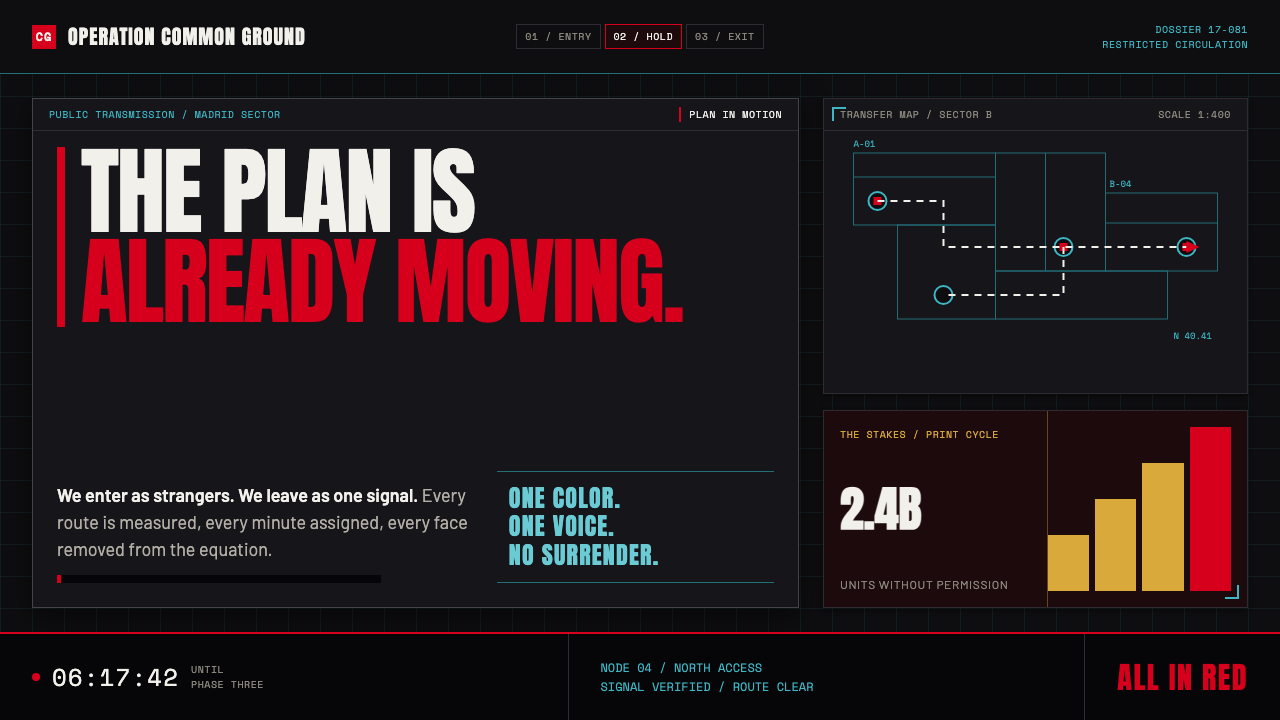 Money Heist (La Casa de Papel)Resistance becomes spectacle. Arterial red cuts through graphite grids and ta…
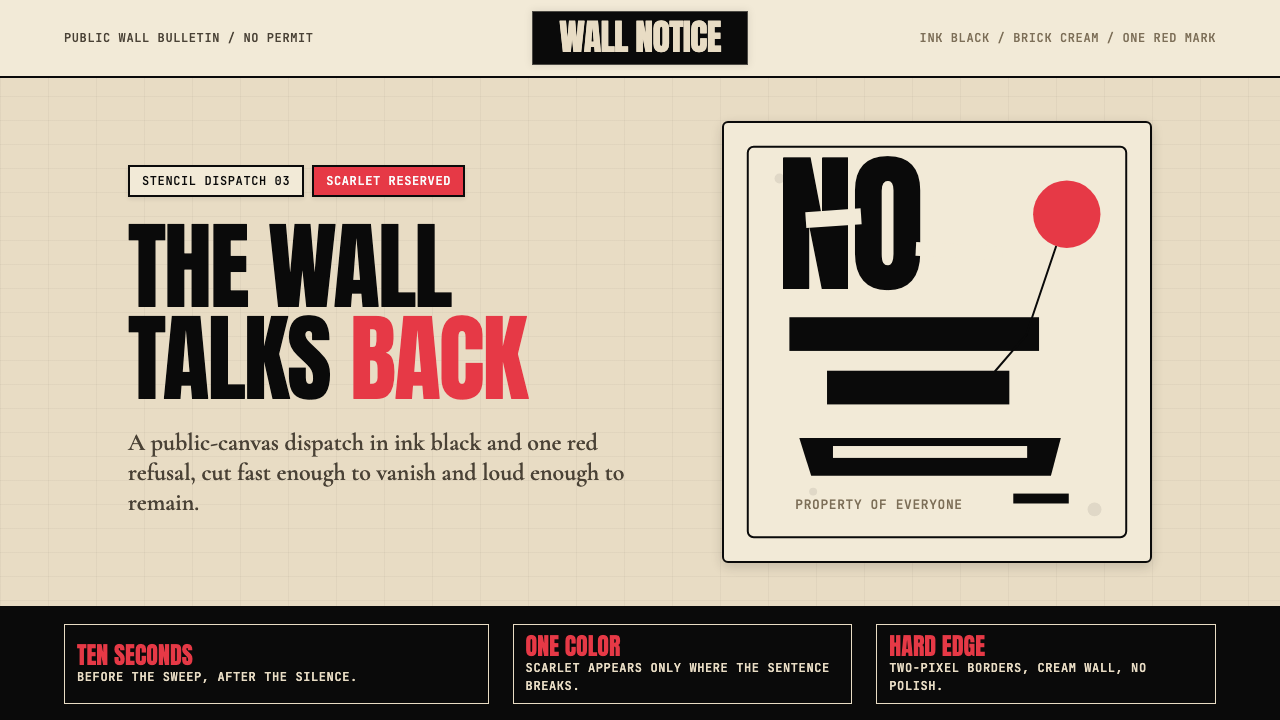 Banksy Stencil GraffitiProtest is reduced to a cut mark. Anton black on brick cream, one scarlet red…
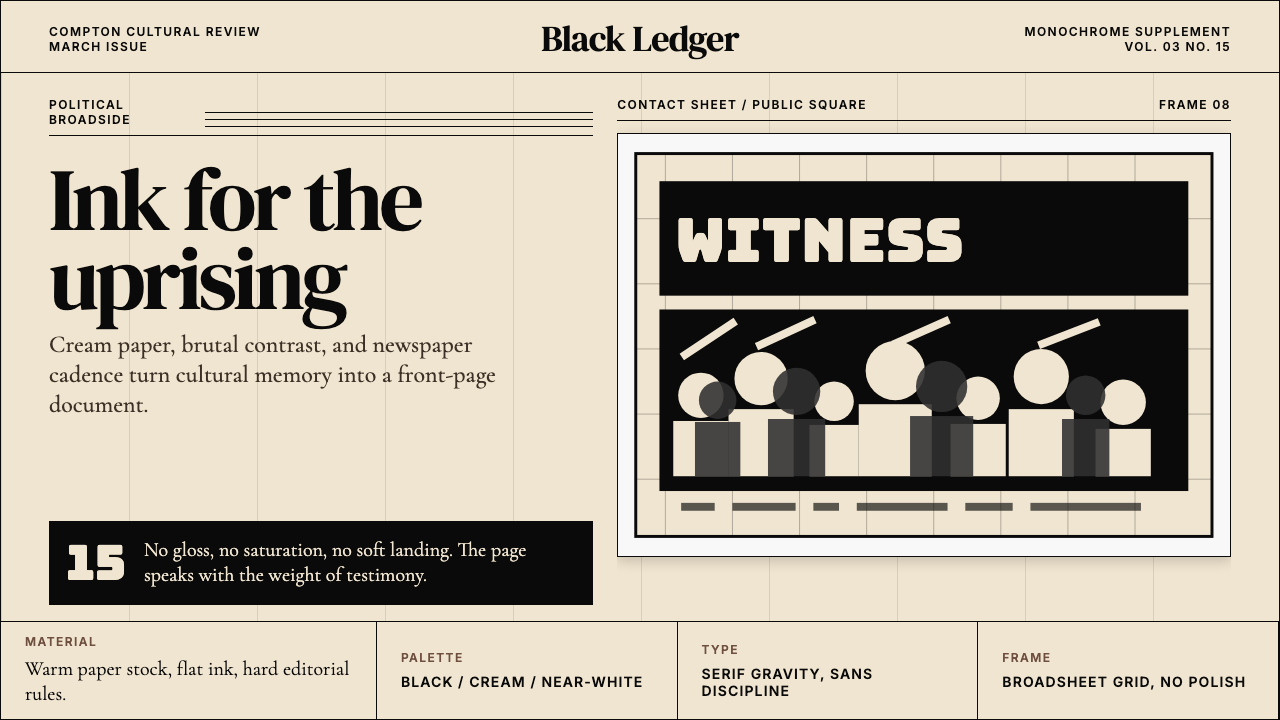 Kendrick — To Pimp a ButterflyPolitical weight, printed cold. Cream paper, hard serif type, monochrome crow…
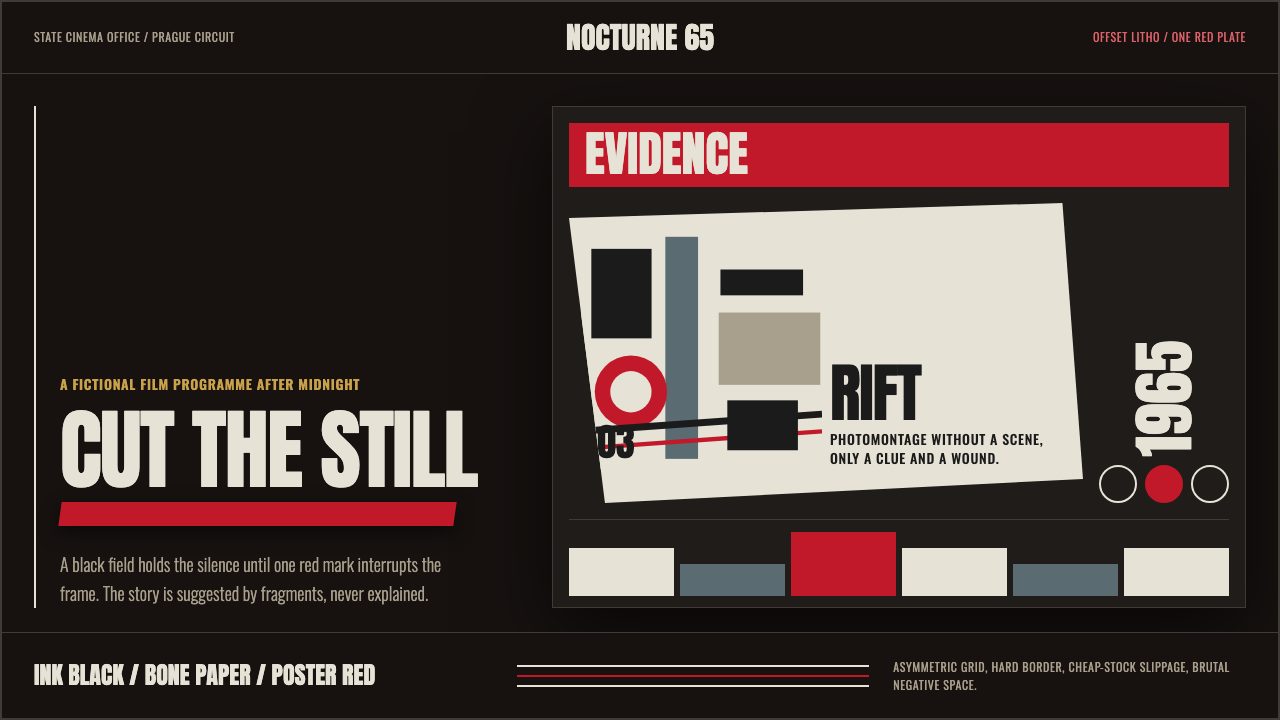 Czech New Wave PosterConcept before spectacle. Ink black, bone type and one poster-red incision fr…
 Daido Moriyama Are-Bure-BokeNothing is clean. Inky black, blown white grain, and tilted frames make the i…
 Tasmanian MONA Museum (2011)Hostile luxury underground. Pitch black, sandstone hairlines, magenta editori…