What is Grime London Pirate Radio (2003)?
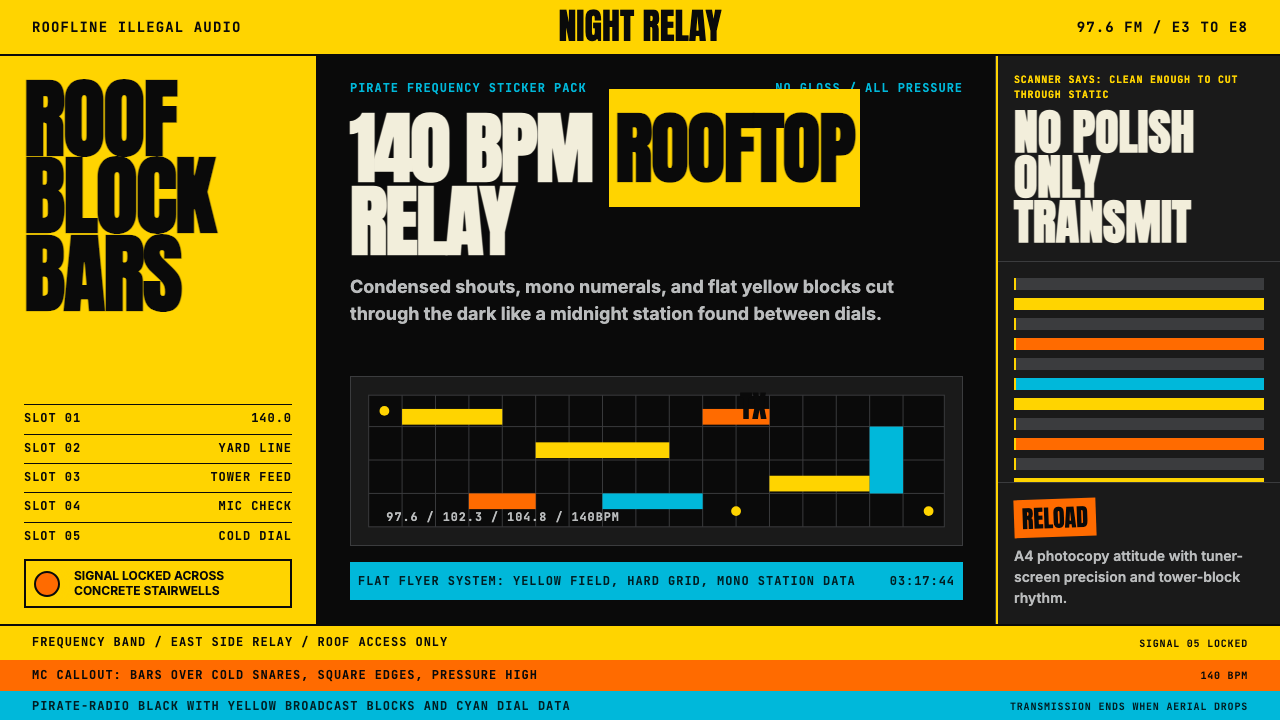
From East London rooftops to album sleeves, Grime's visual language turns pirate-radio urgency into a design system built on saturated yellow, compressed type, and the unapologetic flatness of a photocopied flyer.
Grime London Pirate Radio (2003) in brief
Grime London Pirate Radio (2003) is a visual design style rooted in the music and street culture that erupted from East London's council estates in the early 2000s. It draws its aesthetic vocabulary from four overlapping sources: the frequency stickers and handwritten schedules of illegal FM pirate stations; the photocopied A4 rave flyers distributed in Hackney and Bow; the monochrome LCD readouts of Roland drum machines and early digital audio workstations; and the album artwork that crystallised the movement for a wider audience, most famously Dizzee Rascal's debut sleeve.
The resulting visual language is deliberately raw and confrontational. It operates through maximum contrast — a single saturated colour, almost always a punishing yellow or electric green, detonating against near-total black. Typography is condensed, uppercase, and set at extreme scale differentials: the headline screams while secondary information is compressed into dense blocks of monospace text that recalls FM frequency readouts and equipment specifications. Nothing is polished. Nothing aspires to finish. The aesthetic celebrates the lo-fi broadcast condition itself as a form of authenticity.
Unlike many historical styles that soften over time into decorative nostalgia, Grime's visual logic remains structurally coherent and practically applicable. Its principles — signal strength over refinement, flat colour over photographic texture, compressed information over editorial breathing room — translate cleanly into contemporary screen contexts, particularly where urgency, directness, and subcultural credibility are the intended message.
Where does Grime London Pirate Radio (2003) come from?
Grime as a music genre emerged from the collision of UK garage, dancehall, and the faster, more abrasive sounds coming from US hip-hop and drum and bass. In 2002 and 2003, a generation of MCs in East London — centred on Bow E3, Hackney E8, and the surrounding Tower Hamlets boroughs — were writing over beats running at around 140 beats per minute, a tempo deliberately faster and more aggressive than the 130bpm swing of UK garage. The beats were produced on cheap software, often FruityLoops (now FL Studio), running on budget desktop computers in council flat bedrooms. The output was broadcast on pirate FM stations operating from rooftop aerials, reaching listeners across East London without any commercial infrastructure.
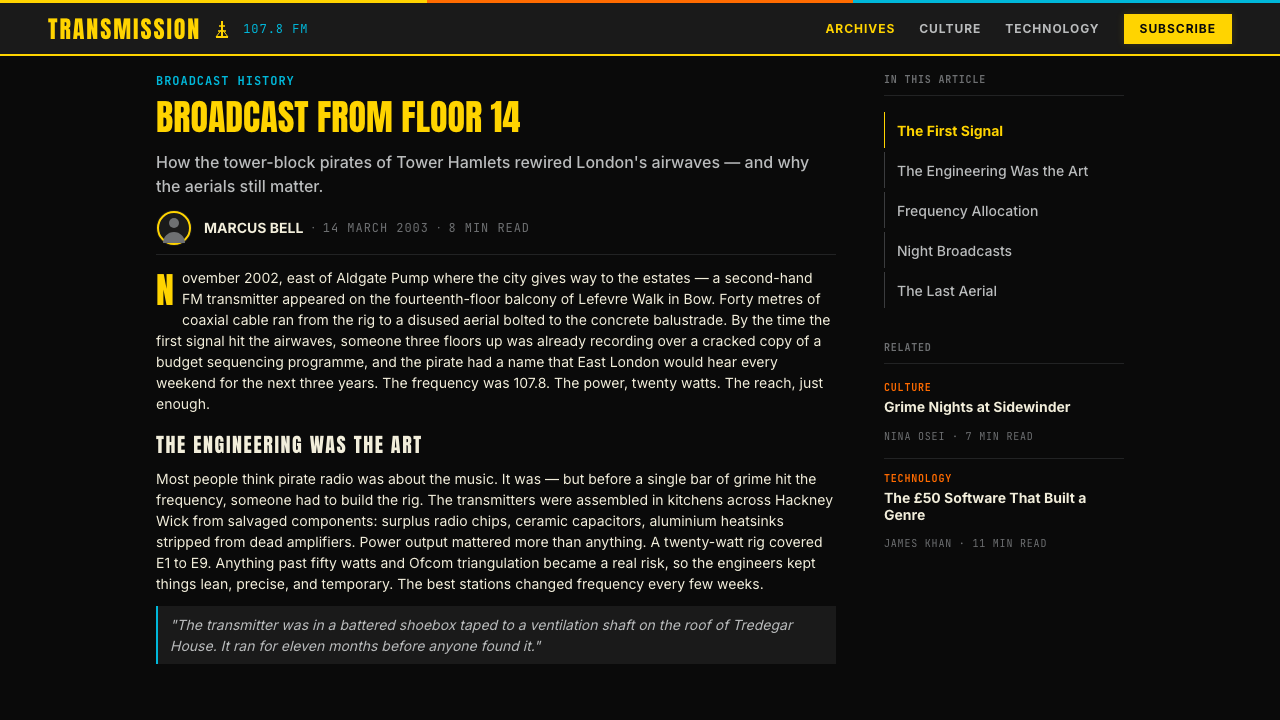
The visual identity of early Grime was shaped by scarcity and urgency. Pirate radio stations needed call-sign art, frequency identifiers, and schedule cards — all produced cheaply, often on domestic inkjet printers or photocopiers. The flyer culture inherited from rave and jungle music pushed designers toward maximum legibility at small size: a single bold colour, a station name in the largest possible type, a frequency in monospace numerals so listeners could dial in. This forced economy of means — one colour, one typeface, one central piece of information — became the aesthetic core of the style.
The movement's visual crystallisation arrived with the release of Dizzee Rascal's debut album, Boy in da Corner, in 2003, which won the Mercury Prize that same year and brought Grime national attention. Tom Hingston Studio designed the sleeve: a hooded figure photographed dead-on by Dean Chalkley against a field of pure, saturated yellow. The design made explicit what pirate flyer culture had been doing implicitly — colour as signal, the face as direct address, no background narrative, no environmental context, just the subject isolated against a single blazing tone. The album's commercial and critical success embedded this visual grammar in the collective memory of British design.
A second wave of cultural visibility came between 2015 and 2017, as artists including Skepta, Stormzy, and AJ Tracey achieved mainstream chart success and major brand partnerships. This revival brought Grime aesthetics into contact with high-budget creative production, and designers began applying the style's principles — the saturated colour field, the monospace numeral, the compressed condensed headline — with greater intentionality and wider application. The pirate-radio vernacular, once born of necessity, was now a recognisable and deliberate visual register.
What defines the Grime London Pirate Radio (2003) look?
Signal Colour
The palette is built around one dominant high-intensity colour deployed against deep black. Dizzee yellow — a near-fluorescent warm yellow — is the archetype, but electric green and urgent red occupy the same structural role in different executions. The key is monochromaticism: one accent, one background, with no secondary colours diluting the impact. The chosen colour functions less as decoration than as a broadcast signal — it is meant to stop the eye the way a pirate station's frequency burst stops the radio dial.
Condensed Uppercase Typography
Headlines are set in condensed or extra-condensed sans-serif letterforms, always uppercase, always at extreme scale. The compression allows more words per line at a larger point size — a legacy of flyer design where the station name needed to fill the page at maximum visual impact. Secondary text shifts register entirely: dense monospace type in a smaller weight recalls equipment readouts and printed schedules, creating a stark scale contrast that organises the composition without requiring colour differentiation.
Monospace Numerals
Monospace type carries specific cultural weight in this system. FM frequency numbers — 88.1, 96.4, 106.8 — were the primary identifying information on pirate station materials, and their fixed-width rendering in dot-matrix or LCD-style typefaces became inseparable from the aesthetic. In contemporary applications, monospace numerals signal data, technicality, and authenticity simultaneously. They appear in track listings, timestamps, stat displays, and anywhere numerical information needs to feel archival and unadorned rather than designed.
Flat Photographic Treatment
When photography appears in Grime-inflected design, it is treated as a flat element rather than a window into space. The approach favours dead-on frontal shots against monochrome grounds, high-contrast duotone reductions, or heavy crops that reduce a subject to silhouette. The Boy in da Corner sleeve established the template: a human figure as a flat shape against a colour field, no depth cue, no environmental light, just form against tone. This flatness allies photography with the graphic elements around it rather than creating a hierarchy between photographic realism and flat design.
Grid Rigidity
Layouts are structured around hard vertical columns and horizontal baselines that echo the grid-like information architecture of pirate-station schedules and equipment rack panels. Elements align to implicit or explicit column divisions; nothing floats freely. This rigidity is not minimalist refinement — it is the grid of necessity, the visual logic of a photocopier's A4 sheet divided into maximum-information zones. The resulting layouts feel dense and intentional, with every square unit accounted for.
Texture Through Lo-Fi Means
Where texture appears, it references analogue broadcast degradation rather than natural materials. Scan lines, dot-matrix grain, halftone patterns from cheap photocopying, and the visual noise of a poorly received FM signal are all legitimate textural elements. These are not applied decoratively as a retro aesthetic exercise — they evoke the specific material conditions of production: a signal transmitted from a rooftop aerial, a flyer pulled through a photocopier at maximum contrast. The texture carries documentary weight.
No-Polish Directness
The defining negative principle of the style is the deliberate refusal of finish. Drop shadows are absent or hard-edged. Gradients do not appear. Colours do not blend. Type is not kerned to refinement. The roughness is not accidental — it is ideological. Pirate radio culture operated outside the sanctioned channels of the music industry, and its visual identity needed to signal that outsider status. Polish and production value were markers of commercial compromise; rawness was authenticity. Contemporary applications of the style inherit this principle whether or not they intend its original political charge.
Who shaped Grime London Pirate Radio (2003)?
Born Dylan Kwabena Mills in Bow, East London, Dizzee Rascal was seventeen when he completed Boy in da Corner, the album whose Mercury Prize win in 2003 brought Grime to national consciousness. As the style's most visible early figure, his visual presentation — the hooded standoff of the debut sleeve, the council-estate setting of early music videos — established the iconographic template that defined Grime's aesthetic for designers and audiences alike. His subsequent commercial success meant that the style's visual grammar was exposed to mainstream design culture without being diluted by it.
Richard Cowie, known as Wiley, is widely credited as the founding architect of Grime as a musical form, developing the eski beat sound from which the genre grew. As a prolific early presence on pirate stations including Rinse FM and Deja Vu FM, Wiley shaped the broadcast culture from which Grime's visual language emerged. His influence operated more at the infrastructural level — building the scene's network and vocabulary — than through any single iconic visual artefact, making him the genre's unseen structural force.
Tom Hingston Studio designed the artwork for Boy in da Corner, creating the image that fixed Grime's visual identity in cultural memory. Hingston had previously worked with Nick Cave, Massive Attack, and Robbie Williams, and brought a graphic design rigour to Grime's raw materials — the saturated field, the frontal figure, the absence of environmental context — that transformed an emergent street aesthetic into a codified visual system. The sleeve remains one of the most reproduced and referenced pieces of British graphic design of the 2000s.
The photographer whose lens captured the Boy in da Corner cover image, Dean Chalkley developed a documentary approach to Grime's early scene, photographing MCs and soundsystems in the environments — stairwells, rooftops, high-street corners — that defined the culture's geography. His work established the photographic grammar of Grime portraiture: frontal address, harsh available light, no styling artifice, the subject as directly present as a pirate station's FM signal. His documentary archive of early Grime remains a primary visual record of the scene.
Joseph Junior Adenuga Jr., known as Skepta, was central to Grime's commercial and critical revival between 2015 and 2017. His Mercury Prize-winning album Konnichiwa (2016) and collaborations with brands including Nike and Moncler brought Grime's visual vocabulary into high-production commercial contexts. Skepta's own visual direction — sparse monochrome, compressed type, Japanese and Nigerian references — demonstrated that Grime's aesthetic principles could absorb outside influences while retaining their structural logic, expanding the style's range without dissolving its identity.
How do you use Grime London Pirate Radio (2003) today?
Grime's visual language is highly transferable to contemporary screen design when its structural logic — not just its surface textures — is understood. The style excels in contexts where the communication needs to feel urgent, unmediated, and subcultural: music and entertainment platforms, streetwear and sneaker brands, youth-facing event promotion, limited-edition product drops, and any digital surface where the brand's credibility depends on feeling genuinely connected to grassroots culture rather than manufactured to simulate it.
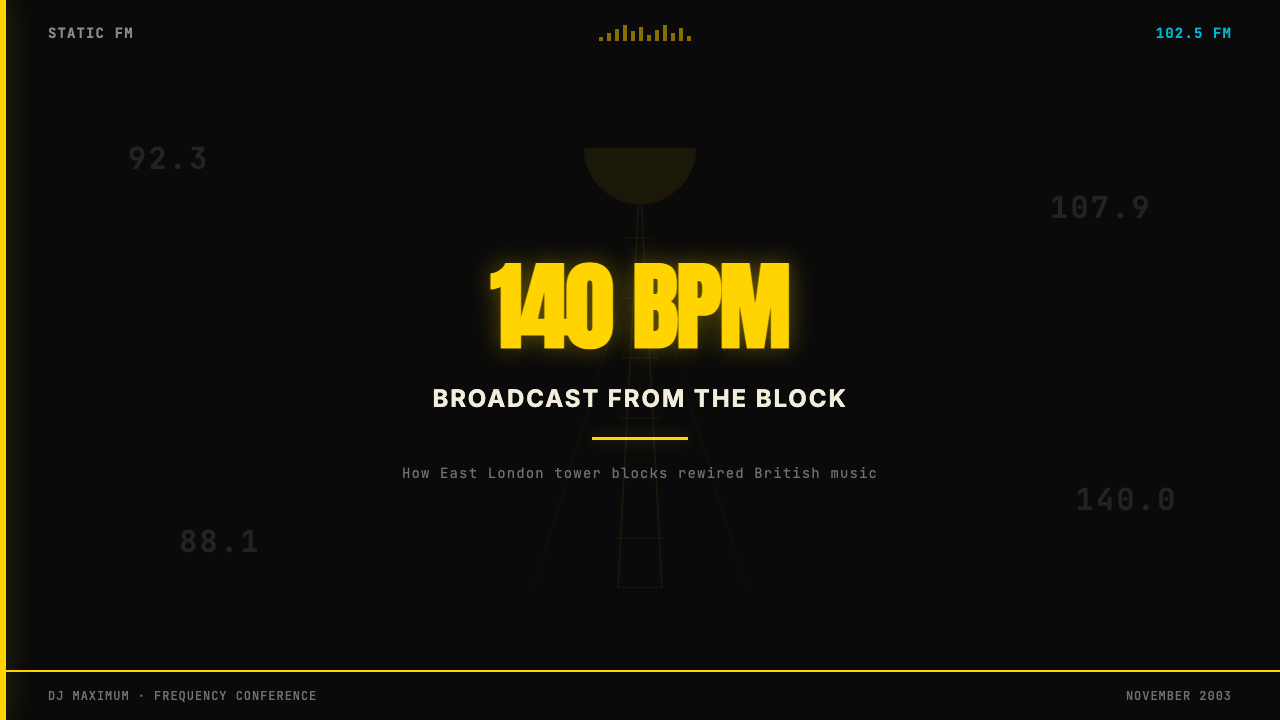
For presentation slides, Grime works most powerfully on cover and section-break pages. A cover built in this style uses a single saturated colour to claim the entire background, with the title set in condensed uppercase at maximum scale — no tagline, no decorative frame, no environmental image. The name alone, the colour alone. Section breaks follow the same logic: one stark accent colour, one headline, nothing else. Content slides should abandon the style's rawness in favour of legibility — use the monospace numeral motif for data points and statistics, the tight column grid for text, but allow adequate contrast and spacing for reading comprehension.
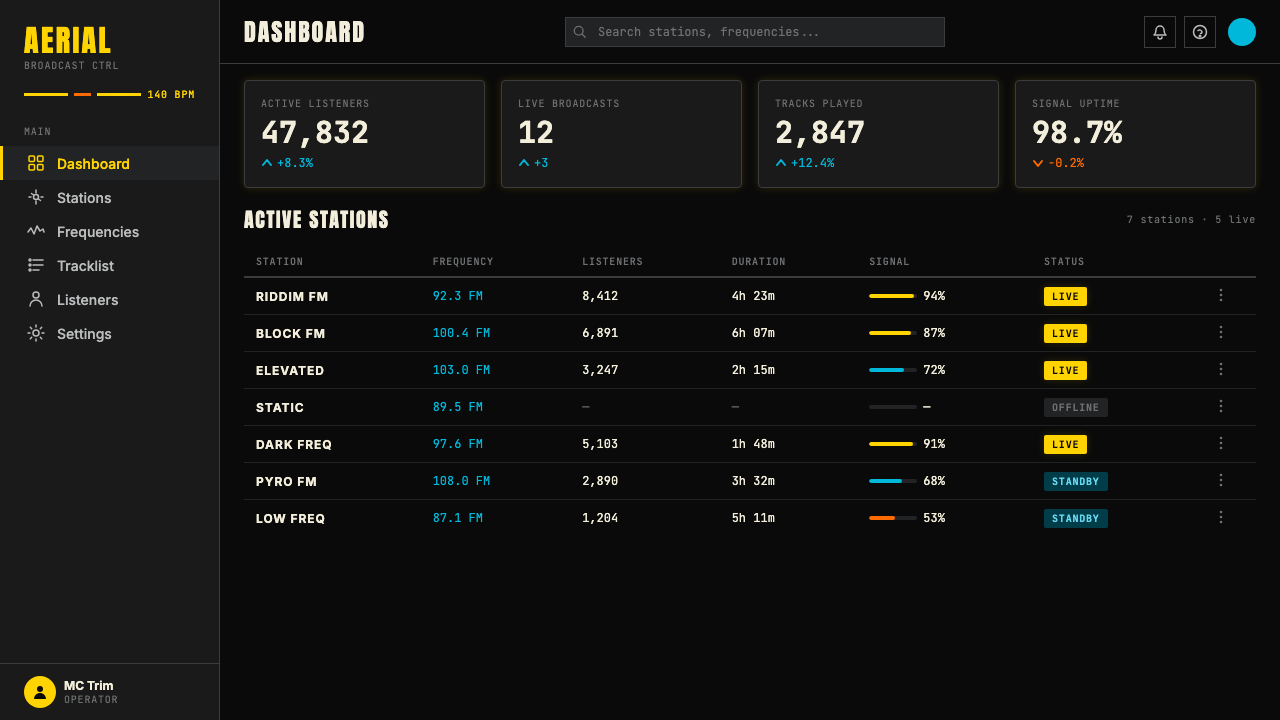
For web interfaces and dashboards, Grime principles work best in hero sections, loading states, and notification components where high-contrast immediacy is the goal. A dark background with a single high-intensity accent colour — used for active states, alerts, and primary calls to action — captures the aesthetic's energy without making an entire interface hostile to extended use. Navigation and data display should be typographically disciplined: condensed labels, monospace counters, strict alignment. Avoid applying the style to form fields, body text, or any component requiring sustained reading.
For editorial and marketing applications, the style's poster-logic translates directly to full-bleed section headers, campaign key visuals, and social media content where a single frame needs to arrest attention in a high-velocity feed. The approach: one colour field, one subject, one headline — no layering, no supporting imagery, no softening elements. Marketing copy should match the visual register: direct, imperative, single-sentence statements. The style struggles with long-form editorial content, nuanced brand storytelling, or any context requiring warmth, approachability, or visual hospitality.
A common mistake when applying this style is treating the saturated accent colour as a secondary element rather than the structural foundation. In authentic Grime design, the colour field is primary — the typography sits inside it, not beside it. Equally damaging is the impulse to soften the contrast through gradients, semi-transparent overlays, or blended transitions. Each of these moves dilutes the signal-strength quality that defines the aesthetic. If an execution feels aggressive, the instinct should be to commit further rather than to moderate — the style's power comes precisely from its refusal to accommodate.
Grime London Pirate Radio (2003) — FAQ
Is Grime design only appropriate for music and entertainment brands?
No, but its cultural specificity means the context of application matters greatly. The style's structural principles — high contrast, compressed typography, monochrome foundation with a single saturated accent — are applicable across many sectors. Where it fails is in contexts where the brand's values are warmth, gentleness, or long-established tradition: healthcare, financial services, heritage food brands, children's products. Where it succeeds beyond music is in any field where urgency, directness, and anti-establishment credibility are genuine brand values — technology platforms positioning against incumbents, sportswear drops, activist campaigns, urban culture institutions.
How does Grime visual design differ from generic dark-mode UI design?
Dark-mode UI design is a functional response to screen ergonomics — it reduces glare, conserves battery, and creates visual comfort for extended use. Grime design is a cultural stance. The black field in Grime work is not a comfortable dark surface; it is a transmission medium, and the accent colour that fires against it is not a considered UI affordance but a signal burst. In practice: dark-mode UI typically uses multiple greys to create depth and hierarchy, softened shadows to separate layers, and muted accent colours for secondary actions. Grime design uses one pure black, one pure accent, hard edges, and a refusal of depth. The two can be combined, but only if the designer is clear about which logic is governing which component.
Can the style work without the yellow colour specifically?
Yes. Yellow is the archetype because it is the colour most associated with the foundational album artwork and with the flyer culture of the 2002–2005 peak period. But the structural role is one of maximum luminance contrast against black — any colour that achieves that contrast can fulfil the same function. Electric green, high-key red, and bright white have all been used in Grime-adjacent visual work with full fidelity to the style's logic. What matters is not the hue but the relationship: the accent must be capable of punching through the black with the force of a broadcast signal. Colours that are muted, desaturated, or medium-dark lose the essential quality regardless of their hue.
How should texture be handled — should every execution include scan-line grain?
No. Texture in this style is a reference to production conditions, not a mandatory surface treatment. Clean, flat executions without any grain or noise can be entirely authentic to the style — the flat colour and compressed typography carry the aesthetic without textural support. Texture should be added only when it serves a specific communicative purpose: evoking the material conditions of pirate broadcasting, referencing the photocopier culture of flyer production, or creating a deliberate analogue feel that contrasts with the digital context in which the work appears. Applied generically as decoration, scan-line effects and halftone grain quickly become retro pastiche rather than authentic cultural reference.
Does the style work in print as well as on screen?
The style was born in print — pirate radio flyers, photocopied schedules, physical album sleeves — and its principles are inherently print-compatible. High-contrast flat colour reproduces well across most printing conditions, including budget offset and digital on uncoated stock. The monochrome foundation means the design remains coherent even in single-colour printing. On screen, the style gains from backlighting, which intensifies the luminance of accent colours and gives the black field a depth unavailable in print. The main print consideration is that very condensed typefaces can fill or lose crispness at small sizes on absorbent papers — the style's scale-dominant approach works best when the headline is given enough physical size to hold its letterform quality.
Related design styles
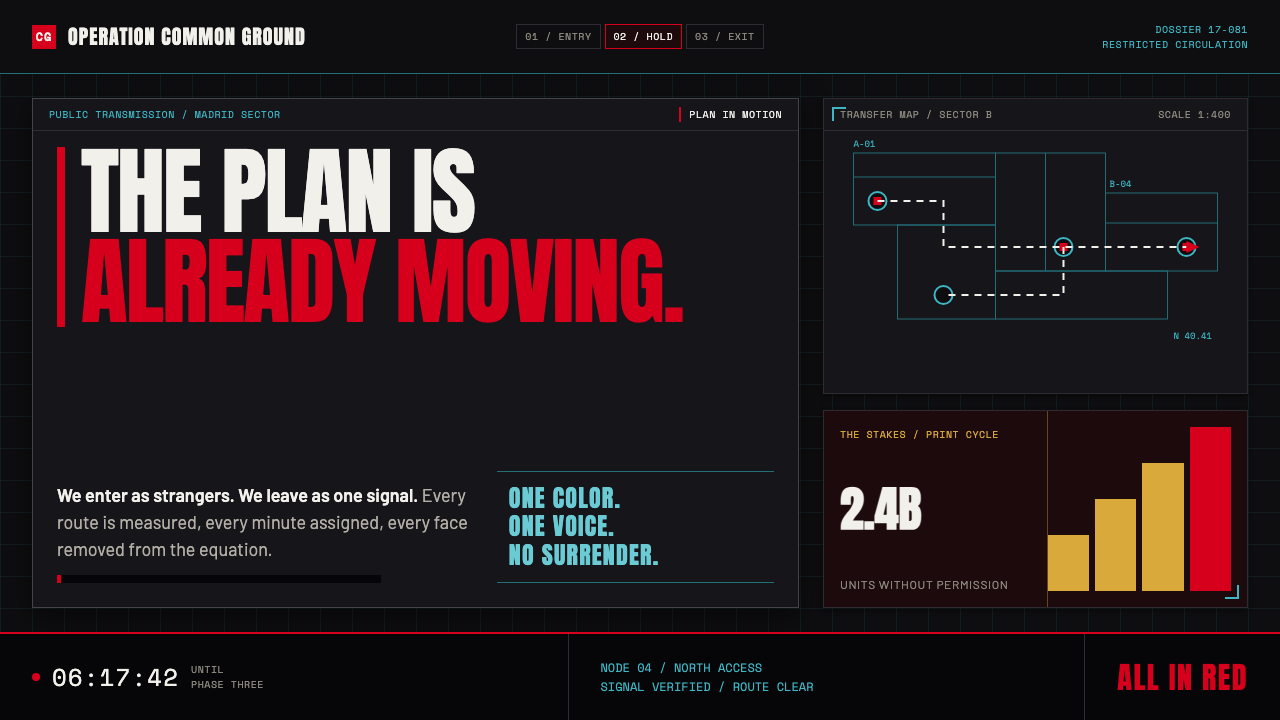 Money Heist (La Casa de Papel)Resistance becomes spectacle. Arterial red cuts through graphite grids and ta…
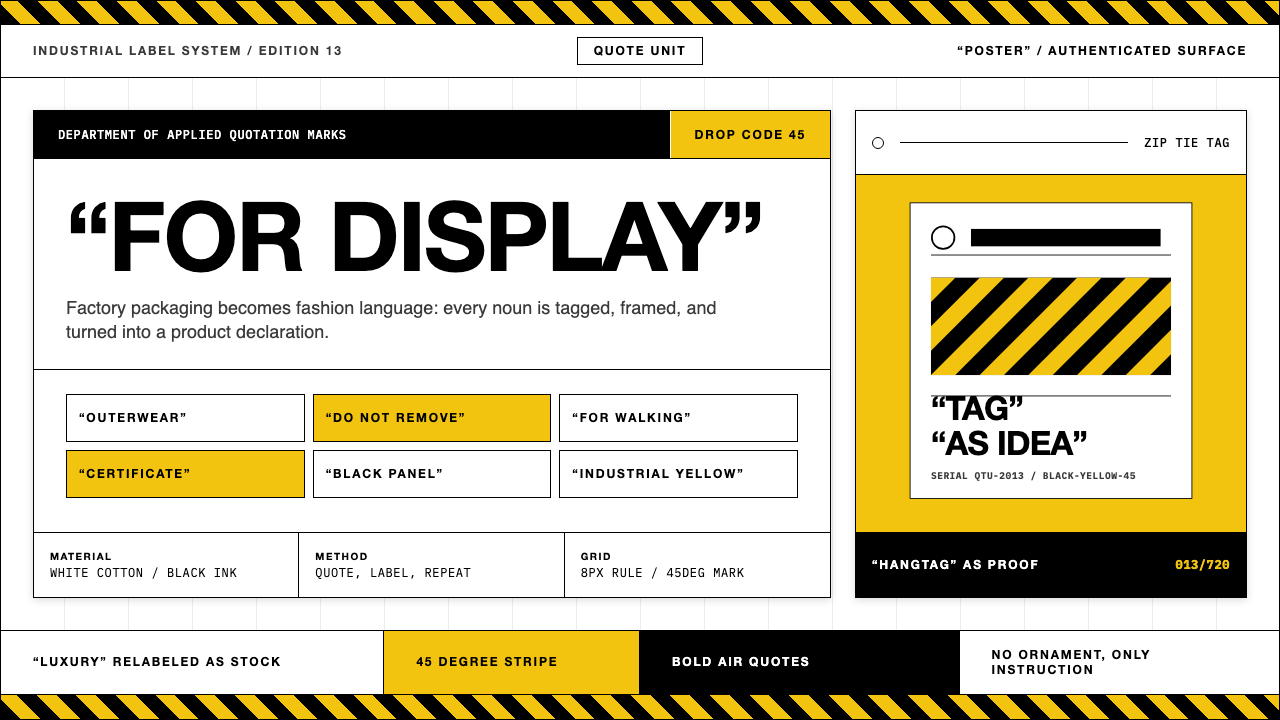 Off-White (Virgil Abloh era)Industrial irony, labeled. Yellow stripes and Helvetica quotes turn luxury in…
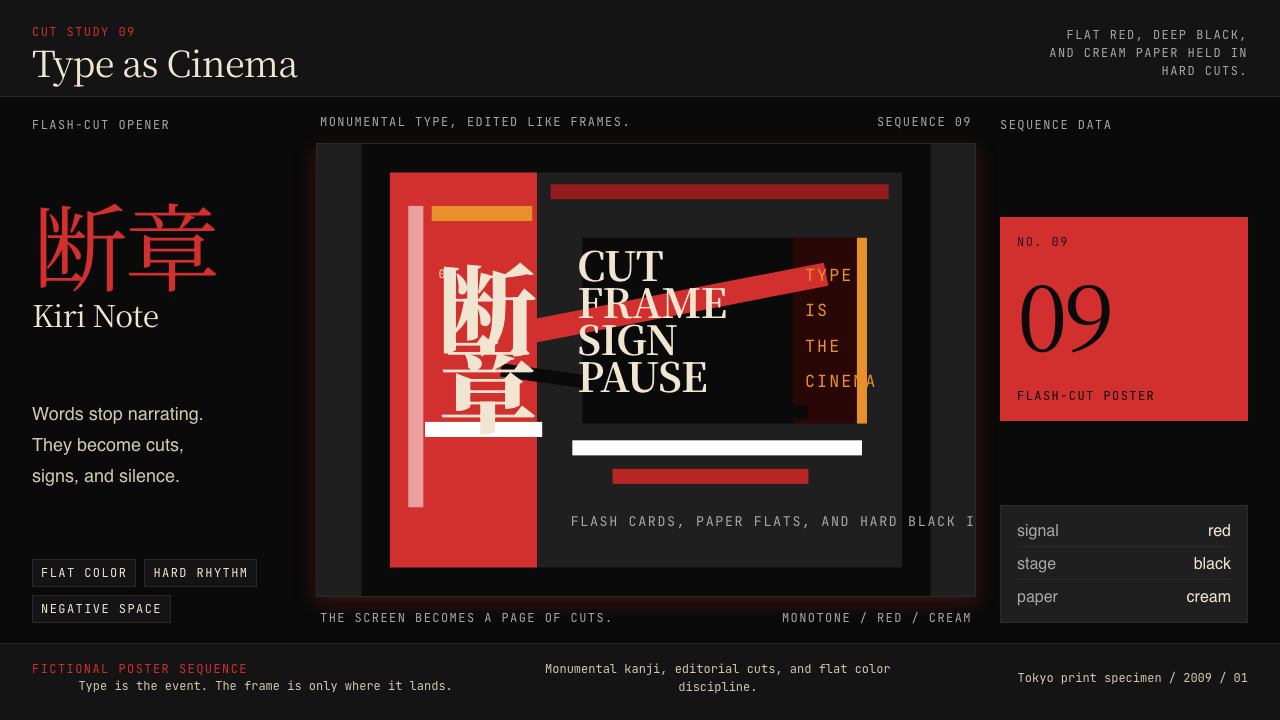 SHAFT Monogatari TypographyType becomes cinema. Red cuts, black flats, and monumental kanji steer the fr…
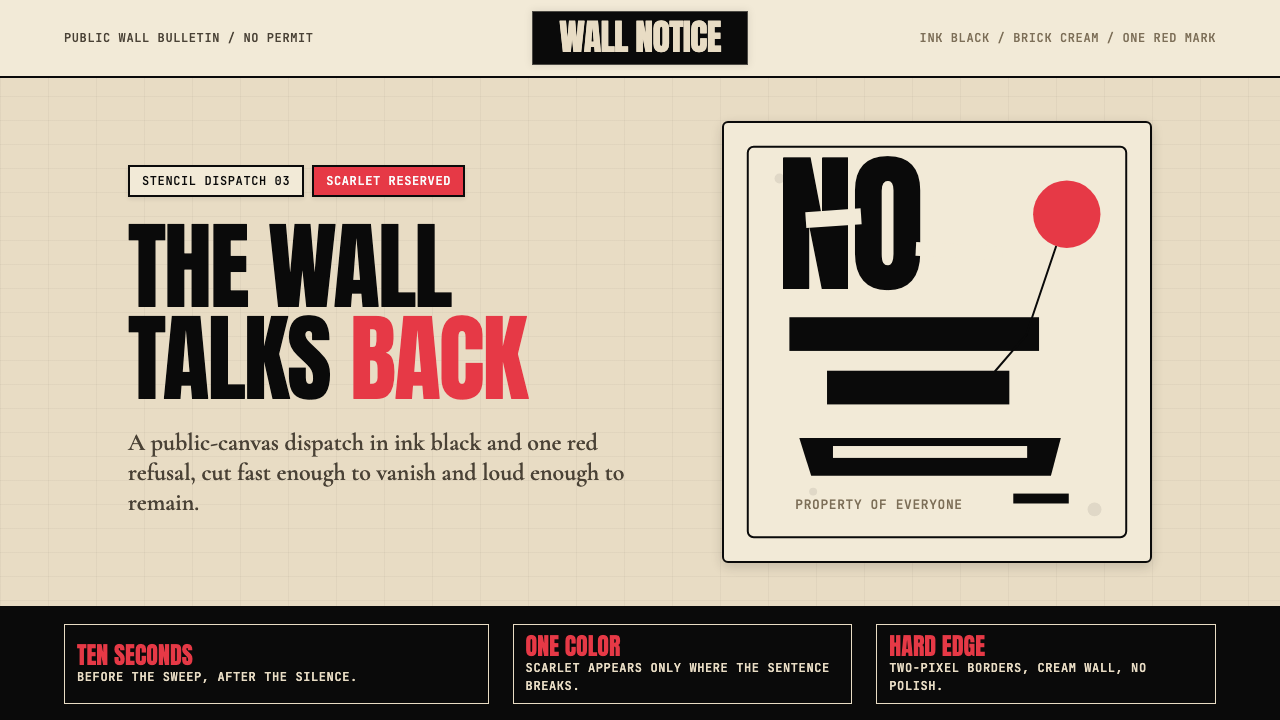 Banksy Stencil GraffitiProtest is reduced to a cut mark. Anton black on brick cream, one scarlet red…
 Bowie — Ziggy StardustTheater at full voltage. Cream-on-black portrait cut by one red and electric-…
 Breaking Bad (2008)Precision turns dangerous. Hazmat yellow and element tiles cut through asphal…