What is Rick Owens Darkstar?
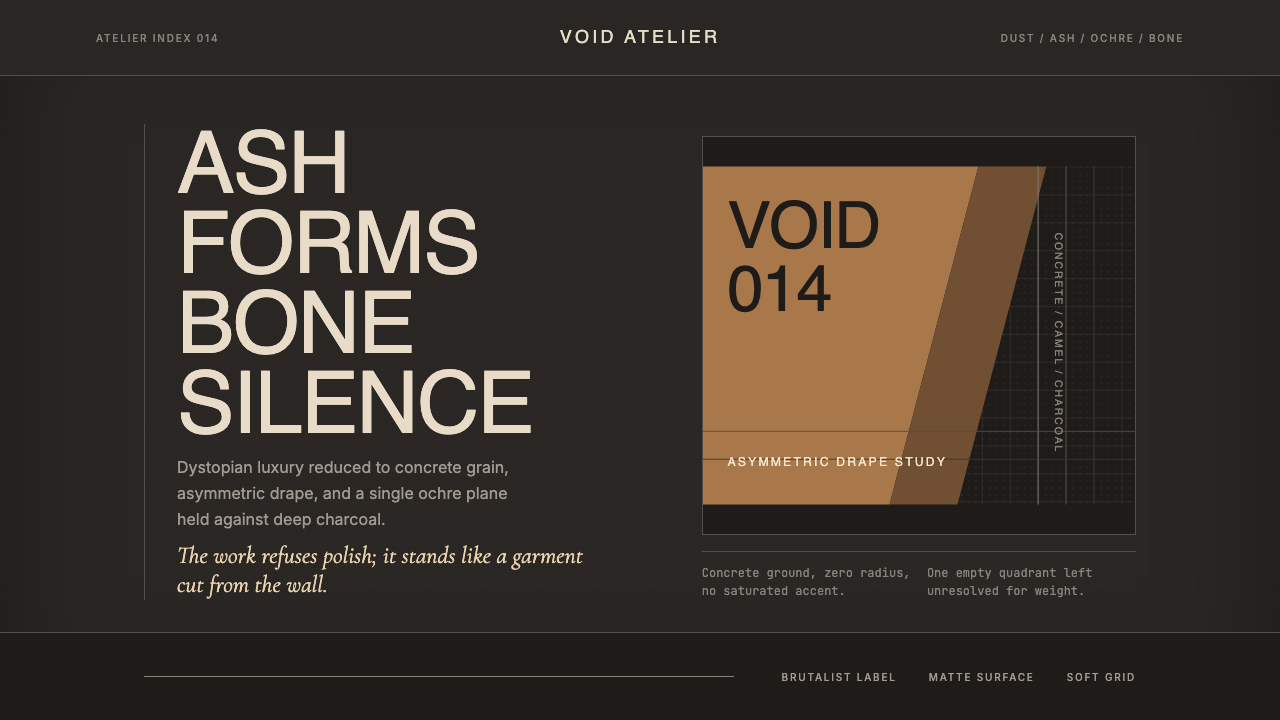
Rick Owens built a complete post-apocalyptic luxury universe out of dust, bone, and concrete — and its gravity translates directly into interface design.
Rick Owens Darkstar in brief
Rick Owens Darkstar is a visual design language distilled from one of contemporary fashion's most singular aesthetic universes. Where most luxury aesthetics pursue warmth, polish, or aspiration, Owens pursues the opposite: austerity, weight, and deliberate discomfort. The palette is compressed to a narrow band of deep charcoal, bare concrete grey, warm bone white, and a single accent of ochre-camel — the precise colors of ash, dried earth, and bleached skeleton. Nothing is saturated. Nothing reflects light easily.
The system's governing mood is what critics have called dystopian glamour — a contradiction held in tension. The materials feel severe and post-industrial, yet everything is executed with the precision of haute couture. Sharp right-angle corners replace any softness. Asymmetric compositions replace conventional balance. A fine film of atmospheric grain overlays every surface, suggesting weathering and time rather than digital polish. The effect is neither minimalism nor brutalism exactly, but something in between: restrained, grave, and charged with the kind of gravity that comes from refusal.
In interface terms, Darkstar is a dark-mode design system where darkness is not merely a preference but a statement. The background is not simply black — it is the deep charcoal of unfinished concrete, with enough warmth to avoid coldness. Type sits in bone white rather than pure white, a distinction that removes clinical harshness. The single ochre accent appears rarely, like a drape of camel-colored fabric catching light in an otherwise colorless room. Grain texture is used as an atmospheric layer, not as decoration. Every element earns its presence by contributing to an overall mood of considered severity.

Where does Rick Owens Darkstar come from?
Rick Owens was born in 1962 in Porterville, California, a small city in the Central Valley that he has described as aesthetically impoverished — strip malls, flat light, a landscape without drama. He moved to Los Angeles in his twenties, enrolled briefly at Otis College of Art and Design, and then spent years working as a pattern cutter in the downtown Los Angeles garment district, learning construction by hand rather than through formal design education. He launched his own label in 1994, initially selling through a single boutique in Los Angeles's Silver Lake neighborhood. The brand's earliest pieces showed what would become permanent obsessions: asymmetric draping, leather treated to look ancient, and a palette that refused the bright California sunlight entirely.
The move to Paris in 2003 marked a transformation in scale and international recognition, but not in aesthetic direction. Owens found the city's architecture — Haussmann stone, bare concrete parking structures, industrial banlieue — congenial to his sensibility. His Paris flagship store, designed with his wife and creative collaborator Michèle Lamy, featured bare poured-concrete walls, totemic furniture in bone and grey, and lighting calibrated to eliminate flattery. The store became as discussed as the clothes: a total environment that made clear Owens was not designing garments to be worn in ordinary life but objects belonging to a self-contained world. Lamy's influence on the aesthetic is difficult to overstate — her personal style, part shaman and part punk aristocrat, shaped the brand's visual language as much as Owens's technical mastery.
The Geobasket sneaker, introduced in 2014 and now one of the brand's most recognized objects, crystallized the Darkstar visual language in product form: an exaggerated sole that reads almost architecturally, an upper in bleached or deep-dyed leather, proportions that are simultaneously athletic and sculptural. Around the same period, the runway shows — staged at the Palais-Royal, on the salt flats of Venice's Lido, on stacked human performers — began attracting the kind of cultural commentary usually reserved for conceptual art. Owens was not making fashion that responded to trend cycles; he was building a mythology.
The design system now called Darkstar represents the current phase of that mythology — roughly 2022 to 2024 in its most refined expression — applied to digital and graphic surfaces. The key insight of its translation from fashion to interface is that the aesthetic's power comes not from any single element but from the compression of everything into a narrow tonal range, punctuated by extreme restraint in accent color. Where other dark-mode systems reach for drama through contrast, Darkstar achieves it through atmosphere: the sensation of standing in a room where the light is low, the walls are concrete, and everything that exists has earned the right to be there.
What defines the Rick Owens Darkstar look?
Palette
The color range is intentionally compressed to near-monochrome: deep charcoal functions as the primary field, warm bone white serves as the typographic and structural foreground, and bare concrete grey mediates between the two. A single ochre-camel tone — the color of desert earth or aged linen — is the system's only true accent, used with extreme restraint, typically once per composition. No saturated colors, no blue, no green. Darkness here is not black but a deeply warmed dark grey that recalls unfinished poured concrete.
Typography
Type is set in austere sans-serif forms — monumental, neutral, with no humanist warmth or geometric showiness. Letterforms are chosen for their architectural quality: they stand like slabs rather than flow like handwriting. Hierarchy is communicated through dramatic scale contrast rather than through color or weight variation: a headline can occupy multiple times the vertical space of supporting text, and that gap is treated as deliberate architecture. Sparse use of a refined serif — selected for editorial gravity rather than warmth — appears occasionally as a counterpoint in long-form content.
Corners and Geometry
Every container, button, card, and panel maintains hard right-angle corners with no rounding whatsoever. This is not an oversight but a philosophical position: rounded corners imply approachability and consumer friendliness, which are values the system explicitly rejects. Shapes tend toward the rectilinear and slab-like. Proportions lean toward the elongated and narrow, or the massively wide — extremes that avoid the neutral centre. Asymmetry is structural, not decorative: layouts are weighted toward one side and balanced through emptiness on the other.
Grain and Atmosphere
A fine layer of grain or noise is applied as a surface treatment across backgrounds and sometimes large typographic elements. This is not retro affectation — it serves a precise function: it destroys the plastic perfection of pure digital surfaces and introduces a material quality associated with aged paper, concrete, and analogue film. The grain level is calibrated to be perceptible without calling attention to itself — it should read as texture rather than effect. Combined with the compressed palette, it gives every surface the quality of something that has existed in the world rather than been generated.
Shadow and Depth
Shadows in the Darkstar system are minimal, dark, and rarely present. When depth is needed, it is suggested through layering of slightly different dark tones rather than through cast shadows with blur. Where a shadow does appear, it is hard-edged — a thin slice of absolute darkness at one edge of an element — suggesting the cool darkness between slabs of stone rather than soft light falling on a rounded object. Glow effects, inner shadows, and diffuse drop shadows are all absent; they belong to a vocabulary of warmth and approachability that the system rejects.
Spacing and Negative Space
Space is used generously and deliberately, but not in the manner of luxury minimalism where emptiness signals expense. In Darkstar, negative space functions more like the silence between architectural masses — it creates weight by contrast, making the elements that do appear feel monumental rather than sparse. Margins are wide, line spacing is generous, and elements rarely crowd each other. The net effect is a layout that breathes heavily, as though measured not in design units but in footsteps through an empty room.
Accent Economy
The ochre-camel accent is the system's single chromatic departure, and its power depends entirely on restraint. Used too frequently, it becomes decoration; used at the right moment — a single active button state, one highlighted data point, a pull-quote in editorial content — it carries the weight of an entire color vocabulary. The principle is similar to the way a single draped textile changes the reading of a concrete room: everything around it becomes the context, and the accent becomes the event. The temptation to add a second accent color must be resisted; a second accent dissolves the system's compression.

Who shaped Rick Owens Darkstar?
Born in 1962 in Porterville, California, Owens trained as a pattern cutter rather than as a formal design student, which gave his work an unusual grounding in construction and material before concept. He launched his label in Los Angeles in 1994 and relocated to Paris in 2003, where his shows and stores became as culturally significant as the garments themselves. Owens has described his aesthetic as rooted in a desire to escape the brightness of California — a turning away from sunshine toward shadow, dust, and weight. His furniture line, runway productions, and architectural installations demonstrate that the Darkstar visual language is not a fashion aesthetic repurposed for other media but a coherent worldview expressed consistently across every scale.
Lamy — artist, performer, and Owens's wife and creative partner since the mid-1990s — is the second intelligence behind the Darkstar aesthetic. Her personal visual language, which draws on West African textiles, punk iconography, shamanic ritual objects, and Parisian avant-garde performance, provided a human dimension and a ritual charge that Owens's architectural severity alone might have lacked. The Paris flagship's atmosphere — somewhere between a cathedral, a bunker, and an art installation — is as much Lamy's creation as Owens's. Her presence in the brand's visual world ensures that Darkstar reads as inhabited rather than merely constructed: a world someone actually lives in, however extreme.
The Australian model, artist, and frequent Rick Owens runway figure, Susman embodied a specific type that became central to Darkstar's human face: the figure who belongs to no particular era or cultural category, whose dress and bearing suggest a mythology rather than a trend. His recurring presence in Owens's presentations — sometimes performing rather than simply walking — helped establish that Darkstar is a total identity system, not a garment collection. The aesthetic has always been about a certain kind of person as much as a certain kind of object.
Pitt's adoption of Rick Owens as a primary wardrobe reference — extensively documented in press coverage from the late 2010s through the 2020s — served as an unusually effective cultural transmission mechanism for the Darkstar visual language. Where fashion insiders had followed Owens for years, Pitt's association brought the aesthetic to audiences who had no prior relationship with avant-garde fashion, demonstrating that Darkstar's severity could read as charismatic rather than alienating when worn with conviction. This crossover effect is relevant for designers: Darkstar translates to contexts with broad audiences when the commitment to the system is total.
The physical stores — in Paris, New York, Los Angeles, Tokyo, Milan, and Seoul — are not mere retail environments but the primary three-dimensional expression of the Darkstar language. Designed under Owens's and Lamy's direction, they establish the material conditions from which every other application of the aesthetic is derived: bare poured concrete, totemic furniture in bleached wood and bone, lighting that reveals rather than flatters, absence of conventional display logic. Understanding the stores is essential to applying Darkstar to digital surfaces correctly, because the stores establish the answer to the most fundamental question: what is this space for, and who is supposed to feel at home here?
How do you use Rick Owens Darkstar today?
Applying Darkstar to designed surfaces requires internalizing its governing principle before touching any individual element: this is a system built on compression and refusal. The charcoal-bone-ochre palette works not because each color is beautiful in isolation but because the extreme tonal narrowness forces every relationship to be meaningful. Adding a color outside the system — even a neutral grey-blue — immediately deflates the atmosphere. Similarly, rounding a single corner, softening a single shadow, or introducing any element that signals approachability will shift the register from severity to merely dark. Commit to the system entirely or do not apply it at all.
For presentation slides, Darkstar is exceptionally well-suited to high-stakes contexts where authority and gravitas are desired: investor decks for fashion or culture brands, architectural pitch presentations, portfolio work for photographers, directors, or artists. A cover slide benefits from extreme compositional austerity: a single short title in bone white, perhaps a sub-heading in charcoal, set against a deep charcoal ground with a grain overlay, and one ochre element — a ruled line, a single word — placed asymmetrically. Content slides should treat text as architecture: wide margins, generous leading, no decorative dividers, section changes marked by a shift in tonal weight rather than a visual ornament. Data slides take on an almost diagrammatic quality — when every element is stripped to necessity, a well-proportioned chart becomes sculpture.
For web interfaces, Darkstar suits products where the audience has already demonstrated cultural literacy — portfolio sites, independent editorial platforms, high-end fashion e-commerce, architecture or design studio sites, and creative tool interfaces. The approach: establish a deep charcoal background as the global surface, use bone white for all primary text, and reach for ochre only for primary calls to action or active states. Hard-edged cards with no border radius replace rounded containers. Navigation is typographic and sparse. Imagery, where present, should be high-contrast and desaturated, treated as objects placed on the surface rather than windows into scenes. For dashboard or data-rich interfaces, the system's tonal compression actually aids scannability: differentiation through brightness and weight instead of hue.
For editorial and marketing contexts, Darkstar carries an immediate editorial authority. A magazine layout in this system uses the grain overlay as a unifying surface across both text and image zones, breaks columns asymmetrically, and places full-bleed photography with no frame or caption — letting the image exist in the space the way a painting exists in a room. Marketing pages work through understatement rather than persuasion: claims stated once, briefly, in large bone-white type on charcoal ground, with no supporting imagery, no testimonials, no visual noise. The ochre accent, if used, marks the single action the page is designed to prompt — a link, a purchase, a sign-up — and appears nowhere else.
A common mistake when applying Darkstar is treating it as simply a dark mode with fashion-forward associations. Dark mode is a preference; Darkstar is a position. The most frequent failure is softness that creeps in through small decisions: a border-radius that is almost nothing but not zero, a shadow that almost has no blur but technically does, a second neutral that is introduced as a background variant but registers as a new color. Each concession individually seems minor; together they dissolve the system's compression and produce a result that is merely moody rather than genuinely austere. The test: if removing an element would be felt as a loss rather than a simplification, it has probably earned its place. If its removal would go unnoticed or even feel like relief, it should not be there.

Rick Owens Darkstar — FAQ
Is Darkstar only appropriate for fashion brands, or can it cross into other industries?
The system travels well beyond fashion whenever the product or context shares its core values: gravity, authority, deliberate difficulty, and the rejection of mass-market friendliness. Architecture studios, high-end furniture and object brands, independent film and music projects, premium photography or video platforms, and certain categories of financial or professional services — particularly those positioning themselves as discerning rather than accessible — can all absorb the language authentically. Where it fails is in any context that needs to communicate warmth, inclusivity, playfulness, or sensory delight. A children's education product, a food delivery app, a social platform built on community — these all require a visual language that is the opposite of Darkstar's governing values.
How does Darkstar differ from other dark-mode or brutalist design aesthetics?
Most dark-mode systems are inverted light-mode systems: the same design logic, the same rounded corners, the same warm shadows, simply applied to a dark background. Darkstar is not an inversion — it is a different design logic built for darkness from the beginning. The distinction from brutalism is tonal: brutalist web design tends toward raw, deliberately unfinished surfaces, often with intentional ugliness as a statement. Darkstar is severe but not crude — it has the precision of haute couture even as it refuses decoration. Think of brutalism as concrete poured without care versus Darkstar as concrete poured with extreme care but left bare: both refuse polish, but only one is meticulous.
The ochre accent seems very specific — can it be substituted with another color?
The ochre-camel tone is not arbitrary — it is derived from the physical materials of the Owens universe: camel-hide leather, desert sand, aged linen, bone. Its warmth is what prevents the dark palette from becoming purely cold, and its earthiness keeps it from reading as a conventional accent color. A substitution is possible but must meet the same criteria: warm rather than cool, desaturated rather than vivid, and associated with natural or aged materials rather than technology or energy. A terracotta, a very deep rust, or a bleached leather tone could serve the same function. Cool colors — electric blue, emerald green, any neon — are incompatible and should not be attempted: they import an entirely different value system into the palette.
How should photography be treated when used within the Darkstar system?
Photography in Darkstar functions like sculpture in a gallery: each image is a discrete object placed in space, not a background or a texture. Practically, this means images are cropped to strong geometric proportions, often unusually narrow or wide, placed with deliberate asymmetry, and treated to reduce their internal color range — desaturation, high contrast, and a slight cooling of any warm tones so that the image reads in the same tonal family as the rest of the surface. Images should not be given frames, strokes, or rounded corners. They exist on the background the way a slab of stone would: with mass, without apology. Lifestyle photography — people smiling, products in context, aspirational interiors lit warmly — is almost always incompatible; the system wants images that are closer to documents or records than advertisements.
Can Darkstar work for body text and long reading experiences, or is it too intense for sustained use?
Long-form reading in Darkstar is achievable but requires specific adjustments. The key challenge is that bone white on deep charcoal, while comfortable for short text encounters, can cause eye fatigue over extended reading if the contrast is too high or the type too small. The solution is not to soften the aesthetic but to calibrate it: reduce the contrast between background and type slightly by warming both rather than reducing brightness, use generous leading and moderate line measure to reduce visual density, and set body text at a size that does not require the reader to strain. The grain overlay should be subtle enough at body text sizes not to break letterforms. The result, when done well, reads as a serious editorial publication rather than a web page — a quality that suits the kind of long-form content the Darkstar audience actually seeks.
Related design styles
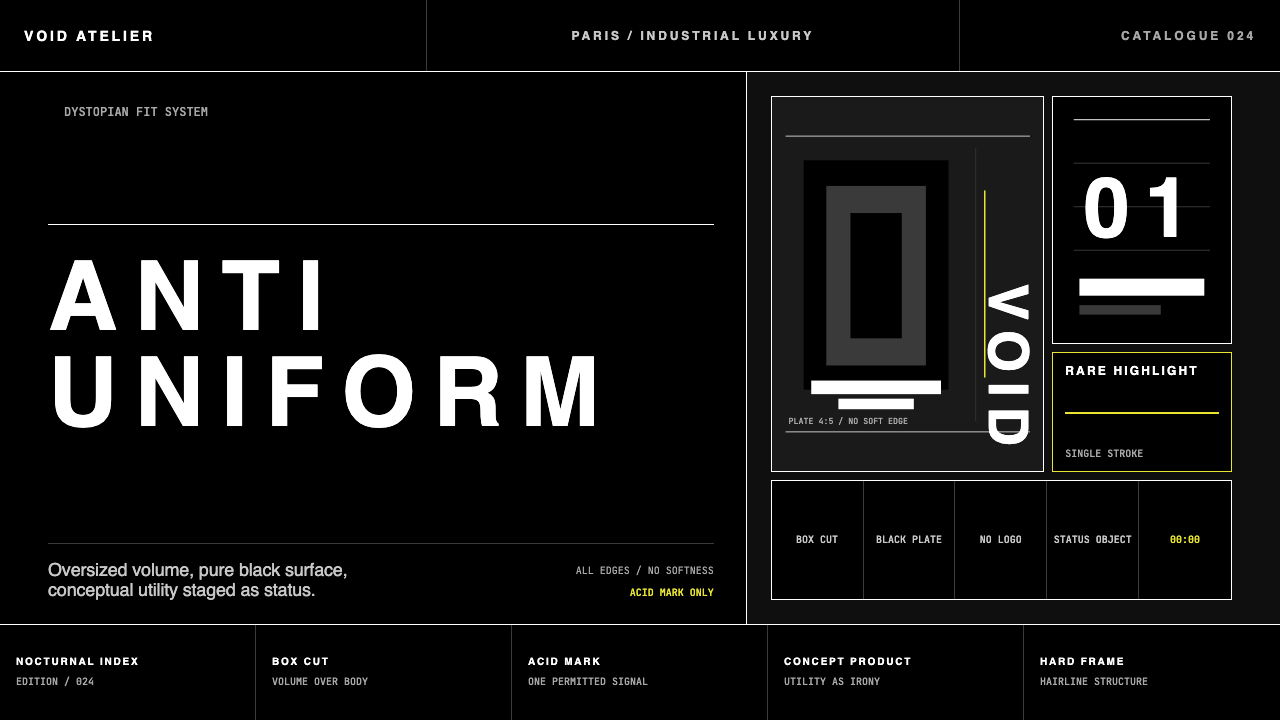 Balenciaga (Demna era)Threatening restraint. Black grids, white hairlines, spaced sans at brutal sc…
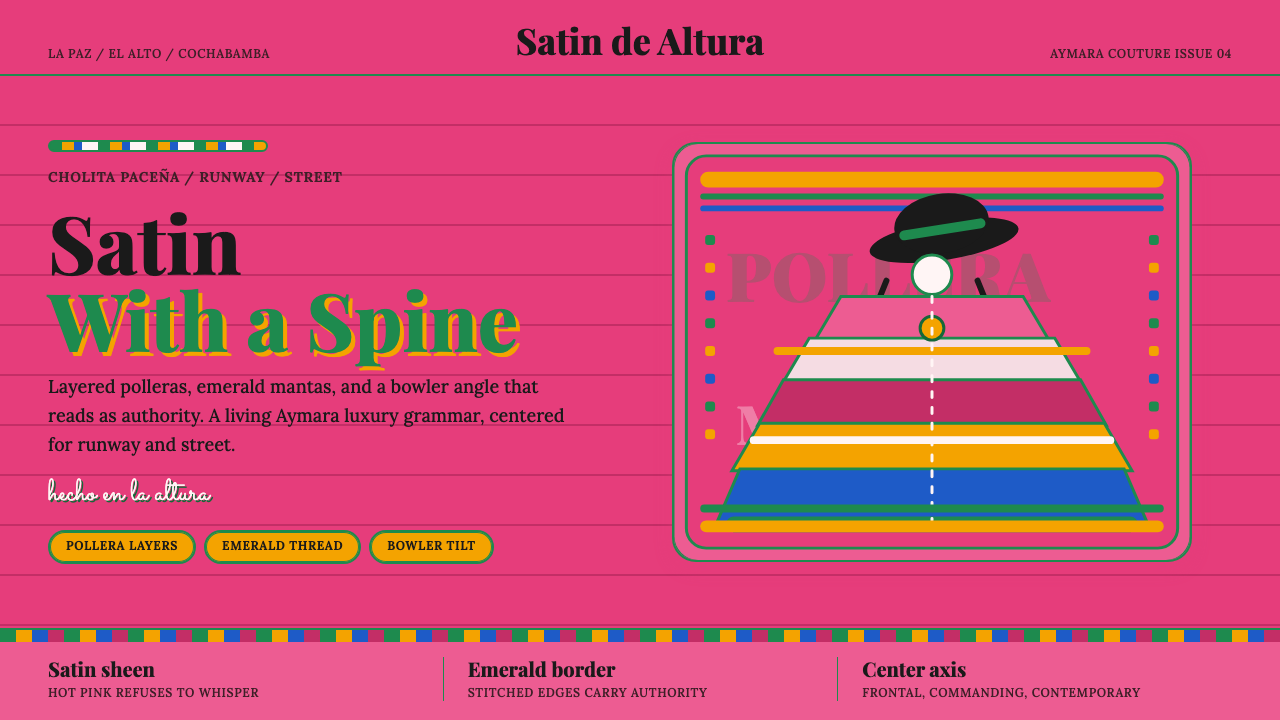 Bolivian Cholita FashionUnapologetic satin power. Hot pink fields, emerald stitches, centered pollera…
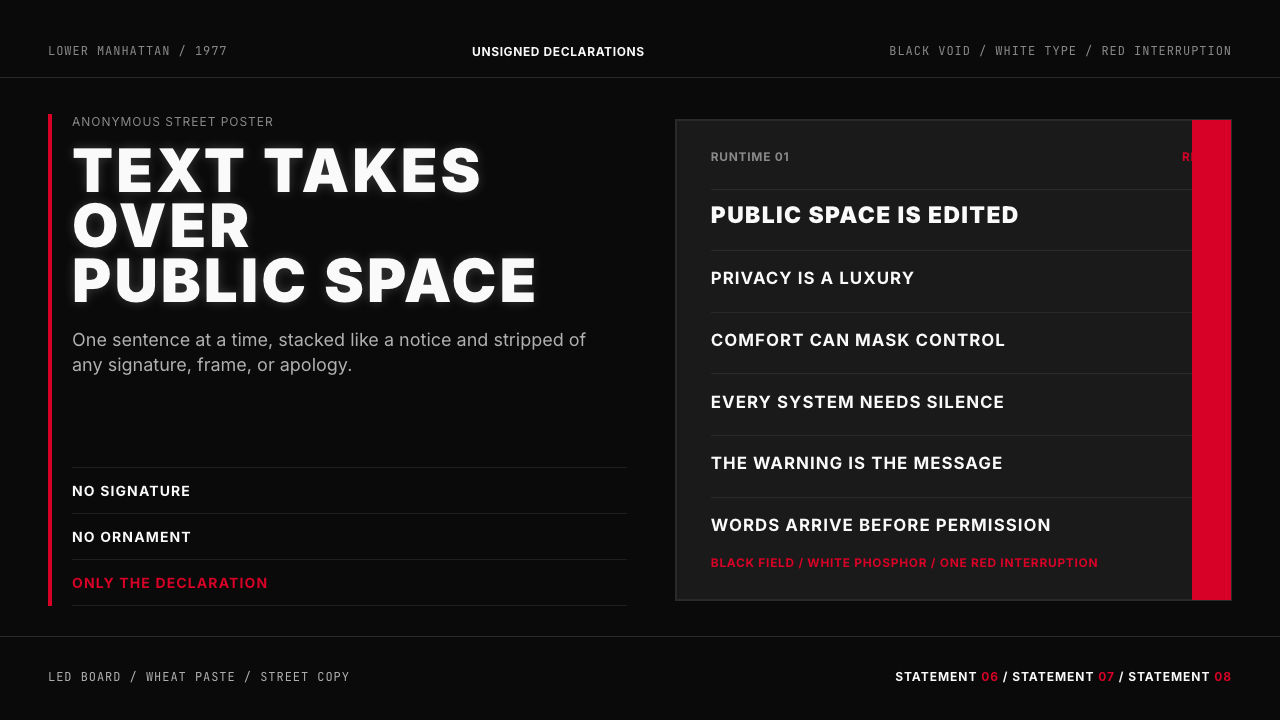 Jenny Holzer Truisms (1977)Austere declarations. White all-caps on black, cut by a single red warning.
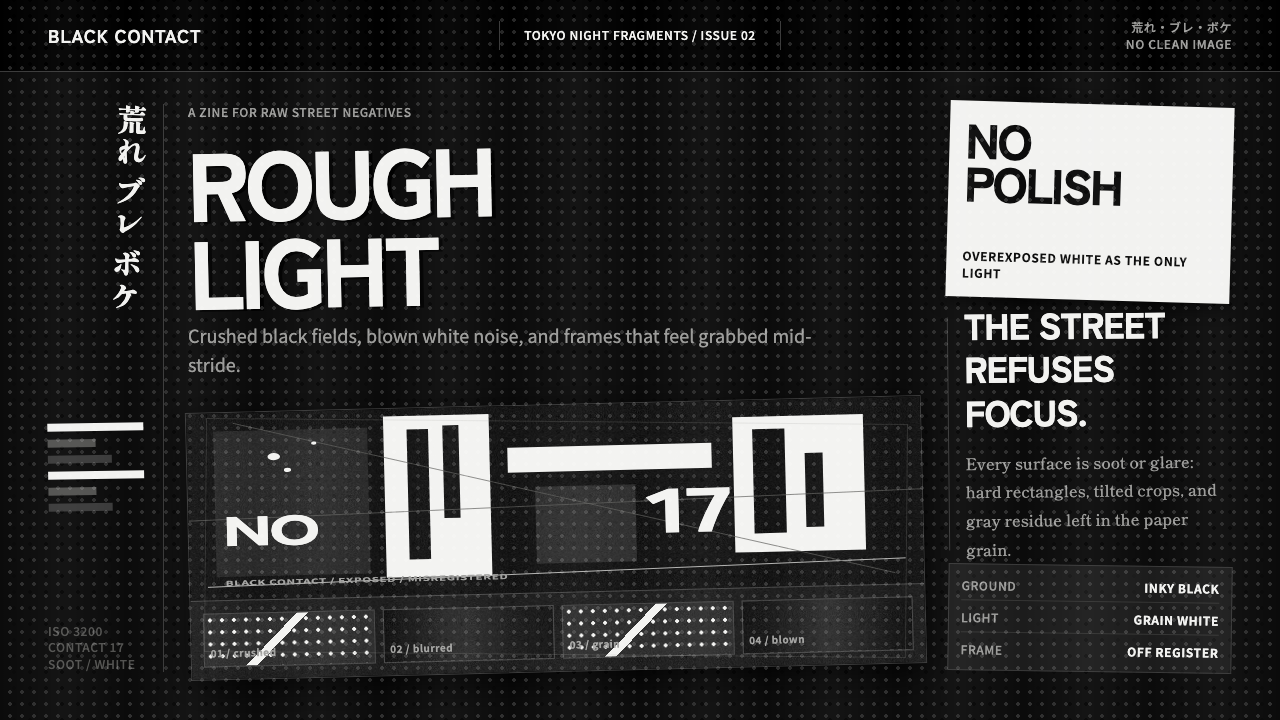 Daido Moriyama Are-Bure-BokeNothing is clean. Inky black, blown white grain, and tilted frames make the i…
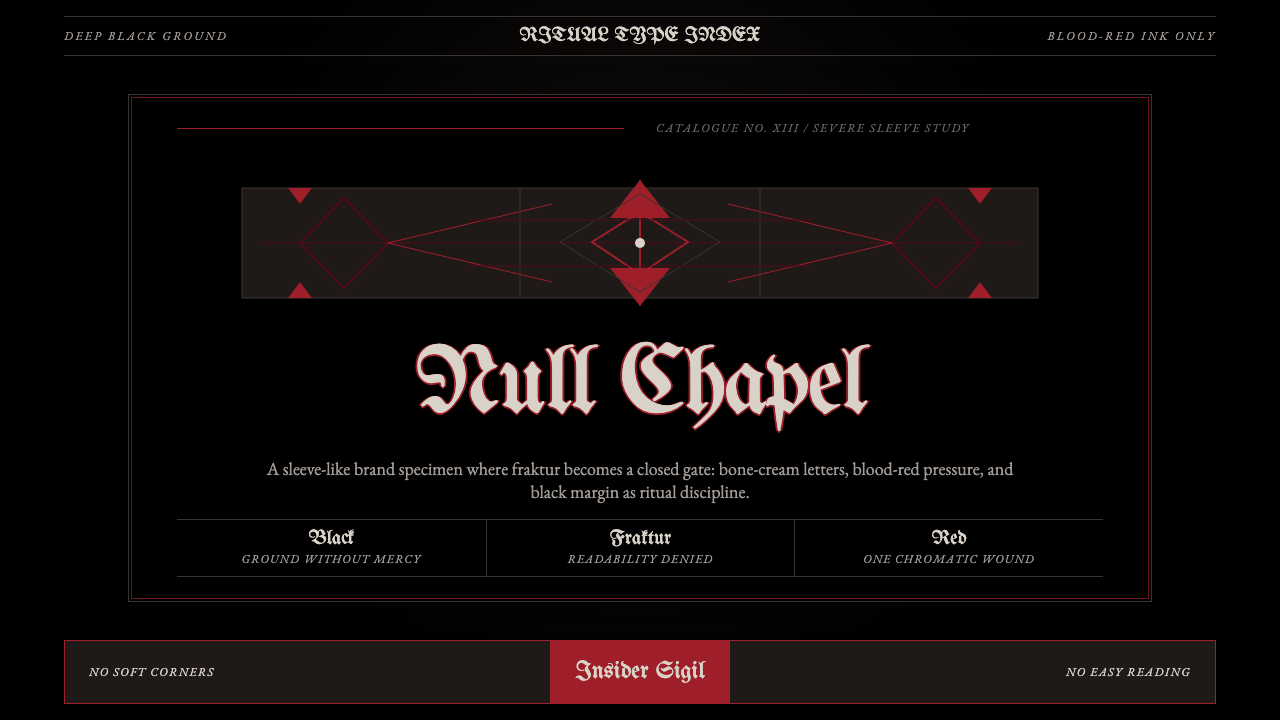 Death Metal BlackletterUnreadable by design. Bone fraktur on black, cut by one blood-red geometric s…
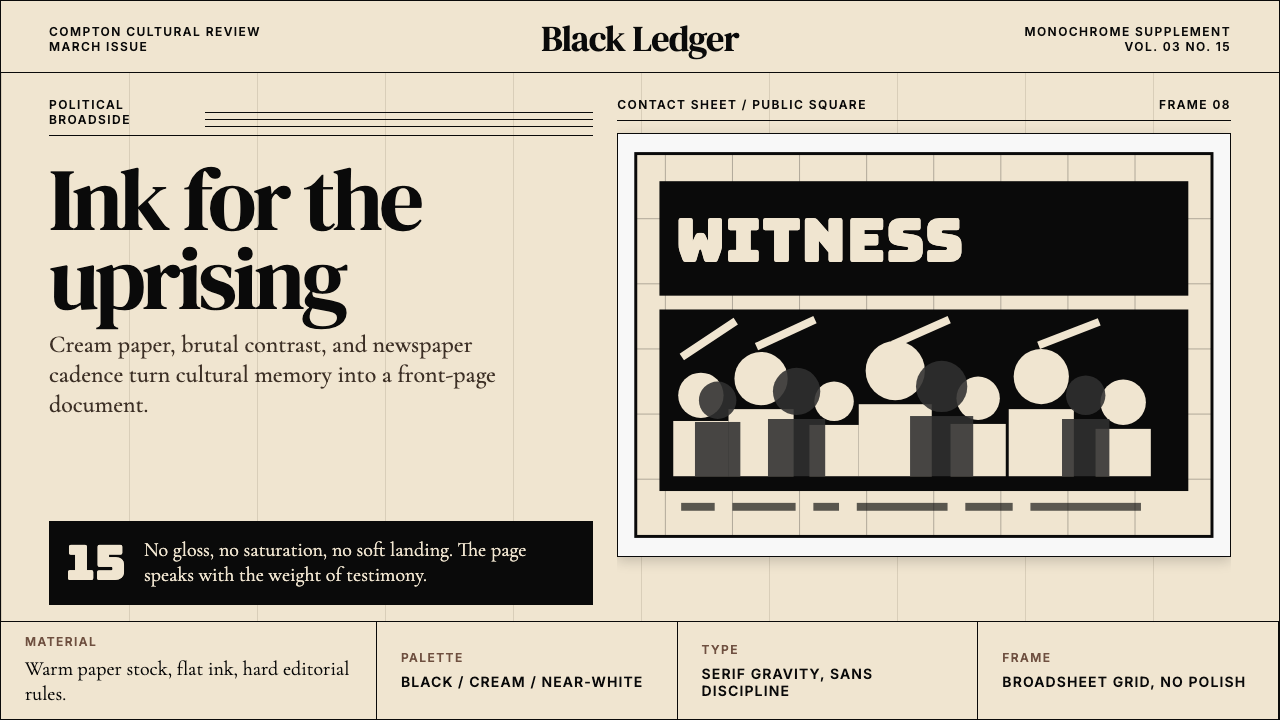 Kendrick — To Pimp a ButterflyPolitical weight, printed cold. Cream paper, hard serif type, monochrome crow…