What is Klein Blue (IKB)?
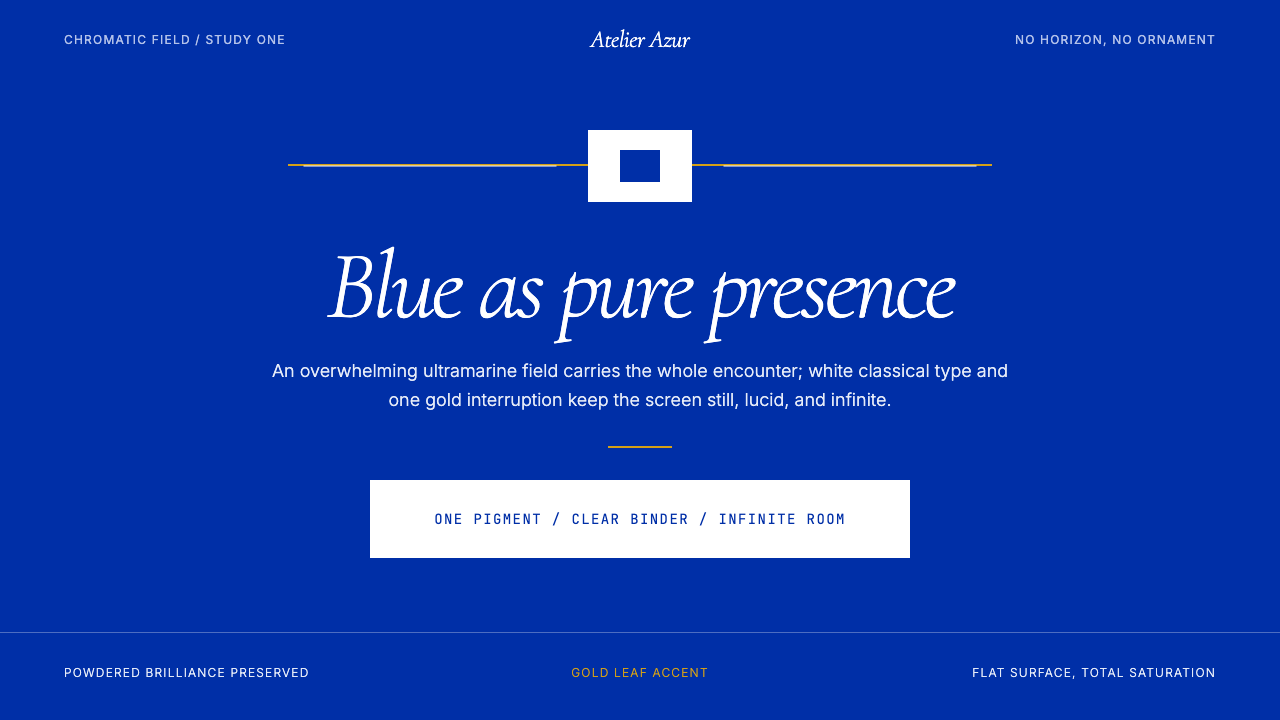
International Klein Blue is not a color applied to a surface — it is a surface that has become entirely, overwhelmingly, undeniably color.
Klein Blue (IKB) in brief
International Klein Blue — abbreviated IKB — is the specific ultramarine pigment formulated by French artist Yves Klein in 1957 and officially registered in 1960. Klein developed the color in collaboration with Parisian art supplier Edouard Adam, suspending pure ultramarine powder in a synthetic resin binder that preserved the pigment's raw, powdery luminosity without the dulling effect that traditional oil or acrylic binders produced. The result was a color of extraordinary saturation: a deep, resonant blue that appeared almost to emit light rather than reflect it.
As a design system, Klein Blue draws directly from Klein's radical conviction that color could be experienced as pure presence — not as a descriptor of objects but as a total environment. The visual language built around IKB rests on three structural decisions: an overwhelming chromatic field of that singular blue covering most or all of a composition; white typography in a classical, often italic serif that reads as an inscription floating above the blue; and a restrained use of gold as the sole accent, referencing both Klein's own deployment of gold leaf in his monochromes and the classical tradition of illuminated manuscripts. Everything else — gradients, secondary colors, decorative ornament — is refused on principle.
The effect is immediately distinctive and, when handled correctly, deeply authoritative. The blue field functions less like a background and more like a medium — something the viewer or reader enters into rather than looks at. This makes IKB one of the most powerful and most demanding design systems in the Curio library: it rewards restraint absolutely and punishes overloading with equal absoluteness.

Where does Klein Blue (IKB) come from?
Yves Klein was born in Nice in 1928, the son of two painters, and grew up surrounded by the Mediterranean light that would eventually animate his obsession with the immaterial. As a young man he trained in judo in Japan, an experience that deepened his interest in Zen philosophy and the concept of emptiness as presence rather than absence. By the mid-1950s, working in Paris, Klein had developed a conviction that most painting was compromised by the very act of composition — by the artist's decision to arrange marks, to tell the color where to go. The monochrome, Klein argued, was the only form that allowed color to exist on its own terms.
His first monochrome exhibitions in the early 1950s used a range of colors — orange, pink, yellow — but Klein became increasingly convinced that ultramarine was uniquely suited to his purpose. Blue, he wrote, has no dimensions; it is beyond dimensions. Unlike red, which advances, or yellow, which agitates, blue recedes infinitely, suggesting boundlessness rather than boundary. The problem was that commercially available blue paints — bound in oil or standard acrylic — lost the powdery, almost tactile quality of raw ultramarine pigment. In collaboration with Edouard Adam, Klein solved this by suspending the pigment in Rhodopas M60A, a synthetic resin that bonded the particles without coating them. The resulting paint preserved the pigment's full chromatic intensity.
Klein registered International Klein Blue on May 19, 1960, with the Institut National de la Propriété Industrielle in Paris — one of the very few instances in art history of an artist attempting to legally own a color. The registration was symbolic as much as legal; Klein understood that ownership of a color was philosophically absurd, but the act itself was a statement about authorship, originality, and the relationship between art and commerce that anticipated conceptual art by a decade. In the same year, he produced his Anthropometries series, in which models covered in IKB were pressed against canvases, leaving body-shaped impressions in pure blue — a process he conducted in front of a live audience in evening dress, with an orchestra playing his Monotone-Silence Symphony.
Klein died in 1962 at thirty-four, leaving behind a body of work that would become enormously influential from the 1980s onward as appropriation art, monochrome painting, and institutional critique brought renewed attention to questions of color, authorship, and the limits of painting. IKB re-entered popular cultural consciousness in the early twenty-first century through fashion, luxury branding, and digital design, where its combination of overwhelming saturation and historical weight gave it a presence that no synthetically invented color could match.
What defines the Klein Blue (IKB) look?
Chromatic Field
The defining visual element of the Klein Blue system is not the color itself but the quantity of it. IKB functions through saturation of the visual field — not as a background behind other elements but as the dominant presence that other elements float within. A half-hearted application that confines the blue to a header bar or an accent stripe misses the system's logic entirely. The blue must be felt as total, which means it should occupy the majority of a composition's area, or it should be absent altogether.
Typography as Inscription
White text on the blue field should read not as a label but as an inscription — something carved into or floating above a unified surface. This effect is best achieved with a classical serif in italic or upright roman, set at a generous size with open letter-spacing. The typeface should carry some historical weight: the contrast between ancient letterforms and a hyper-modern pigment is part of the system's meaning. Tight sans-serif settings undermine this; they belong to rationalist systems that IKB explicitly rejects.
Gold as the Only Accent
Klein's own monochromes often incorporated gold leaf panels alongside IKB canvases, treating the two as complementary absolutes — blue for the immaterial void, gold for the radiance of pure energy. Within a design system, gold functions as the sole permitted accent: a single rule, a logotype element, a call-to-action border, or a highlighted figure in a data table. Warm yellow functions as a gold stand-in when material effects are unavailable. Any other accent color — silver, white used decoratively, red — collapses the system's tonal unity.
Negative Space as Breathing Room
Despite — or because of — the overwhelming chromatic field, successful Klein Blue layouts use generous margins and interior spacing. The blue itself is the content, so crowding it with elements defeats the purpose. Wide margins on text blocks, tall vertical spacing between typographic elements, and deliberate emptiness in the lower portions of a composition all contribute to the meditative quality that distinguishes IKB design from merely monochromatic design. Space here is not emptiness; it is the blue continuing uninterrupted.
Flatness and Anti-Illusion
Klein Blue rejects every device that would introduce spatial illusion into the composition: no drop shadows of any kind, no gradients, no texture overlays, no depth metaphors. The blue field is flat and opaque. This flatness is not a limitation imposed by the system — it is philosophically fundamental. Klein's IKB was meant to eliminate the distinction between surface and space, between the pigment and the infinite. Any technique that re-introduces the conventional reading of 'a colored thing in a space' — even a subtle vignette at the edges — betrays the premise.
Economy of Elements
The more elements a Klein Blue composition contains, the weaker it becomes. The system is strongest when a page contains the blue field, one to three typographic elements, and possibly a single gold accent. Adding icons, illustrations, photography, UI chrome, or secondary color elements erodes the clarity that gives the system its power. Designers accustomed to information-dense interfaces will find IKB genuinely uncomfortable to work with — this discomfort is diagnostic. If the blue field is competing with other visual information, the other visual information should be removed.
Historical-Contemporary Tension
Part of IKB's visual power comes from the productive friction between its elements: the pigment was registered in 1960 and carries the weight of postwar French art history; the serif typography references classical inscription; yet the overall composition reads as rigorously contemporary. This tension between depth and modernity is not accidental — it should be cultivated. Choosing typefaces that are too aggressively modern flattens this tension; choosing those that are too decoratively historical collapses it in the other direction. The aim is a letterform that would look equally at home carved in marble and set on a screen.

Who shaped Klein Blue (IKB)?
Klein (1928–1962) is the originating figure without whom IKB does not exist. His practice moved systematically from color to void: he exhibited empty gallery spaces as artworks, sold 'zones of immaterial pictorial sensibility' for gold leaf, and proposed architectural projects — including a 'roof of fire' and an 'air architecture' requiring no walls — that treated the atmosphere itself as a designed medium. His influence on conceptual art, performance art, and installation art was enormous; his influence on design culture came decades later, when his color became a touchstone for luxury brands and digital aesthetics seeking a combination of historical legitimacy and extreme visual impact.
Adam was the Parisian art materials supplier who worked with Klein on the technical problem of binding ultramarine pigment without diminishing its optical intensity. His contribution was practical and essential: the Rhodopas resin formulation that Klein used was the direct result of Adam's material expertise. In design history, the collaboration between artist and supplier is easily overlooked, but the specific visual quality of IKB — its matte, powdery, light-absorbing surface — is inseparable from this technical solution. No binder change would produce the same effect, and Klein understood this, which is why he sought registration.
Restany was the French critic who co-founded Nouveau Réalisme with Klein in 1960, writing the movement's founding manifesto and situating Klein's work within a broader critique of abstract expressionism's romantic individualism. As an art critic and theorist, Restany gave Klein's essentially physical and mystical practice an intellectual framework that made it legible to the European art world. His framing of IKB as a statement about the 'new perceptual approach to the real' — rather than simply a painterly choice — helped establish the color as a philosophical position, which is precisely the quality that makes it so potent as a design system signal.
Arman (Armand Pierre Fernandez) was a fellow Nouveau Réaliste and Klein's closest collaborator and friend, whose practice of accumulating and destroying everyday objects formed a counterpoint to Klein's dematerialization. Understanding Arman clarifies Klein by contrast: where Arman filled spaces with accumulated material, Klein emptied them of everything except saturated presence. This dialectic between accumulation and void, between material density and chromatic immateriality, remains structurally useful for designers who want to understand what IKB is doing at a compositional level — the blue field is not a background, it is a refusal of accumulation.
How do you use Klein Blue (IKB) today?
Klein Blue is a system that imposes its logic on content rather than adapting to it. Before applying it, the designer must accept a fundamental constraint: the more the content demands visual complexity, the less suitable this system becomes. IKB is not a neutral container for information — it is an argument about experience. The projects it suits best are those where the primary goal is to produce a strong emotional or aesthetic impression, with informational density deliberately subordinated to that impression. Luxury brand materials, cultural institution communications, high-stakes pitch decks, and limited-edition campaign pages are natural contexts. Analytics dashboards with twenty data layers are not.
For presentation slides, Klein Blue works most effectively when the cover and section-break slides are treated as full-bleed chromatic statements and content slides are stripped to near-nothing. A cover slide should present the title in large white classical serif, positioned in the upper or lower third with generous breathing room, against the unbroken blue field. A single gold rule or logotype is the only permitted decoration. Content slides inside the deck should follow a strict economy: one headline, one block of supporting text, and — if data must appear — one chart treated as a geometric object in white and gold against the blue. Avoid tables with multiple columns; if detailed data is required, relegate it to an appendix in a neutral white ground.
For web interfaces, IKB suits hero sections, splash pages, modal overlays, and pricing tier callouts where the goal is to hold attention completely for a brief moment. A full-screen hero in IKB with a centered headline and a gold-bordered call-to-action button creates immediate visual authority. For dashboard or product interfaces where users spend extended time, the blue field is best deployed as a navigation panel or sidebar — a persistent chromatic anchor — while the main content area shifts to a neutral near-white. This maintains the system's emotional signature without fatiguing users who need to process data across long sessions.
For editorial and marketing applications, the style supports high-impact single-page layouts: event posters, campaign landing pages, book covers, journal covers, and institutional annual reports. A full-bleed IKB cover with a white title in generous classical serif, a gold line separating title from subtitle, and a wide lower margin where supporting information sits in smaller roman type achieves the balance of authority and restraint that defines the system at its best. In marketing sequences — email campaigns, social cards, or printed inserts — maintain the blue as the consistent ground across all pieces, varying only the typographic content. The chromatic consistency becomes the brand signal.
The most common mistake when applying Klein Blue is treating it as a color accent rather than a total field. Designers frequently attempt to use IKB as one element among many — a button color, a card background, a navigation bar — within an otherwise neutral interface. This approach dilutes the system entirely. A blue that is competing with other visual elements is not IKB; it is simply blue. A second common mistake is introducing gradients, shadows, or glass-morphism effects into the blue field — any technique that makes the surface look translucent, dimensional, or lit from behind destroys the flat opaque presence that gives IKB its power. A third mistake is over-populating the gold accent: if every heading has a gold underline, every button has a gold border, and every icon is rendered in gold, the accent becomes noise. One deliberate gold element per composition is the correct proportion.

Klein Blue (IKB) — FAQ
Is IKB a trademarked color that cannot be used freely?
Klein's 1960 registration was with the French industrial property office and covered a specific formulation — the pigment suspended in Rhodopas resin — not the color itself as a visual phenomenon. The registration has also lapsed. In practice, no one holds enforceable rights over the visual appearance of deep ultramarine blue, and the color appears in design, fashion, and digital contexts freely. What remains protected, in a cultural rather than legal sense, is the name 'International Klein Blue' and its association with Klein's artistic legacy. Using the system without acknowledging that lineage is not illegal — but it is worth knowing where the color comes from, because that history is part of what gives it its weight.
Can Klein Blue work alongside photography or illustration?
Technically yes, but the integration requires extreme care. Klein Blue is hostile to representational imagery — any photograph or illustration that introduces a naturalistic scene, multiple colors, or organic texture competes directly with the blue field rather than coexisting with it. The most successful integrations treat imagery the way Klein treated his Anthropometries: as traces or silhouettes rather than windows. A high-contrast duotone photograph reduced to near-monochrome — white and the blue, no other tones — can work. A silhouetted figure in white against the blue field can work. A full-color lifestyle photograph placed on a blue background cannot; the color values of the photo will make the blue look arbitrary, and the blue will make the photo look garish.
How does Klein Blue differ from navy blue, cobalt, or other deep blues used in design?
The difference is partly chromatic and partly conceptual. Chromatically, IKB sits in the ultramarine range — a pure, highly saturated blue without significant gray, green, or purple contamination. Navy blue is darker and grayer, traditionally evoking authority and conservatism. Cobalt is somewhat lighter and warmer. Indigo shifts toward purple. IKB is distinct from all of these: it is neither institutional nor moody nor romantic, but overwhelming and singular. Conceptually, what separates IKB from other deep blues in design use is the system it implies — the total field, the classical typography, the gold accent, the anti-illusionistic flatness. You can use navy in a layout the same way you use cream or charcoal. You cannot use IKB that way without evacuating its meaning.
Is Klein Blue suitable for accessibility-compliant design?
White text on deep ultramarine achieves strong contrast ratios that comfortably meet accessibility standards for normal and large text. The system's core — white or gold on the blue field — presents no intrinsic accessibility barrier for sighted users without color vision deficiencies. The challenge arises with gold accents: warm gold on deep blue can fall below recommended contrast thresholds depending on the exact tones used, particularly for small text or fine rules. Gold should therefore be used for decorative and structural elements rather than for body text or interactive affordances that require legible labels. For users with certain forms of color vision deficiency, deep blue and black are easier to distinguish than deep blue and dark navy, so the IKB system — with its high-contrast white typography — is more accessible than many muted palette systems.
How should the system handle dark mode or light mode variants?
Klein Blue as a system does not have a conventional light mode variant — the blue field is both the dark and the light simultaneously; it is neither a dark-mode color nor a light-mode color but a chromatic absolute that exists outside that binary. Forcing IKB into a light-mode inversion — white background with blue type — produces something that reads as corporate stationery rather than as anything related to Klein's vision. If a light-mode context is genuinely required, the better approach is to treat the blue as a structural accent in a cream or white layout, reserving the full blue field only for hero or feature moments. This is a compromise, not a variant — the IKB system proper has no light mode, and acknowledging that clearly is more honest than constructing a diluted alternate that misrepresents the original intention.
Related design styles
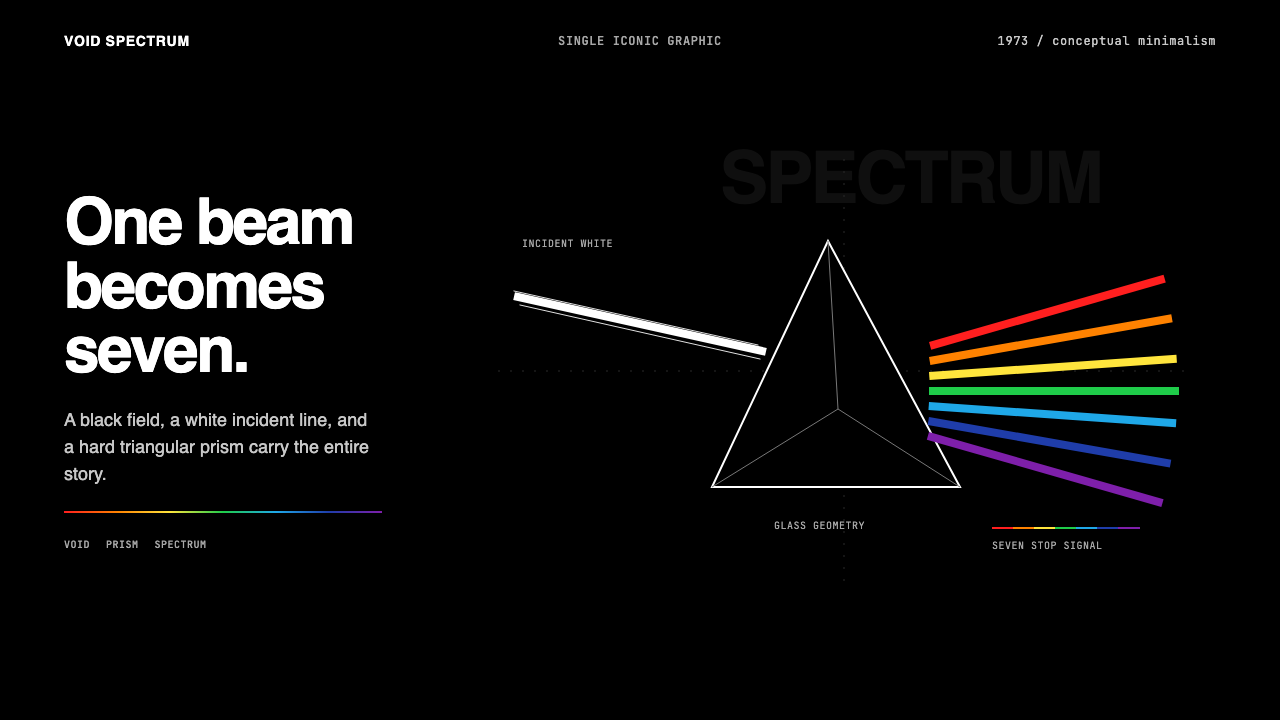 Pink Floyd — Dark Side of the MoonOne image does everything. Black void, white beam, hard prism, seven exact co…
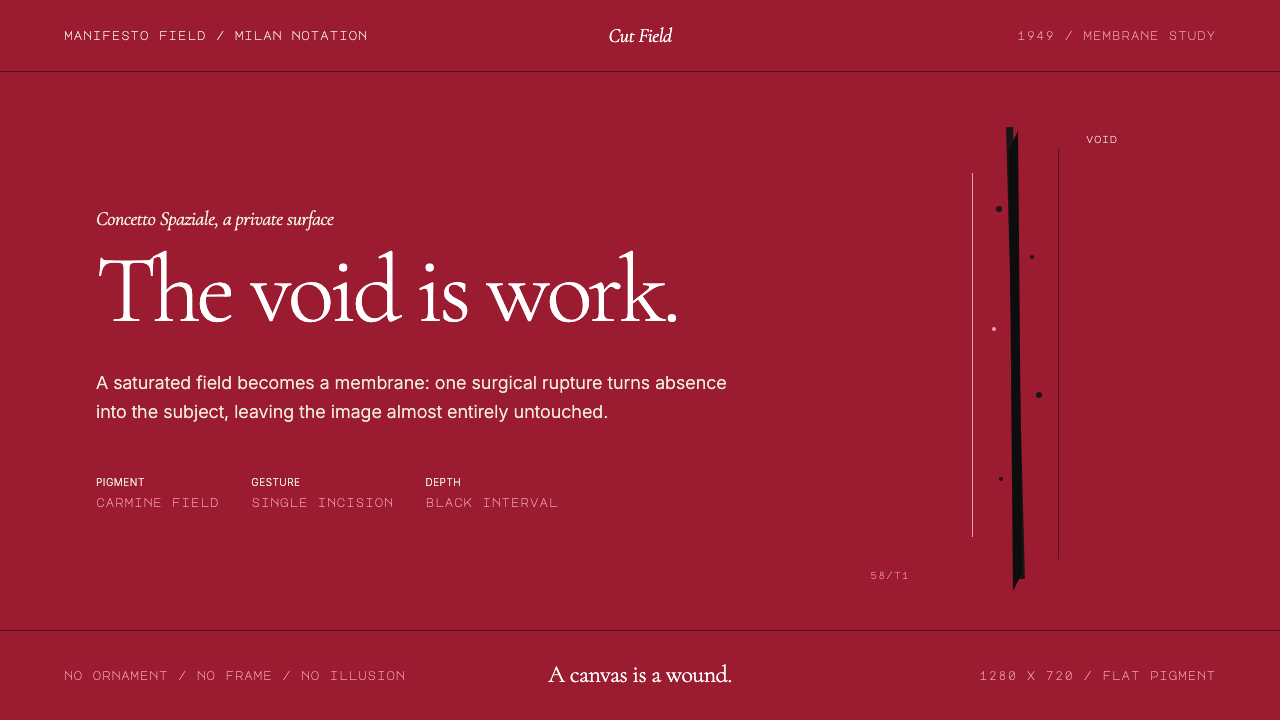 Spatialism (Fontana Cut, 1949)Absence becomes medium. Carmine field, Garamond restraint, one black incision.
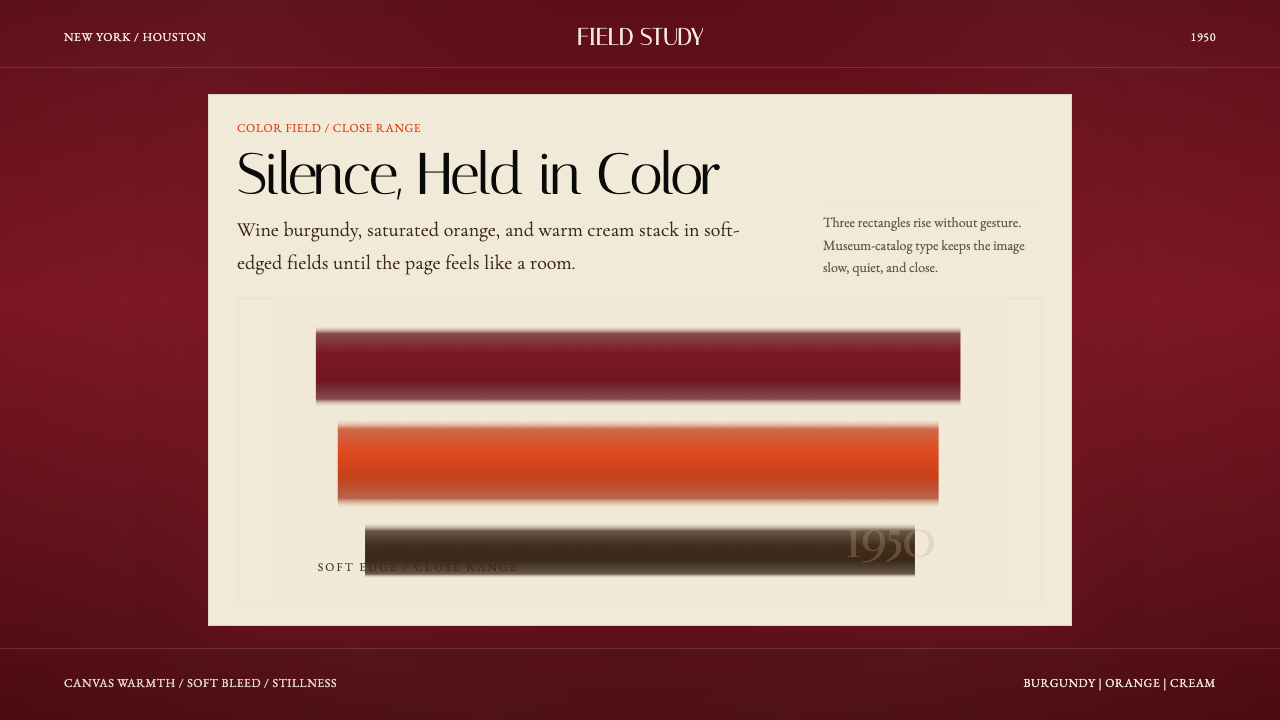 Mark Rothko Color Field (1950)Silence made visible. Burgundy, orange, and cream stack in soft-edged fields.
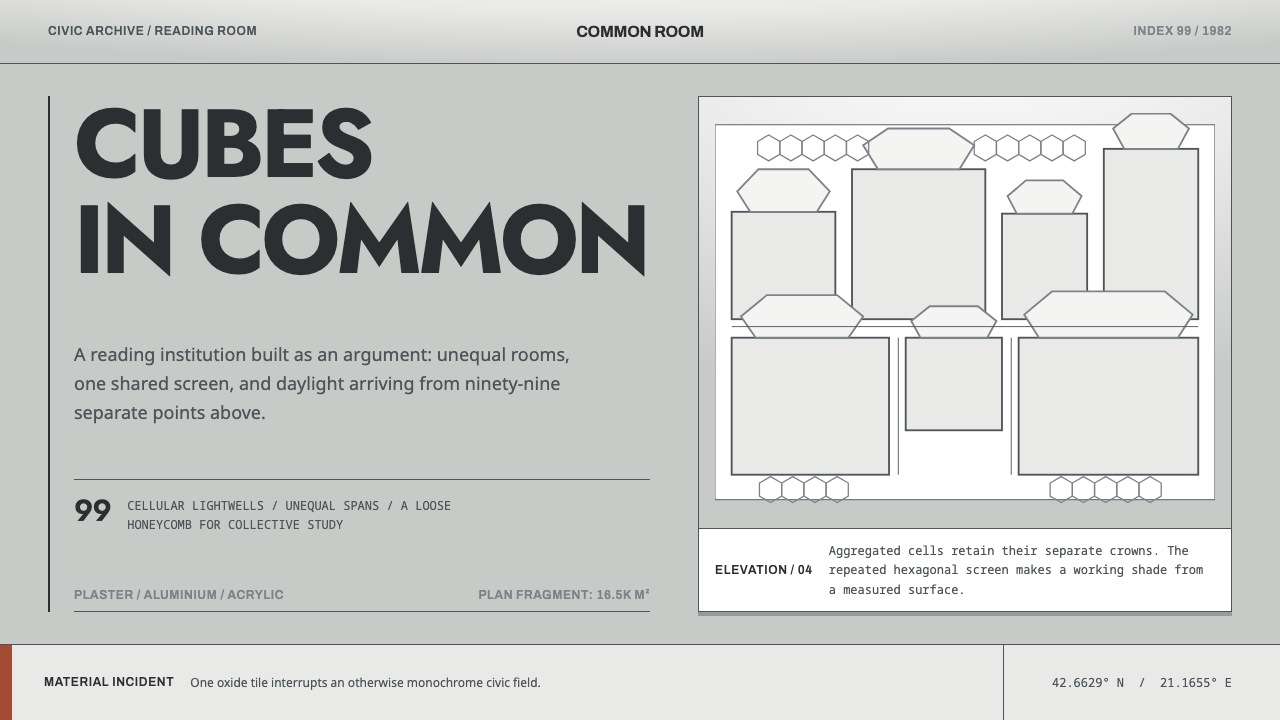 Prishtina National LibraryCivic modernism that refuses one answer. Unequal plaster cells sit beneath a…
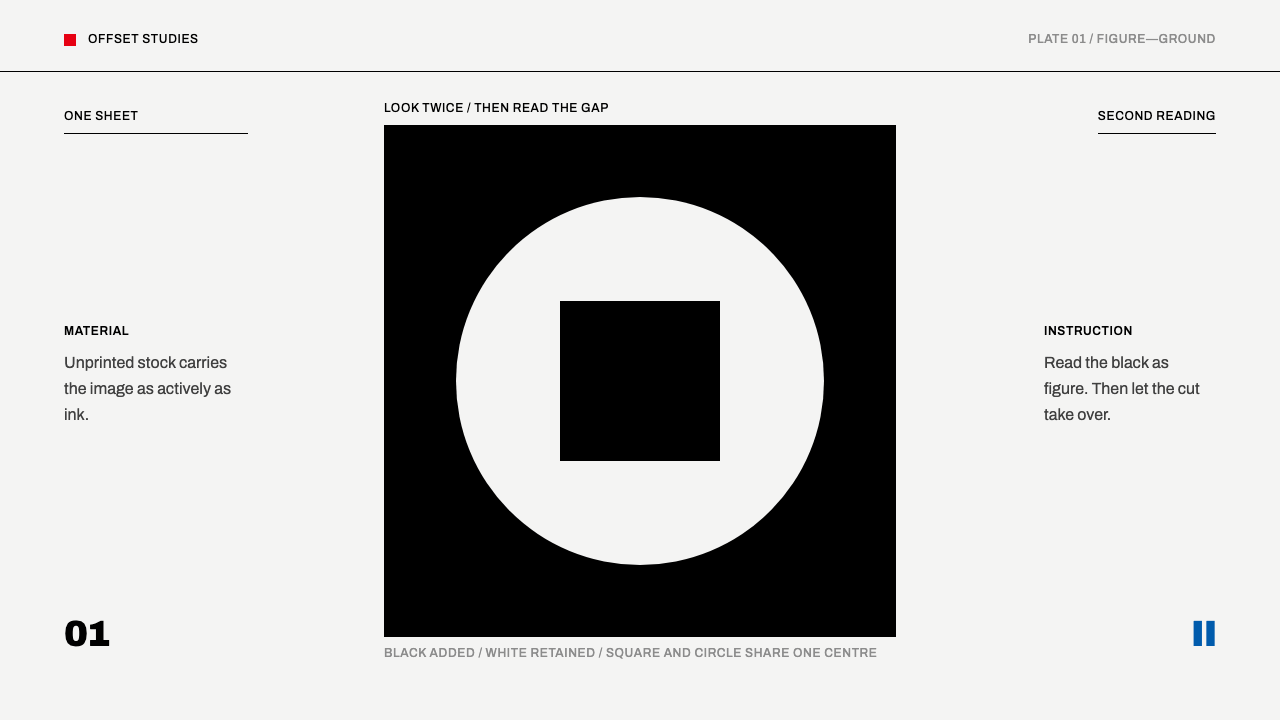 Shigeo Fukuda OpticalOne ink, two readings. Black geometry and a white cut make the sheet do half…
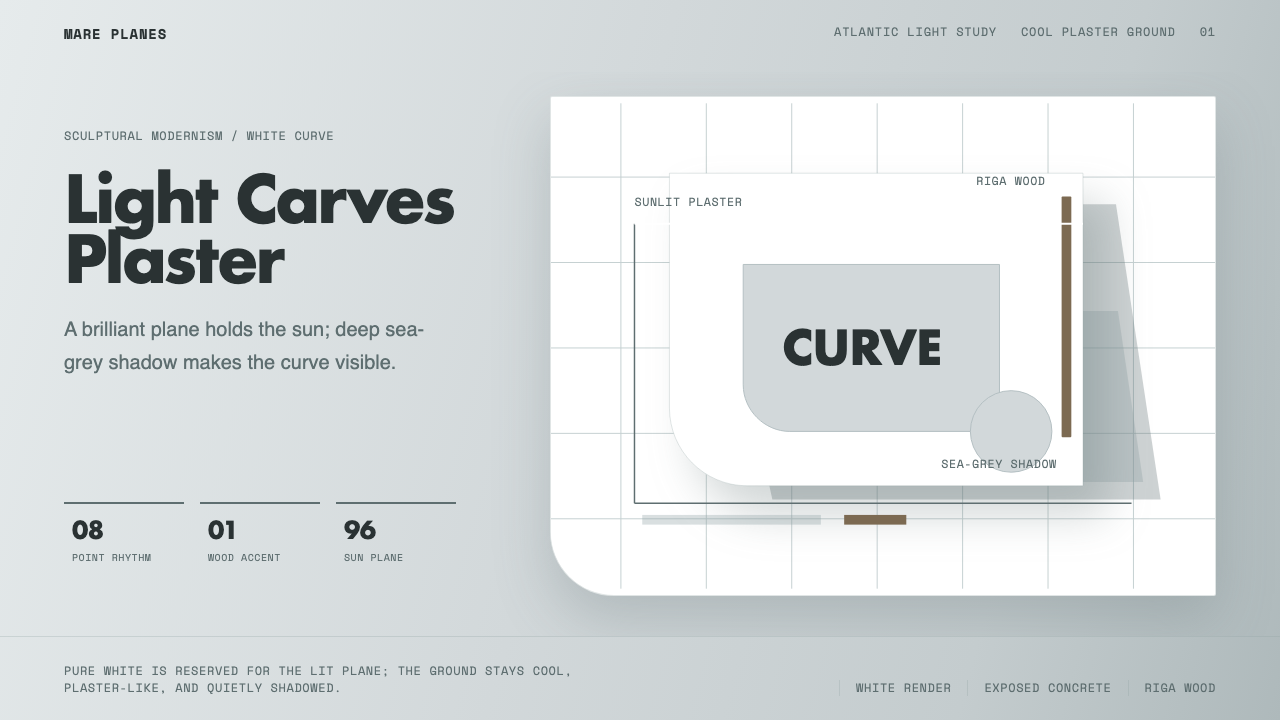 Alvaro Siza WhiteLight makes the form. White planes on cool plaster throw sea-grey shadow and…