What is Pink Floyd — Dark Side of the Moon?
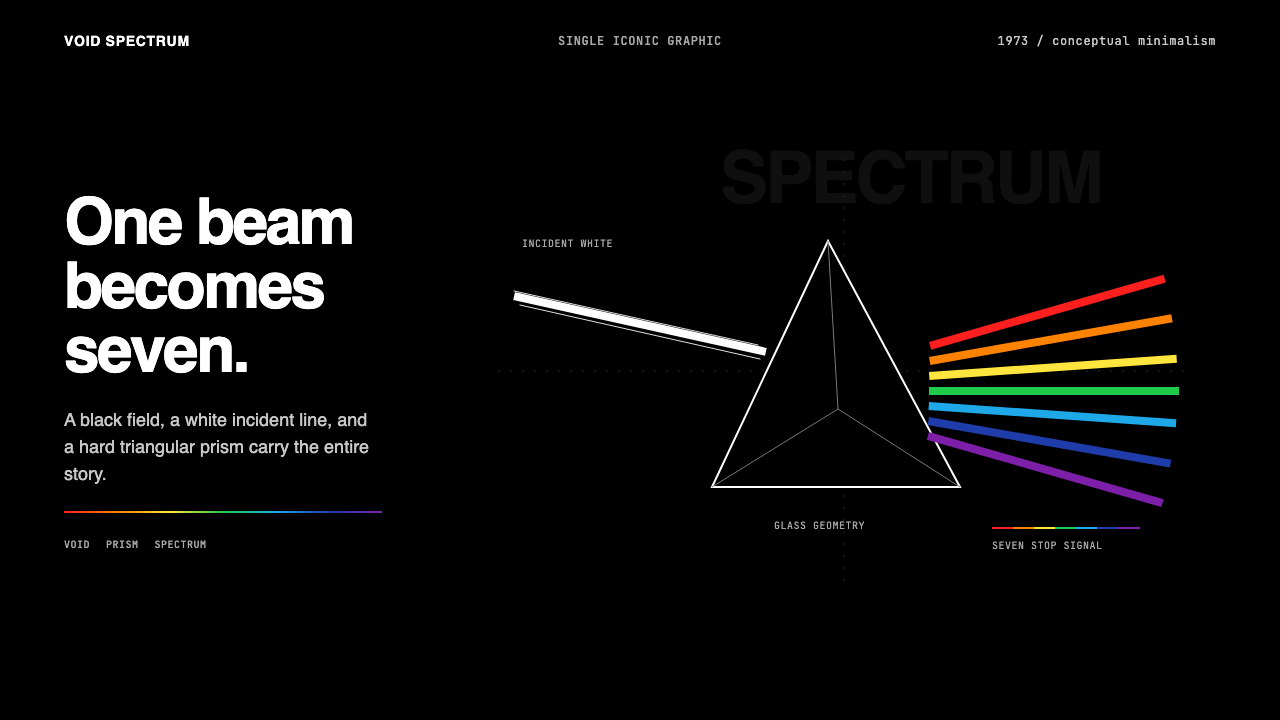
One isosceles prism, one white beam, seven saturated color stops, and pure black — the most iconic album cover ever made became a design system built on absolute restraint.
Pink Floyd — Dark Side of the Moon in brief
Pink Floyd's The Dark Side of the Moon (1973) visual identity is conceptual minimalism at its most complete: a single geometric object — a prism — performs a single physical act — splitting white light into a spectrum — against a field of unbroken black. There are no words on the cover image itself, no textures, no graduated tones beyond the hard spectral band. Every decision has been stripped to its irreducible minimum, and what remains is total.
As a design language, Dark Side distills that discipline into three governing elements: the deep-black void as substrate, pure white or single-hue type as the only text treatment, and one iconic graphic moment per composition. The rainbow spectrum is not decoration — it is the entire statement. Color appears in hard, saturated bands that transition sharply rather than blending softly, echoing the physics of actual prismatic dispersion rather than romantic gradation.
The aesthetic sits at the intersection of scientific illustration and rock-era counterculture, combining the cold precision of optical physics diagrams with the saturated intensity of psychedelic album art. It is neither warm nor cold in any conventional sense — it is exact. That exactness is what gives the style its lasting authority and its unusual capacity to read as simultaneously intellectual and visceral.

Where does Pink Floyd — Dark Side of the Moon come from?
The Dark Side of the Moon was released on 1 March 1973 on Harvest Records in the United Kingdom. The album was recorded at Abbey Road Studios in London between 1972 and 1973, and it went on to spend more than 900 weeks on the Billboard album chart — a commercial longevity without parallel in rock history. The cover was designed by the Hipgnosis studio, founded in London in 1968 by Storm Thorgerson and Aubrey Powell, who had met as schoolmates alongside Roger Waters. Hipgnosis became the preeminent rock album-art studio of the 1970s, responsible for covers by Led Zeppelin, Peter Gabriel, and dozens of other artists, but The Dark Side of the Moon remains the work for which the studio is most remembered.
The brief from Roger Waters was specific: the band wanted something clean, elegant, and 'grown-up' — explicitly rejecting the psychedelic collage style that had dominated album art in the late 1960s. Waters described wanting an image that was sophisticated and in keeping with the album's themes of time, money, mortality, and the pressures of modern life. Thorgerson and Powell settled on the prism concept after Powell discovered a physics-textbook diagram of prismatic light dispersion. The geometric clarity of that diagram — beam enters, spectrum exits — was already a perfect visual argument. The challenge was to execute it with the material precision of scientific illustration rather than the painterly approximation of record-cover art.
The execution was handled by George Hardie, a London illustrator and graphic designer who had studied at the Royal College of Art. Hardie rendered the prism and spectrum with ruling pen and airbrush, achieving the hard edges and smooth tonal transitions that distinguished the image from hand-painted contemporaries. The white beam entering from the left edge, the precise triangular prism, and the seven-band spectrum exiting to the right were laid out against a field of pure black — achieved in final print through a special dense black ink specified by the studio. The inside gatefold sleeve extended the spectrum into a heartbeat line traced in green, a visual motif that echoed the album's opening and closing heartbeat sounds.
Hipgnosis as a studio operated on a philosophy that was conceptual rather than illustrative: images should carry an idea, not merely decorate a product. This approach was itself a rejection of the hand-lettered psychedelic style of the immediately preceding era — the Grateful Dead posters, the Jefferson Airplane covers — in favor of something more controlled, more graphic, and more reducible to a single transferable image. Thorgerson later described the Hipgnosis method as starting from the music's emotional and conceptual content and working backward to the simplest image that could carry it. For Dark Side, the prism was not a metaphor chosen from a list — it was the only object that could simultaneously represent enlightenment, transformation, refraction of experience, and scientific beauty in a single, instantaneously legible form.
What defines the Pink Floyd — Dark Side of the Moon look?
Black Void Ground
The absolute, unrelieved black ground is the defining substrate of the Dark Side palette. It is not a dark grey, not a near-black — it is the maximum density of absence, specified to print at full saturation. Against this void, all other elements achieve their maximum contrast. White becomes blinding, spectral color becomes electric. The black does not recede behind the image; it is as present as the prism itself, functioning as both empty space and active compositional element.
Hard Spectral Color
Color in this system appears as hard, fully saturated bands arranged in the sequence of visible light — the exact order that a prism produces. The transitions between hues are sharp rather than gradated, honoring the physics of actual light dispersion. When applied to design, this means each color stop is used at full intensity, as a distinct zone rather than a blended wash. The palette's power comes from this precision: every color is exactly itself, defined by its position in the sequence, not by any decorative intention.
Single Iconic Graphic
The Dark Side composition law is one image, one idea. A single geometric object performs a single action. There is no secondary graphic, no background texture, no supporting iconography. Each application of the style should commit to one central visual statement and remove everything that competes with it. The corollary is that the one image must be chosen with corresponding care — it carries the entire communicative load alone, with no supporting cast.
White as Signal
White in this system is not a neutral background — it is the source of all color. The white beam is the thing that becomes the spectrum. In typographic application, white carries this same charge: it is the sharpest possible contrast against the black ground, and it should be used for elements of primary importance. When white and spectral color coexist in a layout, white functions as the entry point — the unrefracted, undifferentiated beginning — and spectral color as the resolved, differentiated outcome.
Geometric Precision
Every form in the Dark Side visual language is constructed rather than drawn — the prism is an exact isosceles triangle, the beam is a perfectly straight line, the spectrum bands are parallel and equal-width. There is nothing hand-made about the image; it has the quality of a technical diagram. In application, this means type should sit at rigorous alignments, graphic elements should meet at clean angles, and compositions should feel as though they were plotted rather than arranged by intuition.
Zero Decorative Texture
The original cover contains no grain, no halftone, no paper texture, no noise, no glow, no lens flare. Its surfaces are immaculate. In digital application, this discipline translates directly: no drop shadows with soft falloff, no blurred backgrounds, no frosted-glass effects, no ambient light simulations. If an element cannot be described as a flat, bounded, fully saturated geometric form or a clean type element, it probably does not belong in the system.
Asymmetric Directionality
The prism image has a strong left-to-right directionality — white enters from the left, the spectrum exits to the right — that creates an implicit reading sequence built into every composition. Light travels. Transformation happens across the frame. Layouts that employ this style benefit from encoding a similar directional logic: a beginning, a moment of transformation, and an outcome. Symmetrical arrangements undercut this energy; the style works best when composition has somewhere to go.

Who shaped Pink Floyd — Dark Side of the Moon?
Co-founder of Hipgnosis alongside Aubrey Powell, Thorgerson was the primary creative director behind the Dark Side cover concept. A childhood friend of Roger Waters and Syd Barrett, he brought a literary and conceptual sensibility to rock album art at a moment when the field was dominated by psychedelic illustration. Thorgerson's method — starting from an idea and finding its simplest possible visual embodiment — produced some of the most durable images in rock history, including covers for Led Zeppelin, Genesis, and Peter Gabriel. He continued working until his death in 2013, and his insistence on concept-first design remains the clearest precedent for the Dark Side visual philosophy.
Powell co-directed Hipgnosis with Thorgerson and shared creative responsibility for the Dark Side cover. His discovery of the prism diagram in a physics textbook provided the seed image from which the final cover developed. Powell's contribution to Hipgnosis was often more photographic and production-focused than Thorgerson's more conceptual orientation, and together they created a studio whose output spanned photography, illustration, and graphic design in ways that were unusual for a commercial album-art practice. Powell has continued to discuss and document the Dark Side cover extensively in interviews and publications, providing the most detailed public account of the design process.
The illustrator who gave the prism its final, immaculate form. Hardie studied at Saint Martin's School of Art and the Royal College of Art in London, and his training in technical illustration gave him the precision that the Dark Side image required. Where Hipgnosis developed the concept, Hardie executed it with ruling pen, airbrush, and an exacting eye for the quality of each edge and transition. He went on to design other album covers including the original Led Zeppelin debut, and continued working as a graphic designer and illustrator. The Dark Side prism remains the most reproduced single image to emerge from his career.
As Pink Floyd's primary lyricist and conceptual architect for The Dark Side of the Moon, Waters defined the brief that Hipgnosis worked from. His insistence on sophistication over psychedelia — on visual work that matched the album's philosophical ambitions about mortality, greed, and the fragmentation of identity — was the constraint that pushed Hipgnosis toward the prism solution. Waters's role in the visual outcome is often underestimated: the clarity and restraint of the final image are direct consequences of the clarity of his creative brief. He has been consistent across decades of interviews in describing the album and its art as unified expressions of the same ideas.
How do you use Pink Floyd — Dark Side of the Moon today?
The Dark Side visual language is among the most transferable of any rock-era aesthetic because its rules are optical rather than decorative. Applying it correctly requires understanding what the system is actually doing: using the maximum contrast of black-void ground to make every element register at full intensity, reserving color for moments of singular importance, and committing each composition to one central visual act. The common error is treating it as a dark theme with rainbow accents — that is the shell without the logic.
For presentation slides, the style produces some of its most powerful results. Cover slides benefit from a single centered or asymmetrically placed geometric form — a triangle, a beam, or an abstract spectral band — against pure black, with the title in clean white type at a scale that commands the frame. Content slides should maintain the black ground and use white for all body text, reserving a single spectral color — one stop from the sequence — to mark the single most important element on the slide: a key number, a highlighted term, or a categorical label. Data slides gain particular impact: bar charts and line graphs rendered in spectral sequence against a black field look authoritative and precise, as though they belong to a scientific instrument rather than a business deck.
For web interfaces — dashboards, analytics tools, pricing pages, and dark-mode applications — the Dark Side palette is immediately at home. The approach is to commit fully to the black ground as the page background, use white for all primary text and interface labels, and draw on the spectral sequence for status indicators, tier differentiation, and data visualization. Interactive states can use a shift along the spectrum — hover states progress from one hue to an adjacent one — rather than conventional lightening or darkening. Hard borders replace soft card shadows; flat geometric dividers replace decorative separators. Navigation and headers should be typographic and spare.
For editorial layouts — long-form articles, feature covers, annual reports, or any context where a single strong image anchors the visual identity — the style supports a poster-like compositional logic: one image, one hierarchy, maximum black ground. An editorial spread using this language would place a full-bleed black field across both pages, use a single spectral element as the chapter or section identifier, and set all body text in white or a soft near-white at a comfortable reading weight. Marketing applications follow the same logic at higher intensity: campaign pages built around a single prism moment, with calls to action marked by the single most saturated color in the sequence rather than conventional button styles.
A common mistake when applying this aesthetic is importing softness — blurred glows around spectral elements, semi-transparent overlays, gradient fades at the edges of color bands, or drop shadows with any diffusion. Each of these choices undermines the system's core argument, which is that edges are decisions and every transition is accounted for. A soft glow around a spectral band replaces the physics of dispersion with the aesthetics of neon signage — visually similar, conceptually opposite. Similarly, using too many spectral colors simultaneously, or allowing colors to blend rather than band, collapses the prism metaphor into decorative rainbow, losing the precision that makes the style legible as a system rather than a mood.

Pink Floyd — Dark Side of the Moon — FAQ
Can the Dark Side style work on a light or white background?
It can be adapted, but the fundamental logic changes. The spectral colors derive their intensity from the black ground — on white, they read as bright but not electric, losing the quality of light emerging from darkness. A white-ground adaptation works best if it commits to a single spectral color as an accent against an otherwise entirely monochrome layout: black type, white field, one hard-edged color band as the sole accent element. Using multiple spectral colors on a light ground risks reading as generic rainbow decoration rather than prismatic precision. The original force of the style lives in the contrast ratio that only the black void provides.
How is this different from general dark-mode design?
Dark-mode design in contemporary UI practice typically uses dark greys rather than pure black, applies desaturated colors to reduce eye strain, and prioritizes softness — soft shadows, gentle gradients, low-contrast borders. The Dark Side style is the opposite of this in almost every dimension: it uses the deepest achievable black, fully saturated color, hard edges, and maximum contrast. It makes no accommodation for fatigue or extended reading comfort — it is designed for impact at first encounter. Applying standard dark-mode softening conventions to this style produces something that resembles neither dark-mode UI nor Dark Side — it is the zone where both logics break down. Choose one.
Should all seven spectral colors be used in every application?
No — and using all seven simultaneously is one of the surest ways to undermine the style. The prism image works because the spectrum reads as a unified phenomenon: one event with seven consequences. When all seven colors are assigned to separate interface elements or data categories simultaneously, the unified-event reading collapses into visual noise. The most effective applications of this palette use one or two colors from the spectrum for functional differentiation — red and violet for opposite poles of a scale, yellow for the single critical alert, green for a positive state — and reserve the full seven-band rendering for moments of genuine display, such as a hero image or a loading screen.
What typography works best with this aesthetic?
The Dark Side cover itself uses no body type — the image is the entire communication. When typography enters the system, it should match the image's qualities: clean, geometric, and constructed rather than calligraphic. Neutral sans-serif typefaces with even stroke widths and no humanist warmth are the correct register. Condensed or extended proportions can reinforce the horizontal or vertical directionality of a composition. Type should be set in pure white against the black ground, or in a single spectral color when hierarchy demands differentiation. Mixing typefaces, using script or display faces with calligraphic origins, or allowing any softness in letterform construction — rounded terminals, ink traps, optical corrections — works against the system's technical precision.
Is this style appropriate for brands that want to appear approachable or friendly?
Rarely. The Dark Side aesthetic is authoritative, exact, and demanding of the viewer's full attention. Those are assets for products and brands where precision, mastery, and intellectual seriousness are desired associations: developer tools, scientific instruments, premium audio equipment, advanced analytics platforms, or any context where the experience of encountering something genuinely powerful is part of the product promise. They are liabilities for contexts that depend on warmth, accessibility, playfulness, or community — consumer social applications, children's educational tools, wellness products, or brands whose primary positioning is around belonging rather than capability. The style does not bend toward friendliness without losing itself; better to use a style that is authentically warm than to force this one into an affect it was never designed to carry.
Related design styles
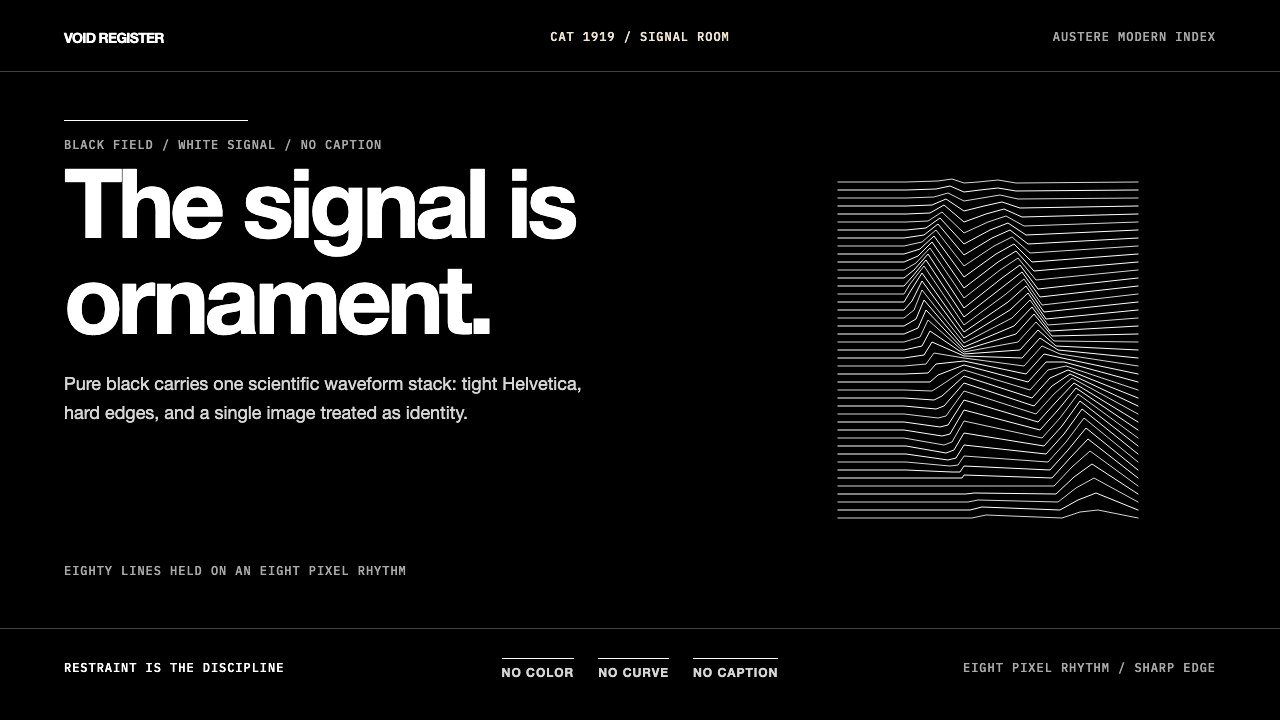 Joy Division — Unknown PleasuresRestraint becomes signal. Black field, tight Helvetica, and white pulsar line…
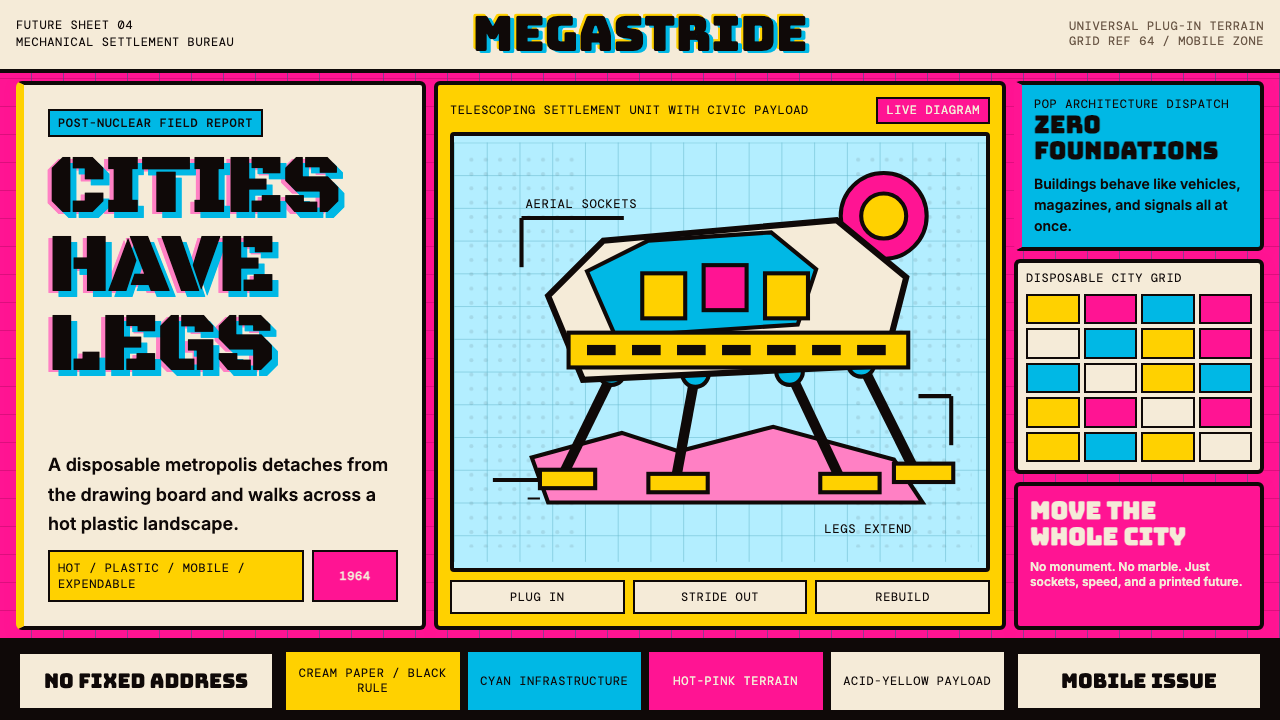 Archigram Walking City (1964)Cities refuse foundations. Hot pink, cyan, and acid yellow lock a bordered co…
 Dhaka Shaheed MinarSolemn before dawn. Marble columns and one red sun hold the page in civic sil…
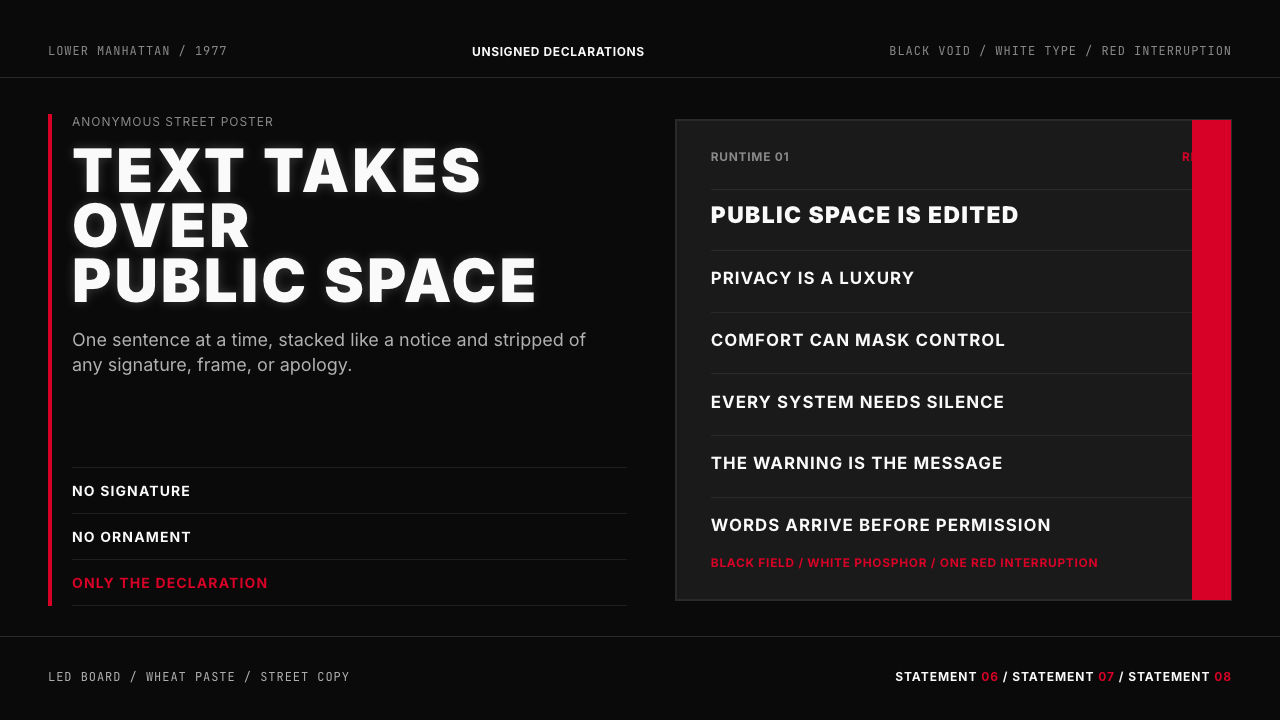 Jenny Holzer Truisms (1977)Austere declarations. White all-caps on black, cut by a single red warning.
 Klein Blue (IKB)Color becomes the content. Pure ultramarine field, white italic serif, one go…
 Olivetti Pintori (1955)Industry becomes poetry. Cream paper, machine red, and hard geometry abstract…