What is Comme des Garçons (Rei Kawakubo)?
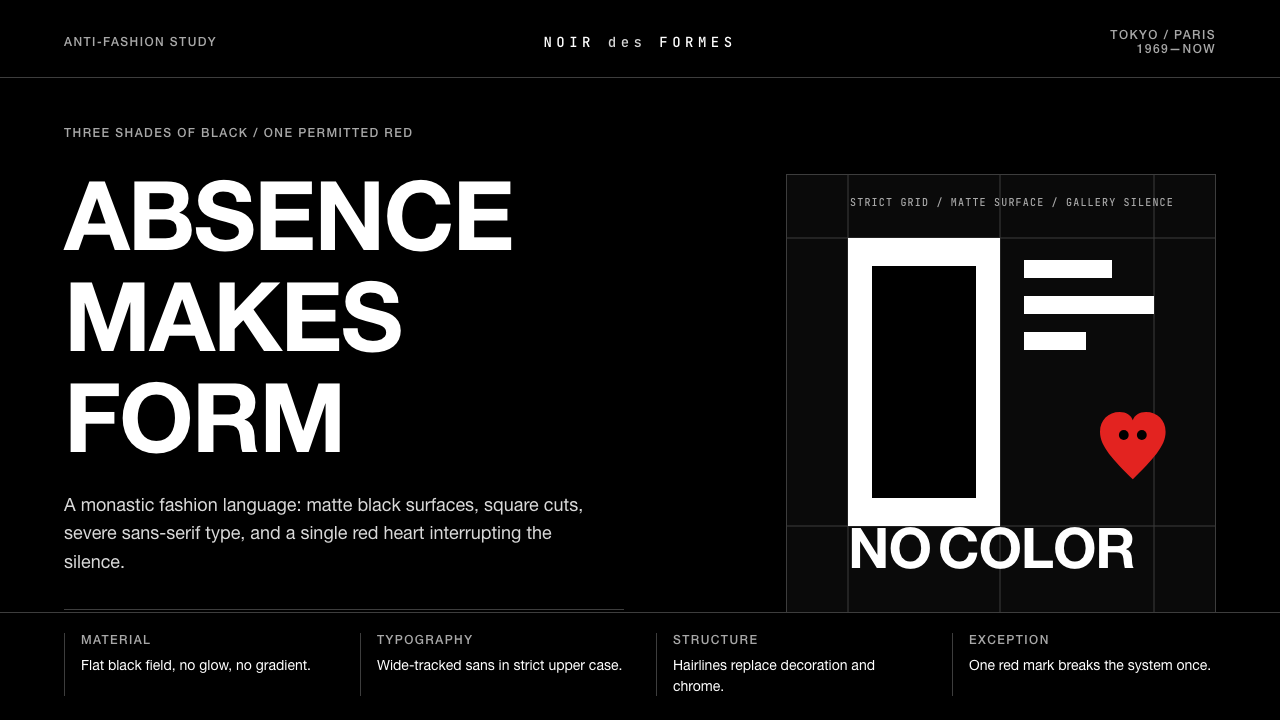
Rei Kawakubo built an empire from the color that contains all colors — black — and proved that the most radical statement a designer can make is to refuse decoration entirely.
Comme des Garçons (Rei Kawakubo) in brief
Comme des Garçons is the conceptual fashion house founded by Rei Kawakubo in Tokyo in 1969. Its visual identity is among the most severe and consequential in the history of fashion: a strict monastic system built from deep black, generous white space, austere sans-serif typography, and an almost total refusal of color, decoration, or ornament. Where other luxury houses pursue beauty through addition, Kawakubo's system pursues meaning through subtraction.
The brand's visual logic operates like a discipline rather than a style. Black is not a background choice but a philosophical position — Kawakubo famously stated she works with 'three shades of black,' acknowledging that within apparent darkness there is infinite variation. Type is set wide, with generous letter-spacing that gives each character room to exist as a form in its own right. Layouts are spare and gallery-like, treating products as art objects that require no contextual embellishment. Containers, cards, and buttons use sharp right angles; nothing rounds, nothing softens.
The one permitted exception to the system's monochrome austerity is the PLAY sub-brand, introduced in 2002 with Filip Pagowski's iconic red heart-with-eyes mascot. This single saturated element functions as the system's only counterpoint — a deliberate, controlled rupture that makes the surrounding severity more visible by contrast. Its existence confirms rather than contradicts the rule: even the playful element is governed by deliberate design thinking.

Where does Comme des Garçons (Rei Kawakubo) come from?
Rei Kawakubo founded Comme des Garçons — the name is French for 'like some boys' — in Tokyo in 1969, beginning as a clothing label before incorporating formally in 1973. She came to fashion without formal training as a designer, having studied fine arts and literature at Keio University. This absence of conventional tailoring education was not an accident but a condition: Kawakubo consistently maintained that not knowing the established rules freed her to question whether those rules served any purpose. She began making clothes because she could not find what she wanted to wear.
The decisive moment in the brand's international history came in Paris in 1981, when Kawakubo presented her spring-summer 1983 collection on the Paris runway. French fashion journalists, conditioned by decades of Parisian elegance, encountered asymmetric silhouettes, deliberately unfinished hems, clothes with holes, wrapped and bound volumes, and a near-total elimination of conventional beauty cues. The response was shock and, in some quarters, contempt. Critics described the work as 'Hiroshima chic' and 'post-atomic.' Kawakubo received these characterizations as unintentional descriptions of her actual intent: to make visible what conventional fashion systematically concealed, including damage, imperfection, and the body's own asymmetry.
Over the following decades, Kawakubo built not a brand in the conventional sense but an institution — a parallel system within the fashion world with its own retail philosophy, publishing arm, and spatial logic. Dover Street Market, the multi-brand concept store co-founded with her partner Adrian Joffe in London in 2004, became a physical embodiment of the Comme des Garçons worldview: an anti-boutique in which merchandise from disparate labels coexisted in an environment closer to art installation than retail. The store model has since expanded to New York, Tokyo, Beijing, Los Angeles, and Singapore, each location an ongoing curatorial project rather than a static shop.
The visual identity that defines Comme des Garçons today — the wordmark, the typographic system, the deep-black art-direction vocabulary — consolidated gradually across the 1980s and 1990s as Kawakubo refined her position. Junya Watanabe, who joined the company as a pattern maker in 1984 and debuted his own line under the Comme des Garçons umbrella in 1992, extended the design philosophy while developing his own formal vocabulary. The house currently operates more than a dozen sub-lines and collaborative labels, each with its own visual register but all anchored to the same fundamental anti-decorative logic.
What defines the Comme des Garçons (Rei Kawakubo) look?
Chromatic Austerity
The Comme des Garçons palette is anchored in black — not as a single flat tone but as a field of layered depths. Deep charcoal, near-black navy, and pure optical black coexist without hierarchy. Against this darkness, white appears as relief rather than background, making the space between elements feel intentional and charged. Color in the conventional sense is essentially absent from the primary brand identity, which positions the system not as bleak but as deliberately stripped — a palette that treats black as the starting point from which all meaning must be earned.
Wide-Tracked Typography
Typography in the Comme des Garçons system is characterized by unusually generous letter-spacing — the kind of tracking that slows the eye and forces each letterform to register individually. The wordmark and all branded text favor clean, humanist sans-serif forms set with considerable space between characters. This creates a quality of deliberate pause, as though the typography itself is performing restraint. Headlines are rarely large by conventional fashion standards; instead, presence is achieved through spacing and placement within a field of white or black.
Gallery-Grade Negative Space
Negative space is not empty in this system — it is load-bearing. Comme des Garçons layouts, whether in print campaigns, lookbooks, or retail environments, allocate space to silence with the same intentionality as they allocate it to content. A single garment floats in the center of a page with nothing competing for attention; a product display places one object in a case designed for several. This discipline of generous space positions each element as a considered object rather than an item in a sequence, elevating commercial work toward the conditions of gallery display.
Hard-Edge Geometry
Comme des Garçons applies sharp right-angle geometry across every touchpoint. Corners are never rounded, boundaries are never blurred, and transitions are never gradual. This hard-edge quality extends from the garments themselves — where seams and hems are used as structural statements — to the two-dimensional work, where borders, containers, and typographic frames all present as precise cuts rather than suggestions. The visual effect is decisive and uncompromising: every edge is a commitment.
Anti-Decorative Logic
The most definitive principle in the Comme des Garçons visual system is the refusal of decoration for its own sake. There are no flourishes, no gradient fields applied for visual richness, no texture overlays, no illustrative embellishments. Every element must justify its presence by function or conceptual necessity. This is more radical than minimalism, which is typically an aesthetic preference; the Comme des Garçons approach is a philosophical stance. Decoration is not simply avoided — it is regarded as a failure of thinking, a capitulation to what convention expects rather than what the work actually requires.
The Controlled Exception
The PLAY sub-brand's red heart-with-eyes mascot — designed by artist Filip Pagowski and introduced in 2002 — functions as the one deliberate break in the system's monochrome severity. It appears as a single saturated graphic on otherwise plain garments, acting as punctuation within an otherwise silent sentence. The heart's visual simplicity — flat, bold, immediate — means it does not contradict the system's values but extends them: even the playful element is diagrammatic and zero-ornament. Its presence makes the surrounding austerity legible by contrast.
Spatial Restraint in Retail
The Comme des Garçons approach to retail space directly mirrors its typographic and photographic logic. Dover Street Market locations treat merchandise as art objects requiring space, light, and conceptual framing rather than density and variety. Display units are often sparse — a single rack in a large room, a single object on a table — and the store environments are regularly redesigned as ongoing installations. This spatial discipline ensures that the brand's visual system does not end at the printed page or digital screen but extends into three-dimensional experience.

Who shaped Comme des Garçons (Rei Kawakubo)?
Kawakubo founded Comme des Garçons in Tokyo in 1969 and remains its creative director. She studied fine arts and literature, not tailoring or pattern-making, and has consistently credited this training gap as the source of her freedom to question fashion's foundational assumptions. Her 1981 Paris debut redefined the terms on which non-Western designers could be taken seriously by the European fashion establishment. She has said she is not interested in clothes but in 'creating things that didn't exist before.' The 2017 retrospective of her work at the Metropolitan Museum of Art in New York — only the second retrospective the Costume Institute has dedicated to a living designer — was titled 'Art of the In-Between,' acknowledging her deliberate occupation of the space between categories.
Joffe joined Comme des Garçons in 1987 and became its president, serving as both Kawakubo's business partner and life partner. He is responsible for the commercial architecture that allows the brand's radical aesthetic to function as a viable enterprise — managing its network of sub-lines, collaborative projects, and retail operations. The conception of Dover Street Market, which Joffe co-developed with Kawakubo, represents his most lasting structural contribution: a retail format that treats curation and installation as core business functions rather than marketing adjacent activities.
Warsaw-born graphic designer and illustrator Pagowski created the red heart-with-eyes emblem that became the PLAY sub-brand's signature mark in 2002. The image had appeared in his personal illustration work before Kawakubo selected it. Its graphic simplicity — a flat red heart bearing a pair of round eyes — has made it one of the most reproduced fashion graphics of the early twenty-first century, appearing across apparel, accessories, and collaborations with Nike, Converse, and others. Pagowski has described the image as having a dual nature: innocent and slightly sinister simultaneously.
Watanabe joined Comme des Garçons as a pattern maker in 1984 and has operated his own line under the Comme des Garçons umbrella since 1992. He is widely regarded as the most direct heir to Kawakubo's design philosophy, extending her interest in deconstruction and formal experimentation while developing a more technically precise and often Western-referencing vocabulary. His work on functional and workwear-derived garments, recombining utilitarian fabrics and construction methods, represents one branch of the Comme des Garçons conceptual tree that leans toward materiality and craft as much as concept.
Throughout its history, Comme des Garçons has maintained a practice of not foregrounding individual collaborators — photographers, art directors, set designers — in ways that typical fashion brands use to signal creative credibility. The house's photographic work, particularly its biannual magazine Six (published 1988–1991), brought together figures including Peter Lindbergh and Cindy Sherman, but the work was always framed as the brand's rather than the contributor's. This practice of institutional rather than personal authorship is itself a design decision consistent with the system's anti-decorative logic: no individual flourish should overwhelm the whole.
How do you use Comme des Garçons (Rei Kawakubo) today?
The Comme des Garçons aesthetic is one of the most challenging historical styles to apply outside fashion because its power depends not on specific visual elements but on what is absent. Applying it correctly requires a genuine commitment to removal: every design decision must begin with 'what can be taken away?' rather than 'what can be added?' A layout or interface built in this spirit will feel strange and perhaps uncomfortably sparse at first; that discomfort is partly the point.
For presentation slides, the Comme des Garçons system works best when the designer resists the impulse to use the full available canvas. A cover slide might place a single line of widely-spaced type against a field of pure black, with nothing else present — no logo mark in the corner, no decorative rule along the bottom, no background texture. Content slides should treat each idea as a discrete object: one concept per slide, minimal text, no bullet-point lists, all typographic hierarchy achieved through scale and weight alone rather than color differentiation. Data visualizations should be stripped back to their essential geometric forms: the data, the axis, and nothing else. Any element that explains what the chart is rather than what it shows should be cut.
For web user interfaces, particularly dashboards, pricing pages, and product detail pages, the approach demands that the system choose one governing contrast — typically dark type on a near-white ground, or light type on a deep near-black ground — and hold that choice without variation across the entire surface. Interactive states (hover, focus, active) should be signaled through weight or opacity changes rather than color introduction. If a second color must enter the system, it should be as constrained and singular as the PLAY heart: one deliberate accent, never decorating but always signaling.
For editorial content and marketing materials, the style rewards commitment to asymmetric placement and extreme scale contrast. An editorial spread might fill three-quarters of the page with a single cropped image against black, then set the article headline in small widely-tracked type at the very bottom edge. Marketing headers can operate with similar boldness: a full-width black block with a product name in white at generous tracking, no imagery, no supporting graphics. The effect reads as confidence so complete that no persuasion is needed — the restraint performs authority.
The most common mistake when working in this system is treating the absence of color as permission for maximalist typography — outsized wordplay, multiple typeface combinations, aggressive layering of text at competing weights. This misreads the system entirely. In Comme des Garçons aesthetic, austerity is total: if the color is gone, the typography must become quieter too, not louder to compensate. A second common error is importing soft-edged elements — blurred drop shadows, rounded corners, gradient fills — under the assumption that they read as contemporary refinements. They do not; they read as a failure of commitment to the system's fundamental argument.

Comme des Garçons (Rei Kawakubo) — FAQ
Is Comme des Garçons a style or a concept?
It is primarily a concept that happens to have a consistent visual style as its expression. Kawakubo has repeatedly stated that she is not interested in making beautiful things but in questioning what clothing and design are for. The visual system — the black, the white space, the austere typography — is the result of that conceptual position, not the starting point. This distinction matters for application: if you use the visual language without understanding the underlying argument, the result will look like a dark, sparse layout rather than a coherent system. The system's austerity is always in service of a position about what design should refuse to do.
How does this system handle imagery and photography?
Photography in the Comme des Garçons tradition is treated as a flat graphic element rather than a window into a scene. Campaign images are typically high-contrast, shot against neutral or void-like backgrounds, often cropped to emphasize geometric or structural qualities of the garment rather than the model's expressiveness. The subject is frequently presented in a way that feels ambiguous or even uncomfortable — stillness, turned heads, occluded faces. When photography is absent, the space it would occupy is not filled with illustration or graphic pattern but left as air. The anti-decorative principle applies to imagery as fully as to typography.
Can this style work for digital products and interfaces, or is it too severe?
It can work, but requires careful calibration for interactive contexts. The challenge is that digital interfaces carry usability obligations that print does not: users must be able to scan, navigate, and recover from errors efficiently. Applied without adaptation, the style's reduction can make interactive states invisible and navigation ambiguous. The solution is to maintain the visual austerity while ensuring that functional signals — which element is interactive, which state is active, what action is available — are legible through weight, scale, or opacity variation rather than color. The style also works better at larger viewport sizes where there is genuine room for the negative space to function; on small mobile screens, the generous white or black fields can become wasted real estate rather than intentional silence.
How does the PLAY sub-brand fit without contradicting the parent system?
The PLAY heart works within the system rather than against it because it obeys the same formal principles despite introducing color. The heart is flat and diagrammatic — no gradients, no drop shadows, no dimensional illusion. It uses a single saturated color, not multiple. It is a mark rather than an illustration. And crucially, it appears as a singular accent on otherwise entirely plain garments: one element of deliberate punctuation in an otherwise silent composition. This is the model for any designer who wants to introduce a single accent into a Comme des Garçons-inspired system — the accent must be equally diagrammatic, equally flat, and must remain truly singular rather than proliferating into a supporting cast.
What kinds of projects should avoid this aesthetic entirely?
Projects where the primary emotional register is warmth, accessibility, playfulness, or sensory pleasure are poor fits for the Comme des Garçons visual system. Children's products, food and beverage brands, healthcare and wellness platforms, community-oriented social applications, and anything targeting audiences who equate severity with unfriendliness will find the system working against rather than for them. The style is also a poor match for contexts requiring high information density — comparison tables with many rows, complex form flows, notification-heavy dashboards — where its generous negative space becomes a functional problem rather than an expressive asset. Knowing when the style's values conflict with the communication's values is as important as knowing how to apply it correctly.
Related design styles
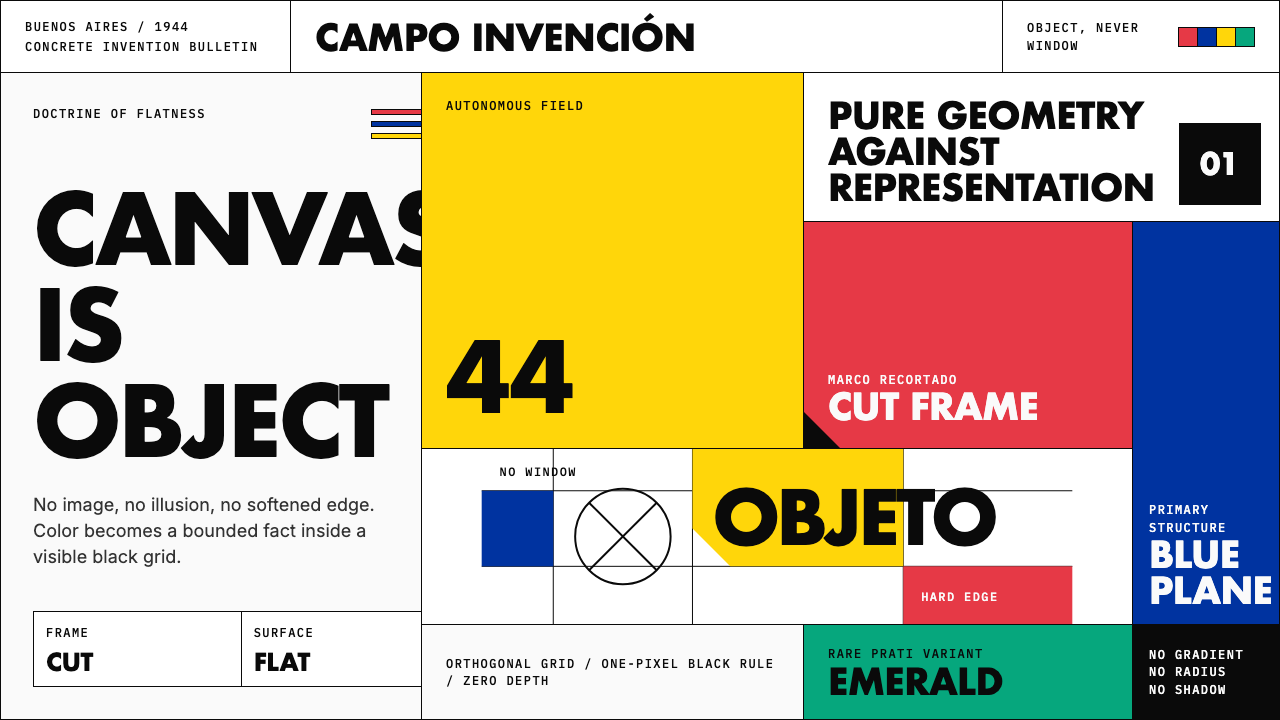 Argentine Arte ConcretoCanvas becomes object. Primary blocks, black hairlines, and a cut-frame grid…
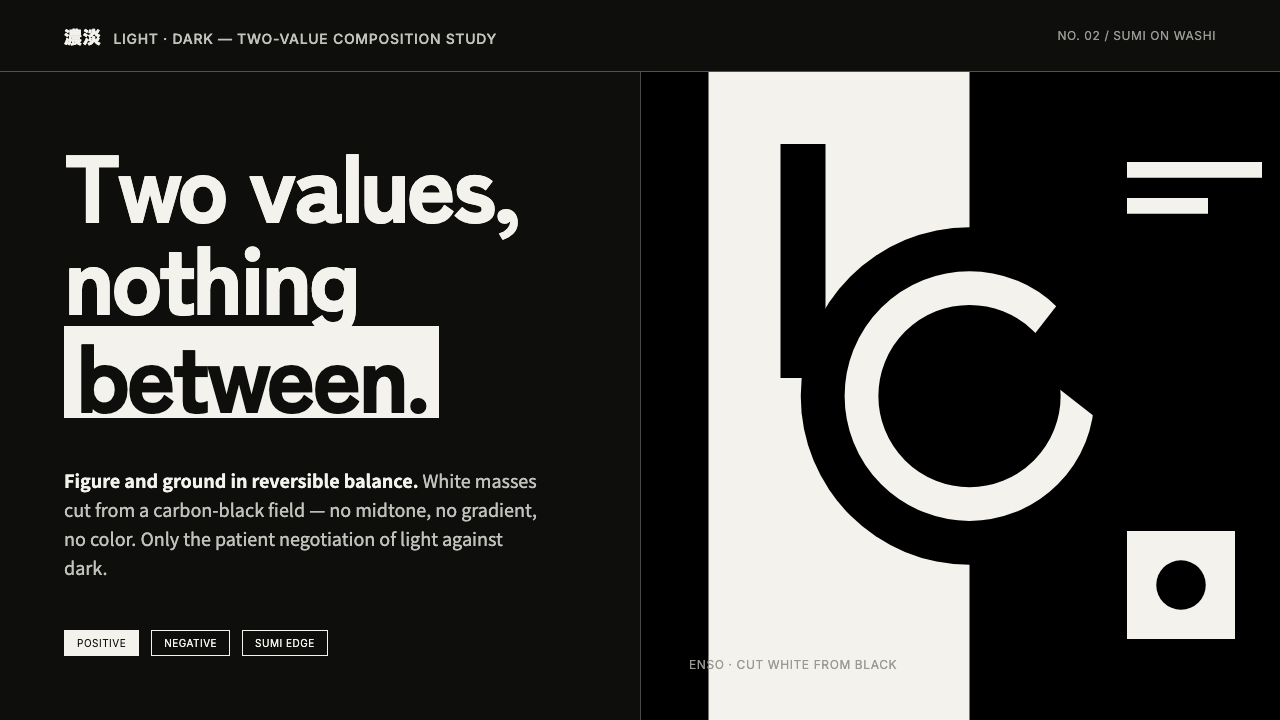 Notan Light-DarkTwo values, nothing between. White masses cut from a carbon-black field, figu…
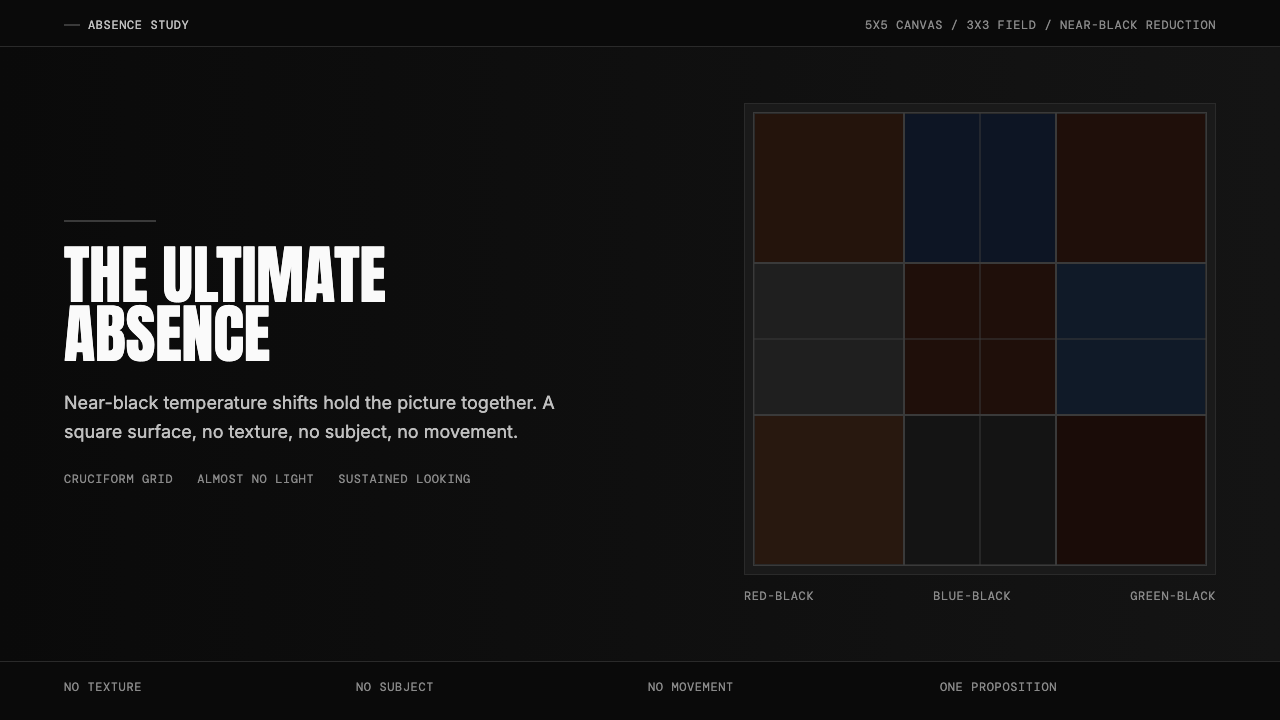 Ad Reinhardt Black Painting (1953)Austere absence. Near-black grid shifts reveal structure on sustained looking.
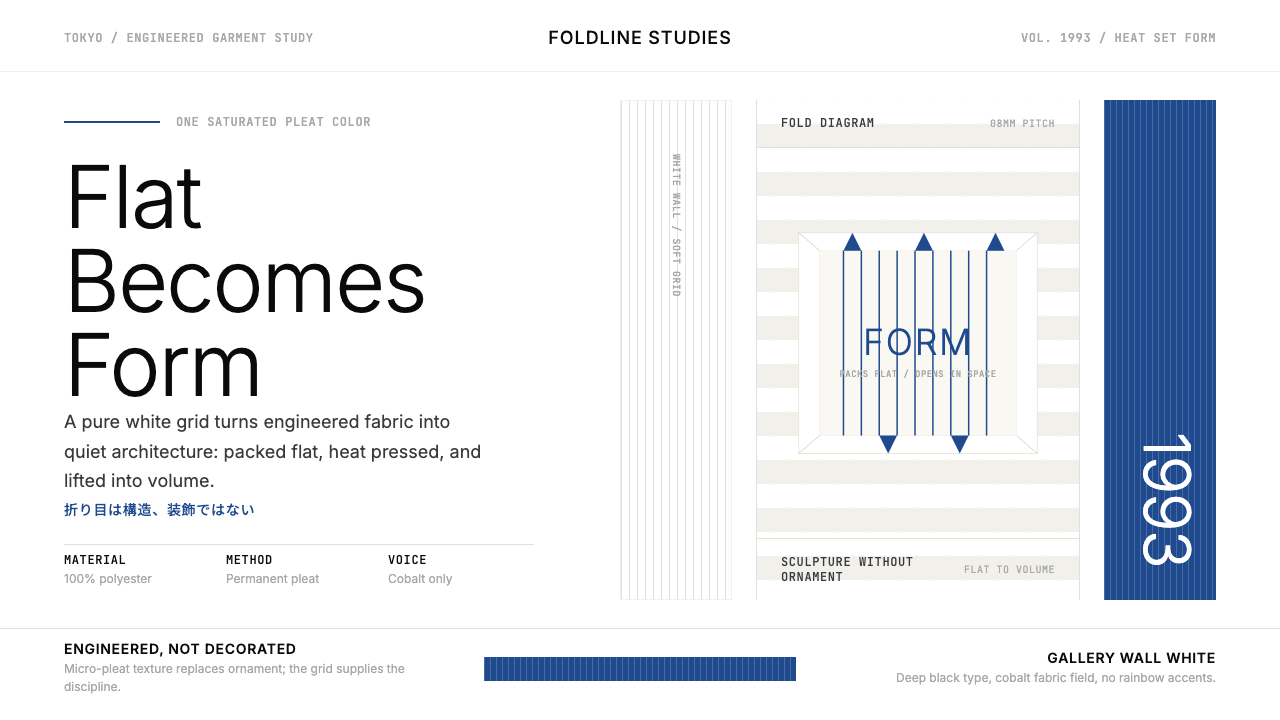 Issey Miyake Pleats PleaseEngineering wears white. Cobalt pleat stripes and a strict Inter grid turn fa…
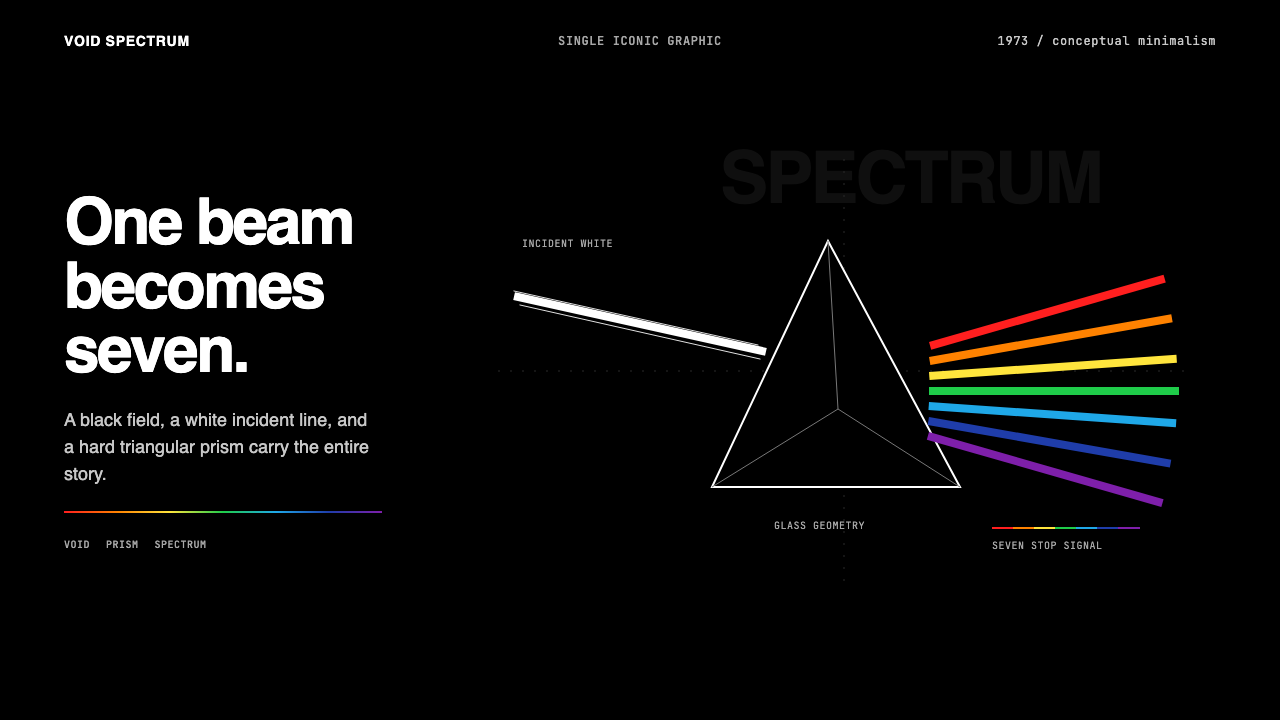 Pink Floyd — Dark Side of the MoonOne image does everything. Black void, white beam, hard prism, seven exact co…
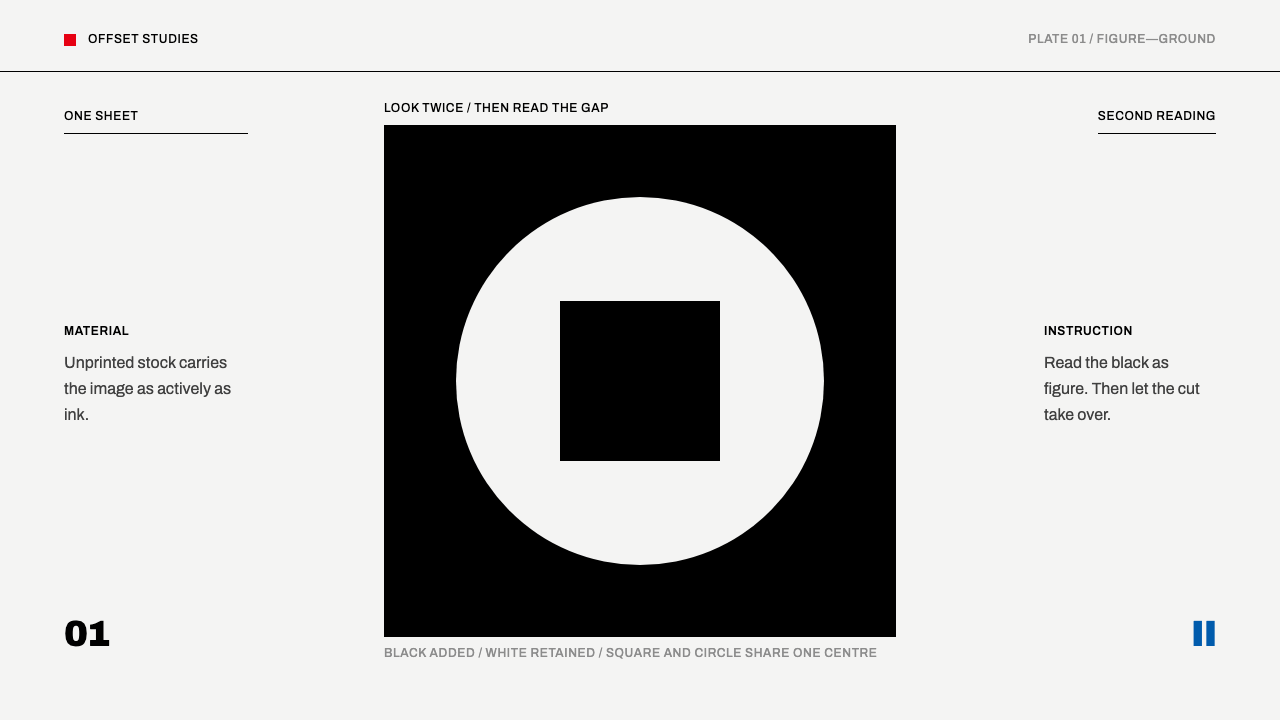 Shigeo Fukuda OpticalOne ink, two readings. Black geometry and a white cut make the sheet do half…