What is Czech Devětsil Avant-Garde?
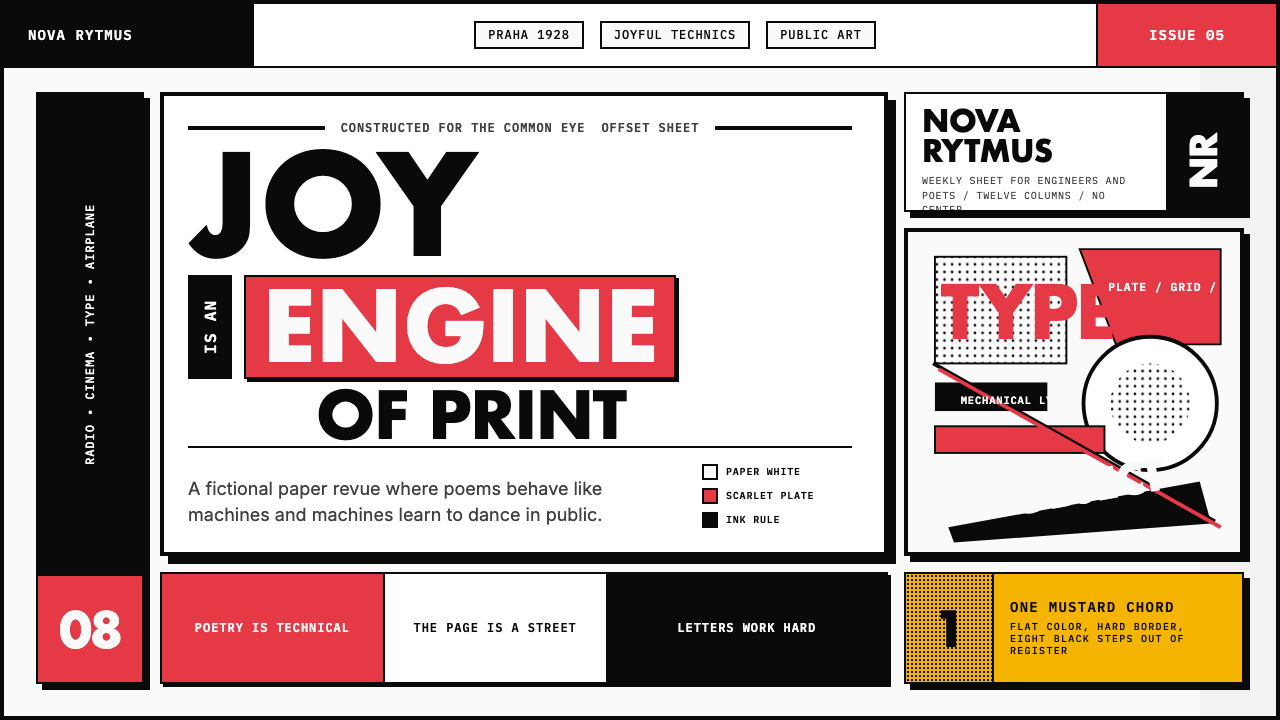
Devětsil declared that modern art should be joyful — and then proved it with scarlet ink blocks, rotated type, and aggressively asymmetric grids that still feel urgent a century later.
Czech Devětsil Avant-Garde in brief
Czech Devětsil Avant-Garde is the visual language produced by the Devětsil group, a Prague-based modernist collective founded in 1920 whose members issued the Poetism manifesto — the radical declaration that art should be joyful, technical, and democratic. Their magazines, book covers, exhibition posters, and typographic experiments fused Russian Constructivism with Bauhaus structural rigor and a distinctly Bohemian wit, producing a style that is at once politically charged and visually playful.
The aesthetic is built on three structural pillars. First, a focused palette: scarlet and ink-black on paper white, with mustard yellow as the signature third chord — no pastels, no gradients, only the saturated primary hues of the offset press. Second, typographic freedom: letterforms treated as objects in their own right, set at wildly varying scales, rotated at sharp angles, and mixed in weight within a single phrase so that the page reads as a visual event before it is read as language. Third, the photomontage and geometric color block as compositional devices — hard-edged shapes and sharply cropped photographs collide on the page along diagonal sight lines, creating the kinetic energy of a machine in motion.
What separates Devětsil work from its Constructivist and Bauhaus contemporaries is the Poetist insistence on pleasure. The grid is real but never austere; the geometry is strict but animated by the sense that design should be fun to look at. Karel Teige, the group's primary theorist and art director, described Poetism as an art of living — closer to circus, cinema, and sport than to the gallery wall. That sensibility shows in every page he designed.

Where does Czech Devětsil Avant-Garde come from?
Devětsil was founded in Prague in October 1920, just two years after the establishment of Czechoslovakia as an independent republic. The country's sudden sovereignty created a cultural vacuum and an intellectual hunger: Czech artists who had spent decades subordinate to Viennese taste now had license to build something entirely new. The group took its name from a common meadow plant — the butterbur — a deliberately humble, anti-monumental choice that signaled its rejection of the grand gestures of nineteenth-century Czech nationalism.
The founding circle included the theorist and graphic designer Karel Teige, the painter and poet Vítězslav Nezval, and the painters Toyen (born Marie Čermínová) and Jindřich Štyrský. Teige was the organizing intelligence: he traveled to Paris, Berlin, and Moscow, corresponded with Le Corbusier and El Lissitzky, and brought back a first-hand knowledge of international avant-garde movements that he then synthesized into the Poetism framework. The 1924 Poetism manifesto, co-authored by Teige and Nezval, argued that Constructivism had solved the problem of useful form — now art should solve the problem of joy.
The visual laboratory for the movement was the little magazine. Teige edited and designed Disk (1923) and then ReD — an acronym for Revue Devětsilu — from 1927 to 1931. These publications were themselves designed objects: asymmetric covers with rotated type, photomontage interiors, geometric color blocks used as structural dividers. The printing technology of the era — letterpress and offset lithography with manually mixed inks — gave the work a characteristic slight off-register quality, a faint misalignment between color layers that reads not as error but as hand-made energy.
By the late 1920s, several members were moving toward Surrealism — Toyen and Štyrský founded a movement they called Artificialism, which merged Constructivist structure with dreamlike subject matter. The group formally dissolved in 1931 after a decade of sustained and remarkably coherent output. Its legacy was kept alive partly through Prague's architecture — Teige was a theorist of the functionalist housing blocks built in the city through the 1930s — and partly through the diaspora of its ideas into postwar Czech graphic design, which remained one of the most inventive in Europe through the 1960s and 1970s.
What defines the Czech Devětsil Avant-Garde look?
Palette: Scarlet, Black, Mustard
The Devětsil palette is three-note and uncompromising: scarlet as the dominant action color, ink-black for typographic structure and shadow masses, and mustard yellow as the warm third chord that keeps the composition from reading as merely aggressive. Paper white is the ground, never tinted or broken. This is not the broad primary triad of the Bauhaus but a more specific, hotter selection — the scarlet is closer to a printer's vermilion than to a painterly crimson, reflective of the movement's explicit embrace of industrial offset printing as the medium of democratic art.
Typography as Object
In Devětsil design, type is never merely a vehicle for language — it is a visual form that occupies space, has weight, and commands attention as a drawn shape does. Letterforms appear at wildly varying scales within a single composition, rotated at forty-five or ninety degrees, mixed across heavy and light weights in the same phrase. Sans-serif forms are overwhelmingly preferred, reflecting the Constructivist identification of the serif as a historical remnant incompatible with modernity. The title of a magazine might be set vertically down the left margin while a pull-quote runs at a diagonal across the center of the page.
Asymmetric Grid and Diagonal Energy
Devětsil compositions are organized on a strict underlying grid but are never symmetrical. Balance is achieved through tension rather than mirroring: a heavy scarlet block in one quadrant is counterweighted by a cluster of small rotated text in another. The distinctive feature that separates Devětsil from other Constructivist traditions is the diagonal — sight lines, text rotations, and the implied vectors of photomontage elements all create oblique movement across the page, giving layouts a kinetic quality that feels more like a frame from a film than a static object.
Photomontage and Hard-Edge Collage
Devětsil was among the earliest Central European movements to treat photomontage as a primary compositional language rather than a novelty. Photographs are cropped to geometric silhouettes — a face reduced to a circle, a hand to a rectangle — and combined with flat color blocks in compositions that read as diagrams of modernity. The cutting is always hard: no feathered edges, no soft blends. The effect is a visual world where photographic reality and geometric abstraction occupy the same flat plane on equal terms.
Off-Register Print Texture
A characteristic surface quality of Devětsil-period work is the slight misalignment between color layers that offset lithography of the 1920s produced when inks were hand-registered. This is not imprecision to be corrected but a structural property of the medium: the faint halo of one color appearing just beyond the edge of another, or the slight shift that makes a black headline sit a hair off its scarlet ground. Contemporary applications of this aesthetic treat this quality as a deliberate choice — introducing a controlled degree of layer offset that signals hand-craft without abandoning precision.
Geometric Color Blocks as Architecture
Flat geometric shapes — rectangles, squares, occasional circles — function as the structural architecture of the page, not as decorative fills. A scarlet rectangle is not illustrating anything; it is organizing space, anchoring the composition's weight, and creating the visual pressure that makes the surrounding type resonate. These blocks are drawn from the same printer's vocabulary as the typographic forms: they have the density and tactility of a saturated ink layer, not the weightlessness of a software fill.
Democratic Joy as Principle
The most distinctive thing about Devětsil work relative to its contemporaries is not any single formal device but the underlying attitude: design should be pleasurable to encounter. Where Bauhaus work can read as sober and where Soviet Constructivism can read as commanding, Devětsil layouts have a playful wit — the composition feels like it is enjoying itself. This is not decoration; it is a political commitment to the idea that beauty and pleasure belong to everyone, not only to the educated elite who could afford the gallery wall.

Who shaped Czech Devětsil Avant-Garde?
Teige was the intellectual engine and primary visual practitioner of Devětsil. As editor and art director of Disk and ReD, he designed covers and layouts that remain among the most cited examples of Central European modernism. He wrote the theoretical frameworks — from Poetism through Constructivism to his later engagement with Surrealism — that gave the group its ideological coherence. His typographic experiments, particularly the practice of treating letterforms as autonomous graphic objects on the page, anticipate practices that would not become standard in graphic design until the postmodern era.
Toyen adopted a gender-neutral pseudonym as a deliberate act of identity construction, rejecting conventional feminine categorization. As a painter and illustrator within Devětsil, she contributed imagery that sat at the boundary between Constructivist geometry and surrealist dreamscape. With Štyrský she developed Artificialism — a short-lived but historically significant movement that attempted to fuse the structural clarity of Constructivism with the interior imagery of psychoanalytically influenced painting. Her work demonstrates that the Devětsil orbit was not a single unified style but a conversation among distinct visions.
Štyrský was Devětsil's most restless visual experimenter. His book cover designs pushed the photomontage vocabulary further than Teige's more systematically typographic approach — combining deeply personal imagery with the movement's hard-edged formal language. His collaboration with Toyen in Artificialism produced some of the most psychologically complex images associated with the Czech avant-garde. His work points toward the later surrealist current that would absorb many Devětsil members as the 1930s progressed.
Nezval was the movement's poet and co-author of the 1924 Poetism manifesto. His contribution to the visual culture of Devětsil was less direct than Teige's but no less important: his language — celebrating the cinema, the circus, the department store window, and the modern city — gave Teige's visual vocabulary its subject matter and its emotional register. Nezval later became the primary Czech proponent of Surrealism, founding the Czech Surrealist Group in 1934, and his trajectory from Poetism to Surrealism tracks the broader evolution of the Devětsil generation.
How do you use Czech Devětsil Avant-Garde today?
Devětsil Avant-Garde is one of the more technically demanding historical styles to apply well, because it combines strict structural discipline — the asymmetric grid, the deliberate color restriction — with a quality of energetic playfulness that is hard to fake. The starting point for any application is to understand that the scarlet is doing structural work, not decorative work: it marks the primary focal point, anchors the most important piece of information, and is used once in the composition rather than scattered.
For presentation slides, the style works at two registers. Cover slides benefit from treating the entire frame as a single poster-like composition: one dominant color block, a title in large sans-serif type at a scale that fills the available space, and a secondary element — a date, a subtitle, a cropped photograph — held in deliberate tension with the primary block. Content slides should be stripped to a single organizing grid: type hierarchies defined purely by size and weight rather than color, with scarlet reserved only for the single most critical label or data point per slide. Data visualization slides take on a diagrammatic quality — the bars and segments of charts become geometric color objects, with the key metric rendered in the accent color and all supporting data in black or near-black.
For web interfaces, the style is particularly effective on dashboards, analytics tools, and pricing pages where information density demands clear visual hierarchy. Apply a strict column grid, use paper-white or near-white as the background, set body text in black for maximum contrast, and deploy the scarlet exclusively for primary actions, critical alerts, or the highlighted tier in a pricing table. Card components should use hard offset shadows rather than soft ones, giving the UI the physical quality of layered paper. Navigation should be typographic — the wordmark and page labels — with geometric indicators rather than illustrative icons.
For editorial and marketing applications, the style's poster-like boldness is most effectively deployed through strong typographic contrast. A feature section header set at an outsized scale, with a short body text block in a much smaller weight, creates the size-contrast energy that characterizes authentic Devětsil typography. Marketing landing pages can alternate between white-ground and scarlet-ground sections for visual rhythm, with mustard as an accent color for secondary calls-to-action. Editorial layouts should assign a wide margin — left or right — for pull-quotes or labels, and use a hard horizontal rule in black or scarlet as a section break rather than decorative ornaments.
The most common mistake when applying this style is using the scarlet and mustard simultaneously at high saturation across large areas, which collapses the hierarchy that makes the palette effective. Authentic Devětsil compositions lead with one dominant color and introduce the second as a calculated accent — not a co-equal partner. A second common error is applying rotation to type decoratively, spinning labels without a compositional reason. In the original work, rotated type creates a diagonal vector that the rest of the composition answers; it is not garnish but architecture. A third mistake is softening the palette toward orange or terracotta because the original scarlet reads as aggressive — but that tension is the point. The scarlet earns its place by doing structural work.

Czech Devětsil Avant-Garde — FAQ
How does Devětsil differ from Russian Constructivism if they look so similar?
The visual vocabulary overlaps substantially — both movements use asymmetric grids, sans-serif type, geometric color blocks, and photomontage. The difference is ideological and emotional. Russian Constructivism was in the service of collective political goals: its imagery is commanding, its tone often heroic or instructional. Devětsil's Poetism manifesto explicitly argued that Constructivism had solved the problem of useful form, and that the next task was joy. Devětsil layouts have a wit and playfulness — rotated type used with evident delight, compositions that feel like they are enjoying themselves — that Soviet work rarely permitted. The palette also differs: Devětsil's scarlet-and-mustard is warmer and more specific than the broader red-black-white of most Soviet work.
Can the style work on a dark background, given that the originals were almost all printed on white paper?
A dark inversion is possible but requires significant adjustment. On a dark ground, the mustard yellow tends to dominate aggressively — it becomes the loudest element rather than the warmest — and the scarlet, which on white reads as vibrant but controlled, can bleed into the surrounding field and lose its structural precision. A workable dark variant commits to a single foreground accent color, typically scarlet or mustard but not both, treats the other as a structural or typographic element only, and uses near-white rather than pure white for type to reduce the harshness of the contrast. The off-register print texture quality, if carried into a dark variant, becomes more prominent and needs to be used with restraint.
Is Poetism the same as the Devětsil visual style, or are they different things?
Poetism was the philosophical and aesthetic program — the argument that modern art should prioritize joy, entertainment, and democratic accessibility, drawing on cinema, circus, sport, and urban life as its reference points. The Devětsil visual style is the design practice that emerged from this argument: the specific palette, typographic approach, and compositional methods that Teige and others developed in their magazines and book covers. Poetism is the 'why'; the visual style is the 'how'. This distinction matters in application: you can apply the Devětsil visual vocabulary to any context, but the result will feel authentic only if the underlying intent carries some of the Poetist spirit — a genuine desire to make the designed object pleasurable rather than merely correct.
How should photography be handled in a Devětsil-inspired design?
Photography in Devětsil work is never naturalistic and never decorative in the conventional sense. Images are cropped to geometric silhouettes or to hard rectangular blocks that read as color planes rather than windows onto scenes. High contrast is essential: the photograph should read clearly alongside solid color blocks without competing tonally or creating ambiguity about which element is primary. In contemporary applications this translates to treating photography as a flat plane — silhouetting against white, cropping to a strict geometric shape, or converting to a high-contrast duotone using the palette's black and scarlet. Soft-edged images, vignettes, and atmospheric photography are incompatible with the style's structural logic.
What kinds of products or brands are a poor match for this style?
The Devětsil aesthetic is demanding and specific in its emotional register — it projects energy, intelligence, and a degree of confrontational boldness. This makes it poorly suited to contexts where softness, warmth, or organic sensory richness are the desired emotional qualities: food and beverage brands, children's products, wellness and healthcare, luxury goods that trade on heritage or artisanal craft, and consumer products whose audience expects approachability and ease. The style also struggles in contexts that require cultural specificity or local warmth — the geometric universalism that is its strength can read as cold or rootless in markets where cultural connection is a purchase driver. It works best for technology tools, analytical platforms, editorial media, and any brand that wants to signal rigor, intelligence, and a commitment to the modern.
Related design styles
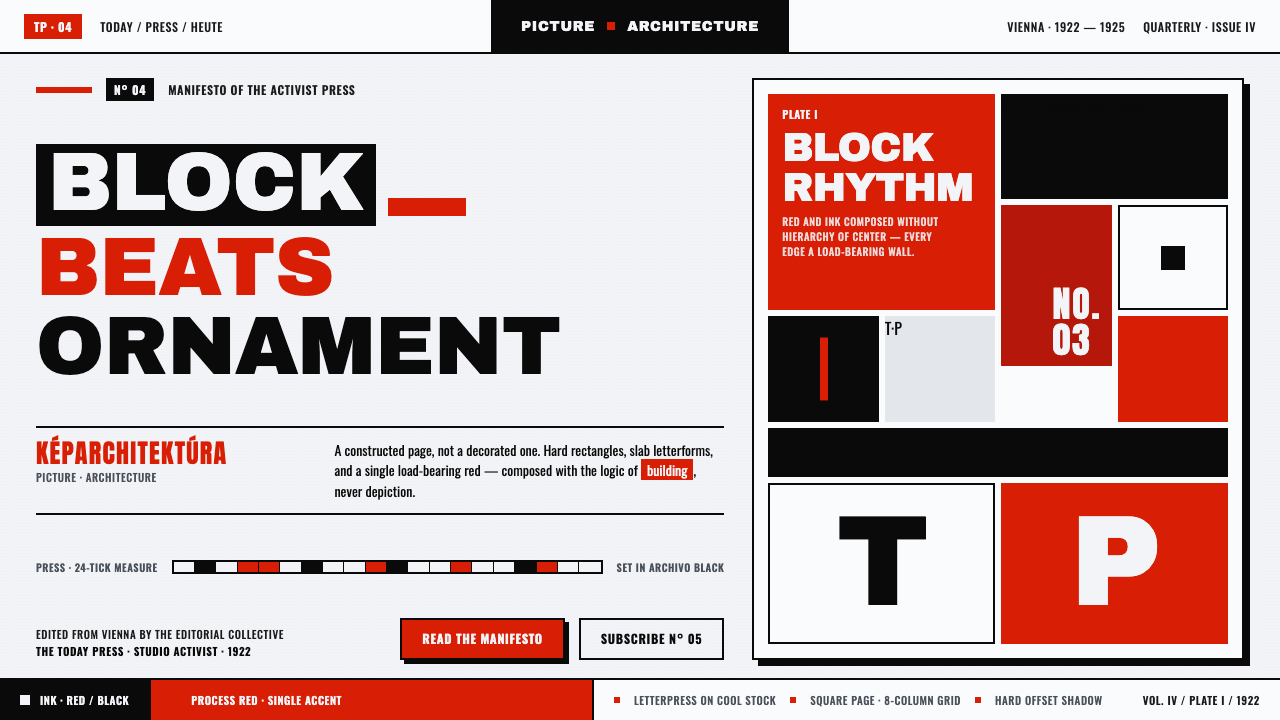 Lajos Kassák MA ConstructivismPage as building, not picture. Red and ink slab-sans blocks set asymmetricall…
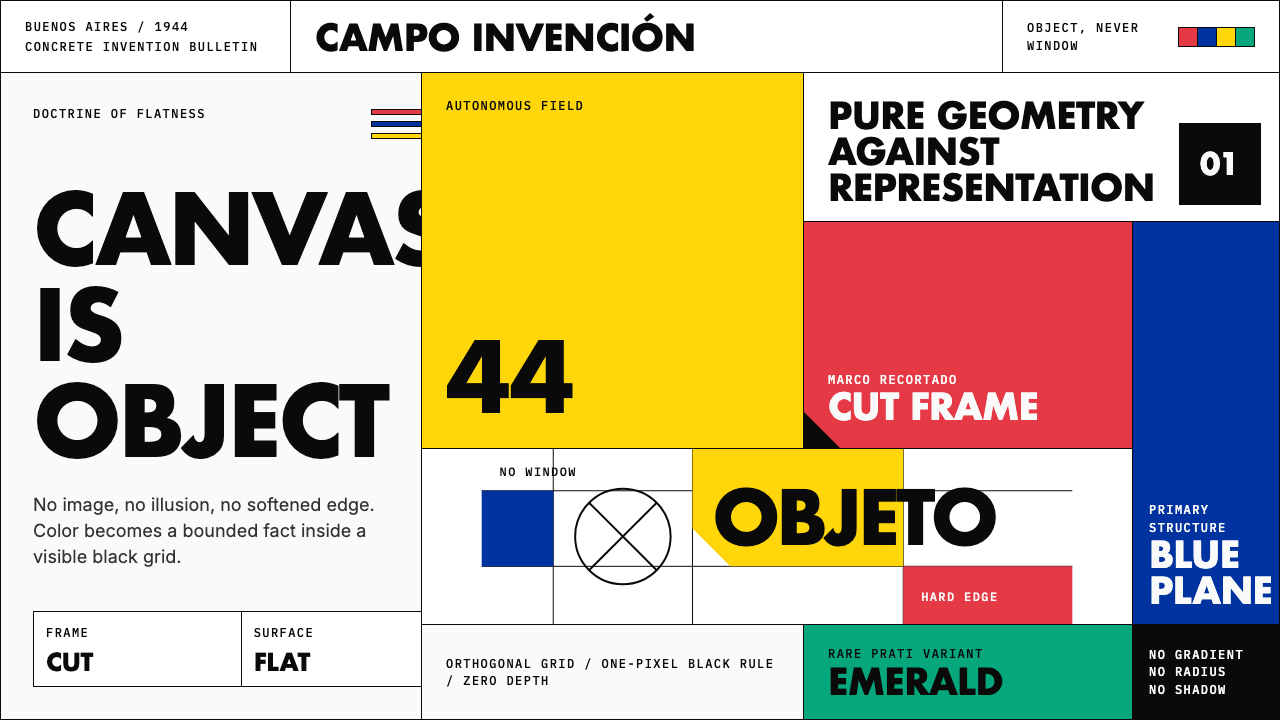 Argentine Arte ConcretoCanvas becomes object. Primary blocks, black hairlines, and a cut-frame grid…
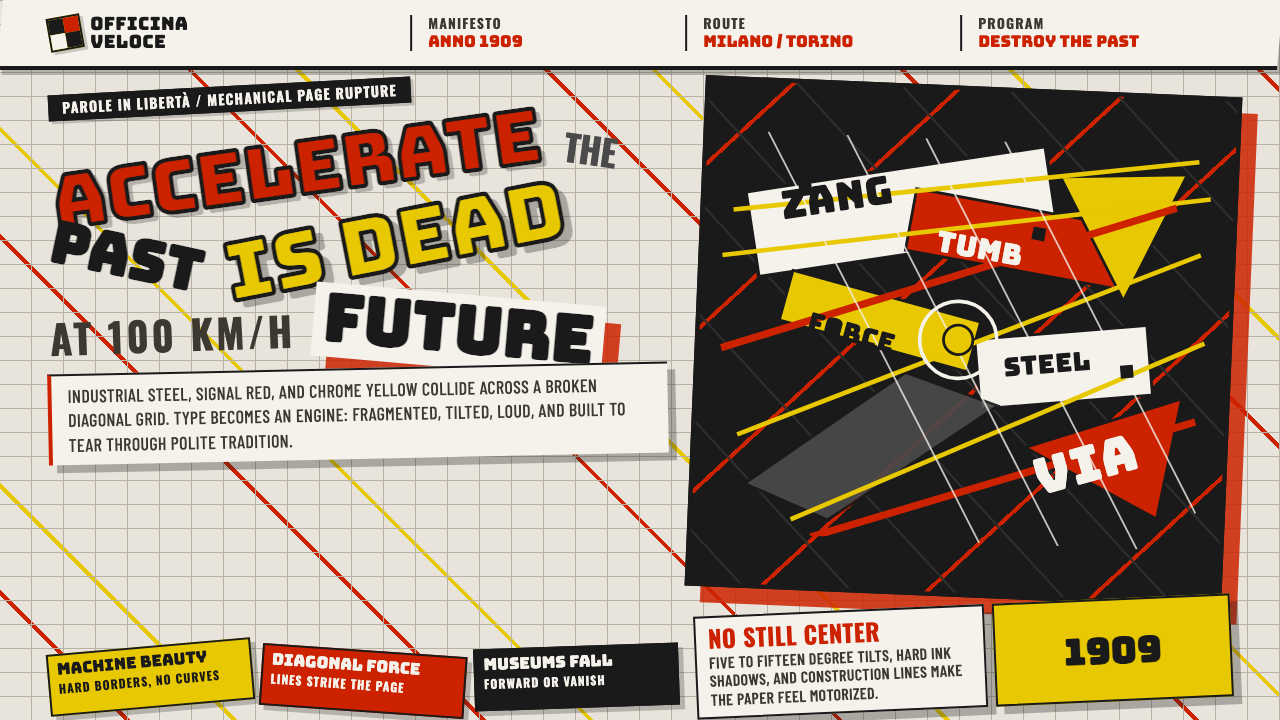 Italian Futurism (Marinetti 1909)Speed murders tradition. Signal red and chrome yellow slash a broken diagonal…
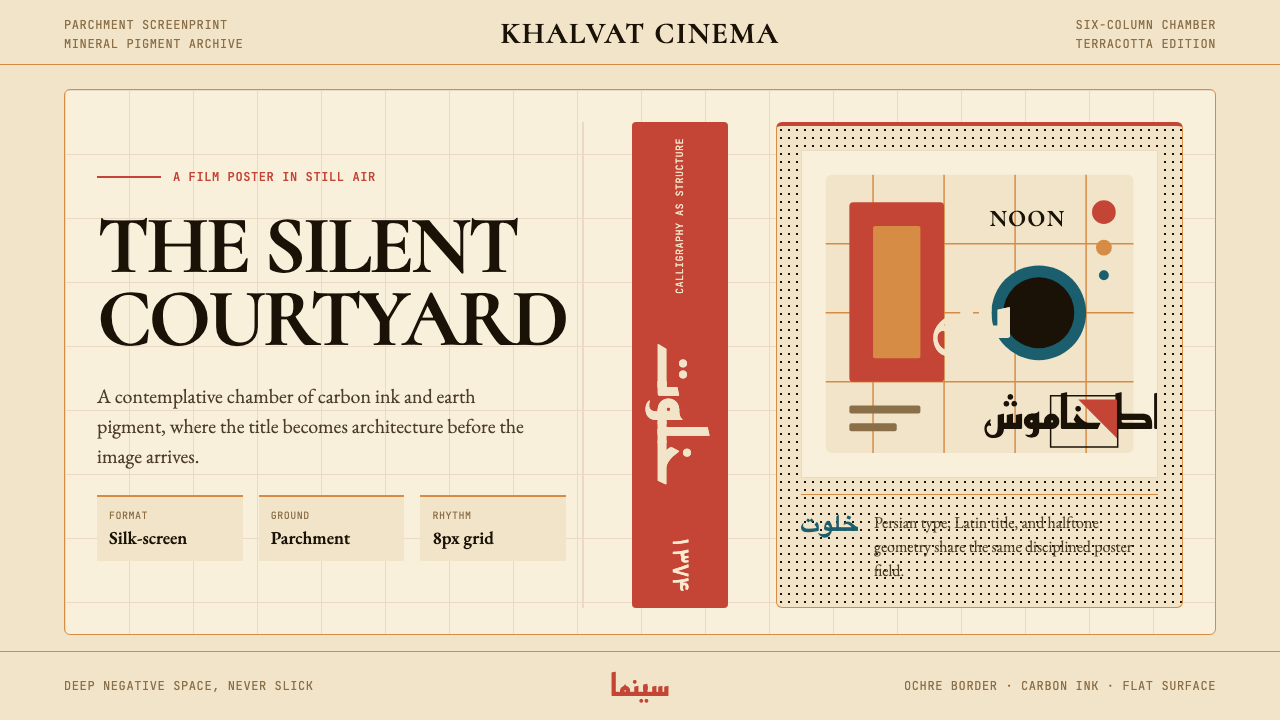 Iranian Modernist Cinema PosterStillness becomes monumental. Terracotta Kufi type breathes inside a Swiss pa…
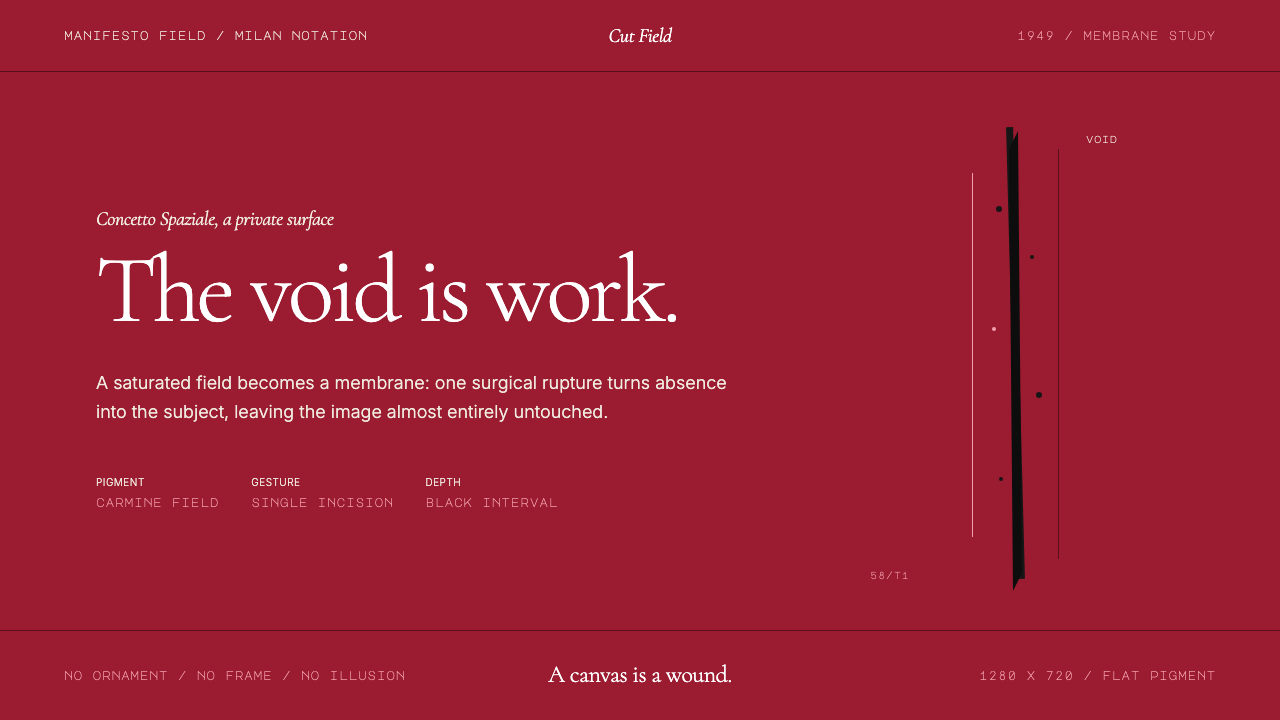 Spatialism (Fontana Cut, 1949)Absence becomes medium. Carmine field, Garamond restraint, one black incision.
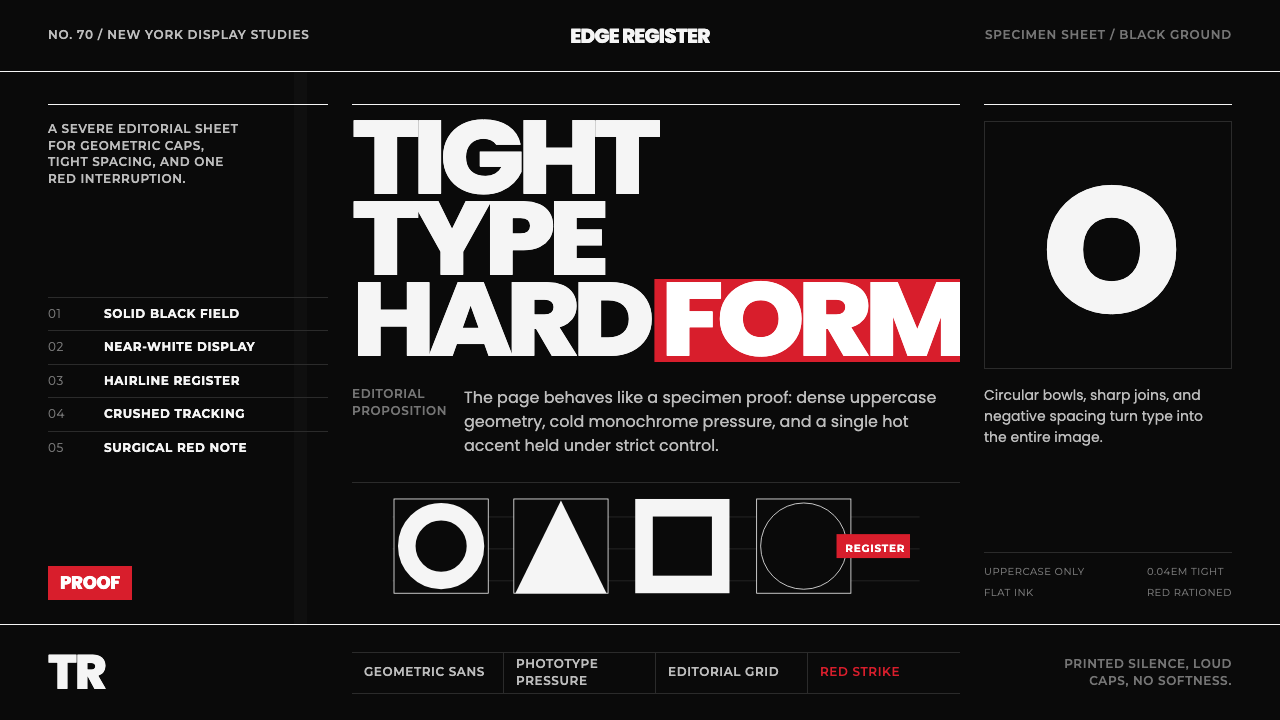 Avant Garde GothicType is the image. Tight white caps on black, ruled grids, one hot red strike.