What is Brutalist Web 2014?
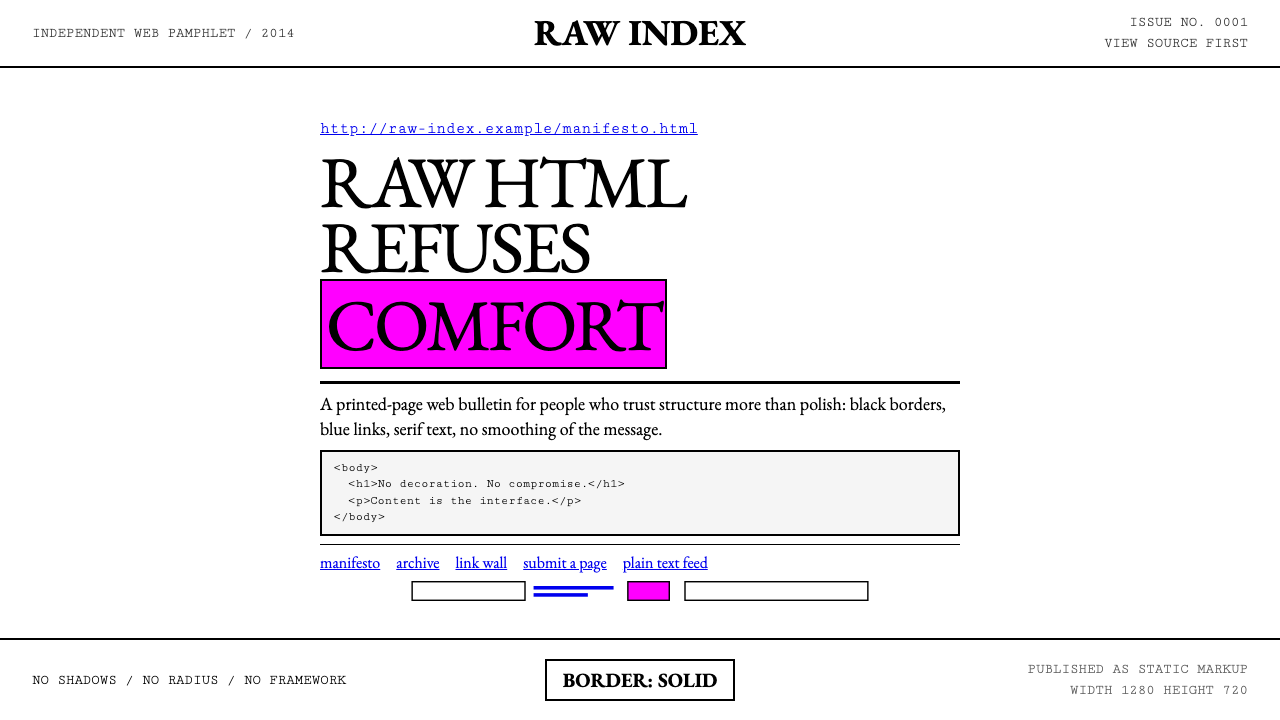
Brutalist web design strips the browser back to its defaults — raw system serif type, default electric-blue hyperlinks, solid black borders — and declares the unadorned HTML document itself to be enough.
Brutalist Web 2014 in brief
Brutalist web design is a deliberate aesthetic practice that refuses to apply any visual layer on top of the browser's default rendering. No custom typefaces, no polished color palette, no smooth gradients, no rounded corners — only the raw structural output of HTML and the browser's own stylesheet. The movement coalesced around 2014 as a conscious countermovement to the then-dominant school of highly crafted, heavily styled SaaS interfaces, treating the un-designed page not as a failure state but as a completed statement.
The visual language is strict and limited. A white page, black text in the browser's default system serif, links in the unmistakable default electric blue with underlines intact. Hard black borders — never rounded, never shadowed — as the only method of visual separation. Monospace type for emphasis, evoking the terminal or the typewriter rather than a brand font. Color, when it appears at all, arrives at full saturation: a harsh fuchsia, a screaming acid yellow, a pure red — never pastel, never blended.
Underneath the aesthetic is a coherent philosophical position: that the conventions of modern web design — smooth gradients, soft shadows, rounded corners, carefully chosen typefaces — are a form of dishonesty. They dress up content in a costume designed to soothe and sell. Brutalism insists that the costume be torn off. What you see is what the medium is: an HTML document rendered in a browser, nothing more, nothing less.

Where does Brutalist Web 2014 come from?
The term 'brutalism' in web design borrows from the architectural movement that peaked in the 1960s and 1970s, whose name derives from the French béton brut — raw concrete. Architects like Le Corbusier in his late period, Alison and Peter Smithson in Britain, and Paul Rudolph in the United States refused to clad their structures in decorative facades; they exposed the building's material honestly, letting concrete and steel speak for themselves. Web brutalism applies the same logic to the digital surface: expose the material of the web — HTML, the browser rendering engine, the default stylesheet — rather than covering it with cosmetic layers.
The movement crystallized around 2014, when Swiss art director Pascal Deville launched brutalistwebsites.com, a gallery cataloguing web designs that violated every convention of contemporary UX. The sites collected there shared a family resemblance: dense text, default or near-default typefaces, hard borders, aggressive link walls, and zero visual concession to the polished aesthetic that a generation of SaaS landing pages had made ubiquitous. What the gallery revealed was that this refusal had been happening in pockets for years — it simply had no name until now.
The movement found unlikely validation from high-profile sources. Balenciaga, under creative direction that prized provocation, stripped its fashion e-commerce site to a nearly raw HTML aesthetic in 2015 — an act that attracted widespread commentary precisely because it came from a luxury brand. The Drudge Report, running essentially the same link-wall layout since 1997 and never updated to fit contemporary design norms, was retroactively canonized as a brutalist ancestor. Bloomberg Businessweek published experimental editorial layouts that broke grid norms in ways the brutalist community recognized as kindred. Each case demonstrated that refusing decoration could itself be a powerful brand statement.
The intellectual context was a reaction to what critics called the 'sameness' of mid-2010s web design — a period when virtually every consumer tech product used the same rounded sans-serif type, the same card-based layout, the same muted pastel palette, and the same modal interactions. The movements that influenced brutalist web design include architectural Brutalism as its direct ancestor, the Italian anti-design movement of the 1960s and 1970s that used bad taste deliberately, and post-digital art, which engaged with the aesthetic of the network itself rather than trying to simulate physical materials on a screen. The Berlin-to-New York axis of independent web design, art publishing, and experimental fashion provided the cultural milieu where these threads converged.
What defines the Brutalist Web 2014 look?
Default Typography
The canonical typeface is whatever serif the operating system ships with by default — a raw system serif that no professional designer would voluntarily choose. Its use is an act of refusal: if every polished site reaches for a premium web font, brutalism reaches for the browser fallback. Web-font equivalents such as a classic old-style serif occupy a middle position — they feel like the default without being literally the system typeface. Monospace type appears for emphasis or code passages, evoking terminal output rather than brand expression. There is no typographic hierarchy beyond size and weight; heading and body share the same family. The message is the content, not its styling.
Electric-Blue Hyperlinks
The browser's default link color — that particular shade of electric blue for unvisited links, and a muted purple for visited ones — is one of the most recognizable visual signals on the early web and one of the first things that polished design systems suppress. Brutalist web design restores it. Links are not re-colored to match a brand palette, not stripped of their underlines, not styled as buttons. They look exactly as they did in the web's first decade. This choice functions simultaneously as historical quotation, anti-brand statement, and structural clarity — links are unmistakably links.
Hard Borders and Flat Structure
Where borders appear, they are solid single-weight lines — the kind produced by a plain border declaration without any rounding, shadow, or color override. Tables render with visible cell borders. Form inputs retain their native browser appearance. Horizontal rules are actual hard lines, not decorative spacers. Nothing is smoothed or softened. No shadows exist anywhere. Elements sit directly on the white page as if placed on paper. The Z-axis does not exist here — no card floats above another surface, no overlay implies depth. If two elements need visual separation, one of them gets a hard black border. That is the only tool available, and it is sufficient.
Content-First Layout
Brutalist web pages are structured by their content, not by a design grid imposed over the content. The natural document flow of HTML — headings stack above paragraphs, lists render as indented rows, sections follow one another in source order — determines the visual result. There is no hero section, no above-the-fold considered separately from below-the-fold, no decorative padding injected to produce visual breathing room. The page is as long as the content is, and it begins at the top of the viewport. This structural honesty can produce unexpectedly dense, scroll-intensive pages that nonetheless read with a kind of archival authority.
Full-Saturation Accent Color
When a brutalist site departs from pure black-on-white, it does not modulate — it erupts. A single accent color appears at full, uncut saturation: the harshest fuchsia, the most aggressive acid green, an institutional red applied without apology. This color is not chosen from a brand palette; it is chosen for maximum visual disruption against the sparse white-and-black field. Pastels, muted tones, and blended gradients are absent. The effect of a full-saturation block is closer to a warning label or a neon sign than to a designed interface — and that is entirely the point.
Link Walls
The dense, undecorated list of hyperlinks in the browser's default blue with underlines is the fundamental navigation pattern of the early web, and brutalism reclaims it as a deliberate aesthetic choice. A link wall — a long column of underlined blue text, each line a separate link — is one of the style's most characteristic patterns. Visited links render in the browser-default muted purple; hover states may invert to a solid background rather than softly fade. The pattern appears in navigation menus, resource pages, and news aggregators. The effect reads as archival, authoritative, and deliberately un-designed.
Anti-Animation
Brutalism is suspicious of motion. Animation in web design typically serves to smooth transitions, guide attention, and make interfaces feel polished — all things the style explicitly rejects. The default is no motion at all. Hover states change properties immediately, without easing or transition duration. Scroll is native. Loading states are plain text strings. The baseline is reduced motion — not as an accessibility accommodation, but as a design principle. There are no scroll-triggered fade-ins, no parallax effects, no springy interactions. Stillness is not a limitation; it is the intended condition of the page.

Who shaped Brutalist Web 2014?
Swiss art director based in Berlin, Deville founded brutalistwebsites.com in 2014, the single most important act in naming and consolidating the movement. By curating what had been isolated experiments into a coherent visual trend, he gave designers a shared vocabulary and critics a target to discuss. His gallery's existence was itself an argument: these sites were not broken or unfinished, but intentional — and there were enough of them to constitute a movement. Deville's own design practice demonstrated that brutalist web principles could be applied at a high level of craft without becoming merely ironic.
Founder and editor of Drudge Report, Drudge is not a designer and did not conceive his site as a design statement — yet his site became the most widely cited proof that an aggressively un-designed page could achieve massive scale and cultural authority. Founded in 1996 and essentially unchanged in its visual structure since the late 1990s, the Drudge Report demonstrated that condensed newspaper typesetting, default link colors, and minimal layout could sustain one of the highest-traffic news properties on the internet. The site served as an inadvertent precedent: what the movement was naming had existed in the web's early infrastructure all along, and preserving that infrastructure outlasted every design trend that tried to replace it.
Georgian fashion designer who served as creative director of Balenciaga from 2015, Gvasalia oversaw a website redesign that applied Brutalist web principles — default-seeming type, unstyled links, raw structural HTML layout — to one of the most prestigious luxury fashion houses in the world. The redesign generated significant press attention precisely because of the gap between the brand's cultural prestige and the deliberate austerity of its digital presence. The move demonstrated that visual severity could be a form of status signaling — that refusing to impress could itself be impressive — and drew a generation of designers' attention to what the brutalist gallery had been collecting.
The inventor of the World Wide Web, Berners-Lee did not design brutalist websites in any intentional aesthetic sense — but the default rendering his browsers established in 1991 is the raw material the movement works with. The first web pages at CERN were pure hypertext documents: plain system serif type, underlined links rendered in the browser's own blue, no style layer. These pages, still accessible in archived form, became canonical reference points for brutalist designers arguing that the un-styled document was the web's original and most honest form. Berners-Lee's original conception of the web as a document system — where the browser mediates between content and reader without imposing its own aesthetic — is philosophically aligned with brutalism's insistence on letting the medium speak for itself.
During Richard Turley's tenure as creative director, Bloomberg Businessweek developed an editorial design language that shared significant DNA with the brutalist web sensibility: oversized type, aggressive cropping, clashing colors at full saturation, and deliberate violations of grid conventions. The magazine's print and digital layouts in this period demonstrated that anti-design impulses could coexist with high editorial budgets and institutional contexts — that brutalism was not only for the personal site with no budget, but could function as a premium editorial register. The Businessweek covers of this era remain some of the most frequently cited examples of editorial risk-taking from the 2010s.
How do you use Brutalist Web 2014 today?
Applying brutalist web design correctly requires understanding what its constraints are actually doing — building visual authority through directness, establishing credibility through apparent effortlessness, and creating a reading experience that trusts the user's intelligence rather than guiding it through animation and visual cues. The style is not suitable for every context, but in the contexts where it works, it works very strongly. Those contexts share a common requirement: the content must be strong enough to carry the page without visual assistance.
For presentation slides, brutalism translates well to cover pages built around a single typographic statement. A brutalist cover refuses the customary opener: no full-bleed photography, no gradient backdrop, no decorative typeface. Title text sits in an oversized system serif flush-left against a pure white ground, with a thin black rule below the title and the date or presenter name in a small monospace caption. Content slides work like ruled ledger pages — each key point as a flush-left line, a horizontal rule between sections, data tables with hard borders and no background fill. The overall effect reads as a primary document — research, not a pitch.
For web user interfaces, brutalism is most naturally at home in dashboards, documentation portals, developer tools, and pricing pages for technical products, where information density and scannable hierarchy matter more than warmth. The implementation approach: let the browser's natural document flow serve as the primary layout mechanism, avoid custom typeface loading, style interactive elements with solid borders and flat color fills rather than soft shadows, and let white space derive from content separation rather than from decorative padding. Navigation rendered as a plain horizontal list of underlined links — without icons or visual hierarchy beyond font weight — fits the idiom exactly.
For editorial and marketing work, the style delivers its strongest results in contexts that want to signal independence, authority, or anti-hype. A long-form article in this style has a narrow column, generous top margin for the headline, a byline in small type or monospace, and section breaks marked by a single solid rule — no pull quotes in decorative typographic marks, no sidebars with background fills. Marketing landing pages can use the style's confrontational quality as a differentiator: a hero section that is simply a large serif headline and a hard-bordered call-to-action, no hero image. A product positioned as anti-hype can let its landing page perform that stance by refusing all visual gestures associated with hype.
The most common mistake when applying this style is treating it as permission to be careless rather than a directive to be precise about which defaults to honor. A well-executed brutalist page requires as many deliberate decisions as any polished interface — the decisions simply move toward the browser's native state rather than away from it. The second most common mistake is partial application: adding a soft shadow to just one card for clarity, softening a solid black border to a mid-gray, substituting a custom blue for the browser's default link color. Each concession undermines the system's coherence. The style depends on totality — a single polished element against an otherwise raw background reads as an error, not a considered choice, because the contrast with everything around it signals incompleteness rather than intention.

Brutalist Web 2014 — FAQ
Is brutalist web design just unfinished or lazy design?
No — and this is the most common misconception. A well-executed brutalist site requires as many deliberate decisions as any polished interface; the decisions simply move toward the browser default rather than away from it. Choosing the system serif over a web font is a decision. Setting a narrow content column is a decision. Using a heavier border weight to signal a more important division is a decision. The tell is consistency: a genuinely brutalist site is consistent throughout, while a lazy unfinished site is inconsistent — some elements styled, some not. Intentional brutalism has a whole-system logic that accidental incompleteness never achieves.
Can brutalist web design work for a commercial product, or does it only suit personal sites and art projects?
It can work commercially, but the style carries strong connotations — independence, refusal of convention, raw authority — that need to align with the product's positioning. It works well for developer tools, independent publications, archival projects, fashion or cultural brands that want to signal confidence through restraint, and any product whose target audience is sophisticated enough to recognize the aesthetic as intentional. It works poorly for products that need to communicate warmth, accessibility, or mainstream consumer appeal. Balenciaga's adoption of the aesthetic was commercially successful precisely because luxury fashion is one of the few sectors where ostentatious disregard for convention reads as desirable rather than negligent.
Does brutalism have any relationship to web accessibility?
There is a meaningful, if not always intended, overlap. The browser's default rendering was built with accessibility in mind long before design systems complicated it. Custom typefaces loaded as web fonts, JavaScript-dependent components, smooth scroll-triggered animations, and low-contrast color palettes chosen for aesthetic reasons all introduce accessibility regressions that a brutalist page simply does not have, because it never introduced those layers in the first place. The brutalist page is not accessible by design intention in most cases; it is accessible by default, which is a different and arguably more durable form of accessibility. Developers in the progressive enhancement and web standards communities have made this connection explicitly.
How is brutalist web different from the minimalism in contemporary design systems?
Contemporary minimalism and brutalist web design can look superficially similar — both use limited color, simple layout, and typographic restraint — but they operate on opposite logics. Contemporary minimalism is highly crafted: it selects a specific typeface at specific sizes, applies a curated color palette, uses custom-designed spacing values, and produces a page that appears simple but is in fact the result of many deliberate design decisions. Brutalist web design produces apparent simplicity by making no decisions at all beyond the content structure — every visual property defaults. The minimalist page is simple because everything unnecessary has been removed by a designer. The brutalist page is simple because nothing has been added. These are philosophically distinct starting points that produce visually similar but qualitatively different results.
Is brutalist web design still relevant today, or is it a historical moment?
Both, depending on how the question is framed. As a transgressive moment — a rebellion against a specific prevailing aesthetic — the brutalist web movement peaked between roughly 2014 and 2018 and then was absorbed by the mainstream it had reacted against. Many of its gestures became themselves design trends, ending their transgressive function. But as a principled approach to building for the web — start with what the browser provides, add only what is structurally necessary — the logic remains as applicable as it was in 2014 and arguably more so, given the continued weight of modern web frameworks. Designers working in progressive enhancement, accessibility-first development, and sustainable web design regularly arrive at brutalist-adjacent conclusions without invoking the movement by name.
Related design styles
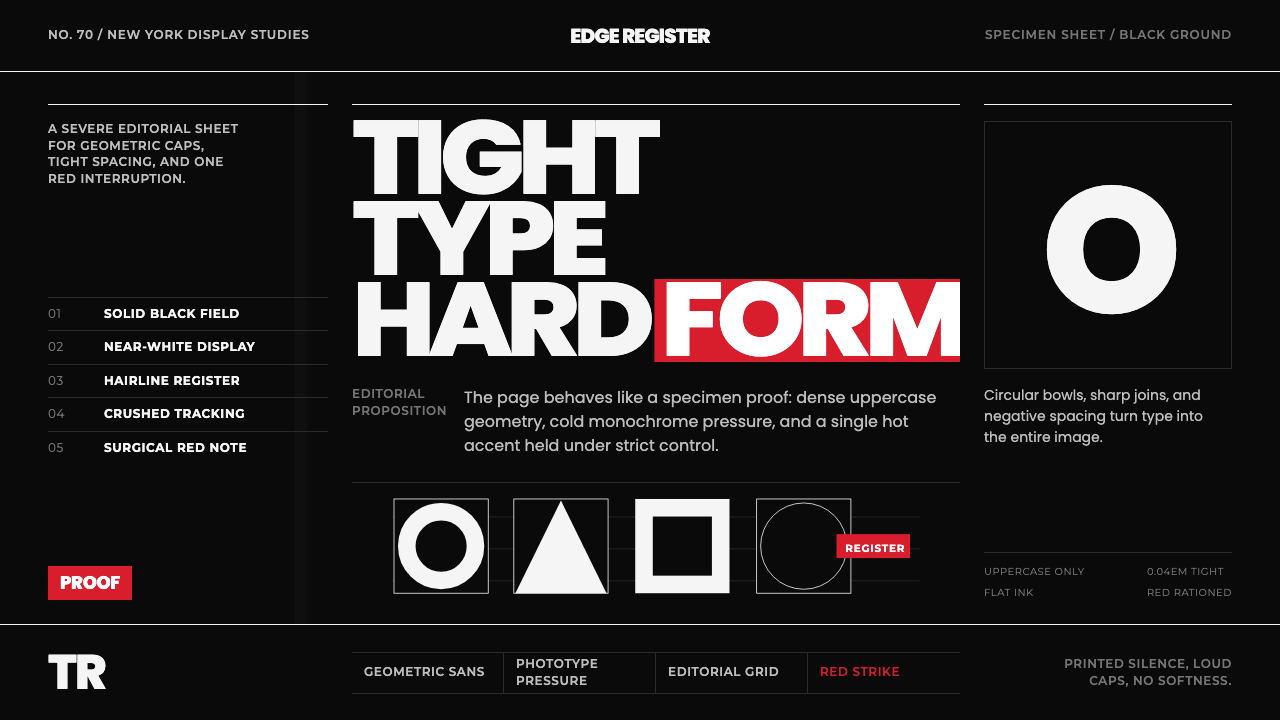 Avant Garde GothicType is the image. Tight white caps on black, ruled grids, one hot red strike.
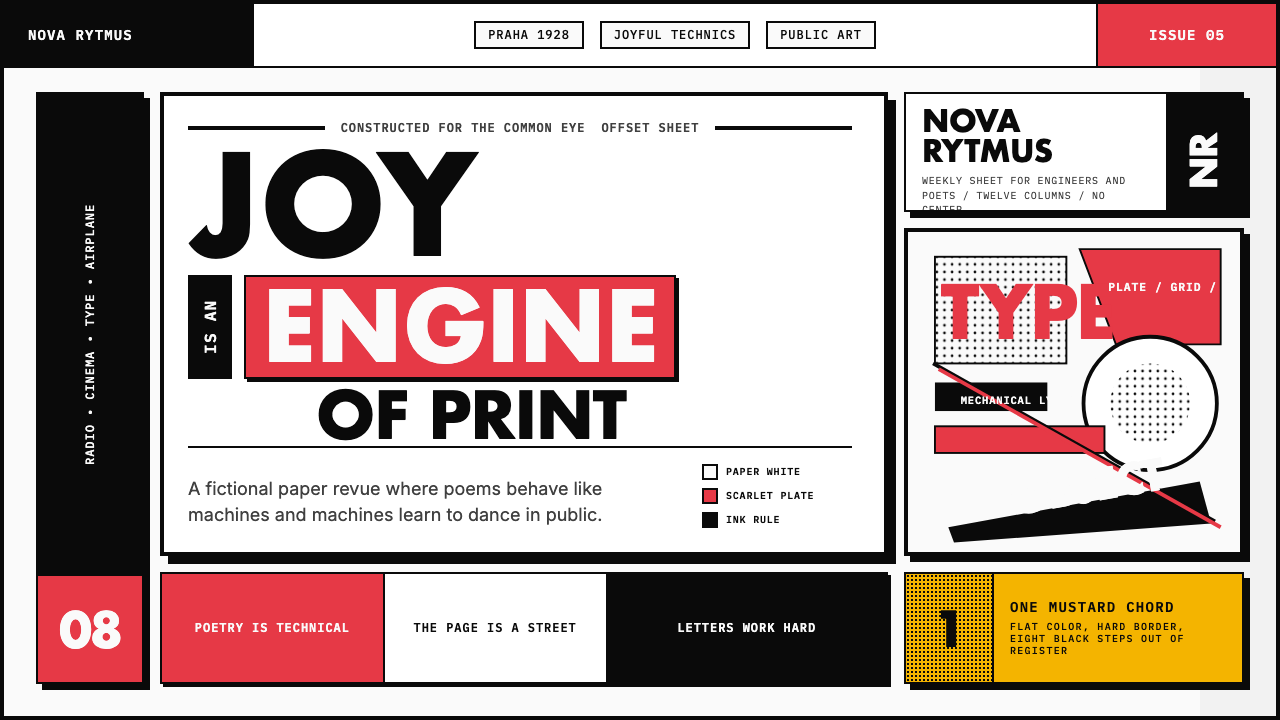 Czech Devětsil Avant-GardeJoy is engineered. Scarlet ink blocks and rotated sans type collide on an asy…
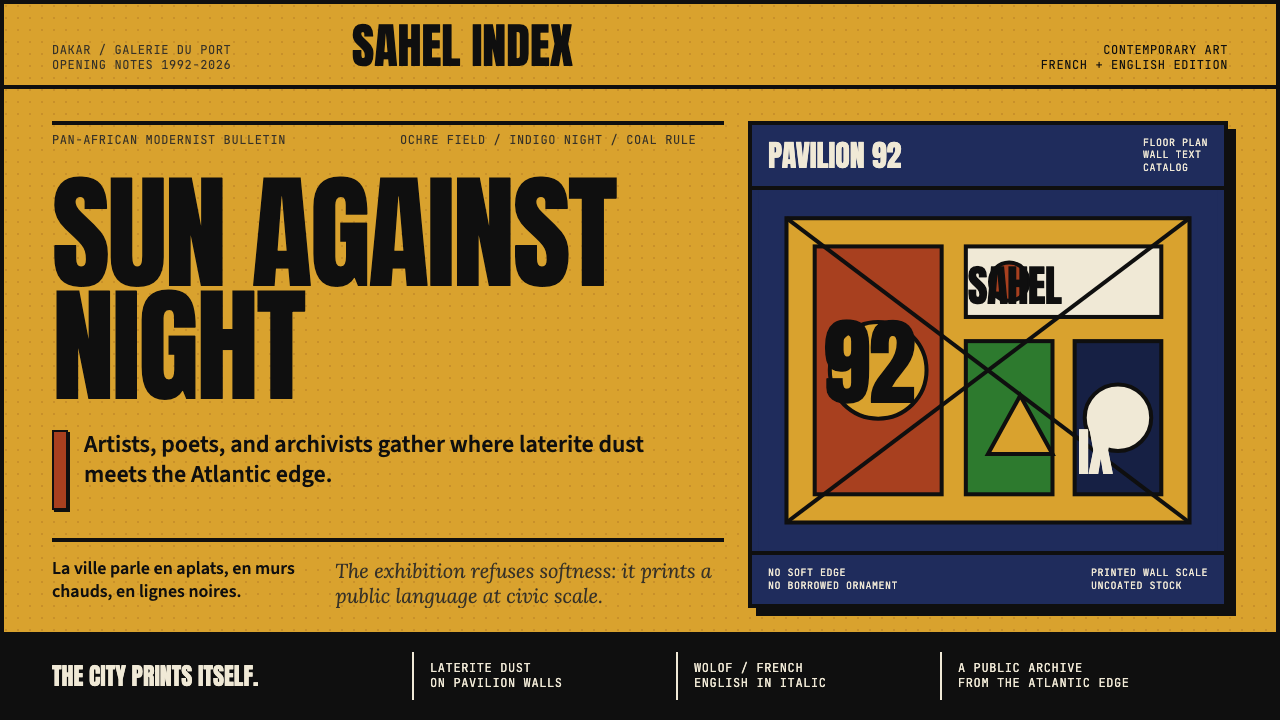 Dak'Art BiennalePan-African modernism speaks loud. Ochre ground, indigo block, Anton type, bl…
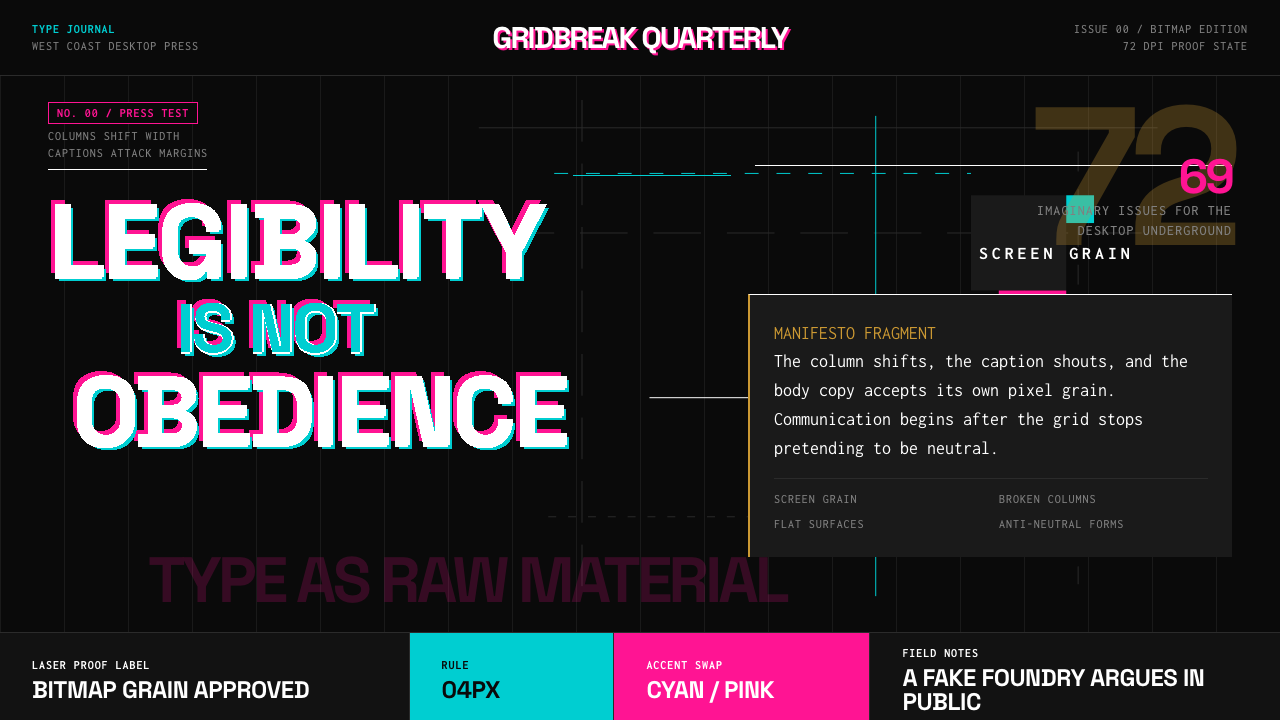 Emigre Magazine (1984–2005)Defies the tidy grid. Cyan, ochre, and hot-pink bitmap type collides on black.
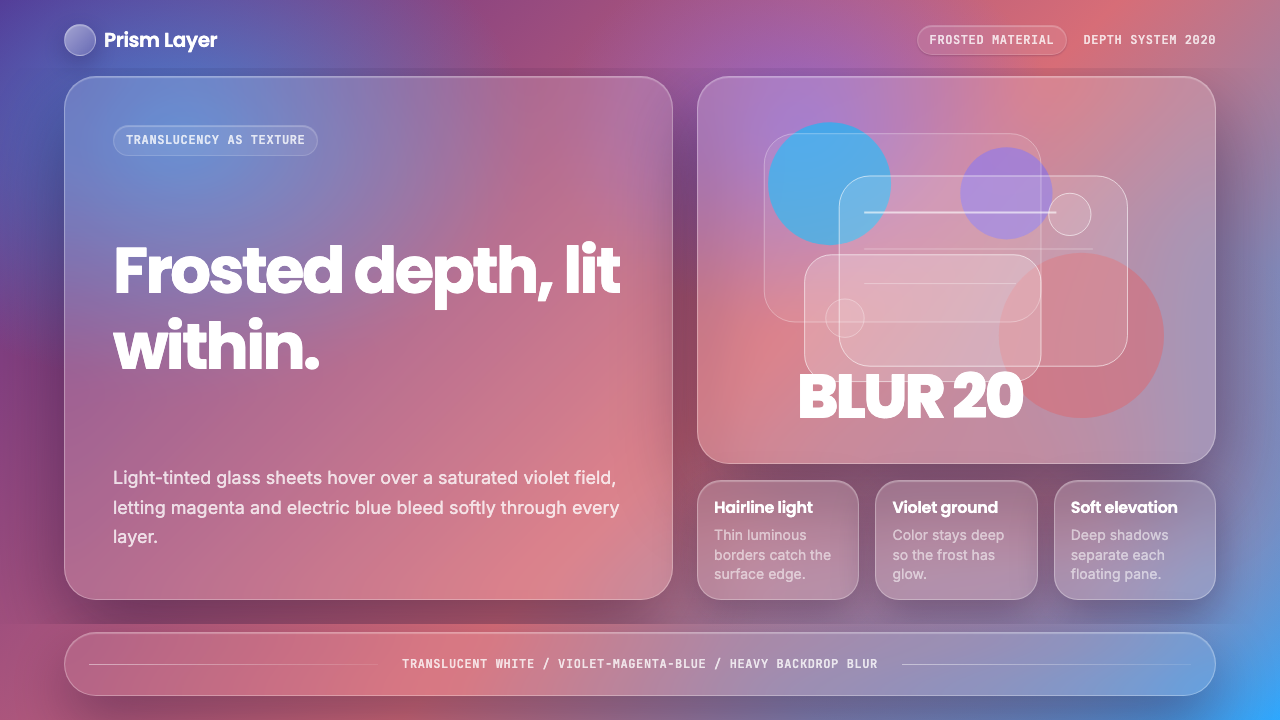 GlassmorphismDepth becomes the texture. White glass blurs violet, magenta, and electric bl…
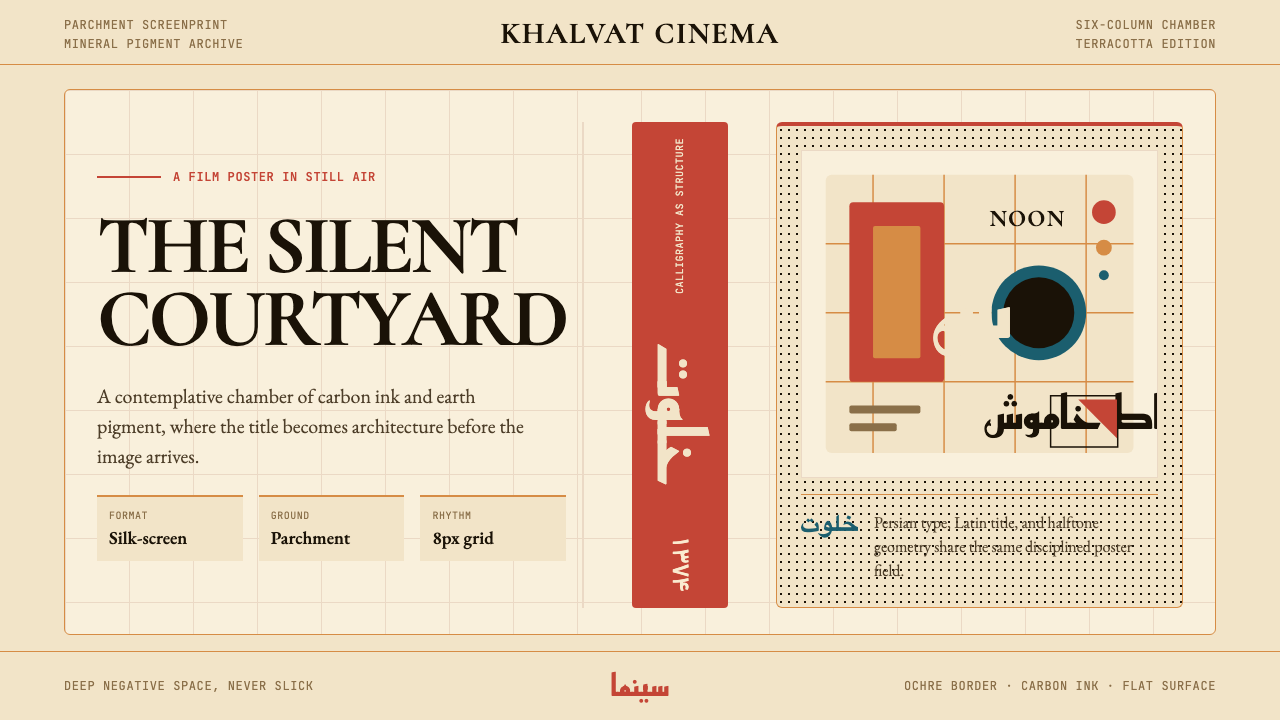 Iranian Modernist Cinema PosterStillness becomes monumental. Terracotta Kufi type breathes inside a Swiss pa…