What is Dak'Art Biennale?
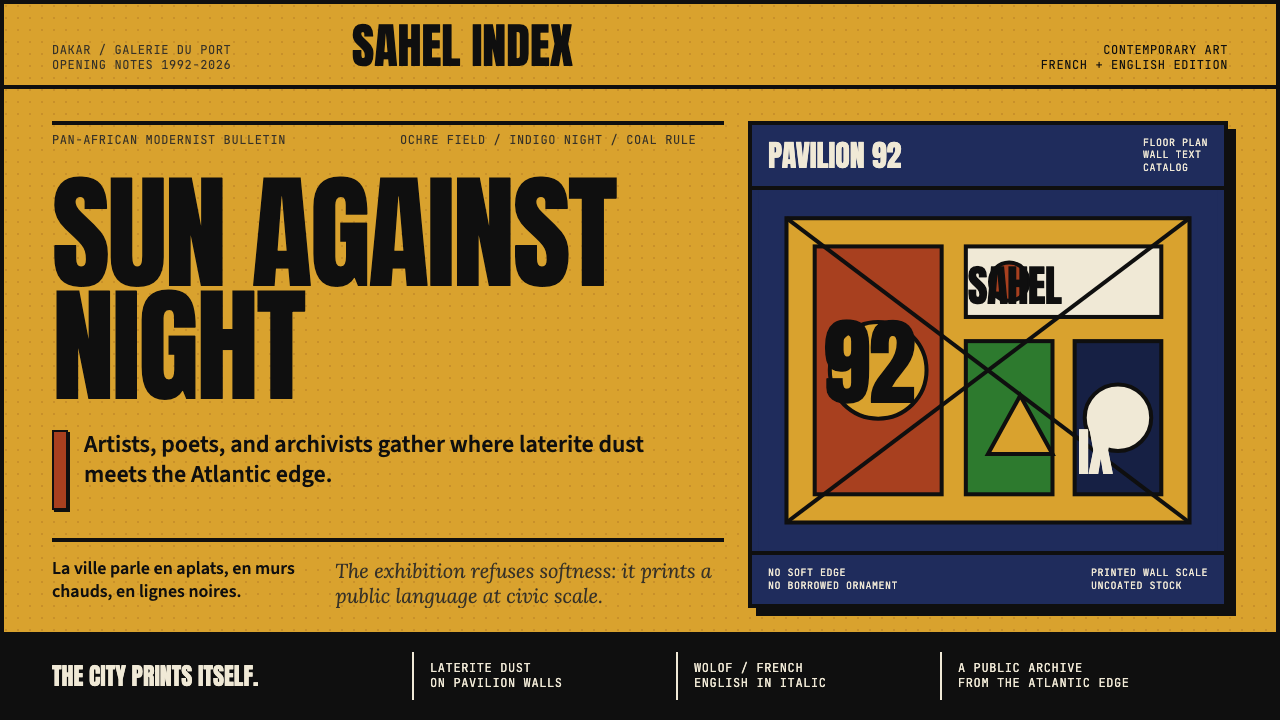
Since 1992, Dak'Art has turned Dakar into the pulse of pan-African contemporary art — ochre ground, indigo block, and monumental type declaring that African modernism speaks on its own terms.
Dak'Art Biennale in brief
Dak'Art — formally the Dakar Biennale — is the oldest continuously running pan-African contemporary-art biennial in the world. Founded in 1992, it takes place every two years in Dakar, Senegal, bringing together artists from across the African continent and the diaspora. Its exhibitions span converted colonial warehouses, open-air pavilions, and the labyrinthine Village des Arts — a compound that functions as studio, gallery, and social space simultaneously.
The visual identity that has come to define Dak'Art's graphic presence draws on a palette of warm yellow ochre, saturated indigo blue, and deep coal black. Surfaces are treated to evoke sand and laterite — the ochre earth of the Sahel — lending a tactile quality that distinguishes the aesthetic from the cool, industrial modernism of European traditions. Monumental sans-serif headlines dominate large-scale print and signage, while French and Wolof appear together as equal typographic presences, refusing the hierarchy that colonial visual culture imposed.
More than a festival identity, the Dak'Art aesthetic represents the most accomplished pan-African modernist graphic system of the post-independence era. It draws simultaneously on the École de Dakar's philosophy of rooting contemporary practice in African visual heritage, on the political urgency of movements like Laboratoire Agit'Art, and on the confident internationalism of a city that has long positioned itself as Africa's foremost cultural capital.

Where does Dak'Art Biennale come from?
Dak'Art was founded in 1992, in the waning years of Léopold Sédar Senghor's long cultural legacy in Senegal. Senghor, the poet-president who governed Senegal from independence in 1960 until 1980, had championed Négritude — the literary and intellectual movement that affirmed the dignity, history, and cultural specificity of African and Afro-diasporic peoples — as a founding principle of the postcolonial Senegalese state. When Dak'Art was established, it inherited this commitment to African cultural self-determination and turned it into a living institutional infrastructure.
The founding vision drew heavily on the École de Dakar, an artistic movement that had taken shape in Dakar through the 1960s and 1970s. The École de Dakar sought a synthesis: borrowing the media and formal vocabularies of Western modernism while insisting on grounding imagery, color, and form in African visual traditions — patterning systems from weaving and textiles, the warm earth tones of West African architecture, the bold graphic quality of mask-making and ceremonial objects. This was not nostalgia but an argued position: that African artists had no obligation to choose between modernity and heritage, because their heritage was itself a form of modernity.
Alongside and sometimes in tension with the École de Dakar was Laboratoire Agit'Art, a collective founded by artists including Issa Samb and El Hadji Sy in the 1970s. Where the École de Dakar engaged with institutions, Agit'Art operated in courtyards, streets, and improvisational performance spaces. It was explicitly political, suspicious of the gallery system, and committed to an art practice embedded in daily life and collective action. Agit'Art's graphic sensibility — raw, urgent, collaged, refusing finish — entered the DNA of what Dakar contemporary art would come to look like, even in more formally produced contexts.
The biennial's current visual identity, refined through the 2022 and 2024 editions, consolidates decades of these influences into a coherent graphic system. Yellow ochre — the color of Dakar's harmattan dust and laterite roads — grounds the palette. Indigo, associated with the ceremonial and domestic textiles of West Africa, provides the structural dark. Carbon black anchors type and rules. The overall effect reads as simultaneously of-the-place and internationally legible, which is precisely what Dak'Art has always sought to be: unapologetically rooted and unapologetically global.
What defines the Dak'Art Biennale look?
Earth-Rooted Palette
The Dak'Art palette is built from three anchoring tones: yellow ochre, which evokes the laterite earth and harmattan dust of Dakar's landscape; a deep indigo blue drawn from West African ceremonial textiles and the night sky over the Atlantic; and a coal black that frames and grounds both. These are not arbitrary brand colors but colors harvested from place. Secondary accents — terracotta, sand white — appear in supporting roles, always subordinate to the three-color core. The warmth of the palette contrasts sharply with the cool neutrals that dominate most contemporary international design, making Dak'Art materials immediately identifiable at a distance.
Monumental Sans-Serif Typography
Headlines are set in bold, condensed sans-serif letterforms at commanding scale — the typographic equivalent of a public proclamation. The choice of sans-serif is not purely modernist inheritance; it also reflects the graphic tradition of West African signage and hand-painted commercial lettering, which favors strong, readable strokes over refinement. Scale contrast between headline and body text is extreme: titles occupy substantial portions of the surface, while supporting text is set small and tight. The typographic system is bilingual at its core, treating French and Wolof as co-equal presences rather than relegating one to a subtitle role.
Sand-Textured Surfaces
Unlike the smooth, flat surfaces that characterize most contemporary digital-first design, Dak'Art's aesthetic incorporates visible texture — the grain of sand, the roughness of unfinished plaster, the fibrous quality of handmade paper. This texture is not decorative noise; it is a material memory, embedding the physical landscape of Senegal into the graphic surface. In digital applications, this quality is approximated through granular overlays and uneven tonal fields that disrupt the pristine flatness of screen rendering. The textured surface places the work in dialogue with the handmade, resisting the seamless polish that connotes mass-produced globalism.
Block Composition and Structural Weight
Dak'Art compositions are organized through large color blocks rather than fine linear grids. An indigo rectangle anchors one edge of a surface; an ochre field occupies another; the interaction between the two creates visual tension without requiring decorative intervention. This block-based structure has roots in both modernist poster tradition and in the bold geometric patterning of West African woven textiles — kente, bogolan, and strip-woven cloth — where large color fields carry symbolic and narrative meaning. The approach favors weight over delicacy: compositions feel substantial, almost architectural, grounded by gravity rather than lifted by lightness.
Political and Cultural Legibility
Every element of the Dak'Art visual system carries a double address: it speaks to an international art world audience fluent in contemporary graphic conventions, and simultaneously to communities for whom the colors, textures, and linguistic choices are culturally specific and legible on different terms. The ochre is not merely a warm neutral — it is the color of the land. The indigo is not merely a dark accent — it is the color of fabric worn at ceremony. This layered legibility is a political act, insisting that a design system can be simultaneously local and global without subordinating one register to the other.
Collage and Layered Accumulation
Unlike styles that achieve their effect through reduction and elimination, the Dak'Art aesthetic permits — even celebrates — accumulation. Photographic fragments, typographic elements, and color fields can coexist in the same space through layering, echoing both the collage practices of Agit'Art and the dense visual environment of Dakar's street culture. This layering is not chaotic; it is organized through scale hierarchy and tonal contrast, with the large ochre and indigo blocks providing a stable substrate beneath the accumulated surface detail. The result is visually rich without feeling cluttered, reflecting a cultural aesthetic where abundance and vitality are valued over austerity.
Diaspora and Continuum
The visual system explicitly refuses a fixed or singular African identity, instead positioning the continent and its diaspora as a continuum of related but distinct visual cultures. This is expressed through deliberate inclusivity in imagery — photographs depicting artists and communities across North Africa, West Africa, East Africa, and the Afro-Caribbean and Afro-European diaspora — and through a typographic openness that can accommodate multiple scripts and languages. The aesthetic thereby performs what the biennial itself argues: that pan-African identity is plural, dynamic, and in continuous formation rather than a settled category inherited from the past.

Who shaped Dak'Art Biennale?
Issa Samb — also known as Joe Ouakam — was a painter, sculptor, philosopher, and performance artist who became one of the founding intellectual forces of the Laboratoire Agit'Art collective in Dakar. His compound on the Médina district became a gathering point for artists working outside institutional structures, and his practice — sprawling, anti-commercial, deeply rooted in Wolof philosophical tradition — modeled an approach to contemporary art-making that refused European museum culture's terms of legibility. His influence on subsequent generations of Dakar-based artists shaped the political and aesthetic DNA that Dak'Art inherited.
El Hadji Sy is a painter and one of the central figures of both Laboratoire Agit'Art and the broader emergence of contemporary Dakar art. Working with intensely saturated color fields and gestural, improvisational mark-making, his canvases brought West African color sensibility — warm ochres, deep indigos, vibrant reds — into a formally ambitious contemporary painting practice. As a teacher and organizer, he helped transmit the Agit'Art ethos to younger artists while maintaining a rigorous studio practice, and his work has been exhibited internationally as one of the definitive expressions of the Dakar school's contribution to global contemporary art.
Bouna Medoune Seye was a poet, performance artist, and key member of Laboratoire Agit'Art whose practice bridged literary and visual culture. He brought the oral tradition of Wolof griotic performance into dialogue with contemporary conceptual art practice, insisting on the body and the voice as primary artistic media. His work contributed to Agit'Art's resistance to the idea that African contemporary art must conform to Western gallery formats to be taken seriously, and his legacy continues to inform the biennial's commitment to performance, public space, and multidisciplinary practice.
Simon Njami is a Cameroonian-Swiss curator, critic, and editor who has served as artistic director of Dak'Art and shaped the conceptual framing of pan-African contemporary art over several decades. As co-founder of the magazine Revue Noire — which documented and championed African contemporary art globally through the 1990s — and as a curator of major international exhibitions including the Africa Remix traveling exhibition, Njami has been instrumental in building the institutional and critical infrastructure through which Dak'Art has engaged with the international art world while maintaining the specificity of its African perspective.
Although El Anatsui is Ghanaian rather than Senegalese, his work has become virtually synonymous with the visual ambitions that Dak'Art embodies. His large-scale tapestries — constructed from thousands of flattened bottle caps and aluminum fragments, woven together with copper wire — translate the visual logic of West African strip-woven textiles into monumental sculptural installations of extraordinary optical richness. The way his work catches and redistributes light in colonial-era warehouse spaces, turning industrial refuse into surfaces of luminous gold and deep indigo, is precisely the kind of visual transformation that the Dak'Art aesthetic, at its best, aspires to achieve: making something entirely new from the materials of a shared history.
How do you use Dak'Art Biennale today?
Applying the Dak'Art aesthetic effectively requires understanding that its power comes from a specific cultural logic, not merely from a color palette. The ochre, indigo, and black work together because they carry material and geographic meaning; borrowing them without understanding that meaning risks producing work that reads as superficial exoticism rather than engaged design. The starting point for any application should be the palette's internal logic: ochre as ground, indigo as structural depth, black as definition, with sand-white and terracotta as supporting accents. From that base, the remaining choices — texture, type scale, block composition — should reinforce the sense of weight, warmth, and declarative confidence that defines the style at its best.
For presentation slides, the Dak'Art aesthetic yields covers of genuine visual authority. A cover slide works well with a large indigo block occupying most of the surface, the title set in a bold, expanded sans-serif against the indigo, and an ochre shape — a horizontal band, a corner accent, a partial frame — introducing the warm ground tone. The biennial's bilingual logic can be adapted by giving equal typographic weight to a subtitle or secondary text rather than subordinating it. Content slides should use the ochre as a background field, keeping type in deep charcoal or black, with indigo used only for emphasis or section markers. Data visualization works particularly well when chart fills are drawn from the three-tone palette, giving bar charts and area graphs the same visual weight as the surrounding design rather than treating them as inserted graphics.
For web interfaces — dashboards, pricing pages, editorial platforms — the Dak'Art system requires careful calibration. The texture element, so powerful in print contexts, should be applied lightly in digital environments: a subtle grain on the background field rather than heavy overlay, which can read as distortion on screen. The block-composition principle translates well to section-based web layouts, where full-width color bands alternate between ochre and indigo grounds across page sections. Typography should maintain the extreme scale contrast of the source aesthetic — large display text at commanding size, body text set small and tight — using a single strong sans-serif family rather than mixing faces. Navigation and interface chrome should remain in black or deep charcoal, reserving the warm palette for content areas.
For editorial and marketing applications, the Dak'Art aesthetic supports formats where boldness and cultural specificity are assets. A poster or marketing cover benefits from the full palette deployed with confidence: a dominant ochre ground, an indigo geometric block cutting across the surface, headline type in black or reversed white, and a photographic element — ideally cropped tightly and reproduced with high tonal contrast — integrated as a block rather than placed as a floating image. Editorial article layouts work with a narrower ochre or sand margin paired with a clean white or cream text area, using deep indigo rules as section dividers rather than decorative lines. The style suits campaigns for cultural institutions, arts organizations, educational platforms, and brands that want to signal international sophistication grounded in African creative tradition.
The most common mistake when applying this aesthetic is reducing it to its color palette alone, treating the ochre-indigo-black combination as a cosmetic overlay that can be applied to any existing layout structure. Authentic application requires adopting the compositional logic as well: large blocks rather than fine lines, extreme typographic scale contrast, textured surfaces rather than smooth ones, and a willingness to let the design feel heavy and substantial rather than light and airy. A second common error is using the palette as decoration rather than structure — scattering ochre accents across a predominantly white layout produces something that reads as African-inspired pastiche rather than a coherent system. Commit to the palette as the primary organizing force, and the style's distinctive authority will follow.

Dak'Art Biennale — FAQ
How is the Dak'Art aesthetic different from a generic 'African-inspired' design?
The difference is specificity versus generalization. Generic 'African-inspired' design typically borrows surface motifs — animal prints, abstract patterns associated with kente or kanga textiles, bright unrelated colors — without grounding them in any particular tradition, history, or geography. The Dak'Art aesthetic is specific to Dakar, Senegal, and the post-independence pan-African cultural project: its ochre comes from Sahel laterite, its indigo from West African ceremonial cloth, its typographic choices from a city where French and Wolof coexist as living languages. Applying it authentically means understanding those references, not just copying the color temperature. The distinction between engaged cultural design and exoticism is almost always a question of specificity and understanding.
Can the Dak'Art palette work in a light-background digital interface without losing its impact?
Yes, but it requires rebalancing rather than direct transposition. The full-palette version — large indigo blocks against ochre grounds — is designed for print surfaces and physical environments where both colors can read at full saturation. In a light-background digital interface, the approach shifts: use a near-white or pale sand background as the canvas, deploy ochre and indigo as accent colors for section dividers, interactive states, and data visualization fills rather than as dominant backgrounds. Black remains the primary typographic color. The key is preserving the weight and warmth of the palette — the visual signal that this is not a cool, neutral international design — while adapting the proportions so the interface remains readable and functional. Reducing the ochre to a warm off-white background and using indigo as the primary structural accent is a well-tested approach.
How should photography be integrated into a Dak'Art-styled layout?
Photography in the Dak'Art system functions as a structural block, not a decorative insert. Photographs should be cropped tightly to eliminate contextual background, reproduced at high tonal contrast — deepening shadows and holding highlights — to align with the boldness of the surrounding color fields. They are placed as geometric shapes within the composition: a photograph occupies a column, a half-page zone, or a defined block, and the surrounding color fields treat it as an equal compositional element rather than a window into a separate space. Avoid soft vignettes or graduated edges; the photograph should have a hard, defined boundary, the same decisiveness that characterizes all other edges in the system. When color photographs are used, those with warm, saturated color temperatures — ochres, terracottas, deep blues — integrate most naturally.
Is the Dak'Art aesthetic appropriate for brands outside the cultural sector?
It can be, but the fit depends heavily on what the brand is trying to communicate. The aesthetic signals: pan-African cultural authority, post-colonial confidence, warmth over coolness, weight over delicacy, collective voice over individual refinement. Brands that genuinely align with those values — and have authentic connections to African creative culture — can use the aesthetic with conviction. Brands that are attracted to the palette's visual distinctiveness but have no substantive connection to its cultural context risk producing work that reads as appropriation. The safest and most honest applications are those where the brand's mission, audience, or origins have a genuine relationship to pan-African culture, contemporary African art, or the broader diasporic community the biennial serves.
How does Dak'Art relate to other African modernist design traditions?
Dak'Art represents one node in a larger network of African modernist visual traditions that emerged across the continent in the decades following independence. It is closest in spirit to the broader École de Dakar tradition and to pan-Africanist graphic movements that used bold color, anti-colonial typography, and graphic urgency as political tools — traditions visible in the independence-era poster design of Ghana, the ujamaa graphic culture of Tanzania, and the political poster traditions of Angola and Mozambique. Where Dak'Art diverges from some of these traditions is in its sustained engagement with the international contemporary art world, which has required it to develop a visual language that can operate in gallery and biennial contexts without abandoning its political roots. The result is a style that has more formal sophistication than the urgency of street-level political graphics, while retaining more cultural warmth and specificity than the cool internationalism of mainstream contemporary design.
Related design styles
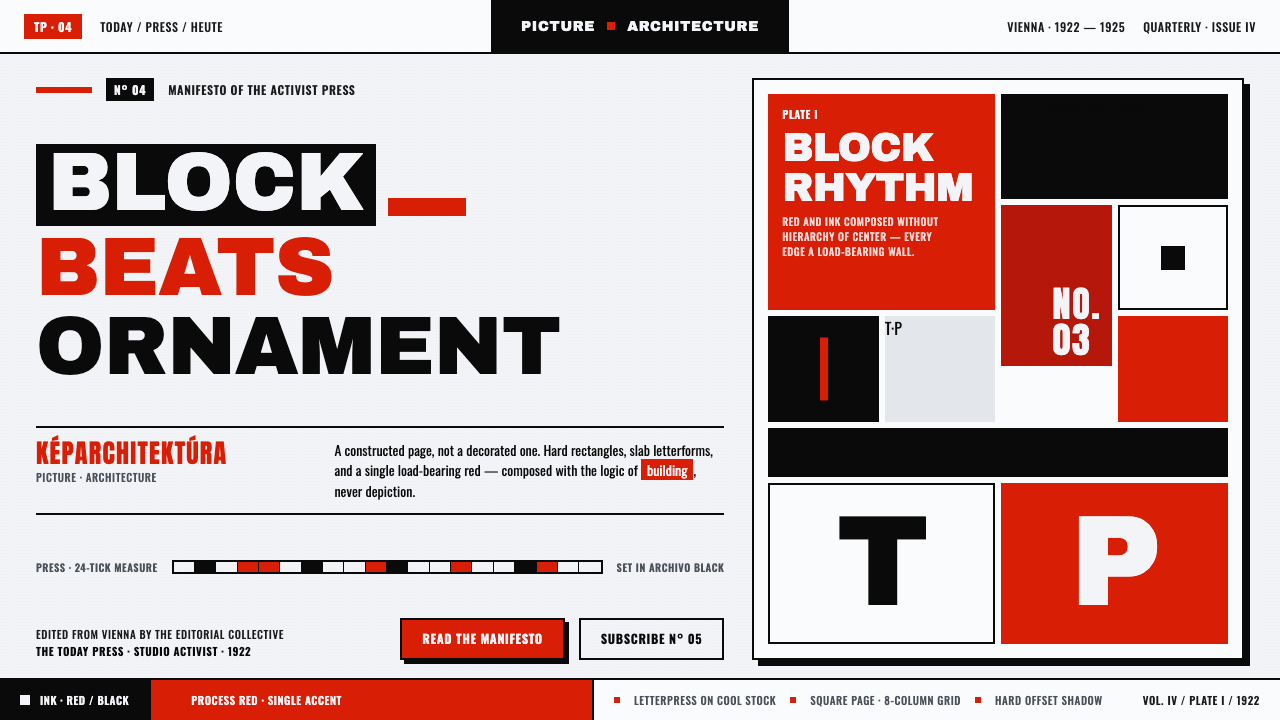 Lajos Kassák MA ConstructivismPage as building, not picture. Red and ink slab-sans blocks set asymmetricall…
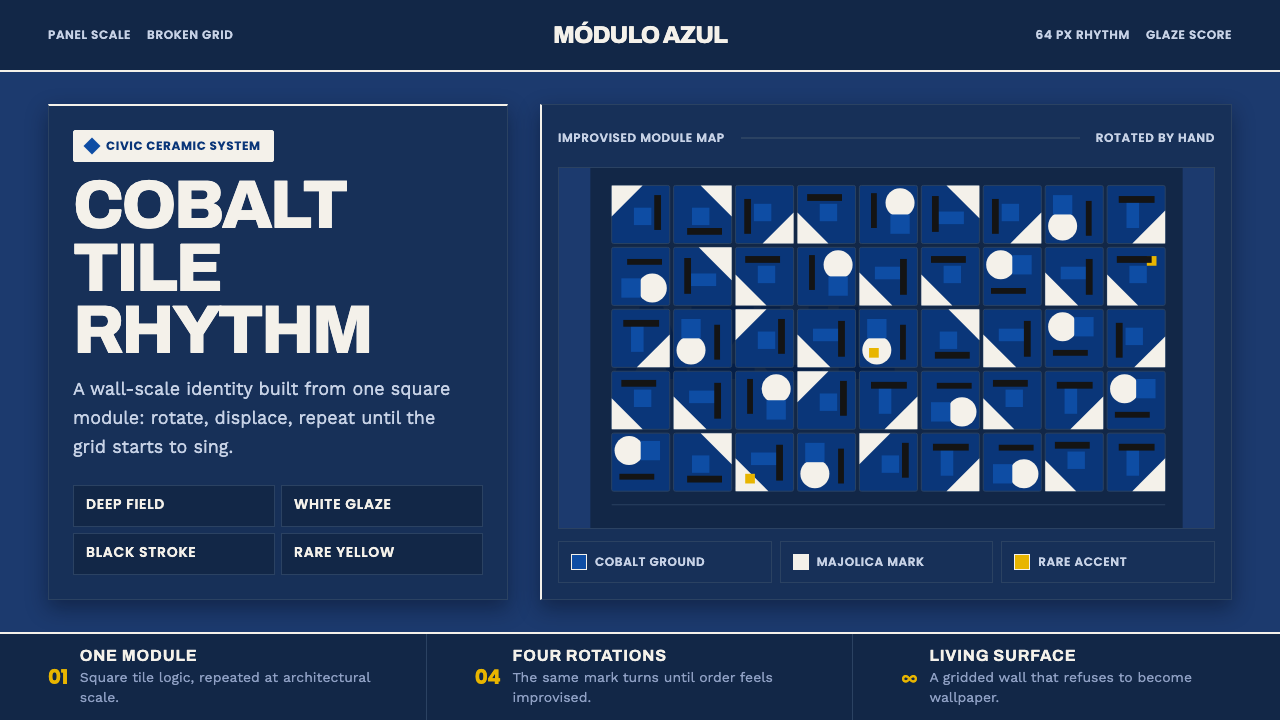 Athos Bulcão Azulejo PanelCobalt grid, alive. Majolica white marks rotate across a broken navy tile fie…
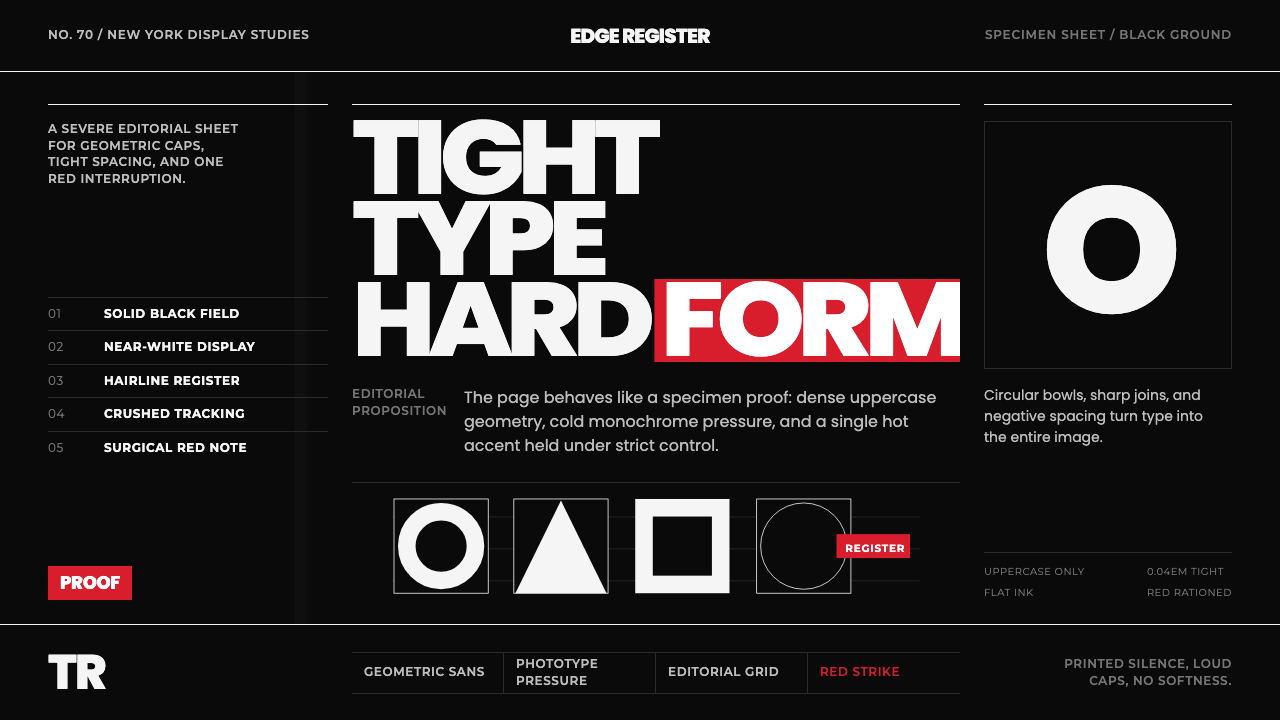 Avant Garde GothicType is the image. Tight white caps on black, ruled grids, one hot red strike.
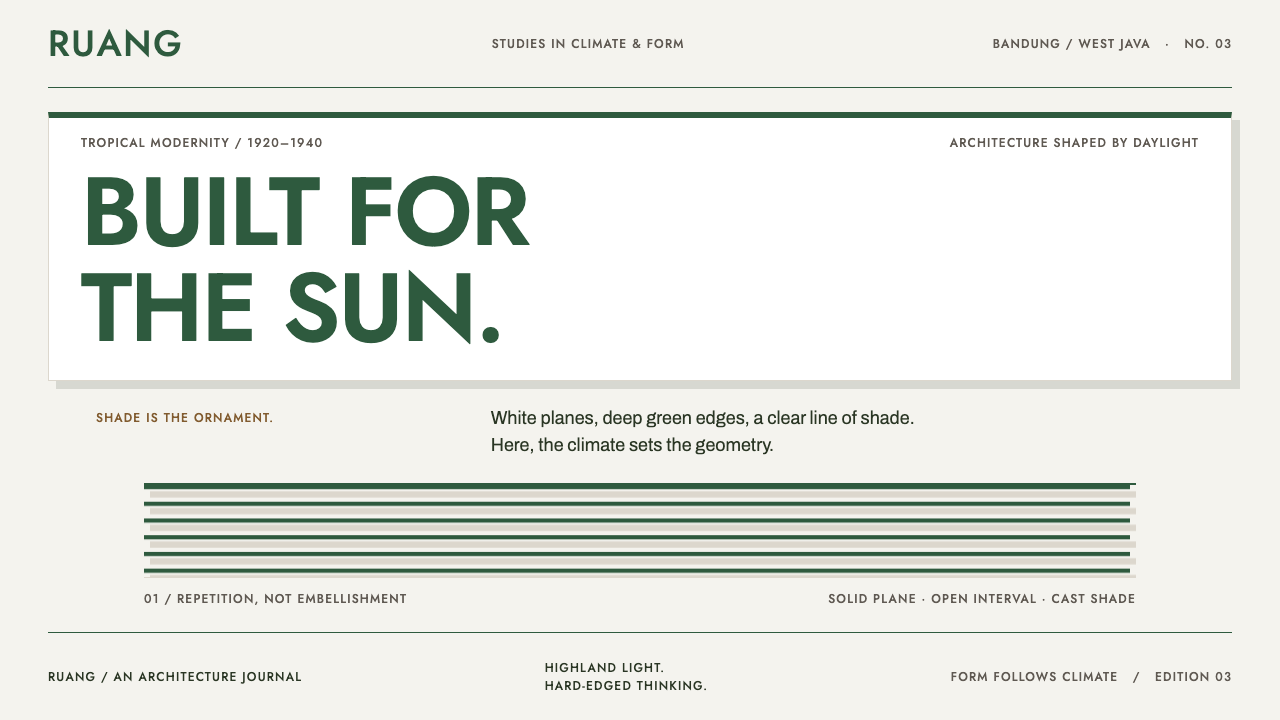 Bandung Tropical Art DecoClimate writes the geometry. Bottle-green bands on stucco white make hard sha…
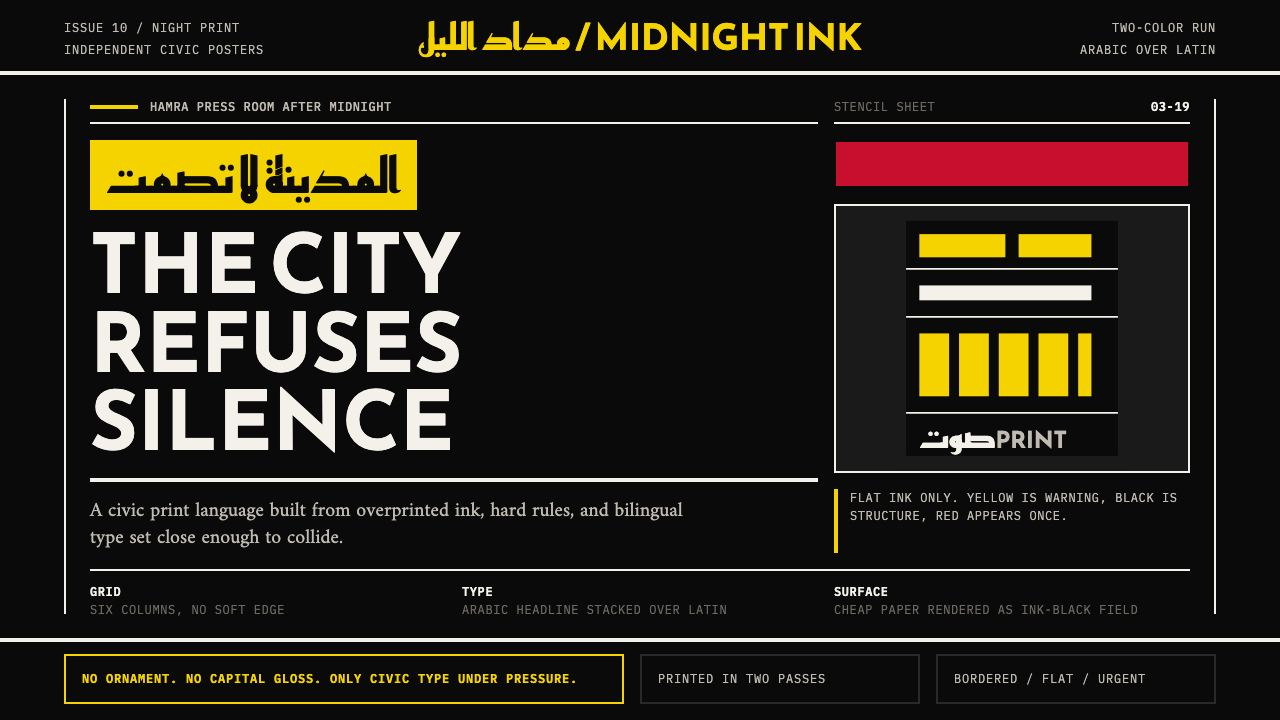 Beirut Indie Graphic DesignCivic type as protest. Sulfur yellow Arabic blocks collide with ink-black pos…
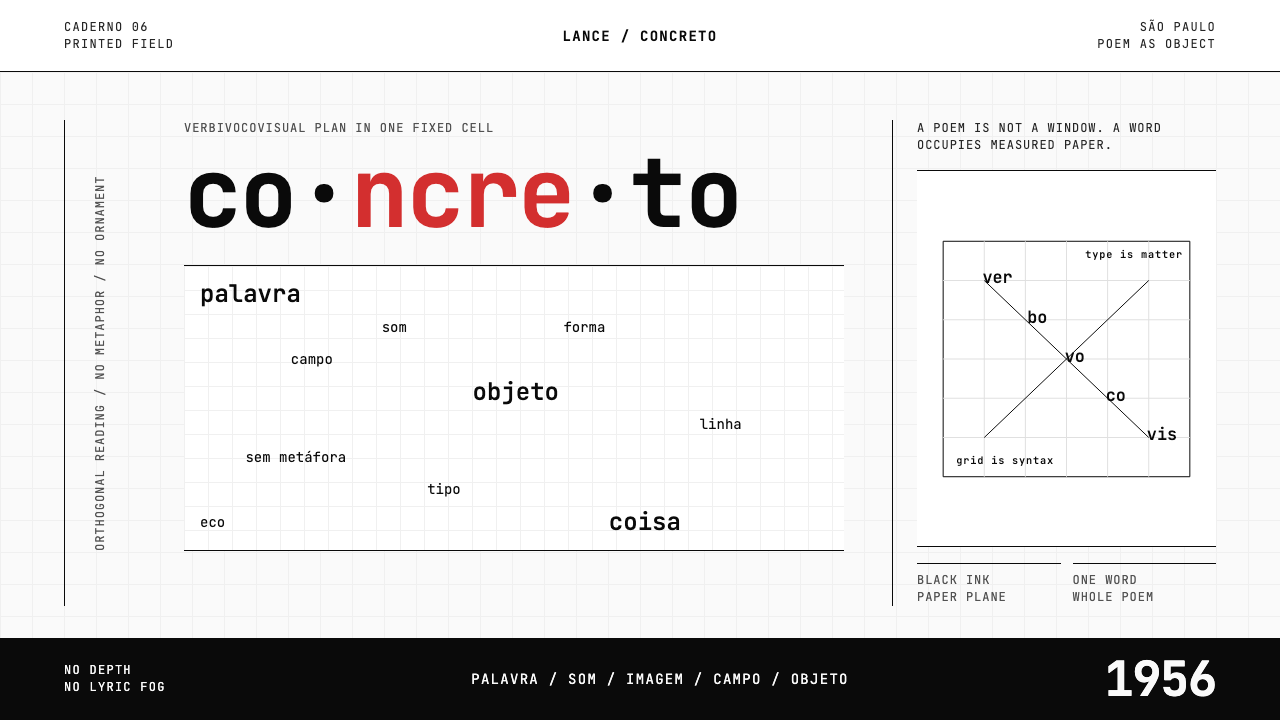 Brazilian Concrete PoetryWords become objects. Monospace cells, black-white paper, one cadmium red rup…