What is Cézanne — Mont Sainte-Victoire?
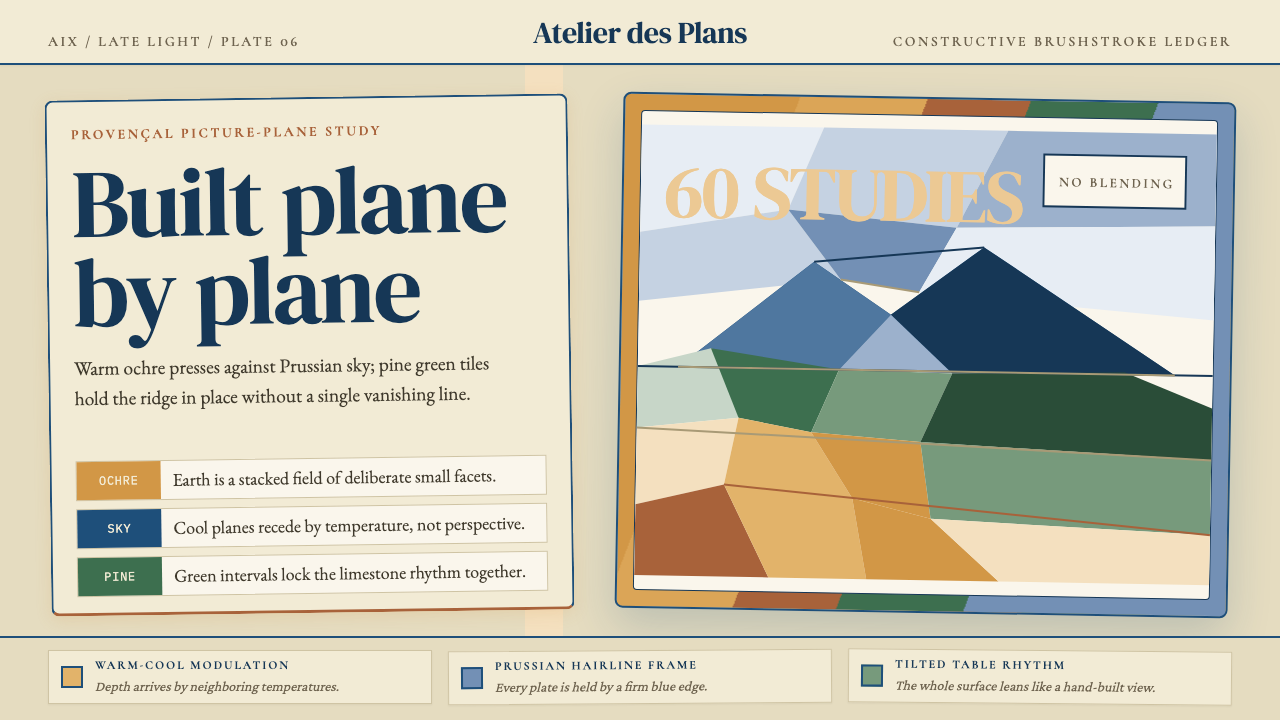
Cézanne didn't paint Mont Sainte-Victoire — he built it, facet by facet, until a limestone mountain became the blueprint for every constructed image that followed.
Cézanne — Mont Sainte-Victoire in brief
Cézanne — Mont Sainte-Victoire names the visual system distilled from Paul Cézanne's late series of paintings of the Provençal limestone peak he could see from his studio in Aix-en-Provence. Between roughly 1885 and his death in 1906, he returned to the same subject more than sixty times. What emerged was not a landscape style but a structural method: the 'constructive brushstroke,' in which every mark is a small, flat tile of color laid against its neighbor to build form from the inside out rather than describing it from the outside in.
The palette of these canvases is specific and purposeful: warm ochre for the bare rock and sun-baked earth, Prussian blue for the sky and its shadows, pine green for the stands of trees that push up the lower slopes. These three temperature zones — warm, cool, verdant — alternate across the picture plane in a rhythm that creates depth without receding lines or vanishing points. The picture feels simultaneously flat and volumetric, a tension that Picasso and Braque studied closely before arriving at Cubism.
As a design language, the Cézanne — Mont Sainte-Victoire aesthetic insists that a surface is composed, not rendered. Each element — a background field, a content card, a data bar, a typographic block — is a discrete color tile with its own temperature and weight. Tiles are laid in sequence; depth emerges from warm-cool opposition; nothing is blended or dissolved. The result is a visual logic that feels simultaneously ancient and radical: earthy, architectural, and rigorously non-decorative.

Where does Cézanne — Mont Sainte-Victoire come from?
Paul Cézanne was born in Aix-en-Provence in 1839 to a prosperous banking family. He traveled to Paris in the 1860s hoping to make his name in the academic Salon, but his early work — thick-painted, psychologically intense, often violent in subject matter — was repeatedly rejected. His friendship with Émile Zola, a childhood companion who became the era's most celebrated novelist, gave him social entrée to the Parisian avant-garde, where he fell in with the Impressionists and exhibited in their first group show in 1874. Camille Pissarro, the oldest and most pedagogically minded of the Impressionists, became a critical influence: working side by side with Pissarro at Pontoise in the 1870s, Cézanne learned to break down observed color into small, responsive marks and to trust the optical mixture of colors placed side by side rather than blended on the palette.
But Cézanne was never fully satisfied with Impressionism. He famously declared his ambition to 'redo Poussin from nature' — to find a way to paint with the Impressionists' directness and chromatic honesty while recovering the structural permanence he admired in the Old Masters. In 1882, after an increasingly difficult decade in Paris, he retreated permanently to Aix. The Mont Sainte-Victoire, visible from multiple vantage points around the city, became his obsession and his laboratory. He painted it from the Jas de Bouffan estate, from the road to Le Tholonet, and most famously from the purpose-built studio — the Atelier des Lauves — he constructed on a hill north of Aix in 1902, where the mountain dominated the horizon through a wide north-facing window.
The late Mont Sainte-Victoire canvases, produced approximately between 1895 and 1906, represent the culmination of this long experiment. The earlier versions, painted in the 1880s, still show a relatively conventional landscape organization: foreground, middle ground, sky. By the late phase, that recession has collapsed. The mountain and the sky press toward the same plane. Individual strokes read simultaneously as color sensation and as structural module. The tension between the flat mark and the volumetric reading it produces became, in the hands of Cézanne's successors, the founding gesture of modern art.
Cézanne died in 1906 from pneumonia contracted after collapsing outdoors during a painting session in the rain. He was largely unknown to the general public at the time of his death. The following year, Ambroise Vollard — his longtime dealer — organized a large retrospective at the Salon d'Automne in Paris, with fifty-six works. The response was electrifying. Maurice Denis, one of the Nabis painters who had long admired Cézanne, called him 'the Poussin of Impressionism.' Picasso and Braque, who had both been quietly absorbing his late work, accelerated their joint dismantling of pictorial convention. Within three years, Cubism was in full development. The Post-Impressionist movement, the proto-Cubist legacy, and the broader modernist construction method all trace their structural DNA directly to the Aix studio and the limestone mountain to its east.
What defines the Cézanne — Mont Sainte-Victoire look?
Constructive Brushstroke
The defining mark-making system: each stroke is a small, flat, roughly parallel tile of color applied with deliberate direction — typically diagonal, following the slope of the form being built. Marks do not blend into their neighbors; they abut. Seen close, the canvas reads as a mosaic of discrete color decisions. Seen from distance, the visual system resolves into coherent mass. This dual reading — flat mosaic and solid volume simultaneously — is the central optical achievement of the method.
Warm-Cool Modulation
Depth and volume emerge not from line or tonal gradient but from the systematic alternation of warm and cool color temperatures. A passage of warm ochre advances toward the viewer; an adjacent patch of Prussian blue or shadow green recedes. This push-pull is the spatial engine of the entire system. It means that the arrangement of warm and cool tiles must be intentional and rhythmic — a warm passage flanked by cool neighbors will read as a ridge or a highlight; the reverse reads as a hollow or a shadow plane.
Palette Restraint — Three Temperature Zones
The Mont Sainte-Victoire palette is deliberately narrow: warm ochre and sienna for earth and rock, Prussian blue for sky and shadow, pine green for vegetation. Secondary hues appear only where the three zones blend optically at their edges. This restraint is not poverty but precision — the same three temperatures recur everywhere in the composition, creating a harmonic unity across the whole surface. No element is an isolated color decision; every tile belongs to the warm, the cool, or the verdant family.
Collapsed Recession
Traditional landscape painting organized pictorial space into clearly separated planes: a distinct foreground, a middle ground, and a sky that receded convincingly to a horizon. In the late Mont Sainte-Victoire canvases, this separation dissolves. The mountain presses against the picture plane with the same urgency as the foreground foliage. Sky and rock share the same scale of brushstroke, the same density of attention. The effect is a compressed, layered frontality — the image is not a window but a wall of color built up in parallel planes.
Geological Weight and Earthiness
The aesthetic carries an irreducible quality of weight and mineral substance. The ochre range evokes limestone, fired clay, and dry Provençal soil — not painted surface but material presence. Even when the system is transposed into digital or print design, this earthiness persists as long as the warm tones lead: surfaces feel tactile rather than luminous, solid rather than airy. This is a key differentiator from other post-Impressionist or geometric styles — the palette has gravity.
Non-Linear, Rhythmic Composition
The compositions do not lead the eye along a single directional path. Instead, the alternating warm and cool tiles create a field of micro-movements — the eye travels between temperature zones in a scanning rhythm rather than following a linear guide. This means the viewer's attention distributes relatively evenly across the whole surface, with no single focal point commanding prolonged attention at the expense of the rest. For design applications, this translates to layouts where the whole is weighted more evenly than in hierarchical, arrow-like compositions.
Structural Flatness with Implied Volume
Each individual tile of color is unambiguously flat — it does not pretend to be a gradient or a modeled surface. Yet the accumulation of flat tiles in temperature sequence produces an undeniable sense of three-dimensional mass. This is the formal paradox at the heart of the system, and it is directly applicable in design: a layout can feel spatial and layered without employing depth blur, drop shadows, or gradient fills. The depth is in the color logic, not in the surface effects.

Who shaped Cézanne — Mont Sainte-Victoire?
Cézanne (1839–1906) spent the decisive decades of his career in relative isolation in Aix-en-Provence, working obsessively on the same subjects — the Mont Sainte-Victoire, the Jas de Bouffan gardens, groups of bathers — and developing the constructive brushstroke method in quiet defiance of both the academic tradition and the Impressionism he had helped establish. His influence on twentieth-century art is structurally unparalleled: Cubism, Fauvism, and the broader tradition of modernist abstraction all treat his late work as their point of departure. He is, as Braque said, 'the father of us all.'
Pissarro (1830–1903) was the elder statesman of Impressionism and the movement's most generous teacher. His collaborative painting sessions with Cézanne at Pontoise in the 1870s were the immediate catalyst for Cézanne's breakthrough: it was Pissarro who taught Cézanne to break observed color into discrete brushstrokes, to work directly from the motif, and to trust optical mixing over palette mixing. Without Pissarro's patient instruction, the technical vocabulary that produced the Mont Sainte-Victoire series might have developed very differently or not at all.
Vollard (1866–1939) was the Paris dealer who took the commercial risk of representing Cézanne when almost no one else would. He organized Cézanne's first solo exhibition in 1895, introducing the artist's mature work to the Parisian art world. After Cézanne's death, Vollard organized the critical 1907 Salon d'Automne retrospective that introduced his late Mont Sainte-Victoire canvases to the generation of Picasso and Braque. Without Vollard's persistent advocacy, the canonization of Cézanne's method might have taken another decade — long enough to delay or deflect the entire Cubist project.
Denis (1870–1943), a painter and theorist associated with the Nabis, was among the first to articulate what Cézanne's method actually meant as a structural principle. His 1907 text on Cézanne's retrospective described the artist as 'the Poussin of Impressionism' — capturing both the classical ambition and the new painterly means — and helped establish the critical framework through which the twentieth century would understand Cézanne's legacy. Denis's formulation that a painting is 'a flat surface covered with colors arranged in a certain order' was both a description of Cézanne's practice and an axiom for all subsequent non-representational art.
Picasso (1881–1973) spent a formative period in 1907 intensively studying Cézanne's work in the collection of Gertrude Stein and at the Salon d'Automne retrospective. The direct result was Les Demoiselles d'Avignon, which decomposed the figure into interlocking faceted planes — a translation of Cézanne's constructive tile system from landscape into the human form. Together with Georges Braque, Picasso developed Analytic Cubism between 1908 and 1912, a movement whose entire visual logic — simultaneous multiple viewpoints, the surface as a field of interlocking planes — is an extension of the spatial method Cézanne had worked out on the slopes of Mont Sainte-Victoire.
How do you use Cézanne — Mont Sainte-Victoire today?
The Cézanne — Mont Sainte-Victoire aesthetic is a structural system, not a surface veneer. Applying it well requires thinking about every element — a background, a card, a chart, a headline — as a discrete color tile with a specific temperature, and then arranging those tiles so that warm and cool zones alternate in a way that creates rhythm and implied depth. The palette is narrow by design: the ochre range for earth and warmth, blue-shifted tones for sky and shadow, and green-pine accents for life and mid-temperature transitions. Using all three zones simultaneously at full saturation produces the characteristic mineral richness; favoring one zone over the others shifts the mood while staying within the system.
For presentation slides, the style is particularly effective on cover pages and section dividers where the full compositional logic can operate. A cover built in this mode treats the slide as a canvas: background fields in ochre or warm stone, a diagonal sweep of cooler blue-gray anchoring one side, and a narrow pine-green accent introducing the third temperature. Type sits as its own flat tile — high-contrast and unadorned, set in a single weight — against the warm ground. Content slides should be handled as structured grids: each content block — a bullet column, a quote, an image — is a distinct tile with a defined temperature, separated by thin ruled lines rather than graduated spacers. Data visualizations adopt the tile logic naturally: bar segments and pie arcs rendered in the ochre, blue, and green zones, with no gradient fills, each segment reading as a flat color decision.
For web interfaces, the system translates well to dashboards, analytics tools, and pricing pages where the user needs to scan and compare large amounts of structured information. The approach begins with a warm near-neutral ground — the base of the palette, not a stark white — and builds information hierarchy through color temperature rather than depth effects. Cards and containers use the ochre or stone tone as their surface; selected or active states introduce the Prussian blue or pine green. Interactive elements gain legibility through hard-bordered treatments rather than soft shadows. Navigation is typographic and flat; icons, if used at all, should be reduced to geometric silhouette rather than detailed illustration. The system performs well in contexts where authority and material solidity are valued — financial tools, research platforms, professional editorial interfaces.
For editorial and marketing applications, the aesthetic supports strong visual hierarchy and poster-like impact. An editorial layout in this mode uses a warm ground for the full page, reserves the cooler blue-shifted tones for sidebar elements or pull-quote backgrounds, and uses the pine green sparingly — perhaps for a single recurring accent in section headers or call-to-action elements. Marketing pages work best when treated as a sequence of facets: alternating full-width blocks in warm and cool ground colors, each block containing one strong typographic statement and minimal other content. The rhythm of warm-cool alternation across a scroll mimics the constructive rhythm of the painting itself, giving the page a sense of accumulating structure rather than arbitrary decoration.
A common mistake when applying this aesthetic is treating the ochre-blue-green triad as a decorative color theme rather than a structural temperature system. Designers who simply swap their existing palette for these three hues while maintaining soft gradients, blurred shadows, and smoothly blended transitions miss the entire point. The constructive logic requires flat tiles, hard edges, and the visible seam between warm and cool areas. Similarly, introducing too many values within a single temperature zone — multiple shades of ochre fighting for attention — breaks the tile-and-temperature logic that makes the system work. Restraint within each zone and clarity at the zone boundaries are what distinguish an authentic application from a color-themed pastiche.

Cézanne — Mont Sainte-Victoire — FAQ
How does this aesthetic differ from other Post-Impressionist styles like Seurat's Pointillism?
Both Cézanne's constructive brushstroke and Seurat's Pointillism are systems that build color from discrete marks rather than blended passages, but they operate on opposite principles. Seurat's dots are uniform in size and governed by scientific color theory — the goal is optical mixing to produce luminous, atmospheric light. Cézanne's tiles are varied in size, directional in their placement, and governed by structural logic rather than optical physics — the goal is to build form and volume, not atmosphere. Seurat's paintings feel vibrant and immaterial; Cézanne's feel weighted and geological. In design terms: Pointillist-derived aesthetics produce luminous, airy surfaces; Cézannian aesthetics produce dense, material, architectural surfaces.
Can the palette work effectively in dark-mode or dark-ground layouts?
The historical Cézanne palette is inherently warm and light-ground — the limestone whites and warm ochres of Provence set the tonal foundation. A dark inversion is possible but requires significant adjustment. On a dark ground, the ochre tones must be warmed and brightened to retain their temperature contrast against the background, and the Prussian blue needs to shift toward a dusty, medium-dark value rather than a deep navy that merges into the ground. Pine green, which reads naturally at mid-tone, transitions best to the dark variant. The risk in dark-ground applications is that the geological weight of the palette becomes oppressive rather than grounding — the system works best when there is genuine tension between a warm ground and cooler mark-making, which a dark-mode layout reduces. Use the dark variant selectively: it suits single-screen data views or cover panels better than full reading layouts.
Is this style appropriate for consumer-facing products, or does it work better in professional contexts?
The Cézanne — Mont Sainte-Victoire aesthetic carries specific connotations: geological weight, material seriousness, constructed structure, and a visual language associated with art history and cultural authority. These qualities make it highly effective for professional tools, research platforms, editorial publications, cultural institutions, and premium products positioning themselves as enduring rather than fashionable. It is less suited to contexts that call for lightness, play, or consumer warmth — children's products, entertainment apps, fast-moving consumer goods, or anything that needs to feel spontaneous rather than deliberate. The palette's earthiness can also feel heavy in interfaces that rely on high information density, unless the warm and cool alternation is handled with restraint. When the product's values align with the aesthetic's — seriousness, craft, permanence — the match is distinctive. When they do not, the result reads as incongruous or unnecessarily somber.
How should typography be handled within this system?
Typography in the Cézanne — Mont Sainte-Victoire system should function as another tile in the composition — a flat, weighted block of color (typically near-black on a warm ground) with its own temperature reading. The key principles are flatness and temperature coherence: type should not be shadowed, embossed, or given gradient treatments. A single typeface family at clearly differentiated size and weight levels creates the strongest system — the scale contrast does the organizational work that the Bauhaus achieves with geometric shapes. Serif typefaces with classical proportions sit naturally against the historical and geological quality of the palette; humanist designs also work well. Avoid highly geometric sans-serifs, which introduce a different aesthetic logic and conflict with the organic, constructed character of the brushstroke-tile system. Letterspacing should be generous in display contexts to allow each letter to read as its own form, consistent with the tile-and-space logic of the overall composition.
What distinguishes an authentic application of this aesthetic from a superficial one?
The deepest test is whether the layout reads as built or as decorated. An authentic application treats every visual element as a discrete tile with a temperature: backgrounds, cards, type blocks, image crops, dividers, and data elements all participate in a warm-cool rhythm that creates implied depth without surface effects. The palette is limited and purposeful; the three temperature zones recur rather than multiply. Edges are crisp and intentional — the seam between a warm ochre field and a cool blue passage is where the structural logic is most visible. A superficial application borrows the color names — ochre, blue, green — while maintaining blended gradients, soft shadows, and decorative layering; the result resembles the palette without embodying the method. The distinction is precisely analogous to the difference between Cézanne's actual canvases and a painting that uses the same pigments but blends them in the Impressionist manner: same colors, entirely different structural logic.
Related design styles
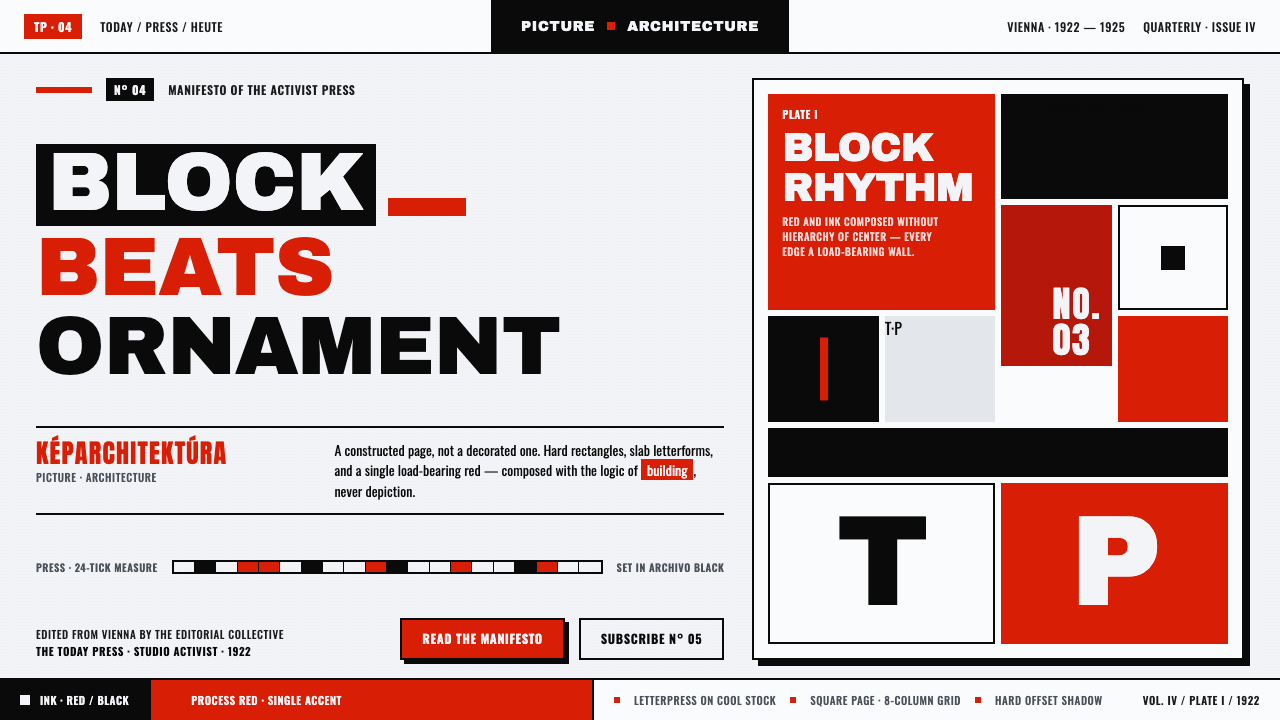 Lajos Kassák MA ConstructivismPage as building, not picture. Red and ink slab-sans blocks set asymmetricall…
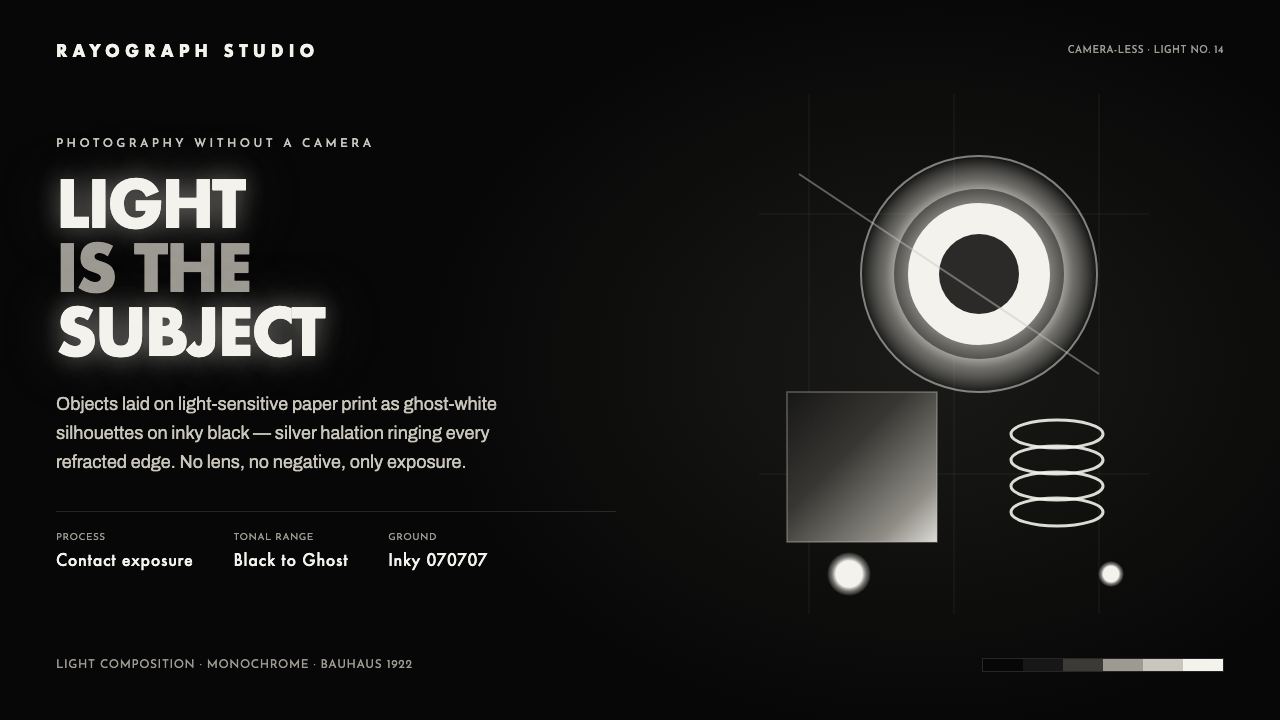 Photogram RayographLight is the subject. Ghost-white silhouettes and silver halation float on in…
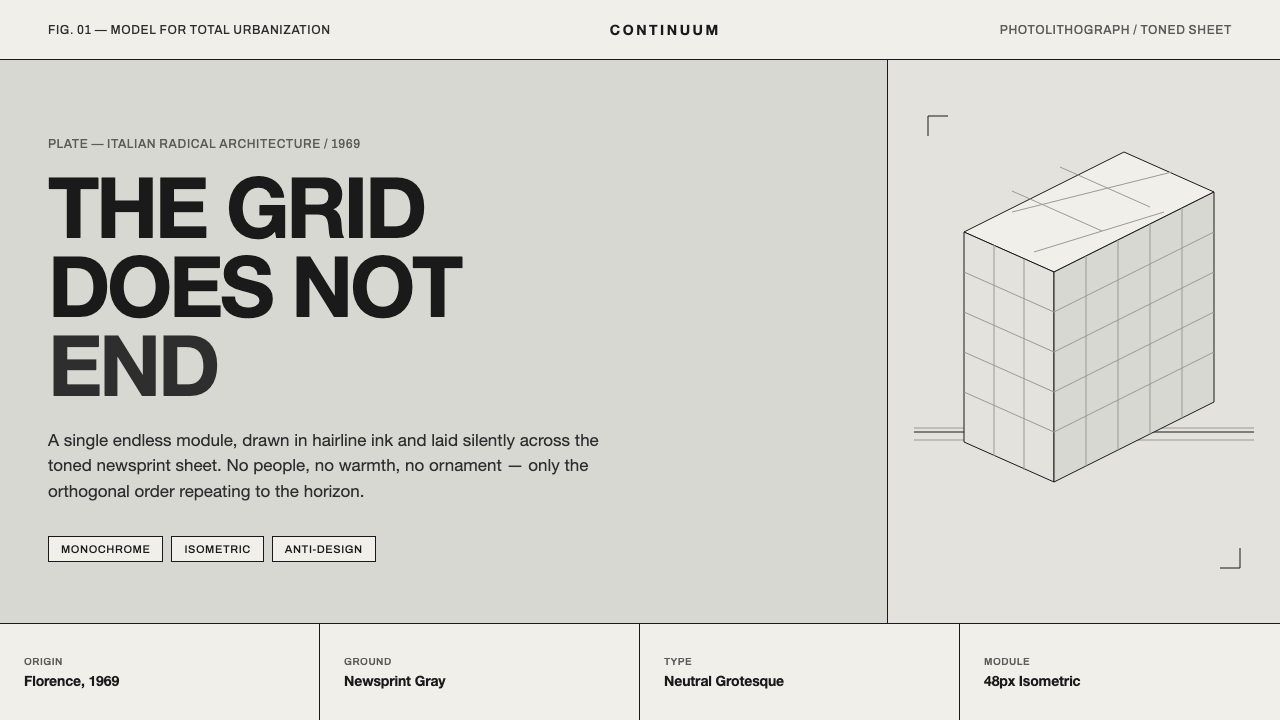 Superstudio Continuous MonumentThe grid does not end. Hairline black isometric ruling on toned newsprint-gra…
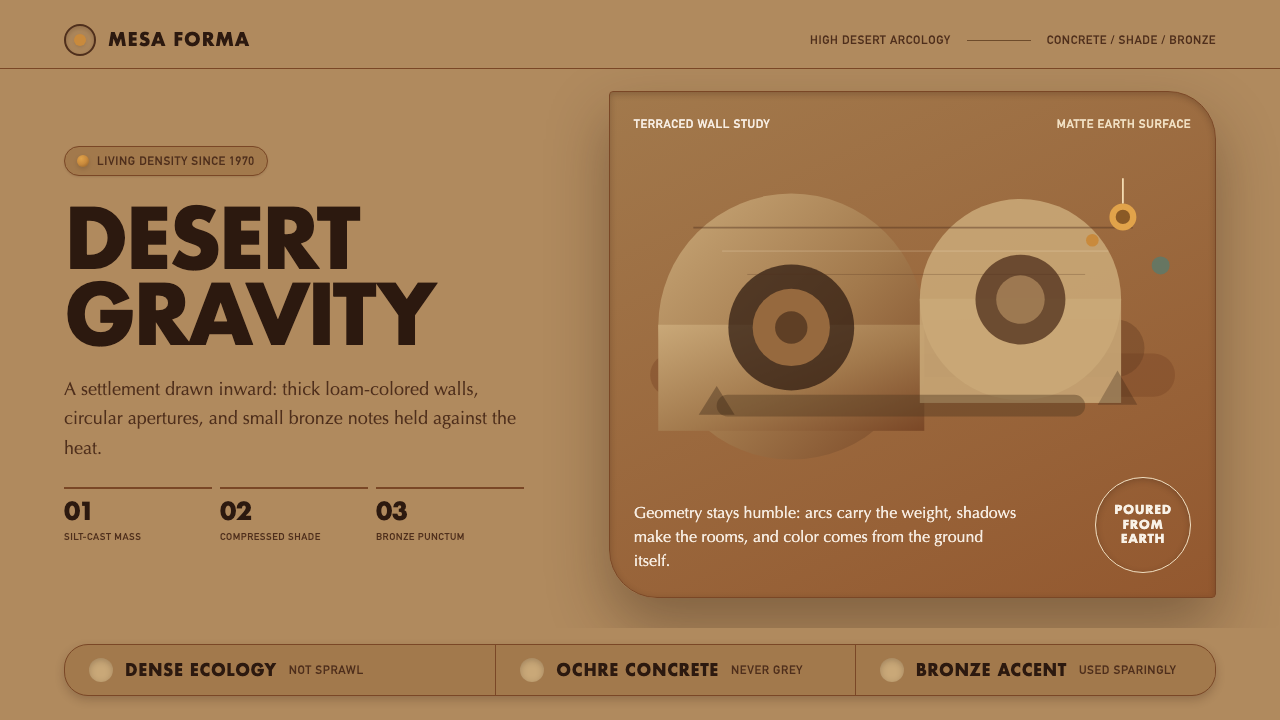 Arcosanti ArcologyArchitecture becomes desert. Ochre concrete, circular apertures, and bronze a…
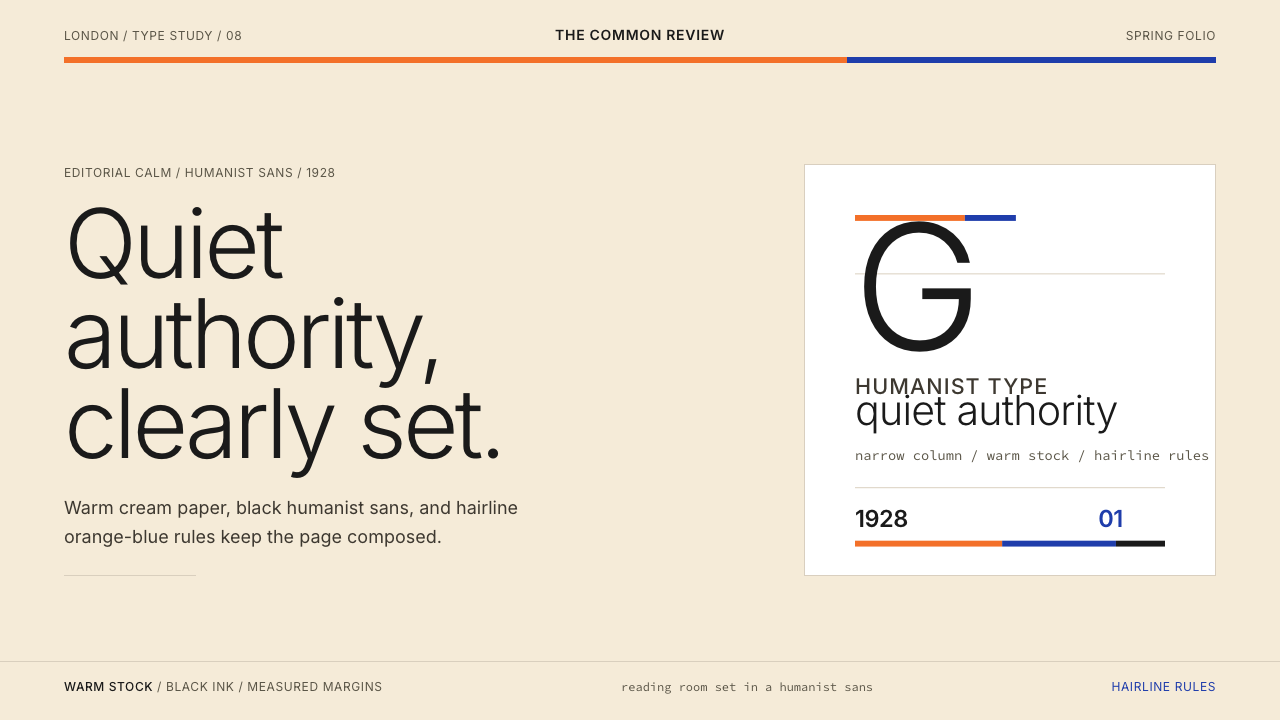 Gill Sans (BBC, 1928)Quiet authority, clearly set. Warm cream, black humanist sans, and hairline o…
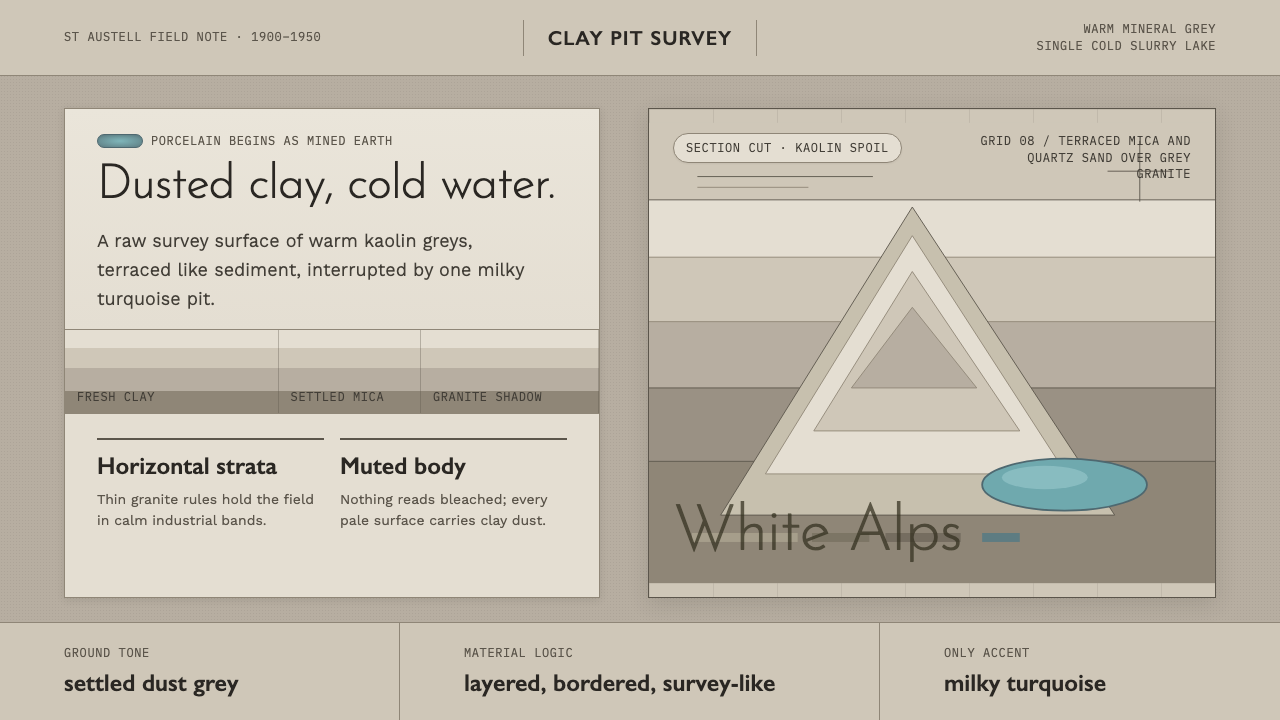 Kaolin Porcelain Clay PitIndustrial calm in dust grey. Horizontal clay strata break for one milky turq…