About Cézanne — Mont Sainte-Victoire
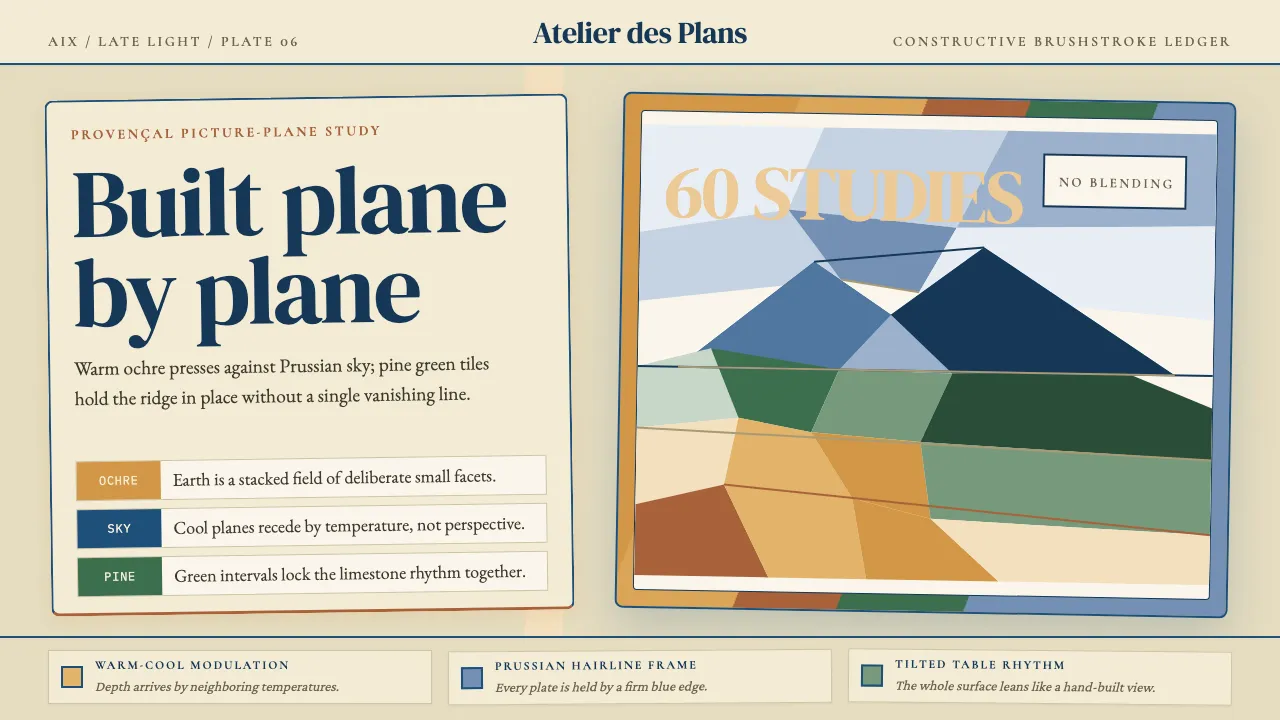
Paul Cézanne's late Mont Sainte-Victoire canvases are the bridge from Impressionism to Cubism. Painting the same Provençal limestone peak 60+ times from his Aix studio, he broke the landscape into modular "constructive brushstroke" facets — warm ochre, Prussian sky, pine green alternating across the picture-plane.
Picasso and Braque called him "the father of us all." The aesthetic insists every brushstroke is a small flat tile of color; the whole picture is built, not described, plane by plane. Depth comes from warm-cool modulation, never line-perspective.
- Origin
- Aix-en-Provence, France
- Era
- Post-Impressionist late phase 1885–1906; canonized after 1907 Salon d'Automne retrospective
- Key figures
- Paul Cézanne · Camille Pissarro · Ambroise Vollard · Maurice Denis
- Movements
- Post-Impressionism · Proto-Cubism · Modernist construction
Cézanne — Mont Sainte-Victoire design spec
Colors
Typography
The other 11 sections — buttons, cards, spacing, motion, techniques and more — open once you unlock. Download the DESIGN.md or send it to your AI in one click. Unlock once, yours forever.
Sign up nowStyles similar to Cézanne — Mont Sainte-Victoire
Also inspired by art & artists, with a close feel.
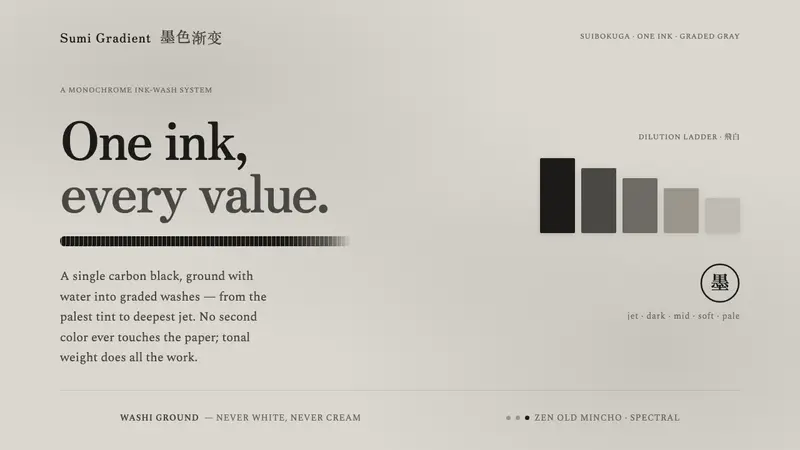 Sumi Grayscale GradientOne ink, every value. A single carbon black diluted into graded grays, marked by a dry-brush stroke.
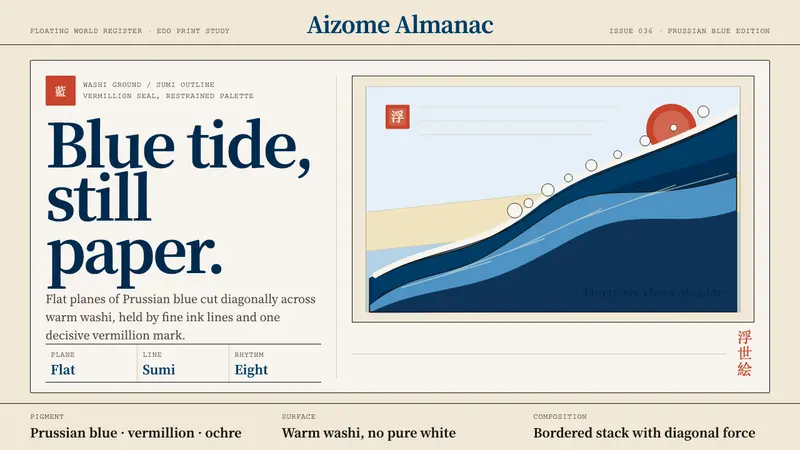 Edo Ukiyo-e (Hokusai)Flat power on paper. Prussian blue diagonals and vermillion seals cut across warm washi.
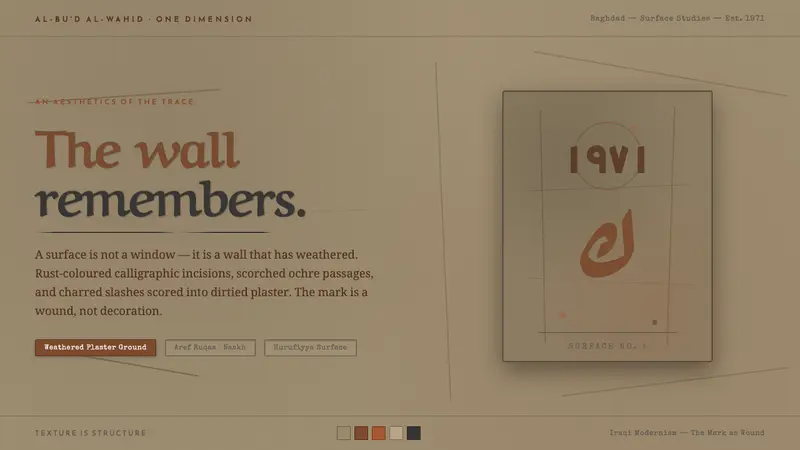 Shaker Hassan Al SaidThe mark is a wound, not decoration. Rust calligraphic scars incised into dirtied ochre-grey plaster.
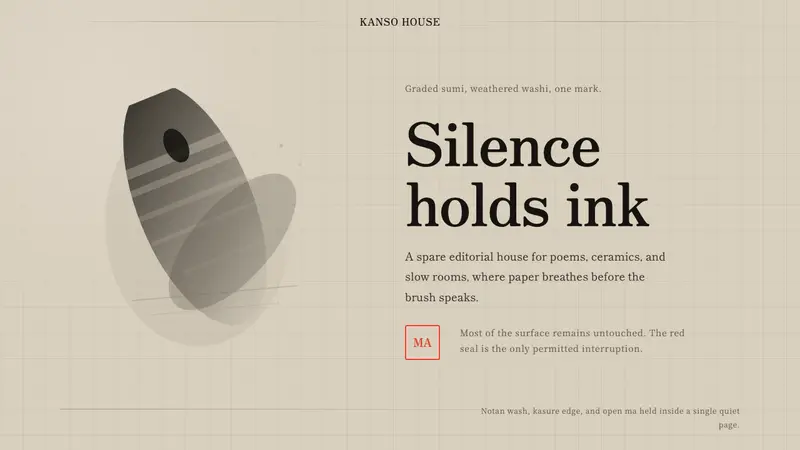 Sumi-e Ink WashRestraint carries weight. Washed black ink floats on oatmeal washi, anchored by one red seal.