What is Penguin Books (1935)?
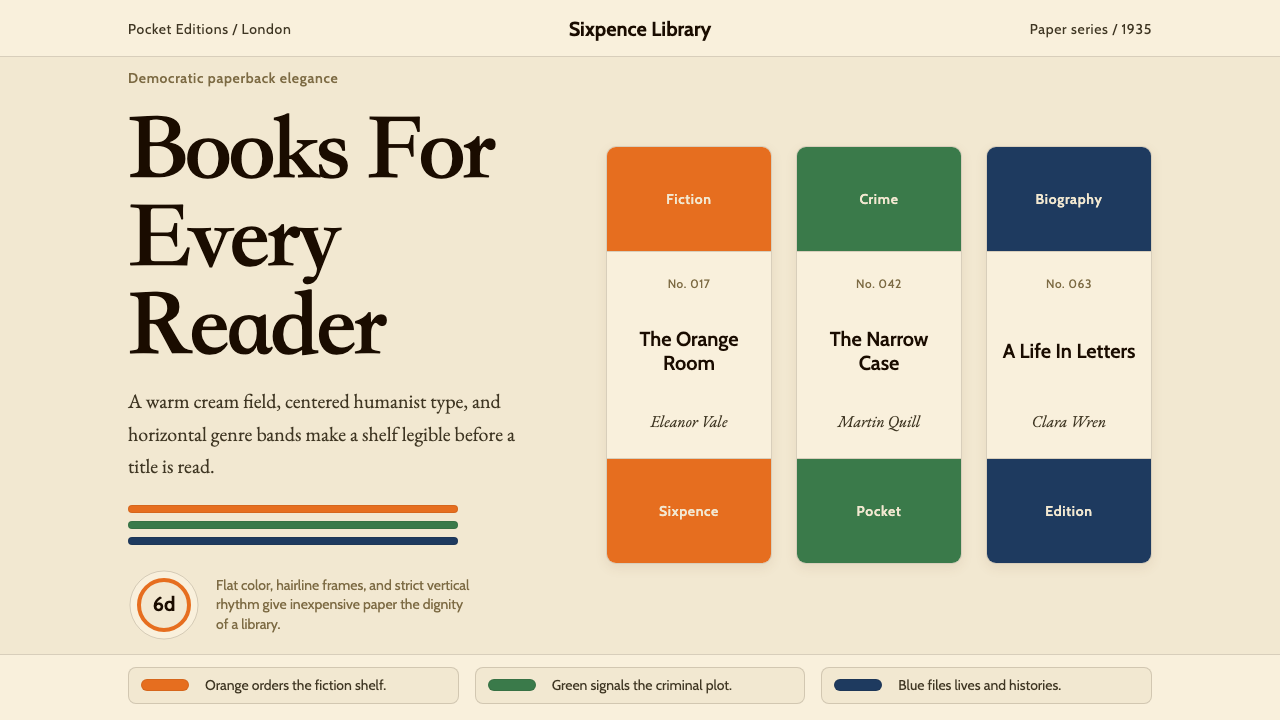
Three horizontal bands, a penguin, and sixpence changed what books looked like — and who got to read them.
Penguin Books (1935) in brief
Penguin Books is a British publishing visual identity founded in 1935 whose cover system — horizontal color bands divided into three registers, restrained sans-serif typography centered on cream stock, and a small illustrated penguin emblem — became one of the most imitated and most enduring graphic standards in the history of print. The system is not merely attractive; it is a coded language where band color signals genre, type placement signals authority, and the cream ground signals quality at a modest price.
The identity works through an almost austere economy of means. The cover is divided horizontally into three zones: a top color band carrying the publisher name and imprint, a wide cream-colored central panel holding the title and author in centered letterforms, and a bottom band matching the top in color and weight. A thin ruled line separates each zone from the next. Within this framework, the only variable that changes from book to book is the color of the bands — everything else, the proportions, the typeface, the cream ground, the penguin mark, remains constant.
What makes the Penguin identity remarkable is its demonstration that strict typographic discipline and a minimal palette can produce infinite variety without visual chaos. A shelf of Penguin originals looks simultaneously unified and individual — each title distinguishable by color, every spine recognizable as part of the same family. It is an object lesson in how constraint, applied intelligently, generates identity rather than limiting it.

Where does Penguin Books (1935) come from?
Penguin Books was founded by Allen Lane in July 1935, initially as an imprint of The Bodley Head. Lane's founding insight was simple and, in hindsight, radical: quality literature should be available at the price of a packet of cigarettes. He priced each title at sixpence and sold them not just through bookshops but through Woolworths stores — chain variety shops that had never stocked books before. The first ten titles included works by Agatha Christie, Ernest Hemingway, and André Maurois. They sold several hundred thousand copies in the first year and established that a large, underserved market for affordable, well-designed reading matter existed.
The original cover design was created by Edward Young, a twenty-one-year-old production assistant at The Bodley Head. Young conceived the three-band horizontal structure, chose the cream ground, drew the first penguin mascot (reportedly sketched from a visit to London Zoo), and established the color-coding convention: orange for general fiction, green for crime and mystery, dark blue for biography and memoirs, red for travel and adventure, cerise for essays and belles-lettres, yellow for miscellaneous. This genre-color grammar was immediately legible to buyers who could now identify the type of book they were picking up without reading the spine — a revolutionary aid to browsing in a Woolworths aisle.
The second pivotal chapter in the Penguin design story came in 1947, when Allen Lane hired the Swiss typographer Jan Tschichold to impose systematic rigor on what had, over a decade of rapid growth, become an inconsistent visual standard. Tschichold spent two years at Penguin, writing his famous Penguin Composition Rules — a detailed typographic specification governing typeface selection, type area proportions, spacing norms, and punctuation conventions. His rules brought Swiss modernist discipline to bear on the entire catalog and produced a coherent typographic standard that remained authoritative for decades. Tschichold himself was ambivalent about the commercial context — he privately described some of the work as below his usual standards — but the resulting system was a landmark in applied typography.
A third significant revision arrived in 1961, when Romek Marber, a Polish-born British graphic designer, redesigned the crime series covers under art director Germano Facetti. Marber's grid introduced a more architecturally structured visual framework: a defined image area in the upper two-thirds of the cover, with the text zone firmly anchored in the lower third. This became known as the Marber Grid and was extended across multiple Penguin series. The Marber Grid preserved the horizontal band logic while creating space for imagery — photography, illustration, and abstract design — within a controlled compositional system. It represents the moment when Penguin's identity evolved from a purely typographic standard to one that could accommodate visual complexity without losing coherence.
What defines the Penguin Books (1935) look?
Color Band System
The defining structural element of the Penguin cover is its three-band horizontal division, where the top and bottom bands carry a genre-identifying color and the center panel remains cream. The color assignments — orange for general fiction, green for crime, deep blue for biography, red for travel — create a genre grammar legible from across a room. The bands are equal in depth, which distributes visual weight symmetrically and frames the central text zone as a calm neutral field within an energetic chromatic border.
Cream Ground
The cream-colored central panel is not merely a background — it is a deliberate quality signal. In the 1930s, cream stock was associated with good-quality printing; white was cheap, cream was refined. The choice to hold the cream constant across all genre variants makes it the unifying visual constant of the identity, the element that says 'Penguin' before the penguin emblem is even registered. Against the warm neutral, black type achieves excellent legibility, and the bold band colors at top and bottom read as vivid contrasts rather than competing saturations.
Centered Typography
The title and author name are set centered on the cream panel, a typographic choice that reads as formal and authoritative without being stiff. Centering aligns with the horizontal symmetry of the band structure and gives the cover a poster-like calm. The hierarchy is straightforward: the title holds the larger, more prominent position; the author name sits beneath it in a smaller but equally weighted setting. No decorative devices — rules, boxes, ornaments — interrupt the text zone. The letterforms carry the full communicative load.
Penguin Emblem
The penguin mascot, drawn in a loose illustrative style that conveys both dignity and a light wit, appears in the lower portion of the central panel or within the bottom band, depending on the series and era. The bird is always rendered simply — a few confident strokes rather than elaborate illustration — and reads as friendly without being frivolous. Its presence softens the system's formal typographic rigor: the reader understands that seriousness and accessibility are not opposites. Across nine decades, the penguin silhouette has remained broadly consistent, a mark of institutional continuity.
Rule Lines and Framing
Thin horizontal rules separate the color bands from the cream center panel, providing a crisp edge that prevents the colors from bleeding visually into the neutral ground. These rules are structural rather than decorative — they define zones and hold the composition tight. Their consistent weight and placement across all covers is part of what makes the system feel rigorous rather than casual. When rule lines were occasionally varied or eliminated in later editions, the covers often lost the precise, architectural feel that made the original system distinctive.
Typographic Restraint
From Jan Tschichold's 1947 rules onward, the Penguin typographic standard prescribed a humanist sans-serif letterform — open, legible, and warm without being decorative — set at specific size relationships that established clear hierarchy without resorting to bold weights or italic emphasis beyond what was functionally necessary. The discipline prohibited mixing typefaces for stylistic effect, setting type in unusual colors within the neutral panel, or using decorative letterforms of any kind. Legibility in service of the text, not the designer's expression, was the governing principle.
Systematic Variation
Perhaps the most sophisticated aspect of the Penguin system is the way it enables variety within strict constraint. The band color changes by genre; the title changes with each book; the period of publication is sometimes signaled by subtle shifts in the penguin drawing or the typeface generation. Yet the overall grammar remains constant. A reader encountering a Penguin title from 1938 and one from 1962 on the same table instantly recognizes both as Penguin. This is the achievement of a system designed with such confidence in its underlying logic that it can absorb variation without losing coherence.

Who shaped Penguin Books (1935)?
Allen Lane founded Penguin in 1935 after being unable to find affordable reading matter at Exeter station and deciding to act on that frustration rather than merely note it. His commercial instinct was to treat the paperback not as a cheap object but as a democratized premium — the same content as the hardback at a fraction of the price, with design quality to match. Lane oversaw the expansion of the color-coding system, hired Jan Tschichold and later Germano Facetti, and defended the design identity of the list against commercial pressures throughout his tenure as publisher until his death in 1970. He received a knighthood in 1952.
Edward Young was a production assistant at The Bodley Head when he designed the original Penguin cover format in 1935 at the age of twenty-one. The three-band horizontal structure, the cream ground, the color-genre coding system, and the first penguin illustration were all his contributions. Young subsequently joined the Royal Navy and later returned to publishing, but it is the cover format he sketched in 1935 — reportedly on the back of an envelope — that represents his lasting contribution to graphic design. Few designers have had a more consequential first project.
Jan Tschichold was one of the twentieth century's pre-eminent typographers, known for his early advocacy of asymmetric modernist layout in the 1928 manifesto Die neue Typographie and his subsequent return to classical centered composition — a reversal he justified on philosophical grounds. Allen Lane hired him in 1947 to systematize Penguin's typography. In two years, Tschichold revised hundreds of books, wrote the Penguin Composition Rules, standardized typeface choices, corrected line spacing, and established the proportional norms that governed the series for decades. His Penguin period demonstrates that the most effective design standards are often written, not just drawn.
Romek Marber was a Polish-born graphic designer who worked in Britain from the 1950s. In 1961, under art director Germano Facetti, he redesigned the Penguin Crime covers and in doing so created the Marber Grid — a compositional framework dividing the cover into a large image field in the upper two-thirds and a tightly controlled text zone in the lower third. The grid was subsequently adopted across other Penguin series and brought the possibility of photographic and illustrative imagery into the cover system without sacrificing typographic order. Marber's solution demonstrated that a strong structural system could accommodate visual ambition as well as typographic purity.
How do you use Penguin Books (1935) today?
The Penguin Books visual language is one of the most directly transferable historical identities in contemporary design, precisely because its underlying logic — color codes genre, type codes authority, neutral ground codes quality — is a structural system rather than a decorative one. Applying it well means understanding what each element is doing and replicating the function, not just the appearance.
For presentation slides, the Penguin approach works particularly well on covers and section dividers. A cover built on Penguin logic uses the three-band horizontal structure: a top band in a bold, solid color carries the series or company name; a wide cream or off-white central field holds the presentation title and subtitle in centered, hierarchically scaled type; a bottom band in the matching color anchors the layout and carries metadata such as date or speaker name. Content slides can adopt a quieter version of the same logic — a color bar along the top edge serving as a section indicator, cream or near-white body, black type — creating a visual family across the deck without overwhelming each content page with color.
For web interfaces, the Penguin idiom is well suited to editorial platforms, publishing tools, newsletter designs, and any interface where the primary product is text and where institutional trust is a key value. The horizontal band as a navigation or header device works exceptionally well: a solid color header band containing only wordmark and navigation links, with the page body in cream or near-white. Pricing and feature-comparison pages benefit from the color-coding logic — assigning a different band color to each tier creates immediate visual differentiation without requiring complex iconography. Dashboard interfaces can use the color bands as section headers, with white card bodies below.
For editorial and marketing material, Penguin logic supports a wide range of output: book cover pastiches, event posters, newsletter templates, product packaging, and social media cards all translate naturally. The key is maintaining the horizontal register structure — three zones, proportionally balanced, with the color in the outer bands and the content in the neutral center. Marketing copy works well in this format because the cream center field gives text strong legibility and the colored bands function as bold visual bookends. The system is also highly effective for series branding, where multiple products in a family each take a different band color while sharing all other visual constants.
A common mistake when applying this style is treating the color bands as decorative trim rather than as semantic identifiers. In the original Penguin system, each color meant something specific; using the bands purely for visual variety without assigning each a consistent meaning destroys the system's legibility advantage. Similarly, introducing gradients, soft shadows, or rounded geometry into what is fundamentally a flat, ruled, rectangular system produces a hybrid that reads as neither Penguin nor contemporary — it loses the historical authority without gaining modern lightness. If you are going to work within the Penguin idiom, commit to the hardness of its edges and the semantic weight of its colors.

Penguin Books (1935) — FAQ
Do I need to use all three bands, or can I adapt the structure?
The three-band structure is the core grammar of the system, but it can be simplified to two bands — a single color band at top or bottom with a large neutral field — without losing the essential logic. What matters is the horizontal register principle: color signals category, neutral ground holds content, ruled lines mark transitions. Collapsing to one band works well for simpler formats like social cards or email headers. What does not work is treating the bands as merely decorative stripes and varying their count, weight, or proportions arbitrarily — once they lose semantic consistency, they become visual noise.
How does this style relate to Swiss International Style?
They share a common ancestry in the European modernist typography of the 1920s and 1930s, and Jan Tschichold — who brought Swiss typographic rigor to Penguin in 1947 — is a direct link between them. But they are distinct. Penguin is fundamentally a cover-design system built around horizontal register, color-coded genre, and centered type — it is warm, institutional, and explicitly British. Swiss Style is grid-driven, left-aligned, and aspires to neutral internationalism. Penguin uses color symbolically and sparingly within a defined genre vocabulary; Swiss Style uses a broader tonal range and incorporates photography as a primary element. Confusing them leads to layouts that are neither.
Can the Penguin style work for digital dark-mode interfaces?
A dark-mode inversion is possible but requires care. The original system is fundamentally a light-ground identity — the cream panel is doing significant work in signaling warmth and quality. Inverting to a dark background loses that quality signal and can make the system feel industrial rather than literary. If dark mode is required, the most coherent approach is to invert the cream to a very dark warm neutral — a near-black with warmth rather than a cool charcoal — and to retain the color bands at their original saturation. Avoid inverting the band colors to pastels or muted tones, as this undermines the boldness that gives the system its immediate recognizability.
Is this style appropriate for brands outside publishing and education?
Yes, with judgment. The Penguin idiom carries strong associations with institutional trust, literary seriousness, and accessible quality — these transfer well to legal services, financial products, think tanks, professional associations, and premium consumer goods where heritage and trustworthiness are desired values. It transfers less well to contexts where warmth, playfulness, or cutting-edge modernity are the primary brand values, because the system reads as established and correct rather than dynamic and emergent. The risk of using it outside its natural territory is that the institutional associations become deadweight — the design reads as borrowed authority rather than authentic positioning.
How much does the typeface choice matter when working in this style?
It matters considerably, though not in the way people often assume. The key quality to match is not a specific typeface name but a typographic character: humanist proportions, open apertures, even stroke weight without mechanical rigidity, and comfortable legibility at book-text sizes. Geometric sans-serifs with very tight apertures or very uniform stroke weights read as wrong in this context — they feel too cold, too Swiss, too contemporary. Heavy display fonts with strong personality undermine the neutrality that lets the color system carry meaning. A secondary serif for body text, used judiciously, is historically appropriate and adds a layer of the literary warmth that the original covers projected.
Related design styles
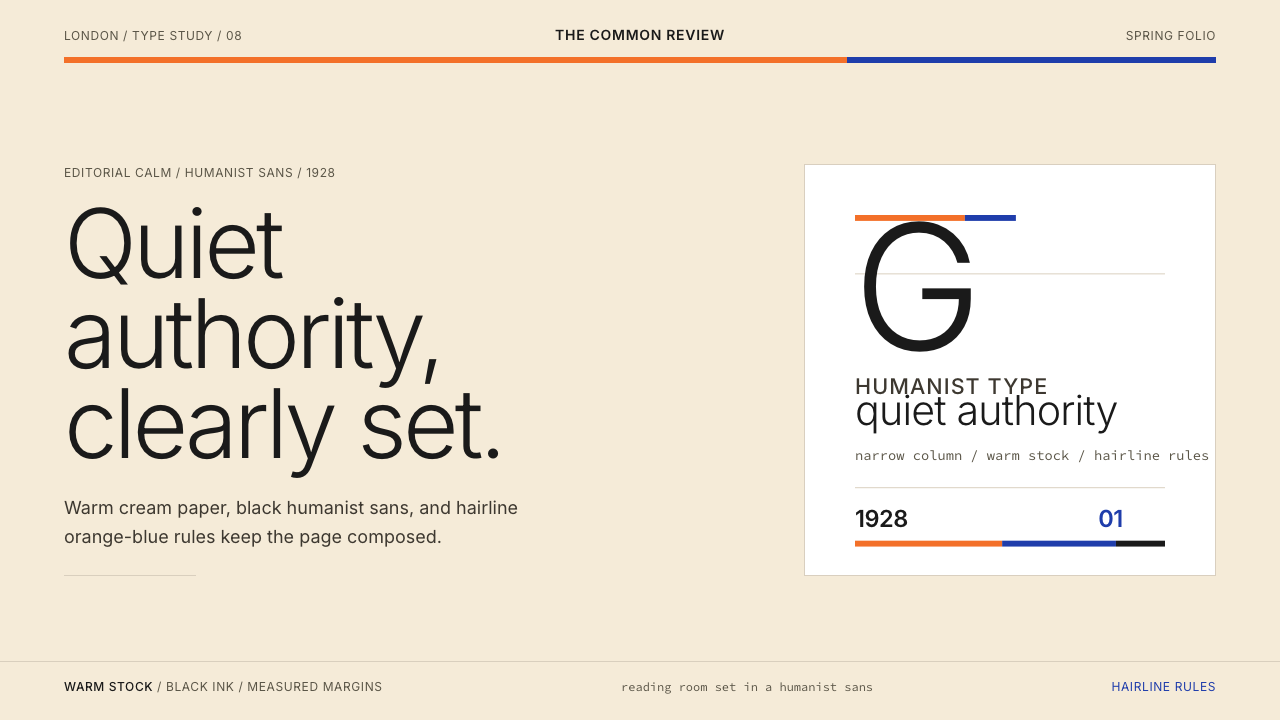 Gill Sans (BBC, 1928)Quiet authority, clearly set. Warm cream, black humanist sans, and hairline o…
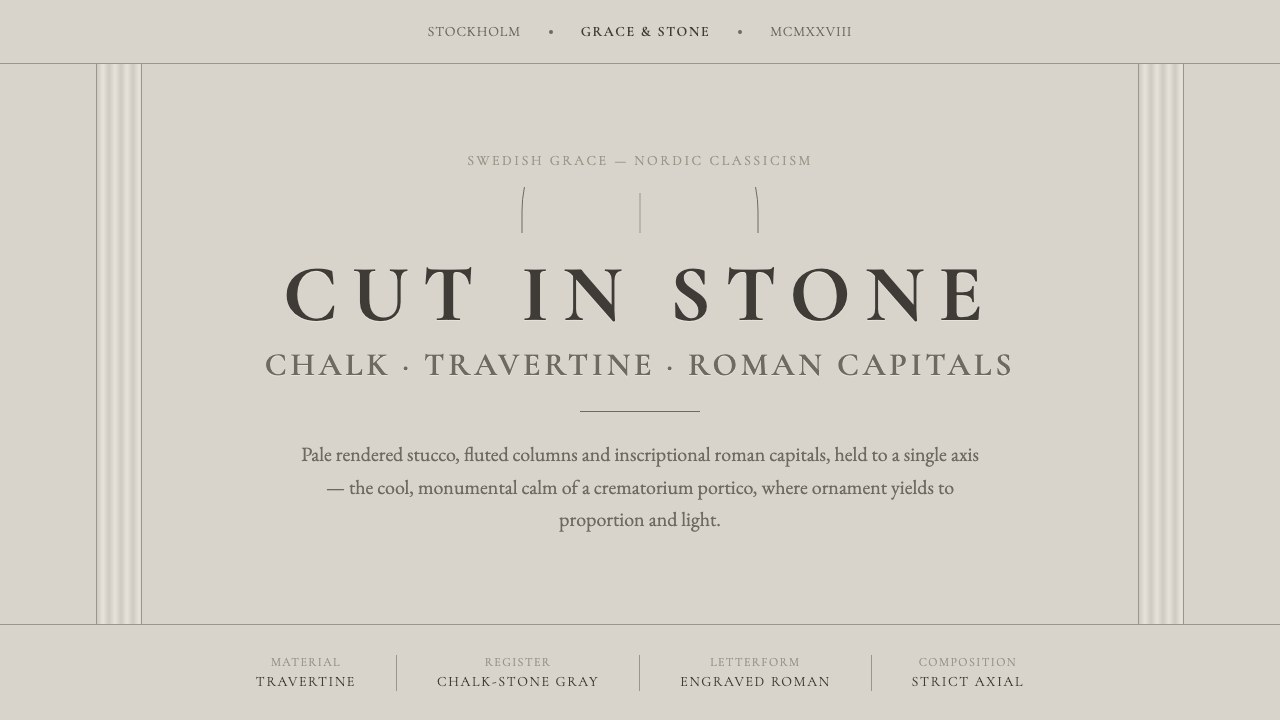 Nordic Classicism AsplundStone, not cream. Engraved Trajan capitals on cool chalk stucco, fluted colum…
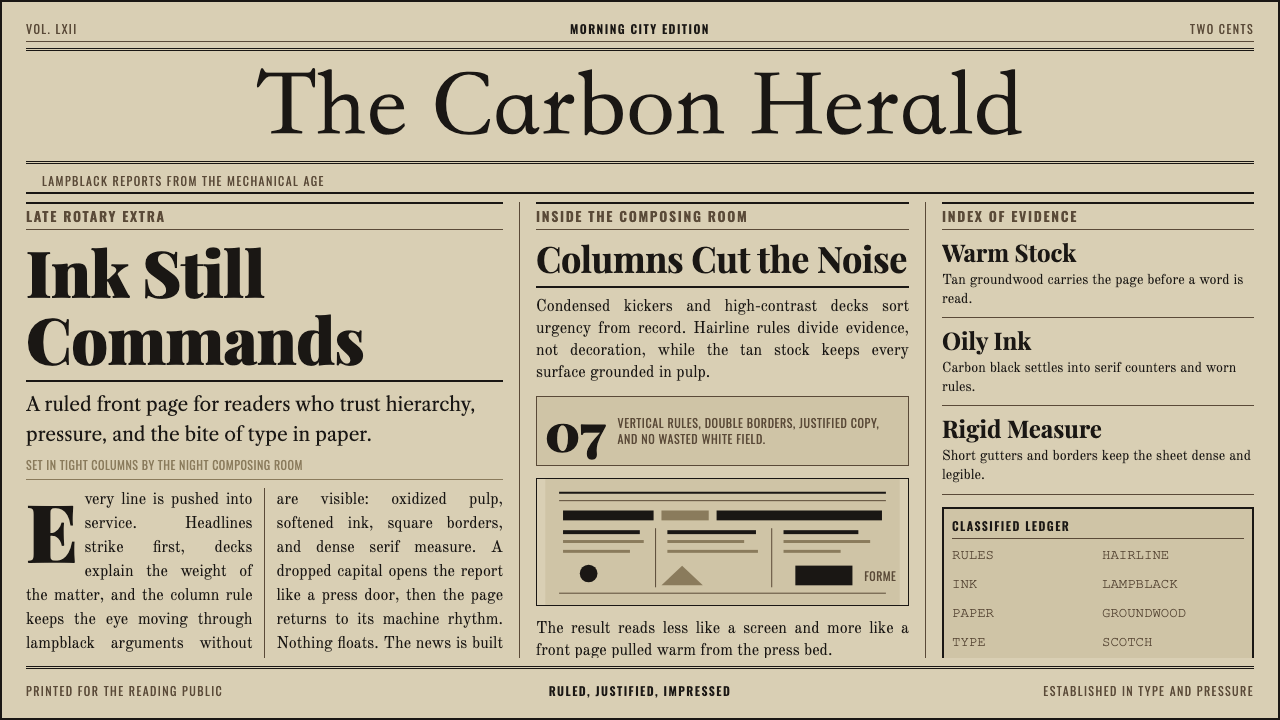 Broadsheet LetterpressAuthority in ink. Lampblack serif decks lock into tan paper with strict ruled…
 Bucharest Interwar ModernismModernism gathers civic weight. Sooted plaster, strict glazing bands and one…
 Cricket Whites FlannelsSummer, kept in good order. Ecru serif and fine club trim cross a dark mown g…
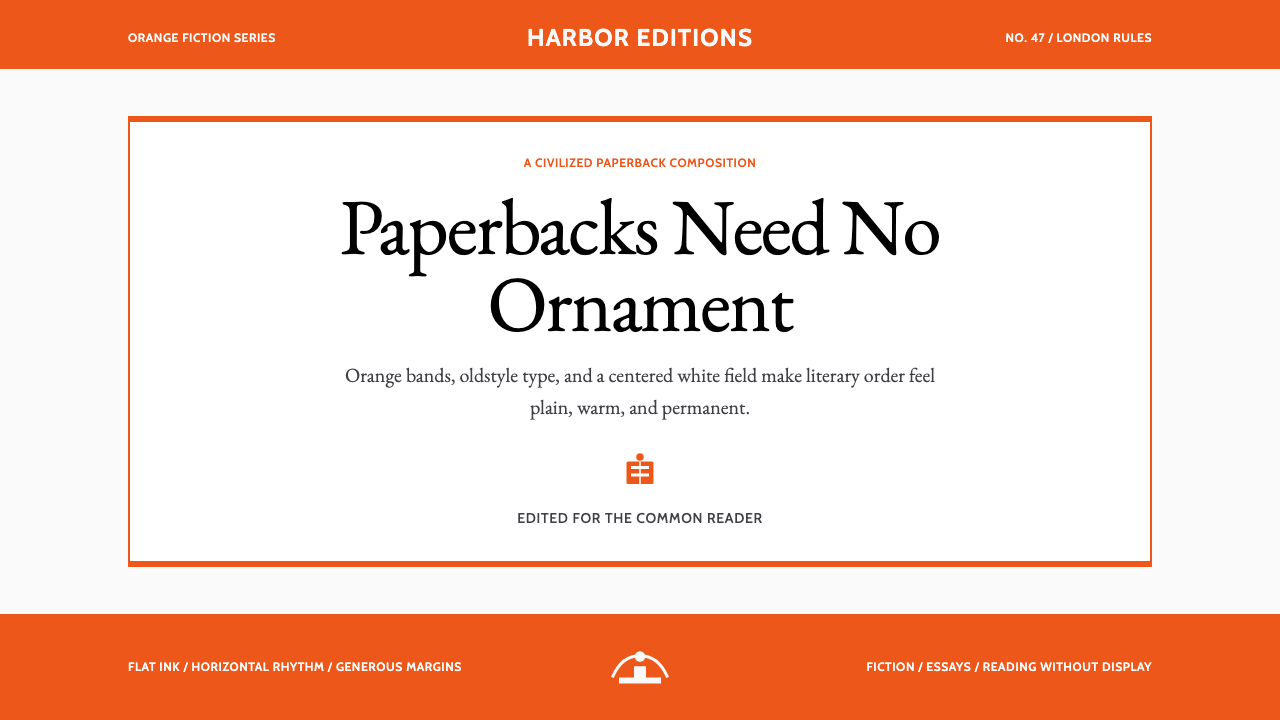 Penguin Classics OrangePaperback authority. Orange tri-bands, serif title panel, and flat ink enforc…