What is Picasso Cubism?
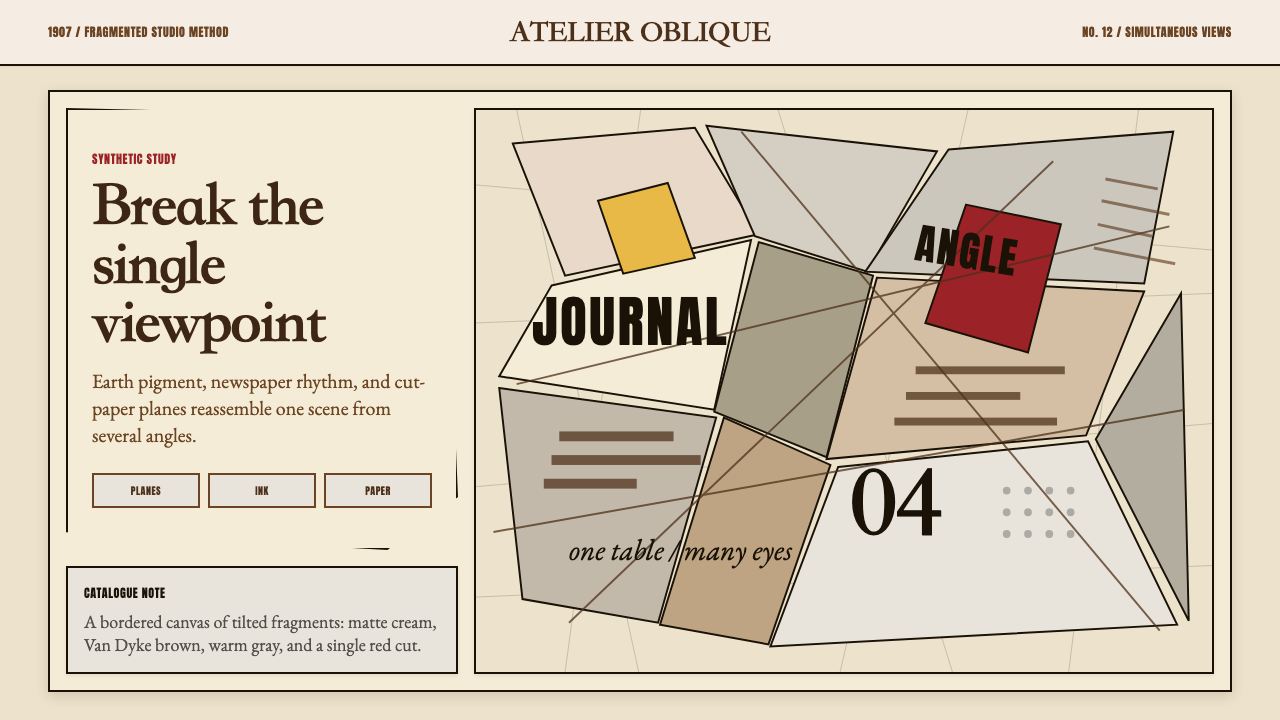
Picasso and Braque shattered the single viewpoint that had ruled Western painting since the Renaissance — and in the wreckage built a new visual language from fractured planes, earth pigments, and collaged scraps of the everyday world.
Picasso Cubism in brief
Cubism is the early-twentieth-century movement, pioneered in Paris between 1907 and 1925, that dismantled the Renaissance convention of painting a scene from a single, fixed viewpoint. Instead of depicting an object as it appears from one position at one moment, Cubist work shows multiple facets simultaneously — the front and side of a guitar neck, the profile and full-face of a portrait subject, the top and elevation of a café table — compressed onto a single flat picture plane. The result is not distortion for its own sake but a more complete account of an object's total form.
The movement divides into two distinct phases. Analytic Cubism, roughly 1908 to 1912, restricted its palette to browns, grays, ochres, and blacks, using near-monochrome to eliminate color as a distraction and focus attention on the dissection of form. Faceted planes overlap and interlock across the picture surface like a shattered mirror reassembled at conflicting angles. Synthetic Cubism, from around 1912, reintroduced color and introduced collage — papier collé — in which pieces of newspaper, wallpaper, wood-grain paper, and printed ephemera were pasted directly onto the canvas alongside painted passages. The found material brought typography, texture, and a fragment of the real world into the picture without pretending to depict them naturalistically.
As a design system, Cubism translates these pictorial strategies into a visual language built on prismatic polygon fragmentation, earth-toned and muted palettes offset by sharp accent notes, hand-cut paper edge qualities, and mixed typographic registers that quote the movement's café-table collage origins. It is a style suited to work that wants to communicate complexity, layered meaning, or intellectual depth without abandoning visual order.

Where does Picasso Cubism come from?
The story of Cubism begins in the winter of 1906 to 1907, in the cramped studios of the Bateau-Lavoir — a ramshackle wooden building on the Butte Montmartre in Paris whose nickname translated loosely as 'the laundry boat,' a reference to its swaying floors and shared water tap. It was here that Pablo Picasso, a twenty-five-year-old from Málaga working through the aftermath of his Blue and Rose Periods, began a painting that would take months to complete and would eventually be called Les Demoiselles d'Avignon. The five nude figures in that canvas do not share a coherent pictorial space. Their bodies are fragmented, their faces — particularly those on the right, reworked after Picasso's encounter with Iberian and African sculpture at the Trocadéro museum — look simultaneously forward and sideways, their features disassembled and recombined. When Picasso finally showed the unfinished canvas to his circle, the reaction was mostly bewilderment. Georges Braque, then painting in a Fauve manner, reportedly said it felt like someone was making him eat rope and spit fire. Within a year, the two were in daily conversation.
The partnership between Picasso and Braque between 1908 and 1914 was among the most intensive collaborative relationships in the history of modern art. The two men worked in close proximity, exchanged canvases, and for a period deliberately avoided signing the fronts of their paintings so that their individual contributions could not be easily distinguished — the work was that intertwined. The breakthrough came through a shared debt to Paul Cézanne, whose posthumous retrospective at the 1907 Salon d'Automne electrified both artists. Cézanne had written that nature could be treated in terms of the cylinder, the sphere, and the cone, and that painters should study from multiple viewpoints simultaneously. Picasso and Braque took this directive further than Cézanne had imagined, systematically dismantling the conventions of Renaissance perspective.
The dealer Daniel-Henry Kahnweiler played a foundational role in giving Cubism an economic and critical infrastructure. A young German art dealer who had opened his gallery on the Rue Vignon in 1907, Kahnweiler signed exclusive contracts with Picasso and Braque and later with Juan Gris, providing them with a steady monthly stipend in exchange for first rights to their production. This arrangement freed the artists from the pressures of the Salon system and from the need to produce immediately saleable work. Kahnweiler also wrote extensively about Cubism — his 1920 book on the movement remained a foundational text — and circulated the work to collectors across Europe and North America, turning a studio experiment into an international movement.
Juan Gris joined the movement around 1911 and brought to it a more systematic, almost architectural approach to the decomposition and recomposition of form. Where Picasso and Braque's Analytic canvases could feel turbulent and improvisatory, Gris worked from a clearly structured compositional plan, laying in grids and tonal sequences before introducing the subject. His Synthetic work in particular — with its crisper color, more legible structure, and sophisticated use of collaged materials — has proved especially influential on subsequent design systems that draw on Cubism. The movement faded as a cohesive force after the First World War, but its core insight — that a representation could carry multiple simultaneous viewpoints — had permanently altered the terms on which visual communication operated.
What defines the Picasso Cubism look?
Palette
Analytic Cubism established a near-monochrome discipline: browns, warm grays, ochres, raw umbers, and blacks, drawn from the earth-pigment tradition of Old Master underdrawing. The range is narrow but not dull — slight warm-cool shifts within the brown-gray family create the tonal modeling that suggests planar rotation. Synthetic Cubism relaxed this restriction, introducing dusty muted greens, terracottas, sandy creams, and occasional sharp notes of red or blue that read as accents against the earthy ground. In contemporary design applications, the palette feels neither historical nor digital — it occupies the space of aged paper, natural mineral pigment, and café-table still life.
Prismatic Fragmentation
The defining formal move of Cubism is the decomposition of a continuous surface — a face, a bottle, a musical instrument — into a mosaic of angular, overlapping planes. These planes do not follow the logic of a single light source; each facet may be lit from a different implied direction, suggesting that the object is being perceived from multiple positions simultaneously. In design work, this translates to geometric polygon grids that read as broken glass or fractured crystal: angular shapes that overlap and share edges, creating interlocking figure-ground ambiguity without becoming chaotic.
Collage and Material Texture
The introduction of papier collé in 1912 brought the texture of torn and cut paper edges, printed newsprint type, wood-grain patterns, and wallpaper fragments directly into the picture. These materials carry their own visual weight — the irregular torn edge, the uneven ink absorption of newsprint, the directional grain of wood — and they coexist with painted passages rather than blending into them. In design, this quality is evoked through layered surfaces that show their seams: visible crop edges, slightly misaligned text blocks, torn-paper graphic elements, and typographic matter that reads as if sourced from different registers of printed culture.
Simultaneous Viewpoints
The conceptual engine of Cubism is the rejection of monocular perspective in favor of showing multiple viewpoints on the same surface at the same time. A Cubist portrait may show one eye seen straight-on and the other in profile; a still-life bottle may show its label, its opening, and its base in the same composition. This principle translates in design to layouts that deliberately layer information from different scales or perspectives — a diagram and its caption occupying the same spatial zone, a data visualization that embeds its own legend within the chart body, or overlapping text and image that read as separate layers without creating illegibility.
Typography as Found Object
Synthetic Cubism introduced stenciled lettering, newspaper headlines, and printed text as visual elements on equal footing with painted marks. Letters appear not as captions explaining the image but as objects within the composition — a fragment of a newspaper masthead, the word 'journal,' the letters 'LE' floating among the planes. This tradition gives Cubist-influenced design a distinctive typographic character: type that mixes registers (serif alongside sans-serif, small alongside large, upright alongside rotated), that appears deliberately collaged rather than uniformly typeset, and that treats letterforms as shapes carrying visual weight independent of their linguistic content.
Structured Flatness
Despite the complexity of Cubist compositions, the picture plane itself remains assertively flat. There is no recession into deep space, no vanishing-point perspective pulling the eye back. Planes overlap but do not cast convincing shadows; figures and grounds shift roles without one definitively retreating behind the other. This commitment to flatness — what the critic Clement Greenberg later identified as the central formal achievement of Cubism — produces a visual tension between local complexity and overall compactness. In design, this translates to layered compositions that read as surface rather than depth: elements appear to be on the same plane even when they overlap, creating a sense of dense, organized complexity rather than spatial recession.
Angular Dynamism
Where movements such as Bauhaus favor the geometric stability of right angles and primary circles, Cubism is characterized by acute and obtuse angles that suggest energy and arrested motion. The tilted plane, the diagonal edge, the irregular polygon that fits against its neighbor like a jigsaw piece — these create compositions that feel in tension, as though the fragmented object is caught mid-reassembly. In design, diagonal elements and non-orthogonal grids introduce a controlled restlessness that distinguishes Cubist-inflected work from the steadier cadence of strictly horizontal-vertical systems.

Who shaped Picasso Cubism?
Born in Málaga in 1881 and trained in Barcelona, Picasso arrived in Paris permanently in 1904 and settled at the Bateau-Lavoir. His encounter with Iberian and African sculpture at the Trocadéro in 1906 catalyzed the formal rupture that produced Les Demoiselles d'Avignon and launched Analytic Cubism. Picasso's contribution to the movement was less systematic than Braque's — he worked by intuition and leap — but his range was extraordinary: he pushed Cubism through Synthetic collage, into sculpture, into theatrical costume design for Diaghilev's Ballets Russes, and eventually into the Neoclassical reaction of the 1920s. His longevity and celebrity ensured that Cubism's formal language remained visible and influential throughout the twentieth century.
If Picasso was the movement's intuitive force, Braque was its methodical intelligence. A painter from Normandy who had been working in the Fauve manner when he first saw Les Demoiselles, Braque spent the summer of 1908 in L'Estaque painting a series of landscapes so geometrically reduced that the critic Louis Vauxcelles described them as composed of 'little cubes' — inadvertently naming the movement. Braque's contribution to Analytic Cubism was the development of a rigorous tonal grammar for modeling fractured planes, and to Synthetic Cubism the invention of papier collé in 1912: the technique of pasting cut paper directly onto canvas that introduced the collage principle and the texture of real-world material into painting. Braque and Picasso's wartime separation ended their collaboration; Braque's subsequent work moved toward a more lyrical, less programmatic exploration of Cubist space.
The Spanish painter Juan Gris moved to Paris in 1906 and settled at the Bateau-Lavoir, initially working as an illustrator before committing fully to painting around 1911. His approach to Cubism was more architectural and systematic than that of Picasso or Braque: he typically began with an abstract compositional scaffold — a grid of tonal relationships — and then introduced the subject into that framework rather than starting from observation and moving toward abstraction. Gris's Synthetic Cubist work is among the most design-legible of the movement: his color is cleaner, his structure more evident, and his compositions carry a decorative balance that made his work influential on the design generation of the 1920s. The Art Deco movement's angular elegance owes a particular debt to Gris's refinement of the Cubist vocabulary.
Kahnweiler was not a painter but the movement's essential critical and commercial architect. Born in Mannheim in 1884, he opened his gallery at 28 Rue Vignon in Paris in 1907 at the age of twenty-two with almost no prior experience in the art trade. His commitment to Picasso, Braque, Gris, and Fernand Léger was total: he provided monthly stipends, purchased production in advance, and refused to sell to institutions that would not commit to long-term acquisitions. His 1920 monograph on Cubism, written partly from memory after the wartime confiscation of his stock as enemy alien property, established the intellectual framework through which the movement was understood for decades. Kahnweiler's model of the dealer-as-advocate transformed how avant-garde art could be sustained economically and shaped the modern gallery system.
Léger developed a variant of Cubism sometimes called Tubism — a style that replaced the brown-gray faceted planes of Analytic Cubism with bold cylindrical and tubular forms, bright color, and an explicit celebration of industrial machinery and modern urban life. His work bridges Cubism and what would become the machine aesthetic of the 1920s: the forms in his paintings look like mechanical components, and his color — strong primaries alongside metallic silvers and blacks — anticipates both Constructivism and the poster tradition of the interwar years. Léger's design influence is particularly visible in motion graphics, typographic posters, and the boldly geometric editorial illustration that characterized the decade following the First World War.
How do you use Picasso Cubism today?
Cubism is one of the more demanding historical styles to apply well in contemporary design, because its complexity must be purposeful rather than merely decorative. The movement's core logic — simultaneous viewpoints, fractured planes, collaged registers — translates into design that layers information visually rather than separating it spatially. Done well, this creates depth and richness without requiring three-dimensional illusion. Done carelessly, it produces visual noise that obscures rather than communicates. The key discipline is to fragment with intention: every angular division, every overlapping layer should serve either compositional structure or information hierarchy.
For presentation slides, Cubist influence works particularly well on cover and section-divider slides where visual impact matters more than information density. A cover built on prismatic polygon fragmentation — geometric planes in the earth-toned palette, one plane carrying the title in bold type, adjacent planes in muted ochre and gray — creates immediate visual authority without demanding close reading. For content slides, the application should be lighter: a geometric polygon as a background texture element, a slightly diagonal rule separating sections, or a collage-style image treatment where photography is cropped into angular shapes rather than rectangular frames. Data slides can use the Cubist palette — browns, grays, warm ochres — for chart elements, with one muted accent color calling out the key datum, treating the chart itself as a still-life composition.
For web interfaces, the style suits editorial platforms, cultural institution sites, and creative agency portfolios better than transactional or utility interfaces. A dashboard built on Cubist principles would use an angular grid with slightly irregular column weights, an earth-toned palette with one stronger accent reserved for interactive states, and typographic layering that mixes scale deliberately — a large rotated label alongside standard body text — to create the collage register shift that is native to the movement. Pricing and feature comparison pages benefit from the style's ability to handle visual complexity: overlapping planes can delineate tiers spatially without requiring conventional card borders.
For editorial and marketing work, Cubism supports strong hero imagery and article illustration through the collage and fragmentation principles. A magazine feature opener can break a portrait photograph into angular segments, offsetting and slightly rotating each piece against an earth-toned ground — capturing the movement's simultaneous-viewpoint logic while keeping the composition legible. Marketing campaigns with conceptual or intellectual positioning — technology, culture, finance — can use geometric fragmentation to signal complexity and depth without resorting to the overused lens flare or gradient mesh of generic digital aesthetics. Poster work is perhaps the most natural home for Cubist design principles: the combination of bold polygon grids, collaged typographic elements, and earth-accent palette produces immediate graphic authority.
A common mistake when applying Cubist influence is confusing fragmentation with randomness. Cubist paintings, however complex they appear, are rigorously composed: Picasso and Braque's planes interlock with structural precision, and Gris's compositional grids are calculated before a mark is made. In design, this means that every angular shape must belong to a system — a grid, a modular scale, a set of consistent angles — rather than being placed intuitively for visual interest. A second common error is applying the full palette — all earth tones plus accent — at uniform density across the entire composition. Authentic Cubist-inflected design typically leads with a dominant ground tone, introduces a secondary plane tone with moderate contrast, and uses the accent color sparingly to draw the eye to one or two focal elements. The restraint is what makes the complexity legible.
A third pitfall is mistaking the style for a purely monochrome system because of Analytic Cubism's gray-brown palette. Synthetic Cubism and the work of Léger and Gris demonstrate that the style accommodates color — but color that is muted, chalky, or deliberately dusty, not saturated or luminous. In digital work, this means pulling back saturation and brightness considerably from default values, favoring pigment-like rather than screen-like color, and ensuring that the one or two accent notes are warm and grounded rather than cool and bright.

Picasso Cubism — FAQ
What is the difference between Analytic and Synthetic Cubism in design applications?
Analytic Cubism (roughly 1908 to 1912) provides a near-monochrome vocabulary: brown-gray faceted planes, dense tonal overlapping, and high formal complexity with minimal color variation. Designs drawing on this phase feel austere, intellectual, and dense — appropriate for editorial work, cultural institutions, or products positioning themselves as rigorous or scholarly. Synthetic Cubism (from around 1912) reintroduces color — muted greens, terracottas, creams, occasional sharp accents — and the collage principle: layered materials, mixed typographic registers, visible seams. Designs drawing on this phase feel warmer, more tactile, and more playful, while retaining the angular geometry. For most contemporary applications, a blend weighted toward Synthetic gives more practical flexibility, while a headline or hero element might invoke the Analytic palette for visual contrast.
Can Cubist design work in digital interfaces, or is it primarily a print style?
Cubism originated in paint and collage, and its most direct translations remain in print — posters, editorial layouts, book covers. However, its core principles transfer to digital with some adaptation. The earth-toned palette works well on screen when saturation is pulled back to avoid the color feeling muddy or dated. The angular polygon grid provides strong structural underpinning for card-based interfaces, modular layouts, and hero sections. The collage typographic register — mixed scales, slight misalignment, layered text and image — works particularly well in editorial web design and cultural institution sites where a crafted, non-corporate feel is desirable. Where Cubism struggles digitally is in high-interactivity contexts: small interactive elements, complex forms, and data-dense tables work better within cleaner, more conventional grid systems. Use the style at the level of art direction and hero imagery, and reserve conventional layout logic for functional UI zones.
How does Cubism differ from other fragmented or geometric styles like Futurism or Constructivism?
All three movements share an interest in geometric abstraction and a rejection of academic naturalism, but their underlying logics are distinct. Cubism is concerned with simultaneity of viewpoint — showing an object from multiple angles at once — and its palette remains grounded in earth pigments and the textures of collage. Futurism is concerned with motion and dynamism: its forms streak and blur, its palette uses high energy contrasts, and its composition implies speed through diagonal force lines. Constructivism is concerned with function and social utility: it uses primary colors as symbolic systems, favors diagonals as directional signals, and treats type and image as elements of a communication system rather than a perceptual experiment. In design terms: Cubism feels material and perceptual, Futurism feels kinetic, Constructivism feels organizational. A Cubist-inflected design invites the eye to explore a complex surface; a Constructivist design channels the eye along a clear directed path.
Is collage texture essential to the Cubist design style, or can the style work cleanly?
Collage texture — torn paper edges, newsprint grain, overlapping found materials — is central to Synthetic Cubism historically, but it is not a prerequisite for Cubist-inflected design. The style's more fundamental properties are the angular polygon geometry, the earth-toned palette, the simultaneous-viewpoint compositional logic, and the mixed typographic register. A design can invoke all of these qualities with clean vector geometry and without any simulated paper texture. The clean version tends to feel more contemporary and more suited to digital contexts; the textured version feels more materially specific and more explicitly historical. The choice depends on whether you want the reference to read as a direct quotation of the original movement or as a distillation of its structural principles. Both are valid; mixing them without intention — clean geometry alongside heavy grunge texture — tends to produce incoherence.
What kinds of projects or brands should avoid Cubist design, and why?
Cubism is a style built on intellectual complexity, visual density, and a deliberate challenge to easy legibility. This makes it unsuitable for several categories of design work. Consumer products aimed at mass-market accessibility — grocery brands, family healthcare, quick-service food — need immediate warmth and clarity that Cubist fragmentation actively resists. Children's design requires organic curves, bright saturated color, and approachable imagery that contradicts the angular, earth-toned, intellectually demanding quality of the style. E-commerce conversion pages, where the user needs to move quickly from browsing to purchasing, work better with clean hierarchy and minimal visual noise. Any context where the primary communication goal is speed of comprehension — emergency services, transit signage, public health communication — is poorly served by a style whose legacy includes deliberately making familiar objects difficult to read at a glance. Cubism works best where the audience has time and inclination to dwell with the image.
Related design styles
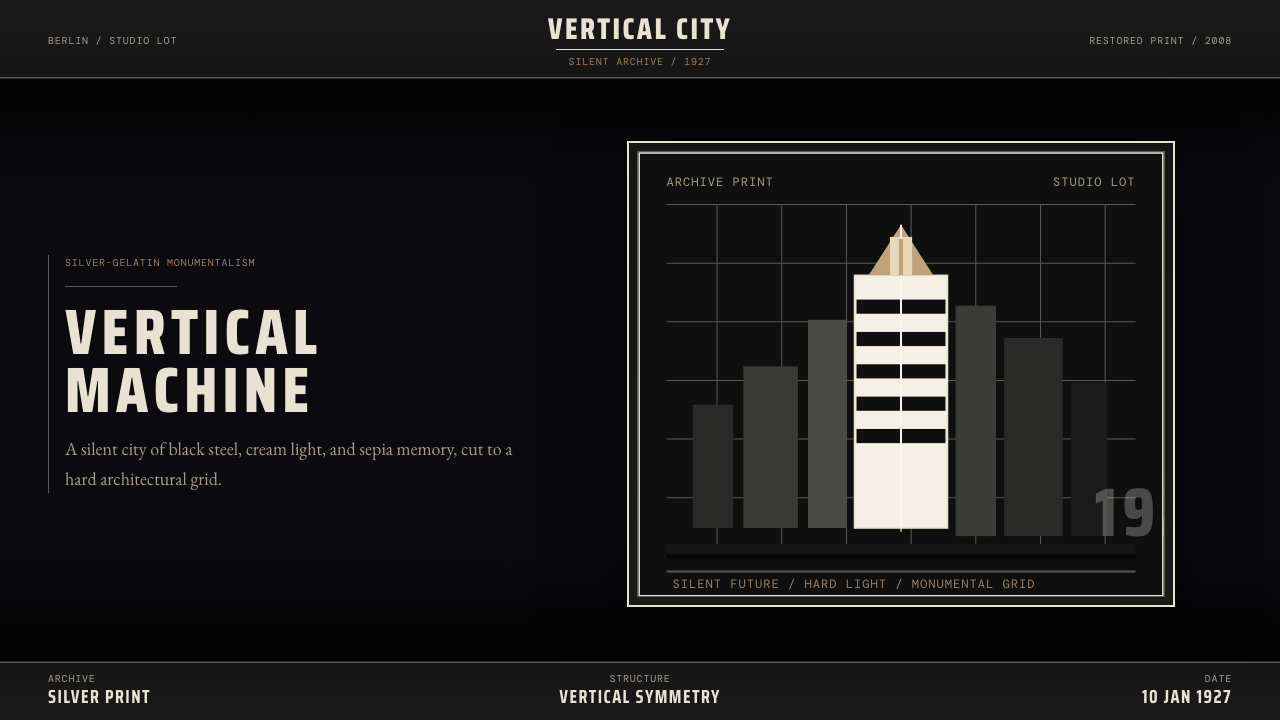 Metropolis (Fritz Lang, 1927)Monumental and severe. Black grid, cream type, sepia shadows.
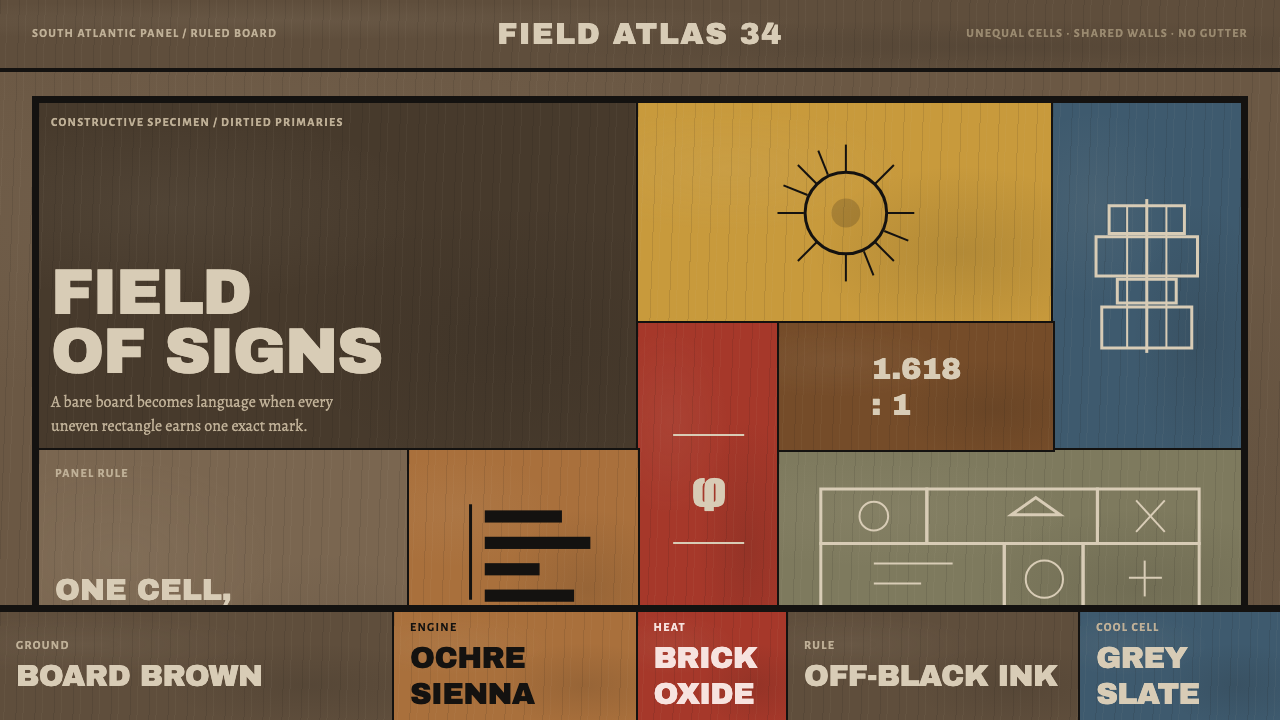 Torres-García UniversalismoGlyphs become structure. Dirtied primaries sit in unequal ruled cells on boar…
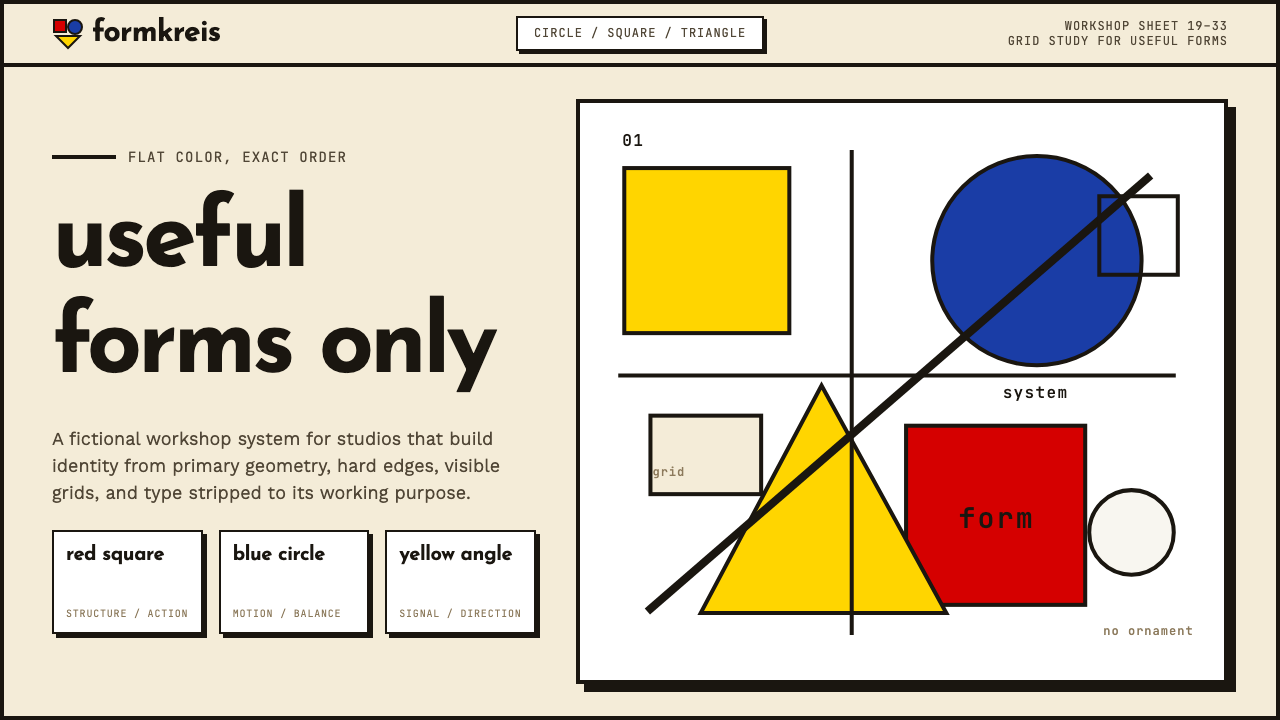 Bauhaus WeimarForm follows revolution. Primary red-blue-yellow on cream, hard shadows, no o…
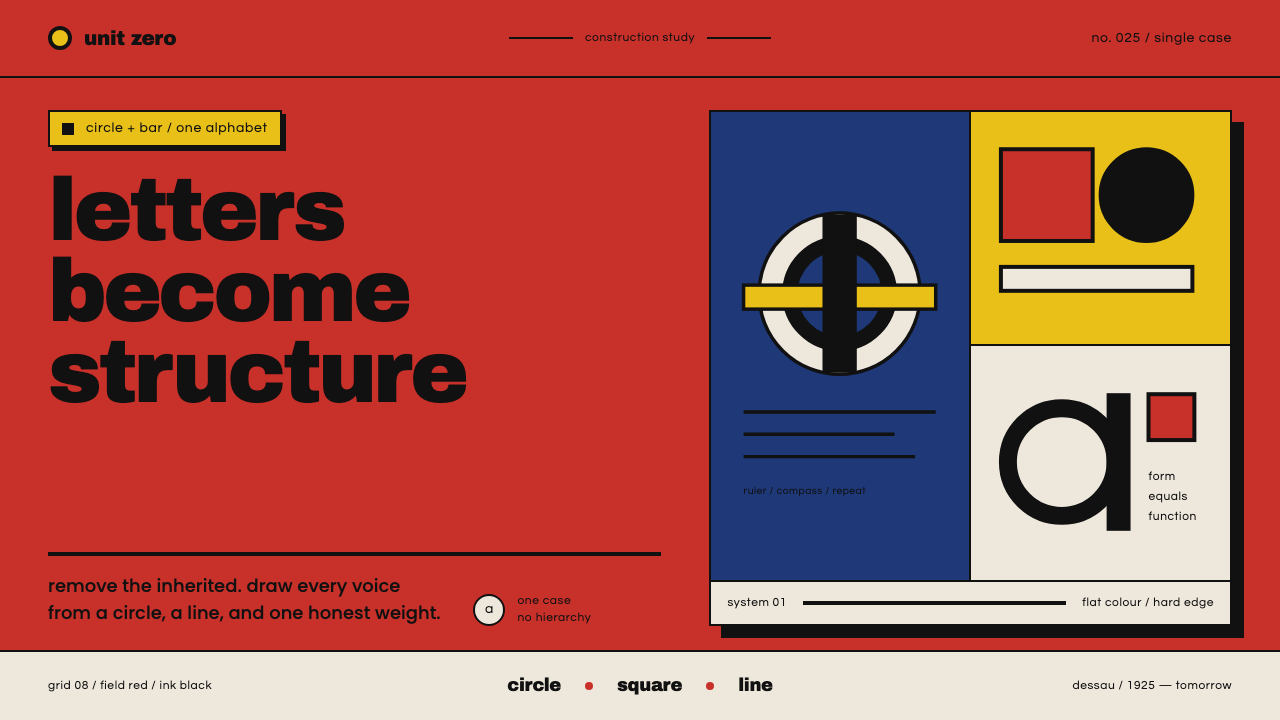 Bayer Universal BauhausLetters become structure. Bauhaus red, primary blocks, and black circle-bar f…
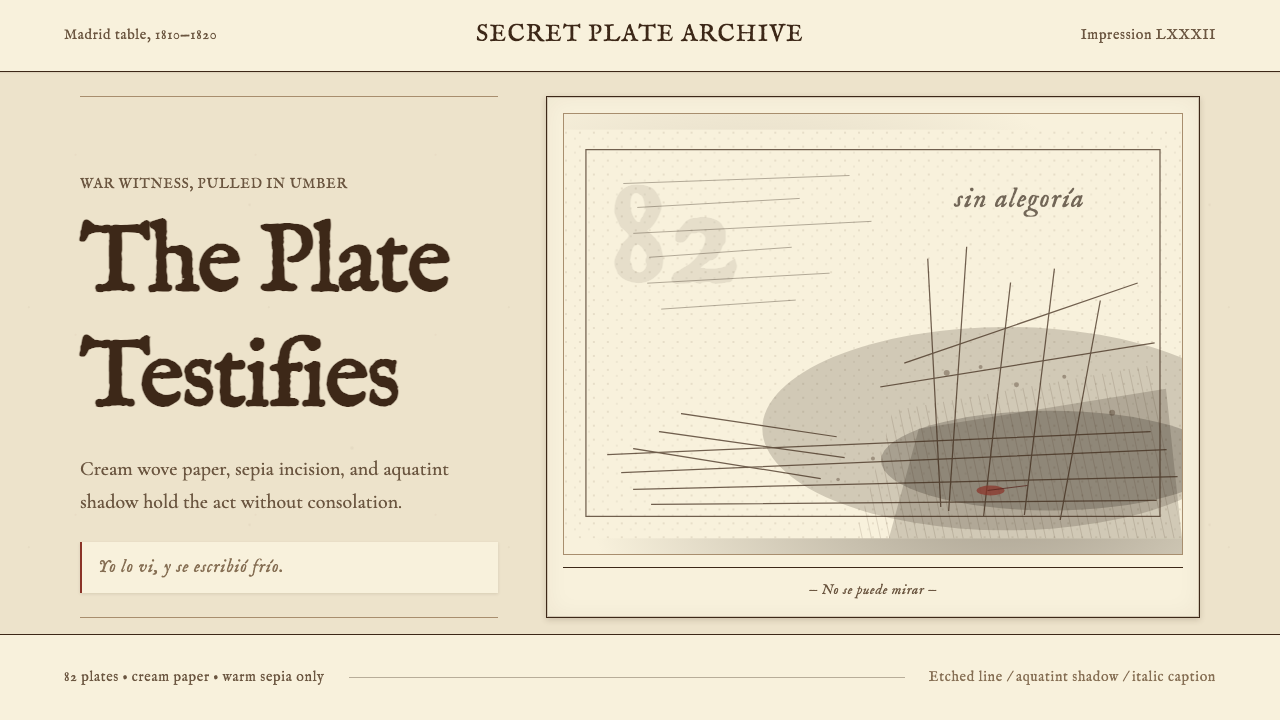 Goya — Disasters of WarWitness without ornament. Cream paper, umber line, aquatint shadow, italic ca…
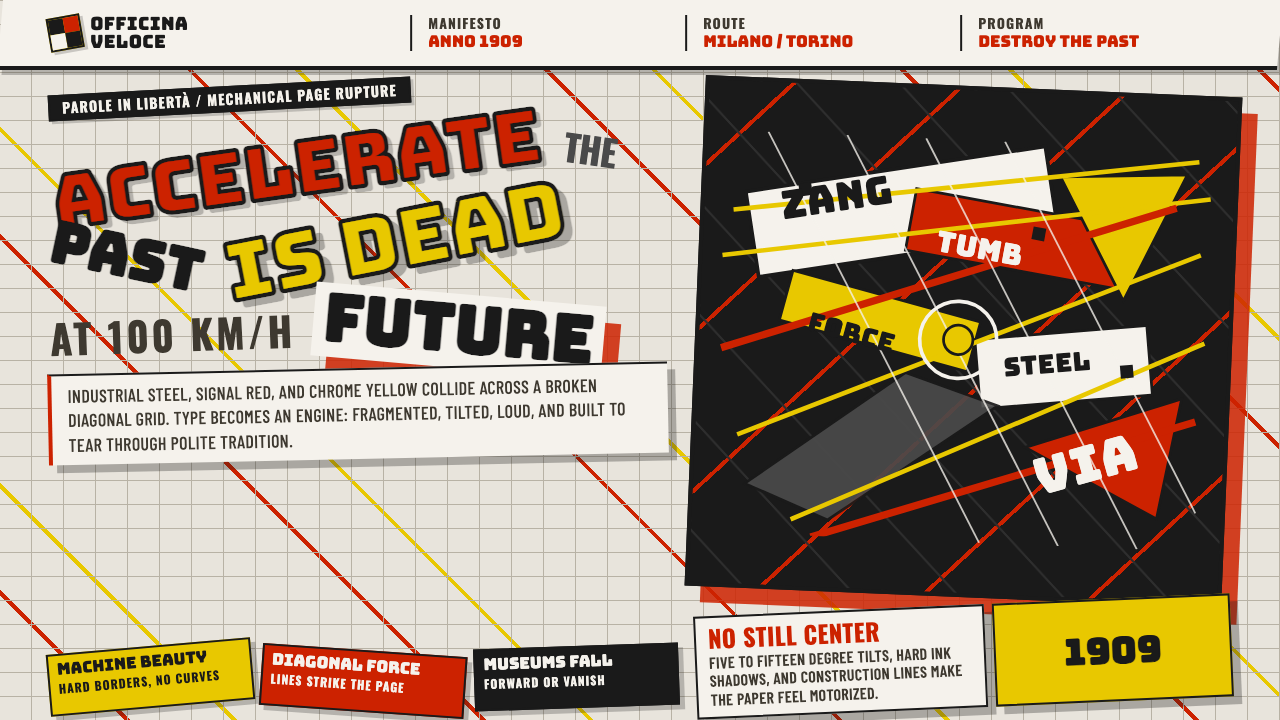 Italian Futurism (Marinetti 1909)Speed murders tradition. Signal red and chrome yellow slash a broken diagonal…