What is Malevich Suprematism?
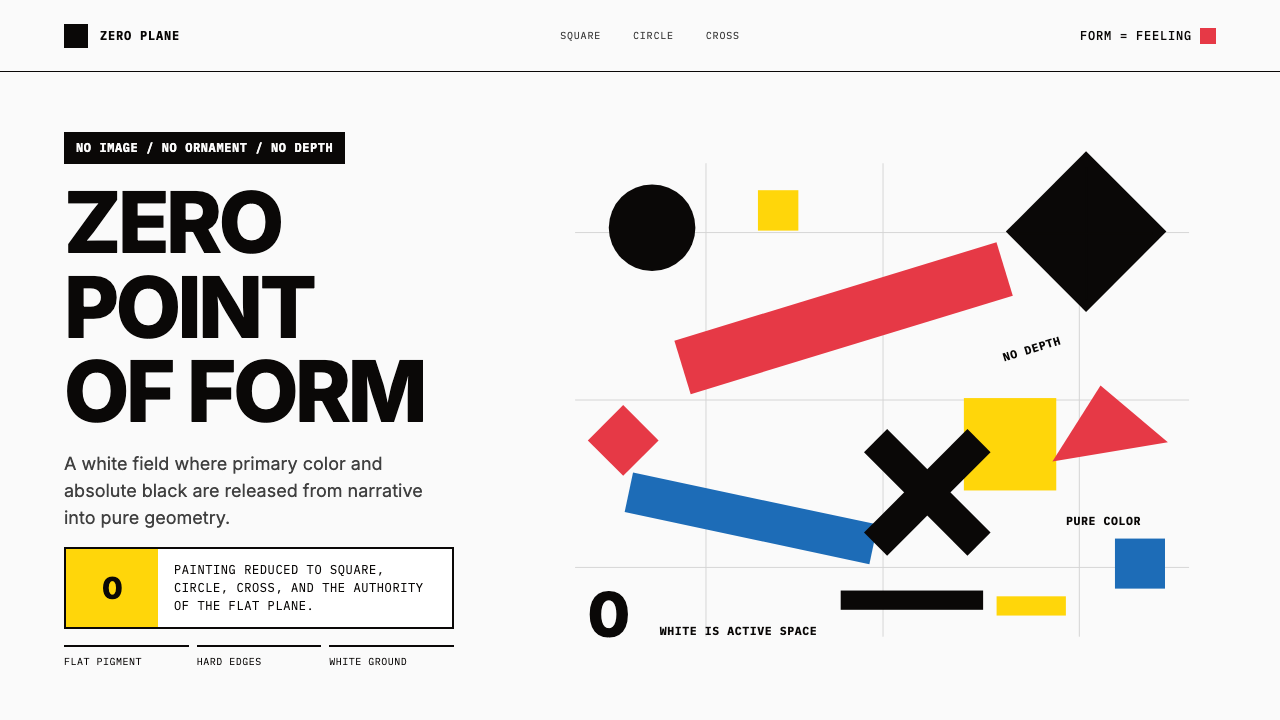
Malevich declared painting's zero hour: pure geometric forms — square, circle, cross — suspended on white, where sensation itself becomes the only subject.
Malevich Suprematism in brief
Suprematism is the most radical artistic reduction of the early twentieth century: a system in which pure geometric forms — the square, the circle, the cross, the rectangle — float on white grounds, stripped of all narrative, all representation, and all ornament. Originating in Russia between 1913 and 1915, it declared that painting's only legitimate subject was the supremacy of pure feeling, liberated from the visible world. Kazimir Malevich, its inventor, considered his 1913 pencil sketch of a black square the zero point of painting — the moment the medium broke free from depicting objects and became a language of sensation in itself.
The palette is doctrinally severe. Black, cadmium red, cadmium yellow, cobalt blue, and white are the sanctioned elements. No mixed tones, no naturalistic gradients, no illusionistic depth. Forms are flat — they do not cast shadows, do not recede in perspective, do not belong to a recognizable space. They hover. The white ground is not empty; Malevich described it as an active field of sensation, not a background but a void charged with potential. This distinction between inactive surface and active void is central to understanding why Suprematist compositions feel weightless rather than sparse.
Visually, the system is immediately recognizable and immediately extreme. A single black square on white. A red rectangle tilting across a canvas. A cluster of bars and circles in red, black, and yellow arranged in dynamic diagonal tension. Color carries no symbolic hierarchy borrowed from nature — red is not blood or fire, black is not death. Each form and each color is a pure sensation, an event on the picture plane, answerable only to its relation with adjacent elements. The severity that makes Suprematism difficult to look at for the first time is also what makes it inexhaustibly legible: there is nothing to decode except the composition itself.

Where does Malevich Suprematism come from?
The seeds of Suprematism were planted in Moscow's pre-war avant-garde, where Malevich had already passed through Impressionism, Symbolism, and Russian Cubo-Futurism. By 1913 he was collaborating on the Futurist opera Victory over the Sun — a deliberately absurdist theater piece — for which he designed backdrops and costumes using stark geometric shapes. One backdrop featured a black divided square. Malevich later identified this moment as the conceptual birth of Suprematism: the realization that a geometric form on a stage could carry complete expressive force without representing anything at all.
The public declaration came in December 1915 at the 0.10 (Zero-Ten) exhibition in Petrograd — the title signaling the group's intention to reduce painting to zero before rebuilding from ten pure principles. Malevich showed thirty-five works under the banner 'Suprematism of Painting.' The most dramatic gesture was placement: his Black Square was hung high in the corner of the room, precisely where Russian Orthodox families hang their icons. The choice was not accidental. Malevich was displacing the sacred image with an image of absolute geometric sensation, claiming for abstract art the reverence traditionally reserved for religious objects. Contemporaries understood the provocation immediately.
The movement's theoretical framework was published in 1916 as the pamphlet From Cubism and Futurism to Suprematism: The New Realism in Painting. Malevich argued that both Cubism and Futurism, despite their radicalism, remained attached to the material world — they fragmented objects but still depicted them. Suprematism cut the remaining thread. The 'additional element' — the geometric form liberated from object-reference — was now the entirety of painting's content. This was not emptiness but fullness: pure feeling, uncontaminated by subject matter.
The Vitebsk period (1919–1922) gave the movement its second act and its pedagogical arm. When Malevich arrived at the Vitebsk People's Art School in 1919, he displaced Marc Chagall as its dominant voice and transformed the school into UNOVIS — Affirmers of the New Art — a collective in which students and teachers wore black squares on their clothing as a kind of movement insignia. El Lissitzky, who emerged from UNOVIS, developed the Proun compositions: spatial diagrams that took Suprematist geometric language and extended it into imagined architectural and typographic space, connecting pure abstraction to the practical demands of Soviet poster design and exhibition architecture. When the Soviet cultural climate hardened against pure abstraction in the early 1920s, Malevich turned to writing and theory; Lissitzky and Popova carried the visual vocabulary outward into applied work, ensuring that Suprematist geometry would outlive the movement's moment of institutional power.
What defines the Malevich Suprematism look?
Geometric Primacy
The square, circle, cross, and rectangle are not chosen for their resemblance to anything in the world — they are chosen because they are irreducible. No geometric form is more basic than these. Suprematist compositions are built exclusively from these elements, and the relationships between them — overlapping, hovering apart, tilting on a diagonal — carry the entire expressive load of the work. There is no hierarchy among the forms themselves; a small circle can command a composition as forcefully as a large rectangle.
Active White Ground
The white ground in Suprematist work is not a background or a neutral field — it is an active void, a space charged with potential energy. Malevich described white as the color of infinity, a field of pure possibility against which geometric forms register as events rather than objects. This understanding of white as participatory rather than passive is one of the most consequential ideas Suprematism contributed to modern design: the blank space around a form is itself a force, not an absence.
Canonical Four-Color Palette
Suprematism permits four chromatic elements: pure black, an intense red, a strong yellow, and a deep blue — deployed against white. These colors are used in their most saturated, unmodified state; no tints, no shades, no mixed intermediates. Each color is used as a flat, opaque plane with no internal variation. The severity of this restriction means that every color decision is legible: black anchors, red activates, yellow sharpens, blue deepens. When only one or two colors appear in a composition, the reduction is even more concentrated.
Diagonal Dynamism
While the square and rectangle are the most iconic Suprematist forms, the movement discovered early that tilting a form on the diagonal transforms its character entirely. A horizontal rectangle is stable, almost inert. The same rectangle rotated to a steep angle becomes a vector — it implies motion, direction, and force. Many of the most energetic Suprematist compositions exploit this effect, setting bars and planes at competing angles to generate a sense of movement across a static surface. This diagonal dynamism distinguishes Suprematism from the more stable, centered compositions of contemporaneous geometric abstraction.
Flatness Without Depth
There is no perspective, no shadow, no modeling, and no atmospheric depth in Suprematist work. Forms do not recede or advance in three-dimensional space — they exist on a single plane, their scale and position defined entirely by their compositional relationship with other elements on the same plane. Where forms overlap, the overlapping form reads as simply 'in front,' but this is a graphic convention, not a spatial illusion. The result is a pictorial world that operates under its own laws, entirely independent of how light behaves on physical objects.
Economy of Elements
Suprematism practices an extreme economy of means. A single form on a white ground constitutes a complete work. Nothing is added for visual richness, decorative appeal, or compositional weight beyond what the expressive intention requires. This is not minimalism in the contemporary sense — it is not a style preference but a philosophical commitment to the idea that every element must justify its existence by what it contributes to the work's total sensation. The discipline enforces a kind of compositional accountability that distinguishes Suprematist-derived design from work that borrows only the geometric surface.
Sensation Over Meaning
Suprematism insists that pure sensation — the direct visual experience of form in relation to ground — is more primary than symbolic or narrative meaning. A red square is not a flag, not a warning, not a symbol of revolution. It is a red square: a sensation of intense color in a particular geometric boundary on a white void. This resistance to symbolic reading is one of Suprematism's most challenging and most valuable contributions. When applied to design, it demands that the designer trust the sensory impact of composition itself rather than relying on learned associations to carry communicative weight.

Who shaped Malevich Suprematism?
Malevich invented Suprematism and remained its defining theorist throughout his life. Born in Kiev in 1879 to Polish parents, he arrived at geometric abstraction through Impressionism and Cubo-Futurism before producing the Black Square in 1913. His 1915 installation at the 0.10 exhibition — placing the Black Square in the icon corner — remains one of the most deliberately provocative gestures in the history of art. After the Vitebsk period, he returned to figurative painting briefly in the late 1920s, but his theoretical writings — including The Non-Objective World, published in Germany in 1927 — spread Suprematist ideas across Europe and into the Bauhaus circle. He died in Leningrad in 1935; his body was transported in a coffin marked with a black square.
Lissitzky joined UNOVIS at Vitebsk in 1919 and became the movement's most influential applied practitioner. His Proun series — the name coined from a Russian phrase meaning 'project for the affirmation of the new' — extended Suprematist geometry into imaginary architectural and typographic space, creating compositions that implied three-dimensional construction while remaining resolutely flat. His work in exhibition design, particularly the Proun Room installed at Berlin in 1923, demonstrated that Suprematist visual logic could organize an entire spatial environment. His later typographic work for Soviet journals and international avant-garde publications spread the geometric vocabulary far beyond the Russian context.
Rozanova was a founding participant of Suprematism and one of its most formally inventive contributors. Her 1917 Green Stripe — a single diagonal band of vivid color on white — distilled Suprematist logic to a single gesture and anticipated by decades the concerns of Color Field painting. Before her premature death from diphtheria in 1918, she had produced a body of work that extended Suprematism into book design and textile pattern, demonstrating the movement's applicability beyond painting. Her relative obscurity in Western art history compared to Malevich reflects the gendered exclusions of early modernist historiography rather than the actual significance of her contribution.
Popova brought an architectural rigor to Suprematist geometry that connected the movement to Constructivism. Her Painterly Architectonics series (1916–1918) subjected geometric planes to structural analysis — exploring how forms overlap, what happens at their boundaries, and how compositional forces balance across a surface. After 1921, she redirected her energy from easel painting into industrial and theatrical design: her textile designs for Soviet factories and her set and costume designs for theater productions represent the movement's most sustained engagement with designed objects. Popova's ability to translate a purely sensational visual language into functional applied work remains one of Suprematism's most practically relevant legacies.
Klyun was among Malevich's closest colleagues and a consistent exhibitor at the 0.10 exhibition, showing his own Suprematist canvases alongside Malevich's foundational works. His contributions to the movement included explorations of spherical and curved forms within an otherwise rectangular vocabulary — a direction Malevich himself pursued in the late Suprematist period with works exploring the oval and the circle as alternatives to the absolute authority of the square. Klyun's theoretical writings also helped articulate the philosophical underpinning of Suprematism in ways that complemented rather than simply repeated Malevich's own formulations.
How do you use Malevich Suprematism today?
Suprematism transfers to contemporary design not through historical imitation but through structural principle: pure geometry carries visual force without ornamentation, negative space is an active participant, and the relationship between elements creates meaning rather than any single element in isolation. Applying these principles correctly requires restraint — the willingness to leave a composition incomplete by conventional standards because the work has already said everything it needs to say.
For presentation slides, Suprematism offers a powerful approach to both cover and section-divider pages. A cover built on Suprematist logic uses a single large geometric form — a rectangle, a square, a diagonal bar — in one of the canonical colors placed asymmetrically against a white or near-white field. The title appears in clean, unornamented type with no decorative framing. Section dividers can use the same geometric element at reduced scale to signal progression. Content slides should be typographic and grid-based: the Suprematist influence shows in how white space is treated as territory rather than absence, in how a data visualization is treated as a geometric object with its own compositional weight, and in how hierarchy is established through scale and positioning alone.
For web interfaces, the style is particularly well-suited to dashboards, data displays, and analytical tools where the content itself carries complexity and the interface must not compete with it. The approach: keep the background pure white or very close to it, use black for all body text and structural lines, and deploy the canonical colors only for states that require attention — active selections, alerts, primary actions. Card components acquire their visual definition from a clean border or a solid block of color rather than shadow and blur. Navigation is typographic and spatial rather than icon-dependent. On pricing pages, the primary color reserved for the recommended tier creates a bold focal point that the rest of the layout defers to.
For editorial and marketing work, the Suprematist sensibility produces materials of unusual visual authority. A poster or hero section built on a Suprematist composition — large geometric form anchoring one region, type in high contrast, the remaining field left open — reads immediately and at distance. Marketing pages can alternate full-width blocks of white with blocks of a single strong color, with a geometric form serving as a visual anchor in each. Editorial layouts benefit from treating column dividers and rule lines as geometric objects with compositional weight, not mere separators. The key is using color as event rather than atmosphere: one strong color decision per composition, not a palette spread evenly across the surface.
A common mistake when applying this aesthetic is confusing Suprematist severity with emptiness and compensating by adding more elements — a texture, a gradient, a decorative typeface, a soft shadow — until the work loses the very quality that makes the reference legible. Suprematism is not sparse because it ran out of things to add; it is sparse because every addition was refused. When a layout feels incomplete under a Suprematist approach, the solution is almost always to make the elements that remain more decisive — bolder in scale, more precise in placement, more absolute in color — rather than to add new ones. The style rewards commitment and punishes hedging.

Malevich Suprematism — FAQ
What is the difference between Suprematism and Constructivism?
Both movements emerged from the Russian avant-garde and both use geometric abstraction, but their philosophies are opposed in a fundamental way. Suprematism is purely sensational: it is concerned with the experience of pure form and pure color in themselves, with no utilitarian purpose and no interest in producing functional objects. Constructivism, which emerged as a critique of Suprematism after 1921, rejected art-for-sensation's-sake entirely and insisted that geometric visual language must be put in service of social production — posters, architecture, industrial design, propaganda. El Lissitzky and Lyubov Popova are figures who moved between the two positions. In practical design terms, Suprematism is the more meditative and compositional of the two; Constructivism is more aggressive, more typographic, and more explicitly communicative.
Can Suprematism be applied to dark backgrounds?
The canonical Suprematist ground is white — active white, not neutral white — and this is not a historical accident but a philosophical commitment. White is the color of infinity in Malevich's system; it is the void from which forms emerge. A dark inversion is possible in contemporary application, but it changes the character of the system fundamentally. On a black ground, forms advance rather than float; the sense of weightless suspension is replaced by a sense of emergence or pressure. If a dark variant is needed, it works most coherently when restricted to a single color of form — a white rectangle on a near-black field, or a single vivid red on deep charcoal — rather than deploying the full canonical palette, which can become visually chaotic against a dark ground.
How does Suprematism handle text and typography?
In the original paintings, Malevich used no text at all — the works are entirely non-verbal. In the applied and printed work that emerged from the movement, particularly from El Lissitzky and from UNOVIS-trained designers, text is treated as a geometric element: set in clean, unornamented letterforms, positioned on the composition as if it were a rectangle or a bar, and aligned to the geometric logic of the surrounding forms rather than to conventional text-centered layout conventions. Text weight and scale create hierarchy; decorative devices are absent. When applying this approach in contemporary design, the principle is that text behaves as form — its mass, its position, and its angle on the page are compositional decisions of the same order as the placement of a geometric shape.
Is Suprematism suitable for brands that need to communicate warmth or approachability?
Rarely. Suprematism is a style of absolute conviction — it does not accommodate, it does not soften, and it does not invite in the way that warmer visual languages do. Brands that need to signal approachability, sensory pleasure, organic authenticity, or emotional intimacy will find Suprematism working against them. The style is better suited to products and institutions that wish to communicate intellectual rigor, formal authority, clarity of purpose, or radical modernity: analytics platforms, architecture firms, contemporary art institutions, technology infrastructure companies, financial tools. Attempting to 'warm up' a Suprematist composition by adding texture, rounded corners, or gradient color almost invariably produces something that has neither the warmth of the warmer reference nor the authority of the Suprematist one.
How do I avoid making Suprematist-influenced work look like a generic 'geometric abstract' style?
The generic geometric abstract style borrows the forms but ignores the logic. A Suprematist composition is not a collection of shapes; it is a composition in which every element's position, scale, color, and angle is a deliberate decision accountable to the total sensation of the work. The discipline shows in what is absent: no gradients, no soft shadows, no decorative framing, no naturalistic texture, no more than four colors, no representational element however abstract it may appear. It shows equally in scale decisions — Suprematism tends toward extremes of scale rather than comfortable middle-sizes — and in the treatment of the ground as active territory. If a composition could have a fifth element added and still feel coherent, it probably does not yet embody Suprematist logic; the mark of the discipline is that removing any existing element would fundamentally alter the work.
Related design styles
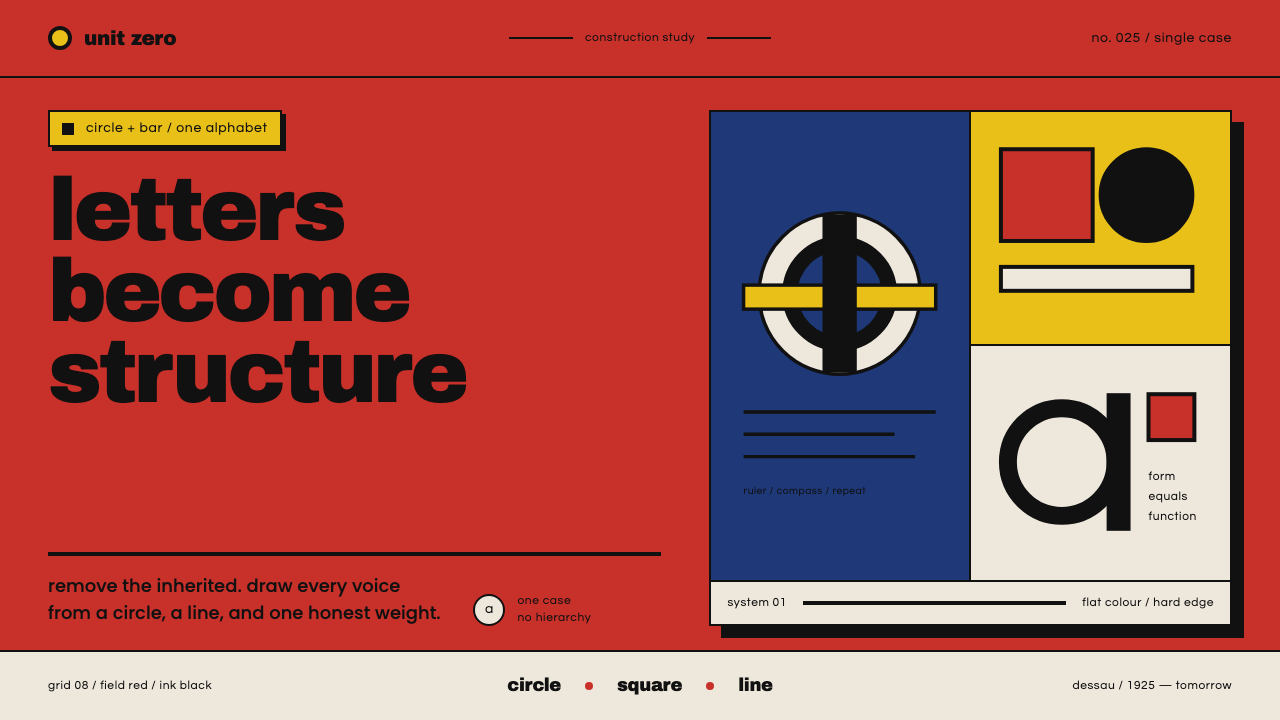 Bayer Universal BauhausLetters become structure. Bauhaus red, primary blocks, and black circle-bar f…
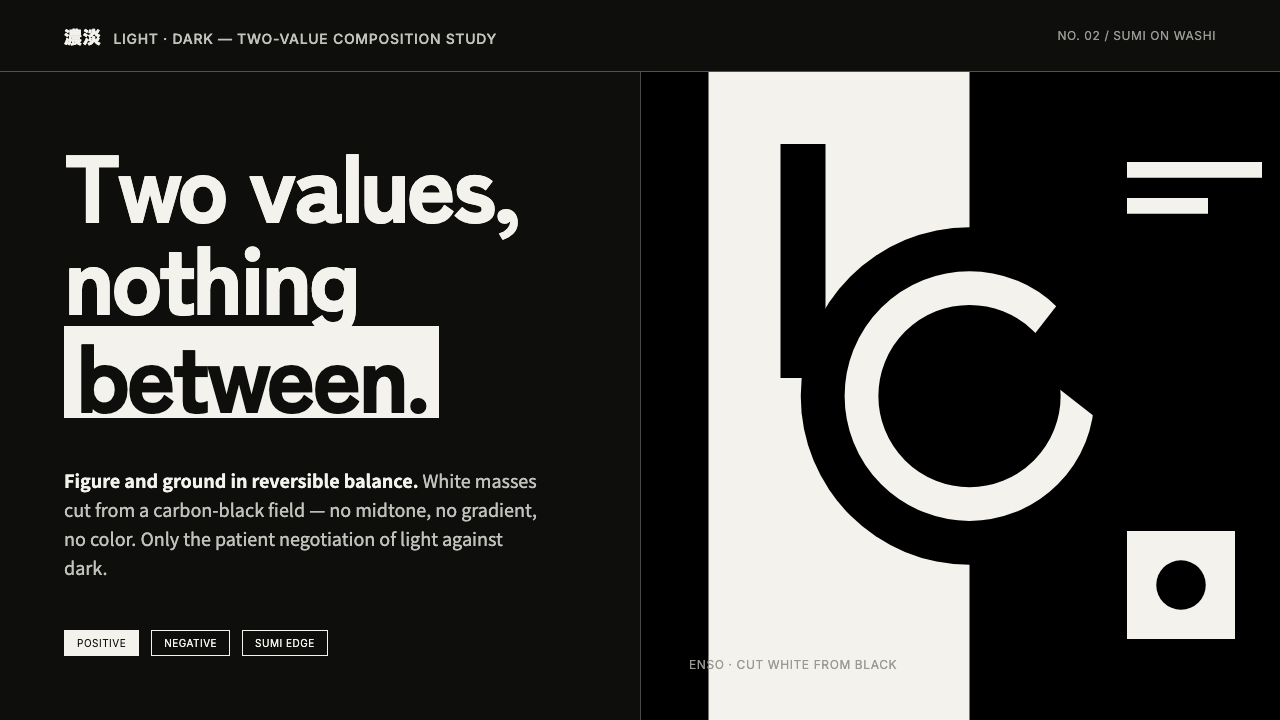 Notan Light-DarkTwo values, nothing between. White masses cut from a carbon-black field, figu…
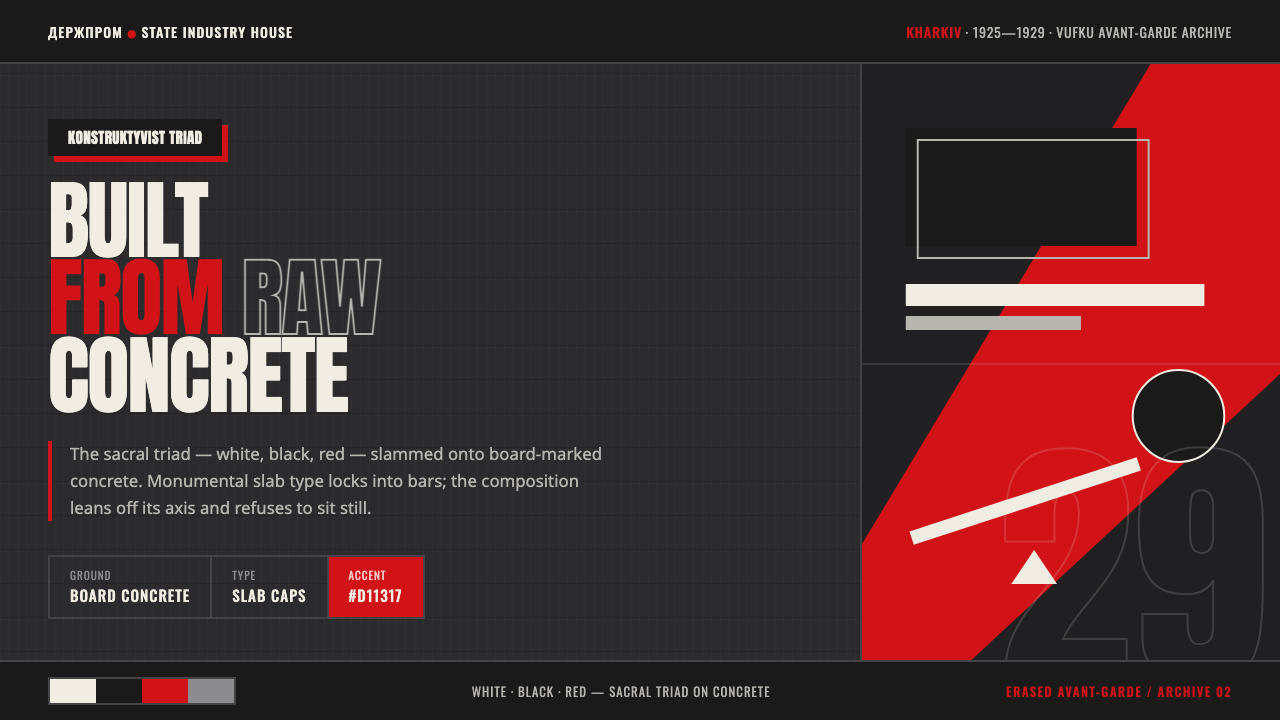 Kharkiv Constructivism (Derzhprom)Monumental, made structural. White-black-red triad on raw concrete, slab caps…
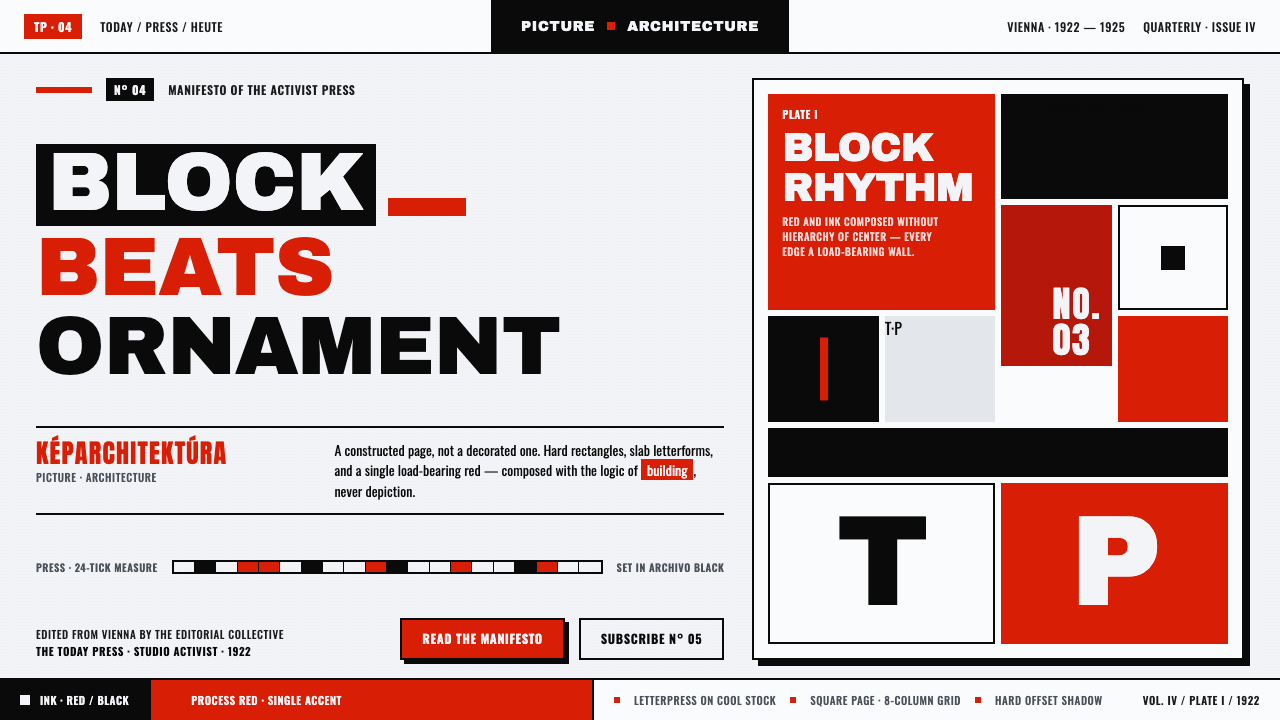 Lajos Kassák MA ConstructivismPage as building, not picture. Red and ink slab-sans blocks set asymmetricall…
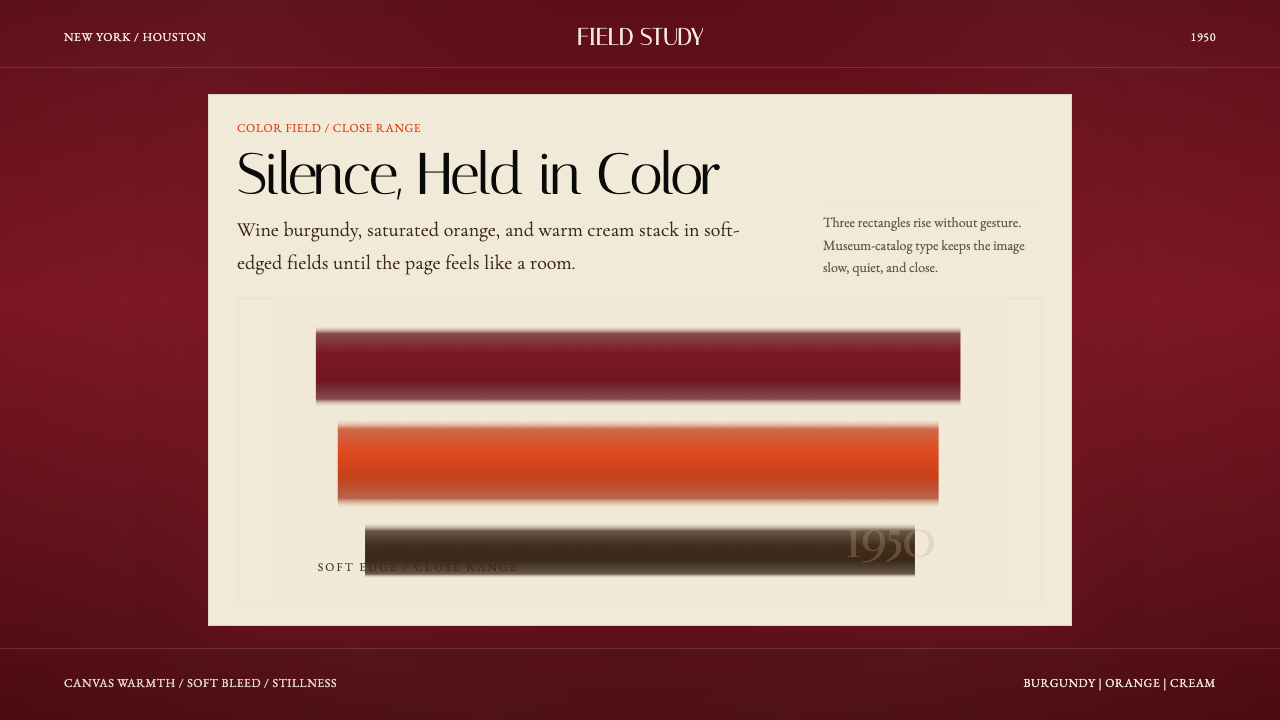 Mark Rothko Color Field (1950)Silence made visible. Burgundy, orange, and cream stack in soft-edged fields.
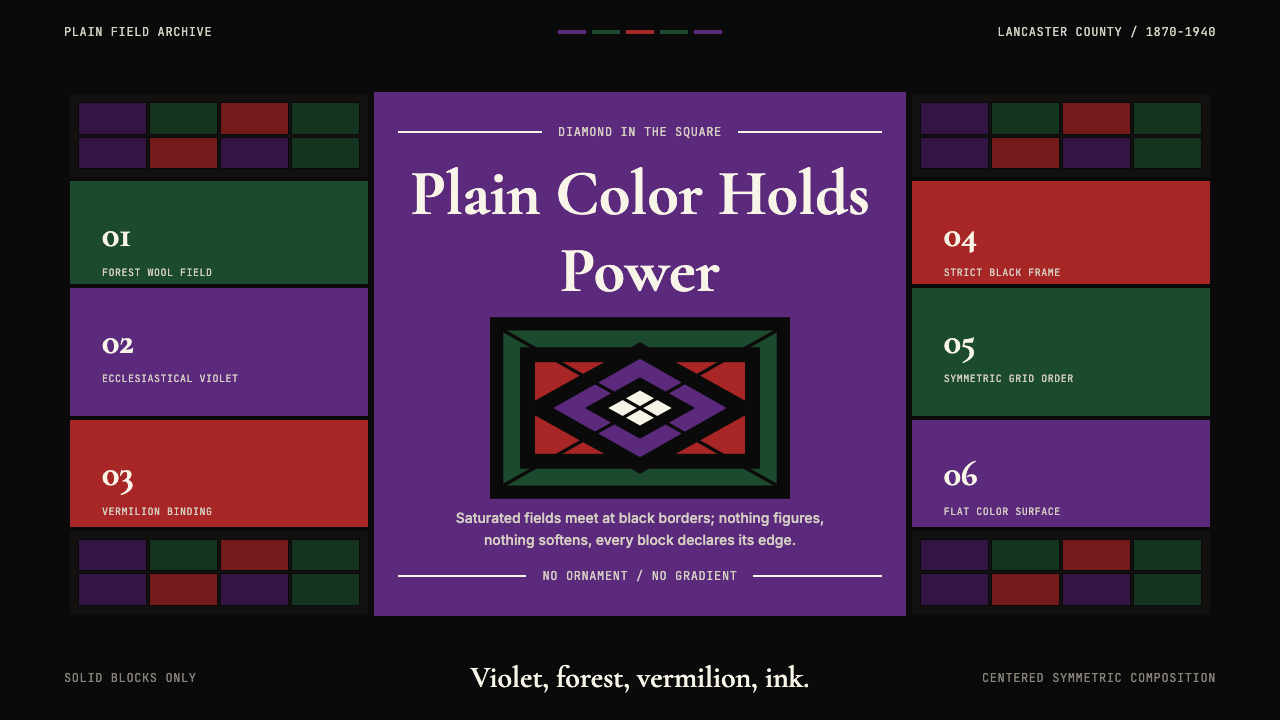 Amish Pennsylvania Quilt Bold GeometricRadical plainness. Violet, forest, and vermilion blocks lock into ink-black q…