What is Amish Pennsylvania Quilt Bold Geometric?
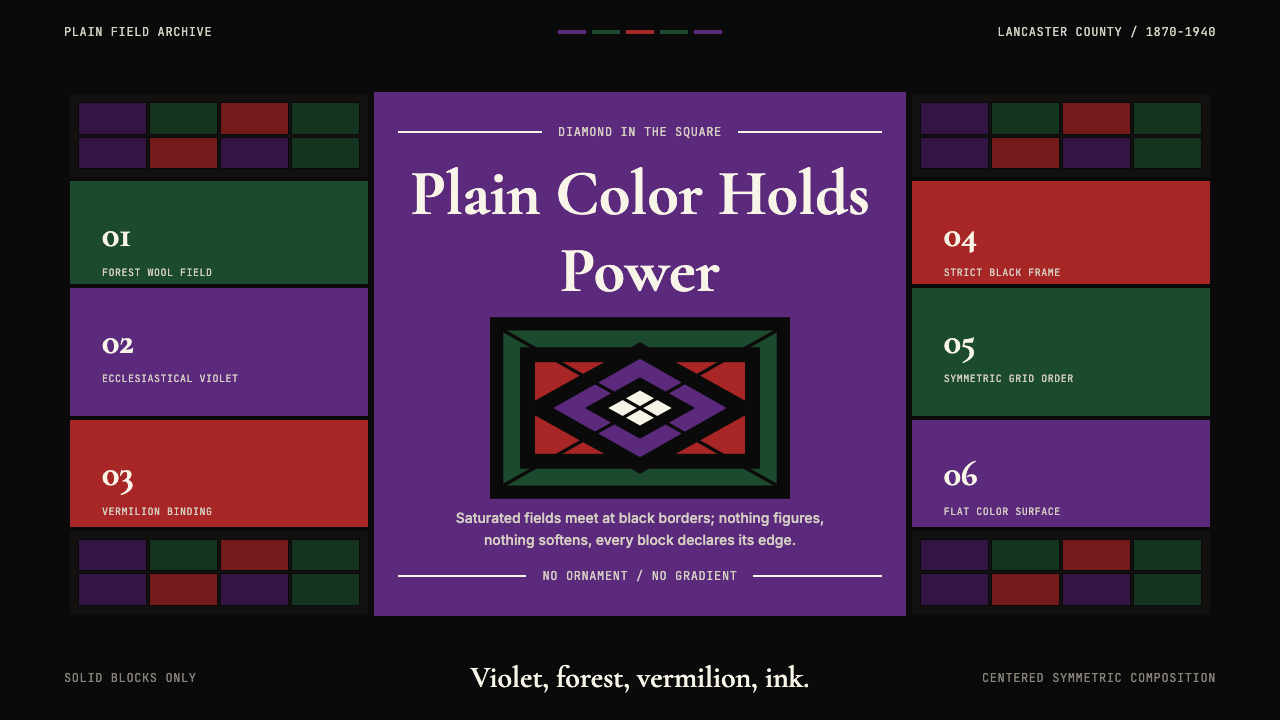
Amish Pennsylvania Quilt Bold Geometric translates the radical color-field geometry of Lancaster County's plain-community quilts — saturated solid blocks framed by ink-black borders — into a design language that anticipated color-field painting by half a century.
Amish Pennsylvania Quilt Bold Geometric in brief
Amish Pennsylvania Quilt Bold Geometric is a design system rooted in the wool quilts made by Old Order Amish women in Lancaster County from roughly the 1870s through the 1940s. Those quilts — Diamond in the Square, Bars, Center Square, Sunshine and Shadow — are among the most formally rigorous works of textile art ever produced in North America. Their visual power comes not from complexity but from its deliberate absence: large, flat, unbroken fields of saturated color — ecclesiastical violet, deep forest green, vermilion red — held together by wide expanses of ink-black or midnight-blue ground.
The Ordnung, the unwritten code governing Amish community life, prohibited figurative ornament, representational imagery, and anything that might elevate individual aesthetic expression over communal plainness. Paradoxically, this prohibition produced a tradition of extraordinary visual force. With no flowers, no birds, no narrative scenes permitted, quilt makers channeled everything into the elemental: the relationship between one color and another, the weight of a border, the precision of a seam. The result is an aesthetic of pure color geometry — squares, diamonds, rectangles, and bars — that reads today with startling modernity.
In interface design terms, this system operates on a small number of powerful contrasts rather than a dense hierarchy of visual information. The palette is deliberately limited: two or three saturated hues against a near-black ground. Composition is symmetric and centered, echoing the Diamond in the Square format. Borders and frames are wide enough to carry visual weight of their own. Nothing within a color field breaks the flatness — no texture, no gradient, no internal pattern. The power of the system is the power of restraint applied to already-bold material.
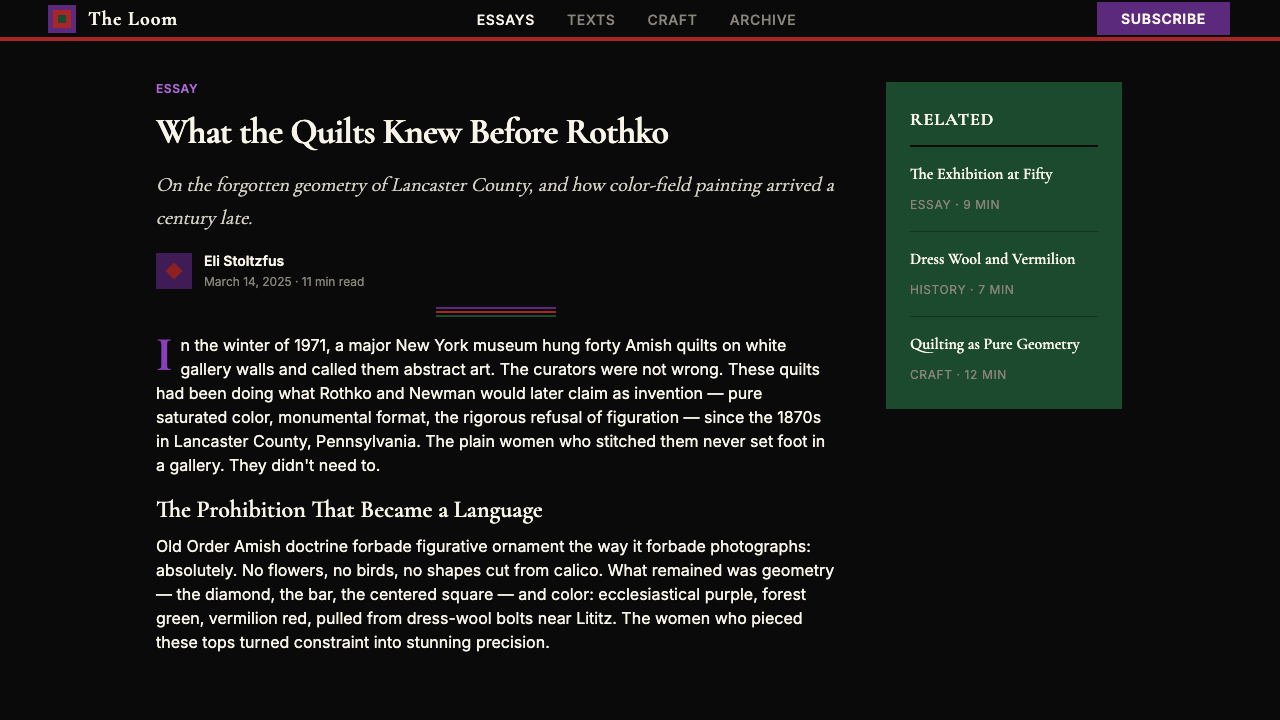
See the Amish Pennsylvania Quilt Bold Geometric design system
Where does Amish Pennsylvania Quilt Bold Geometric come from?
The Amish, an Anabaptist sect originating in the Alsace region of present-day France and Switzerland, began migrating to Pennsylvania in the early eighteenth century, settling in the rich farmland of Lancaster County. By the mid-nineteenth century, the Lancaster County Amish had developed a quilting tradition that diverged sharply from the pieced, patterned quilts made by their non-Amish neighbors. Where mainstream American quilts of the Victorian era featured complex multi-color patchwork, intricate appliqué, and naturalistic floral motifs, Amish quilts used solid-color wools in large geometric forms, sewn with exceptional technical precision and finished with elaborate hand quilting.
The choice of solid wool over printed cotton was partly practical — wool was what Amish farms produced — and partly doctrinal. The Ordnung's prohibition on worldly display extended to printed cloth with its commercial patterns and colors. Plain fabric, dyed in the deep, saturated hues available from natural and then commercial dyestuffs, was the permitted material. Within this constraint, quiltmakers exercised remarkable aesthetic judgment: the pairing of a violet center diamond with a forest-green inner border and a black outer border, or of vermilion bars against a near-black ground, reflects color sensibility of the highest order.
The peak period of Lancaster County Amish quilt production, roughly 1870 to 1940, corresponds precisely to a time when the outside world was producing Art Nouveau, then Modernism, then the Bauhaus — movements that self-consciously theorized the relationship between color, form, and meaning. The Amish quilters knew nothing of these movements and had no interest in them. Their formal choices were governed by community tradition and the logic of the Ordnung, not by art theory. That the results should anticipate so much of what the modernist avant-garde would later formalize is a historical irony that has fascinated scholars since the 1971 Whitney Museum exhibition.
That exhibition — Abstract Design in American Quilts, organized by Jonathan Holstein and Gail van der Hoof — is the single most important event in the public reception of Amish quilts. Holstein and van der Hoof hung quilts from the nineteenth and early twentieth centuries on the walls of the Whitney as they would hang paintings, stripped of their domestic context. The quilts held their own as large-scale abstract art. Critics who had spent careers writing about Ellsworth Kelly, Frank Stella, and Kenneth Noland recognized immediately that these anonymous rural women had been making color-field and hard-edge abstraction decades before those terms existed. The exhibition traveled internationally and transformed the market for Amish quilts, triggering a collecting boom that by the 1980s had removed many of the finest examples from Lancaster County communities entirely.
What defines the Amish Pennsylvania Quilt Bold Geometric look?
Color
The palette is built from a small number of saturated solid hues — deep violet, forest green, vermilion, and occasionally teal or indigo — deployed against wide expanses of near-black or midnight ground. These are not colors chosen for harmony in the conventional sense; they are chosen for maximum luminous impact against the dark field. The effect is something close to stained glass: each color holds its own visual weight, and the contrast between saturated hue and deep ground creates an almost physical sense of presence. Secondary tones or blended hues are entirely absent. Every color is at full strength.
Geometry
The compositional vocabulary is severe and limited: diamonds, squares, rectangles, and bars. The Diamond in the Square format — a square rotated forty-five degrees and set inside a second square — is the most iconic form, and its logic of a centered, symmetrically framed focal element runs through the entire design system. There are no curves, no diagonal lines that are not derived from the forty-five-degree rotation of a rectangle, and no organic or irregular forms whatsoever. The geometry is uncompromising, and its precision is part of what gives the system its formal authority.
Border and Frame
Wide, dark borders are as structurally essential to this system as the color fields they contain. In historic quilts, the outer border — typically black or very deep navy — might constitute a third or more of the total surface area. This is not a passive frame; it is an active compositional element that holds the saturated interior in tension and amplifies its luminosity by contrast. In interface terms, wide dark borders and framing elements perform the same function: they give color fields room to breathe while intensifying their apparent saturation.
Symmetry and Centering
Unlike the asymmetric, directional compositions of Bauhaus or Swiss International Style, Amish quilt geometry is radically centered and symmetric. The Diamond in the Square composition has bilateral symmetry on both axes; the Bars pattern is symmetric across its central horizontal axis. This centering is not timid or classical — it is deliberate and confrontational, presenting the composition as an object rather than a flow. Applied to interface design, this quality produces layouts that feel monumental and still: landing pages, hero panels, and full-screen modals work particularly well in this register.
Flatness
Every color field in this system is unbroken flat — no texture, no gradient, no internal variation of any kind. The only visual information within a color field is its edge: how it meets the adjacent color or border. This absolute flatness was a material consequence of the quilting tradition (solid wool dyed to uniform color), but it reads today as a formal commitment that anticipates the color-field painting of Rothko and Barnett Newman. In digital applications, this flatness translates directly: no drop shadows, no noise overlays, no grain textures, no inner glows. Color is color, edge is edge.
Scale and Proportion
The power of Amish quilt geometry comes partly from its scale: these are large objects, and the color fields within them are large in proportion. A center diamond might occupy forty percent of the total surface; the surrounding inner borders, outer borders, and corner blocks divide the remaining area into carefully proportioned bands. This allocation of area — not decoration within areas — is where the aesthetic decisions are made. In interface design, the same logic applies: the proportion of dark ground to saturated color, of border width to interior field, determines the emotional register of the whole.
Zero Ornament Within the Field
The Ordnung prohibition on worldly display translates, in visual terms, to a near-total suppression of ornament within each color field. Unlike the patterned quilts of non-Amish American quilt traditions — log cabin, nine-patch, flying geese — Amish solid quilts have nothing to look at within a color field except the color itself. The decorative energy is entirely displaced into the overall geometric composition, the color relationships, and the elaborate hand-quilting stitchwork that covers every field (and which disappears at the scale of reproduction). Applied to digital design, this principle mandates that no icon, pattern, illustration, or texture should interrupt a color panel without strong structural justification.

See the Amish Pennsylvania Quilt Bold Geometric design system
Who shaped Amish Pennsylvania Quilt Bold Geometric?
Holstein was a New York textile collector who, together with his partner Gail van der Hoof, assembled a major collection of Amish and non-Amish American quilts in the late 1960s and early 1970s. His critical insight — that certain quilts, particularly the Lancaster County Amish geometric examples, could be read as monumental abstract art independent of their domestic function — led directly to the 1971 Whitney Museum exhibition. Holstein went on to write The Pieced Quilt (1973), the first serious critical study of American quilt art, and spent decades advocating for the recognition of quilts as a legitimate art form rather than craft or folk artifact.
Granick is the author of The Amish Quilt (1989), the most thorough scholarly study of the Lancaster County tradition. Her research documented the specific color conventions, regional variations, and dating methods for Amish quilts, establishing the historical record that later design scholarship has drawn on. Granick was particularly attentive to the role of community women as the actual decision-makers in quilt composition — tracking how a particular pairing of violet and green or a specific border proportion might travel from one family's quilts to a neighbor's over decades, constituting an oral-and-tactile aesthetic tradition entirely outside the institutions of the mainstream art world.
Pellman was a curator and author affiliated with The Old Country Store in Intercourse, Pennsylvania, who published extensively on Amish and Mennonite quilts beginning in the 1980s. Her books — including Amish Quilt Patterns (1984) and The World of Amish Quilts (1984, co-authored with her husband Kenneth Pellman) — brought systematic documentation of the compositional formats and color conventions to a broad audience. Pellman was unusual among quilt scholars in maintaining close, respectful relationships with Lancaster County Amish community members, and her writing reflects an insider-adjacent perspective on how quilts were made and valued within the community rather than merely from without.
Van der Hoof co-organized the 1971 Whitney Museum exhibition with Jonathan Holstein and shared in the assembly of the collection that made the show possible. Her contribution to the critical framing of Amish quilts as high art has been somewhat overshadowed by Holstein's subsequent solo publishing activity, but the original scholarly and curatorial vision behind the Whitney show was genuinely collaborative. The exhibition's catalogue text reflects her sensitivity to the quilts as objects carrying cultural and community meaning, not merely formal properties, and her influence can be traced in later quilt scholarship that takes community context seriously alongside visual analysis.
Newman was not an Amish quilt scholar but a New York abstract expressionist painter whose zip paintings — large fields of saturated color divided by narrow vertical bands — bear a structural resemblance to Amish quilt geometry so striking that critics noted it immediately when the 1971 Whitney exhibition opened. Newman's own account of his work emphasized spiritual presence over formal analysis: the large color field was meant to envelop and overwhelm the viewer in the way that sublime natural phenomena do. The Amish quilts, made by women who would have been baffled by such theorizing, produce a remarkably similar effect through entirely different means and motivations, which is precisely what makes the comparison so persistent and so interesting.
How do you use Amish Pennsylvania Quilt Bold Geometric today?
Amish Pennsylvania Quilt Bold Geometric is a high-impact system that rewards restraint in application. Its power derives from a small number of moves — a very limited palette of saturated solids against a near-black ground, wide structural borders, and rigorous centered symmetry — applied at generous scale. The temptation to add more — more colors, more visual information, more graphic elements — consistently undermines it. Fewer elements, larger fields, and more deliberate negative space always strengthen the system.
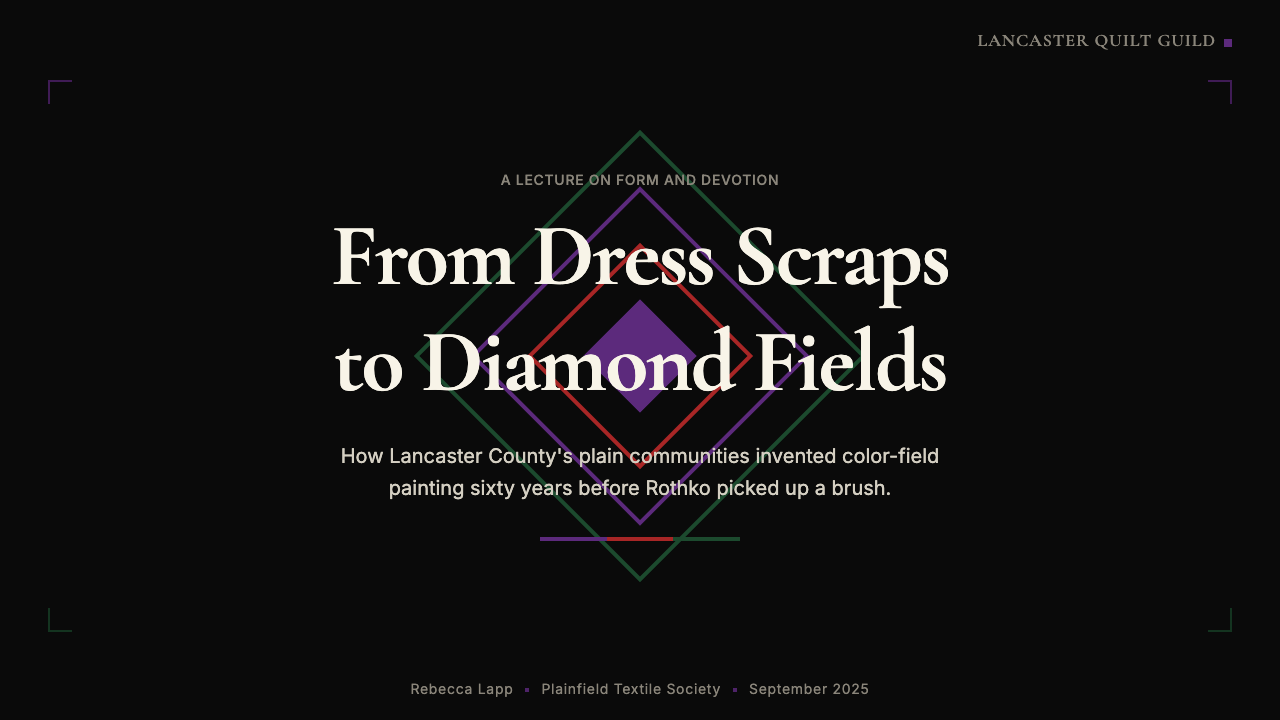
For presentation slides, this system is exceptionally suited to moments requiring maximum visual impact with minimum complexity. A cover slide built in this system uses the Diamond in the Square logic directly: a centered geometric element in one saturated hue occupies the dominant proportion of the frame, surrounded by wide dark borders. The title sits within or beneath the geometric form in light type against the dark field. Content slides should resist the urge to fill space: a single saturated sidebar or top band, a generous dark background, and clean light type on the dark field. Data visualizations become geometric objects — the bars of a bar chart, the segments of a distribution — rendered in the two or three palette hues without softening or gradation.
For web interfaces, the system is particularly effective in hero panels, full-bleed landing sections, and modal overlays where the full-screen environment allows the dark ground and saturated fields to read at the scale they require. Dashboard applications can use this system for high-priority status panels, alert states, or tier-differentiation elements, where the saturated colors carry semantic meaning — status green, alert red — against a consistently dark interface ground. Pricing pages work well with a centered layout that foregrounds one tier using the saturated color logic: a single highlighted column in deep violet or forest green against a near-black surrounding.
In editorial and marketing contexts, this system produces work that is bold enough to stop attention at distance — poster-level impact — while remaining formally simple enough to reproduce cleanly at any scale. Feature campaign imagery uses large geometric color fields as background panels, with copy or product isolated in the central diamond or rectangle. Marketing emails and social cards benefit from the same logic: a dominant geometric field in one saturated hue, a wide dark border, and minimal type. The system performs poorly when asked to carry a lot of body text or detailed information, because the large dark fields and high contrast work against extended reading comfort.
A common mistake in applying this system is treating the dark ground as interchangeable with a lighter or neutral background. The near-black or midnight ground is not merely a stylistic choice — it is the element that makes the saturated color fields luminous rather than simply bright. On a lighter ground, the same violet or forest green reads as simply saturated; against near-black, it glows with a quality close to transmitted light. A second common error is using the three palette hues simultaneously in the same composition at full saturation. Authentic Amish quilt compositions lead with one dominant color, deploy a second as inner framing, and use a third sparingly or not at all. This restraint is not poverty of imagination; it is what produces the formal authority that makes the system memorable.
See the Amish Pennsylvania Quilt Bold Geometric design system
Amish Pennsylvania Quilt Bold Geometric — FAQ
How does this system relate to color-field painting — are the visual similarities coincidental?
The similarities are structural rather than coincidental, though the causal direction is surprising. The Lancaster County Amish quilts that most closely anticipate color-field painting were made from the 1870s onward — decades before Barnett Newman's first zip painting (1948) or Mark Rothko's mature color-field canvases (early 1950s). The Amish quilters did not influence the painters: they were an isolated rural community with no connection to New York art circles. The parallel emerged because both traditions arrived at similar formal conclusions through entirely different routes. The quilters were working within the constraints of the Ordnung and the logic of available dyed wool; the painters were working through the theoretical aftermath of Abstract Expressionism. That two such different contexts produced such similar visual results suggests the large saturated color field is not a culturally specific discovery but a fundamental formal mode with deep perceptual roots.
Can this dark, high-contrast system work on light backgrounds?
It can be adapted to a light ground, but something essential is lost in the translation. The luminosity that makes authentic Lancaster County quilts so arresting depends critically on the dark surrounding field: the colors appear to glow because they are read against near-black, not because they are intrinsically brighter. On a light or neutral ground, the same hues read as simply saturated — good-looking, but without the almost electric quality that gives the system its authority. A light-ground adaptation works best when it treats the dark as a contained element — a wide dark border around a light central field, for instance — rather than inverting the whole system. This partial inversion retains the structural logic of the original while accommodating contexts where a predominantly dark interface is not appropriate.
What makes this different from simply using a dark theme with bright accent colors?
The difference is in the proportion, the palette discipline, and the compositional logic. A standard dark theme with accent colors typically uses a near-black background as a passive setting for interface elements — navbars, cards, buttons — in which color appears as small, scattered accent. The Amish quilt system inverts this relationship: the saturated color fields are the primary compositional elements, occupying large and deliberately proportioned areas, with the dark functioning as border and frame rather than background fill. The palette discipline is also more severe: where a generic dark theme might use any color that reads clearly on dark, this system restricts to two or three deeply saturated solid hues with historical specificity. The result has a formal coherence and visual weight that generic dark-mode UI rarely achieves.
Is this system appropriate for brands or contexts that want to feel warm or approachable?
Probably not as a primary system. The deep dark ground and saturated geometric fields produce a quality of visual presence that is monumental, still, and slightly austere — qualities that read as authoritative and serious rather than warm or inviting. This makes the system well suited to contexts where gravity and clarity are valued: premium product launches, high-stakes data presentations, arts and culture institutions, or technology brands positioning themselves as exceptional rather than friendly. For consumer applications where emotional warmth, playfulness, or sensory richness are important — food, children's products, wellness, community platforms — the system will likely feel cold and remote. A partial use of the palette (one saturated hue as accent against a lighter ground, for instance) can bring something of the style's boldness into a warmer register without committing to the full austerity of the system.
How do you handle typography in this system, given that text has to be legible against very saturated color fields?
Typography in this system works best when it treats the legibility challenge as a formal constraint to lean into rather than solve away. The historic quilts had no typography, but the compositional logic suggests clear principles: text should sit either on the dark field (where light type has maximum contrast and reads cleanly) or within a dedicated dark band or border (where the dark ground again provides the contrast). Text placed directly on a saturated color field — violet, forest green, vermilion — creates a legibility challenge that the system does not resolve elegantly; when text must appear on a saturated field, very light or very dark near-solid type works best, and the text block should be kept short. The system favors large-scale display type over extended body text: the visual environment rewards brevity and weight, not density and length.
Related design styles
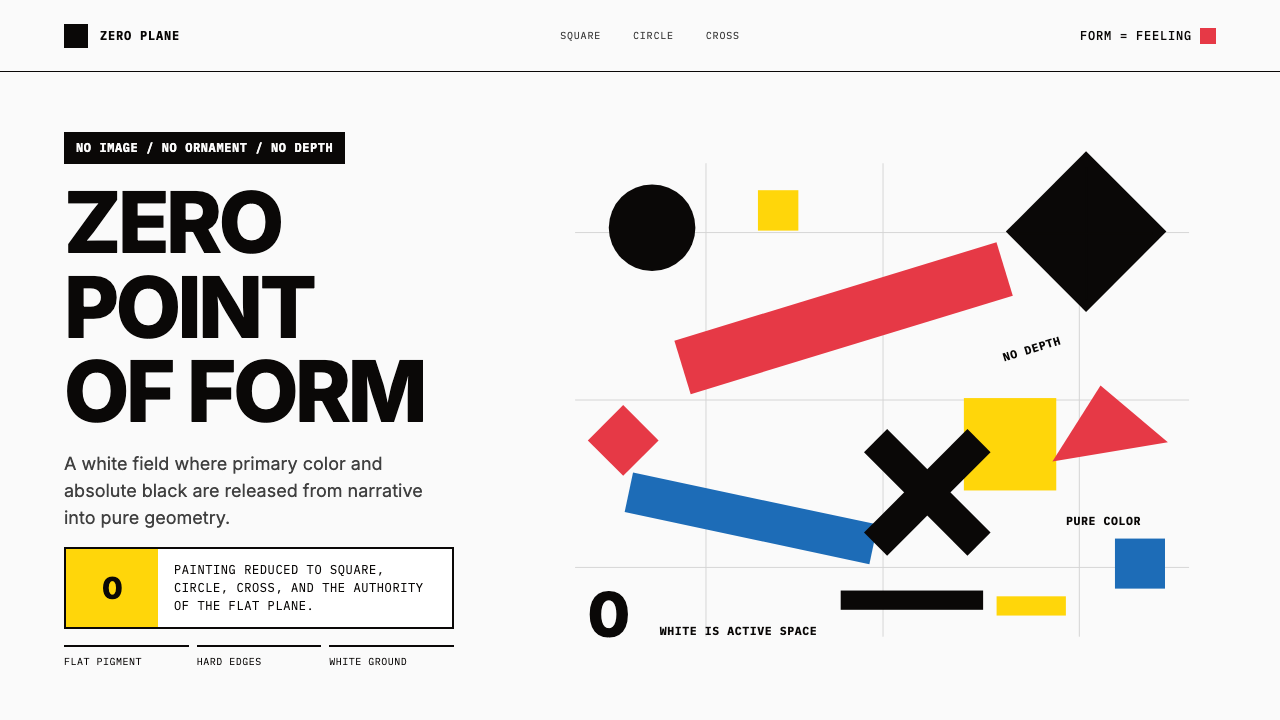 Malevich SuprematismGeometry declares zero. Red, yellow, blue and black blocks float on active wh…
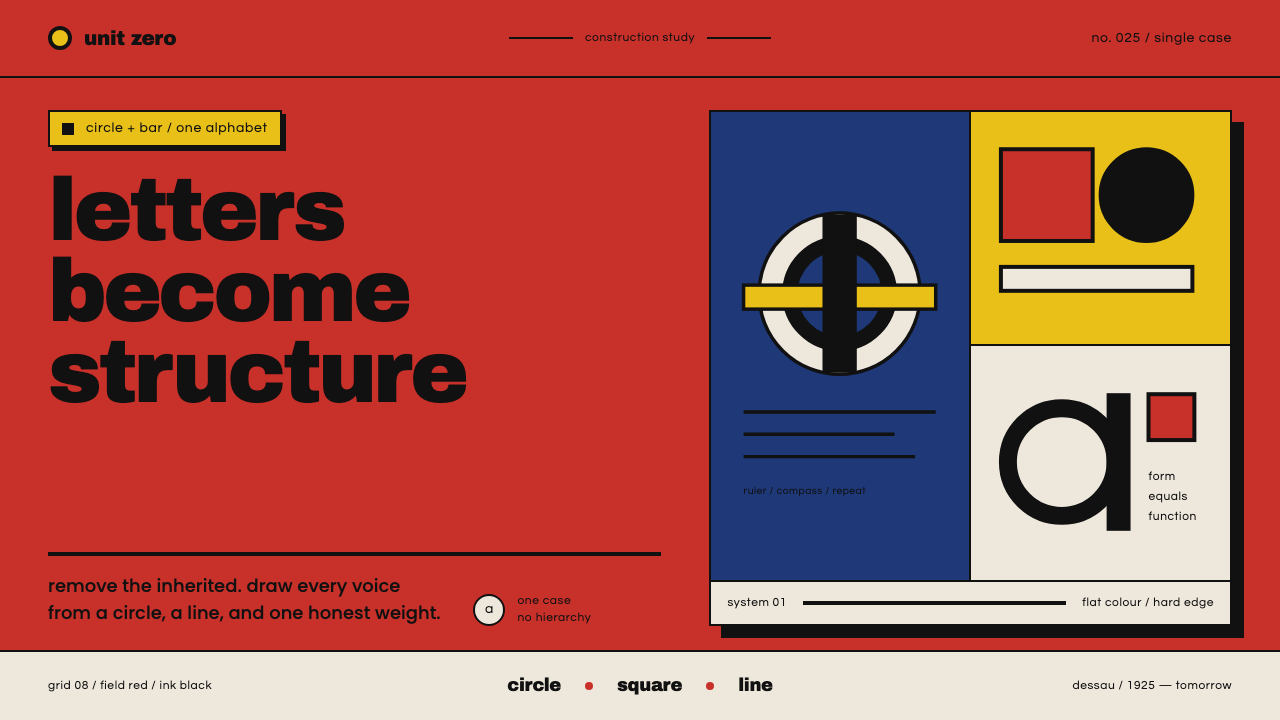 Bayer Universal BauhausLetters become structure. Bauhaus red, primary blocks, and black circle-bar f…
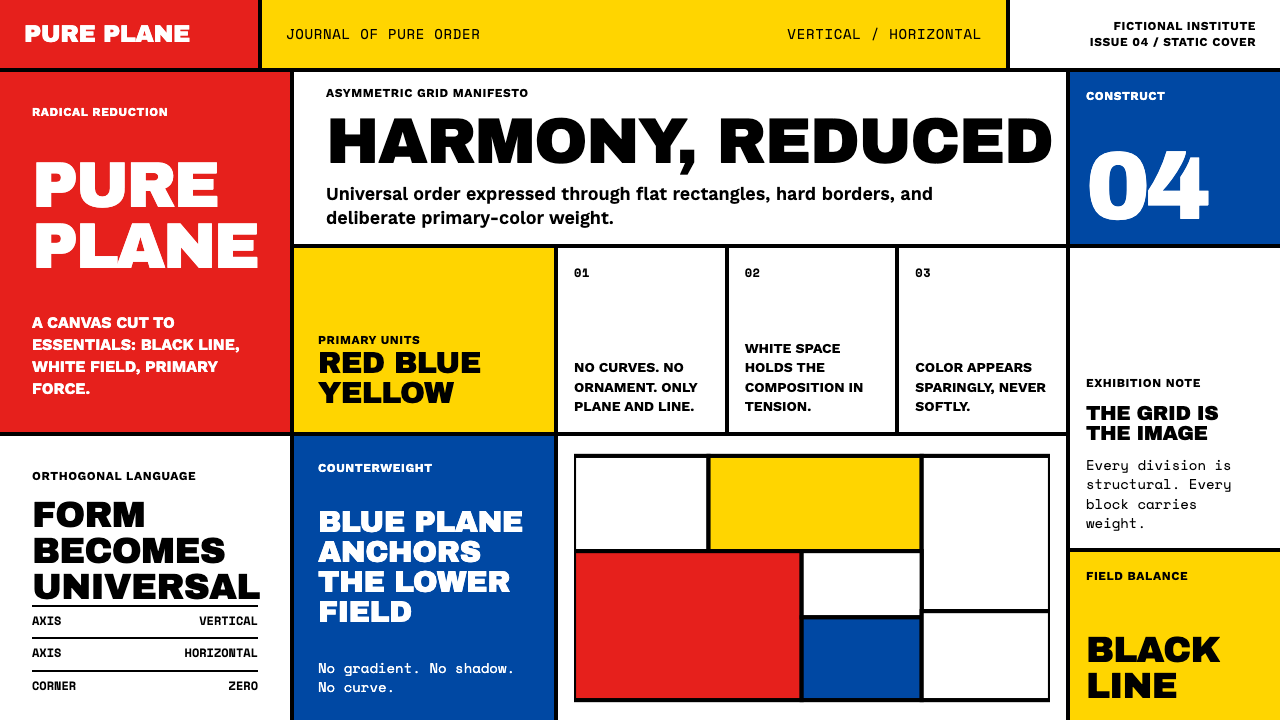 De StijlPrimary colors, locked in a black grid. Mondrian's compositions, in thick bor…
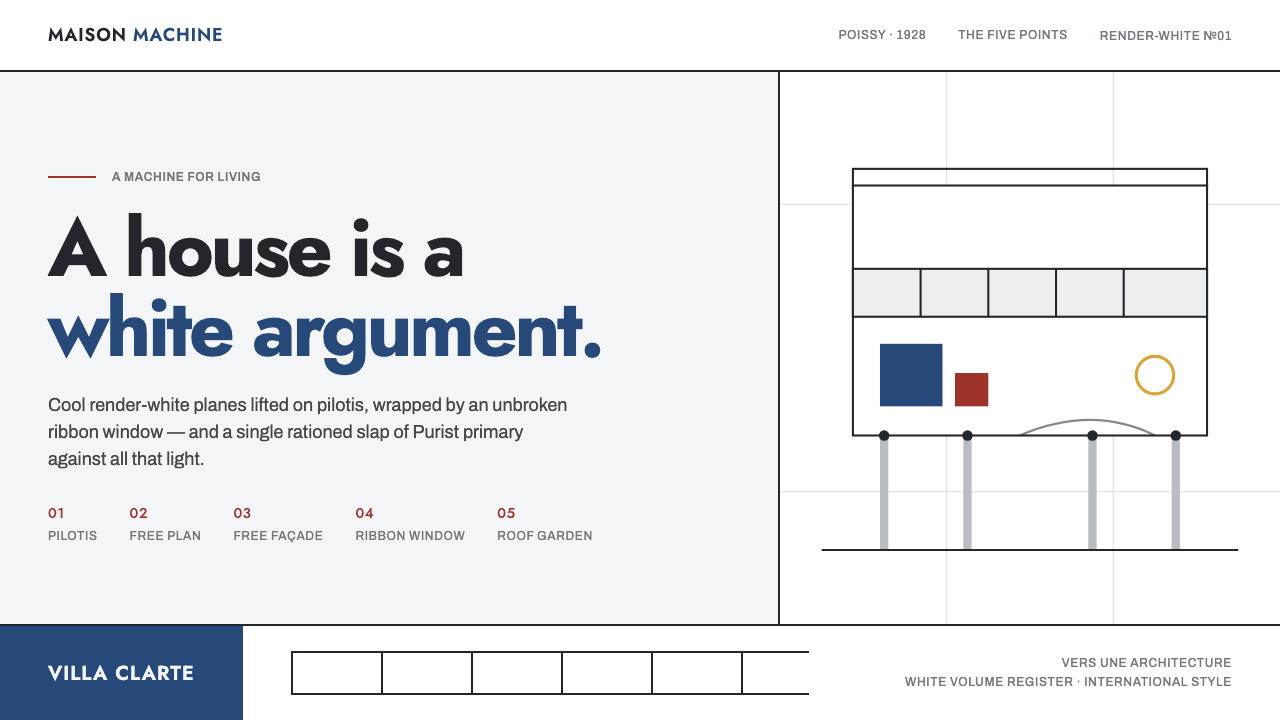 Le Corbusier Purist WhiteA house is a white argument: render-white planes, ribbon windows, one slap of…
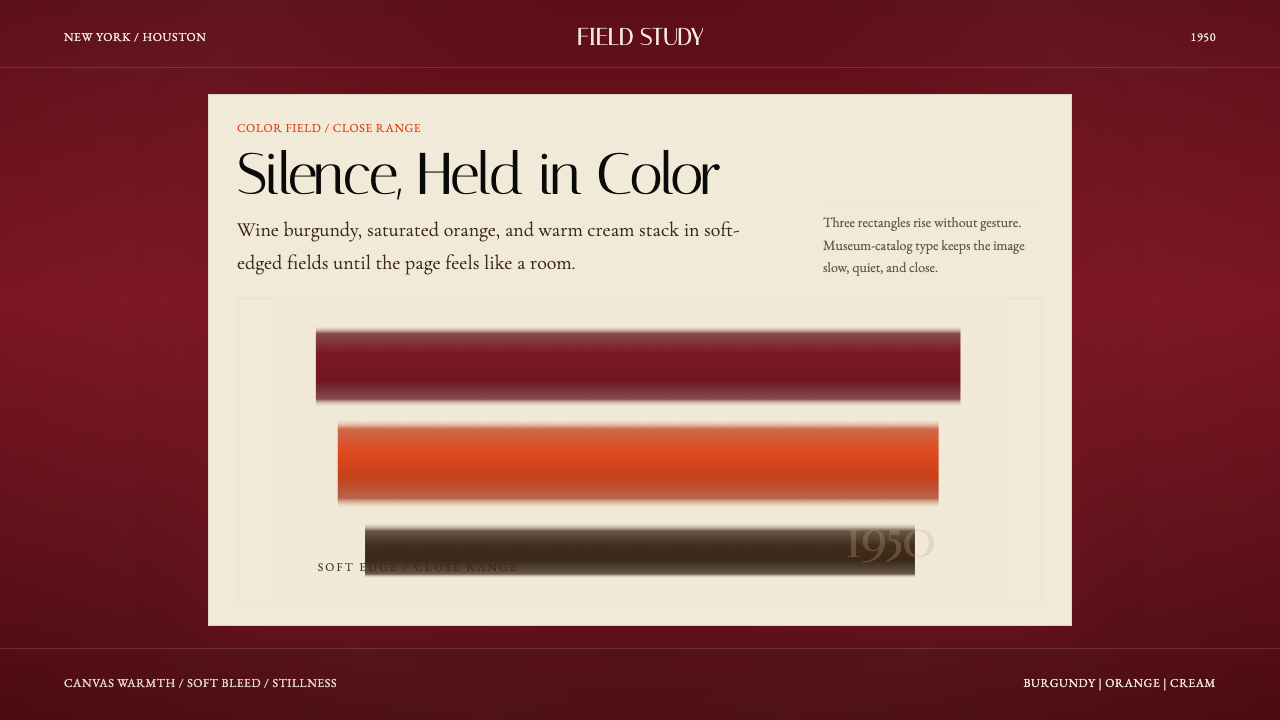 Mark Rothko Color Field (1950)Silence made visible. Burgundy, orange, and cream stack in soft-edged fields.
 Notan Light-DarkTwo values, nothing between. White masses cut from a carbon-black field, figu…