What is De Stijl?
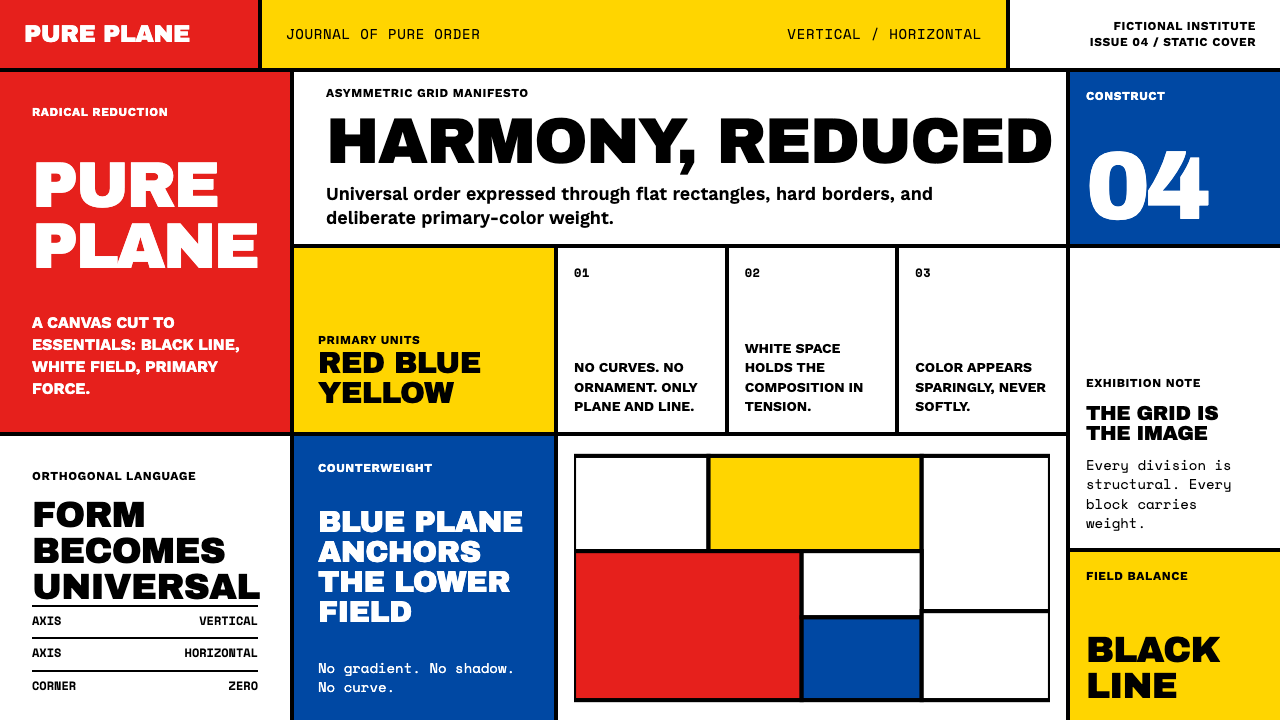
De Stijl reduced the entire visual world to a black grid, three primary colors, and pure white — and in doing so produced one of the most recognizable and enduring design languages of the twentieth century.
De Stijl in brief
De Stijl — Dutch for 'The Style' — is a Dutch art and design movement founded in 1917 whose visual language restricts itself to vertical and horizontal black lines, pure primary red, blue, and yellow fills, and white or neutral grounds. The result is a composition of asymmetric rectangles separated by thick black borders, with color used sparingly as a flat, symbolic fill rather than as shading or representation.
The movement called its underlying philosophy Neoplasticism, a term coined by Piet Mondrian. Neoplasticism held that universal harmony could be expressed through the most reduced visual means possible: the right angle, the straight line, the primary color, and their opposites — oblique angles, curves, and mixed or muted hues — were to be rejected entirely. What remained after this purification was not emptiness but a distilled representation of the fundamental forces of existence: the vertical and horizontal, the particular and the universal, the material and the spiritual.
Visually, De Stijl is immediately legible. A thick black orthogonal grid divides a white surface into unequal rectangular fields. Most fields remain white; a handful are filled with an unmodulated primary color — a block of pure red anchoring one corner, a narrow strip of blue cutting across the middle, a small square of yellow providing tension. The asymmetry is carefully calibrated so that the composition feels balanced through weight and visual tension rather than symmetry. Nothing curves. Nothing blends. No surface has texture. The grid itself is the content.

Where does De Stijl come from?
De Stijl was founded in Leiden in October 1917 by the painter Piet Mondrian, the painter and architect Theo van Doesburg, and a small circle of collaborators including the designer Bart van der Leck, the architect J.J.P. Oud, and the furniture maker Gerrit Rietveld. The founding coincided with the publication of the first issue of their journal, also called De Stijl, which became the primary vehicle for disseminating their ideas. The Netherlands had remained neutral during the First World War, but the catastrophe of the war — which seemed to many European artists to reveal the bankruptcy of Western civilization's inherited values — provided the movement's moral urgency. A new visual order, they argued, was not merely an aesthetic preference but a necessity if human culture was to be reconstructed on better foundations.
Mondrian arrived at his radical reduction through a decade of progressive abstraction. Trained in the Dutch landscape tradition, he had gradually dissolved the representational content of his work: first the curves of trees gave way to horizontal and vertical lines, then colors simplified to the primary three, then compositions stripped to the grid. By 1913 he was producing works that bore no resemblance to observed nature. His theoretical writings — collected in journals and later in his essays on Neoplasticism — argued that true painting must transcend the particular and contingent to express the universal relationships underlying all phenomena. The orthogonal grid was his solution: a structure that embodied the tension between opposites without privileging either.
Theo van Doesburg's role was as much organizational and polemical as it was artistic. He managed the journal, corresponded with Bauhaus figures — eventually causing a split with Mondrian over his introduction of diagonal lines in 1924 — lectured across Europe, and designed typefaces and architectural interiors that applied De Stijl principles to three-dimensional space. His work at the Café Aubette in Strasbourg, completed in 1928 with Jean Arp and Sophie Taeuber-Arp, represents one of the most ambitious attempts to apply the movement's language to an entire interior environment.
Gerrit Rietveld translated De Stijl into furniture and architecture with arguably the most tactile and enduring results. His Red and Blue Chair, designed around 1917 and refined over subsequent years, decomposed the chair into a spatial construction of independent structural members colored according to the De Stijl palette. His Rietveld Schröder House in Utrecht, built in 1924, extended this logic to architecture: the house's exterior breaks down into intersecting planes of primary color and neutral gray, with no enclosing corners and sliding partitions that transform the interior geometry. The house is a UNESCO World Heritage Site and remains the clearest surviving demonstration of what De Stijl architecture actually felt like to inhabit.
The movement formally dissolved with van Doesburg's death in 1931, though Mondrian had already distanced himself from the group following the 1924 diagonal dispute. The influence, however, was just beginning. The Bauhaus absorbed De Stijl thinking through direct contact with van Doesburg, who lectured in Weimar in 1921 and 1922. The International Style in architecture owed a significant structural debt to Rietveld and Oud. By the 1960s, De Stijl's visual vocabulary had become so thoroughly absorbed into graphic design, corporate identity, and modernist architecture that it was often mistaken for a neutral, universal language rather than the product of a specific philosophical program.
What defines the De Stijl look?
The Orthogonal Grid
The defining structural element of De Stijl is the grid of thick black horizontal and vertical lines. These lines are not mere borders or separators — they are load-bearing visual elements in their own right, with a visual weight that commands attention equal to the color fills they enclose. The grid is always asymmetric: the rectangular fields it creates vary substantially in size, producing visual rhythm and tension rather than mechanical regularity. The intersections of these lines are not chamfered or rounded; they meet at strict right angles, and this orthogonal purity is non-negotiable within the system.
Color as Absolute
De Stijl uses only pure primary red, blue, and yellow as chromatic elements, set against fields of white, gray, or black. These colors are never mixed, never tinted, never shaded, and never applied as gradients — each appears as a flat, unmodulated fill at full intensity. The theoretical rationale, drawn from Mondrian's Neoplasticism, is that primary colors represent the universal before individuation: they are the irreducible starting points of all color, just as horizontal and vertical lines are the irreducible starting points of all spatial organization. Color carries conceptual weight, not decorative weight.
Asymmetric Balance
De Stijl compositions are never mirror-symmetrical, yet they achieve a precise visual equilibrium. A large white field on one side is balanced by a smaller but more intensely colored field on the other; a thick horizontal band across the upper portion is answered by a narrow vertical stripe at the edge. This balance is arrived at through intuitive calibration of visual weight rather than geometric formula, which is why De Stijl compositions feel alive and taut rather than mechanical. The asymmetry was also a philosophical position: symmetry implies a fixed center of authority; asymmetry implies dynamic tension between equals.
Zero Curve, Zero Ornament
Within the De Stijl system, the curve does not exist. Neither does diagonal orientation, decorative flourish, representational imagery, or surface texture. Mondrian's rejection of the curve was explicit and philosophical: the curve belongs to nature and to individual sensation; the straight line belongs to the universal. In applied design, this absolute flatness extends to every component — there are no rounded corners on rectangles, no drop shadows, no icons that reference organic shapes, no typographic ornaments. The visual field is clean to the point of severity, and this severity is the point.
Spatial Rhythm Through Scale Contrast
Because De Stijl excludes texture, gradient, and decorative variety, it creates visual rhythm entirely through the contrast of scale — large fields against small ones, wide lines against narrow ones, vast white expanses against concentrated color. This scale contrast is the primary mechanism for guiding attention and establishing hierarchy within a composition. A small square of pure yellow in a large white field draws the eye with startling force; a wide black horizontal line stops the gaze and resets it. Learning to orchestrate scale contrast is the central skill in working fluently with this visual language.
Typography as Grid Element
In De Stijl's application to graphic design, letterforms are treated as geometric constructions that must align to and reinforce the orthogonal grid. Typefaces are geometric and sans-serif, stripped of calligraphic variation. Text blocks are set in strict rectangles, their widths and margins determined by the same grid lines that govern the color fields. Headlines function like color blocks — as weighted rectangular masses in the composition — rather than as separate typographic flourishes. Capital letters and reduced letter-spacing are common, enhancing the geometric, architectural quality of text.
Extension into Three Dimensions
What distinguished De Stijl from a purely painterly movement was its ambition to extend Neoplastic principles into furniture, architecture, and interior space. Rietveld's furniture treats construction members as lines in space — each beam, leg, and plane painted independently in primary or neutral colors, the joints designed to make the spatial logic visible rather than concealed. In architecture, De Stijl eliminated the corner as a form of ornament: walls intersect as planes in space rather than as monolithic enclosures. The spatial experience that results is one of constructed transparency — boundaries present but not imprisoning.

Who shaped De Stijl?
Mondrian is the defining figure of De Stijl and the artist whose mature work most completely embodies Neoplastic principles. His Composition series, developed from the early 1920s onward, reduced painting to black grid lines and primary color rectangles on white grounds with a rigor that has never been surpassed within the system he established. His theoretical writings — including the essays collected as Plastic Art and Pure Plastic Art — provide the philosophical framework for the entire movement. After spending years in Paris and London, he emigrated to New York in 1940, where his final works, Broadway Boogie-Woogie and Victory Boogie-Woogie, introduced a staccato colored grid that some saw as a departure and others as the fullest expression of his thinking.
Van Doesburg was the movement's propagandist, architect, and eventually its most significant internal dissident. He founded the journal De Stijl and used it to broadcast Neoplastic ideas across Europe, building relationships with the Bauhaus, Russian Constructivism, and Dada simultaneously. His architectural collaborations — including the Café Aubette interior in Strasbourg — pushed De Stijl into three-dimensional space with an exuberance that often exceeded Mondrian's own more austere vision. His introduction of diagonal lines in 1924, which he called Elementarism, caused Mondrian to permanently break with the group, regarding diagonals as a reintroduction of the individual dynamic that Neoplasticism sought to transcend.
Rietveld was the cabinetmaker and architect who gave De Stijl its most enduring physical form. Trained as a furniture designer, he developed a constructional method in which every component is visually distinct, painted in its own color, and assembled in a way that exposes rather than conceals the logic of construction. The Red and Blue Chair became iconic not because it is comfortable but because it makes spatial and structural logic visible in three dimensions. His Rietveld Schröder House in Utrecht, designed in 1924 with Truus Schröder, remains a UNESCO World Heritage Site and the only building fully realized according to De Stijl principles — a house in which walls, floors, and ceilings dissolve into intersecting colored planes.
Van der Leck was a painter and designer whose work was crucial to the movement's early formation, though he left the group by 1918 after disagreements about the nature of abstraction. His contribution was a distinctive approach to applying flat primary-color shapes across white grounds in a way that retained a compositional looseness that Mondrian's later work would eliminate. He also made significant contributions to applied graphic design: his poster and package work for the Batavier shipping line and later for the Delft Salad Oil company demonstrated that Neoplastic principles could function commercially without becoming merely decorative.
Oud was the municipal architect of Rotterdam when De Stijl was founded, and he became the movement's primary link between its aesthetic principles and social housing practice. His workers' housing projects — including the Hoek van Holland development and the Kiefhoek housing estate — applied De Stijl's principles of flat surfaces, primary color accents, and horizontal emphasis to large-scale residential architecture. Unlike Rietveld's more experimental buildings, Oud's work was built to be lived in at scale, demonstrating that a radical aesthetic vision could be practically deployed in service of public housing.
How do you use De Stijl today?
De Stijl is one of the most immediately recognizable historical styles in contemporary design work, and this recognizability is both its greatest asset and its primary risk. Applied with understanding, the system creates compositions of extraordinary clarity and authority. Applied carelessly, it produces cliché — the three-primary-color grid that signals modernism without meaning anything in particular. The difference lies in whether the designer uses the system's logic or merely its surface appearance.
For presentation slides, De Stijl works with particular strength on cover and section-break pages, where a bold asymmetric composition can carry the full weight of a spread. A cover built on De Stijl principles uses the thick black grid as the primary organizational structure, reserves one or at most two color fills for the most important element, and keeps the title in geometric, uppercase letterforms tightly aligned to a grid column. Content slides benefit from the system's discipline of restricting color to one accent per page — the grid lines themselves handle all the structural work, freeing the designer from any need for decorative dividers or visual ornament. Data visualization fits naturally: bar charts become color blocks within the grid, their bars reading as primary-color fills against a white field.
For web interfaces, De Stijl is best suited to dashboards, pricing pages, and landing pages where hierarchy needs to be immediately legible at a glance. The approach requires a strict column grid, a white or near-white background, black for all body text and navigational elements, and a single primary color reserved for the most critical interactive state or tier indicator. Card components take on hard borders without shadow; buttons use flat fills; inputs have visible borders and no rounded corners. Navigation should be typographic, with text labels aligned to the grid — icon-based navigation imports a visual language that conflicts with the movement's exclusion of representational imagery.
For editorial and marketing work, De Stijl's poster heritage makes it naturally suited to high-impact full-page layouts. An editorial page uses the black grid as a macro-structure element: a thick horizontal rule divides above-the-fold from scroll content, vertical lines define text columns, and the grid establishes the measure of every text block. Color appears in large fields as section markers or background panels — a primary-yellow panel signals a feature section; a narrow red rule marks a critical call-out. Marketing pages work as a series of full-width panels, each dominated by one primary color or white, with hard-edged geometry creating the transitions between sections rather than gradients or fades.
The most common mistake when applying De Stijl is using all three primary colors simultaneously at equal visual weight. In Mondrian's actual Compositions, one color typically dominates by area — usually a significant red or blue field — while the other primaries appear as much smaller accents. Using equal quantities of pure red, pure blue, and pure yellow simultaneously at full saturation produces visual chaos, not the taut equilibrium the style is known for. A second frequent error is applying primary colors as superficial fills onto a layout that otherwise uses the design conventions of another style — rounded corners, soft shadows, gradients in transitions. De Stijl requires the supporting geometry to be as radical as the color: orthogonal everything, hard everything, flat everything.

De Stijl — FAQ
Is De Stijl the same as Mondrian's personal style, or is it a broader movement?
De Stijl is broader than Mondrian alone, though his paintings are its most famous products. The movement encompassed furniture design by Rietveld, architecture by Oud and van Doesburg, graphic design by van der Leck and van Doesburg, and interior design including the Café Aubette. What unified these diverse practices was a shared philosophical program — Neoplasticism — and a shared visual vocabulary: orthogonal grids, primary colors, asymmetric composition, and the total exclusion of curves and ornament. Mondrian's canvases are perhaps the purest and most reductive expression of these principles, which is why he tends to be identified with the movement as a whole, but many practitioners extended the logic into applied and spatial design in ways that went well beyond painting.
How does De Stijl differ from Bauhaus? They seem very similar.
They share deep roots — both rejected ornament, favored geometric form and primary colors, and believed that designed objects could carry universal meaning. But their philosophies diverged significantly. Bauhaus was primarily pedagogical and practical: it sought to reform design education and reconnect art with industrial production. De Stijl was primarily philosophical: it sought to express a metaphysical vision of universal harmony through pure visual means. As a result, Bauhaus work is more varied in its color use and more open to asymmetric, dynamic composition. De Stijl is more absolute and more restrictive — its palette is strictly primary, its grid is strictly orthogonal, and its philosophy admits fewer exceptions. When the two movements appear similar, it is usually because their shared rejection of ornament and their shared interest in geometric form produce superficially similar results, but the underlying systems are quite different.
Can De Stijl work with photography, or does it exclude images entirely?
The original De Stijl movement was largely hostile to representational imagery — Mondrian explicitly rejected it, and most De Stijl paintings contain no photographic or illustrative content whatsoever. In contemporary applications, photography can be incorporated, but it requires significant transformation: cropped to a strict rectangle that aligns to the grid, treated in high-contrast black-and-white or duotone with a primary color overlay, or used as a fill within one of the grid's rectangular fields rather than as a freestanding element. The moment photography introduces curves, organic forms, or naturalistic color into the composition, it begins to undermine the system's structural logic. Photography that has been reduced to near-graphic quality — a strongly lit geometric subject, a high-contrast architectural detail — integrates more successfully than naturalistic portraiture or landscape.
Why does De Stijl use primary colors specifically? Are they just a stylistic choice?
For Mondrian, the primary colors were not a stylistic preference but a philosophical necessity. His theory of Neoplasticism held that individual colors — the infinite particular shades of observed nature — represent the world of appearances, the subjective and contingent. Primary red, blue, and yellow, by contrast, are colors before individuation: they cannot be produced by mixing other colors, and they stand at the origin of all chromatic possibility. Using them exclusively was an attempt to access the universal rather than the particular — to reach the level of reality that underlies all appearances. In contemporary use, most designers treat the primary palette as a stylistic constraint rather than a metaphysical commitment, but understanding the philosophical origin clarifies why De Stijl applies color so differently from other styles that also use primaries: it is not decoration, it is argument.
Is De Stijl appropriate for products that need to feel approachable or warm?
Generally not, and understanding why matters as much as the answer itself. De Stijl's visual language was deliberately constructed to transcend the personal, the sensory, and the emotionally particular in favor of the universal and structural. The result is a style that communicates authority, precision, and rational order with unusual force — but also one that keeps emotional warmth at a deliberate distance. Products that need to feel nurturing, intimate, playful, or culturally rooted will fight against the style rather than benefit from it. De Stijl works best for products whose core proposition is clarity, reliability, and systemic thinking: financial tools, design systems documentation, analytical platforms, architecture and spatial design portfolios. If the product needs to feel warm first and rigorous second, look to styles that have expressiveness and humanity built in rather than designed out.
Related design styles
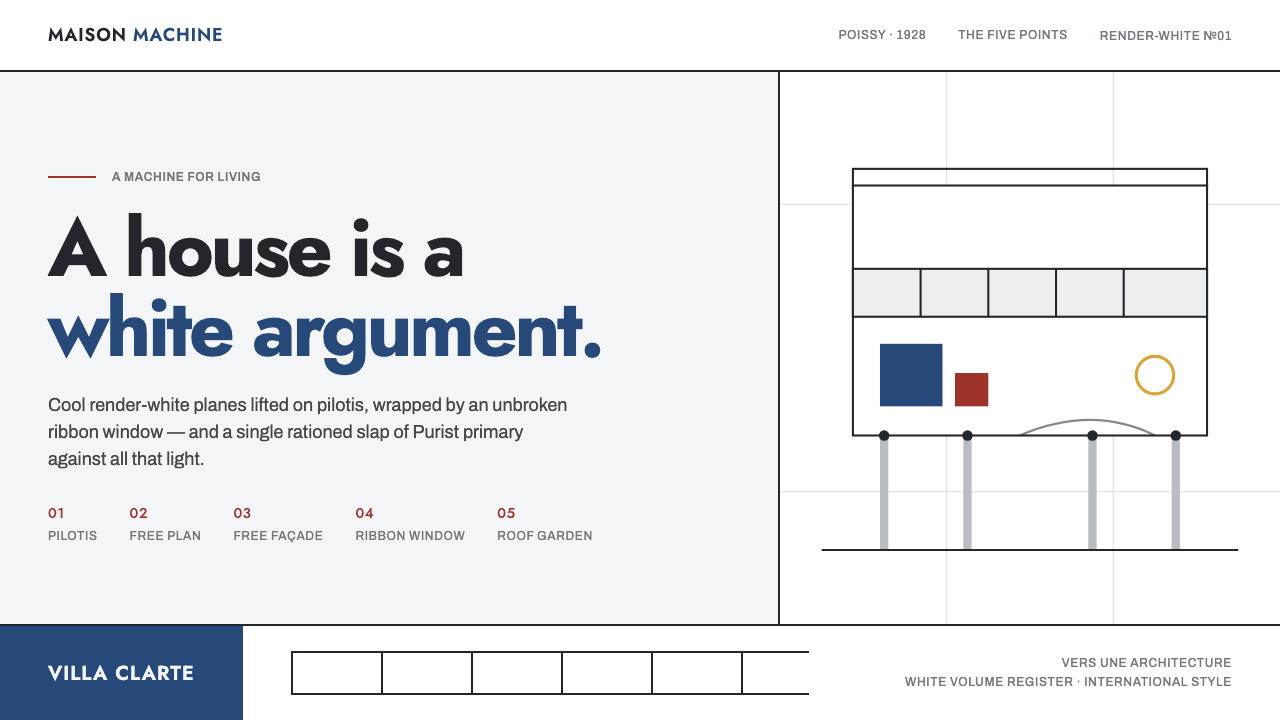 Le Corbusier Purist WhiteA house is a white argument: render-white planes, ribbon windows, one slap of…
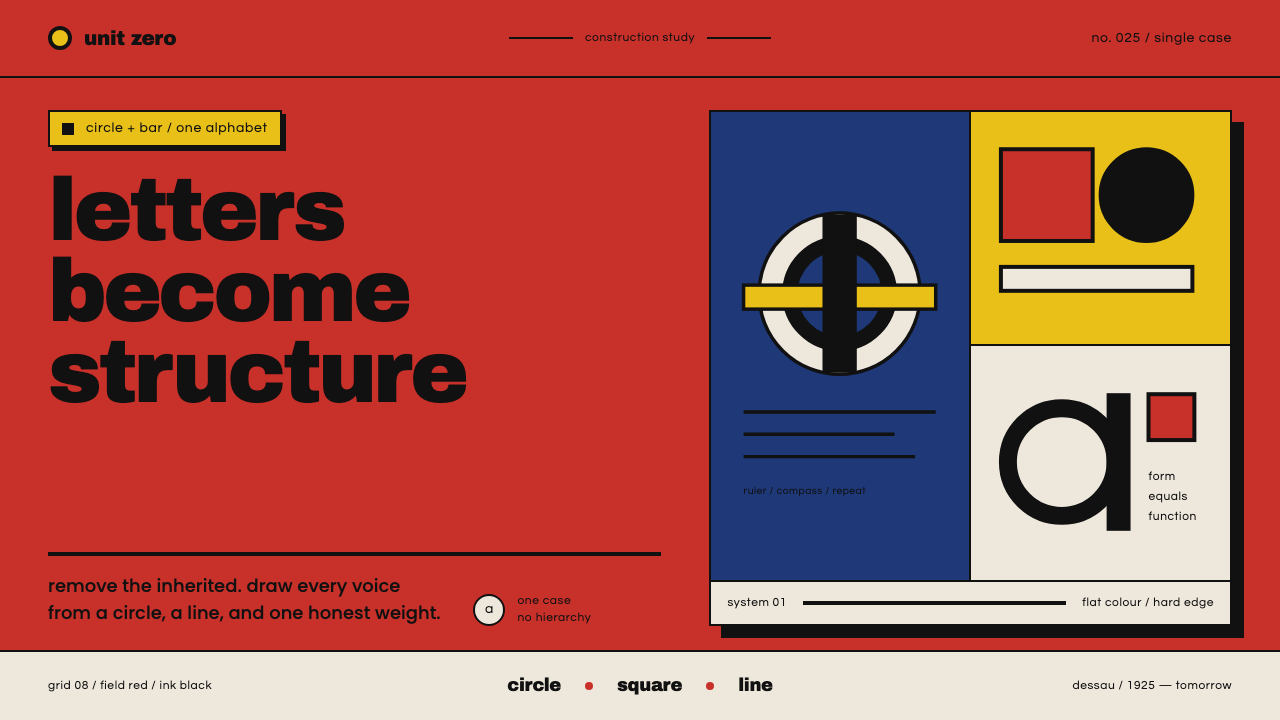 Bayer Universal BauhausLetters become structure. Bauhaus red, primary blocks, and black circle-bar f…
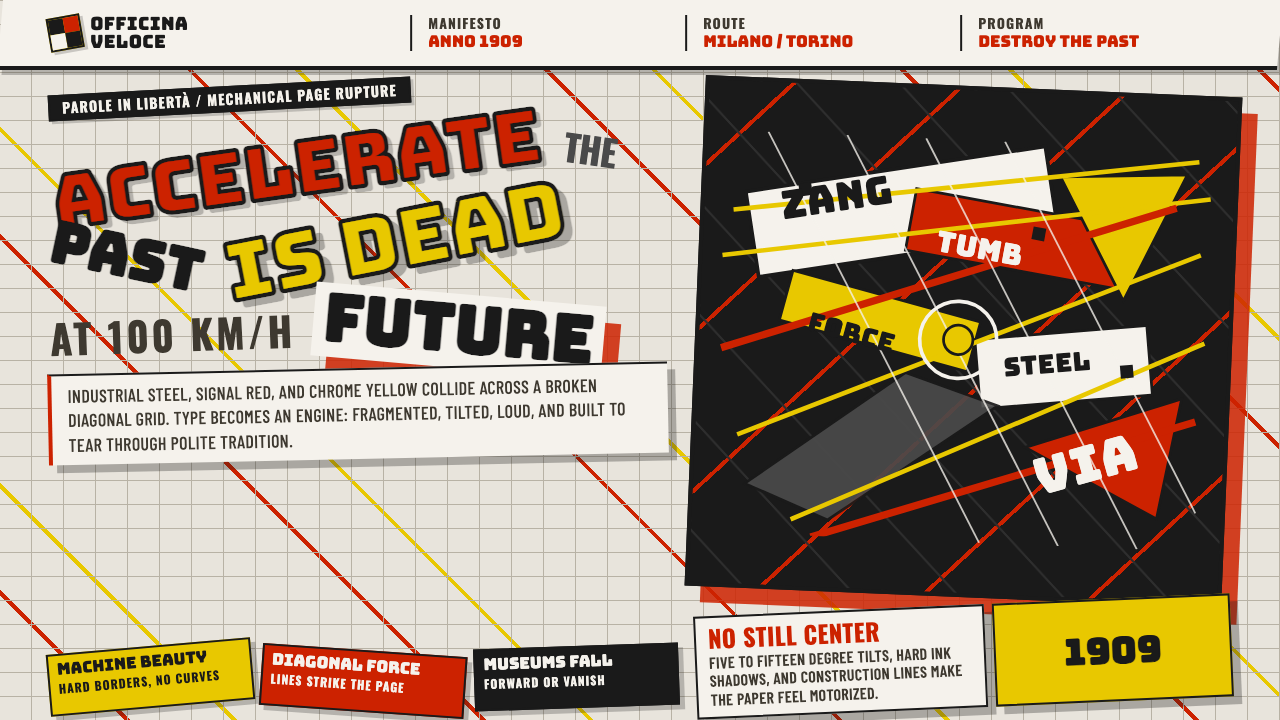 Italian Futurism (Marinetti 1909)Speed murders tradition. Signal red and chrome yellow slash a broken diagonal…
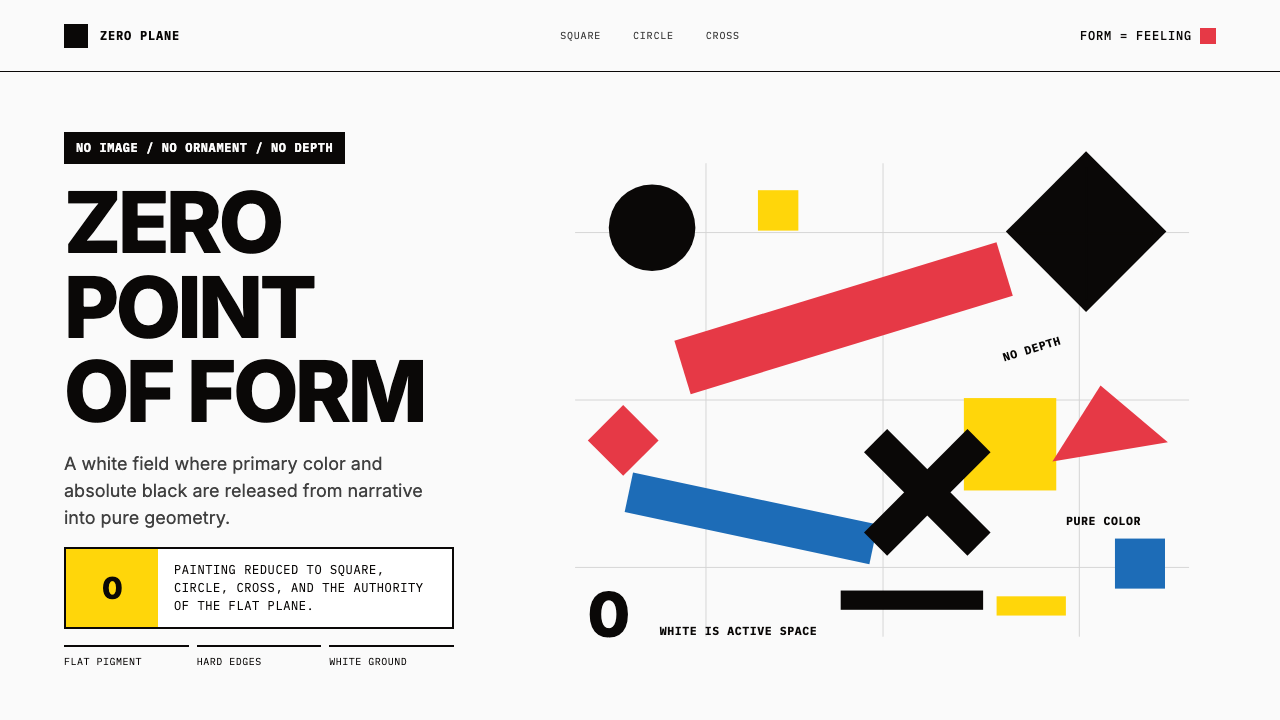 Malevich SuprematismGeometry declares zero. Red, yellow, blue and black blocks float on active wh…
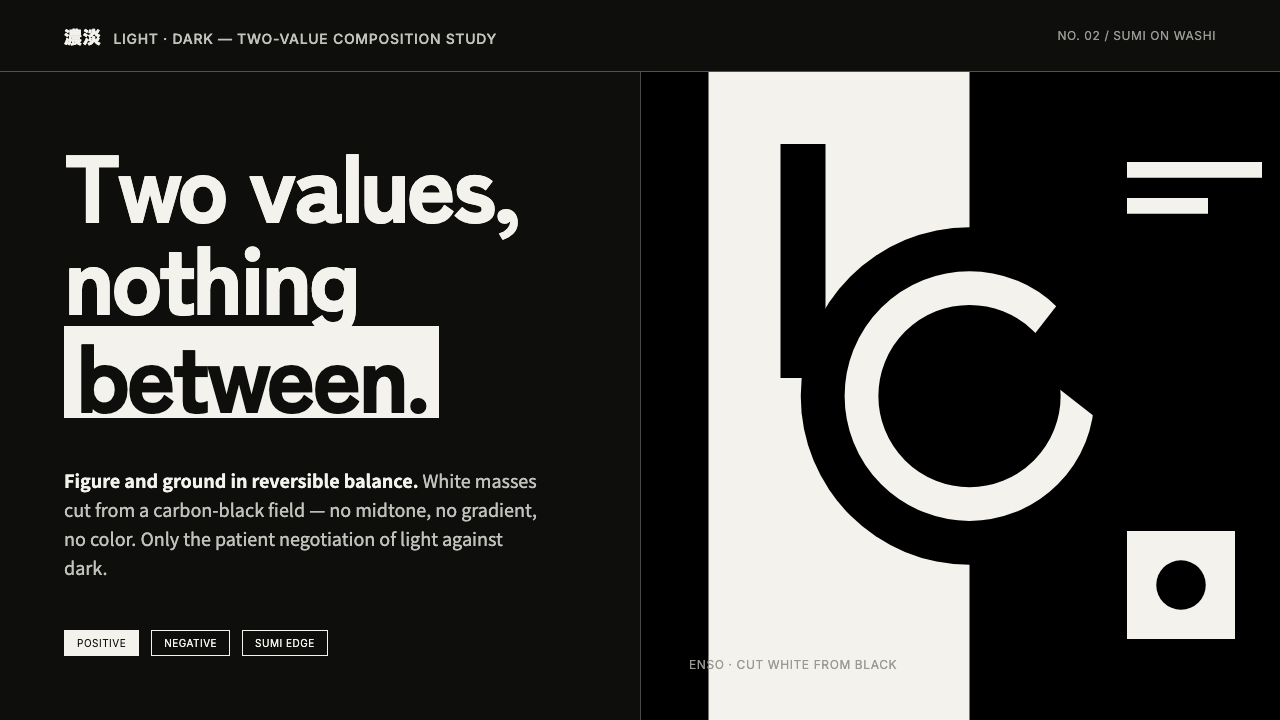 Notan Light-DarkTwo values, nothing between. White masses cut from a carbon-black field, figu…
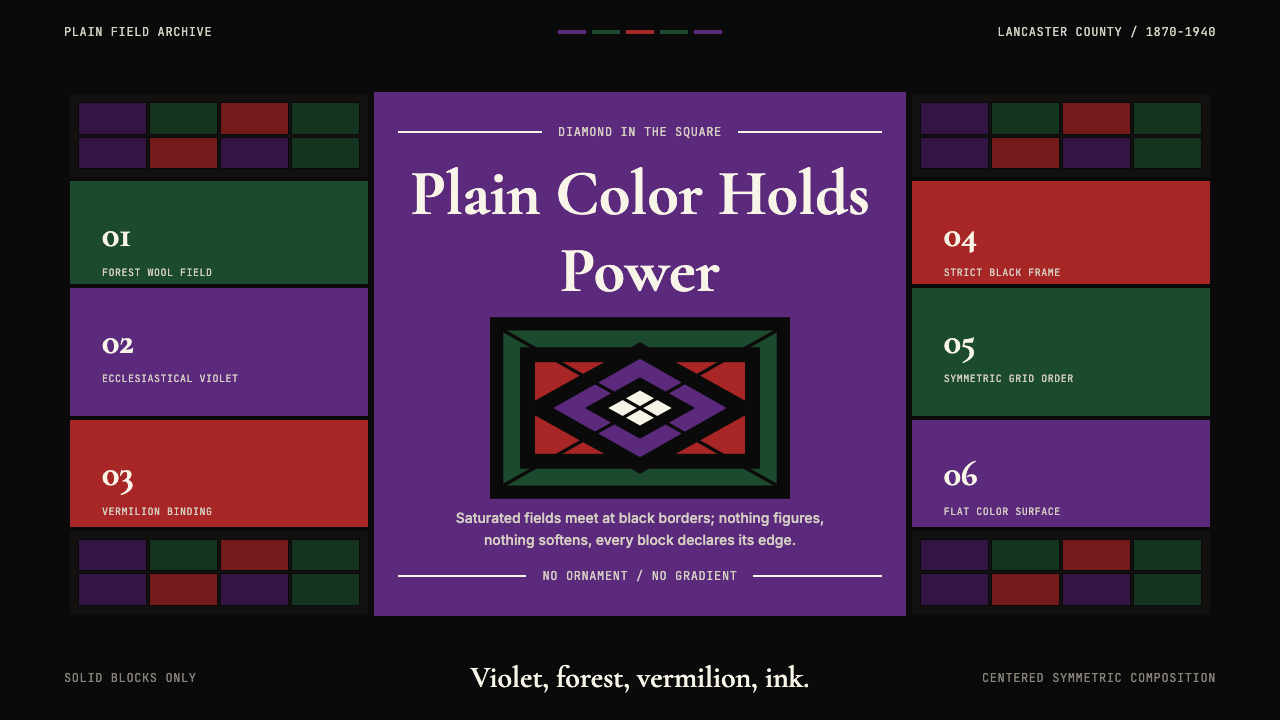 Amish Pennsylvania Quilt Bold GeometricRadical plainness. Violet, forest, and vermilion blocks lock into ink-black q…