What is Paul Rand / IBM Corporate Identity?
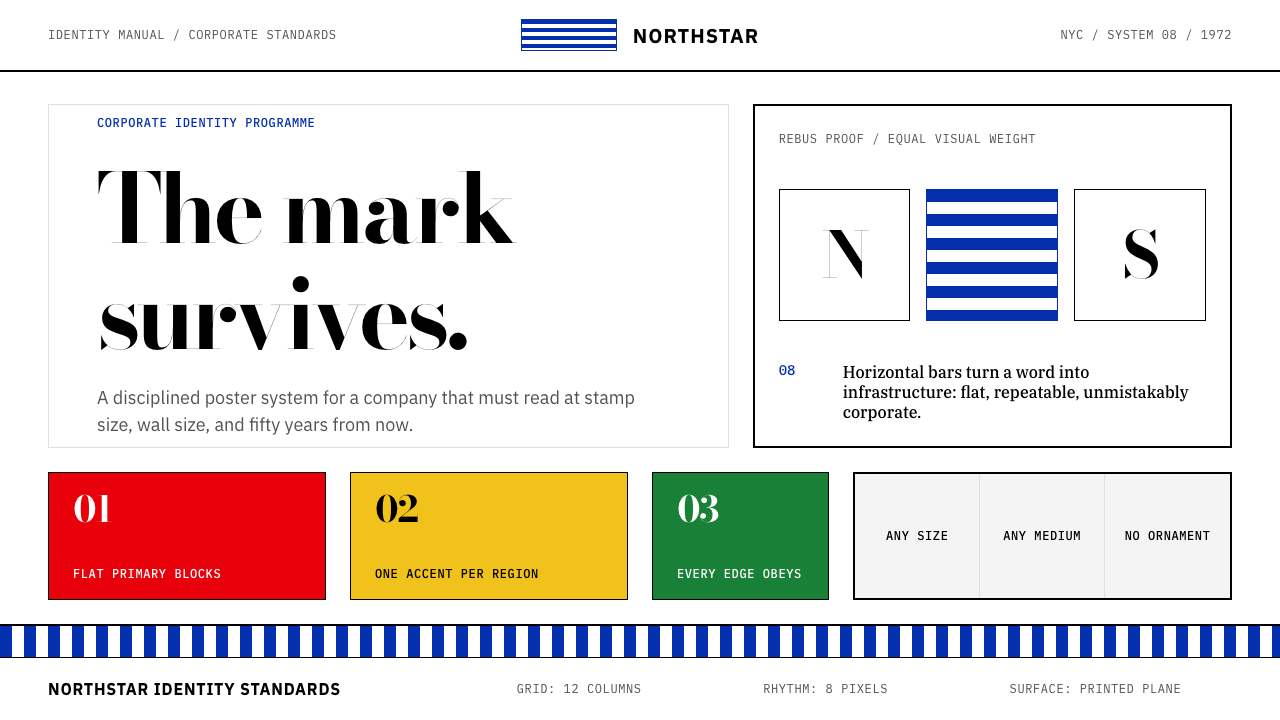
Paul Rand spent four decades proving that a corporate logo could be a work of art — and that rigorous structure was the only foundation worth building on.
Paul Rand / IBM Corporate Identity in brief
Paul Rand / IBM Corporate Identity is a design system rooted in American corporate modernism — the belief that a business communication should be as formally disciplined as a fine-art print. Its visual language is built from flat primary rectangles, IBM Blue as an anchor color, high-contrast serif display type alongside geometric sans-serif body text, and an absolute refusal of ornament. Every composition obeys a hard grid. Every color carries a specific role. Nothing is decorative.
The system draws directly from Paul Rand's forty-year relationship with IBM, which began in 1956 and produced some of the most recognized marks in design history: the IBM 8-bar logo (1972), the ABC eye (1962), the UPS shield (1961), and the NeXT cube (1986). Rand's conviction was simple and unyielding — a mark must work at any size, in any medium, for decades. That conviction shaped not just the logos but the entire grammar of IBM's printed materials, posters, and presentations.
Visually, the style is bold and diagrammatic. Color blocks are flat and hard-edged. Type sits in sharp hierarchical contrast — a heavy display face for headlines, a clean geometric sans for body copy, with scale doing the organizing work rather than decoration. Rand's famous rebus posters, which replaced words with images to spell out slogans, demonstrated that corporate communication could be witty, precise, and visually inventive all at once. That spirit — serious discipline with unexpected playfulness — is the defining tension of this system.

Where does Paul Rand / IBM Corporate Identity come from?
Paul Rand was born Peretz Rosenbaum in Brooklyn in 1914 and trained himself on the work of the European modernists — Cassandre, El Lissitzky, Jan Tschichold — at a time when American commercial art was dominated by Victorian illustration and ornate lettering. By his mid-twenties he had redesigned the covers of Esquire and Apparel Arts, invented a bold typographic identity for the advertising agency William H. Weintraub & Co., and established himself as the leading practitioner of what he called 'functional graphic design': the idea that beauty and utility were not competing values but the same value expressed at different scales.
His engagement with IBM began in 1956 when the industrial designer Eliot Noyes — who was coordinating a comprehensive modernization of the company under CEO Thomas J. Watson Jr. — invited Rand to redesign the IBM logotype. The original City Medium typeface wordmark was considered too rigid and institutional; Rand's solution was to introduce horizontal stripes across the letters, initially eight, as a way of suggesting both speed and solidity. The resulting 8-bar IBM logo, formalized in 1972, became one of the most reproduced corporate marks of the twentieth century and remains in use today. Watson Jr.'s commitment to design — he called it a competitive advantage, not a luxury — gave Rand unusual freedom to operate at the level of a genuine creative director rather than a vendor.
The intellectual foundations of the IBM identity were drawn from the International Typographic Style (Swiss Style) and from Rand's reading of American pragmatist philosophy. Rand was a close reader of John Dewey, and his book Art and Industry (1947) makes explicit the Deweyan argument that art is not a category separate from life but a quality of experience that good design can produce in everyday contexts. This philosophical grounding distinguished his corporate work from that of contemporaries who treated identity design as pure problem-solving: for Rand, the IBM poster was simultaneously a business asset and a cultural object, and he refused to treat those as different things.
The peak period of the IBM identity — the 1960s through the 1980s — coincided with IBM's dominance of the computing industry and with the broader adoption of corporate modernism as the standard visual language of American business. Rand's rebus posters, produced throughout this period, are the most celebrated artifacts of the collaboration: compositions in which the letters I, B, and M are replaced by an eye, a bee, and a stylized M, or in which the word 'love' is rendered as a heart — playful inversions that made the IBM communications instantly recognizable in any language. Rand continued working with IBM until 1996, the year of his death, maintaining a consistency of vision across four decades that few designers in any field have matched.
What defines the Paul Rand / IBM Corporate Identity look?
IBM Blue as Anchor
A specific cool, saturated blue functions as the immovable center of the palette — authoritative and institutional without being somber. It does not flex to context: it is always the dominant structural color, used for backgrounds, large type, and the horizontal bar motifs that echo the 8-bar logo. Secondary colors — red, green, yellow — appear as accents within a primarily blue field, never as equals to it.
Flat Primary Rectangles
Color is applied as hard-edged, solid rectangles — never gradients, never blurred, never vignetting. These blocks function as structural elements in the composition: they define zones, separate content, and create rhythm. A large primary rectangle at the top of a layout anchors everything below it. The flatness is not a stylistic choice but a statement of intent: this system trusts geometry, not atmosphere.
High-Contrast Serif Display
Headlines are set in a high-contrast modern serif — the kind of face associated with Bodoni, where the difference between thick and thin strokes is extreme. This contrast gives display type a strong graphic presence even at small sizes, and it pairs deliberately with the softness of geometric sans-serif body text. The combination is not timid: it announces a hierarchy that the reader cannot miss.
Hard Grid Structure
Every composition is governed by a grid that is visible in its effect even when the grid lines themselves are not shown. Margins are consistent. Column widths are fixed. Elements align to invisible axes. The discipline produces a quality that Rand called 'visual logic' — the sense that every object is exactly where it should be and could not reasonably be placed anywhere else. Randomness and visual approximation are simply not present.
Rebus Wit and Visual Wordplay
Rand's most distinctive contribution to the IBM identity was the rebus poster: compositions in which letters are replaced by images that carry the same phonetic value. The I of IBM becomes an eye, the B a bee. This device does several things simultaneously — it makes the viewer stop and decode, it demonstrates that corporate communication can be playful, and it proves that meaning can be carried by image as effectively as by text. Applied to contemporary work, it translates as a willingness to substitute visual metaphor for literal statement.
Zero Ornament, Maximum Precision
There are no decorative borders, no drop shadows, no gradient overlays, no illustrative flourishes. What remains when all ornament is removed is not emptiness — it is precision. Spacing between elements is exact and deliberate. The weight of a rule line is a considered decision. The margin between a headline and the text below it is part of the design, not a default. This precision distinguishes authentic work in this style from imitations that borrow the primary colors but retain visual clutter.
Timeless Reproducibility
The system was designed from the outset to work at any scale and in any medium — embossed on a business card, projected at stadium size, reproduced in single-color newsprint, rendered on a screen. This medium-agnosticism produces a visual quality that resists dating: work designed within this system in 1972 and work designed in it today are difficult to distinguish, not because the style is static but because it was built on principles that do not depend on any particular technology or cultural moment.

Who shaped Paul Rand / IBM Corporate Identity?
Rand (1914–1996) is the central figure of American corporate modernism. His four-decade relationship with IBM produced the 8-bar logo, the rebus poster series, and a complete system of printed communications that influenced every major American corporation's identity program. He also taught at Yale School of Art for decades, shaping generations of American designers. His books — Thoughts on Design (1947), A Designer's Art (1985), and Design, Form, and Chaos (1993) — remain foundational texts. His other major marks include the ABC eye (1962), the UPS shield (1961), Westinghouse (1960), and the NeXT cube (1986), commissioned by Steve Jobs.
Noyes (1910–1977) was the industrial designer who served as IBM's design coordinator from 1956, orchestrating the comprehensive modernization program that brought Rand, Eero Saarinen, and Charles and Ray Eames into the IBM orbit. Noyes ensured visual and material coherence across IBM's products, buildings, and communications — the typewriters, the mainframe casings, the architecture of IBM offices, and the graphic identity system all belonged to a single design philosophy. His own industrial designs, including the IBM Selectric typewriter housing, embody the same values of precision, modularity, and formal authority.
Watson Jr. (1914–1993) succeeded his father as IBM's CEO in 1952 and made design a central element of corporate strategy, famously declaring that 'good design is good business.' His partnership with Eliot Noyes and his support for Rand gave the IBM identity program the executive authority it needed to maintain coherence across a corporation employing hundreds of thousands of people. Watson's commitment meant that Rand was not merely a vendor producing deliverables but a trusted advisor whose judgment shaped IBM's public face for decades. His influence legitimized corporate investment in design quality throughout American business.
Tschichold (1902–1974) did not work directly with IBM, but his influence on Rand — and through Rand on the entire IBM identity — is substantial. His 1928 manifesto Die neue Typographie established the principles of asymmetric grid layout, sans-serif primacy, and functional hierarchy that Rand absorbed and adapted for American corporate contexts. Tschichold's later work for Penguin Books demonstrated that these principles could be applied at industrial scale with complete consistency, a proof of concept that informed Rand's approach to IBM's vast output of printed material.
Jobs (1955–2011) commissioned Rand to design the NeXT identity in 1986, after Jobs had left Apple. The NeXT cube logo — a tilted black square with the NeXT wordmark set at a precise angle — was accompanied by a hundred-page brand manual that Rand delivered alongside a single design option, famously telling Jobs he did not present options but solutions. Jobs paid the reported fee without negotiation and later described Rand as 'the greatest living graphic designer.' The NeXT engagement demonstrates the IBM identity's core principle in concentrated form: one correct answer, rigorously derived.
How do you use Paul Rand / IBM Corporate Identity today?
The Paul Rand / IBM Corporate Identity system is among the most practically transferable of the historical modernist styles because its principles are structural and medium-agnostic. Applying it correctly requires internalizing what the system is doing at the level of logic — using color to assign authority, using grid to make every placement deliberate, using typographic hierarchy to guide reading sequence — rather than simply borrowing the visual surface. A layout that uses IBM Blue but ignores the grid is not in this style; it is a pastiche.
For presentation slides, the system works with particular force on cover pages and section dividers. A cover benefits from a full-bleed primary rectangle occupying a substantial portion of the field, with the title set in high-contrast serif display type against the colored ground and a secondary line of geometric sans beneath. Content slides should be treated as strict grids: no decorative dividers, type hierarchy defined entirely by size and weight, data charts treated as geometric objects — bars and segments in the primary palette, axes in black or the anchor blue. Section dividers can echo the horizontal bar motif of the 8-bar logo: a cluster of parallel rules in varying weights, referencing the source material without replicating it.
For web interfaces — particularly dashboards, pricing pages, and analytics products — the system provides an exceptionally clear visual hierarchy. The approach: commit to a hard grid with generous but fixed gutters, use IBM Blue for the primary navigation and header zone, reserve red or green for status indicators and calls to action, and keep the content field near-white. Card components should have hard, offset shadows rather than soft diffuse ones, or no shadow at all with a visible border. Interactive states should be communicated through color change at full saturation, not opacity reduction. Icon sets, if used, should be geometric and stroke-based with consistent line weight.
For editorial design and marketing materials, the style supports the kind of poster-like boldness that makes hierarchy legible at a glance. A marketing page in this system alternates full-width blocks between IBM Blue grounds with reversed type and near-white grounds with dark type, maintaining a single accent color — typically a warm red or a clean yellow — for all interactive and call-to-action elements. Typographic pull-quotes can be set at a dramatically larger scale than the body, with a thin horizontal rule as the only separating device. Printed collateral benefits from the system's roots in offset and letterpress: the aesthetic was designed for physical reproduction and loses nothing in print.
The most common error when working in this system is mistaking the primary palette for permission to use all colors at high saturation simultaneously. Authentic IBM-era Rand work leads with one color — almost always IBM Blue — and introduces a second as a controlled accent. A third primary color appears rarely and only to mark a specific distinction. The second common error is using multiple display typefaces to create variety: this system generates variety through scale, weight, and placement, not through typeface substitution. A single serif display face and a single geometric sans, used at multiple sizes and weights, will produce more coherent results than any combination of mixed families.

Paul Rand / IBM Corporate Identity — FAQ
Is the Paul Rand / IBM style the same as Swiss International Style?
They share common ancestry — both draw on European modernism, both are grid-based and sans-serif dominant — but they are distinct in character. Swiss International Style, as practiced by Müller-Brockmann, Armin Hofmann, and their contemporaries, is cooler, more typographically systematic, and more committed to the mathematical grid as an end in itself. Rand's American corporate modernism is warmer in its wit, more willing to use a bold serif for display purposes, and more comfortable with playful visual devices like the rebus. Swiss Style tends toward the universal and anonymous; Rand's work, even at its most disciplined, retains a personality and a sense of authorship.
Can this style work for consumer products, or is it only appropriate for B2B and enterprise?
The style's native territory is enterprise, institutional, and professional contexts — it was literally invented for one of the world's largest corporations. It transfers well to any product where authority, clarity, and a sense of considered quality are desired: financial services, analytical tools, professional software, educational platforms, and premium hardware. It is poorly suited to products that depend on warmth, playfulness, or sensory richness — children's products, food brands, wellness applications, and consumer lifestyle categories generally. The rebus wit provides some relief from the system's severity, but it is wit of a particular kind: clever and geometric, not warm and organic.
How do you use the rebus device without it seeming like a direct imitation of the IBM posters?
The rebus device is a principle, not a specific visual. Rand's principle was: find an image that carries the same meaning or phonetic value as the word it replaces, and trust the viewer to decode it. Applied to contemporary work, this translates as a willingness to substitute a strong, flat image for a word or phrase when the image is unambiguous. A cloud icon replacing the word 'storage,' a lock icon replacing 'security,' or a stylized graph replacing 'growth' — these are rebus-logic compositions without directly echoing any specific poster. The key is that the substituted image must be as flat and geometric as the surrounding type: photographic imagery or rendered illustration breaks the system's logic.
The IBM 8-bar logo is a registered trademark. How should designers engage with this visual system without trademark risk?
The IBM 8-bar logo itself is protected, but the underlying design principles — horizontal rule systems, hard grid layouts, primary palette with blue as anchor, high-contrast serif display type, flat color blocking — are not. Designers working in this system should treat the horizontal bar motif as a general visual principle (parallel rules as a structural device) rather than as a direct reproduction of the IBM logo. The goal is to internalize the logic of the system — what Rand was trying to achieve — and apply that logic to original work, rather than to quote specific artifacts. This is the same distinction that separates 'working in the Bauhaus tradition' from 'copying a specific Bauhaus poster.'
Does this style work well in dark mode or on dark backgrounds?
The canonical IBM / Rand system was built for light grounds — white or very pale fields are the norm, with IBM Blue providing the dominant dark anchor. A dark inversion is possible and does appear in some contemporary IBM design language variations, but it requires rethinking the color roles. On a dark ground, the structured blue loses some of its anchoring force because it no longer contrasts against white; a lighter, more electric variation of the blue is typically needed. The primary accent colors — red, yellow, green — can become aggressive at high saturation on dark grounds and should be used more sparingly than on light grounds. The typographic system and grid logic transfer without modification; the color system requires deliberate recalibration.
Related design styles
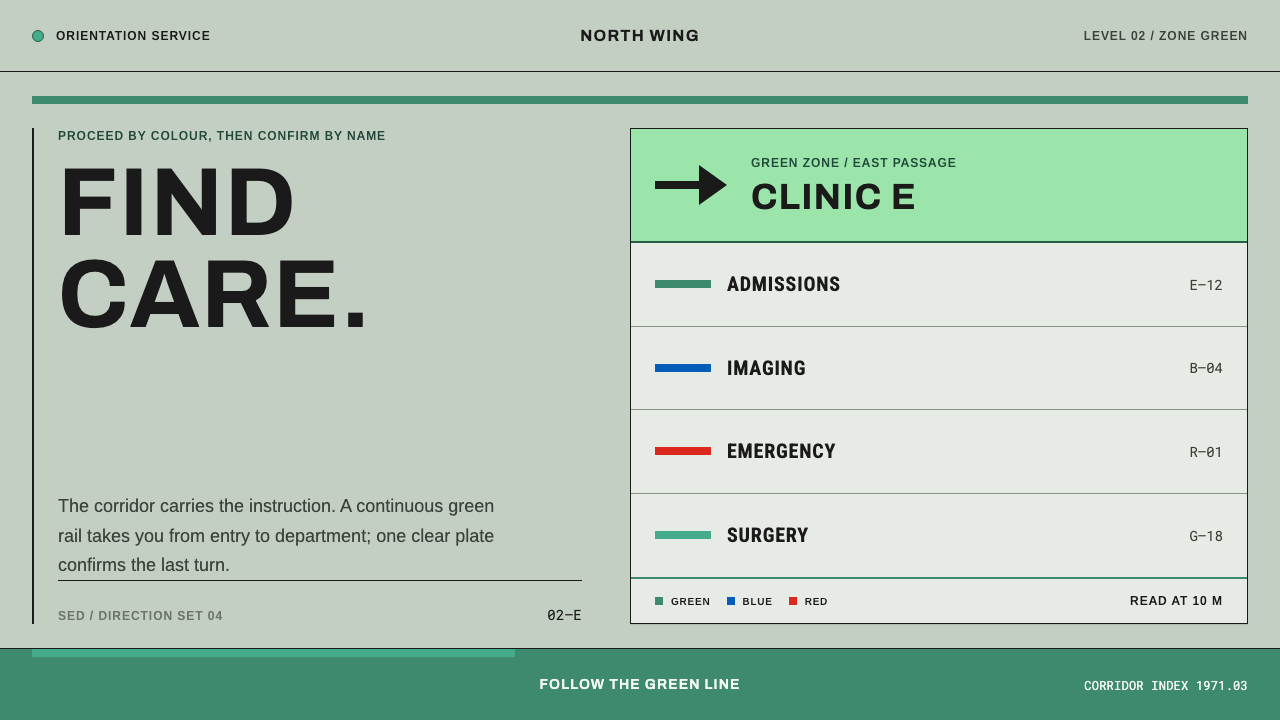 Hospital Wayfinding 1970Colour removes hesitation. Enamel green rails and open grotesque plates lead…
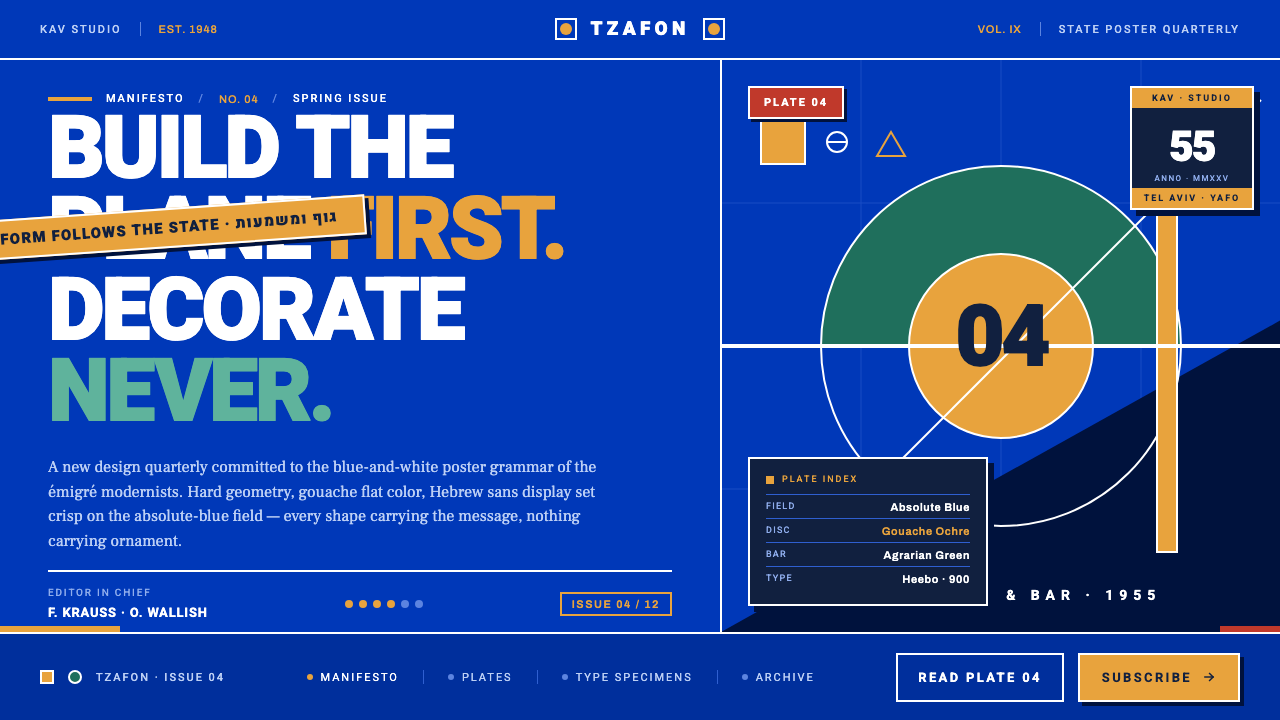 Israeli Bezalel ModernismForm follows the state. Hard Bauhaus discs and ochre bars on absolute blue, H…
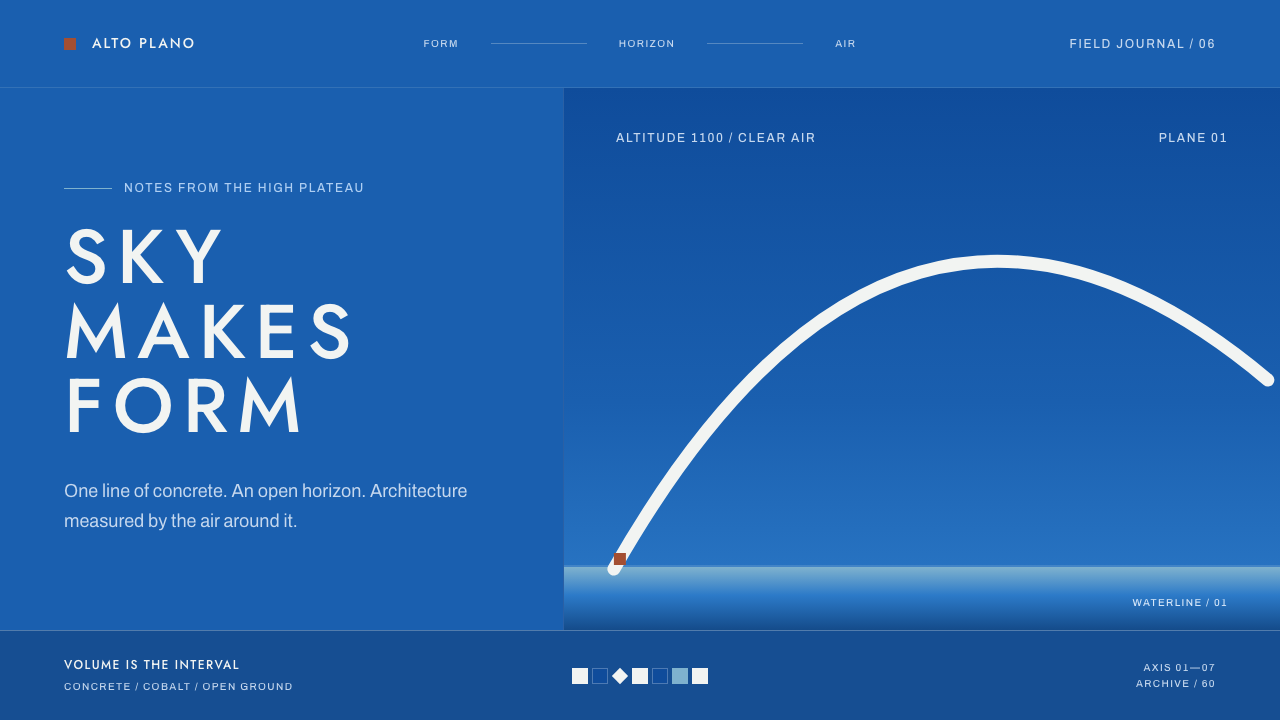 Niemeyer Brasília CurvesEmptiness makes the monument. Concrete-white arcs cut across a saturated coba…
 Sapporo Winter 1972Icy order, exact and calm. Glacial blue grid, snow-white type, one red sun di…
 Saul Bass CorporateAuthority distilled. Deep blue geometry, tight Inter lockups, and white space…
 Tokyo 1964 (Kamekura)Ceremony reduced to a mark. Crimson disc and gold rings lock to a black axial…