What is Architectural Blueprint?
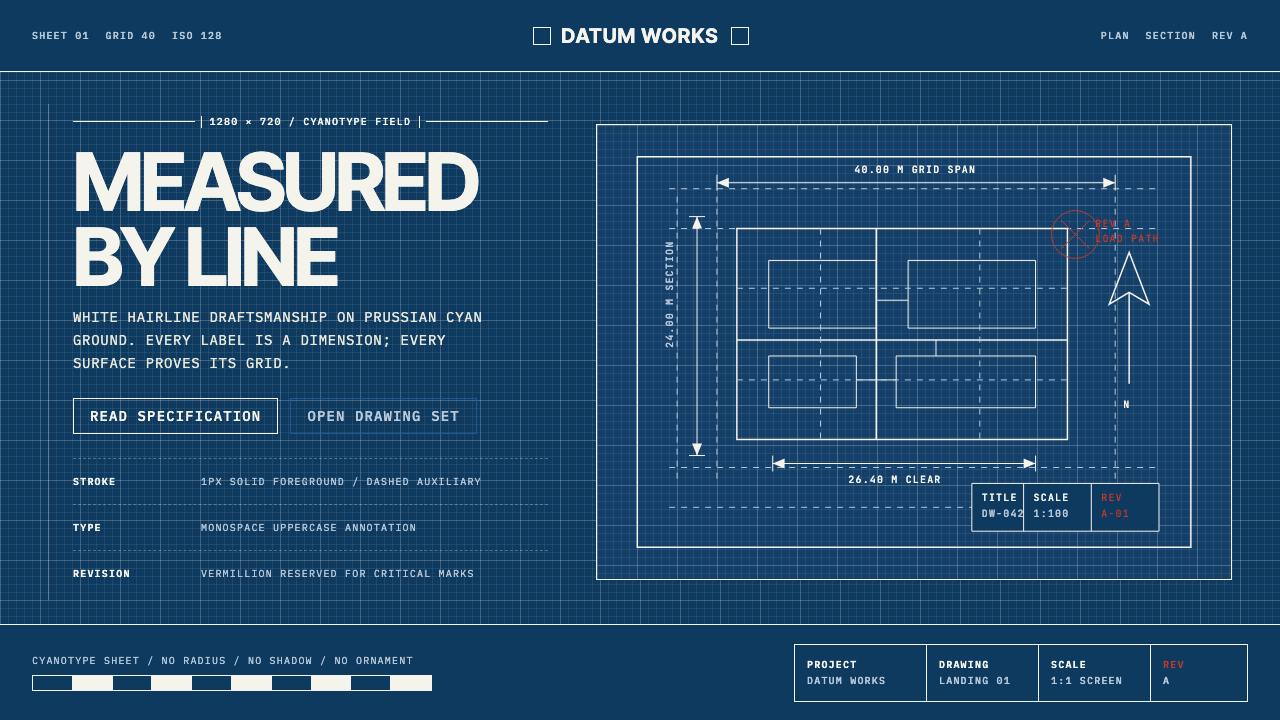
Architectural Blueprint translates the cyanotype drafting table directly into a design system — Prussian-cyan grounds, white hairlines, dimension ticks, and vermillion revision marks, with every stroke treated as a measurement.
Architectural Blueprint in brief
Architectural Blueprint is the aesthetic of technical drafting made into a visual design language. Its foundation is the cyanotype process — the photographic chemistry that gave nineteenth-century engineers a reproducible, high-contrast medium for copying plans. Everything about the visual grammar descends from that original constraint: a deep Prussian-cyan ground that reads as the sensitized paper, white lines that read as the unexposed emulsion, and the strict economy of marks that comes from a discipline where every line must justify its presence.
The system is tonal and binary. Prussian cyan and pure white carry the full weight of composition — there is no warm tone, no ambient gray, no decorative gradient. Vermillion is the sole exception, reserved strictly for revision clouds, correction marks, and critical dimensions, exactly as it appears in the physical practice of architectural mark-up. Zero radius, zero shadow, zero ornament: the visible grid is not a design decision imposed on top of a composition — it is the composition.
This is not a stylized tribute to blueprints. It is the actual typographic and compositional conventions of technical drafting applied at interface scale: hairline weight construction lines, heavier weight object lines, dimension ticks and leaders, north arrows, title blocks in the lower right corner, monospaced uppercase annotation. The discipline demands that every element either measures something or names something — decorative elements have no role.

Where does Architectural Blueprint come from?
The physical basis of Architectural Blueprint is the cyanotype process, invented by the English scientist Sir John Herschel in 1842. Herschel discovered that certain iron salts were sensitive to ultraviolet light and could fix an image when washed in water. The characteristic Prussian-blue tone — named for the iron compound at its chemical heart — was a byproduct of the chemistry, not a design choice. Anna Atkins, a botanist and photographer, immediately recognized the process's value for scientific documentation and used it to produce the first photographically illustrated books, contact-printing algae specimens directly onto the sensitized paper. Engineers and architects soon followed: the cyanotype's high contrast and its resistance to fading made it ideal for reproducing ink drawings at full scale.
By the late nineteenth century, the blueprint had become the universal language of technical drafting. Architectural and engineering offices across Europe and North America maintained blueprint rooms — darkrooms equipped with UV-exposure frames where draftsmen's original linen or vellum drawings were contact-printed and reproduced in quantity. The conventions that evolved in this medium — the specific hierarchy of line weights, the standardized symbols for doors, windows, stairs, and sections, the title block format in the lower right corner, the revision cloud — were not aesthetic decisions. They were functional protocols agreed upon across the profession so that a drawing produced in one office could be read unambiguously in another.
The Bauhaus and its contemporaries — above all Mies van der Rohe and Le Corbusier — elevated technical drawing to a form of architecture in itself. Mies's plans for the Barcelona Pavilion and the Farnsworth House are not merely construction documents: they are compositions in which the precision of the line communicates the absolute control of the spatial idea. Le Corbusier's purism extended to his drawing hand; his section drawings of the Villa Savoye demonstrate that a correctly-weighted line in the right position can carry the full architectural argument without perspective illusion. The technical drawing became a statement of ideology — precision as the visible signature of rational modernism.
The digital era did not replace the blueprint aesthetic; it intensified its influence. When computer-aided drafting software arrived in the late 1970s and early 1980s, it was calibrated to the conventions of hand drafting — layers, line weights, annotation styles, title blocks. The visual language of technical drawing entered screen design as a literal interface: early CAD software used cyan-on-black precisely because that palette preserved the perceptual contrast of the cyanotype print on a low-resolution monitor. Contemporary applications of the blueprint aesthetic — in product design presentations, engineering documentation, and architectural portfolio work — return to these conventions not as nostalgia but as a claim: this is measurement, not decoration.
What defines the Architectural Blueprint look?
Ground and Tone
The foundational color is a deep, saturated Prussian cyan — the exact hue of the developed cyanotype print, which sits between a navy and a true cyan without leaning toward either. This is a dark-mode system by definition: white carries all the informational load, and the cyan ground is the field against which every element reads. There is no light mode equivalent; inverting the palette produces something different in kind, not merely in polarity.
Line Hierarchy
Technical drafting assigns meaning to line weight with the same rigor that typography assigns meaning to type size. Construction lines — used to establish geometry before the final drawing — are drawn as hairlines, the thinnest marks the medium can produce. Object lines defining walls, edges, and primary forms carry a heavier weight. Dimension lines and leaders are lighter than object lines but heavier than construction lines. This three-tier hierarchy is not a visual preference; it is a professional convention that allows any trained reader to parse the drawing instantly.
Annotation and Typography
All text in a technical drawing is set in monospaced uppercase — the letterforms that produce the most legible annotation when written by hand with a technical pen, and the forms that early typesetters and plotters could reproduce most reliably. In a design system derived from blueprints, this convention carries forward: labels, callouts, dimension numerals, and section tags are all monospaced and capitalized. No script, no display serif, no mixed case in structural labels. The only typographic variation is scale — a room label in large monospaced capitals versus a tolerance note in small monospaced capitals.
Grid as Composition
The drafting grid is not a background element — it is the primary organizational force. In blueprint-derived design, the visible grid is part of the finished composition, not a scaffold to be removed before delivery. Grid intersections anchor dimension marks. Grid lines at module intervals establish the underlying proportional system. The act of making the grid visible is itself a statement: this layout was not intuited, it was measured. The grid should be regular, fine-pitched, and maintained at a consistent weight — neither so light it disappears nor so heavy it competes with object lines.
Dimension and Annotation Marks
Dimension lines with terminal ticks or arrowheads, extension lines running perpendicular to the measured element, leaders connecting callout text to the annotated feature — these are not decorative devices. In blueprint-derived design, they function as both navigation and hierarchy tools: a dimension string along the edge of a diagram directs the eye along the measurement axis; a leader forces the reader to connect label to element. North arrows, scale bars, and revision triangles from physical drafting practice all translate into interface conventions that communicate the same things — orientation, proportion, and change history.
Vermillion as Signal Color
In the physical practice of architectural mark-up, a red pencil or red pen on a blueprint signals human intervention — a correction, a query, a critical measurement that cannot be ignored. Vermillion (a saturated warm red) is the only color permitted in a blueprint system outside of Prussian cyan and white, and it is strictly functional: it marks revisions, highlights critical dimensions, and flags errors or unresolved conditions. It is never used for decoration, hierarchy alone, or brand differentiation. Its power comes entirely from restraint — if everything is red, nothing is.
Title Block and Metadata Frame
The title block — a structured rectangular zone in the lower right corner of every technical drawing — records the document's identity: project name, drawing number, scale, revision history, date, and the names of the drafter and checker. It is a formal metadata container, and in blueprint-derived design systems it translates into a persistent information zone: a footer or sidebar that carries authorship, version, and context data independently of the main content area. The title block's formality communicates that this document has a provenance, a revision history, and a responsible party — claims that are the aesthetic opposite of anonymous or provisional.

Who shaped Architectural Blueprint?
Herschel invented the cyanotype process in 1842, discovering that iron salts sensitized with potassium ferricyanide would produce a stable Prussian-blue image when exposed to ultraviolet light and washed in water. Although trained as an astronomer and mathematician, Herschel was instrumental in the early development of photography: he coined the terms 'photography,' 'negative,' and 'positive,' and his cyanotype invention gave engineers and architects a reproducible, durable, and inexpensive method for copying technical drawings. The specific visual character of the blueprint — its deep cyan ground and white lines — is a direct consequence of his chemistry.
Mies van der Rohe's contribution to the blueprint aesthetic is architectural in the most literal sense: his precision plans and sections — for the Barcelona Pavilion, the Farnsworth House, the Illinois Institute of Technology campus — demonstrate that a technical drawing can simultaneously function as a construction document and as a composition of extraordinary spatial intelligence. Mies's maxim 'less is more' is perfectly legible in his drafting practice: every line in his drawings carries structural necessity. As director of the Bauhaus from 1930 and later as a central figure of the Chicago modernist scene, he established precision of execution as the primary value of architectural design.
Le Corbusier's Purist aesthetic extended from his paintings to his technical drawings: both operated on the principle that a correctly-proportioned, correctly-positioned element required no further justification. His section drawings — most famously of the Villa Savoye and Unité d'Habitation — are studies in line-weight discipline, where the thickness of a line communicates whether an element is cut, visible, or implied. Le Corbusier's Modulor proportional system formalized the relationship between human scale and architectural measurement, making the act of dimensioning a drawing a philosophical statement about the relationship between the body and the built environment.
Wright's relationship to the blueprint aesthetic is more complicated than Mies's or Corbusier's: his drafting style was expressive, his line work was precise but not arid, and his color sense extended to his presentation drawings, which used warm earth tones that the standard cyanotype medium could not reproduce. But Wright's contribution to blueprint culture was pedagogical: the Taliesin Fellowship that he established in 1932 trained apprentice architects through comprehensive drawing — not just design, but the full discipline of measured, annotated, reproducible documentation. Wright demonstrated that precision drawing and organic architecture were not contradictions.
Atkins was the first person to recognize that Herschel's cyanotype process had systematic documentary value. Beginning in 1843, she used the process to produce 'British Algae: Cyanotype Impressions,' the first book to be illustrated with photographic images rather than hand-drawn plates. Each image was made by placing a dried algae specimen directly on sensitized paper and exposing it to sunlight — a technique called photogram or photogenic drawing — producing a white silhouette on a Prussian-blue ground. Atkins established the core visual logic of the blueprint before it was applied to architecture: white form reading against a cyan field, maximum contrast, no tonal graduation.
How do you use Architectural Blueprint today?
Architectural Blueprint's visual authority comes from its strict adherence to drafting conventions. Applying it well means understanding that every element must earn its place by measuring or naming something — aesthetic decoration has no role. When this discipline is maintained, the style reads as precise, authoritative, and trustworthy. When it breaks down — when decorative elements are added, when the color system is violated, when the grid is ignored — the result is neither blueprint nor design, but costume.
For presentation slides, the style is particularly effective on technical documentation decks, engineering proposals, and architectural portfolios. A cover slide should use the full Prussian-cyan ground, white headline type in monospaced uppercase, and a single framing element — a title block in the lower right, a thin white border rule at the margins, or a dimension-tick motif that echoes the subject matter. Content slides should treat data as plans: diagrams are orthographic, labels are in monospaced uppercase callouts with leaders, and the grid is always visible underneath. Data slides gain the most from the convention of dimension strings — place measurement values outside the chart area as if annotating a section drawing, rather than labeling bars directly.
For web interfaces, Architectural Blueprint is best suited to technical platforms, developer tools, engineering dashboards, and any product where the message is precision and measurability. Implement the dark Prussian-cyan background at full depth, use white for all primary text and interactive elements, and reserve vermillion strictly for alerts, error states, and critical action prompts. Navigation components benefit from the title-block convention: a persistent sidebar or header that carries version number, build status, and identity information independently of the main content. Input fields and containers should be hard-bordered in white, with no soft shadow — the line is the boundary, not a suggestion of depth.
For editorial and marketing contexts, the style is most powerful when the subject matter directly connects to engineering, architecture, technical specification, or scientific measurement. A product specification sheet, a technical announcement poster, or a data-journalism article about infrastructure can all carry the full blueprint vocabulary. Use the grid visibly, let dimension lines annotate the layout itself, set pull quotes in monospaced uppercase as if they were construction notes. For marketing pages aimed at technical buyers — developer tools, infrastructure products, scientific instruments — the blueprint aesthetic signals that the maker understands precision and takes specification seriously.
The most common mistake when applying Architectural Blueprint is treating it as a color theme rather than a system. Adding the Prussian-cyan ground and white type while continuing to use rounded corners, soft shadows, gradient fills, and decorative illustration produces a hybrid that satisfies neither the blueprint's logic nor contemporary interface expectations. The system requires commitment to its orthographic principles: hard borders, right angles, a visible grid, monospaced uppercase annotation, and the complete absence of decorative elements. The vermillion accent is particularly prone to overuse — if it appears more than three or four times on a screen, it has lost its signaling function. Restraint is not a stylistic preference here; it is a structural requirement.

Architectural Blueprint — FAQ
Is Architectural Blueprint only suitable for dark-mode interfaces?
The canonical form of the style is dark: Prussian cyan is the ground, white is the figure. This is not a stylistic preference but a historical and perceptual fact — the cyanotype process produces a dark ground, and the visual logic of the style depends on white reading as light against that depth. A light-mode variant is possible but requires rethinking the system from its foundations: inverting to white ground with cyan lines produces something closer to a schematic diagram or a modern CAD line drawing, which is a related but distinct visual register. If your context requires a light interface, consider whether a schematic-diagram system serves better, and if you do adapt Blueprint to light mode, treat it as a distinct palette with its own rules rather than a simple color swap.
Can the Blueprint style incorporate photography or illustration?
Photography is difficult to integrate authentically, because photographic tonality — especially skin tones, organic textures, and naturalistic color — directly contradicts the binary logic of the blueprint system. If photography is necessary, the appropriate treatment is to convert it to a high-contrast duotone using only the system's two colors, or to silhouette the subject against the cyan ground as if it were a photogram. Illustration works better when it is completely orthographic: isometric projections, exploded diagrams, schematic cross-sections. Any illustration that uses perspective projection, soft shading, or naturalistic color will create a tonal conflict with the blueprint ground. The system's strength lies in its consistency — one element that violates the orthographic principle undermines the whole.
How do you handle color when you need more than cyan, white, and vermillion?
The short answer is: you should not need more than three colors if the system is applied correctly. The blueprint palette's power comes from its constraint — every color in the system carries a specific and exclusive function, and adding a fourth color dilutes all three. If your use case genuinely requires additional differentiation — for example, multi-team revision marks or a multi-series data chart — the correct approach is to vary the weight, dash pattern, or opacity of white lines rather than introducing new hues. If a color distinction is truly unavoidable, the historically grounded option is to choose from the limited set of colors that appeared in actual drafting practice: yellow for highlight, green for existing conditions versus proposed conditions. These additions should be as rare and functional as vermillion itself.
Is Blueprint suitable for consumer-facing products, or is it too technical?
Blueprint's severity is a feature in some consumer contexts and a liability in others. It communicates precision, expertise, and uncompromising standards — qualities that resonate with technically sophisticated audiences and with consumers who want assurance that a product has been engineered rather than merely styled. Architecture, engineering, industrial equipment, scientific instruments, professional software, and developer tools are all natural homes for the style. It struggles in contexts that depend on warmth, accessibility, or sensory pleasure: food, personal wellness, children's education, casual social products, and any interface where the primary emotional cue should be invitation rather than authority. The deciding question is whether the product's core value claim is precision and competence or warmth and ease — Blueprint serves the former powerfully and the latter poorly.
What distinguishes Architectural Blueprint from general dark-mode design?
General dark-mode design uses a dark background to reduce eye strain, improve perceived contrast, and align with user preference — the color of that background is typically a near-black or very dark gray chosen for neutral readability. Architectural Blueprint uses Prussian cyan as its ground for a specific historical and semantic reason: it is the color of the cyanotype process, and it carries the meaning of technical documentation. The distinction extends beyond color: Blueprint requires monospaced uppercase type, orthographic composition, a visible grid, dimension-line conventions, and the functional use of vermillion as the sole accent. A product can be dark-mode without any of these commitments; Blueprint requires all of them simultaneously. The style is not a dark-mode option — it is a complete semiotic system with its own grammar.
Related design styles
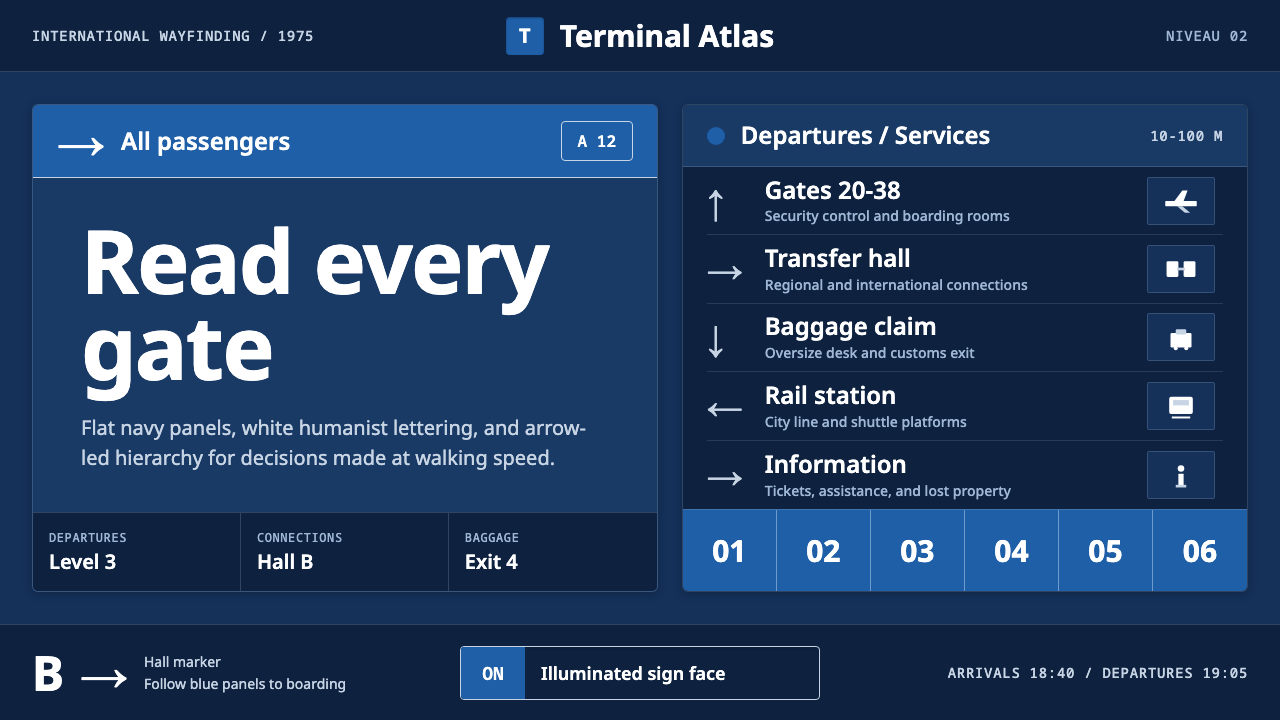 Frutiger CDG AirportLegibility at runway scale. Navy panels, white humanist sans, arrow-led grids.
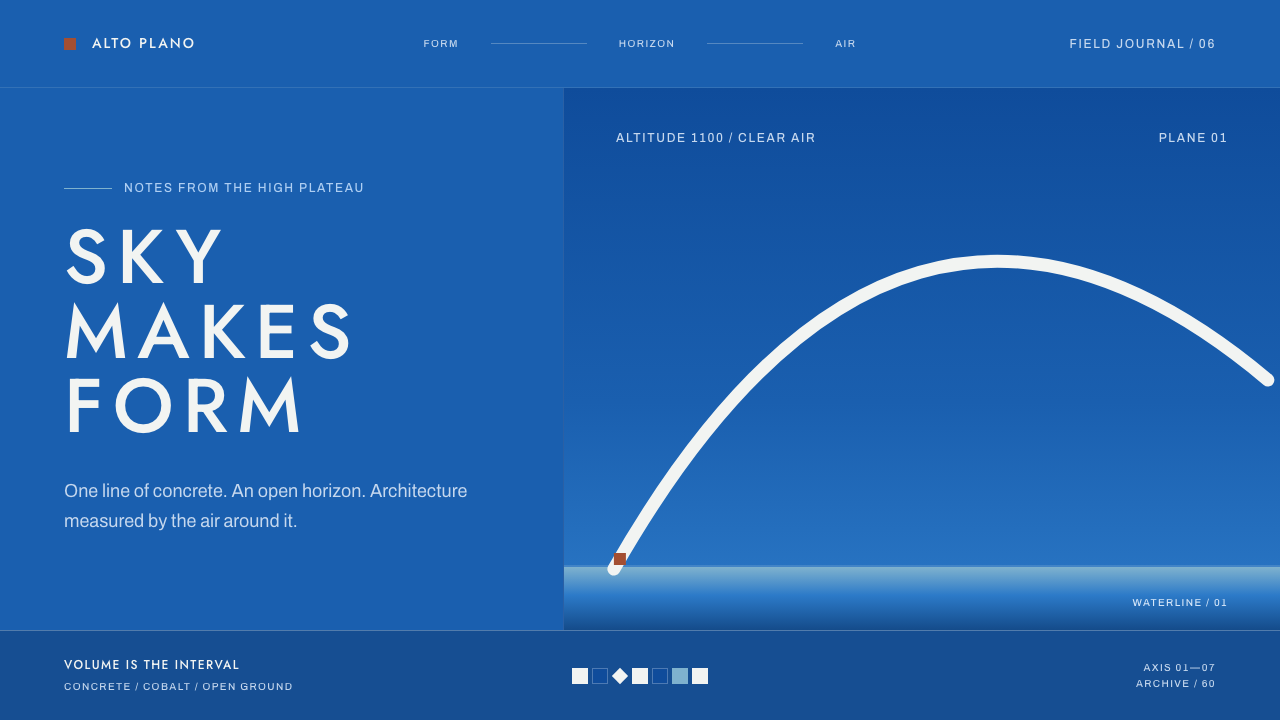 Niemeyer Brasília CurvesEmptiness makes the monument. Concrete-white arcs cut across a saturated coba…
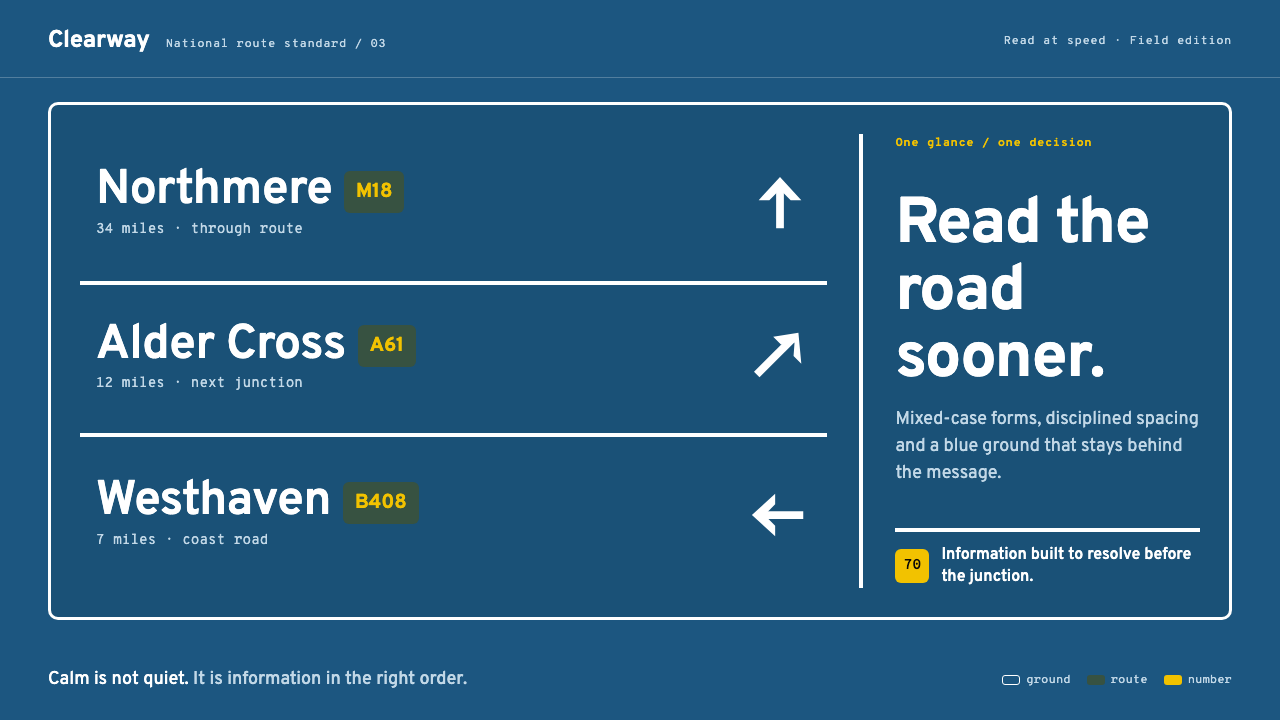 Transport UK Road SignsClarity at seventy. White mixed-case lettering advances across recessive moto…
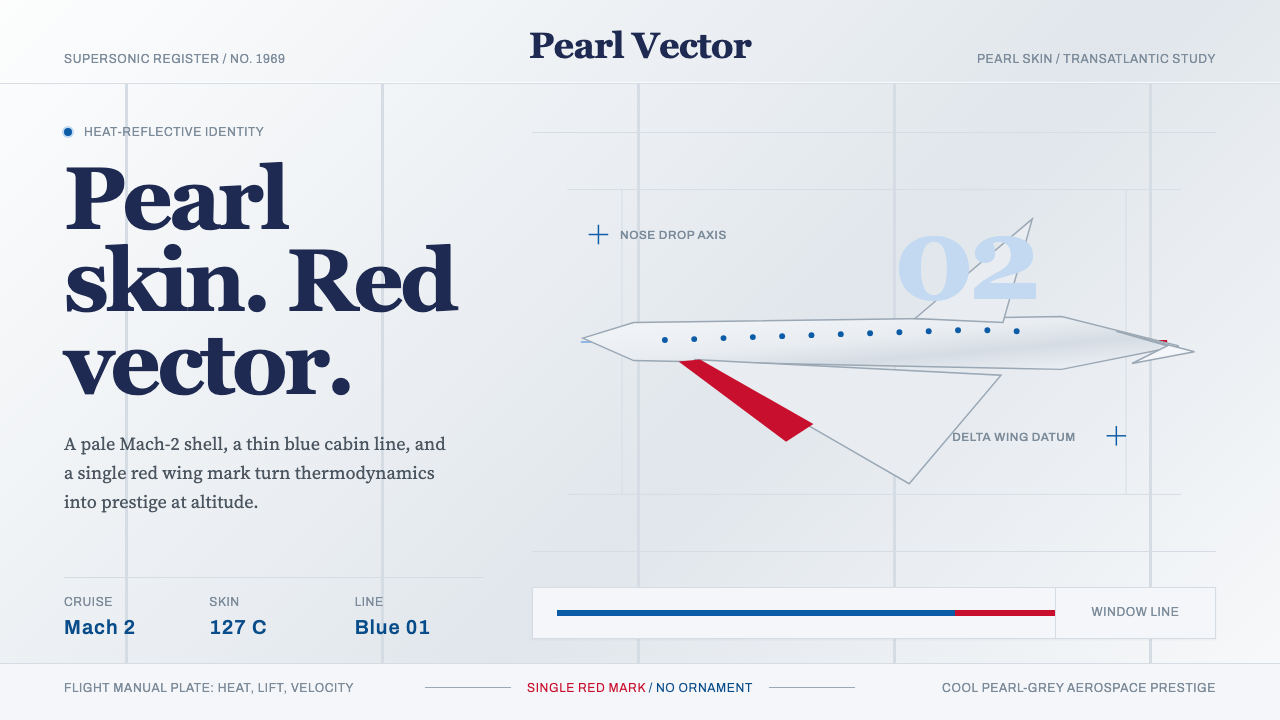 Concorde SupersonicPhysics made prestige. Pearl grey, sky-blue window line, and one red wing vec…
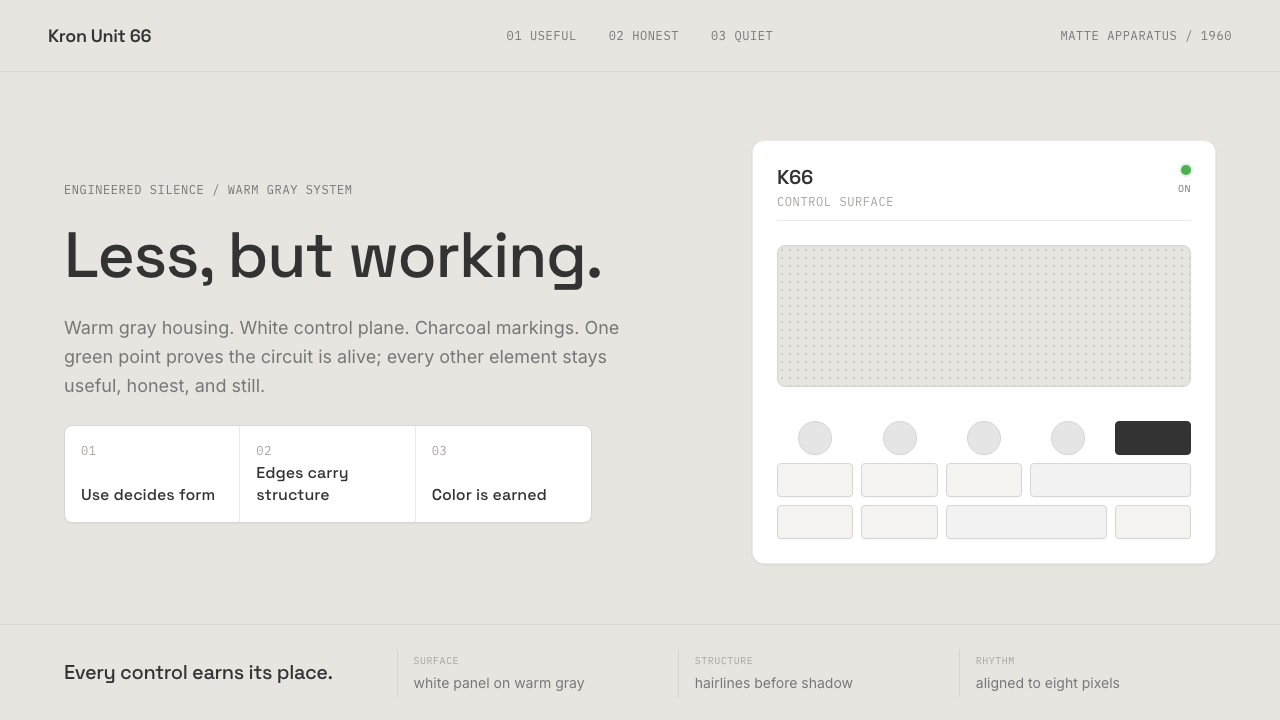 Dieter Rams / BraunQuiet by design. Warm gray, white panels, hairline grids, and one earned gree…
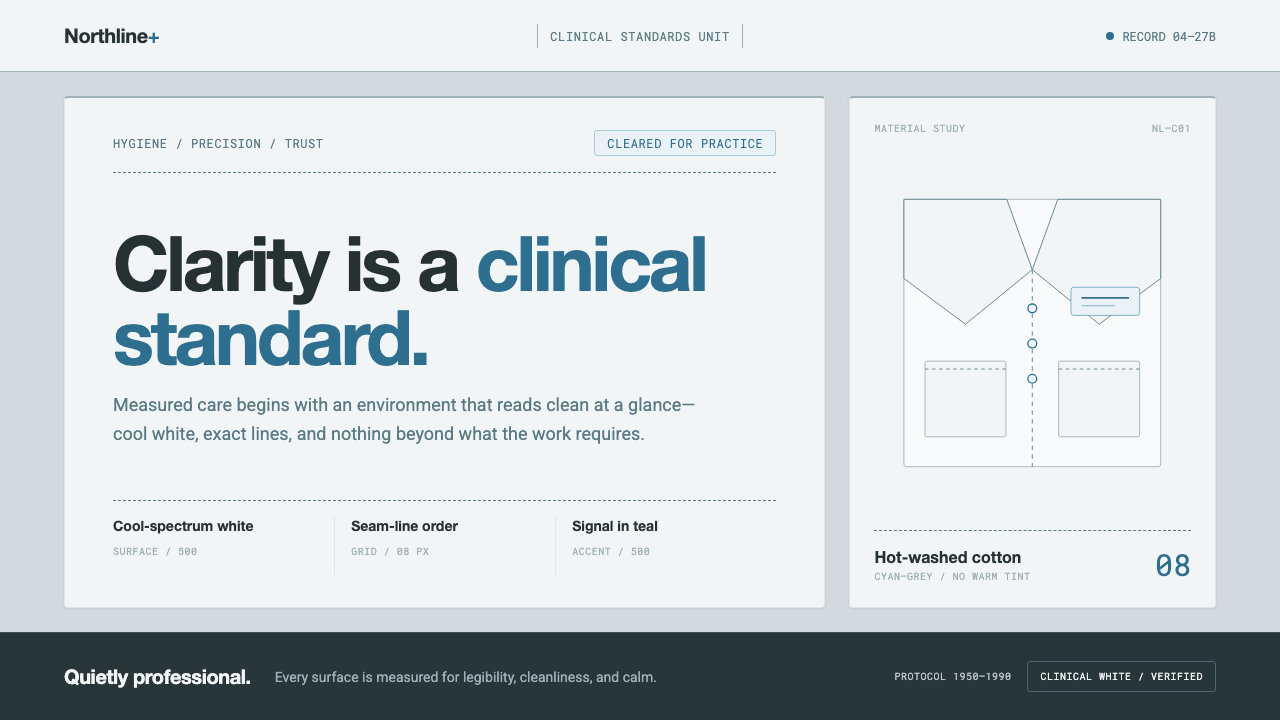 Doctor's Clinical Lab CoatSterile by design. Cool clinical white, teal signals, and seam-line grids enf…