What is Saul Bass Corporate?
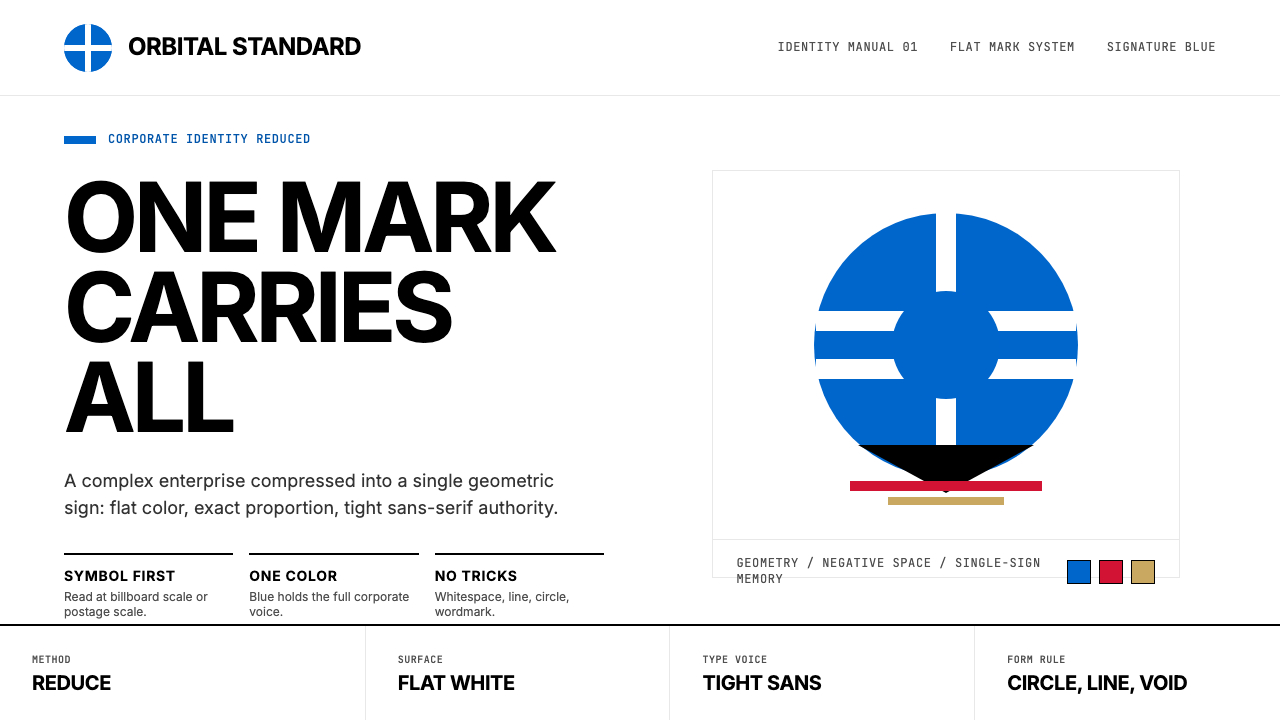
Saul Bass proved that a corporation's entire identity could live in a single geometric shape — and that shape could be unforgettable.
Saul Bass Corporate in brief
Saul Bass Corporate is the visual system distilled from the identity work Saul Bass produced between the early 1950s and the mid-1990s, the era when American corporations first understood that a logo was a strategic asset rather than a decorative monogram. The system is built around a single discipline: reduce every enterprise — no matter how sprawling — to one geometric mark, then surround that mark with enough white space and typographic restraint that nothing can compete with it.
The palette anchors in deep, authoritative blue, used at near-maximum saturation and paired with clean white grounds. Black handles all typographic weight. Color functions as identity signal rather than decoration: one hue, sometimes two, applied flatly and without graduation. The type sensibility is rooted in mid-century Helvetica-era sans-serifs — mechanical, confident, set tightly against the mark. The result reads simultaneously as institutional authority and quiet modernist elegance.
What separates this system from generic modernism is its commitment to symbol over description. Bass never illustrated what a company did; he found the geometric essence of what a company was. The AT&T globe suggested worldwide reach without depicting a telephone. The Bell System bell was a bell — simple, immediate, owned. This philosophy of visual compression, symbol-first and stripped of narrative decoration, is the defining character of the style.

Where does Saul Bass Corporate come from?
Saul Bass was born in the Bronx in 1920 and trained under György Kepes at Brooklyn College, where he absorbed the post-Bauhaus visual grammar that Kepes and László Moholy-Nagy had carried from Central Europe to American design education. By the time Bass opened his Los Angeles studio in 1952, he had internalized a European modernist conviction — that design was a form of visual thinking, not beautification — and was ready to apply it to the American corporate landscape, which was just beginning to understand that mass communication required consistent visual identity.
His first major landmark was the 1954 identity for Kelton Corporation, but the work that established his reputation was a series of film title sequences beginning with Carmen Jones in 1954 and accelerating through The Man with the Golden Arm (1955), Vertigo (1958), and Psycho (1960). These sequences demonstrated that a purely geometric vocabulary — animated bars, spirals, fragmented type — could carry narrative tension and psychological weight without a single representational image. The same formal discipline Bass applied to film titles he then carried directly into corporate identity.
The peak corporate-identity era ran from approximately 1968 through 1985. In 1969 Bass redesigned the Bell System identity, replacing an older bell illustration with a cleaner, bolder geometric version that held at every scale from business card to interstate highway billboard. In 1973 he created the continental mark for United Airlines — a geometric tulip that suggested flight and organic life simultaneously. In 1983 he designed the AT&T globe for the post-divestiture era: a spherical grid of lines that implied worldwide telecommunications reach. Each project applied the same method: weeks of reduction, stripping away every line until only the irreducible symbol remained.
Elaine Bass, his wife and long-time collaborator, played a central role in this body of work that historical accounts underrepresented for decades. From the early 1970s onward she co-directed the studio's film title work and shaped the conceptual approach to several corporate projects. The firm's late work — including the Quaker Oats redesign and several pharmaceutical identities from the late 1980s and early 1990s — bears her equal influence. Herb Lubalin, working in New York during the same era, extended related principles into typographic identity systems, and his work provides a useful parallel: where Bass found the symbol, Lubalin found the letterform-as-mark.
The movement Bass represented — mid-century American corporate modernism — reached its zenith at the precise moment when American corporations were becoming genuinely global and needed marks that would function across languages, cultures, and scales. A Bass mark worked in newspaper advertising, on the side of a Boeing 747, in a black-and-white television commercial, and as a vinyl floor decal in a retail location. This cross-media resilience was not accidental; it was the direct consequence of the geometric reduction principle. Shapes that can be drawn with a compass and a straightedge reproduce cleanly at any size in any medium.
What defines the Saul Bass Corporate look?
Deep Blue Primacy
The signature color is a deep, cool blue used at near-maximum saturation — dense enough to carry institutional weight, controlled enough to avoid aggression. This blue functions as the primary identity anchor: it appears in the mark itself, in headlines, and in key structural elements. It is almost never diluted to a pale tint for backgrounds or gradated through a range. White provides the counterweight, giving the blue room to register with full force against a clean ground.
Geometric Symbol-Mark
The central visual object is always a closed geometric form — a globe, a bell, a tulip resolved into geometric arcs, a sphere of intersecting lines. The mark is never an illustration of what the company does; it is a symbolic compression of what the company is. Lines are reduced to the minimum number needed for immediate recognition. Every curve is purposeful, every angle considered. The mark functions equally well at the size of a postage stamp and the size of a building facade.
Helvetica-Weight Sans-Serif Discipline
Type is set in a mechanically clean, mid-weight sans-serif that neither competes with the mark nor retreats from it. The relationship between mark and logotype is precisely calibrated: the company name sits below or beside the symbol at a size that asserts it clearly without demanding equal visual attention. Lettering is tracked tightly — white space is a resource concentrated in the surrounding field, not distributed through the wordmark. Headlines and body text use scale contrast rather than decorative differentiation to establish hierarchy.
Generous White Space
The mark is never crowded. Substantial clear space — proportional to the mark's own size — is maintained on all sides, treating the empty field not as unused area but as an active compositional element that amplifies the symbol's presence. This spatial discipline extends to page and screen layouts: content is never packed edge-to-edge; margins are wide and deliberate. The effect is one of confidence — a mark that does not need to fill space to be heard.
Flat Rendering Without Depth Effects
Marks are rendered as flat vector shapes, with no gradients, no drop shadows, no embossing, and no three-dimensional simulation. Each element is a solid field of color or an absence of color. This flatness is not a technical limitation but a philosophical position: the mark's power comes from its shape, and any depth effect would dilute that shape's authority by introducing a secondary reading — the simulation of light. Flat rendering also ensures perfect reproduction across every medium, from printing in a single ink to embossing on a metal plaque.
Structural Minimalism
The overall system vocabulary is deliberately restricted. A complete identity system might consist of a mark, a logotype, a single primary color, and one typographic family — nothing more. Decorative elements, illustrative accents, pattern backgrounds, and secondary iconography are absent by principle. This restriction is not perceived as scarcity; when applied correctly it registers as authority. The restraint signals that the organization behind the mark is confident enough not to require visual noise to assert its presence.
Cross-Media Scale Invariance
Every element in a Bass-derived identity is designed to hold its integrity at radically different scales simultaneously. The mark that appears on a business card must be identical in character to the mark on an airplane fuselage. This requirement drives every reduction decision: if a detail cannot survive reproduction at the smallest intended size, it is removed. The resulting marks tend toward bold geometries with thick-to-medium stroke weights and clear interior white space — forms that resist the degradation of printing imprecision, low-resolution screens, and long viewing distances.

Who shaped Saul Bass Corporate?
Bass (1920–1996) built one of the most consequential bodies of corporate-identity work in American design history, shaping the visual face of AT&T, the Bell System, United Airlines, Continental Airlines, Quaker Oats, Minolta, and dozens of other major enterprises. His parallel career in Hollywood — designing title sequences for Alfred Hitchcock, Otto Preminger, Martin Scorsese, and Steven Spielberg — gave him an unusually deep understanding of how moving images and static marks operate on human attention. His conviction that a logo must work as a symbol, not a description, defined mid-century American corporate modernism and continues to influence every subsequent generation of identity designers.
Elaine Bass (1927–2004) was Saul's wife and studio partner whose contribution to the Bass body of work was systematically underacknowledged during both their lifetimes and afterward. From the 1970s onward she co-directed every film title sequence the studio produced and was a primary collaborator on multiple corporate identity projects. Her work brought a refined attention to pacing, proportion, and the emotional register of geometric forms that shaped the studio's mature style. Reassessment of her role has grown significantly among design historians since the 2010s.
Lubalin (1918–1981) worked in New York during the same era as Bass and pursued a parallel but distinct approach to corporate identity: where Bass built marks from pure geometric symbol-forms, Lubalin built marks from letterforms pushed to their geometric extreme. His work for the International Typeface Corporation and publications such as Avant Garde demonstrated that typography itself could function as identity, with letters locked, overlapped, and compressed into singular visual objects. The two bodies of work together define the outer boundaries of mid-century American corporate modernism.
Kepes (1906–2001), a Hungarian-born designer and theorist who studied under Moholy-Nagy at the Bauhaus, taught at Brooklyn College where Bass was his student, and later founded the Center for Advanced Visual Studies at MIT. His 1944 book Language of Vision provided the theoretical framework — borrowed largely from Gestalt psychology — that underpinned Bass's understanding of how geometric forms communicate. Kepes argued that visual communication operated through universal perceptual principles, not cultural conventions, which directly justified the reductive, symbol-first approach Bass developed.
Rand (1914–1996) was Bass's closest contemporary and most instructive parallel. Both trained in the same post-Bauhaus tradition, both produced some of the most enduring American corporate marks of the twentieth century — Rand's IBM striped logo, NeXT cube, and ABC eye are as canonical as Bass's AT&T globe. Where Bass was drawn to pure geometric symbol-forms with organic resonance, Rand favored the integration of letterforms and symbols, often wrapping the company name itself into the mark. Comparing the two bodies of work illuminates the full range of the mid-century American corporate modernist approach.
How do you use Saul Bass Corporate today?
Saul Bass Corporate transfers well to contemporary design precisely because its principles are structural. The system is not a collection of period-specific ornaments to be applied as a surface layer; it is a set of decisions about hierarchy, symbol-making, and spatial economy that are as valid on a digital dashboard as they were on a printed annual report. Applying it correctly requires committing to the core discipline — one dominant mark, one primary color, maximum white space — rather than borrowing visual surface elements selectively.
For presentation slides, the style is particularly effective on cover and section-break pages. A cover should lead with the mark or symbol — large, centered or slightly offset, surrounded by clear space — with the title in a clean, tightly tracked sans-serif below. The deep blue and white relationship should be literal and high-contrast: no translucency, no overlaid texture, no gradient sky. Content slides should apply the same spatial restraint: wide margins, a single organizing type hierarchy, and any iconography reduced to simple geometric indicators rather than illustrative icons. Data slides work best when charts and graphs are treated as geometric objects — bars become rectangles, lines become architectural elements, and color coding uses the primary palette sparingly to signal only the most critical distinctions.
For web UI, the system suits dashboard interfaces, pricing pages, and B2B product pages where institutional credibility and information density need to coexist. The practical approach is to anchor the primary color to interactive elements and key metrics, keep background fields near-white, and use black for all body text. Navigation should be typographic and minimal — logotype plus text links, no icon clusters. Card components should have clean borders rather than soft shadows, and the overall grid should be explicit enough that the geometric alignment of elements reads as intentional structure rather than accident.
For editorial and marketing material, the style supports strong visual hierarchy with poster-like impact. A marketing page laid out in this system alternates full-width blocks between white-ground and deep-blue-ground sections, with the primary color used consistently for calls to action and key pull quotes. Editorial layouts use a wide margin column for callouts or metadata and a controlled measure for body text, with horizontal rules rather than ornamental dividers marking section breaks. The style is especially well-suited to annual reports, product launch decks, and institutional communications where the audience expects seriousness and precision.
The most common mistake when applying this system is treating the deep blue as one element within a broader decorative palette, rather than as the entire identity anchor. Bass-derived work succeeds when the blue is used with the same discipline as a corporate logo color — appearing consistently, at full saturation, in the same role across every touchpoint. A second common error is softening the white space to accommodate more content: every concession to density reduces the authority the style generates. When the system starts to feel too spare, that is a signal to remove more elements, not add them.

Saul Bass Corporate — FAQ
How is Saul Bass Corporate different from Swiss International Style?
Both descend from the same post-Bauhaus tradition, but their priorities diverge clearly. Swiss International Style, as developed by Armin Hofmann and Josef Müller-Brockmann in the 1950s and 1960s, is primarily concerned with typographic systems — the mathematical grid, the modular type scale, the photographic grid — and uses a broader range of colors, including photography treated as a compositional element. Saul Bass Corporate is symbol-first: the identity lives entirely in one geometric mark, and everything else — type, color, space — serves that mark. Swiss Style produces rigorous page systems; Bass produces singular icons. A Swiss-derived layout looks systematic; a Bass-derived one looks authoritative.
Can this style work for a startup or small brand, or does it only suit large corporations?
The style originated with large corporations, but its principles suit any brand that wants to project authority, precision, and confidence — regardless of size. A startup in fintech, legal technology, or B2B infrastructure can benefit from the same visual discipline that made AT&T and United Airlines instantly recognizable. The key is commitment: the style only works when the mark is genuinely reduced, the color is genuinely restrained, and the white space is genuinely maintained. A small brand that applies the full system with discipline will read as more established than it is; one that applies it halfway will look merely cold.
What is the right way to handle color in a digital interface without undermining the system?
The discipline is to treat the deep blue as a single identity color, not as part of a multi-color palette. In a digital UI, the primary color should appear in the most important interactive elements — primary buttons, active navigation states, key metric highlights — and nowhere else. Secondary and tertiary UI elements should be handled in grays and neutrals derived from the main white-to-black range. When a second accent color is genuinely needed, it should contrast with the primary blue rather than harmonize with it, and its role should be strictly functional — success states, warnings, destructive actions — rather than decorative.
How do I avoid the style reading as cold or unapproachable?
The severity of the style is a feature in contexts that call for institutional seriousness, but it can become a liability in consumer-facing or emotionally sensitive contexts. The most effective mitigation is generous white space — paradoxically, adding more breathing room around elements reads as more inviting than filling space with softer decorative elements. A second approach is to ensure the geometric mark itself has a quality of resolution and elegance rather than blunt geometry. Bass's best marks — the AT&T globe, the United tulip — are not cold; they are precise and finished, which is a different register. The coldness problem usually arises when the style is applied incompletely, with the austerity but without the spatial generosity or the formal quality of the mark.
Does this style work in dark mode or on dark backgrounds?
The canonical Saul Bass Corporate palette is light-ground — white or near-white backgrounds against which the deep blue mark registers at full force. A dark inversion is structurally possible but requires careful recalibration. On a very dark background, the deep blue mark tends to lose contrast and read as recessive; reversing to a white or light-toned mark on a dark-blue field is the more structurally consistent approach. A black background with a white mark and a single accent of the primary blue can also work well. What does not work is applying the light-ground system directly to a dark UI without adjustment — the proportional relationships between mark weight, color saturation, and spatial field all shift when the background luminosity changes.
Related design styles
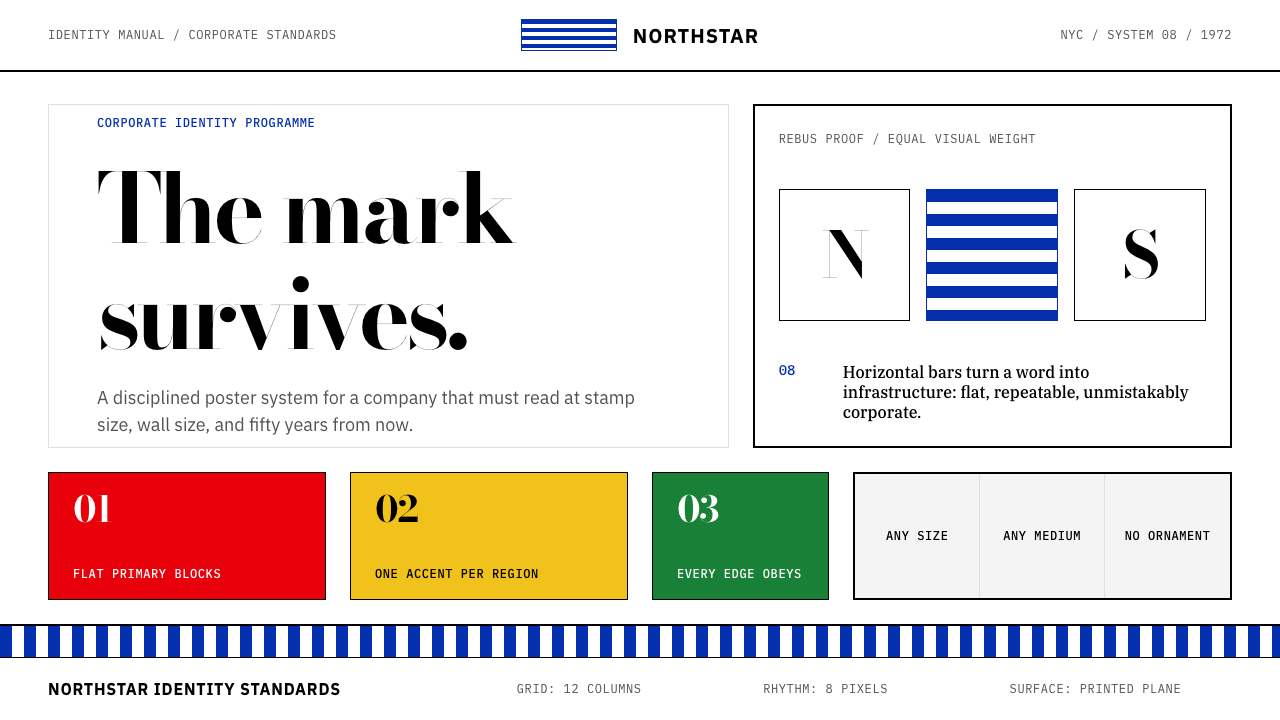 Paul Rand / IBM Corporate IdentityCorporate modernism stays exact. Blue 8-bar stripes, high-contrast serif, har…
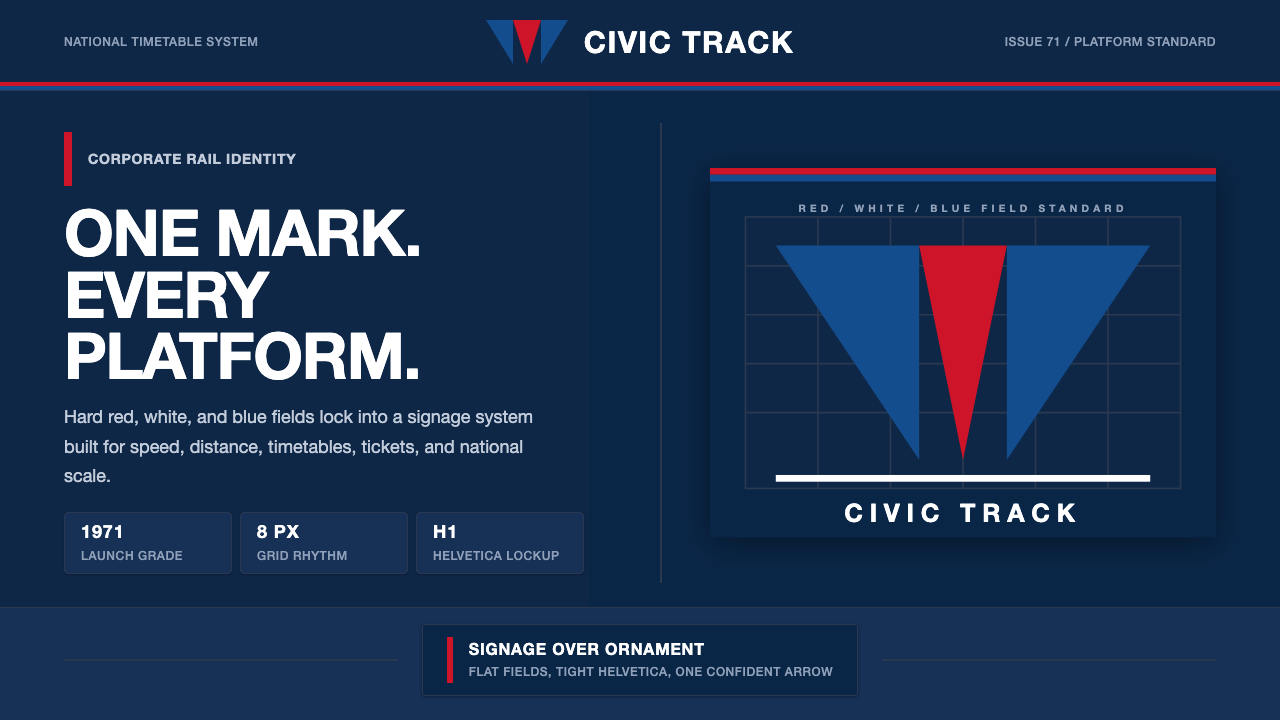 Amtrak Arrow (1971)Civic authority at speed. Deep navy, Helvetica lockups, and red-blue arrows.
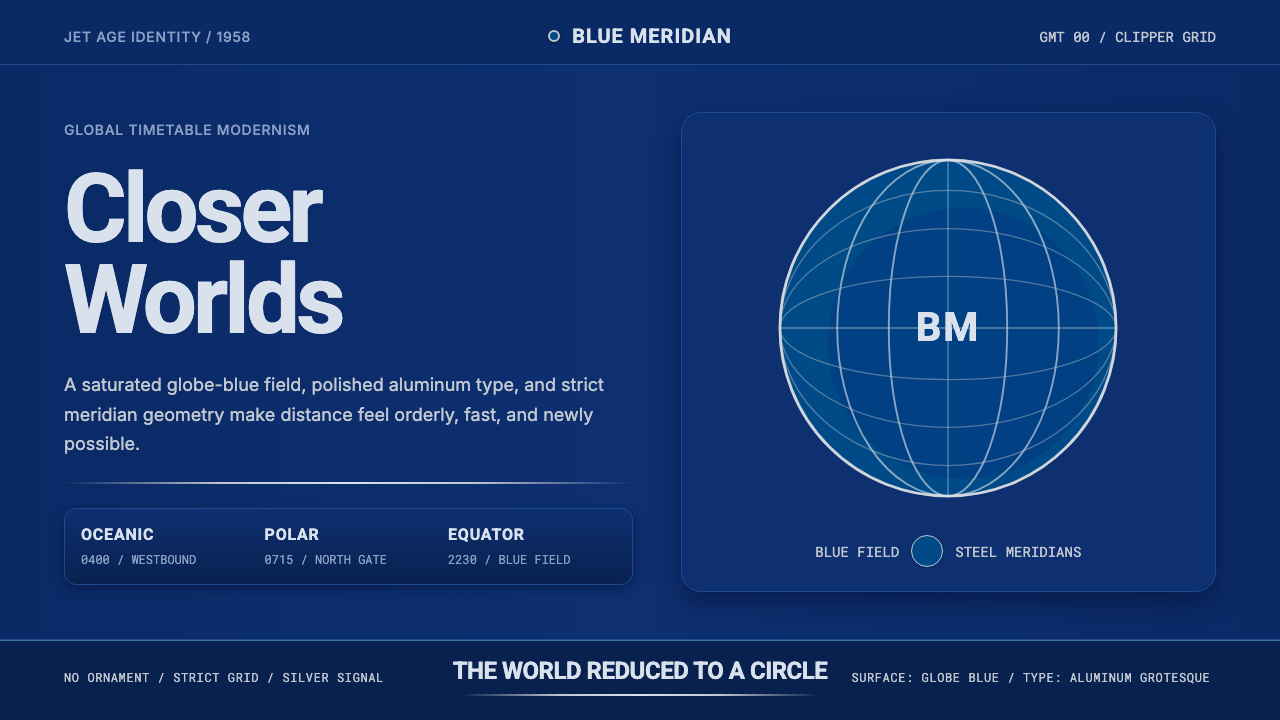 Pan Am Jet AgeJet-age confidence. Globe-blue field, steel type, meridian circle on a strict…
 2001 — A Space OdysseyAbsolute restraint. Black void, white monolith geometry, one HAL-red signal.
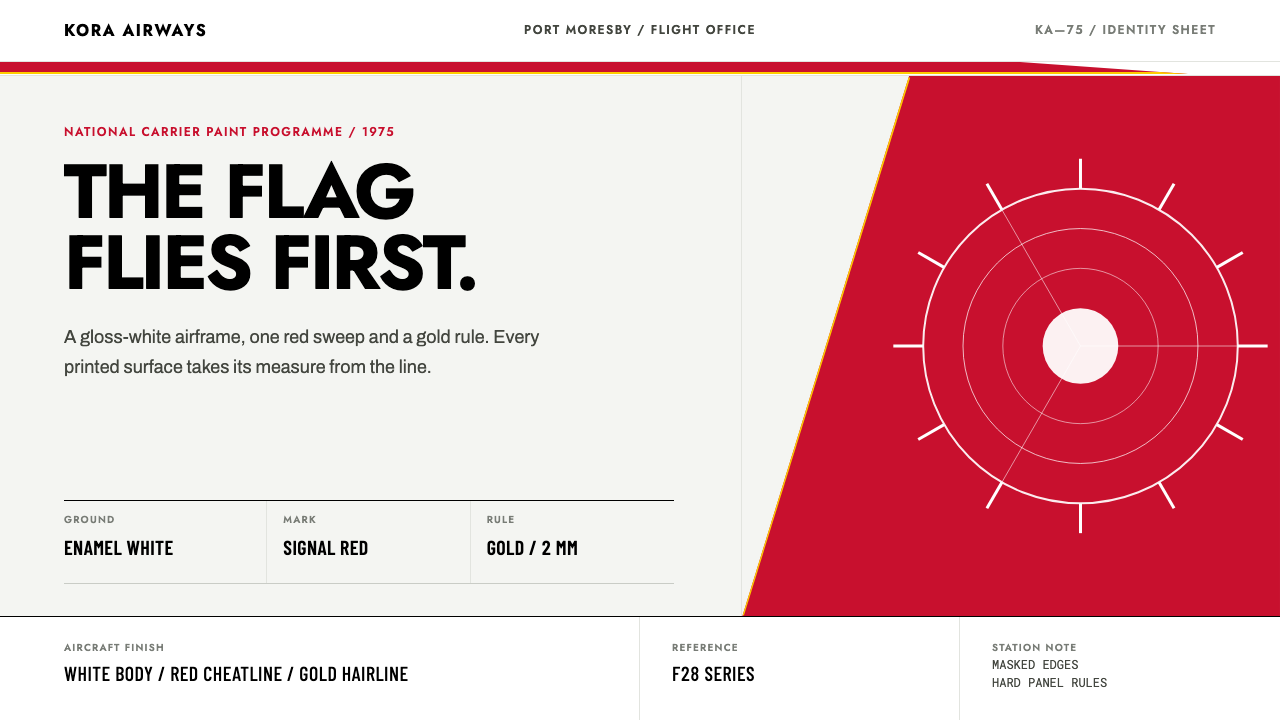 Air Niugini Livery 1975A flag engineered for flight. Signal red sweeps across enamel white, underlin…
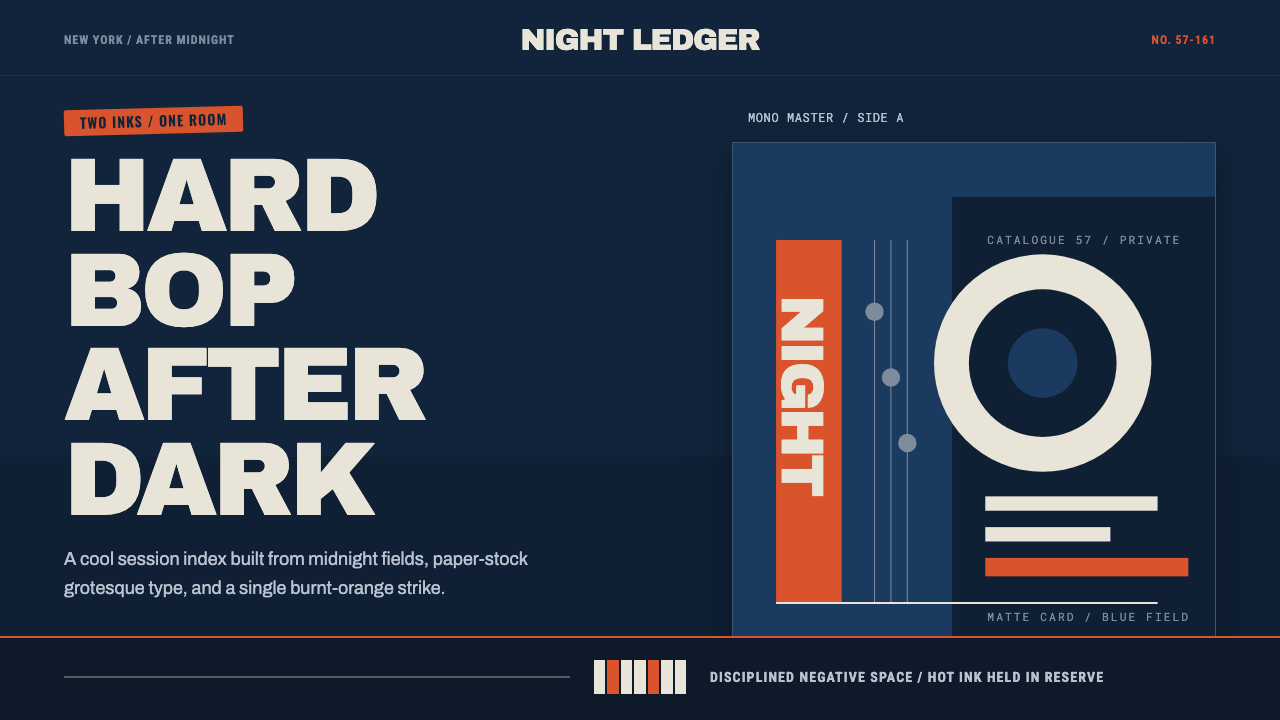 Blue Note JazzCool intelligence, printed flat. Midnight blue, paper type, and one burnt-ora…