What is 2001 — A Space Odyssey?
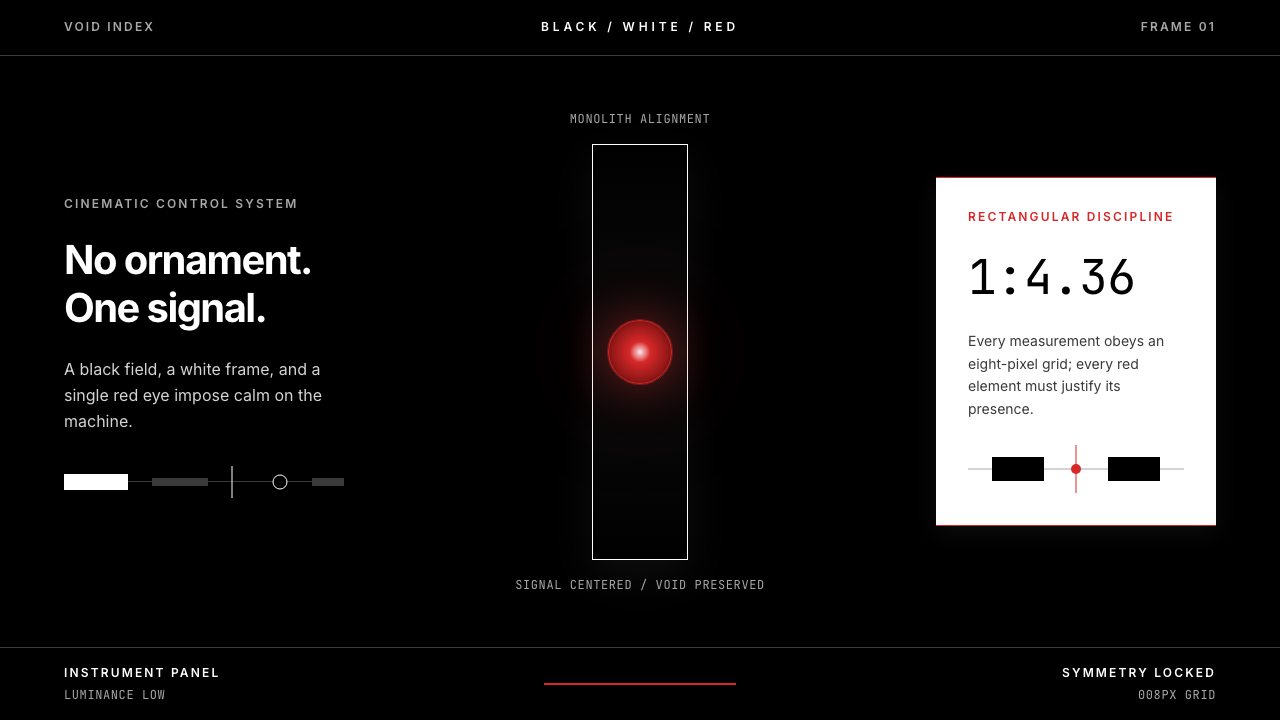
Kubrick's 1968 masterpiece gave science fiction its most austere visual grammar: pure black void, a white rectangular monolith, and a single saturated red eye that became the century's most unsettling signal.
2001 — A Space Odyssey in brief
The visual aesthetic of 2001: A Space Odyssey is the cinematic realization of modernist discipline applied to the cosmos. Where other science-fiction films of the 1960s reached for the spectacular — bold lettering, busy consoles, flashing lights — Kubrick and his collaborators chose restraint. The result is a visual system built on three tones — deep black, pure white, and one saturated red — deployed with almost ceremonial precision. Every frame is composed as if it might be a poster: symmetric, weighted, and stripped of any element that does not earn its place.
At the core of the aesthetic is what might be called a three-tone discipline. The black of outer space is not merely a background; it is an active, absorbing presence. The white of the Discovery One's interior and the monolith's surface is not merely illuminated — it is geometrically uncompromising, smooth to the point of unreality. And HAL-9000's red eye is not decorative: it is the only warm tone in a world of cold neutrals, which is precisely why it reads as menacing. The three tones never compete; each occupies its own register of meaning.
The style draws its deeper logic from two streams: the Bauhaus modernism that shaped mid-century graphic and industrial design, and the traditions of wide-screen symmetric cinematography that Kubrick refined across his career. The result is a visual language that feels simultaneously ancient — monolithic, ritual, architectural — and futuristic, because it has stripped away every convention that dates a designed object and retained only what geometry and contrast alone can carry.

Where does 2001 — A Space Odyssey come from?
Stanley Kubrick began developing 2001: A Space Odyssey in 1964, in close collaboration with science-fiction author Arthur C. Clarke. Their source material was Clarke's short story 'The Sentinel' (1951), which introduced the idea of an alien artifact — a precisely shaped object of inexplicable origin — found on the moon. From this premise, Kubrick built a film that would refuse the conventions of the genre: no alien monsters, no heroic action sequences, no expository dialogue to explain the inexplicable. The visual design was required to carry meaning that language would not be allowed to speak.
Production design for the film was led by Tony Masters, Harry Lange, and Ernie Archer, working under Kubrick's obsessive supervision at MGM's Borehamwood studios in England. Kubrick spent months consulting with aerospace engineers, scientists at NASA and the aerospace industry, and industrial designers to ensure that the spacecraft and space-station interiors looked operationally plausible rather than fantastical. The result was an aesthetic grounded in the actual design language of 1960s aerospace and industrial production: clean molded surfaces, modular components, a palette dictated by function rather than drama.
The film's title sequence and graphic identity had input from Saul Bass, whose poster and title work for major Hollywood films of the 1950s and 1960s had established a visual standard of geometric reductivism in American commercial design. The influence is visible in the film's on-screen graphics, instrumentation displays, and the clean sans-serif typography used throughout. Cinematography was handled by Geoffrey Unsworth, whose wide-angle lenses and precise lighting schemes gave interiors their characteristic even, shadowless illumination — a quality that reads simultaneously as clinical and transcendent.
Kubrick was deeply engaged with the music of the film, ultimately choosing pre-existing classical compositions — Johann Strauss II's 'The Blue Danube,' György Ligeti's choral works, Richard Strauss's 'Also sprach Zarathustra' — over the original score composed by Alex North. This decision reinforced the film's aesthetic philosophy: the music, like the visuals, had been stripped of novelty and sensation, and what remained was structure, pattern, and an almost geological sense of duration. The film was released by MGM in April 1968, received mixed initial reviews from critics expecting conventional narrative, and went on to become one of the most influential works in cinema history.
What defines the 2001 — A Space Odyssey look?
Three-Tone Palette
The entire visual system resolves into three tones: an absolute, light-absorbing black that stands in for the void of space; an almost aggressive, shadowless white that coats the spacecraft interiors and the monolith's surface; and a single saturated red used exclusively for HAL-9000's eye and its associated displays. Secondary colors appear only as ambient glow or instrument readouts and carry no compositional weight. The discipline is total — mixing in additional hues would dissolve the system's symbolic clarity immediately.
Monolithic Geometry
The monolith — a perfect black rectangle whose proportions remain constant across all its appearances — is the film's central visual argument: that pure geometric form, stripped of any surface markings or materiality cues, can carry enormous psychological weight. This principle extends throughout the film's design. Doorways, corridors, control panels, and furniture all tend toward simple rectangular and circular forms. Curved surfaces appear as continuous, uninterrupted arcs. Nothing is ornamented; every edge is a decision.
Symmetric Framing
Kubrick's camera consistently seeks and holds perfect bilateral symmetry — corridors recede to a central vanishing point, circular rooms are shot from their geometric center, the Discovery One's pod bay presents itself as a balanced architectural elevation. This symmetry is not merely compositional preference; it functions as a signal of inhuman precision. Human scenes in earthbound settings are shot with more conventional asymmetry, making the spacecraft's symmetry feel alien and totalizing. The style holds this framing as a defining characteristic rather than a technique.
Shadowless Interior Light
The spacecraft interiors in the film are lit from all directions simultaneously, producing an even, almost directionless illumination that eliminates cast shadows from surfaces and faces alike. This lighting condition — technically difficult to achieve, instantly recognizable once seen — gives white surfaces their particular quality of glowing from within rather than reflecting a source. The effect strips the interior spaces of any sense of natural time or human warmth. Applied to design, it means that surfaces should appear to be self-luminous rather than lit, and that depth is communicated through geometry rather than shadow.
Typographic Clarity
All on-screen text in the film — from flight-path displays to food-machine interfaces to HAL's status readouts — uses clean, geometric sans-serif letterforms set without decorative flourish. Labels are functional: they identify, they quantify, they direct. There is no hierarchy expressed through weight variation within a single screen; all text elements carry equal visual authority. This approach treats type as instrument rather than as graphic expression, which is precisely why it reads as technological rather than designed.
Ritual Pacing and Negative Space
The film's visual rhythm is defined by held compositions and generous negative space — the camera does not cut away from an empty corridor until the emptiness itself has been fully registered. Applied to design, this principle means that white or black space is not waste to be filled but the primary means of directing attention. A design derived from this aesthetic should be able to remove half its visual elements and retain its communicative effectiveness, because the remaining elements have been positioned with such deliberateness that the surrounding space amplifies rather than diminishes their presence.
Zero Surface Decoration
No surface in the film's designed world carries decorative marking: the monolith has no inscription, the Discovery One's hull has no livery beyond functional labeling, the pod bay has no graphics beyond instrumentation. This principle — that a surface should be what it is and nothing more — is the film's most transferable design lesson. In contemporary application, it means rejecting textures that simulate materials, patterns applied for visual interest alone, and any graphic element whose removal would not diminish the design's communicative function.

Who shaped 2001 — A Space Odyssey?
Kubrick directed, produced, and co-wrote 2001: A Space Odyssey, maintaining creative control over every aspect of its production including production design, lighting, and the final selection of musical accompaniment. His insistence on consulting actual aerospace engineers and scientists grounded the film's visual language in genuine technological aesthetics rather than science-fiction convention. Kubrick's broader filmography — from The Shining to Barry Lyndon — demonstrates a consistent approach to visual design as a system of controlled meaning, and his influence on the relationship between cinema and designed environments is without parallel.
Clarke co-wrote the screenplay of 2001 with Kubrick simultaneously with the novel, so that neither adaptation preceded the other — an unusual creative arrangement that meant the visual and literary versions were developed in parallel dialogue. Clarke's influence is most visible in the film's commitment to scientific plausibility: the silence of space, the physics of zero-gravity movement, the operational logic of the spacecraft. His conviction that humanity's encounter with genuine alien intelligence would be utterly incomprehensible to human frameworks gave the film its refusal of resolution and its embrace of visual abstraction as the only adequate language.
Unsworth served as director of photography for 2001 and developed the specific lighting approach that defines the film's aesthetic. His solution to lighting the spacecraft interiors — building light sources directly into the sets and using large diffusion panels to eliminate directional shadows — created the film's characteristic even, omnidirectional interior illumination. This approach required extraordinary technical ingenuity given the state of film equipment in the mid-1960s. Unsworth later received Academy Awards for his work on Cabaret (1972) and Tess (1979), but 2001 remains the most distinctive demonstration of his contribution to the relationship between light and designed space.
Bass contributed to the graphic identity of 2001, bringing to the film the same philosophy of geometric reductivism that had defined his poster and title-sequence work for films including Vertigo, Anatomy of a Murder, and North by Northwest. His influence on the film's on-screen graphics — the clean, functional displays and typographic treatments — is consistent with his broader conviction that visual communication should be reducible to its most essential symbolic form. Bass's work across the 1950s and 1960s established geometric simplicity as the dominant mode of serious American graphic design, and his collaboration with Kubrick represents a convergence of two of the period's most rigorous visual minds.
Masters served as production designer for 2001 and was responsible for translating Kubrick's visual principles into buildable sets. His challenge was to design spacecraft interiors that felt simultaneously functional and eerie — spaces where every component had a plausible operational purpose but the totality produced an atmosphere of uncanny precision. Masters worked with industrial designers and aerospace consultants to develop the film's modular, white-surface aesthetic, and his sets for the Discovery One's centrifuge — which was built as an actual rotating wheel — remain among the most technically ambitious production design achievements in film history.
How do you use 2001 — A Space Odyssey today?
The visual language of 2001: A Space Odyssey is one of the most disciplined and transferable dark-mode aesthetics in design history, because it is built on a logic — not a mood. Applying it correctly means understanding the three-tone system as a structural argument: black is void and context, white is form and precision, red is the single point of agency or warning. Decoration is not merely discouraged; it is conceptually incompatible with the system. Any element you add that cannot be assigned to one of those three roles will immediately read as a violation.
For presentation slides, the style performs best on covers and section dividers. A cover in this aesthetic should be predominantly black, with a single geometric element — a white rectangle, a circular form — centered or placed with deliberate asymmetry, and the title set in clean, widely-spaced sans-serif type. The single permitted accent color should appear only if there is a genuine hierarchy point to make — a subtitle, a date, a key number — and should be used for that element and no other. Content slides should follow the same economy: white or light-value type on a deep background, with spacious margins that treat negative space as a structural element rather than wasted area. Data visualizations in this mode work best when charts and graphs are rendered in white on black, with a single accent-color series used only for the most important data set.
For web interfaces — particularly dashboards, analytics platforms, and developer tools — the aesthetic translates into a dark-mode design language built around high contrast and deliberate scarcity of color. The background should be a deep, near-black tone; primary content surfaces a step lighter; interactive elements and alerts in white or the single accent color. Navigation should be typographic and minimal, with geometric icon-forms used only where a text label would be impractically long. The cardinal rule is color conservation: if the accent color appears in more than one or two roles on a given screen, it has lost its signal value and become decorative.
For editorial and marketing applications — film posters, event graphics, technology brand identity — the style's poster-like boldness is its most useful quality. A marketing application in this mode should commit fully to the dark ground: resist the temptation to soften it with gradients, textures, or color bleeds. Typography should be set with generous letter-spacing at large scale and tight margins at body scale, creating two distinct zones of visual intensity. The single accent color should appear at most once per composition, and only at a scale that justifies its visual weight — a single word, a single numeral, a single geometric mark.
The most common mistake when working with this aesthetic is treating the red accent as an invitation to apply color liberally — using multiple accent tones, introducing colored backgrounds, or allowing the accent to appear so frequently that it becomes ambient. The second most common mistake is softening the contrast: adding mid-gray surfaces, softening type weights, or introducing subtle gradients that reduce the stark opposition between black and white. The system's power comes entirely from the severity of its constraints. Relaxing any of them produces not a gentler version of the style but a different style entirely — one that lacks the original's sense of controlled inevitability.

2001 — A Space Odyssey — FAQ
Is this aesthetic the same as general dark-mode design?
No — they share a dark background but operate on entirely different logic. Generic dark-mode design typically uses a range of gray surfaces to create depth hierarchy, multiple accent colors for different interactive states, and soft shadows to distinguish layers. The 2001 aesthetic uses only two surface values — deep black and near-white — with a single accent color that does not vary. It is a much stricter constraint than dark mode as a pattern. The easiest way to distinguish them: generic dark mode wants the interface to recede and feel comfortable; the 2001 aesthetic wants the interface to feel precise and slightly inhuman.
Can I use this style with images and photography?
Yes, but with strict handling. Photographs should be converted to high-contrast treatments — deep shadows crushed to black, highlights held to near-white — so that they read as graphic objects rather than naturalistic windows. Full-color photography works against the three-tone discipline and should be avoided. Images work best when they are simple in composition: a single subject, strong geometric framing, minimal background complexity. The film's own visual reference — star fields, clean industrial surfaces, geometric forms in space — gives the clearest template for what imagery is compatible with the aesthetic.
How do I handle brand colors that are not black, white, or red?
The three-tone system is the style's core. If a brand's primary color is blue, deep green, or gold, it can substitute for red in the accent role — but only one color can occupy that role. The key is that the accent must be genuinely saturated and must appear in a field of near-neutral tones (black and white or their close equivalents) in order to carry the same signal weight. A desaturated or muted accent color will not read as a HAL-eye — it will read as a generic dark-mode interface. The system needs the contrast between the accent's saturation and the ground's neutrality to function.
Does this style work for consumer-facing products, or is it better suited to technical tools?
The style is strongest in contexts where precision, authority, and a degree of emotional distance are appropriate values: developer tools, data platforms, scientific visualization, premium technology hardware branding, and film or event identities. It is less well-suited to products where warmth, approachability, or sensory delight are the primary emotional targets — consumer wellness apps, food brands, children's products, or any context where users should feel welcomed rather than impressed. The aesthetic's association with the cold rationality of HAL-9000 is not accidental; it is intrinsic to the visual system. Using it in an emotional or nurturing context creates cognitive dissonance that undermines trust rather than building it.
How does this aesthetic relate to the Bauhaus movement it draws on?
Both share the foundational commitments: geometric form, zero surface decoration, typographic clarity, and the principle that every visual element must justify its presence. The key differences are tone and palette. Bauhaus is primarily a light-ground aesthetic — white or cream backgrounds, primary colors deployed at full saturation against light fields — and carries an activist, utopian energy. The 2001 aesthetic inverts the ground to black, reduces the color system to a single accent, and shifts the emotional register from energetic to austere. Where Bauhaus says 'nothing wasted,' 2001 says 'nothing permitted.' They are related by descent but diverge sharply in mood and application domain.
Related design styles
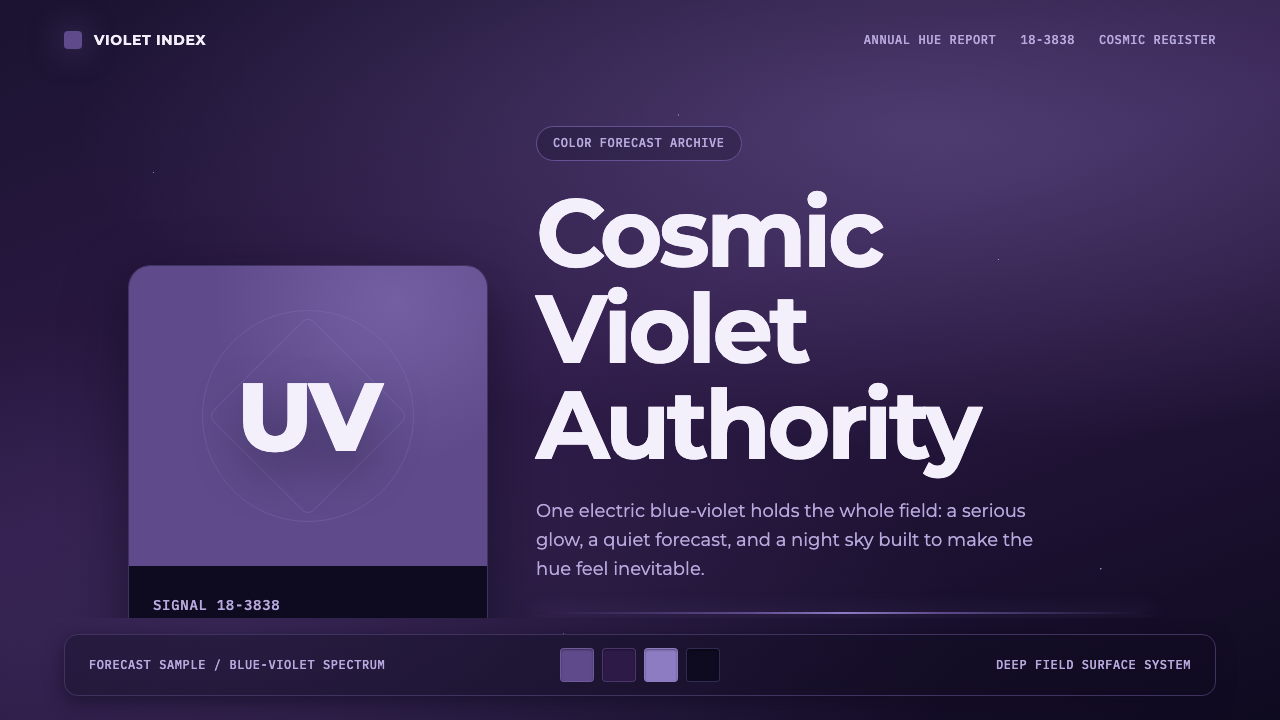 Pantone Ultra VioletCosmic authority. Ultra Violet glows through chip blocks, Montserrat, and dee…
 Corian Solid SurfaceSeamless matte calm. Glacier White floats over cool grey shadow with neutral…
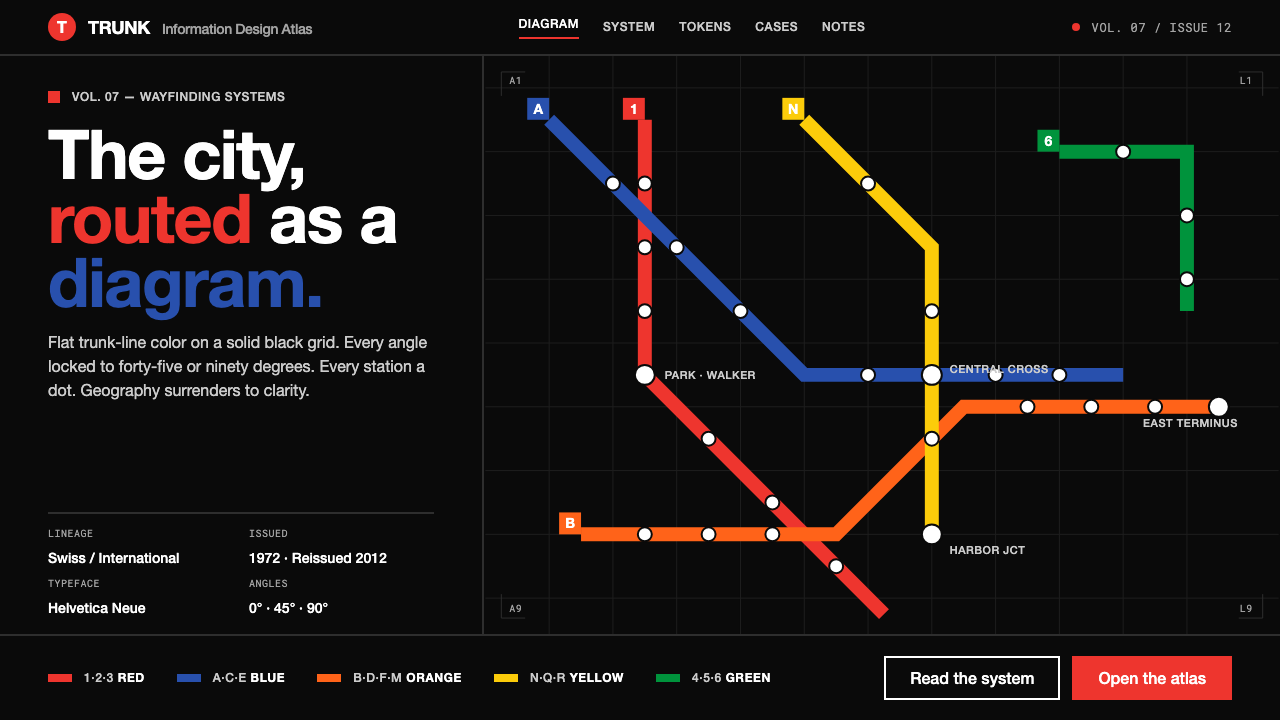 NYC Subway VignelliThe city as a circuit diagram. Flat trunk-line color on black, angles locked…
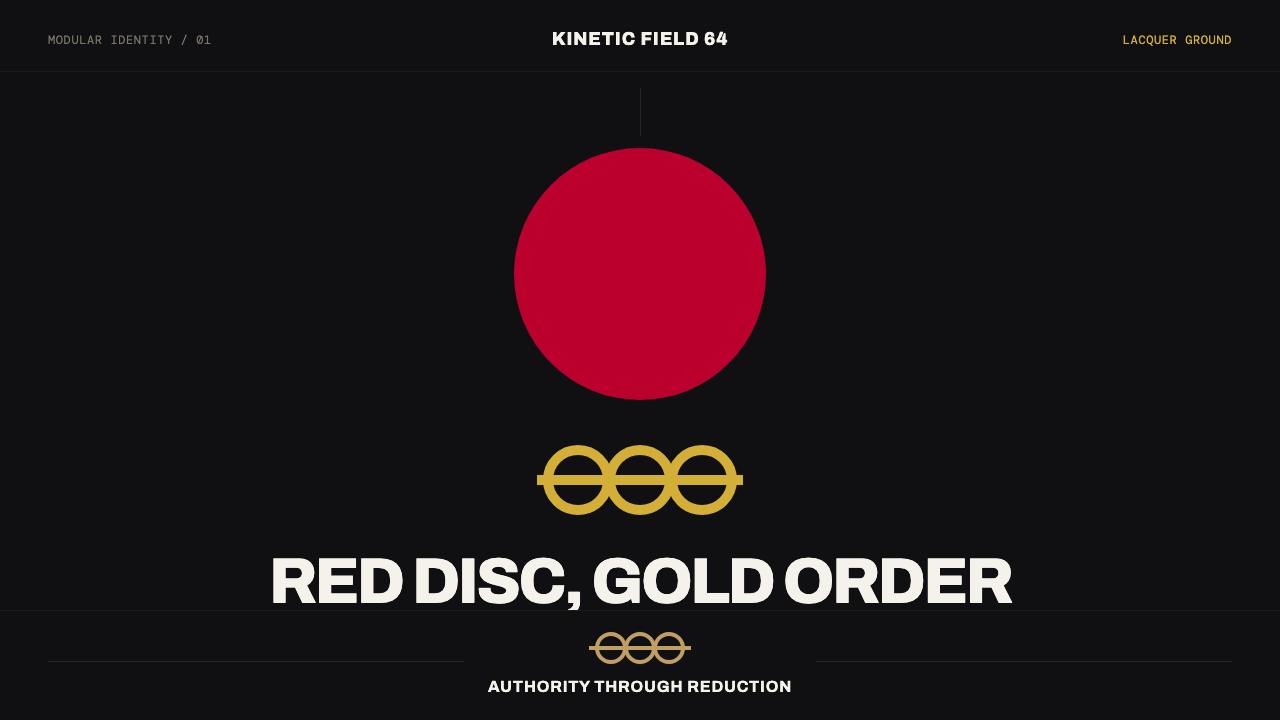 Tokyo 1964 (Kamekura)Ceremony reduced to a mark. Crimson disc and gold rings lock to a black axial…
 Akzidenz-Grotesk BertholdObjectivity in black ink. White grotesque type, hard grid, one rationed red b…
 Hospital Wayfinding 1970Colour removes hesitation. Enamel green rails and open grotesque plates lead…