What is Massimo Vignelli NYC?
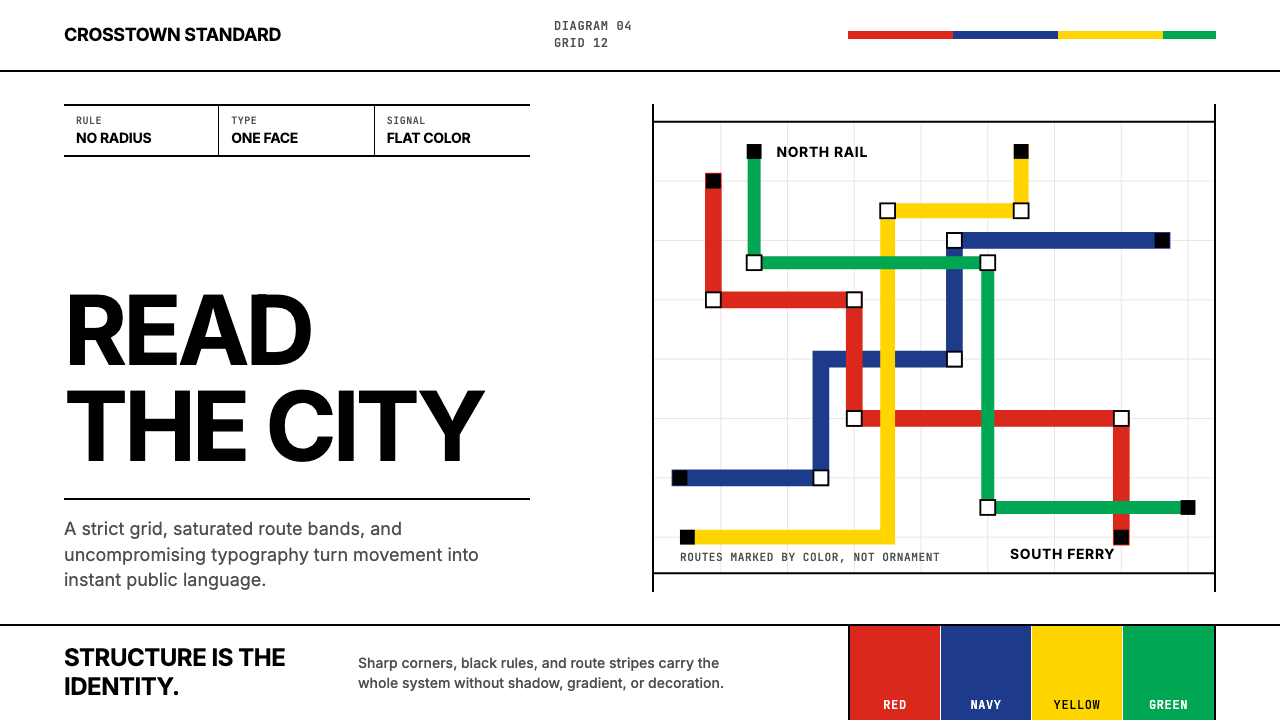
One typeface, five route colors, and an unshakeable grid gave New York City a visual identity that still shapes how we read urban systems today.
Massimo Vignelli NYC in brief
The Massimo Vignelli NYC system is a design language rooted in Modernist orthodoxy and refined through the specific demands of navigating a metropolis at scale. Its visual grammar is anchored by a single neutral sans-serif typeface, a small palette of high-saturation route colors set against white or off-white grounds, and a grid so strict it functions more like infrastructure than composition. Nothing is decorative. Every element — color, rule, label — is load-bearing.
This style descends directly from what Vignelli called the Vignelli Canon: the conviction that design must serve communication through semantic clarity, visual power, and intellectual elegance. Ornament that cannot be justified by function is not merely unnecessary — it is a failure of discipline. What survives that discipline is a system of almost diagrammatic precision: sharp right angles, no radius on any corner, no gradient on any surface, no shadow that blurs what should be a decision.
The result is a visual language that reads simultaneously as civic and corporate, urgent and calm. Its authority comes not from complexity but from the relentless consistency of its rules. A Vignelli-derived layout looks the same at the scale of a wall-mounted map and at the scale of a ticket stub — because the same grid, the same type, and the same color logic govern both.

Where does Massimo Vignelli NYC come from?
Massimo Vignelli was born in Milan in 1931 and trained at the Politecnico di Milano and later at the Venice Istituto Universitario di Architettura. His formation was classical Milanese Modernism — a tradition that valued rigor, craft, and the belief that good design was a form of civic responsibility. In 1957 he founded Vignelli Associati in Milan with his wife and creative partner Lella Vignelli, an architect whose spatial thinking would shape every aspect of their shared practice. They moved to New York in 1966 to open the American office of Unimark International, a design firm whose explicit mission was to bring systematic, rule-governed visual communication to corporate and institutional clients.
The commission that defined Vignelli's public legacy came in 1970, when the New York City Transit Authority hired Unimark to redesign the subway signage and map system. The existing signage was a chaos of competing typefaces, improvised color patches, and inconsistent station identifiers accumulated over decades of independent line expansions. Vignelli and Bob Noorda — the Dutch designer who led the signage portion of the project — replaced this chaos with a single typeface, a fixed palette of route colors, and a strictly maintained grid of sign panels. The typeface chosen was Helvetica, then newly arrived in the United States and associated with the Swiss International Style that Vignelli admired. The subway map that accompanied the signage — designed by Vignelli himself in 1972 — was a diagrammatic masterpiece: it distorted geography to prioritize legibility, representing the subway network as a geometric diagram rather than a geographically accurate rendering. It was controversial precisely because it was correct: clarity had been chosen over comfort.
The American Airlines identity, developed by Vignelli for Massimo's firm Vignelli Associates beginning in 1967 and lasting until 2013, applied the same discipline to corporate identity at national scale. The wordmark used a single typeface at a fixed weight; the livery used a restricted color scheme applied consistently across aircraft, ticketing, signage, and printed matter. The system demonstrated that Vignelli's principles were not a solution specific to transit but a method applicable wherever institutional clarity was the primary design objective.
Vignelli articulated his design philosophy formally in The Vignelli Canon, self-published in 2010 and made freely available as a download. The Canon is a short, direct document that lists the values he believed every designer should internalize: semantics (design must communicate something true), syntactics (elements must relate to each other by rule, not accident), and pragmatics (the solution must work in the real world). He also listed what he considered the acceptable typefaces — a short list dominated by Helvetica, Futura, Garamond, Bodoni, and Century Schoolbook — and argued that a designer who mastered three or four typefaces deeply would always outperform a designer who used dozens superficially. Vignelli died in New York in 2014. His system lives on wherever a transit map chooses geometry over geography, or wherever a corporate identity chooses discipline over expression.
What defines the Massimo Vignelli NYC look?
Typographic Singularity
The system commits to a single neutral sans-serif typeface used across every element — headlines, body text, labels, captions — at varying weights and scales. This singularity is not poverty but discipline: all hierarchy is communicated through size and weight alone, never through typeface switching. The typeface sits flush, tight, and geometric, with no tracking added for decoration and no italic used for emphasis when weight contrast can serve the same purpose.
Route-Color Logic
Color in this system is semantic, not aesthetic. Each hue is assigned to a category — a transit line, a service tier, a data series — and used consistently and exhaustively for that category alone. The palette is small: a handful of high-saturation primaries and secondaries, each distinct enough to remain readable when reproduced small or under artificial light. Color never appears as background wash or ambient decoration; it appears as signal.
Hard-Rule Grid
The organizing structure is a rigid grid of columns and baselines, treated not as a suggestion but as law. Elements snap to the grid without exception; no element floats freely or bleeds at an arbitrary angle. Alignment is the primary visual argument: every flush edge between elements communicates that they belong to the same system. The grid is invisible in the final artifact but present in every spacing decision, making the whole feel engineered rather than composed.
Zero Radius, Zero Ornament
Every corner in this system is a right angle. There are no rounded rectangles, no pill-shaped buttons, no softened card edges. This is not a stylistic preference but a philosophical position: the corner is a structural decision, not an opportunity for comfort. Similarly, there are no decorative borders, no flourishes on letterforms, no gradient fills, no ambient shadows. The page is a surface for information, and every mark on it must justify its presence by carrying meaning.
Ruled Lines as Structure
The hairline rule and the bold rule are both primary design elements. A thin rule separates columns without wasting space; a thick rule announces a section break with the authority of a headline. Rules are always horizontal or vertical — never diagonal, never curved. Their weight is consistent within a document tier: all dividers of the same function share the same rule weight. This regularity makes the structure of a document readable before a single word is processed.
Diagrammatic Imagery
When imagery enters the system, it is treated as a diagram rather than an illustration. Maps are geometric schematics, not photographic or painterly renderings. Charts and graphs adopt the same palette as the typographic system and are drawn with the same rule weights as structural dividers. Photography, when used, is cropped aggressively to isolate a shape or object against a clean field. There is no atmospheric photography, no soft-focus imagery, no visual element that introduces ambiguity of purpose.
Systematic Scalability
Perhaps the most important property of the Vignelli system is that it scales without degradation. A layout built on its rules looks as coherent on a wall-mounted transit map as on a folded pocket guide, and as coherent in a full-page advertisement as in a two-column data table. This scalability is a direct consequence of the system's reliance on proportion and rule rather than fixed size: no element is designed at a specific scale, only at a specific ratio to the grid.

Who shaped Massimo Vignelli NYC?
Vignelli (1931–2014) was the primary architect of the system that bears his name. Trained in Milan and Venice, he developed a design philosophy rooted in Modernist discipline and European craft tradition. His most visible public work — the 1972 New York City subway map and the 1967 American Airlines identity — demonstrated that systematic design could function as civic infrastructure. Late in his career he codified his principles in The Vignelli Canon (2010), a freely distributed document that argued for the primacy of a small number of typefaces and the rejection of design as self-expression. He was equally rigorous in his criticism of what he called the 'visual pollution' produced by undisciplined design.
Lella Vignelli (1934–2016) was an architect and the co-founder of Vignelli Associates. While Massimo's name is most often cited in discussions of the graphic and typographic work, Lella's architectural training was foundational to the practice's spatial and three-dimensional output — furniture, exhibition design, and the systematic organization of physical environments. The two worked as a single creative unit for over five decades, and the system's characteristic precision in three-dimensional space — the way physical wayfinding elements relate to each other in a station environment — reflects her contribution as much as his.
Bob Noorda (1927–2010) was a Dutch graphic designer who joined Unimark International and led the signage design for the New York City subway project. Where Vignelli designed the map, Noorda designed the physical sign system — the placement logic, the panel formats, the reading-distance hierarchy. Noorda's contribution was particularly concerned with the experience of information in motion: how a commuter moving at speed through a station could extract the information needed to make a routing decision before the relevant sign passed out of view. His approach to sign placement — positioning critical information at decision points rather than distributing it evenly — became a foundational principle of transit wayfinding.
Unimark International was a design firm founded in Chicago in 1965 with the explicit mission of applying the Swiss International Style to American corporate and institutional clients at scale. At its peak it had offices in over a dozen countries. Vignelli served as its vice-president of design. The firm's methodology — standardized systems, strict typographic rules, centrally defined color palettes — produced identity programs for Ford, Knoll, and the American Institute of Architects, among many others, in addition to the subway work. Unimark's approach was deliberately anti-expressive: the designer's personality was to be subordinated to the needs of the system. The firm dissolved in 1979, but its output defined what 'corporate identity' meant to a generation of American designers.
Not a person but an instrument: Helvetica was designed by Max Miedinger and Eduard Hoffmann at the Haas type foundry in Switzerland in 1957 and quickly became the typeface Vignelli treated as the closest available approximation of a neutral communications vehicle. Its strokes are nearly even in weight, its letterforms are compact and upright, its spacing is regular without being mechanical. Vignelli's use of Helvetica in the New York subway system effectively canonized the typeface as the default voice of public institutional communication in the United States. The 2007 documentary film 'Helvetica' — named for the typeface — uses Vignelli's subway work as one of its central case studies.
How do you use Massimo Vignelli NYC today?
The Vignelli NYC system transfers well to contemporary design work precisely because its underlying logic is structural and semantic rather than ornamental. Applying it correctly means internalizing the rule system — one typeface, semantic color, strict grid, no radius, no gradient — rather than borrowing its surface characteristics. A presentation deck that uses a bold sans-serif and a route-colored stripe on every slide without committing to the grid and the typographic discipline will look themed rather than systematic.
For presentation slides, the system excels at both cover and content formats. A cover slide benefits from the poster-like authority of the original transit work: a single bold route-color stripe, a headline in the system's typeface at a large scale, and nothing else on a white field. Content slides should be treated as strict grids: text hierarchy communicated entirely through size and weight, no decorative dividers, no soft-shadow card elements. Data slides become diagrammatic objects in their own right — bar charts and line graphs inherit the route-color palette directly, and the chart itself should be drawn with rule weights that match the surrounding typographic structure. Every data visualization is also a layout.
For web interfaces, this system is best suited to contexts where hierarchy and rapid information retrieval are paramount: dashboards, admin panels, pricing pages, and data-heavy product pages. The approach requires defining a strict column grid and committing to it without exception. Body text is always near-black on near-white; the route-color palette is reserved for interactive states, status indicators, and category labels. There are no soft shadows, no rounded cards, no ambient blurs — components have borders, not drop shadows, and inputs have visible strokes. Navigation is typographic: text labels organized at consistent scale, no icon-only navigation that requires learned visual vocabulary. The result is a UI that reads before it is used.
For editorial and marketing applications, the style supports strong information hierarchy with a clarity that is unusual in commercial contexts. An editorial layout in this system uses tight column control, a large-measure headline at the top of a page, and body text in a narrow column with a wide margin available for pull quotes or navigational metadata. Section breaks are announced by a bold horizontal rule — never by a decorative flourish or an icon. Marketing pages work well with the system's inherent poster quality: alternating full-width blocks of light-on-dark and dark-on-light type, with route-color accents deployed exclusively for calls to action. The visual rhythm of these alternating blocks creates structure without requiring additional graphic elements.
A common mistake when applying this system is treating its color palette as permission to use multiple saturated colors simultaneously. In Vignelli's original subway work, each color belongs to a specific line — colors do not appear together except to differentiate parallel choices. In a web or presentation context, this means picking one accent color as the system's primary signal and using the others only to mark distinctly different categories, never for visual enrichment. A second frequent error is softening the grid through compromised alignment — an element that breaks from the column grid by even a small margin dissolves the system's authority immediately. The grid only works when it is absolute.

Massimo Vignelli NYC — FAQ
How is Vignelli NYC different from Swiss International Style?
The two are closely related — Vignelli was explicitly influenced by Swiss Style and shared its commitment to the grid, sans-serif type, and systematic thinking. The differences are contextual and tonal. Swiss Style, as codified by Armin Hofmann and Josef Müller-Brockmann in the 1950s and 1960s, emerged from the needs of global corporate communication and tends toward cool neutrality: photography is used extensively, color appears in a broader range, and the grid is mathematically rationalized to a fine degree. Vignelli's New York work emerged from a specific civic challenge — unifying a chaotic public transit system — and has a harder, more assertive character: the color is bolder and more semantic, the typography is less refined at small sizes and more authoritative at large ones, and the overall register is closer to infrastructure than to publication design.
Why did people reject the 1972 subway map if it was so well designed?
The 1972 map was rejected — and eventually replaced in 1979 with a geographically accurate version — primarily because it prioritized abstract legibility over familiar representation. Vignelli's map distorted the geography of New York significantly: Central Park was drawn as a small rectangle rather than its actual elongated shape, and distances between stations were equalized for clarity rather than reflecting real travel time or physical distance. For experienced New Yorkers, who navigated by geographic intuition and street knowledge, the map was disorienting. For tourists or new arrivals, it was actually clearer. The controversy was less about design quality and more about who the map was designed for. Vignelli maintained until his death that the 1972 map was the correct solution. The debate remains one of the most instructive case studies in the tension between design logic and user familiarity.
Can this style work for products outside transit and corporate identity?
Yes, but with awareness of where its values align with the product's values. The system's core properties — precision, authority, semantic color, typographic clarity — are assets in any context where users need to parse complex information quickly and trust the source implicitly: financial dashboards, medical information systems, analytical tools, educational platforms, legal documents, and government services. The style struggles in contexts that call for emotional warmth, tactile richness, or cultural specificity. A wellness app, a children's educational product, a food brand, or any product where the user relationship is primarily emotional rather than informational will find the system too severe. Knowing this boundary is not a limitation — it is the condition of the system's coherence. A Vignelli-derived layout that tries to soften itself with rounded corners and pastel accents is not a Vignelli layout; it is a contradiction.
What does 'semantic color' mean in practice?
Semantic color means that each hue in the palette carries a fixed meaning and is used consistently and exclusively for that meaning. In the subway context, red means one specific transit line; orange means another. The colors do not float across the system picking up decorative or hierarchical assignments depending on context — they are dedicated. In a web or presentation application, this means assigning each color in the palette to a specific category or function at the outset — primary action, warning state, category A, category B — and never reassigning it. A button that is route-orange in one context and route-orange in another for a completely different reason breaks the semantic logic and forces users to re-interpret the color each time. The discipline requires treating your palette like a legend: every color on screen should be traceable to a specific entry in an explicit key.
Is there a Vignelli-approved way to handle dark-mode or inverted layouts?
Vignelli's historical work was predominantly light-ground — white or near-white backgrounds with dark type and saturated accent colors. He did work with dark backgrounds in specific contexts, particularly in exhibition and environmental design, where inverted contrast can improve readability in low-ambient-light conditions. The principles transfer cleanly to an inverted scheme: the background becomes near-black or a very deep saturated color, the type becomes near-white, and the route-color palette remains in place but may need its saturations adjusted so that lighter hues (particularly yellows) do not dominate aggressively against a dark field. What does not change is the structural logic — no radius, no gradient, no soft shadow, one typeface. A dark Vignelli layout that softens itself with blurs or gradients in the name of making the darkness more comfortable has abandoned the system. The discomfort, where it exists, is the point.
Related design styles
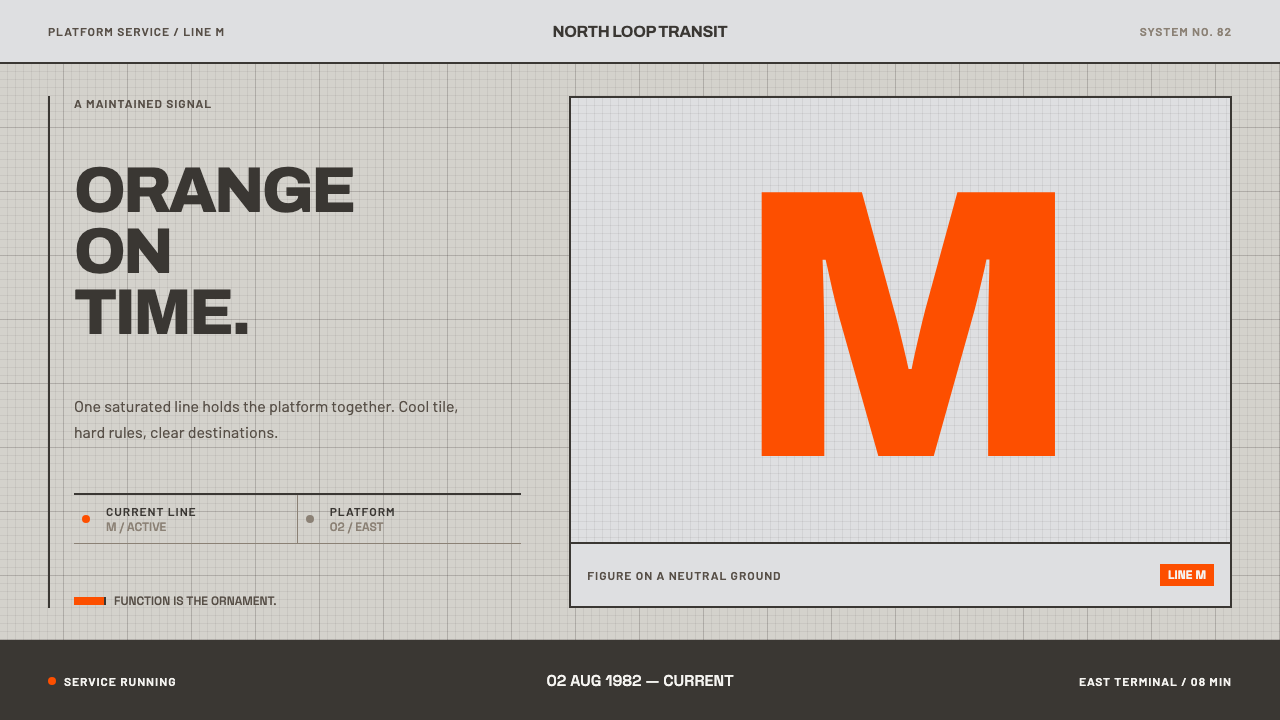 Helsinki Metro OrangeOne orange does the work. Archivo signage cuts across an 8px concrete tile gr…
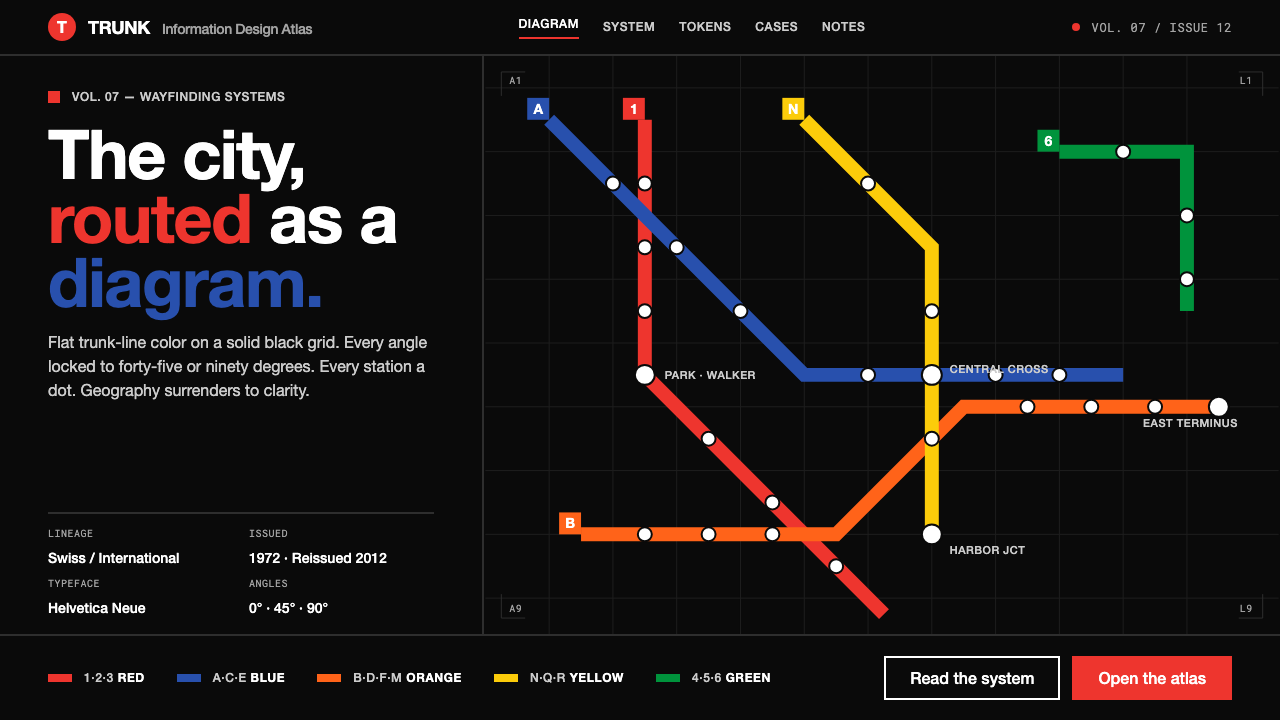 NYC Subway VignelliThe city as a circuit diagram. Flat trunk-line color on black, angles locked…
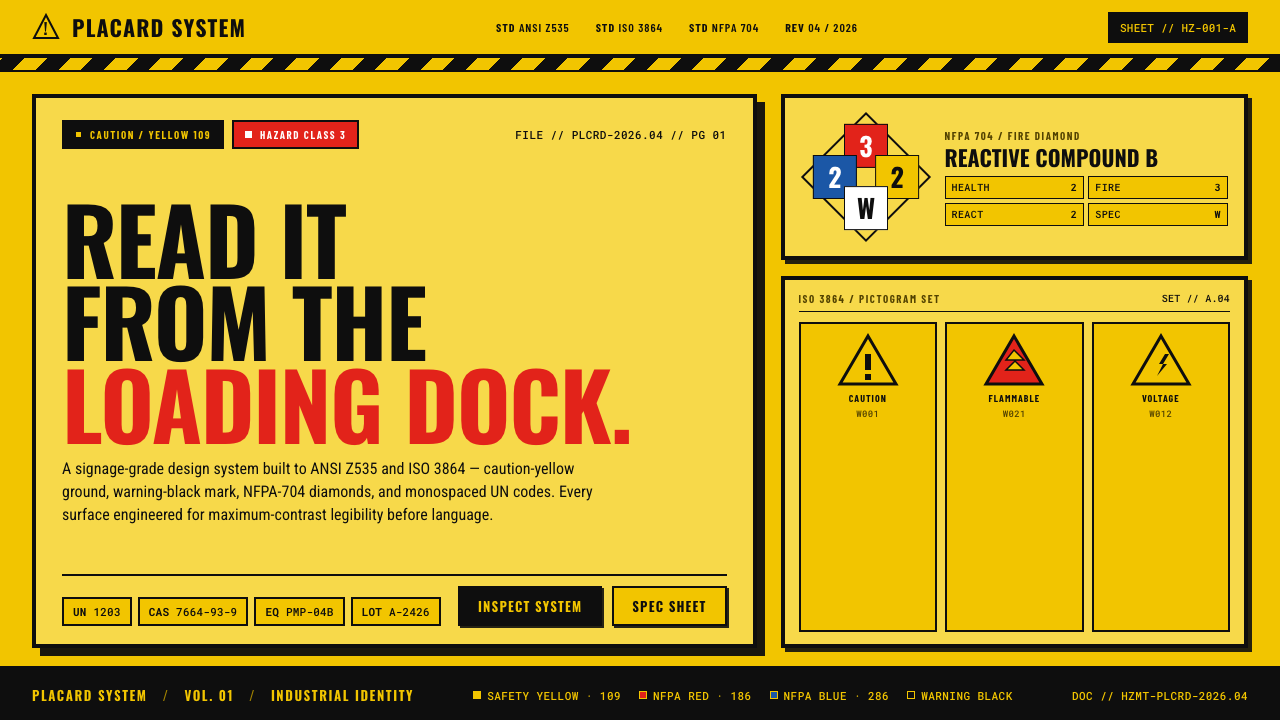 Hazmat SignageRead it from the loading dock. Caution-yellow ground, NFPA diamonds, monospac…
 Swiss Railway ClockPrecision refuses decoration. Black batons and one red hand cut through ename…
 Airport Wayfinding GeometricLegibility becomes command. Signal yellow, black sans, and green route bands…
 Audiogram ChartShape carries the diagnosis. Open red and blue marks cross a disciplined clin…