What is Olympic Poster Berlin (1936)?
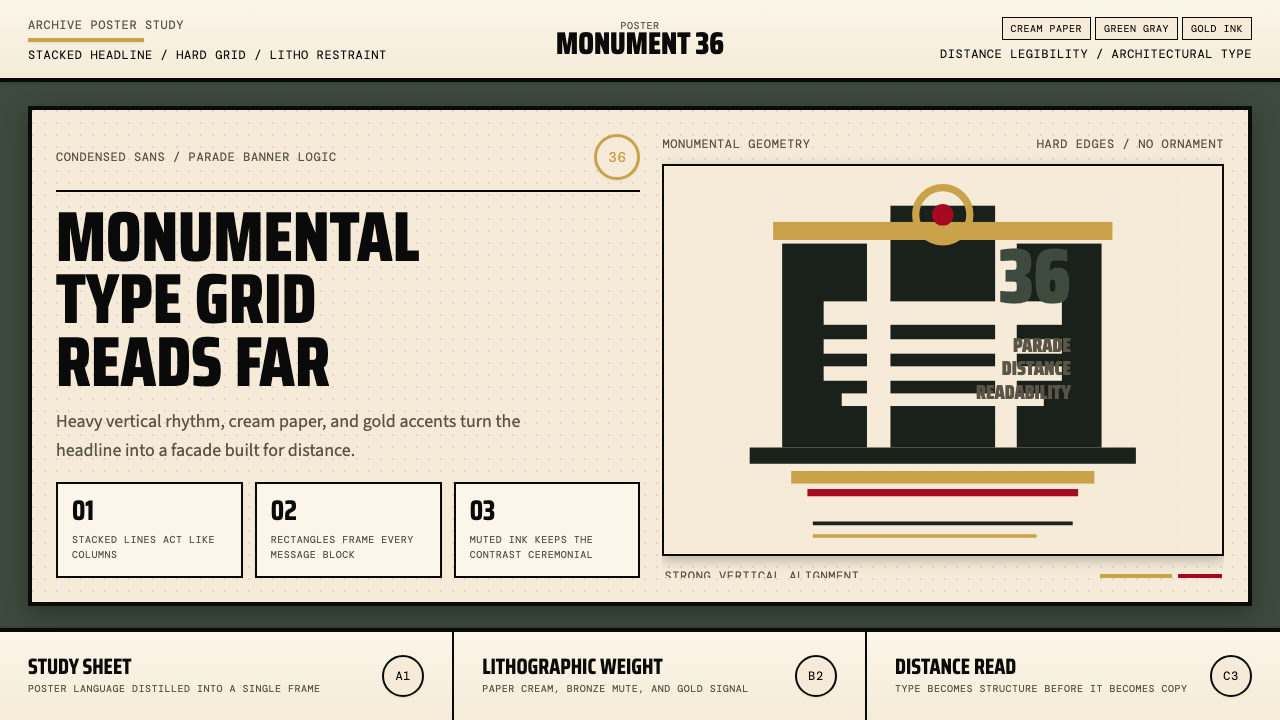
Berlin 1936 turned the Olympic poster into architecture — compressed type stacked like parade banners, monumental silhouettes, and a muted lithographic palette engineered for legibility at a distance.
Olympic Poster Berlin (1936) in brief
The Berlin 1936 Olympic poster style is a visual system derived from the official graphic identity of the XI Summer Olympiad, held in Berlin under the Nazi government. Its defining characteristics are heavy condensed sans-serif headlines stacked vertically in the manner of parade lettering, monumental architectural silhouettes anchoring the lower register of a composition, and a muted lithographic palette built from deep green-gray, Olympic gold, and cream paper. Every element is calibrated for maximum legibility at distance — treating typography as load-bearing architecture rather than decorative surface.
Stripped of its political context, the system's pure design merit is both specific and transferable. Compression and verticality give headlines enormous presence in small spaces. The green-gray ground reads as atmospheric and serious without resorting to black, while gold accents communicate ceremony and measured prestige. The rectilinear panel structure — mimicking the flat planes of a lithograph sheet — imposes order without ornament. Taken together, these elements produce a visual language of engineered monumentality: purposeful, legible, and authoritative.
The style belongs to a broader lineage of monumental athletic poster design that the 1936 games helped establish and that subsequent Olympic host cities — London 1948, Melbourne 1956, Tokyo 1964, Munich 1972 — each interpreted through their own visual culture. The Berlin iteration is the foundational reference: the moment a purpose-built event identity became a replicable design grammar.

Where does Olympic Poster Berlin (1936) come from?
The 1936 Summer Olympics were awarded to Berlin in 1931, two years before the Nazi seizure of power. When Adolf Hitler came to office in 1933, the games became an instrument of international image projection. Joseph Goebbels's Propaganda Ministry and the Reich Sports Office, led by Carl Diem — a career sports administrator and the games' chief organizer — worked in concert to project an image of German efficiency, classical order, and physical supremacy. The official poster commissioned from graphic artist Franz Würbel became the most visible expression of that ambition: a monumental Olympic bell tower rendered in precise architectural silhouette, surmounted by a stylized eagle and flanked by compressed vertical lettering.
Franz Würbel's design synthesized two currents that ran through 1930s German graphic culture. The first was a tradition of condensed, vertically stacked poster lettering inherited from nineteenth-century commercial lithography and carried forward by the German publicity poster movement of the 1920s. The second was a monumental classicism — heavy, symmetrical, derived from Greco-Roman architectural sources — that the regime was actively promoting as the aesthetic face of its ideology. Würbel navigated these two registers skillfully, producing work that read simultaneously as modern (in its compressed sans-serif lettering) and ancient (in its architectural gravitas), satisfying both the modernist poster canon and the regime's classicist ambitions.
The palette was partly technological and partly ideological. Lithographic printing in the 1930s favored limited, saturated separations, and the combination of a dominant cool ground tone, a warm metallic accent, and a neutral light field was a practical solution to the constraint of limited ink runs. But the specific choice of a deep green-gray — rather than a neutral gray or a warm tan — gave the work its distinctive atmospheric quality: the color of weathered bronze and aged stone, materials associated with permanence and monumental architecture. Gold reinforced the Olympian register. The cream field, evoking uncoated paper, kept the composition accessible and legible.
Leni Riefenstahl's documentary films of the games — Olympia, released in two parts in 1938 — extended the visual grammar of the poster into motion. Her techniques of extreme foreshortening, low-angle heroic framing, and the reduction of athletic bodies to geometric silhouettes against open sky were cinematic equivalents of Würbel's poster composition. Together, poster and film established an aesthetic template for athletic monumentalism that outlasted its political context and was selectively absorbed by subsequent Olympic design programs. The Japanese graphic designer Yusaku Kamekura, who designed the celebrated Tokyo 1964 Olympic poster, acknowledged the Berlin visual tradition as part of the lineage he was working within and departing from — a measured inheritance that shaped the broader Olympic poster canon stretching through to contemporary games.
What defines the Olympic Poster Berlin (1936) look?
Condensed Vertical Typography
Headlines are set in heavy condensed sans-serif letterforms with tight vertical spacing, stacking words like parade banners. The extreme compression concentrates visual weight into a narrow column, creating a tower of text that reads as architectural mass rather than language. This technique maximizes legibility at distance while conferring a sense of official proclamation to even ordinary informational copy.
Atmospheric Ground Tone
The dominant background color is a deep, desaturated green-gray — not quite olive, not quite slate — that evokes weathered bronze, aged stone, and the atmospheric haze over a stadium on an overcast morning. This tone distinguishes the style from neutral-gray or black-ground compositions by carrying geological and monumental associations. It functions as a complete mood field rather than a neutral backdrop, and the specific character of the hue cannot be achieved by simply darkening gray.
Architectural Silhouette
Representational imagery is reduced to precise flat silhouette — typically a tower, stadium colonnade, or monumental gateway rendered as a single-value shape against the ground tone. No gradation, no internal line detail, no cast shadow within the silhouette itself. The reductive technique gives figurative imagery the same visual weight as a geometric form, integrating it seamlessly with the typographic architecture of the composition rather than treating it as a separate illustrative element.
Olympic Gold Accent
A warm metallic gold functions as the composition's prestige marker. It appears selectively — applied to a title word, a dividing band, or an emblem — never as a dominant field color. The restraint is essential: gold used too broadly becomes decoration; used as a focused accent against the green-gray ground, it signals ceremony, achievement, and official status. The warmth of the gold in contrast with the coolness of the ground produces a subtle visual tension that keeps the eye engaged.
Rectilinear Panel Structure
Compositions are organized around hard-edged rectangular panels that evoke the flat planes of a lithograph printing sheet. Text blocks, image zones, and color fields align to a strict orthogonal grid, with no diagonal elements, no rounded corners, and no overlapping regions that blend. Each panel is a discrete plane. This structural rigidity gives the style its architectural character — the layout behaves like a facade, with weight distributed across load-bearing horizontals and verticals.
Cream Field for Legibility
The green-gray ground is consistently paired with a cream or warm off-white zone — typically the area reserved for secondary information, event details, or subheadings. This light field does not compete with the monumental ground tone; it serves as the legibility zone where smaller type can be read clearly. The contrast between the two ground tones — deep atmospheric and pale luminous — creates a natural visual hierarchy without any additional graphic devices.
Monumental Scale Contrast
The relationship between the largest and smallest typographic elements is extreme — the primary headline may be four to six times the visual weight of supporting text. This scalar distance is not simply a hierarchy signal; it is a deliberate technique borrowed from architectural proportion, where the difference in scale between a column and a door handle signals their different structural roles. In this system, scale carries the organizational logic that other styles delegate to color or decorative framing.

Who shaped Olympic Poster Berlin (1936)?
Würbel was the German graphic artist commissioned to design the official poster for the XI Summer Olympiad. His composition — a monumental bell tower silhouette surmounted by an eagle, flanked by heavy condensed lettering on a deep ground — became the defining visual document of the Berlin games and the template against which all subsequent Olympic poster design would be implicitly measured. The work demonstrated that a single poster image could function simultaneously as civic symbol, tourist advertisement, and ideological projection, and the formal decisions he made — palette, type treatment, silhouette reduction — proved durable enough to influence sports communication design for decades.
Diem served as the secretary-general and chief organizer of the 1936 Berlin Olympics and was the primary force behind the games' comprehensive visual and ceremonial program. He revived and institutionalized the torch relay — now a fixture of every modern Olympic games — as a designed spectacle connecting ancient Olympia to Berlin. His organizational thinking extended to every aspect of event identity, from signage systems and printed programs to stadium graphics, establishing a model of total visual coordination for large-scale international sporting events that influenced all subsequent Olympic host committees.
Riefenstahl directed Olympia, the two-part documentary film of the 1936 games, released in 1938. While not a poster or print designer, her contribution to the visual language associated with Berlin 1936 is inseparable from the poster style's legacy. Her cinematic techniques — extreme foreshortening, low-angle heroic framing, the reduction of athletic figures to pure geometric silhouettes against sky — are the moving-image equivalents of Würbel's poster composition, and together they established the aesthetic vocabulary of athletic monumentalism that endured across the twentieth century in both advertising and sports photography.
Kamekura designed the iconic poster for the Tokyo 1964 Olympics — widely regarded as one of the greatest in the Olympic poster canon — and in doing so both acknowledged and transformed the Berlin visual inheritance. Where Würbel's work was monumental and atmospheric, Kamekura's was precise and solar: a photographic sun disk in Olympic red against a field of pure white, with condensed vertical lettering below. The structural decisions — hierarchy through scale, a dominant single symbol above, compressed type stacked below — are clearly in dialogue with the Berlin grammar even as the palette and cultural register are entirely Japanese and modernist. Kamekura's work demonstrates how deeply the Berlin 1936 formal logic had penetrated the global Olympic design language.
Although Bayer is primarily associated with Bauhaus typography, his work in the 1930s — including exhibition and information design produced for the German government during the same period as the Berlin games — represents a crucial parallel track in the development of the monumental-condensed-typographic aesthetic. Bayer had left the Bauhaus by 1928 and worked as a commercial typographer and exhibition designer in Berlin, where his layouts combined the compressed vertical type treatment with architectural spatial thinking in ways directly adjacent to the poster grammar of Berlin 1936. His later emigration to the United States helped transmit aspects of this visual culture into American corporate and institutional design.
How do you use Olympic Poster Berlin (1936) today?
The Berlin 1936 poster style is best understood as a grammar of engineered monumentality rather than a period costume. Applying it correctly means internalizing its organizing logic — typography as architecture, scale as hierarchy, a restrained atmospheric palette carrying emotional weight — not simply overlaying condensed type on a dark background. The style works because every element has a structural role; pastiche fails when decorative additions dilute the compression.
For presentation slides, the style performs exceptionally well on both cover and content pages. A cover benefits from the full grammar: a dominant condensed headline stacked vertically occupies the upper two-thirds of the field, a reduced architectural or organizational silhouette anchors the lower register, and a gold accent isolates a key word or subtitle. Content slides should inherit the rectilinear panel logic — body text contained in a well-defined light field, section headers in heavy condensed type against the green-gray ground, data callouts treated as discrete panels. Avoid filling the slide with green-gray; the deep tone works as a structural zone, not a wallpaper.
For data slides and dashboards, the style offers a distinctive alternative to soft-shadow, rounded-card conventions. Charts and metrics become geometric objects in a rectilinear grid — bar graphs take on the visual weight of architectural elevations, and the gold accent functions as a highlight for the most important value. Navigation and label type should be set in condensed weight to maintain the compression register. The palette's limited range — deep ground, light field, gold accent — forces hierarchy decisions that are often left ambiguous in default dashboard styles, resulting in layouts that are genuinely easier to read.
For editorial and marketing work, the style supports a strong poster-like boldness that suits launch communications, event announcements, and institutional statements. A full-page feature layout uses the vertical stack of condensed type for the main headline, with a narrower roman weight for standfirst and body. Color-block sections alternate between the deep green-gray and the cream field. Marketing pages work well when they commit to the monumental register throughout — feature blocks presented as architectural panels, calls to action isolated in gold-accented type, body copy in a clean light-weight roman on cream. The temptation to relieve the severity with soft gradients or rounded elements should be resisted; the style's authority depends on its structural integrity.
A common mistake when applying this style is treating the condensed headline as the only design decision and leaving everything else in a neutral default state. The style is a system: the condensed type requires the deep atmospheric ground to deliver its full effect; the ground requires the cream field to create hierarchy; the cream field requires the gold accent to signal priority. A second frequent error is using the deep tone as a continuous background across every surface — the green-gray is a load-bearing zone, not a universal fill. Used sparingly as a structural panel, it reads as monumental; used everywhere, it becomes oppressive and illegible.

Olympic Poster Berlin (1936) — FAQ
Is it appropriate to use a style associated with the 1936 Berlin Olympics?
This is a legitimate question that deserves a direct answer. The design language distilled here is the formal grammar — condensed type, monumental silhouette, atmospheric palette — not the political content or emblems of the regime. Similar questions attach to other historical design traditions that operated under or alongside authoritarian contexts. The approach taken here is consistent with how design history treats the material: analyze and document the formal properties, set aside the political application, and allow designers to make their own contextual judgments. The style is employed by sports organizations, cultural institutions, and editorial designers worldwide precisely because its formal properties — compression, legibility, monumentality — have genuine utility independent of their original political deployment.
How does this style differ from generic sports design?
Generic contemporary sports design typically relies on dynamic diagonal compositions, gradient fills, high-saturation accent colors, and rounded letterforms — a visual language built around energy and motion. The Berlin 1936 grammar is the opposite: static, orthogonal, compressed, and atmospheric. The shared ancestry is the poster tradition, but the tonal register is entirely different. Where contemporary sports design performs excitement, Berlin 1936 performs authority and permanence. This makes it particularly well-suited to institutional contexts — awards, championships, commemorative communications — where gravitas is more appropriate than energy.
Can the style work in a lighter, more open layout, or does it require dark backgrounds?
The deep ground tone is not mandatory — it is the dominant register, but the style has a light-field mode. In this mode, the cream or warm off-white becomes the primary background, the condensed type is set in the deep green-gray, and gold accents operate as before. This inversion reads as a lighter, more editorial version of the same grammar, appropriate for body-text-heavy contexts like long-form articles, printed programs, or annual reports. The key is to retain the compression of the type, the rectilinear panel structure, and the limited palette even in the light version — the style's authority comes from its structural discipline, not exclusively from its dark ground.
What kinds of projects are a poor fit for this style?
The style's monumental severity makes it a poor fit for contexts that require warmth, playfulness, or organic human connection — consumer food brands, children's products, wellness platforms, personal creative portfolios, or any product positioning itself around intimacy and approachability. The compressed type and architectural compositions communicate authority and formality; they resist the softness and conversational register that those contexts require. The style also struggles at very small scales where the compressed letterforms lose legibility, and in richly illustrated contexts where the flat silhouette approach conflicts with detailed photographic or illustrative content.
How should gold accents be used without tipping into kitsch?
Gold becomes kitsch when it is used for its own decorative sake — as a border, a background shimmer, or a fill applied to show luxury rather than to signal meaning. In the Berlin 1936 grammar, gold is a precision instrument: it appears at exactly one or two points in the composition, where it marks the single most important word, number, or emblem. The restraint is structural — gold should feel earned, not sprinkled. A useful test: if removing the gold accent does not change what the viewer reads as most important, it is decorative; if removing it collapses the hierarchy, it is structural. Only structural gold belongs in this system.
Related design styles
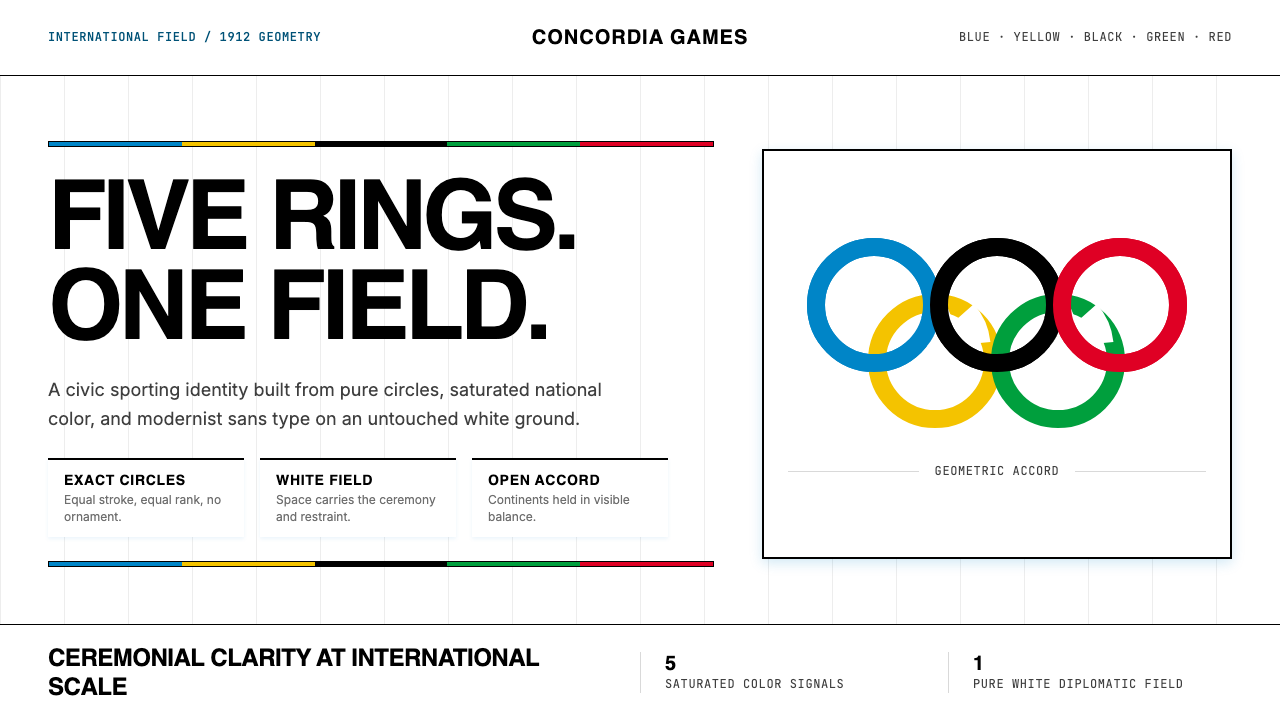 Olympics Five Rings (1912)Ceremony without noise. Saturated five-ring color on pure white, locked to a…
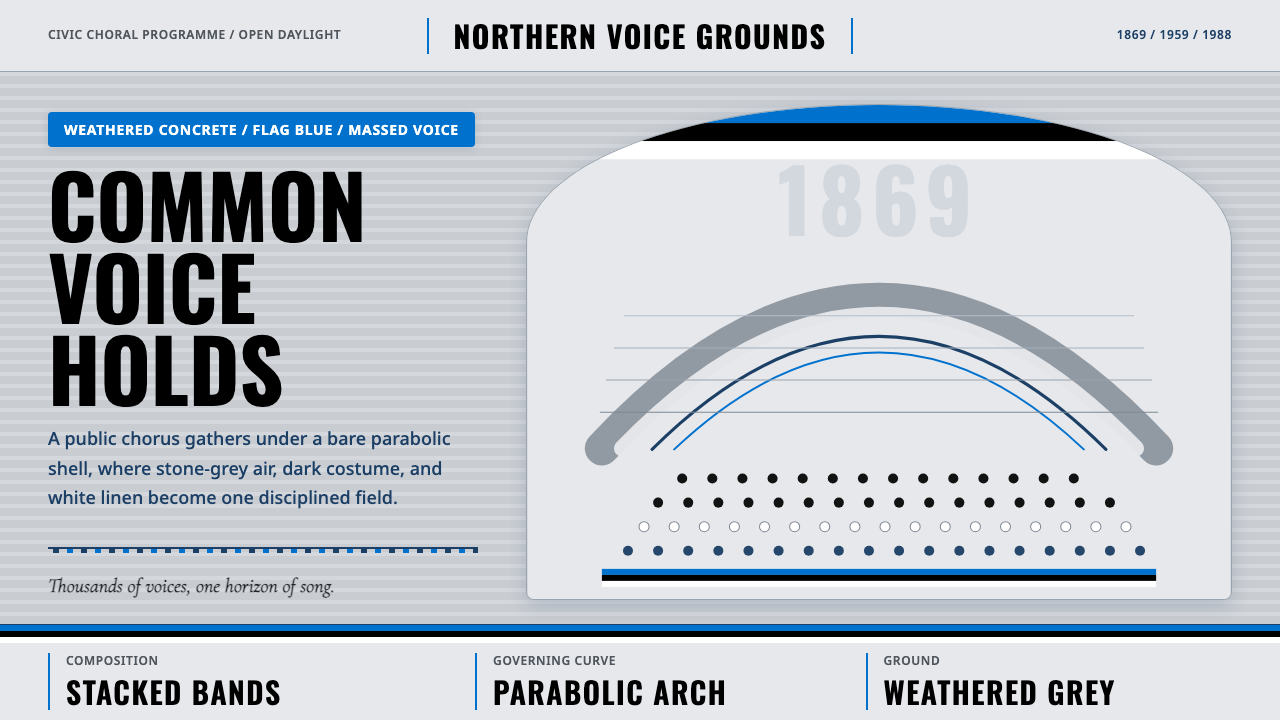 Estonian Song FestivalCivic monumentality sings. Blue-black-white bands meet a concrete arch.
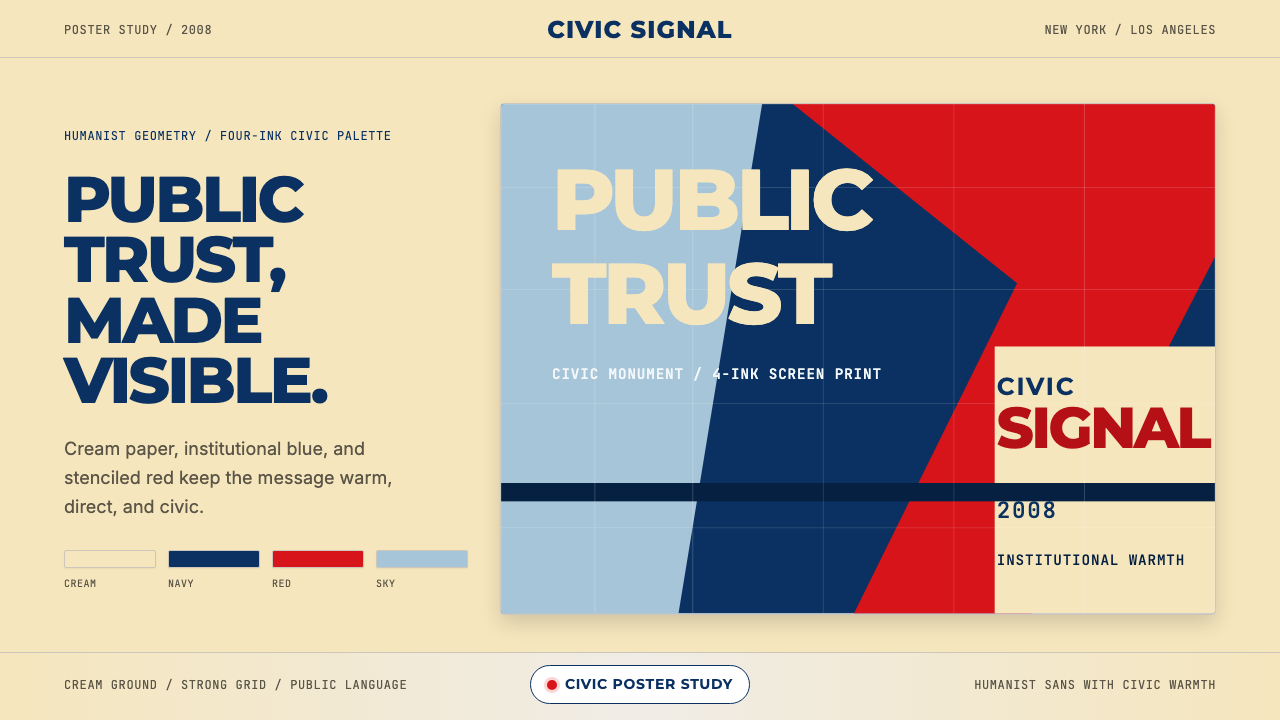 Gotham / Obama Hope Poster (2008)Public trust, made visible. Cream, navy, and red grid the poster.
 Baťa Zlín Functionalist BrandMachine-age precision. Brick red, concrete bands, and Oswald type lock into a…
 Chilean Allende-Era Propaganda (1972)Solemn revolution. Red, cobalt and yellow lock into thick black mural geometr…
 Iridescent Scarab DrawerOrder makes the shimmer read. Jewel scarabs pinned in a grid on black foam, m…