What is Gotham / Obama Hope Poster (2008)?
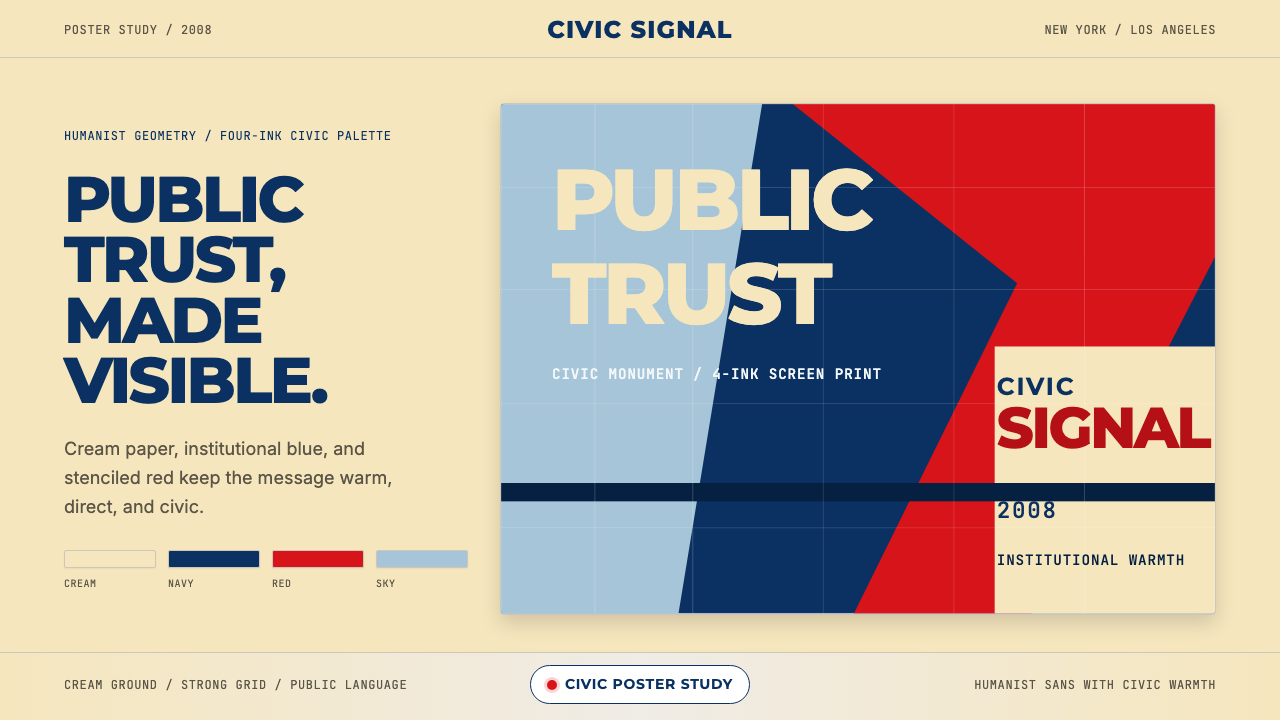
A typeface born from New York bus-terminal signage and a four-color stenciled portrait together redefined what American civic authority looks like on a page.
Gotham / Obama Hope Poster (2008) in brief
The Gotham / Obama HOPE Poster design system draws from two convergent sources: a typeface commissioned in 2000 to capture the workaday lettering of mid-century New York, and a political poster created in 2008 that became one of the most widely reproduced graphic images in American history. Together they constitute a visual language of civic monumentalism — formal enough to convey institutional weight, warm enough to feel human.
Visually, the system is built on a palette of cream, deep institutional blue, and a warm assertive red, with typography that is simultaneously geometric and humane. Where purely geometric sans-serifs feel mechanical, and purely humanist ones feel casual, Gotham occupies the productive middle ground: letters whose proportions derive from hand-painted vernacular signage rather than the drafting table, yet whose overall texture reads as authoritative and stable. The HOPE poster's stenciled portrait introduced a second visual grammar — flat planes of color describing a face in four tonal zones — that extended the typographic palette into image-making.
The resulting aesthetic is monumental without being cold. Cream grounds instead of stark white soften the contrast. The red is neither fire-engine nor corporate; it carries warmth and urgency simultaneously. The blue anchors without dominating. Together these choices produce a tone that political designers describe as accessible authority — credibility extended to an audience rather than asserted over it.

Where does Gotham / Obama Hope Poster (2008) come from?
In 1999, GQ magazine commissioned type designers Tobias Frere-Jones and Jonathan Hoefler to create a typeface that could evoke the vernacular lettering found across New York City — the hand-painted address plates, the cast-iron signs on the Port Authority Bus Terminal, the incised numerals on old bank facades. The brief was deceptively simple: make something that felt American and civic without resorting to the clichés of slab serifs or patriotic scripts. Frere-Jones spent months photographing New York signage, cataloguing the informal geometric letterforms that had accumulated on the city's surfaces over decades. The result, completed and released around 2000, was Gotham — a humanist geometric sans-serif that felt simultaneously timeless and specifically American.
Gotham's adoption was swift and wide. Within a few years it had appeared in corporate identities, magazine mastheads, architectural signage, and television titles. Its legibility at large sizes and its warmth at text sizes made it unusually versatile. But its cultural moment came in 2008, when the Obama presidential campaign, led by design director Scott Thomas, selected Gotham as the campaign's primary typeface. Thomas recognized that Gotham occupied a visual register that was neither the stiff formality of traditional government typefaces nor the casual approachability of contemporary digital sans-serifs — it occupied the precise tonal position the campaign needed: hopeful, serious, trustworthy.
Simultaneous with the campaign's typographic choices, street artist Shepard Fairey created what would become the defining graphic artifact of the 2008 election. Working from a photograph, Fairey hand-traced a portrait of Barack Obama and reduced it to four flat color zones — a deep blue-green shadow, a medium blue midtone, a warm red, and a cream highlight — applied with the visual logic of a stencil. The word HOPE, set in Gotham Bold, anchored the bottom of the composition. Fairey initially distributed the poster as a grassroots image, but it was rapidly adopted and reprinted until it reached ubiquity. The Library of Congress later acquired an original for its permanent collection.
The poster's power derived from the combination of stencil flatness with institutional typographic weight. Fairey's color reduction technique had precedents in propaganda poster traditions from the early twentieth century — Soviet constructivist graphics, World War II recruitment posters — but fused with Gotham's civic warmth, the result felt neither propagandistic nor purely commercial. It occupied a new register: monumental optimism rendered in the graphic grammar of a democratic vernacular. The HOPE poster became, alongside the Obama campaign's broader identity system, a case study in how design choices construct political meaning — and how a typeface can carry ideological freight without declaring it explicitly.
What defines the Gotham / Obama Hope Poster (2008) look?
Color
The palette is anchored by three tones: cream, deep institutional blue, and a warm assertive red. Cream grounds the composition with openness and approachability, avoiding the sterility of stark white. The blue carries the weight of civic authority — neither the cold navy of old government forms nor the bright cobalt of contemporary tech — but something in between that reads as trustworthy and stable. The red is warm rather than aggressive, carrying urgency and optimism in equal measure. These three tones are used at high saturation but moderate contrast, avoiding the visual harshness of four-color boldness while retaining monumental impact.
Typography
The defining typographic choice is a humanist geometric sans-serif drawn from vernacular sources rather than the drafting table. Letters have slightly irregular proportions that give them warmth — stroke endings that echo hand-lettering, apertures that feel open rather than constructed. Weight contrast within words is used at headline scale to assert hierarchy: a bold word against a lighter supporting line creates rhythm without ornament. At large display sizes, the letterforms carry sufficient presence to function as visual anchors for an entire composition, not merely as labels.
Stencil Tonality
The HOPE poster introduced a tonal system derived from stencil-printing logic: a face or figure is rendered not with continuous gradation but in four discrete flat color zones, each corresponding to a shadow, midtone, light midtone, and highlight. This approach treats portraiture and illustration as a form of graphic architecture — the face becomes a composition of flat planes rather than a naturalistic rendering. When extended to the broader design system, this stencil tonality means that photographic imagery is always reduced to flat zones rather than reproduced with full gradation.
Composition
Compositions are centered and frontally stable — a deliberate contrast with the asymmetric dynamism favored by many modernist traditions. The HOPE poster is nearly perfectly symmetrical along its vertical axis, with the portrait occupying the upper three-quarters and the word HOPE filling the lower quarter. This frontality is a political decision: it positions the subject as an object of direct address rather than dynamic motion. In applications beyond the poster itself, this vertical anchoring principle translates to layouts that are grounded and deliberate rather than restless.
Scale and Hierarchy
Typographic hierarchy operates primarily through scale — a single dominant word or short phrase set at a size that dwarfs any supporting text. Secondary information is reduced to a register that almost disappears against the dominant element, making the primary message impossible to miss. This extreme scale contrast is characteristic of poster logic: the image and headline must read at distance before any detail is legible. In contemporary digital applications, this translates to hero sections where the primary message is unmistakable and all supporting context is visually subordinate.
Civic Warmth
Unlike design systems that derive authority from coldness or precision, this system builds trust through warmth. The cream ground, the slightly irregular letterforms, and the warm-weighted red all contribute to an emotional register that is formal without being forbidding. This quality is described by design historians as vernacular institutionalism — the visual language of buildings and organizations that people actually trust, accumulated over decades of public contact, distilled into a reproducible aesthetic. It is the opposite of the clean corporate minimalism that signals efficiency; it signals reliability.
Flatness
All elements — whether typographic or pictorial — are resolved as flat shapes with hard edges. There are no soft gradients, no ambient shadows suggesting three-dimensional depth, and no photographic texture applied to surfaces. The stencil portrait technique enforces this flatness on imagery; the typographic tradition enforces it on letterforms. The result is a visual world that is fully two-dimensional but never feels sparse — the warmth of the palette and the density of the tonal zones fill the flatness with presence.

Who shaped Gotham / Obama Hope Poster (2008)?
Frere-Jones is the primary designer of Gotham, which he developed while still a partner at Hoefler & Frere-Jones. His research methodology — walking New York streets and photographing vernacular lettering on buildings, transit infrastructure, and storefronts — gave Gotham its documentary authenticity. Rather than designing from abstract geometric principles, he reverse-engineered the visual proportions of letterforms that had been trusted by everyday Americans for decades. After a widely publicized legal dispute, Frere-Jones now operates his own independent type foundry, where he continues to expand the Gotham family and other typefaces in the humanist-geometric tradition.
Fairey is a street artist and graphic designer who rose to prominence through his OBEY Giant campaign, a long-running guerrilla art project. His 2008 HOPE poster began as a grassroots gesture — he printed and distributed copies himself before any formal affiliation with the Obama campaign — and grew into a phenomenon that appeared on magazine covers, in museum collections, and replicated millions of times worldwide. The poster's creation was not without controversy: Fairey later faced legal action over the source photograph he had used as a reference. Despite the dispute, the poster's design legacy is secure, and Fairey's technique of reducing photographic portraiture to flat tonal stencil planes has been widely studied and imitated.
Thomas served as Design Director for Barack Obama's 2008 presidential campaign and was responsible for the coherent visual identity system that united campaign materials across print, digital, and environmental applications. His decision to build the campaign's typographic identity around Gotham — combined with a consistent use of the cream-blue-red palette — established the tonal register that made the campaign's materials instantly recognizable. Thomas later documented the design process in a book, providing one of the most detailed public accounts of how a modern political campaign builds and maintains a visual identity system under the constraints of a fast-moving electoral cycle.
Hoefler co-directed the type design firm Hoefler & Frere-Jones during the period when Gotham was developed, and his institutional and editorial typography work provided the broader context for the studio's output. While Frere-Jones led the Gotham design research, Hoefler's complementary work on typefaces for editorial clients including The New York Times Magazine established the studio's reputation for typefaces that operated simultaneously as historical research and contemporary design solutions. Following the dissolution of the partnership, Hoefler now operates Hoefler&Co, which continues to license Gotham and related typefaces.
How do you use Gotham / Obama Hope Poster (2008) today?
The Gotham / HOPE Poster design language is well suited to contexts where authority and approachability must coexist — where the design needs to feel both serious and humane. Unlike purely cold institutional aesthetics, this system carries warmth; unlike purely warm consumer aesthetics, it carries gravity. Understanding this dual register is the starting point for applying it correctly. The system works best when the product or message is genuinely civic in nature: not trying to seem governmental, but genuinely concerned with public trust.
For presentation slides, the system rewards a simple vertical hierarchy. Cover slides benefit from the poster's own compositional logic: one large visual element — a portrait, an icon, a single powerful word — occupying the upper portion, with a short identifying phrase below in a weight and scale that reads as a caption to the dominant element rather than a competing headline. Content slides should limit typographic levels to two: a single lead statement at large scale and supporting text at a comfortable reading size. The cream-blue-red palette maps naturally onto slide states: cream grounds for standard content, deep blue for emphasis or section headers, red used sparingly for single critical figures or call-out data. Data visualization should follow the stencil logic — flat shapes with hard edges, bars and areas in the blue-and-red range, no gradient fills.
For web interfaces, the system suits dashboards, pricing pages, and institutional landing pages where hierarchy and scannable confidence matter more than sensory delight. The approach is to anchor the page with a typographic hero — a short phrase in large, bold, open letterforms — and then descend through the page in clearly differentiated tonal zones. Navigation should be spare and typographic, without decorative icons. Cards and panels work best with defined borders rather than drop shadows; if elevation is needed to distinguish interactive elements, a hard-offset shadow in a muted version of the blue reads more authentically than a soft ambient glow. Color should be used purposefully: cream or near-white for background fields, deep blue for primary interactive elements, red for single critical actions or alerts.
For editorial and marketing applications, the style's poster heritage is an advantage. Full-bleed section dividers in deep blue with cream type create the visual impact of a monumental stamp without requiring complex illustration. Pull quotes set at generous scale in the red tone break editorial rhythm effectively. Marketing pages can alternate between cream-on-blue and blue-on-cream full-width bands to create rhythmic section differentiation. For social media cards and event graphics, the stencil portrait approach is directly applicable: reduce the central visual to flat tonal zones and let the typographic anchor hold the bottom of the frame, following the original poster's proportional logic.
A common mistake when applying this system is treating the warmth of the palette as an invitation to add softness: rounded corners, gradient fills, drop shadows, soft-focus photography. These additions directly undermine the system's authority. Gotham's warmth comes from letter proportions, not from visual texture; the HOPE palette's warmth comes from color choice, not from diffusion. Another frequent error is deploying all three palette tones simultaneously at equal weight — cream backgrounds with both deep blue type and red accents compete for attention rather than establishing clear hierarchy. Use one primary tone per section or per slide, reserving the accent color for the single most important element in the composition.

Gotham / Obama Hope Poster (2008) — FAQ
Is this design system only appropriate for political or governmental contexts?
No — the civic warmth of the system is a tone, not a category restriction. It works wherever an organization needs to project reliable competence to a broad public audience: educational institutions, public health communications, nonprofit organizations, civic technology platforms, and financial services that want to feel trustworthy rather than prestigious. The key is that the audience must be one you are serving, not one you are selling to in a purely commercial register. The moment the design starts optimizing for conversion pressure rather than public trust, the tonal authenticity breaks down.
How do I use the stencil portrait technique in contexts that do not involve a human subject?
The stencil reduction principle is not limited to portraiture — it is a method of rendering any image in flat tonal zones rather than continuous gradation. Objects, architecture, landscapes, and diagrams can all be subjected to the same four-zone reduction: shadow, midtone shadow, midtone light, and highlight, each filled with one of the palette tones. The discipline is to resist adding intermediate tones to smooth the transitions — the hard boundary between zones is the aesthetic content, not a rendering limitation to be overcome. In practice, this means treating photographic source imagery as material to be interpreted graphically rather than reproduced faithfully.
Does the system support dark-background variants?
A dark inversion is possible but requires careful adjustment. The canonical application uses cream as the primary ground, and this ground contributes significantly to the system's warmth. On a deep background — navy or near-black — the cream tones become the highlight color rather than the ground, which compresses the tonal range and risks making the composition feel darker and more austere than intended. A workable dark variant treats deep blue as the primary ground, cream and red as the two foreground tones, and reserves black for structural outlines only. The warmth must then come entirely from color temperature rather than ground tone, which is achievable but demands discipline.
How does this system differ from Swiss International Style, which also uses strong sans-serif typography and flat color?
Swiss International Style, which matured in the 1950s and 1960s, prioritizes mathematical precision, strict grid adherence, and neutrality — it aims for a universal visual language that communicates across cultural contexts with minimum interference from aesthetic character. The Gotham / HOPE system, by contrast, is deliberately culturally specific: it encodes the vernacular traditions of American civic lettering, the emotional register of political poster-making, and the warm color palette of institutional trust rather than universal neutrality. Swiss Style is cooler, more systematic, and more committed to typographic purity. The HOPE system is warmer, more frontal, and more willing to deploy emotion as a design material. The technical similarities — sans-serif type, flat color, strong hierarchy — mask a fundamental philosophical difference in what the design is trying to communicate.
What contexts should this system avoid?
The system struggles wherever sensory richness, cultural intimacy, or commercial playfulness are the primary values. Luxury brands depend on material refinement and restraint that reads as exclusive rather than civic; this system's warmth would undercut that register. Children's products and entertainment platforms depend on visual energy and delight that requires color variety and dynamic composition beyond what the three-tone palette supports. High-fashion editorial work demands either the stark minimalism of pure photography or the decorative richness of illustrative traditions — neither of which aligns with stencil flatness and institutional typography. When in doubt, ask whether the product's emotional promise is trust and reliability, or aspiration and desire — only the former maps cleanly to this system.
Related design styles
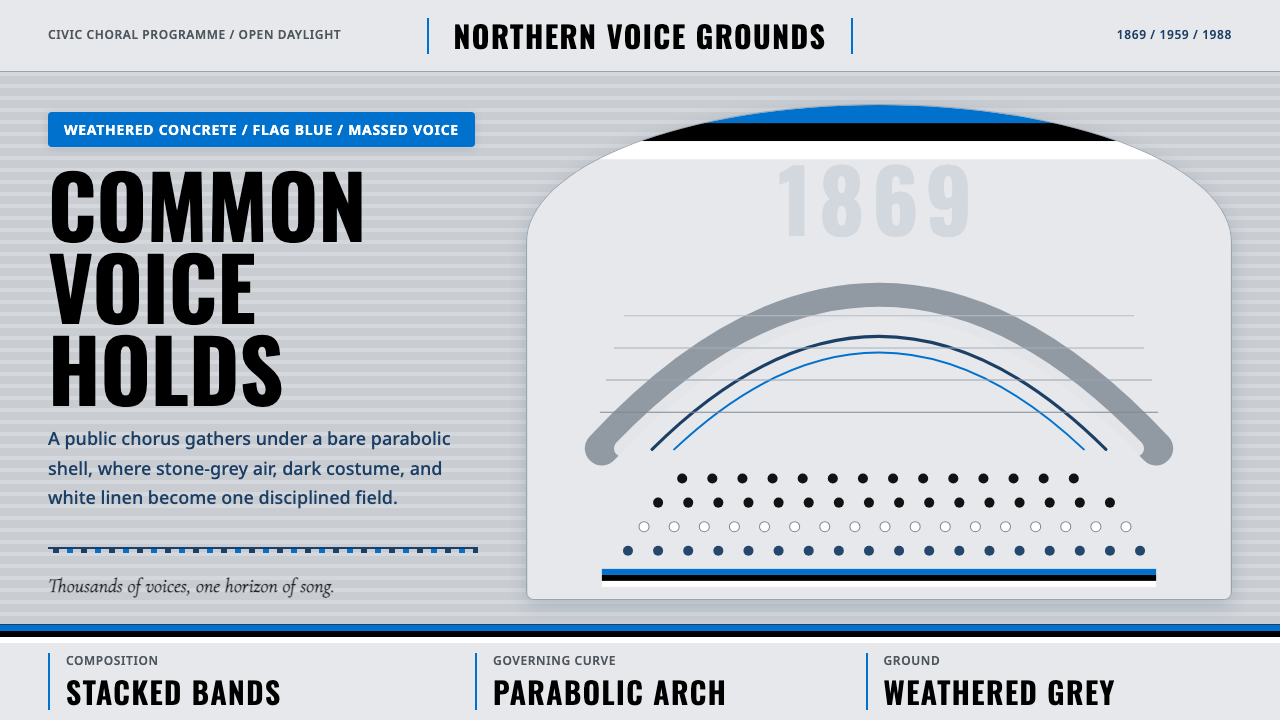 Estonian Song FestivalCivic monumentality sings. Blue-black-white bands meet a concrete arch.
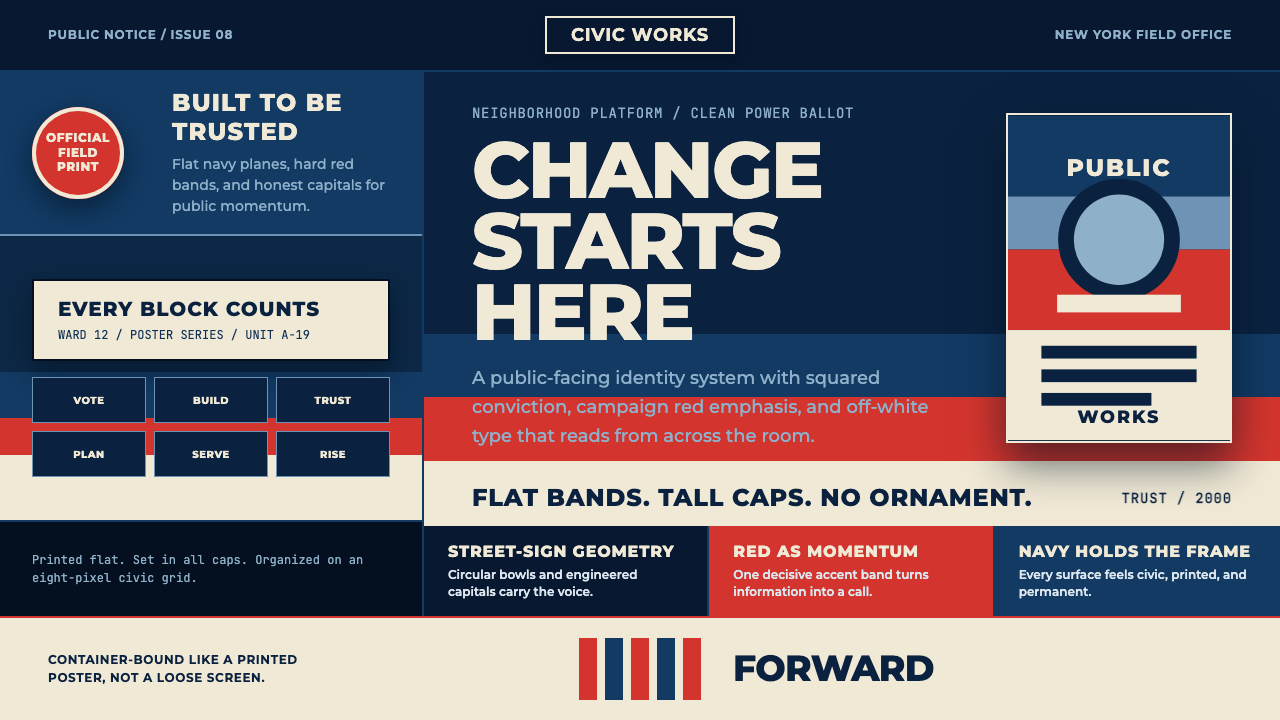 Gotham Geometric SansCivic trust in tall caps. Navy, red, and off-white bands turn geometry into c…
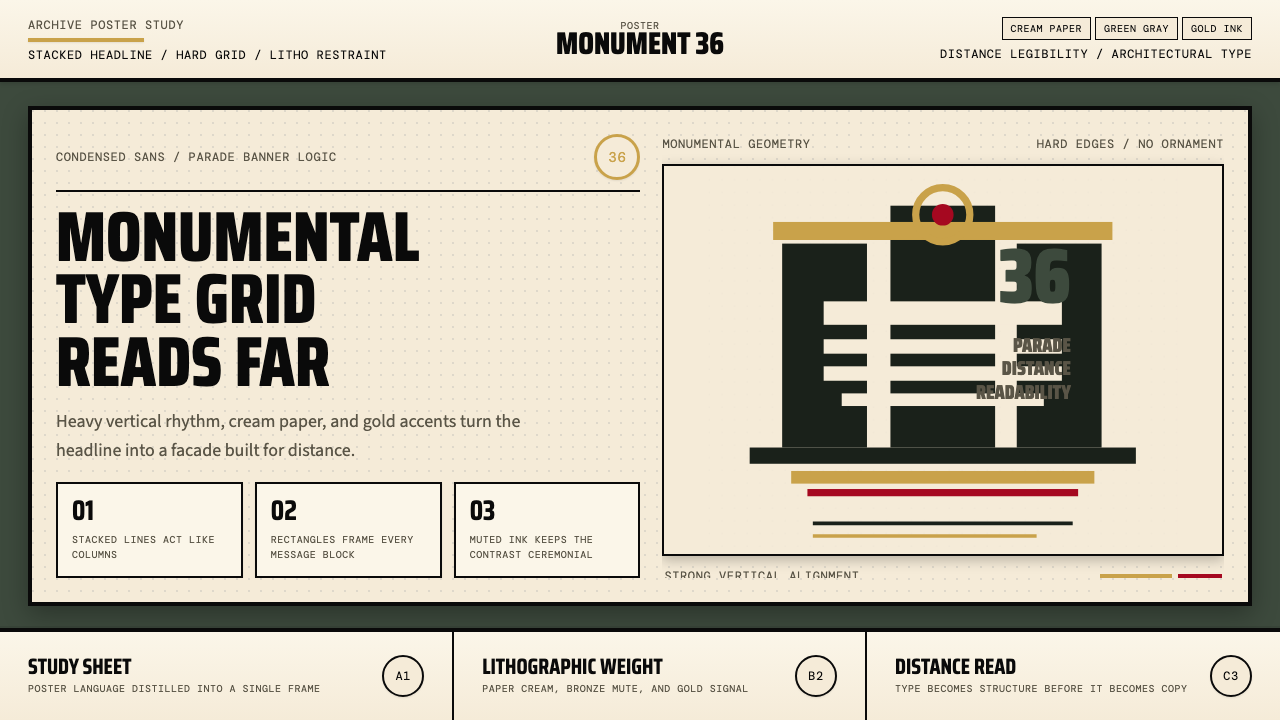 Olympic Poster Berlin (1936)Monumental and legible. Green-gray, cream, and gold turn type into architectu…
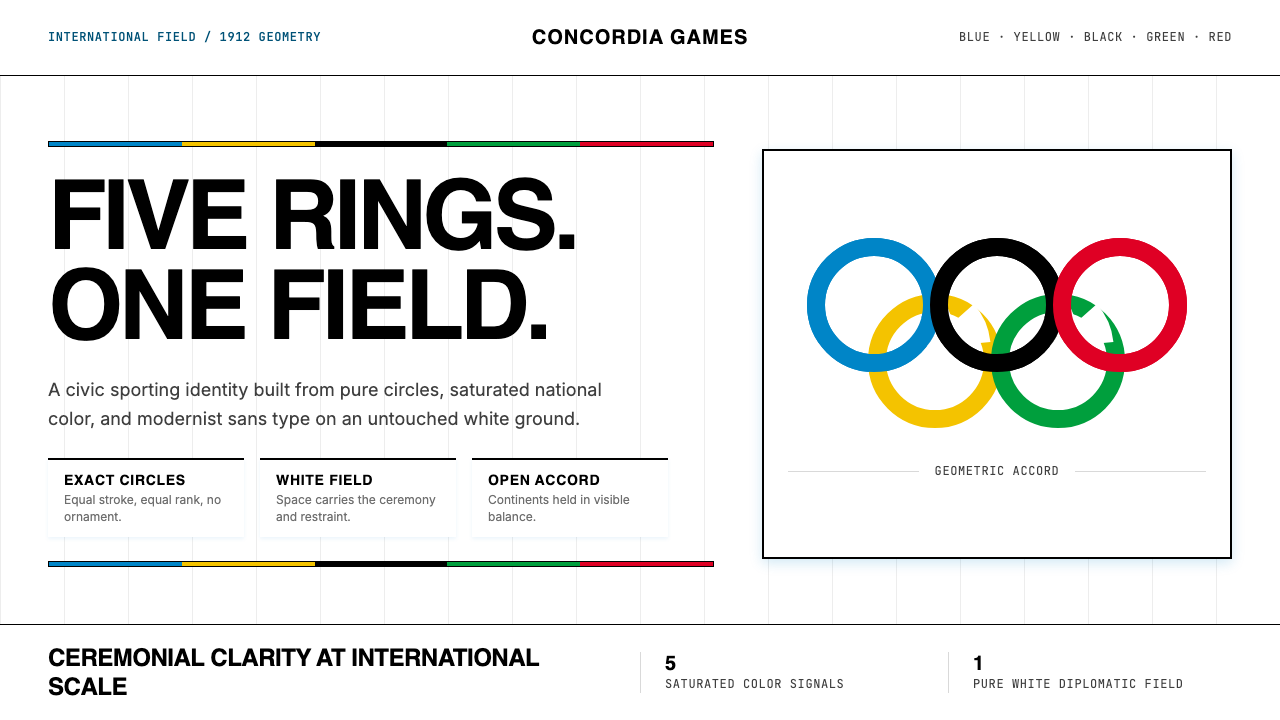 Olympics Five Rings (1912)Ceremony without noise. Saturated five-ring color on pure white, locked to a…
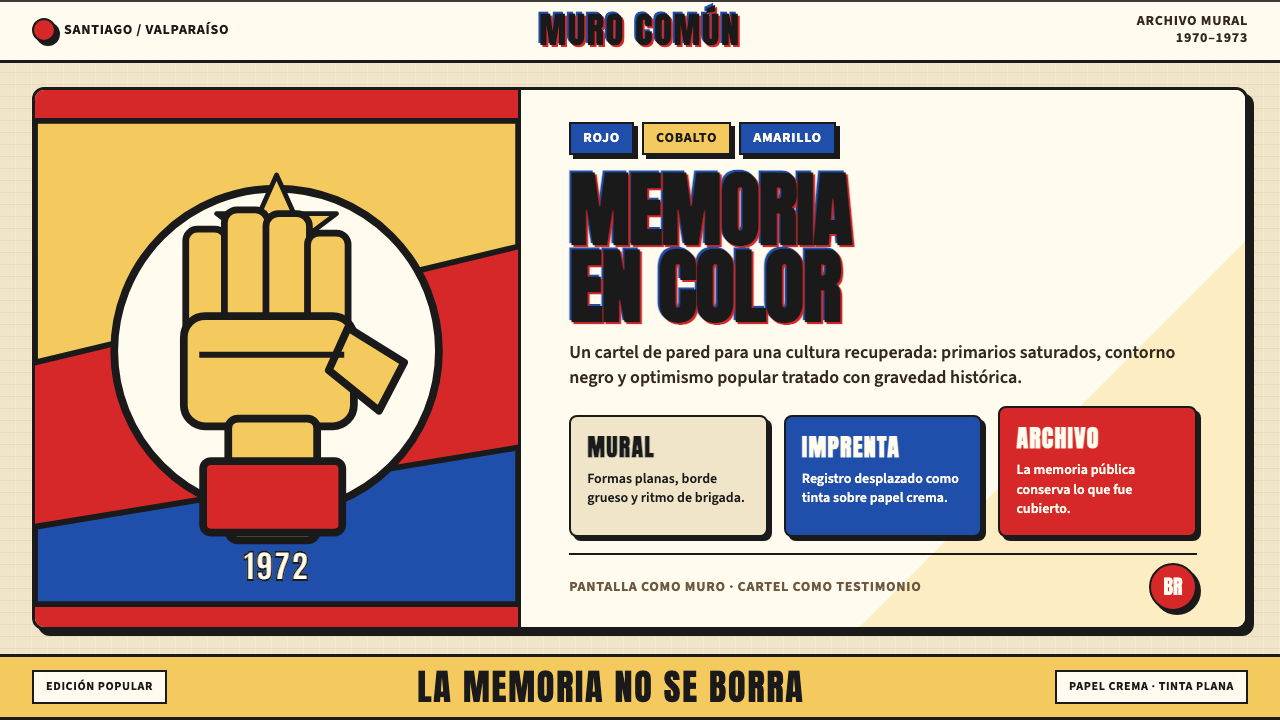 Chilean Allende-Era Propaganda (1972)Solemn revolution. Red, cobalt and yellow lock into thick black mural geometr…
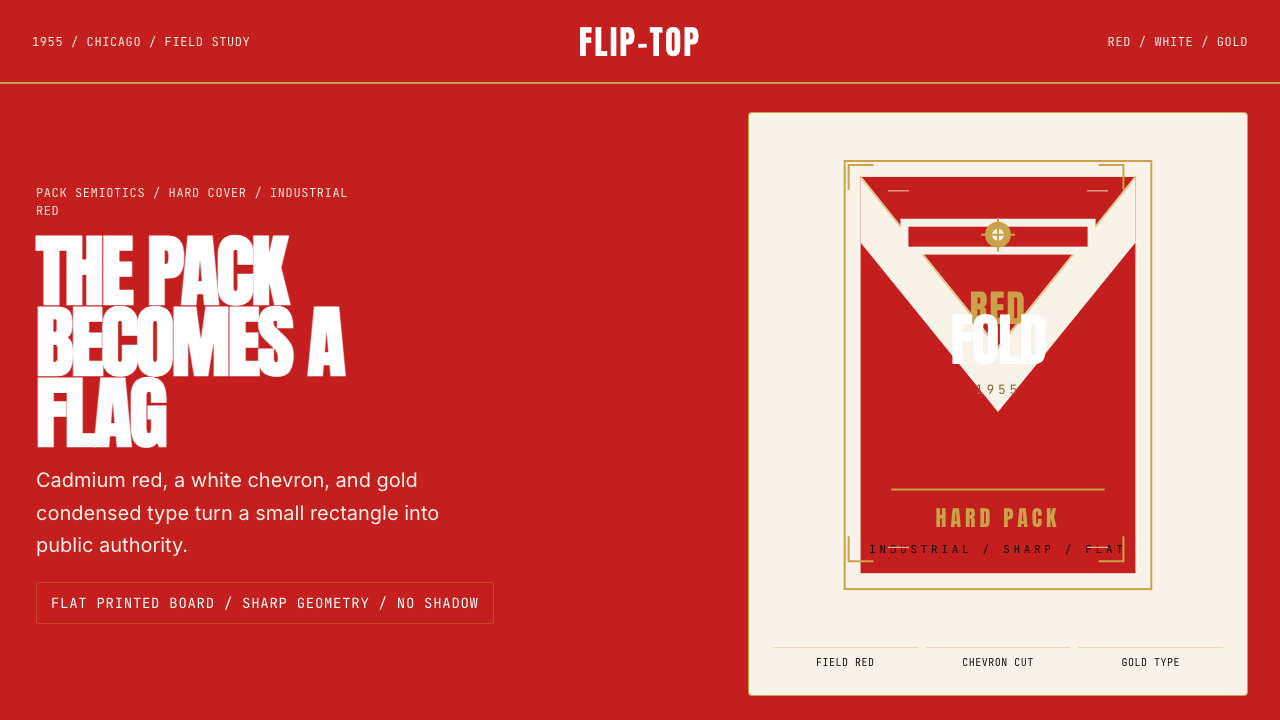 Marlboro Red Flip-Top (1955)Authority in one fold. Cadmium red, white chevron, and gold type read like a…