What is Olympics Five Rings (1912)?
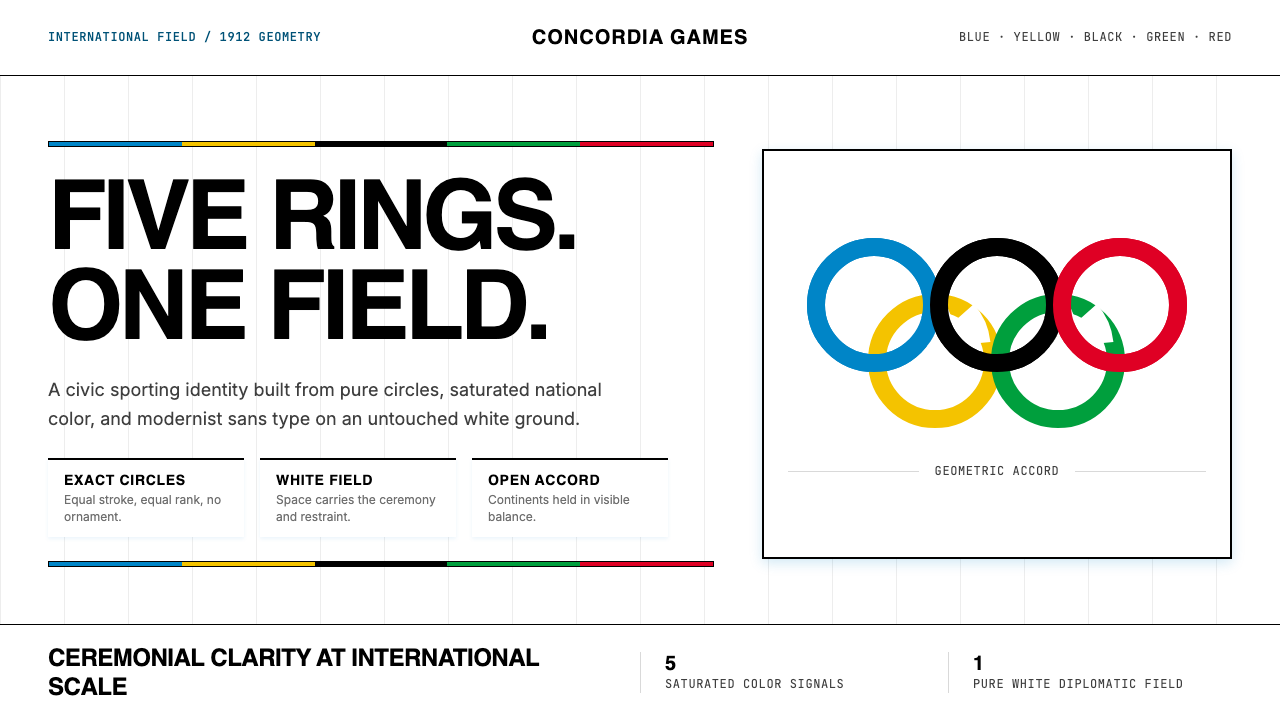
Five interlocking rings on pure white — the Olympic emblem drawn by Pierre de Coubertin in 1912 fused diplomatic symbolism, geometric precision, and saturated civic color into the world's most universally recognized sporting identity.
Olympics Five Rings (1912) in brief
The Olympic Five Rings design is one of the most constrained and consequential visual systems in history: five equally-sized rings in blue, yellow, black, green, and red, interlocking in a single horizontal chain on a field of pure white. Every element is fixed — the proportion of ring diameter to gap, the sequence of hues, the relationship of figure to ground. This rigidity is not accident but doctrine. The emblem must remain legible whether stamped on a podium medal or projected across a stadium facade.
As a design language, the Five Rings aesthetic borrows from the same modernist current that produced the Bauhaus: saturated flat color against generous white space, hard geometric forms with no surface ornament, and a civic gravity that communicates authority without aggression. It is the visual register of the opening ceremony — precise, ceremonial, internationalist. Where Bauhaus work carries a political urgency, the Olympic idiom carries ritual solemnity: the composition is not dynamic but monumental.
The palette itself encodes meaning that has shifted over time. Coubertin's original 1912 reading held that between the five ring colors and the white ground, every national flag in the world could be composed — making the full emblem a chromatic representation of global membership rather than a map of five specific continents. The continental association came later, solidified through IOC communications across the twentieth century. Both readings coexist today, and neither diminishes the emblem's visual authority.

Where does Olympics Five Rings (1912) come from?
The Modern Olympic Games were revived in 1896 by Pierre de Coubertin, a French educator and sports advocate who believed that international athletic competition could foster peace among nations. The early Games operated without a unified visual identity: each host city designed its own posters, programs, and insignia. By the time of the 1912 Stockholm Olympics, Coubertin — then serving as president of the International Olympic Committee — recognized that a permanent symbol was needed, one that could travel across languages, cultures, and political systems without modification.
Coubertin sketched the five-ring emblem in 1912, incorporating it first into a design for the IOC's twentieth anniversary celebration and subsequently proposing it as the official Olympic symbol. His own account stated that the design was entirely his invention, though the precise circumstances of its creation remain a subject of scholarly discussion. The rings appeared publicly for the first time at the 1914 Paris Congress celebrating the IOC's twentieth anniversary, but the Games at which the emblem was formally introduced to international audiences were the 1920 Antwerp Olympics — a choice heavy with symbolic resonance, as Antwerp was still recovering from the devastation of the First World War.
The five colors were chosen with deliberate internationalism. Coubertin wrote in the Olympic Review of 1913 that the six colors combined — the five ring hues plus white — reproduced the colors of all national flags then competing. This was not a symbolic assignment of colors to continents but a claim of total chromatic inclusion. The continental interpretation — blue for Europe, yellow for Asia, black for Africa, green for Oceania, red for the Americas — entered IOC official communications gradually during the mid-twentieth century and is now the dominant public reading, though the IOC itself has at various times clarified that no official color-to-continent assignment was ever formally adopted.
The emblem's visual language was shaped by the broader graphic culture of the early twentieth century: the turn toward geometric abstraction, the influence of international exposition design, and the growing use of standardized symbols in diplomatic and organizational contexts. The five rings share formal kinship with the modernist reduction of complex ideas to simple geometric marks — a sensibility that ran from the Bauhaus workshops in Germany to the Soviet Constructivists to the emerging practice of corporate identity design. What distinguished Coubertin's emblem was its combination of geometric clarity with chromatic richness: rather than reducing to monochrome or near-monochrome, the design committed fully to five saturated hues, making it simultaneously bold and systematic.
What defines the Olympics Five Rings (1912) look?
Saturated Five-Color Palette
The five ring colors — blue, yellow, black, green, and red — are each deployed at full saturation with no tinting, shading, or blending. The palette is neither primary in the strict Bauhaus sense nor analogous in the harmony-theory sense; it is a deliberately diverse chromatic set that reads as globally inclusive. Each color is visually distinct from its neighbors at any scale, ensuring that the interlocking geometry remains legible when reproduced small. The pure white ground provides the maximum possible contrast for all five hues simultaneously.
Geometric Ring Form
The circle is among the most universally legible geometric forms, carrying associations of continuity, wholeness, and equality — no starting point, no hierarchy of edges. Coubertin's choice of the ring (an open circle, a circle defined by its stroke rather than its fill) adds a second layer: transparency and interconnection. Where solid circles would read as distinct colored dots, rings can interlock physically, the overlap zone demonstrating relationship rather than collision. The equal sizing of all five rings reinforces the emblem's core claim of parity among nations.
Horizontal Linked Chain
The five rings are arranged in a single horizontal row, with rings two and four descending slightly to interlock with their neighbors — creating an alternating-height chain. This horizontal orientation carries a reading direction that suits most of the world's writing systems and produces a natural banner-like form appropriate for the ceremonial contexts where the emblem appears. The chain structure implies sequence and connection without hierarchy: no ring sits above the others in the final row.
Pure White Ground
The white ground is not neutral absence but an active sixth element. It maximizes chromatic contrast for all five ring colors simultaneously, ensures reproducibility across surfaces ranging from fabric to stone to digital display, and contributes its own symbolic reading — Coubertin included white explicitly in his original color-inclusivity argument. In practice, the white ground also functions as a visual reset: the generous space surrounding the rings prevents the emblem from appearing crowded and gives the interlocking geometry room to breathe.
Zero Ornament, Total Legibility
The emblem carries no typographic accompaniment in its base form, no decorative borders, no gradients, no drop shadows, no textures. Every element that could qualify as ornament has been removed or was never considered. This discipline is not minimalism for its own sake but a function of the emblem's operational requirements: it must reproduce faithfully at the scale of a lapel pin and at the scale of a building. Any added visual complexity would degrade at small sizes and distort the emblem's neutrality as a symbol of universal membership.
Civic and Ceremonial Gravity
Unlike commercial brand marks, which typically aim for approachability or aspiration, the Olympic emblem is calibrated to communicate institutional authority and solemn occasion. Its symmetrical rhythm, restrained color use (each hue appears exactly once), and clean geometry produce an effect closer to a flag, a seal, or a treaty document than to a logo. When the emblem appears in design work, it imports this ceremonial register — invoking not just a sporting event but a global civic ritual that has been staged continuously since 1896.
Interlocking as Meaning
The interlocking of the rings is not merely compositional — it is the emblem's primary semantic device. Each ring touches its neighbors but remains its own closed form: union without merger, cooperation without loss of individual identity. This structural metaphor scales remarkably well. At the level of a nation it reads as international solidarity; at the level of an athlete it reads as shared endeavor; at the level of a viewer it reads simply as elegant geometric rhythm. Few design decisions in the history of visual identity have done so much semantic work with so little formal complexity.

Who shaped Olympics Five Rings (1912)?
The French educator, historian, and sports advocate who founded the International Olympic Committee in 1894 and revived the Modern Olympic Games in Athens in 1896. Coubertin served as IOC president from 1896 to 1925 and was the sole credited designer of the Five Rings emblem, which he sketched in 1912. His stated intention was to create a symbol that would be genuinely international — not rooted in any single national tradition — and that would communicate the Olympic movement's aspirations through pure form and color rather than text or figurative imagery. His broader intellectual project linked sport to humanist education, and the design reflects this: the emblem is a diagram of a principle, not a depiction of an event.
Founded in Paris in 1894 with Coubertin as its first secretary-general and Demetrios Vikelas as its first president, the IOC became the institutional custodian of the Five Rings emblem. Over the course of the twentieth century, the IOC developed an increasingly detailed set of guidelines governing the emblem's use, proportions, color reproduction, and surrounding clear space — transforming what began as a single hand-drawn symbol into one of the most strictly protected marks in global trademark law. The IOC's management of the emblem across political disruptions, boycotts, and the transition from analog to digital reproduction has kept the Five Rings visually consistent for over a century.
The Antwerp Olympics of 1920 marked the first formal use of the Five Rings flag at an Olympic Games. The choice of Antwerp as host — a Belgian city emerging from four years of German occupation during the First World War — was itself a political statement, and the IOC's decision to deploy the Five Rings emblem at this Games gave the symbol its inaugural public meaning: not merely a geometric device but a proclamation of international renewal after catastrophic conflict. The Antwerp Games also introduced the Olympic oath and the release of doves, cementing the ceremonial visual language with which the Five Rings became permanently associated.
The German graphic designer who created the complete visual identity for the 1972 Munich Olympics, widely regarded as the most systematically designed Games in history. Aicher did not redesign the Five Rings emblem — its form was fixed — but he built a comprehensive design system around it: a rigorous geometric typeface, a color palette of blues and greens that departed from the traditional primary-color heaviness, a set of pictograms for all Olympic sports that reduced athletic figures to horizontal, vertical, and forty-five degree elements. Munich 1972 demonstrated that the Five Rings could anchor a sophisticated modern identity system without being diluted or overshadowed, and Aicher's pictogram methodology became the international standard for wayfinding and sport iconography.
The Japanese designers responsible for the visual identity of the 1964 Tokyo Olympics, which is credited with bringing Japan's postwar graphic design to international attention and demonstrating that the Five Rings emblem could integrate with non-Western visual traditions. Kamekura's poster designs — bold photographic compositions using the Five Rings as a geometric focal point above precise sans-serif type — established a new register for Olympic graphic work: the emblem as anchor for photography and color fields rather than as decorative supplement. Tokyo 1964 remains a benchmark for how a national design tradition can express its own visual logic while remaining fully legible within the Olympic visual system.
How do you use Olympics Five Rings (1912) today?
The Olympic Five Rings aesthetic — saturated flat color on white, hard geometric forms, civic gravity, zero ornament — is among the most transferable ceremonial design languages available. Applying it correctly requires understanding what the system is actually doing: using color to assert presence and differentiation without decorative purpose, using geometric precision to communicate institutional credibility, and using generous white space to give every element the visual authority it needs. The style is not casual and resists contexts that call for warmth or approachability; it is the language of the podium and the opening ceremony, not the locker room.
For presentation slides, the Olympic register works with exceptional force on cover and section-break pages. A cover built in this idiom typically anchors a bold geometric element — a ring form, a concentric circle, a horizontal band — in one saturated color against a white ground, with the title set in a clean geometric sans-serif at commanding scale. Section slides can use the five-color sequence as a navigational system: each section adopts one of the five hues as its dominant accent, creating an ordered progression that feels simultaneously systematic and ceremonial. Data slides should lean into the diagrammatic quality of the style: charts become geometric objects, with bars, arcs, and rings colored according to a strict palette rather than arbitrary software defaults.
For web interfaces, the Olympic aesthetic is well-suited to institutional, civic, and multi-stakeholder platforms where authority and universal legibility are primary concerns — organization landing pages, government portals, international conference sites, and sports data dashboards. The approach: define a clean column grid, keep the background at or near white, use black for all body text and navigation labels, and reserve the saturated colors for primary interactive states, category indicators, or status flags. Hard-bordered components replace soft-shadow cards; block-level color washes replace photographic hero sections. The style reads poorly on consumer-facing e-commerce or social products where emotional warmth is required.
For editorial and marketing work, the Five Rings palette and geometric vocabulary support strong visual hierarchy and memorable poster-like impact. A campaign built in this register uses full-width color blocks — each in a single saturated hue — to separate thematic sections, with white-ground spreads for detailed content. Type is set at extreme scale contrast: a dominant headline at several times the scale of body text, with no decorative devices bridging the two. Marketing materials gain credibility by committing fully to the system: one dominant ring color per layout, a second as structural accent, the white ground always preserved as a breathing zone rather than filled.
A common mistake when working with this aesthetic is treating the five ring colors as a license to use all five simultaneously at equal weight across a composition. Authentic Olympic-register work leads with one or at most two colors; the others appear only incidentally or as a sequential system across multiple pieces. A related error is importing soft gradients, ambient shadows, or photographic textures into a design that otherwise claims the Five Rings vocabulary — these elements belong to a different design register and immediately undercut the civic authority the style depends on. The emblem's power comes precisely from what it refuses.

Olympics Five Rings (1912) — FAQ
Does each ring color officially represent a specific continent?
The continental color assignments — blue for Europe, yellow for Asia, black for Africa, green for Oceania, red for the Americas — are widely repeated but were never formally adopted by the IOC as the emblem's official meaning. Coubertin's own 1913 statement described the six colors (five rings plus white) as collectively reproducing every national flag then in competition, with no continent-to-color mapping. The continental interpretation gained traction through mid-twentieth-century IOC communications and has since become the dominant public understanding. The IOC's current position acknowledges the association while noting it was not part of Coubertin's original design intent. For design purposes, this ambiguity is actually useful: the colors can be used in any order or assignment without contradicting Olympic protocol.
Can the Five Rings aesthetic work on dark backgrounds?
The canonical Olympic ground is white or very near white, and this should be the default. Dark-ground versions are possible — stadium lighting, broadcast graphics, and some official Games design systems have used black or deep blue grounds effectively — but they require care. On a dark field, yellow dominates aggressively, black rings become invisible unless outlined, and the system's reliance on simultaneous contrast for legibility breaks down. A dark-ground adaptation works best when it commits to one or two ring colors as foreground accents against the dark field and treats the other ring forms as structural lines or outlines only. The white ground is not merely convention; it is part of the system's chromatic logic, and departing from it changes the emblem's perceived register from civic ceremony to entertainment spectacle.
How does the Olympic design language differ from Bauhaus?
Both systems share a commitment to geometric form, saturated flat color, and the rejection of surface ornament. But their cultural registers are distinct. Bauhaus work carries a modernist-political urgency — it is design as argument, as ideological position. The Olympic emblem carries ritual solemnity — it is design as covenant, as institutional promise. Bauhaus compositions are typically asymmetric and dynamic, built on tension and reading direction. The Five Rings composition is symmetric in rhythm and monumental in feeling: it does not move the eye through a layout but commands a centered gaze. In practical terms, Bauhaus is more suited to complex information design where hierarchy and flow matter; the Olympic idiom is more suited to identity, ceremony, and moments where a single bold statement is required.
Is the Olympic emblem considered a trademark, and does that affect design use?
Yes, the Five Rings emblem is one of the most comprehensively protected marks in international trademark law, protected under both national laws and the Nairobi Treaty of 1981, which requires signatory nations to protect the symbol against commercial use without authorization. For design work, this means the actual Five Rings emblem cannot be incorporated into commercial work without IOC licensing. However, the aesthetic language of the emblem — its use of saturated ring forms on white, its civic palette, its geometric vocabulary — is not ownable. Designing in a style inspired by the Olympic visual register, without reproducing the emblem itself, occupies different legal and ethical territory. The practical distinction: replicate the specific rings-and-colors configuration and you are in trademark territory; work with rings, saturated flat color, and ceremonial geometry as a design vocabulary and you are working with a visual idiom.
What kinds of projects suit this aesthetic, and where does it struggle?
The Olympic Five Rings aesthetic performs well in contexts where institutional authority, universal legibility, and ceremonial gravitas are desired: annual reports, international organization identity systems, sports federation materials, multi-stakeholder conference design, and public-interest information campaigns. It also works for educational and cultural institutions that want to project credibility across diverse audiences. It struggles in contexts requiring warmth, informality, or cultural specificity: consumer products, food and hospitality brands, children's education, wellness and lifestyle applications, and any context where the user experience depends on organic texture, human warmth, or playful irreverence. The emblem's civic solemnity, which is its greatest strength in appropriate contexts, becomes a liability when the product's essential promise is intimacy or delight.
Related design styles
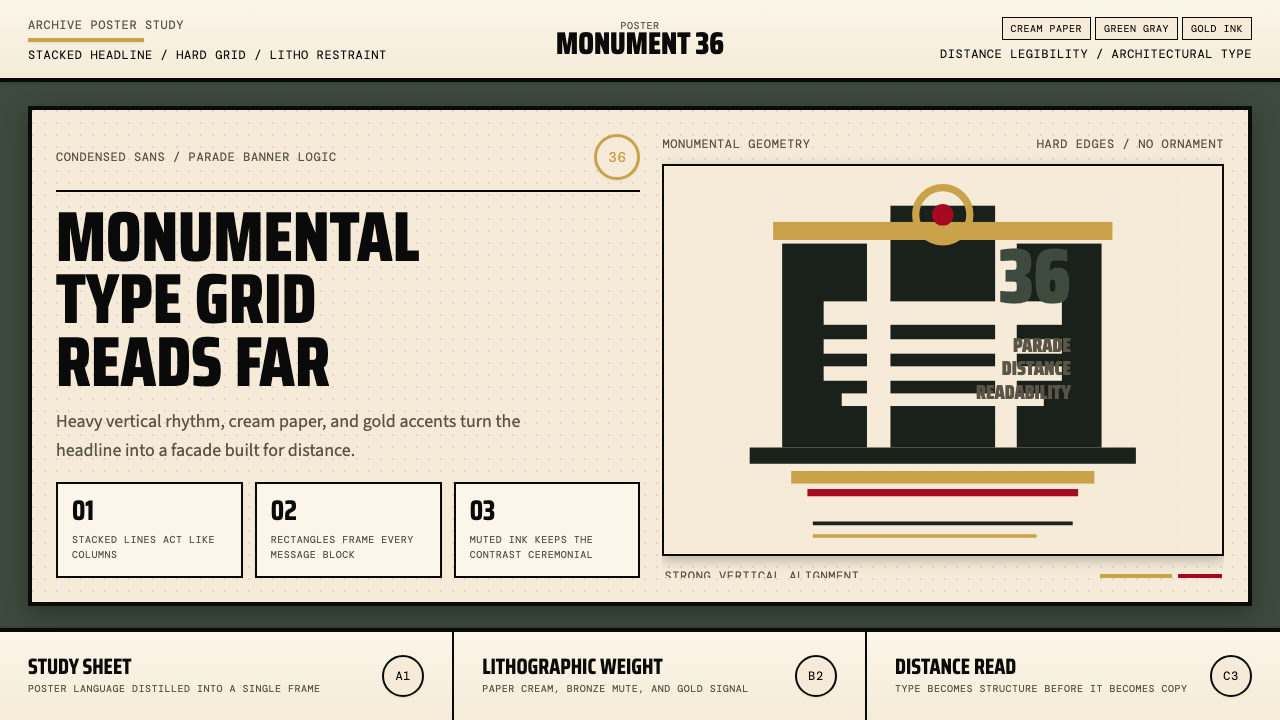 Olympic Poster Berlin (1936)Monumental and legible. Green-gray, cream, and gold turn type into architectu…
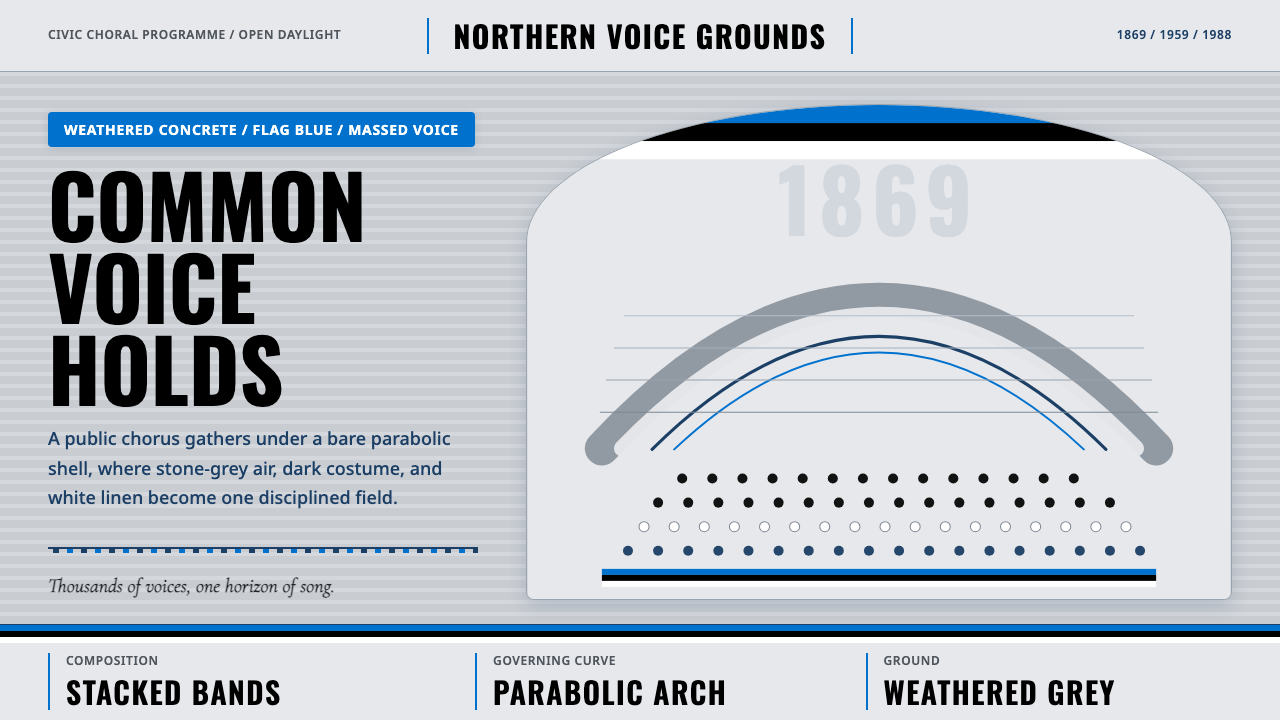 Estonian Song FestivalCivic monumentality sings. Blue-black-white bands meet a concrete arch.
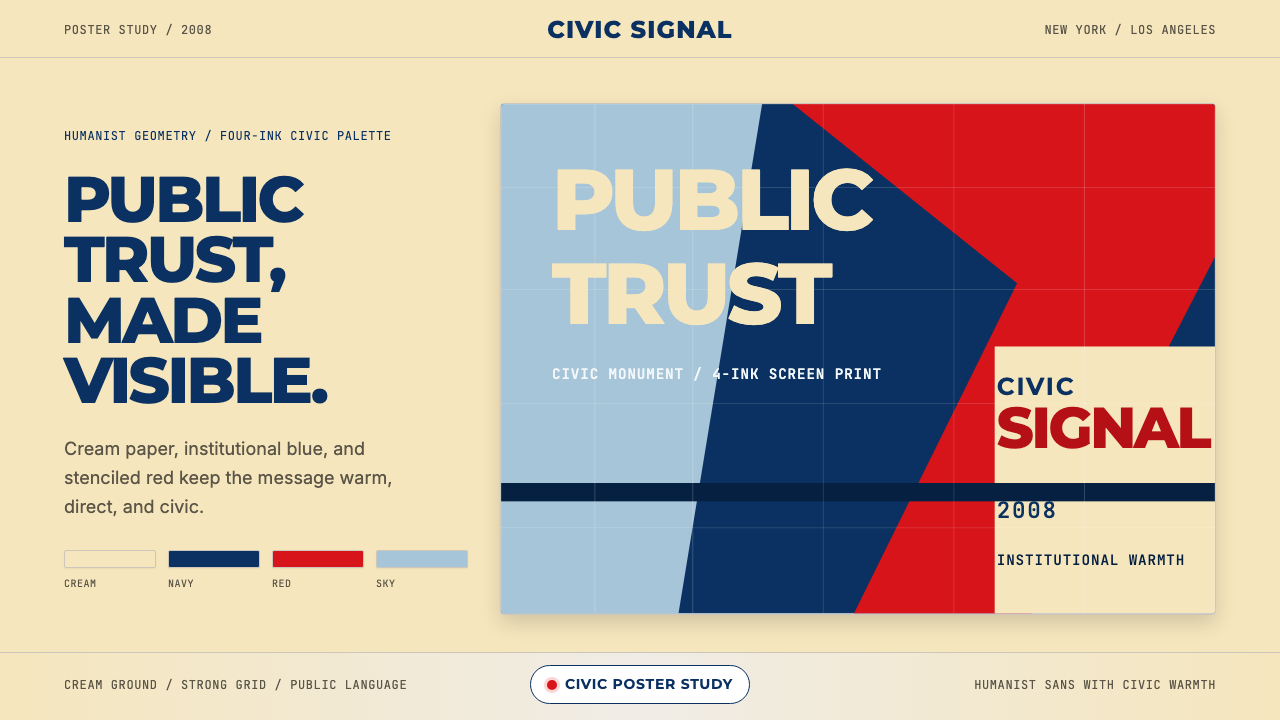 Gotham / Obama Hope Poster (2008)Public trust, made visible. Cream, navy, and red grid the poster.
 Le Corbusier Purist WhiteA house is a white argument: render-white planes, ribbon windows, one slap of…
 Bandung Tropical Art DecoClimate writes the geometry. Bottle-green bands on stucco white make hard sha…
 Baťa Zlín Functionalist BrandMachine-age precision. Brick red, concrete bands, and Oswald type lock into a…