What is Chilean Allende-Era Propaganda (1972)?
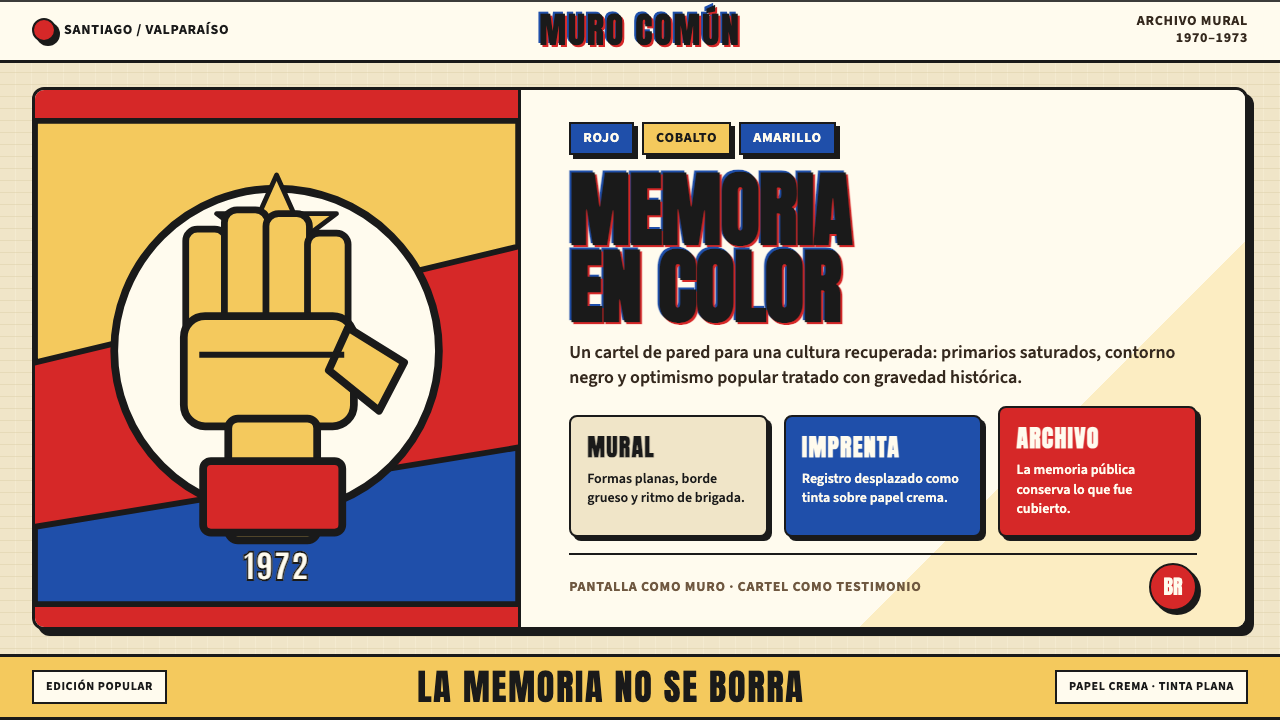
Chile's Unidad Popular government painted revolution in saturated primary red, cobalt blue, and hot yellow — flat, bold, and cut brutally short by a coup.
Chilean Allende-Era Propaganda (1972) in brief
Chilean Allende-Era Propaganda is the visual language produced between 1970 and 1973 by the Unidad Popular government of Salvador Allende and its affiliated cultural organizations. It speaks in flat saturated primary red, cobalt blue, and hot yellow, bound by thick lampblack outlines on a cream-newsprint ground. Every element — from street murals to state-published paperbacks — shares the same visual grammar: bold, confrontational, unapologetically flat.
The style emerged from two principal creative forces. The Brigada Ramona Parra, a muralist collective affiliated with the Chilean Communist Party, developed an outdoor visual system designed to be painted rapidly and read at speed by passersby. Editorial Quimantú, the state publishing house established in 1971, produced affordable paperback books and pamphlets that brought the same visual vocabulary indoors — into homes, schools, and factories. Together, these two channels gave the movement an unusually coherent and widely distributed visual identity.
The aesthetic carries a political gravity that distinguishes it from other Latin American graphic traditions. Clenched-fist motifs, diagonal worker-and-farmer compositions, and monumental sans-serif headlines express revolutionary optimism rather than mere political messaging. The style is encyclopedic in its ambition: it aimed to make culture legible to workers who had been excluded from it, using visual boldness as a form of democratic access.

Where does Chilean Allende-Era Propaganda (1972) come from?
The roots of this visual tradition lie in the broader wave of socialist graphic design that swept Latin America in the 1960s and early 1970s — a period when Cuba's ICAIC posters, Mexican muralism, and Soviet Constructivist influences all circulated freely among left-wing cultural networks across the continent. Chile had its own specific conditions: a large, organized labor movement, a literate urban working class, and a democratic political tradition that gave the left genuine electoral possibilities. When Allende's coalition won the 1970 presidential election, it inherited and accelerated a graphic culture that had already been building for years in labor newspapers, union halls, and student movements.
The Brigada Ramona Parra was founded in the late 1960s, named after a young Communist woman killed by police during a 1946 strike. By 1970, the BRP had developed a distinctive mural methodology: teams of painters would divide a wall into zones, with each member responsible for a specific visual element — outline, fill color, lettering — allowing large-scale works to be completed in a single night. The resulting aesthetic was shaped as much by these production constraints as by any formal theory. Thick outlines were readable from a distance and forgiving of imprecision. Flat solid fills dried faster than blended tones. The palette of red, blue, and yellow corresponded to the cheapest and most widely available exterior paints in Chile at the time.
Editorial Quimantú — the name derives from the Mapuche words for 'sun' and 'knowledge' — was established in 1971 when the Allende government nationalized the Zig-Zag publishing house. Under director Joaquín Gutiérrez, Quimantú published over ten million books in less than three years at prices accessible to working-class readers. The design team, which included graphic artists trained in both local and international traditions, applied the same bold typographic and chromatic logic to book covers, political pamphlets, and illustrated educational materials. The visual connection between BRP murals and Quimantú publications was not formally coordinated but emerged from a shared political and aesthetic environment.
The Larrea brothers — Antonio and Vicente — were among the most significant graphic designers working within this ecosystem. Their poster work for Allende's election campaigns and for cultural events under the UP government synthesized the street-mural energy of BRP with a more formally refined compositional sensibility, demonstrating that the visual language could function at multiple scales and contexts without losing its essential character. Mauricio Babarovic contributed illustration work that translated the flat-color mural aesthetic into printed editorial contexts, extending its reach further into middle-class readership. The September 11, 1973 coup led by General Augusto Pinochet ended this creative moment with sudden violence: BRP murals were whitewashed, Quimantú was shut down and its presses turned over to the junta, and many artists were killed, disappeared, or forced into exile.
What defines the Chilean Allende-Era Propaganda (1972) look?
Color System
The palette is built on three primaries — a warm, insistent red, a deep cobalt blue, and a vibrating hot yellow — deployed against cream or off-white grounds that evoke the newsprint on which much of this work was originally printed. Black is reserved for heavy outlines and headline type rather than used as a background tone. The colors carry political and emotional weight: red signals urgency and solidarity, blue grounds compositions in gravity, yellow energizes. Secondary mixing is almost entirely absent — the palette's power comes from its refusal to soften.
Thick Outline and Mural Geometry
Every form — figure, letterform, symbol — is enclosed by a thick lampblack outline. This convention originated in the BRP's street-mural practice, where heavy borders ensured legibility at distance and compensated for the imprecision of rapid execution. Shapes are reduced to their essential geometry: a fist is a mass of angular wedges, a face a simplified oval with blocked shadow zones. Diagonal lines organize compositions into upward or forward momentum, visually encoding the rhetoric of progress and struggle.
Typography
Headlines are set in wide, bold, uppercase sans-serif letterforms that occupy the full width of their allotted space — a style influenced by both commercial signpainting traditions and the geometric sans-serifs circulating in international socialist graphic design of the era. Letter-spacing is tight to zero, maximizing density and visual weight. Body text, where it appears, uses narrower weights of the same genre, creating clear hierarchy through scale contrast alone. Text is frequently set at a slight diagonal, reinforcing the kinetic energy of the overall composition.
Figure and Symbol
The human figure is the dominant subject — specifically the laboring figure: the miner with helmet, the factory worker with raised fist, the campesino with tool in hand. These figures are rendered without individuating detail, as types rather than portraits, so that the viewer projects collective identity onto them. The clenched fist, the raised arm, the dove, and the star appear as recurring symbolic vocabulary. Compositional logic places figures rising toward the upper-right corner of the frame, a visual convention encoding aspiration and futurity.
Flatness and Anti-Illusionism
There are no gradients, no soft shadows, no modeled volumes suggesting three-dimensional space. Every element is flat. Depth, where it must appear, is created through overlapping flat planes rather than perspective or atmospheric haze. This flatness was both a production necessity — fast-drying solid colors applied with broad brushes — and an ideological position: the work refused bourgeois refinement in favor of proletarian directness. The result reads equally well at the scale of a building-side mural and at the scale of a book cover.
Paper and Ground
Where print materials survive, they reveal an intentional relationship with their substrate. Quimantú publications used inexpensive newsprint and uncoated stock, and designers worked with rather than against these surfaces — allowing the warm cream or grey of the paper to function as a fourth tone in the composition alongside the three primaries. This is not poverty aesthetics accidentally preserved; it is a deliberate chromatic system in which the ground participates as an active color.
Political Legibility as Design Principle
Every formal decision in this style subordinates itself to a single overriding objective: maximum communicative impact on a viewer who may be illiterate, passing at speed, or encountering the image at distance. This is a design system optimized for the public sphere rather than the gallery. Scale hierarchy, figure-ground contrast, symbolic vocabulary, and diagonal energy all serve legibility before they serve aesthetics. The measure of a successful piece in this tradition is whether it communicates its message before the viewer has consciously decided to read it.

Who shaped Chilean Allende-Era Propaganda (1972)?
As president of Chile from 1970 until his death during the 1973 coup, Allende was the central political figure whose government created the conditions for this visual culture to flourish. His image — typically rendered in the flat portrait style of BRP murals, with clenched jaw and steady gaze — became one of the most reproduced political portraits in Latin American graphic history. The visual legacy of his government has been actively recovered and recontextualized since Chile's return to democracy in 1990, making Allende's portrait simultaneously a historical document and a living symbol of democratic resistance.
The BRP was not a single artist but a collective — at its peak numbering in the hundreds — that operated as a coordinated visual force across Santiago and other Chilean cities. Their mural methodology, developed under the practical pressures of rapid nocturnal production, created the formal vocabulary that defined the entire era: thick outlines, flat primaries, diagonal figures. Several BRP members were killed or disappeared after the 1973 coup. The collective survived underground and in exile, and its surviving members and successors continue to produce murals in Chile today.
Vicente Larrea, working alongside his brother Antonio, produced some of the most formally accomplished graphic work of the Unidad Popular era. Their poster designs for Allende's presidential campaigns and for cultural events under the UP government showed how the visual language of political muralism could be translated into refined print design without losing its essential urgency. The Larrea brothers synthesized street graphic energy with a compositional sophistication that gave the style credibility across social contexts, from factory walls to university galleries.
Quimantú functioned as an institution as much as a design identity. Established in 1971 from the nationalized Zig-Zag publishing house, it published over ten million books in under three years at prices specifically calibrated for working-class readers. Its design output — book covers, series identity systems, illustrated pamphlets — extended the chromatic and typographic logic of the BRP murals into the domestic sphere. The consistency of Quimantú's visual program across hundreds of titles made it one of the most coherent state publishing design systems in twentieth-century Latin American history.
Babarovic contributed illustration and editorial design work that translated the flat-color aesthetic of the muralist tradition into finer-grained printed contexts. His work for Quimantú publications demonstrated that the formal language of outdoor muralism — thick outlines, flat color zones, simplified figure types — could carry intellectual and literary content without collapsing into mere propaganda. His contribution widened the style's social reach, making it credible to readers who might have dismissed purely street-political imagery as agitprop.
How do you use Chilean Allende-Era Propaganda (1972) today?
Chilean Allende-era propaganda is a visually powerful but culturally loaded historical style. Applying it responsibly requires acknowledging its political weight and treating it with the same seriousness one would bring to any design language rooted in historical trauma and struggle. When used for contemporary projects — presentations, editorial design, digital interfaces — the application should draw on the formal vocabulary while remaining conscious of the cultural context it inherits.
For presentation slides, the style works with exceptional force on cover and title pages. A cover composition benefits from a dominant diagonal element — a figure or abstract wedge form — rendered in one heavy primary against a cream or off-white ground, with the title set in wide uppercase type that stretches nearly edge to edge. Content slides should commit to the style's hierarchical clarity: one large typographic element per slide sets the register; supporting points sit in a smaller weight of the same genre without additional decoration. Data visualizations take on a poster-like quality when bar charts and proportional diagrams are rendered in the primary palette with thick black borders on each element, turning data into graphic forms rather than neutral chart objects.
For web interfaces, the visual system translates most naturally into contexts that benefit from bold, high-contrast information hierarchy: editorial landing pages, cause-driven organization sites, cultural event pages, and campaign microsites. The approach is to commit fully to a cream or warm off-white background, use a single dominant primary for interactive and structural accents, and reserve the other primaries for categorical distinction rather than decoration. Typography should be wide and bold in headlines, with clear scale breaks between heading and body levels. Navigation bars and section headers can use the thick-rule convention derived from the mural tradition — a heavy horizontal stroke as section delimiter rather than a hairline.
For editorial and marketing work, this style generates immediate visual authority. Feature spreads and report covers respond well to the asymmetric diagonal composition: a large simplified figure or geometric mass occupying one half, with the title and key information locked into high-contrast type on the opposing half. Campaign materials — posters, social cards, printed pamphlets — are the most natural application because the style was originally built for exactly these formats. Marketing pages can use the alternating ground convention: a cream section followed by a red or deep blue section, each carrying the same typographic weight so that neither interrupts the reading rhythm.
A common mistake when applying this style is treating it as a generically bold red-and-black visual system — flattening its specificity into something that reads more like a sports brand or action graphic than a historical graphic language. Authentic application requires the cream ground, the three-primary constraint, the thick outline convention, and the figure-based compositional logic to work together. A second common mistake is using photographic imagery in a naturalistic way: if photography appears, it should be treated as a flat graphic element — high-contrast, reduced to near-silhouette, with color removed or replaced by a primary tone — so that it integrates with the flat-color system rather than creating a tonal discontinuity.

Chilean Allende-Era Propaganda (1972) — FAQ
How does this style differ from Cuban revolutionary poster design of the same era?
Cuban ICAIC posters, produced from the early 1960s onward, drew heavily on European Surrealism, optical art, and photomontage — producing a graphic tradition that was more internationally cosmopolitan and formally experimental. Chilean Allende-era design, by contrast, was shaped by the constraints of rapid mural production and cheap newsprint printing. It is rawer, more typographically frontal, and more reliant on thick-outline figure drawing than Cuban work. Both traditions share flat color and political urgency, but the Chilean aesthetic is closer to muralism and street poster practice, while Cuban graphic design engaged more directly with international fine art movements.
Is it appropriate to use this style for commercial projects?
The question of appropriateness depends on context, intent, and transparency. The visual language was produced by and for a political movement that ended in mass violence; using it purely for commercial gain without acknowledgment risks reducing it to aesthetic decoration. Where the style is most appropriately used commercially is in contexts where its values align with the project's values: labor rights organizations, cultural institutions, publications dealing with political history, or campaigns for causes with a genuine connection to democratic or social justice themes. If a commercial project draws on this style, brief contextual acknowledgment — in a style guide note, an about page, or an artist's statement — is a meaningful way to treat the source material with respect.
How should photography be integrated if imagery is needed?
Photography should be treated as a graphic element rather than a naturalistic document. The approach is to push contrast to near-maximum, reducing the image to strong figure-ground separation, then to apply a flat primary color tone over the midtones — a technique related to duotone printing — so that the photograph reads as part of the flat-color system rather than as a separate photographic register. Cropping should be aggressive, cutting to the essential silhouette of the subject. Photographic images treated this way integrate with the style's flatness and reinforce rather than interrupt its visual logic.
What digital contexts suit this style and which do not?
This style suits contexts where bold hierarchy, strong identity, and political or cultural seriousness are appropriate values: campaign sites, cultural organization pages, editorial publications, event promotion, and social advocacy materials. It is less suited to transactional contexts — e-commerce product pages, consumer app interfaces, or business software dashboards — where the style's confrontational visual weight can feel mismatched with a user experience requiring smooth, low-friction interaction. It is also unsuitable for contexts requiring warmth and intimacy, such as health applications, children's platforms, or personal service brands, where the bold palette and heavy type conventions would create tonal dissonance.
How does the style handle dark or inverted backgrounds?
Historically, this visual language was light-ground — cream and off-white were the canonical surfaces, derived from the newsprint and uncoated stock on which most work was produced. A dark inversion is possible but requires care. On a deep black or very dark ground, red retains its urgency but yellow becomes intensely dominant, and the cream-paper warmth that moderates the palette is lost entirely. A dark variant works best when it commits to a single primary foreground color — typically red or blue — and uses white or cream for type only, treating the dark ground as a night-mural convention rather than as a true palette inversion. Cobalt blue on a near-black ground, with cream type, comes closest to historical precedent in the tradition's nighttime street-painting practice.
Related design styles
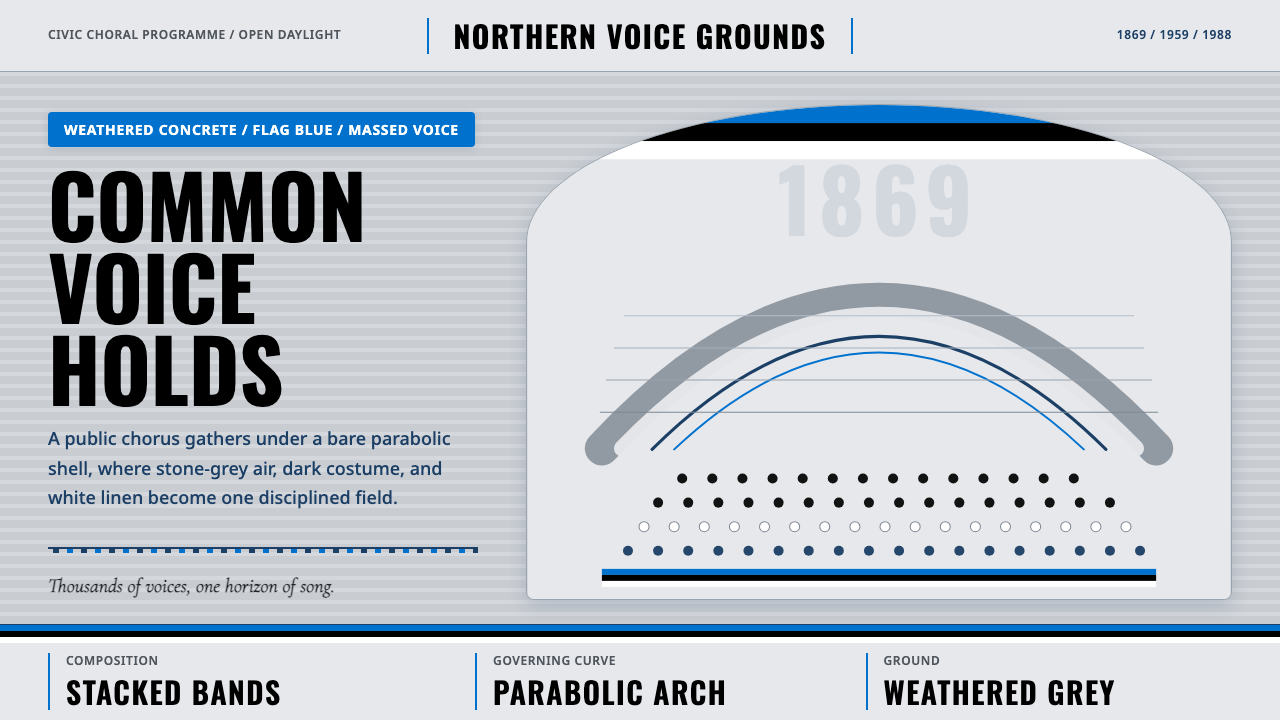 Estonian Song FestivalCivic monumentality sings. Blue-black-white bands meet a concrete arch.
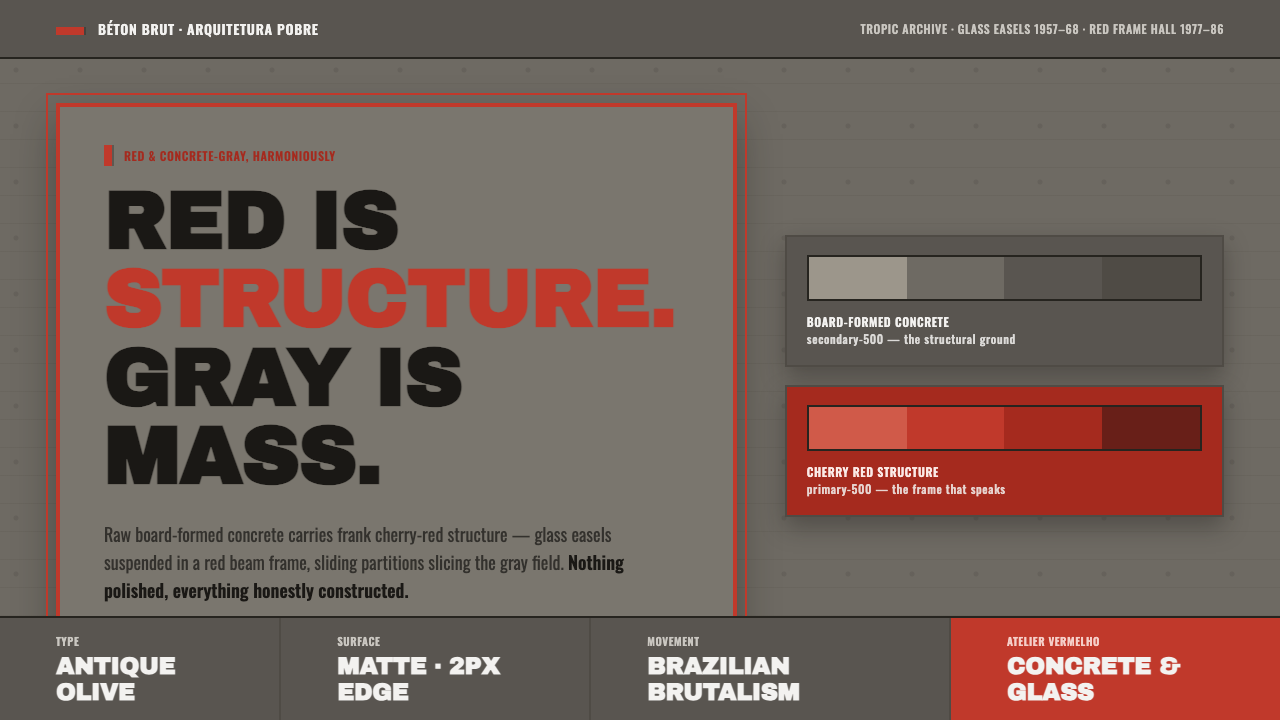 Lina Bo Bardi ConcreteRed is structure, gray is mass. Cherry-red beam frames suspended over board-f…
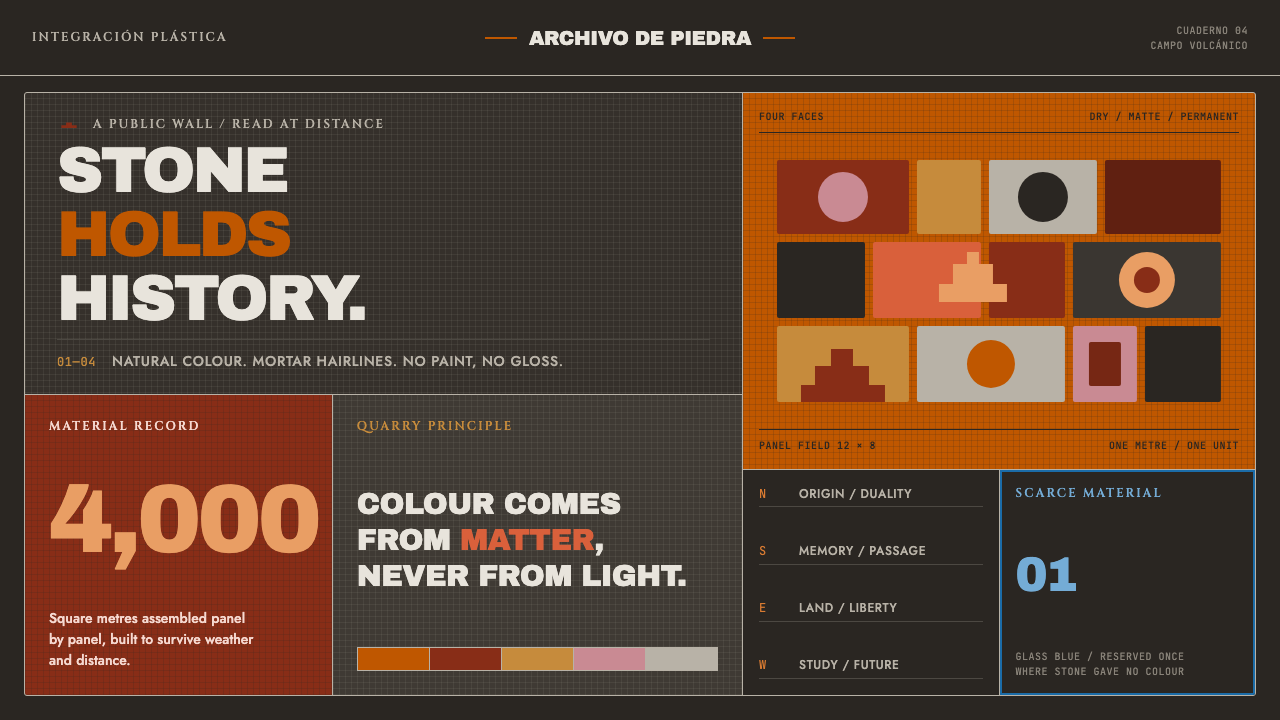 UNAM Library MosaicStone outlasts paint. Burnt-orange panels lock across volcanic gray with one…
 Yugoslav Socialist ModernismGeometry on concrete. EXAT-51 circles and bars in hot orange and clean teal,…
 Air Niugini Livery 1975A flag engineered for flight. Signal red sweeps across enamel white, underlin…
 Dhaka Shaheed MinarSolemn before dawn. Marble columns and one red sun hold the page in civic sil…