What is Lance Wyman Mexico Olympics (1968)?
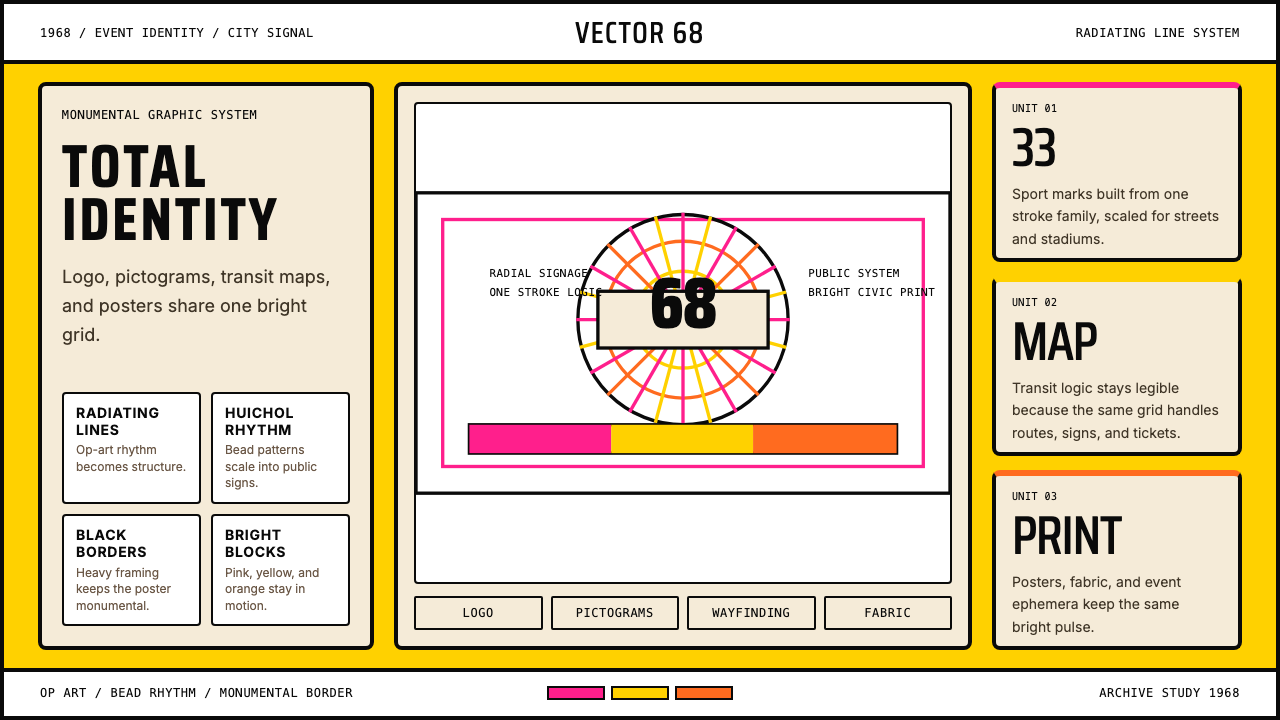
Lance Wyman's 1968 Mexico City Olympics identity proved that a single visual system — radiating lines fused with Huichol beadwork rhythms — could make an entire city legible to visitors speaking dozens of languages.
Lance Wyman Mexico Olympics (1968) in brief
The 1968 Mexico City Olympics identity is the most fully resolved example of total event graphic design ever produced. Every component — the logotype, the numbered pictograms for each sport, the wayfinding system across stadiums and transit, the color palette, the poster series, and the television graphics — was governed by a single visual logic. Nothing was left to chance or to a separate contractor with a different sensibility. The result is a body of work that still reads as a coherent, singular voice half a century after the games closed.
The defining motif is the radiating line: concentric rings that expand outward from a central point, creating an optical vibration associated with the Op Art movement then at its international peak. But Wyman and his collaborators did not simply import a European art-world trend. They fused the Op Art energy with the visual grammar of Huichol Indian beadwork, an indigenous Mexican tradition in which tiny glass beads are pressed into wax in concentric, spiraling patterns that similarly generate optical movement. The result was a visual system that could claim modernist internationalism and Mexican cultural specificity simultaneously — a rare achievement in Olympic branding, where generic universalism is the default.
Visually, the system is warm and saturated rather than cool and minimal. The palette runs across a wide band of intense hues — sun-baked orange, deep rose, leaf green, bright turquoise, and strong magenta alongside the more neutral black and white — without ever feeling chaotic, because every color serves a coded function in the wayfinding hierarchy. Type is treated as pure form: the logotype famously locks the word MEXICO into the rings of the numerical identifier 68, making letter and number inseparable. The pictograms reduce each sport to an arrangement of geometric strokes that harmonize with the radiating ring motif at any scale.

Where does Lance Wyman Mexico Olympics (1968) come from?
The commission began in 1966, two years before the games, when Mexico City was awarded the 1968 Summer Olympics — the first time the Games had been hosted in a Latin American country and the first time in a developing nation. The organizing committee, led by architect Pedro Ramírez Vázquez, understood from the outset that the visual identity had to do double duty: serve functional wayfinding for an international audience while projecting a confident image of Mexican modernity to a world that harbored doubts about the country's organizational capacity. Ramírez Vázquez recruited Lance Wyman, a young American graphic designer then based in New York, after seeing his work in an international design competition. Wyman was not yet thirty.
Wyman traveled to Mexico City and spent time studying the country's visual culture before proposing a direction. The encounter with Huichol beadwork — and more broadly with pre-Columbian graphic traditions, including the repeating geometric patterns of Aztec and Zapotec decoration — convinced him that the Op Art tendency he was already exploring had a deep resonance with indigenous Mexican visual forms. This was not superficial cultural borrowing: the structural similarity between Op Art's optical grids and Huichol beadwork's concentric spiral logic is genuine, and Wyman's design exploits it to produce something that feels simultaneously ancient and radically contemporary. His collaborator Eduardo Terrazas, a Mexican architect and designer, was instrumental in ensuring the cultural grounding was substantive rather than decorative.
The editorial coordinator Beatrice Trueblood played a critical role in ensuring the system extended into print and publication, overseeing the official Olympic publications that carried the visual identity into contexts far beyond stadium wayfinding. The pictogram system was developed by Wyman in close coordination with the broader team, and it set a standard that every subsequent Olympic design program has had to acknowledge. The 1972 Munich Olympics, designed by Otl Aicher, is often considered the more rigorously systematic successor — but it was Mexico 1968 that established the idea that pictograms should function as a self-contained graphic alphabet rather than merely illustrative icons.
The games themselves took place against a backdrop of social and political turbulence: the Tlatelolco massacre, in which Mexican security forces killed student protesters just ten days before the opening ceremony, cast a long shadow. The visual identity system, conceived in more optimistic years, was completed and deployed regardless. It has since been studied and celebrated almost entirely on its formal merits — as a landmark of graphic modernism — with the political context forming an inescapable footnote to its reception history. The identity was canonized almost immediately, appearing in design annuals and museum collections by 1969 and 1970, and it has never left the canon.
What defines the Lance Wyman Mexico Olympics (1968) look?
Radiating Rings
The fundamental visual unit of the entire system is the concentric ring expanding from a point — a motif that simultaneously invokes Op Art optical vibration and the spiral geometry of Huichol beadwork. These rings appear at every scale, from the master logotype down to small directional indicators. They give the system its sense of energy in stillness: the rings do not depict motion but create the sensation of it through pure optical geometry.
Typographic Integration
The master logo fuses the word MEXICO with the numeral 68 in a way that makes neither element legible in isolation — the letters of the city name flow through and lock into the ring structure of the year digits. This is typography treated not as a label applied to a graphic but as a structural participant in the same visual system. The typeface used across the system is bold, rounded, and closely tracked, harmonizing with the curved geometry of the rings rather than working against it.
Warm, Coded Palette
Unlike many modernist identities that restrict themselves to a handful of colors, the Mexico 1968 system deploys a generous palette of saturated warm and cool hues. Each color is coded to a function — identifying sports categories, distinguishing venue zones, or signaling transportation modes — so the richness never becomes arbitrary. The palette reads as festive and energetic without sacrificing the legibility that wayfinding demands.
Pictographic Alphabet
The sport pictograms are built from the same stroke logic as the radiating ring motif: each figure is composed of bold geometric arcs and lines that echo the system's master geometry. A figure skating icon does not attempt to realistically depict a skater — it reduces the essential movement and equipment to an arrangement of curved strokes that harmonizes visually with a running-track icon or a swimming icon beside it. The pictograms function as a closed family, not a collection of illustrations.
Wayfinding as Total System
The identity extended beyond print and broadcast into the physical environment of Mexico City itself: signage, banners, pavement graphics, and vehicle livery all drew from the same visual grammar. A visitor arriving without any Spanish could navigate using color and pictographic form alone. This ambition — that a graphic identity should make a city fully navigable — set the precedent that every subsequent Olympics organizing committee has been measured against.
Cultural Hybridity
The system's deepest characteristic is its refusal of the usual choice between universal modernism and local cultural expression. The Op Art influence placed it firmly in the international avant-garde of the late 1960s; the Huichol beadwork resonance grounded it in a specific indigenous Mexican tradition. The two reference points do not coexist superficially — they share a genuine structural logic that Wyman identified and exploited. Cultural hybridity here is not decoration applied over a neutral base; it is the load-bearing logic of the entire visual architecture.
Scale Invariance
The radiating ring motif works at every scale without modification: as a monumental stadium banner several meters wide, as a lapel pin a centimeter across, as a television graphic filling a broadcast frame for a fraction of a second. This scale invariance was not accidental — it was a deliberate criterion built into the design logic from the outset. A system that must operate simultaneously at architectural and typographic scales cannot depend on fine detail or soft gradation; it must be built from bold, simple geometry that holds its identity at any reproduction size.

Who shaped Lance Wyman Mexico Olympics (1968)?
Wyman was the creative director of the entire 1968 Mexico City Olympics visual identity program. A New Yorker who had trained in industrial design before moving into graphic practice, he was in his late twenties when the commission began. His design approach — starting from research into local cultural forms before proposing a visual direction — was less common in international sports branding at the time than it is today. After Mexico 1968, he went on to design the identity for the 1970 FIFA World Cup (also held in Mexico) and became a central figure in information design and wayfinding, eventually designing systems for the Washington D.C. Metro. He has described the Mexico project as the work that formed his understanding of what a total identity system could be.
Terrazas served as the lead Mexican collaborator on the project, working closely with Wyman on the visual identity while also contributing to the broader cultural programming of the games. An architect and designer who had studied in Los Angeles and New York, he brought an understanding of both Mexican visual tradition and international design discourse that was essential to the project's claim to cultural authenticity. Terrazas went on to become an internationally recognized artist whose own practice — particularly his use of concentric geometric patterns derived from Huichol sources — can be read in direct conversation with the 1968 identity work. He has said that the project confirmed for him that indigenous visual forms were not raw material to be refined by modernism but a fully developed visual intelligence in their own right.
As president of the Mexico 1968 organizing committee and one of Mexico's most prominent architects, Ramírez Vázquez was the institutional authority who both hired Wyman and gave the design program the organizational support it needed to become a total system rather than a logo and a few posters. His own architectural practice — including the National Museum of Anthropology in Mexico City, completed in 1964 — reflected the same interest in fusing international modernism with pre-Columbian visual heritage that Wyman's identity program embodied. His decision to treat the visual identity as a serious design commission rather than a marketing exercise was the precondition for everything the program achieved.
Trueblood served as editorial coordinator for the 1968 Olympics, overseeing the official publications — guides, programs, and commemorative volumes — that extended the visual identity into the printed page at a scale and quality level that matched the environmental and broadcast applications. Her role ensured that the system's coherence was not limited to signage and television but was maintained across every printed surface the games produced. The official publications from Mexico 1968 are among the most collectible artifacts of twentieth-century graphic design, and the consistency of their design owes a great deal to Trueblood's editorial oversight.
How do you use Lance Wyman Mexico Olympics (1968) today?
Applying the Mexico 1968 visual language to contemporary work requires understanding what the system is actually doing structurally: it creates cohesion across radically different applications — from a stadium banner to a lapel pin to a television lower-third — by building everything from the same geometric motif and the same color-coded hierarchy. The radiating ring, the bold strokes, and the warm saturated palette are not decorative flourishes; they are the system's engineering. Any application that treats these elements as surface ornament rather than structural logic will produce pastiche rather than a coherent design.
For presentation slides, this system translates into a cover treatment built around a central radiating ring element that anchors the slide and pulls the eye to the title. The rings should expand outward from a point that is deliberately off-center — upper left or lower right — creating compositional tension rather than static symmetry. Content slides should be organized around a single bold structural color per slide, with subordinate information rendered in a neutral tone. Data slides benefit enormously from the pictographic logic: treat chart elements as geometric objects that belong to the same visual family as the system's icons, rather than default chart styles imported from a spreadsheet application.
For web interfaces, the Mexico 1968 approach is particularly effective in navigation systems, event pages, and any interface where a large number of categories must be distinguished quickly. The color-coding logic — where each category receives a distinct saturated hue that persists across all representations of that category — is directly applicable to product taxonomy, service tier differentiation, or multi-sport scheduling interfaces. Interactive states benefit from the ring motif: a hover or selection state can be indicated by a radiating ring that expands outward from the selected element, communicating activation through the system's own visual language rather than an imported interaction pattern.
For editorial and marketing work, the system's poster heritage is the most immediately useful reference. Full-bleed backgrounds in a single saturated hue, with the primary content element — a title, a figure, a product — treated as a bold geometric object against that field, produce work that is instantly energetic without becoming busy. The key discipline is restraint in the number of active colors per composition: the Mexico 1968 posters typically commit to one dominant hue and one or two supporting tones, never attempting to demonstrate the full palette's breadth in a single frame. Event announcements, conference materials, and seasonal campaign assets are all natural applications.
The most common mistake when working with this system is treating the radiating ring as a decorative backdrop rather than a structural element. In the original work, the rings are the architecture — they organize space, direct the eye, and create hierarchy. When applied as a texture or a background pattern behind unrelated type and imagery, they lose their structural function and become visual noise. A second frequent error is expanding the palette arbitrarily: the warmth and richness of Mexico 1968's color is achieved through careful orchestration of specific hues, not through adding more colors. Adding a pastel or a muted earth tone to approximate the 'feel' of the system typically undermines the optical energy that makes it distinctive.

Lance Wyman Mexico Olympics (1968) — FAQ
How closely is the Mexico 1968 identity tied to Op Art, and can I use one without the other?
The Op Art connection is real but not deterministic. What Wyman took from Op Art was the radiating concentric ring as a generator of optical movement — not the full toolkit of Op Art, which includes figure-ground inversions, moiré patterns, and high-contrast black-and-white illusionism. The Mexico 1968 system is warmer, more colorful, and more symbolically organized than a pure Op Art work. You can use the radiating ring motif without the aggressive optical destabilization of classic Op Art, and the result will read as Mexico 1968 rather than Bridget Riley. Conversely, you can employ Op Art's disorienting figure-ground play without the ring motif and without any Mexican cultural reference — that is simply Op Art, not Mexico 1968.
Is it culturally appropriate to use the Huichol visual reference in non-Mexican design contexts?
This is a genuine question that did not receive much scrutiny in 1968 but has become more central to design ethics since. The Mexico 1968 identity used the structural logic of Huichol beadwork — the concentric spiral geometry — rather than directly reproducing sacred iconography or specific cultural artifacts. Wyman worked alongside Eduardo Terrazas, a Mexican collaborator with deep knowledge of that tradition, and the approach was sanctioned by a Mexican state institution. Applying the resulting visual language — the radiating ring as a modernist graphic device — is several steps removed from appropriating Huichol cultural property directly. When in doubt, work at the level of structural abstraction rather than specific cultural symbol, acknowledge the source, and avoid representing the derivative work as a documentation of indigenous tradition.
How does Mexico 1968 relate to later Olympic identity systems, particularly Munich 1972?
Mexico 1968 and Munich 1972 are the two most studied Olympic identity systems and are often discussed as a pair, but they represent different design philosophies. Mexico 1968 is warm, culturally specific, and generates its coherence through a single dominant motif — the radiating ring — applied across all touchpoints. Munich 1972, designed by Otl Aicher and his team, is cooler, more systematically gridded, and derives its coherence from a comprehensive manual of typographic, photographic, and color rules rather than from a single visual element. Munich is more rigorous typographically and more photographically rich; Mexico is more visually immediate, more motif-driven, and more culturally legible at a distance. Both set standards that subsequent Olympic programs have struggled to match; most fall short of both.
Can the system work in a minimal, reduced form — just the ring motif, without the full warm palette?
Yes, and it has been done effectively. The radiating ring stripped back to a single color — or even rendered in black only — retains its optical energy and its identification with the Mexico 1968 tradition. A monochromatic or duotone application of the ring motif reads as a knowing, restrained reference to the system rather than a full deployment of it. This reduction is appropriate for contexts that cannot accommodate the warm palette — technical documentation, scientific publications, or products where the organizational culture prefers a cooler register. The risk is that without the color coding that gives the system its wayfinding logic, the rings become purely decorative; maintaining even a limited coded use of one accent color helps preserve the structural intent.
What distinguishes an authentic Mexico 1968 application from a generic 'retro Olympics' pastiche?
The distinguishing factor is structural logic versus surface quotation. An authentic application builds its composition from the radiating ring as an organizing principle — the ring determines the hierarchy, the rhythm of the layout, and the integration of type with image. A pastiche, by contrast, takes the ring as a decoration and places it behind or beside a layout that is otherwise organized on entirely different logic. You can tell the difference by asking: if you removed the ring, would the composition still work? In pastiche, it usually would — the ring is furniture. In an authentic application, removing the ring removes the composition's reason for being. The same test applies to the color palette: in a genuine application, each color has a coded function; in pastiche, the warm hues are applied for 'vibe' without systematic purpose.
Related design styles
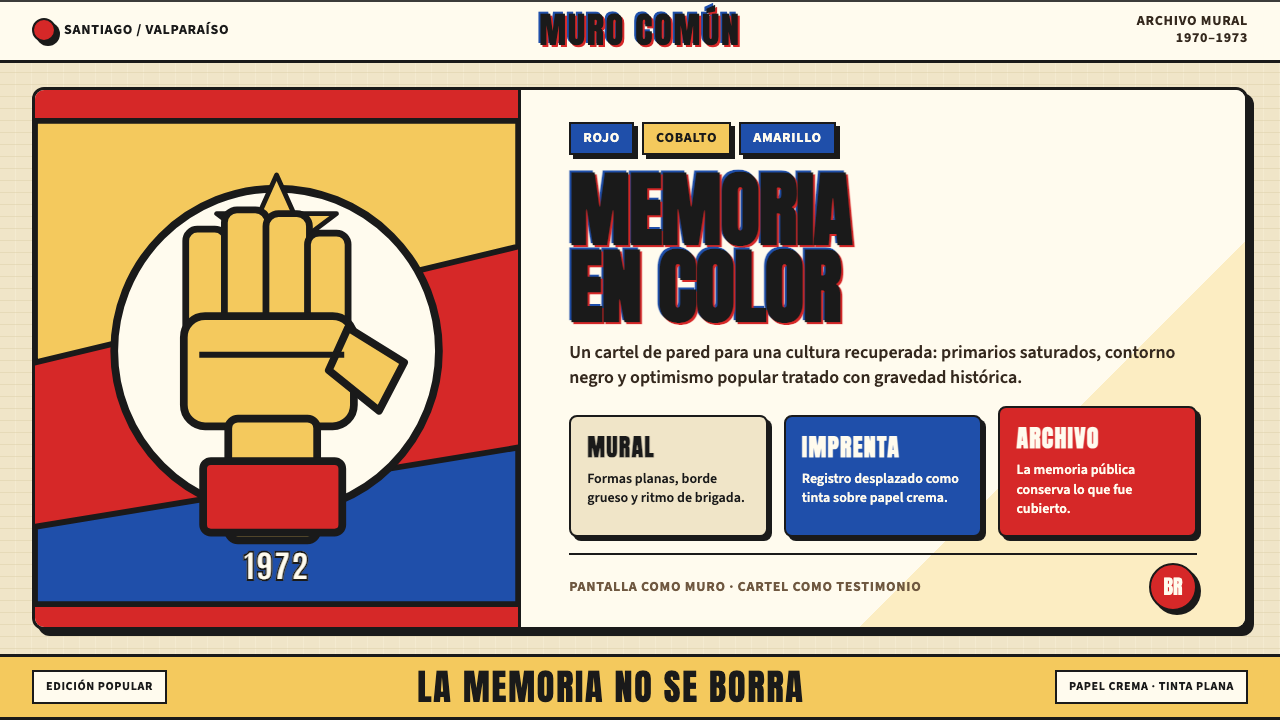 Chilean Allende-Era Propaganda (1972)Solemn revolution. Red, cobalt and yellow lock into thick black mural geometr…
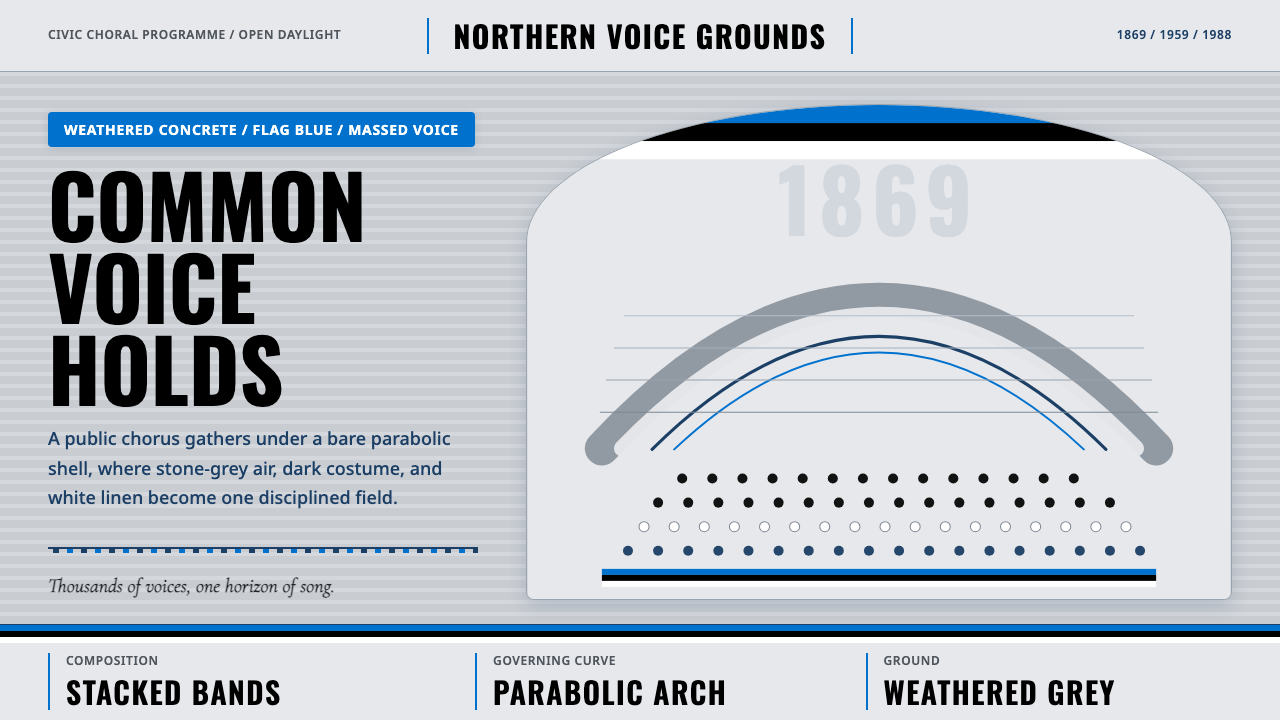 Estonian Song FestivalCivic monumentality sings. Blue-black-white bands meet a concrete arch.
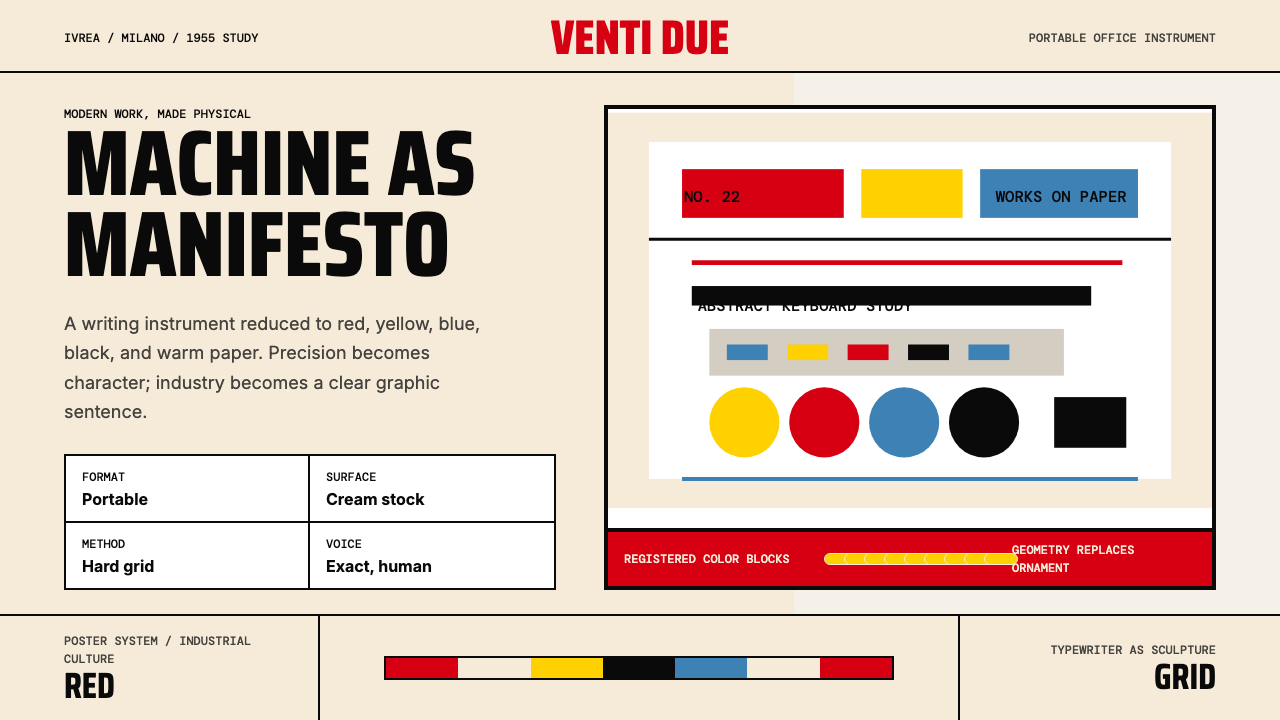 Olivetti Pintori (1955)Industry becomes poetry. Cream paper, machine red, and hard geometry abstract…
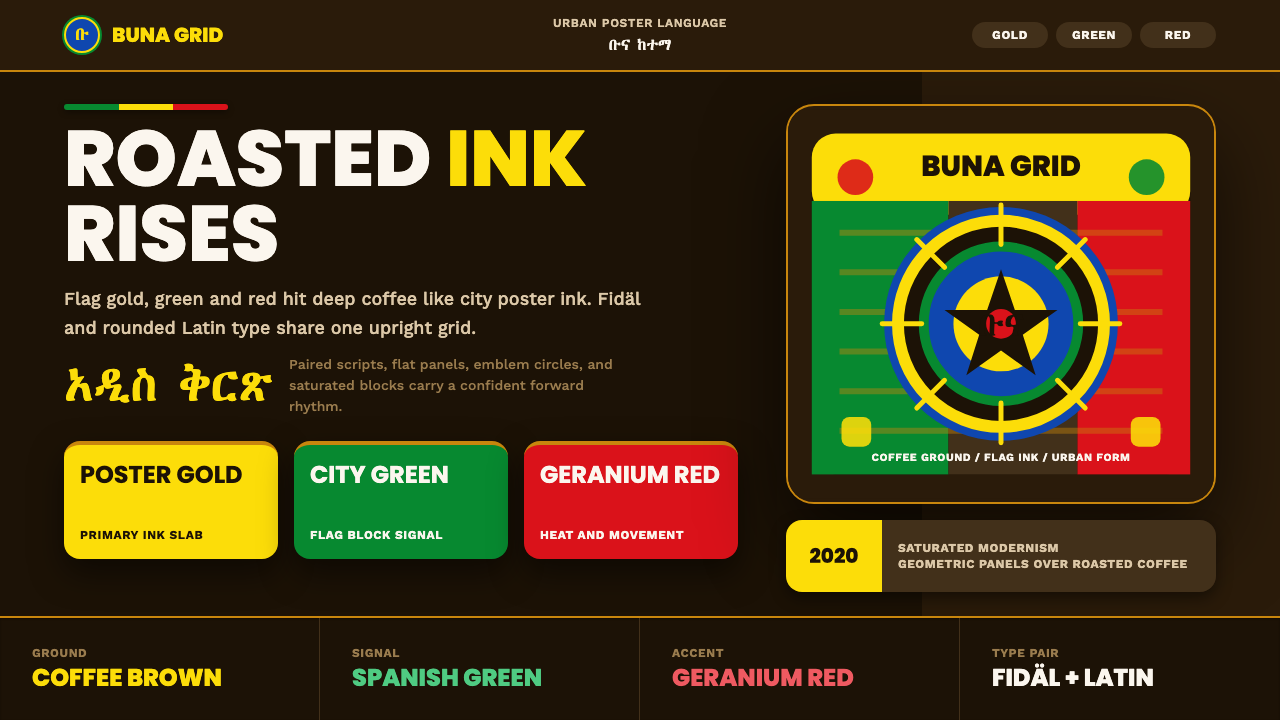 Addis Ababa ModernUrban coffee modernism. Flag gold, green and red snap from a roasted-brown gr…
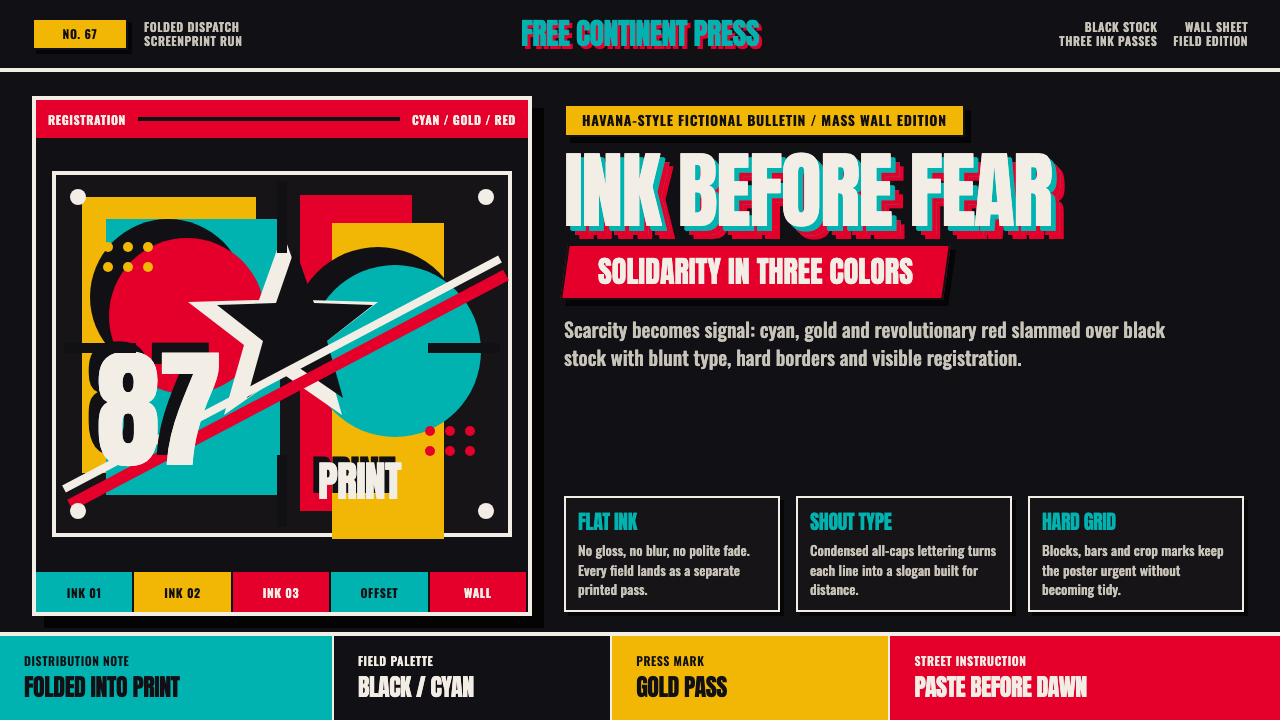 Cuban OSPAAAL Tricontinental PosterUrgency from scarcity. Cyan, gold and red slam over black in blunt silkscreen…
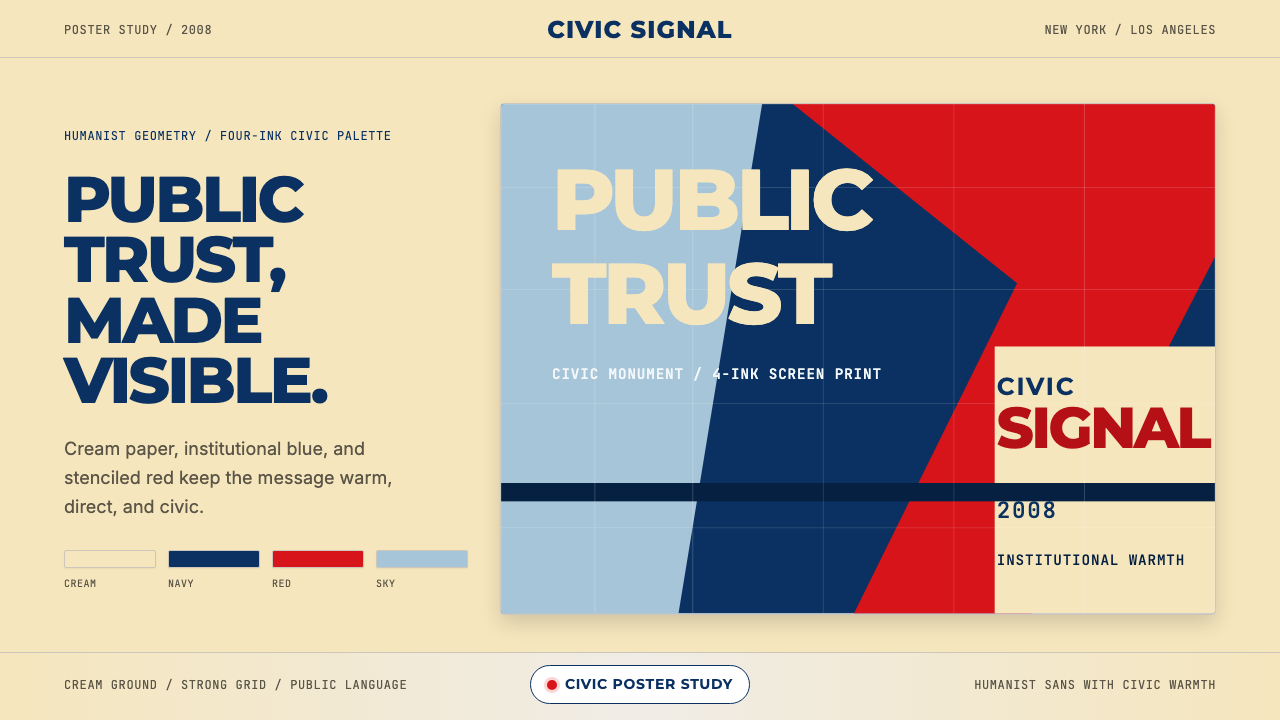 Gotham / Obama Hope Poster (2008)Public trust, made visible. Cream, navy, and red grid the poster.