What is Ferrari Rosso Corsa (1947)?
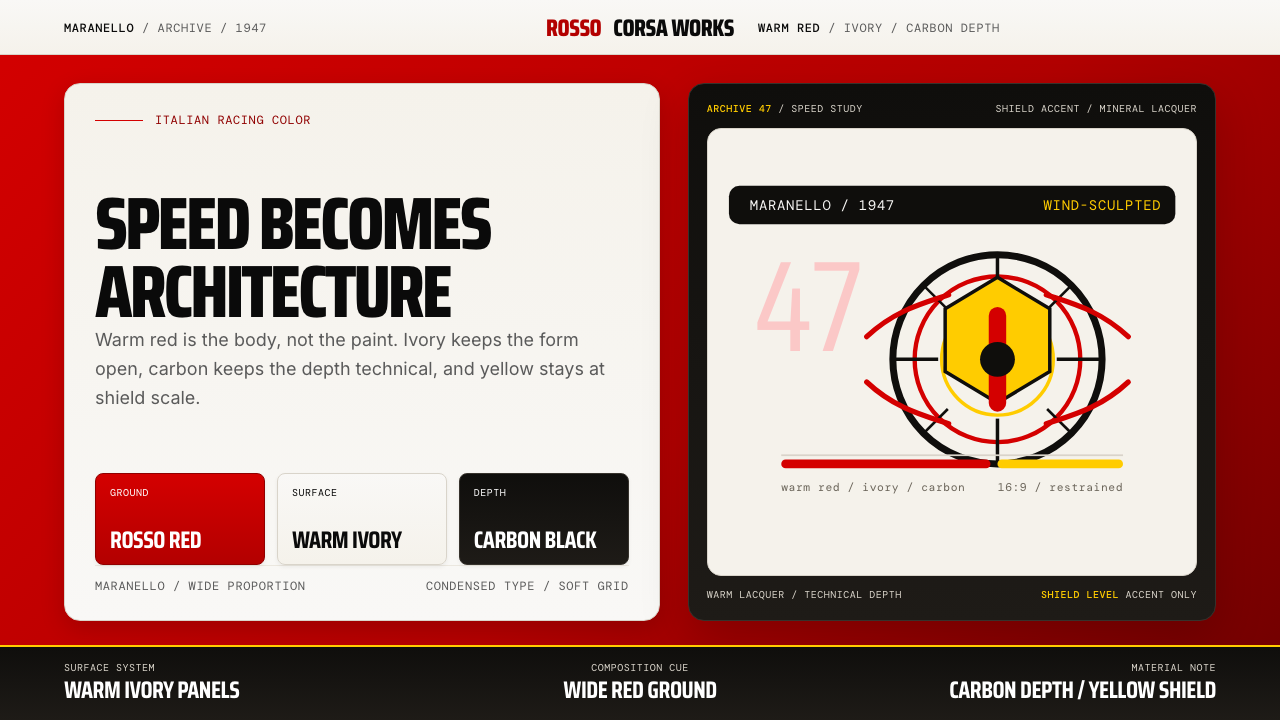
Since 1947, Ferrari's warm racing red has been the world's most recognizable signal that speed, passion, and precision have been fused into a single object.
Ferrari Rosso Corsa (1947) in brief
Ferrari Rosso Corsa is a design system rooted in the visual identity of the Maranello marque as it crystallized in the postwar decades following Enzo Ferrari's founding of the company in 1947. Its palette revolves around a warm, slightly orange-shifted racing red — a hue carrying national and sporting provenance — counterpoised with pristine warm-white content surfaces, a signature Maranello yellow reserved for shield-level accents, and deep carbon-black panels that evoke technical precision and mechanical depth.
The system's aesthetic logic is sculptural rather than graphic. Every element — the swell of a color field, the taper of a typographic hierarchy, the controlled restraint of yellow accents — echoes the aerodynamic discipline of coachbuilt bodywork: nothing is arbitrary, nothing is decorative for decoration's sake. Red is the primary ground, white is the working surface, black is structural depth, and yellow is the rarest, most loaded note — used with the same parsimony that Maranello applies to its prancing-horse badge.
Visually, the system is bold without being loud. The red is warm enough to feel physical and inviting rather than aggressive; white surfaces give content room to breathe; carbon panels anchor the composition with technical gravitas. The overall impression is one of confident Italian luxury engineering: high-performance values expressed through material restraint and formal exactness rather than maximalist decoration.

Where does Ferrari Rosso Corsa (1947) come from?
The racing red associated with Italian motorsport predates Ferrari by four decades. In the early years of international grand prix racing, the governing bodies informally assigned national racing colors by convention: France raced in blue, Britain in green, Germany in white and later silver, and Italy in red. The exact shade varied from car to car and year to year — early Italian reds were sometimes vivid crimson, sometimes brick-toned — but the national identity of Italian racing as 'red' was firmly established by the time the Formula One World Championship launched in 1950. Ferrari, as the dominant Italian constructor, became the primary carrier of that color, and through decades of championship victories it fused the identity of racing red with the identity of the Maranello brand itself.
Enzo Ferrari founded Scuderia Ferrari as a racing team in 1929, initially running Alfa Romeo cars, and established Auto Avio Costruzioni — the manufacturing entity that would become Ferrari — in Maranello in 1943. The first true Ferrari, the 125 S, was completed in 1947. From the very beginning, the cars wore the Italian racing red, and the prancing horse badge — derived from the personal emblem of World War One flying ace Francesco Baracca, given to Enzo Ferrari by Baracca's mother — was placed on a yellow shield, the yellow drawn from the civic colors of Modena. That pairing of red body and yellow badge became the visual anchor of the brand's entire subsequent identity.
The coachbuilding tradition of Emilia-Romagna and the broader Italian carrozzeria culture shaped the formal aesthetic that Ferrari would come to represent. Bodywork was not mass-produced but hand-formed — each panel beaten and shaped by craftsmen who understood the car as a continuous sculptural form. Battista 'Pinin' Farina established Carrozzeria Pininfarina in Turin in 1930, and his studio's partnership with Ferrari — formalized in 1952 — produced some of the most celebrated automotive silhouettes of the twentieth century. Pininfarina's sensibility was one of sensual precision: curvature that appeared effortless but was aerodynamically justified, surfaces that caught light as though they were themselves a kind of performance.
Flavio Manzoni, who became Ferrari's head of design in 2010, continued and codified this visual philosophy for the contemporary era. Under Manzoni, Ferrari's design language was articulated as a coherent system — not just the shape of individual cars but the architecture of showrooms, the typography of communications, the proportions of branded objects. The Rosso Corsa design system, as it is understood today, is the distillation of that long institutional process: a century of Italian racing identity, four decades of Pininfarina collaboration, and a deliberate contemporary effort to translate automotive values into a rigorous and transferable visual language.
What defines the Ferrari Rosso Corsa (1947) look?
Color Architecture
The palette is organized as a strict four-role hierarchy. Rosso Corsa — warm, orange-shifted Italian racing red — functions as the primary page ground or hero surface, not merely an accent. Warm white serves as the primary content surface, ensuring readability and breathing room. Maranello yellow, the color of the prancing-horse badge's shield, is reserved exclusively for the highest-priority accents: active states, primary calls to action, and key indicators. Carbon black anchors technical panels and structural dividers. No additional hues enter the system; the power of the palette comes from its discipline.
Surface Contrast
The system achieves depth through stark juxtaposition of surfaces rather than gradients or blending. A deep red zone meets a crisp white panel with a clean, hard edge — no soft transition, no ambient shadow feathering the boundary. Carbon-black panels sit as discrete, weighted elements. This hard-surface logic reflects the language of coachbuilt bodywork: panels are distinct objects, meeting at precisely defined lines, not merging into one another. The effect is both visually commanding and technically legible.
Typography Scale
Typographic hierarchy is expressed through dramatic scale contrast — headline type operates at a significantly larger scale than body text, with the size difference itself performing the organizational function that decorative borders or rules might otherwise serve. Type set against red grounds is kept to single-weight white, maintaining maximum legibility. On white surfaces, a dark color carries body text, with hierarchy established through weight and size alone. The typographic sensibility is Italian industrial: confident, precise, unhurried.
Yellow as a System Signal
Maranello yellow operates as a precise semantic marker rather than a decorative color. Its function is analogous to the yellow shield on which the prancing horse sits: it designates something of singular importance. In interface applications, yellow marks the single most critical interactive element per view — the primary button, the tier differentiator, the live indicator. When yellow appears more than once in a composition, its signal strength is diluted. The discipline of using it sparingly — even when restraint feels visually insufficient — is what preserves its authority.
Sculptural Negative Space
Negative space in this system is not emptiness — it is the white body panel between two red sections, the breath between a headline and its subtext, the deliberate pause that gives speed its legibility. Pininfarina's design philosophy held that the space around a form is as designed as the form itself; that a silhouette is defined as much by what is absent as by what is present. Applied to layout, this means generous margins, unhurried spacing between elements, and a refusal to fill every available zone with content.
Material Texture and Finish
The system evokes a specific material vocabulary: lacquered body panels, brushed or anodized aluminum, matte carbon fiber, polished glass. These are not literal textures applied to digital surfaces but tonal qualities — the depth and saturation of the red suggests lacquer, the clean flatness of white panels suggests polished paint, the carbon sections feel dense and light-absorbing. This material suggestion is achieved through color choice and surface treatment rather than simulated grain or texture overlays.
Formal Precision
Every compositional decision in the system is made with the exactness of an engineering tolerance. Alignment is not approximate — elements sit on an invisible but strictly observed grid. Color zones are defined by clean, resolved edges rather than soft transitions. The yellow accent appears once, in the right place, at the right scale. This precision is the visual correlate of the engineering culture that produces the machinery itself: obsessive, iterative, intolerant of the merely adequate.

Who shaped Ferrari Rosso Corsa (1947)?
Enzo Ferrari (1898–1988) founded Scuderia Ferrari in 1929 and established the Ferrari automobile company in Maranello in 1943. A former racing driver and Alfa Romeo team manager, he approached car manufacturing with an obsessive, often ruthless devotion to performance. His decision to house the prancing horse badge — borrowed from the family crest of fallen World War One ace Francesco Baracca — on a yellow shield against the Italian racing red body established the brand's visual DNA in its first year. Ferrari remained the controlling force behind the company's identity until his death, and his conviction that racing success and commercial identity were inseparable shaped the Rosso Corsa visual system as a philosophy, not merely a color.
Battista 'Pinin' Farina (1893–1966) founded Carrozzeria Pininfarina in Turin in 1930 and formalized a design partnership with Ferrari in 1952 that would define the visual character of Maranello's road cars for decades. His aesthetic philosophy centered on what he called 'organic elegance' — curves justified by aerodynamics and engineering logic, not by fashionable decoration, surfaces that looked as though they had been shaped by wind rather than by a stylist's pencil. This philosophy is the formal ancestor of the Ferrari Rosso Corsa visual system's sculptural logic: beauty as a consequence of precision rather than an addition to it.
Sergio Pininfarina (1926–2012) succeeded his father at the helm of Carrozzeria Pininfarina and deepened the studio's relationship with Ferrari across the most celebrated decades of the marque's road car production. Under Sergio, Pininfarina delivered some of the most iconic silhouettes in automotive history — shapes whose formal discipline and sensual precision became inseparable from the idea of Ferrari red in the popular imagination. His tenure demonstrated that the red was not simply a color but a system: it was readable only in conjunction with the proportions and surfaces it clothed.
Flavio Manzoni joined Ferrari as Senior Vice President of Design in 2010 and undertook the systematic articulation of Ferrari's design language as a comprehensive, transferable visual identity — extending beyond individual car models to encompass branded spaces, communications, and objects. Under his direction, Rosso Corsa was codified not merely as a historical color but as the structural foundation of a design system with defined roles for each color, defined typographic hierarchies, and defined spatial principles. Manzoni represents the moment when the brand's intuited aesthetic became an explicit, scalable design architecture.
Francesco Baracca (1888–1918) was Italy's leading World War One flying ace, credited with thirty-four aerial victories before his death in combat in June 1918. His personal aircraft carried a prancing horse emblem on its fuselage. After the war, his mother Countess Paolina Baracca gave Enzo Ferrari permission to use the emblem, suggesting it would bring him luck. Ferrari placed the horse on a yellow shield — yellow being the color of Modena, his hometown — and set it against the red of his cars. Baracca's emblem thus became one of the most recognized brand symbols in the world, linking the Rosso Corsa identity to a lineage of Italian courage and aeronautical mastery that predates the automobile itself.
How do you use Ferrari Rosso Corsa (1947) today?
Ferrari Rosso Corsa is among the most demanding historical design systems to apply correctly in contemporary work, precisely because its power depends on restraint. The visual system operates as a hierarchy of four materials — red, white, black, yellow — and its authority comes from keeping each in its assigned role. Applying it well requires understanding not just what the elements are but what each one is for: red is ground, white is surface, black is structure, yellow is the one unmistakable signal.
For presentation slides, the system delivers exceptional impact on cover pages and section openers. A cover built on a full-bleed red ground with white display type and a single yellow accent for the marque or subtitle carries the visual authority of a race car livery — bold, unambiguous, purposeful. Content slides shift to white as the primary surface: body text in a dark tone, headline hierarchy expressed through scale contrast alone, data callouts in yellow used sparingly (at most one per slide). Data visualization slides treat charts as engineered objects — clean bar charts, precise line graphs — without decorative frames or gradient fills. Carbon-black panels work well as slide backgrounds for technical specifications or comparative tables, where their material gravity reinforces the precision of the data.
For web interfaces, the system is ideally suited to dashboards, pricing pages, and high-performance product landing pages where hierarchy and immediate scannability are the primary design objectives. The recommended approach is a rigorously maintained grid with white or very light warm surfaces as the default background for content zones, reserving red for hero sections or navigation bars where brand impact is needed at full strength. Yellow appears at most once per viewport — on the primary call-to-action button or the active plan indicator in a pricing table. Carbon-black panels serve as footers, technical specification sections, or secondary navigation. Shadow on interactive components should be hard-edged and offset rather than soft and diffuse, reinforcing the material logic of the system.
For editorial and marketing work, the system's inherent poster logic — bold color fields, strong typographic scale contrast, controlled accent — translates naturally to campaign materials, feature stories, and brand-led print and digital advertising. An editorial spread works well alternating full-bleed red pages with white content pages, using the color itself as the structural break between sections. Marketing pages benefit from the system's ability to signal premium positioning without relying on photographic luxury cues: a red hero, a white body section with generous margins, a yellow primary button, and a carbon specification section communicates high-performance intent with typographic and color means alone. The system pairs naturally with motorsport imagery — race cars, pit-lane photography, circuit detail — but does not require it; the color vocabulary carries enough identity on its own.
A common and costly mistake when applying this system is treating the yellow as a secondary accent color deployed freely wherever visual energy is needed. Yellow in this system is not an energizing accent — it is a singular marker of the one thing that matters most in any given view. Using it on two or three elements simultaneously collapses the hierarchy the entire palette is built to create. A related error is softening the system's hard-edge material logic with gradients, soft shadows, or blended color transitions — these read as inconsistent with the system's formal precision and dilute the sense of engineered certainty that is its primary emotional register. The palette's power is multiplicative when its discipline is maintained, and rapidly diminishing when its rules are loosened.

Ferrari Rosso Corsa (1947) — FAQ
Is Ferrari Rosso Corsa appropriate for non-automotive and non-luxury contexts?
It can be, but the context needs to support the values the system projects: performance, precision, confidence, and a degree of emotional intensity. It works well for financial platforms emphasizing high performance, sports technology products, professional tools where authority is a desired quality, and any brand where the aspiration is to communicate that it takes its domain as seriously as Ferrari takes speed. It struggles in contexts requiring approachability, warmth, or playfulness — the palette's inherent boldness and severity can feel exclusionary in consumer contexts that depend on broad emotional accessibility. Before applying it, ask whether the product's core promise is performance and precision; if yes, the system will reinforce that promise. If the product's promise is warmth, community, or ease, choose differently.
How does this system differ from a generic 'red and white' brand palette?
The distinction is in the specific character of each element and the rigidity of their roles. Generic red-and-white palettes typically treat red as a brand accent applied to buttons, highlights, and hero images over a predominantly white layout. Ferrari Rosso Corsa inverts that logic: red is the ground, not the accent. White is the working surface that content lives on, not the background the brand color sits against. Yellow performs the accent function that red plays in most systems — but with extreme parsimony. And carbon black provides a fourth structural tone that generic two-color systems lack entirely. The result is a system with significantly more formal complexity and visual authority than a standard red-accent identity.
Can this system work effectively in dark mode or on dark backgrounds?
The system has a natural dark-mode pathway through its carbon-black component. A dark-mode inversion works best when carbon black replaces the primary background role that red occupies in light mode, with warm white shifting to a slightly softened off-white for body text and content surfaces, and red taking the role of a strong section accent or hero element rather than a continuous ground. Yellow retains its singular signal function in either mode. The key risk in dark-mode application is allowing red to lose its identity against the dark ground — it must remain clearly warm and distinct from the carbon tone, not slide toward a generic dark-red that reads as muted or unconfident.
What kinds of imagery pair well with this design system?
The system is strongly compatible with photography and imagery characterized by precision, motion, and material beauty: close-up engineering details, aerodynamic forms, controlled motion blur, high-contrast light on curved surfaces. Imagery that emphasizes craftsmanship — a welder's arc, a machined component, stitched leather — also fits the system's material logic. What works less well is lifestyle imagery centered on human warmth, soft natural settings, or organic textures, which read against the system's precision-and-performance register. In editorial use, treating photographs with high contrast and controlled cropping — rather than as ambient, atmospheric images — keeps them coherent with the system's formal discipline.
How should the yellow accent be handled in multipage or multiscreen applications?
The governing principle is one dominant yellow element per view, not per application. In a multipage application, yellow can appear on every screen, but each screen should have at most one element carrying yellow — the element that represents the most important action or the most critical status in that context. Across a multi-section website, yellow can mark each section's primary call to action without dilution, because the user's eye encounters each in a discrete visual context. The error is using yellow as a decorative accent — hover effects, icon fills, decorative dividers — where it accumulates without semantic purpose. Each use should be defensible as 'this is the one thing on this screen that matters most right now'.
Related design styles
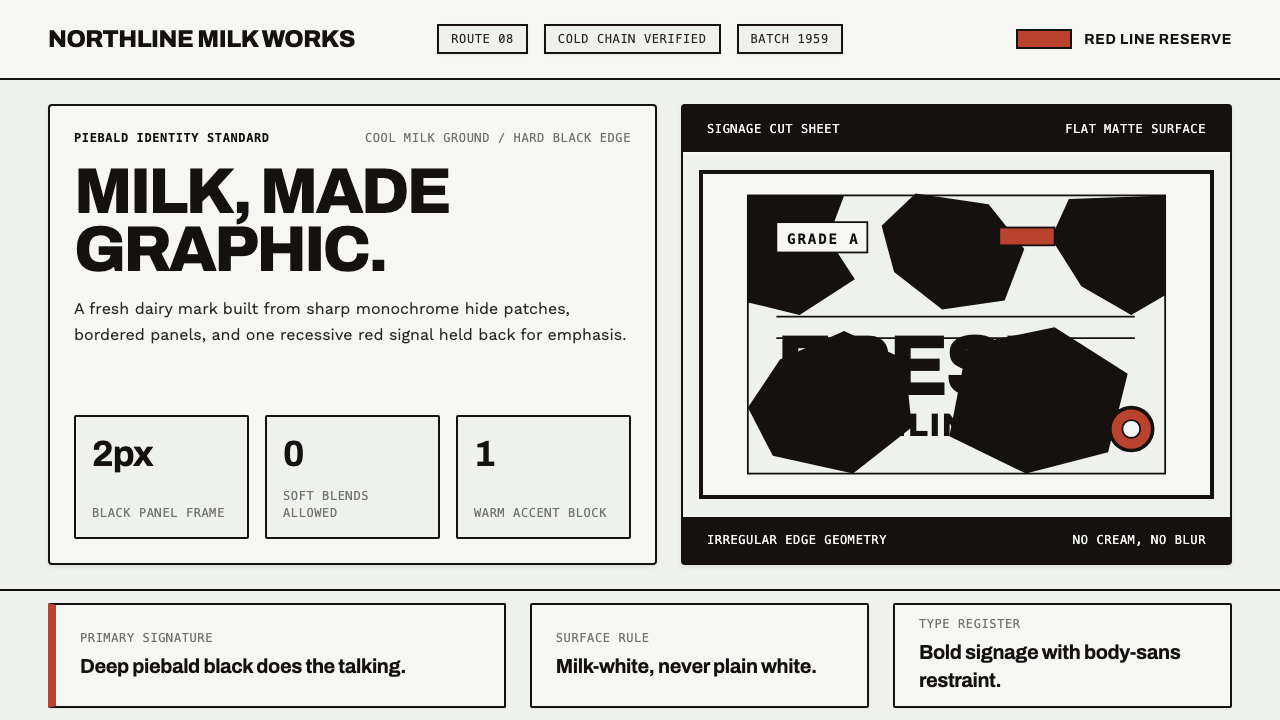 Holstein Friesian DairyMilk-white turns graphic. Hard black hide patches, 2px borders, and one red a…
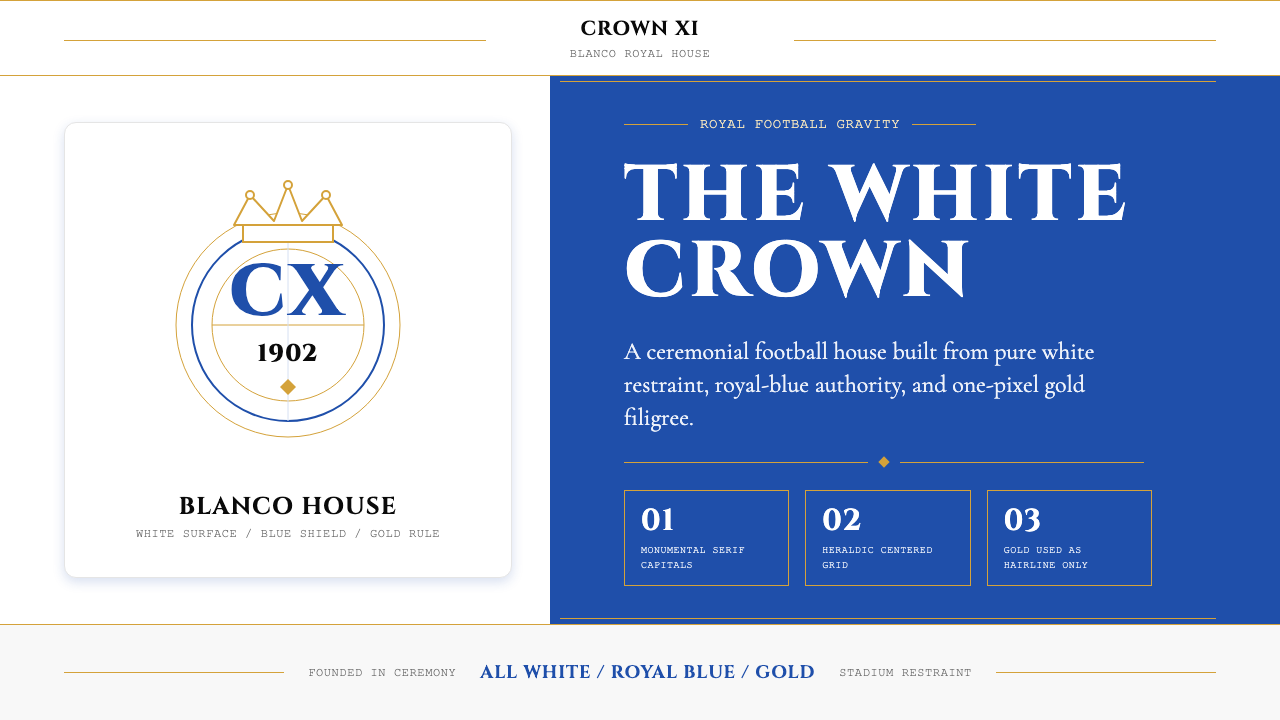 Real Madrid (Blanco)Royal restraint wins. Pure white, royal blue panels, and 1px gold filigree ca…
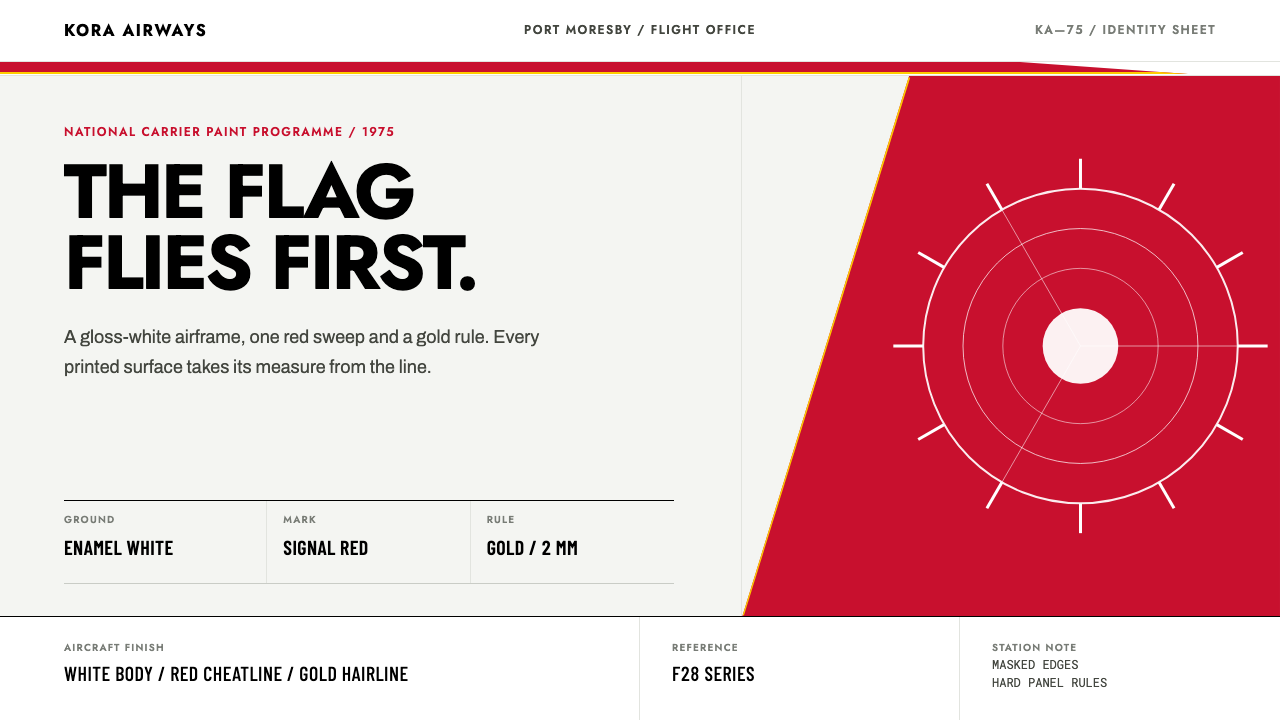 Air Niugini Livery 1975A flag engineered for flight. Signal red sweeps across enamel white, underlin…
 Akhal-Teke Golden HorseGold that behaves like light. Specular sheen glowing from a stable-dark groun…
 Chilean Allende-Era Propaganda (1972)Solemn revolution. Red, cobalt and yellow lock into thick black mural geometr…
 El Al Israel AirlinesNational blue takes command. White aircraft geometry cuts a flat jet-age post…