What is Yves Saint Laurent (YSL)?
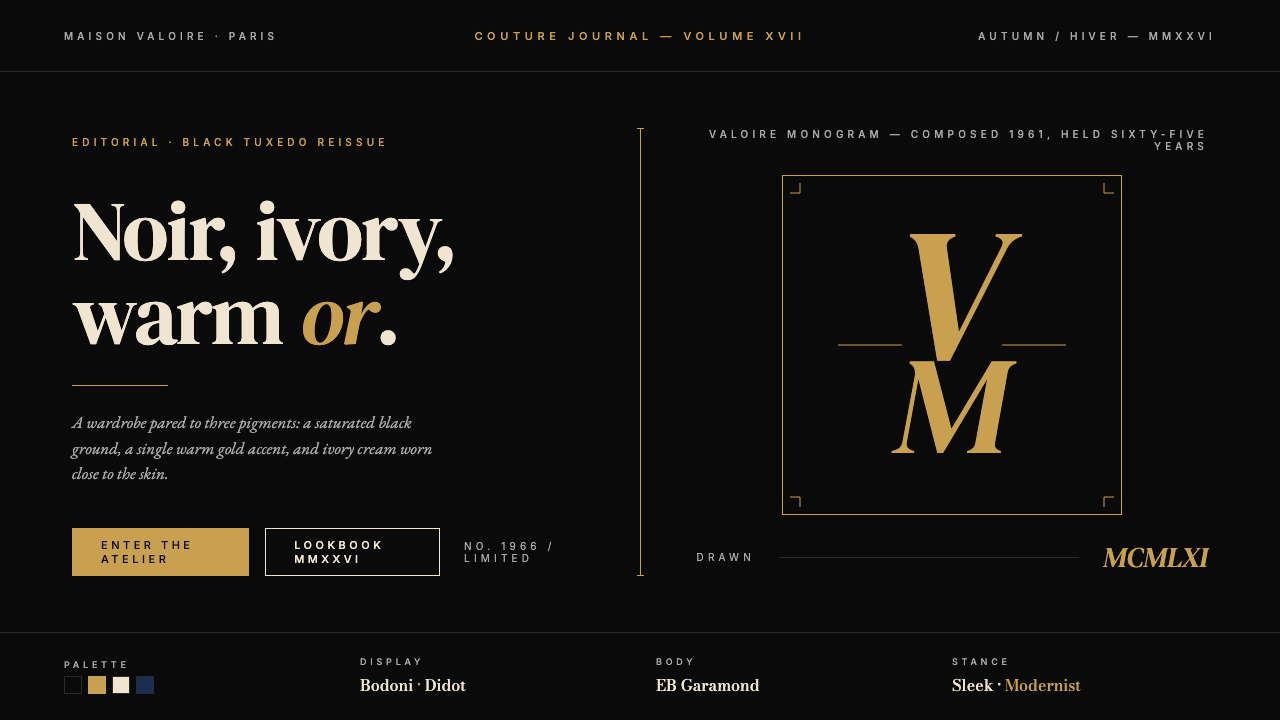
Yves Saint Laurent distilled haute couture into its most severe and glamorous form — saturated black, warm gold, and the conviction that restraint is the ultimate luxury.
Yves Saint Laurent (YSL) in brief
Yves Saint Laurent (YSL) is a French luxury house whose visual identity is one of the most immediately recognizable systems in global fashion: saturated black grounds, warm gold accents, ivory or cream type, and the vertically interlocked YSL monogram that graphic master A. M. Cassandre drew in 1961. The entire palette is a study in chiaroscuro — the dramatic interplay of deep dark and high-contrast light that painters from Caravaggio to Rembrandt used to command attention and suggest depth. YSL translates that technique into graphic and product design with absolute economy.
The house's visual language is built on hierarchy through contrast rather than hierarchy through complexity. Where many luxury brands accumulate detail to signal richness, YSL reduces. The typeface choices lean toward Didot and Bodoni — high-contrast French serifs whose hairline strokes and swelling curves carry an inherent tension between fragility and weight. Letter-spacing is generous to the point of architectural deliberateness, each character given room to breathe as though set in stone rather than on paper. The overall effect is billboard-scale confidence at any size.
Under creative director Anthony Vaccarello, who took the house's reins in 2016, the visual identity has sharpened into what might be called dark-mode luxury. The photographic vocabulary is cooler and more severe — high-gloss surfaces, gold hardware catching hard light, silhouettes cut with mathematical precision. The brand's entire system communicates through absence as much as presence: everything that is not deep black, warm gold, or ivory cream is excluded by design.

Where does Yves Saint Laurent (YSL) come from?
Yves Henri Donat Mathieu-Saint-Laurent was born in 1936 in Oran, Algeria, then a French territory, and arrived in Paris at seventeen with a portfolio of sketches that won him a position at Christian Dior. When Dior died suddenly in 1957, Saint Laurent — then twenty-one — was named head designer of the house, launching with a collection that was celebrated as saving Dior from irrelevance. The experience gave him direct access to the grammar of Parisian haute couture at its most institutionalized and taught him, paradoxically, how to dismantle that grammar productively.
In 1960, Saint Laurent presented a collection inspired by Left Bank bohemia — leather jackets, turtlenecks, the wardrobe of Parisian intellectuals — that conservative Dior clients rejected and that resulted in his departure from the house, partly engineered by the house's financial backers. In 1961, he and his life and business partner Pierre Bergé founded the Maison Yves Saint Laurent. That same year, Adolphe Jean-Marie Mouron, known professionally as A. M. Cassandre and already celebrated as the greatest French poster artist of the twentieth century, designed the YSL monogram: three letters, interlocked and stacked vertically, which have remained essentially unchanged ever since. The monogram is a masterclass in letterform economy — three individual characters resolved into a single, self-contained architectural object.
The 1960s were the decade that defined the house's cultural position. In 1965, Saint Laurent presented the Mondrian collection — shift dresses whose color-block panels directly quoted Piet Mondrian's grid paintings — to worldwide acclaim. The collection demonstrated that fashion could function as applied art history, and established the house's intelligence and visual literacy as core brand values. In 1966, Saint Laurent presented Le Smoking: a tuxedo suit designed for women, which challenged the most fundamental conventions of gendered dress. Le Smoking was not merely a fashion statement; it was a philosophical argument about female authority and bodily autonomy made through tailoring, and it transformed the silhouette of couture permanently.
The brand entered a new chapter in 1999 when Gucci Group (later absorbed into Kering) acquired it, and a further chapter in 2012 when creative director Hedi Slimane controversially rebranded the ready-to-wear line as Saint Laurent Paris. Slimane's tenure stripped the aesthetic to its most severe rock-and-roll severity. When Vaccarello succeeded Slimane in 2016, he retained the severity but deepened the glamour — restoring warmth to the gold accents, enriching the photographic palette, and steering the visual language toward what it is today: a system so confident in its own reductiveness that the entire luxury vocabulary fits inside three tones and one monogram.
What defines the Yves Saint Laurent (YSL) look?
Palette
The YSL palette is among the most restrictive in luxury branding: saturated black as the dominant ground, warm gold as the sole accent, and ivory or cream as the primary typographic tone. Deep navy occasionally makes an appearance as a secondary dark. The system derives its power from the severity of this limitation — no pastel softening, no earth-tone approachability, no rainbow seasonal variation. The black is not charcoal or dark grey; it is full-depth, light-absorbing, cinematic black. The gold is warm-spectrum — closer to old amber than to bright yellow — and reads as precious metal rather than highlight.
Typography
YSL's typographic choices consistently favor high-contrast serif letterforms in the French Didot and Bodoni tradition — typefaces characterized by an extreme contrast between thick stroke and hairline thin stroke, with delicate bracketed serifs and an almost mathematical elegance to their proportions. These are typefaces designed to be read at scale, and YSL deploys them at scale: wordmarks and headline treatments at sizes where individual letterform details become architectural features. Letter-spacing is a defining element — set wide enough to give each character sovereignty over its surrounding space, creating a cadence that feels measured and deliberate. Body text, when it appears, tends to be sparse.
Monogram and Logo
The 1961 Cassandre monogram remains one of the most studied logo designs of the twentieth century. Its genius lies in spatial efficiency: three letters — Y, S, L — are resolved into a single compact vertical form through a system of interlocking and overlapping that allows each character to remain legible while the whole reads as a unified geometric object. The monogram functions at any scale without adjustment, from the face of a perfume bottle to a building-height advertisement. Its construction is entirely rational yet the result feels irreducibly elegant — a hallmark of Cassandre's method.
Photography and Light
YSL's photographic language is defined by hard, directional light — the kind that creates sharp shadows, emphasizes surface gloss, and gives gold hardware a near-incandescent quality. Backgrounds are typically pure black or very deep neutral tones, against which subjects emerge with the clarity of objects lit for a museum case. Skin tones are cool or neutral rather than warm and flattering. The editorial stance is confrontational rather than inviting: the camera does not flatter; it examines. This approach aligns the brand's visual language with art photography and cinema rather than commercial lifestyle imagery.
Spacing and Silence
YSL layouts use negative space as a primary compositional element rather than as leftover area between content blocks. A perfume advertisement may commit the majority of its area to pure black, with the product and wordmark occupying a small, precisely positioned zone. This asymmetric weighting is deliberate: in a visual landscape cluttered with competing bids for attention, a brand that is willing to leave space demonstrates the confidence of established authority. The silence in a YSL composition carries as much meaning as the marks.
Silhouette and Structure
From the garments to the graphic design, YSL is obsessed with clean silhouette. In fashion, this means shoulders that are either precisely squared or precisely softened — never ambiguous — and proportions where every seam placement is a structural decision. In graphic design, this translates to hard edges, sharp corners, and geometric cropping. Nothing bleeds or feathers. The YSL design vocabulary has no room for organic or hand-drawn elements; everything resolves to an edge.
Restraint as Luxury Signal
Where some luxury brands communicate through accumulation — of pattern, of hardware, of signature print — YSL communicates through elimination. The brand has no house check, no loud monogram repeat across fabric, no seasonal color story layered over a base identity. The identity is the base, and the base never changes. This discipline functions as a luxury signal in a specific way: it presupposes an audience sophisticated enough to read absence as richness. You do not need to be told this is expensive. The restraint tells you.

Who shaped Yves Saint Laurent (YSL)?
Born in Oran in 1936, Saint Laurent arrived at Dior as a teenager and became head of the house at twenty-one following Dior's death. His foundational contributions — the Mondrian dress of 1965, Le Smoking of 1966, the Saharan jacket, the peasant blouse, the tuxedo-for-women — were not merely trend-setting but paradigm-shifting. Each proposed a different relationship between the dressed body and social authority. Saint Laurent retired in 2002 at a ceremony at the Centre Pompidou, declaring that he had belonged to a world that no longer existed. He died in 2008.
Bergé was Saint Laurent's life partner and the business architect of the Maison. Where Saint Laurent provided creative vision, Bergé provided financial discipline, political acumen, and the organizational structures that turned an atelier into a global luxury group. He co-founded the house in 1961, navigated the transitions through multiple ownership structures, and managed the brand's intellectual property and legacy with meticulous care. Bergé was also an important patron of arts and letters in France, and his personal collection — auctioned at Christie's Paris in 2009 after Saint Laurent's death — was among the most significant private collections of the twentieth century.
Adolphe Jean-Marie Mouron, who worked under the name Cassandre, was the pre-eminent French commercial poster artist of the twentieth century, responsible for such canonical works as the Normandie ocean-liner poster of 1935 and the Dubonnet triptych. His design of the YSL monogram in 1961 was one of his last major commissions. Cassandre brought to the monogram the same principles that governed his poster work: strict geometric construction, optical clarity at any scale, and the resolution of complex information into an irreducible visual unit. The fact that the monogram has required no substantive revision in more than sixty years is a measure of how completely Cassandre solved the problem.
Vaccarello succeeded Hedi Slimane as creative director in 2016, a transition that returned warmth to the gold register while preserving the severity of the overall system. His collections have consistently explored the YSL archetype — the tuxedo, the sequined evening dress, the power-shouldered jacket — through a contemporary lens that emphasizes polish and gloss over raw edge. Under Vaccarello, the brand's visual communications — advertising campaigns, packaging, store environments — have achieved a rare consistency: every touchpoint expresses the same three-tone vocabulary with equal conviction.
Slimane served as creative director from 2012 to 2016 and is responsible for one of the most discussed rebrands in recent fashion history: renaming the ready-to-wear line Saint Laurent Paris and stripping the visual identity to its most severe and confrontational state. His campaigns relied on deep contrast, hard light, and a rock-and-roll vernacular that polarized opinion. Many longtime clients and critics protested the erasure of the YSL monogram from ready-to-wear communications; others argued Slimane had identified the latent severity at the core of the brand's identity and made it explicit. The debate illuminates how much interpretive range exists within the three-tone system.
How do you use Yves Saint Laurent (YSL) today?
The YSL visual system is among the most transferable luxury aesthetics for contemporary design work precisely because its rules are simple to state and demanding to execute. The system works through extreme reduction: if an element cannot be justified as deep black, warm gold, or ivory-cream, it does not belong. Applying the style correctly requires internalizing this as a discipline, not borrowing its surface markers — the serif headline and the black background — while retaining the decorative complexity the system was built to exclude.
For presentation slides, the YSL system is most powerful on high-stakes covers and executive summary pages. A cover in this mode commits the majority of the frame to pure black, with a large serif wordmark or title in ivory at generous letter-spacing occupying a carefully weighted portion of the field. A single gold rule or accent element marks the structure without decorating it. Content slides should treat information with the same economy: one organizing hierarchy, body text sized for breath rather than density, data expressed in the fewest possible marks. Charts and graphs take on a diagrammatic clarity when rendered in the brand's three tones — gold bars on black grounds, cream axis labels — and resist the temptation of gridlines, drop shadows, or color variety.
For web interfaces, the YSL visual language is most appropriate for luxury product pages, high-end editorial sites, and premium membership or pricing presentations where gravitas matters more than approachability. The approach begins with the background: full-depth black or very deep off-black for the primary surface, cream or ivory for typographic hierarchy, and gold reserved exclusively for interactive emphasis — hover states, primary calls to action, tier differentiation in pricing tables. Navigation is typographic and sparse. No icon libraries, no illustrated elements, no gradient overlays. The spacing budget is generous: sections breathe, cards do not touch. Dashboard applications in this system benefit from the clarity of extreme contrast — white type on near-black grounds reads with surgical precision.
For editorial and marketing work — campaign pages, lookbooks, brand identity presentations, event materials — the YSL system functions like a controlled theatrical vocabulary. Full-bleed black sections alternate with cream or ivory sections, establishing a rhythm that feels authoritative rather than monotonous. Typography leads: headlines in a high-contrast serif at large scale, set with wide tracking, require no supporting imagery to carry the frame. When photography is used, it follows the house's photographic logic: hard directional light, high contrast, dark or neutral backgrounds, gold hardware in focus. Avoid lifestyle imagery with warm tones, soft focus, or natural light — these undermine the system's entire register.
A common mistake when working in the YSL mode is treating the gold as a generous accent rather than a disciplined point. The moment gold becomes a fill, a background, or a large-area element, it stops reading as accent and starts reading as excess — and excess is precisely what the YSL system is designed to eliminate. A second frequent error is substituting a warm dark brown or charcoal for black, in an attempt to soften the severity. The severity is not incidental to the system; it is the system. A third error is using multiple serif typefaces, or mixing serif with sans-serif, in search of visual variety. The YSL typographic vocabulary is a monologue, not a conversation: one typeface family, varied only in weight and scale.

Yves Saint Laurent (YSL) — FAQ
How is YSL different from other French luxury house aesthetics like Chanel or Hermès?
The three houses represent three distinct philosophies of luxury communication. Chanel builds its visual identity around the interplay of black, white, and camellia-cream with a double-C monogram, gold chain hardware, and a vocabulary that emphasizes Parisian femininity and historical continuity. Hermès centers on warmth — its signature orange, the hand-stitched leather vocabulary, equestrian heritage, and a craft narrative that foregrounds artisan process. YSL's system, by contrast, is the most theatrical and confrontational of the three: it leans into drama rather than warmth, chiaroscuro rather than balanced tone, and an architecture of absence rather than a richness of material detail. Chanel invites; Hermès tells a story; YSL commands.
Can the YSL palette work with photography that includes people, or is it primarily a graphic system?
Photography is central to the YSL system, but the photographic language must conform to the palette's logic rather than the reverse. YSL campaigns use human subjects extensively, but the lighting and post-production approach ensures that the image reads within the brand's tonal range: hard directional light that pulls skin toward cool neutrality, backgrounds that are pure black or very deep neutral, and gold hardware that functions as the warm accent element in an otherwise desaturated or monochromatic frame. When flesh tones appear, they are treated as a fourth neutral — present but not warm. Soft-light portraiture, golden-hour natural light, and richly saturated color photographs are incompatible with the system.
Is the YSL visual system suitable for digital dark-mode interfaces?
The YSL system is natively a dark-mode system — its default ground is full-depth black rather than the dark-grey of most digital dark-mode implementations, which makes it unusually well-suited to dark-background digital environments. The important adaptation is in the gold: on screen, a warm gold must be carefully calibrated to avoid reading as either orange (too casual) or bright yellow (too garish). The gold should read as a precious-metal tone — luminous but controlled. Cream and ivory text on black grounds will render with high legibility at appropriate size. The main risk in digital application is over-applying the gold as interactive highlight; it should remain exceptional.
What types of brands or products are the best and worst fit for the YSL aesthetic?
The YSL system communicates authority, severity, and a specific kind of Parisian glamour that reads as aspirational in luxury fashion, high-end jewelry and watchmaking, premium spirits, exclusive real estate, and certain categories of financial services and private banking where gravity and discretion are valued. It works well for brands that want to signal that they are for a self-selecting audience, not for everyone. It is poorly suited to any context requiring warmth, playfulness, or accessibility: children's products, food and beverage outside the premium spirits segment, healthcare, consumer technology aimed at mass adoption, or any brand whose primary promise is approachability. The severity that makes YSL compelling in its correct context makes it alienating in the wrong one.
How should the Cassandre monogram be used relative to the wordmark in contemporary applications?
The YSL monogram and the wordmark serve different functions and should not be treated as interchangeable. The monogram functions as a symbol — compact, heraldic, immediately readable at small scales — and is most appropriate on product surfaces, hardware, embossing, packaging, and contexts where a full wordmark is impractical or too forward. The wordmark — SAINT LAURENT in wide-tracked uppercase — functions as a declarative statement and works best in advertising, editorial, and brand identity contexts where space and size allow the letter-spacing to breathe. Using both simultaneously in a single layout risks redundancy; typically one anchors the composition while the other, if present at all, is subordinate in scale. In digital contexts, the monogram often functions as an avatar or favicon equivalent while the wordmark leads in communications.
Related design styles
 Akzidenz-Grotesk BertholdObjectivity in black ink. White grotesque type, hard grid, one rationed red b…
 Lagos Fashion WeekBlack luxury speaks plainly. Matte ink, bone serif, and one gold hairline set…
 ChanelLuxury needs no color. Black on white, pearl-cream warmth, geometric capitals…
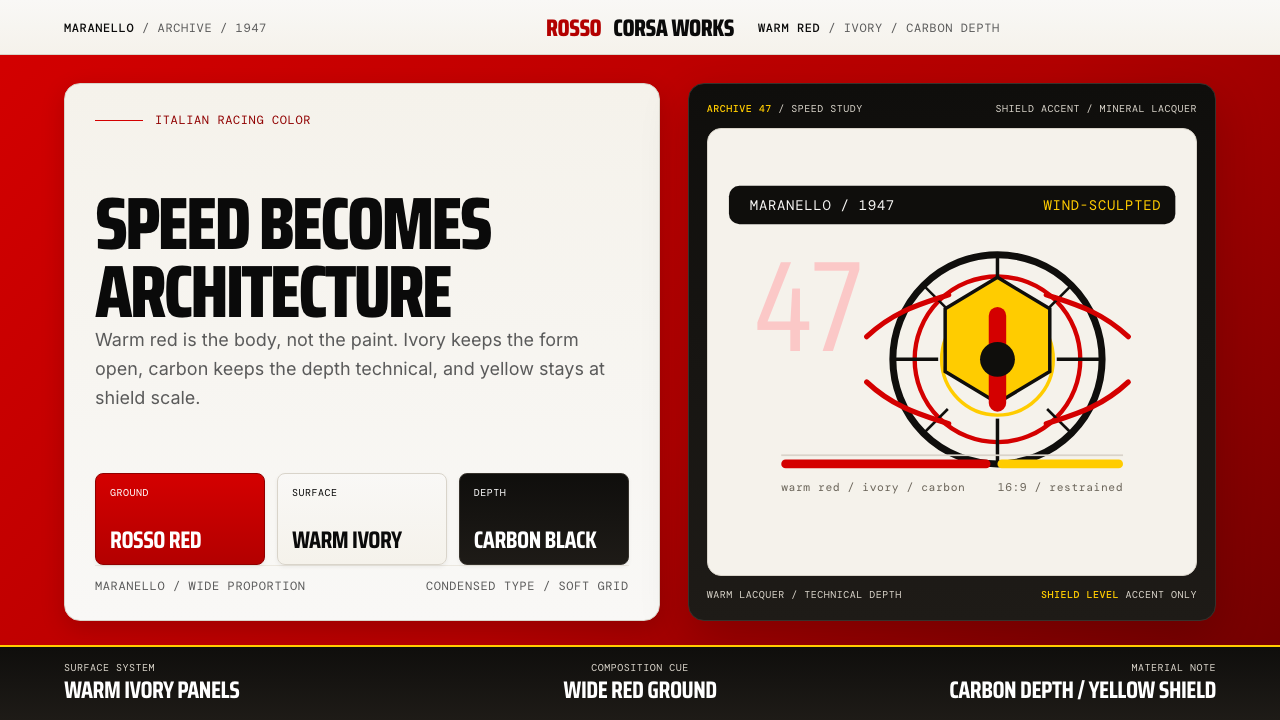 Ferrari Rosso Corsa (1947)Speed becomes architecture. Racing red, warm ivory, and carbon-black panels.
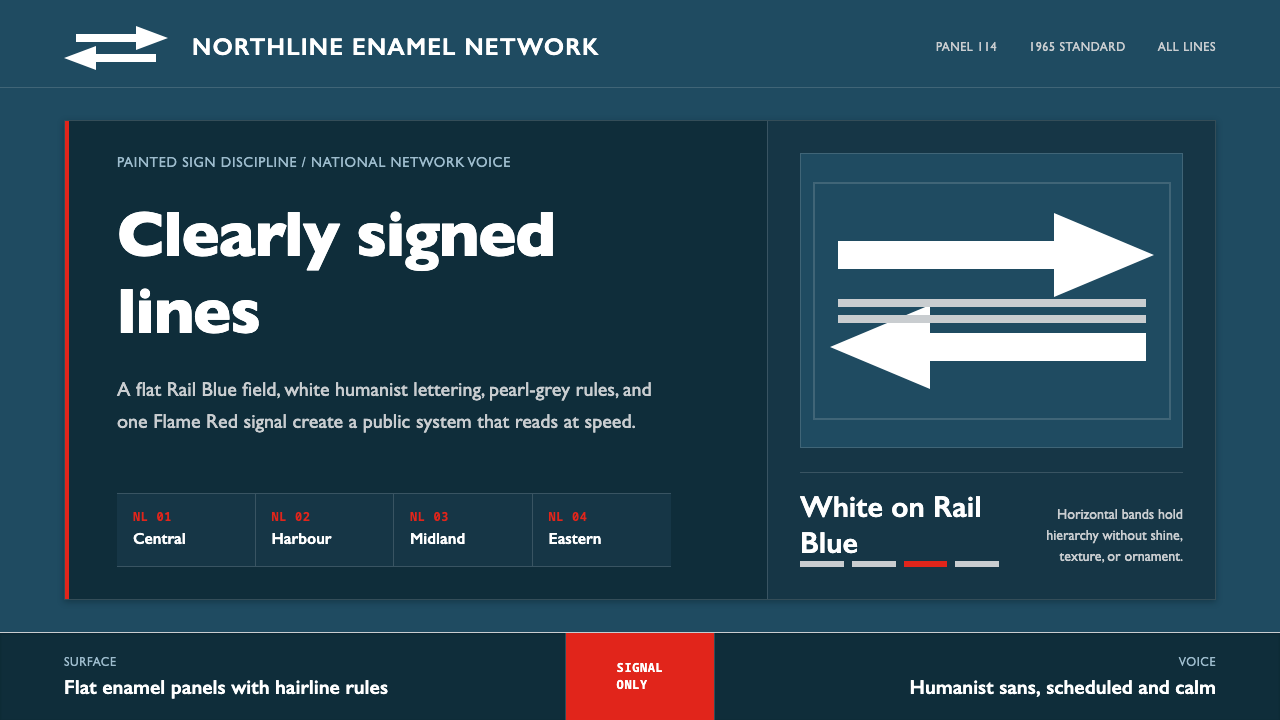 Gill Sans British RailPublic authority, enamel-flat. Rail Blue bands, white humanist type, one red…
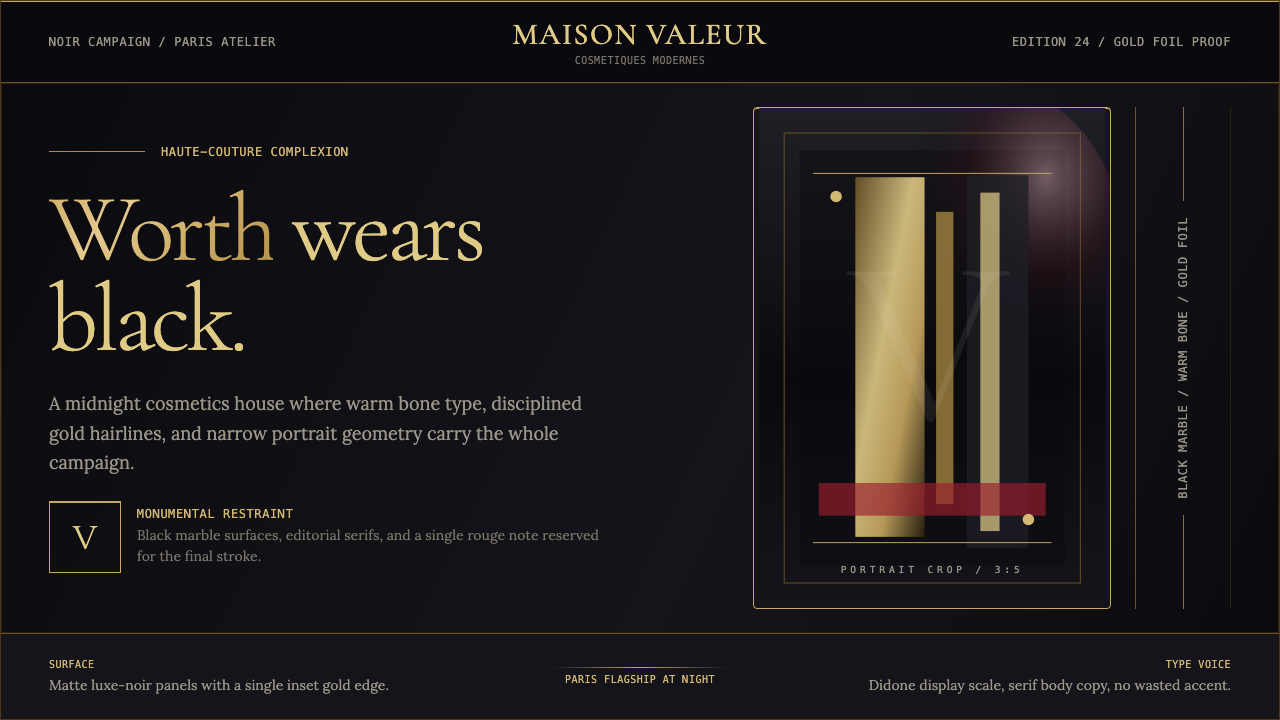 L'Oréal Paris CosmeticsMonumental restraint. Black marble fields, gold Didone type, and narrow portr…