What is Lagos Fashion Week?
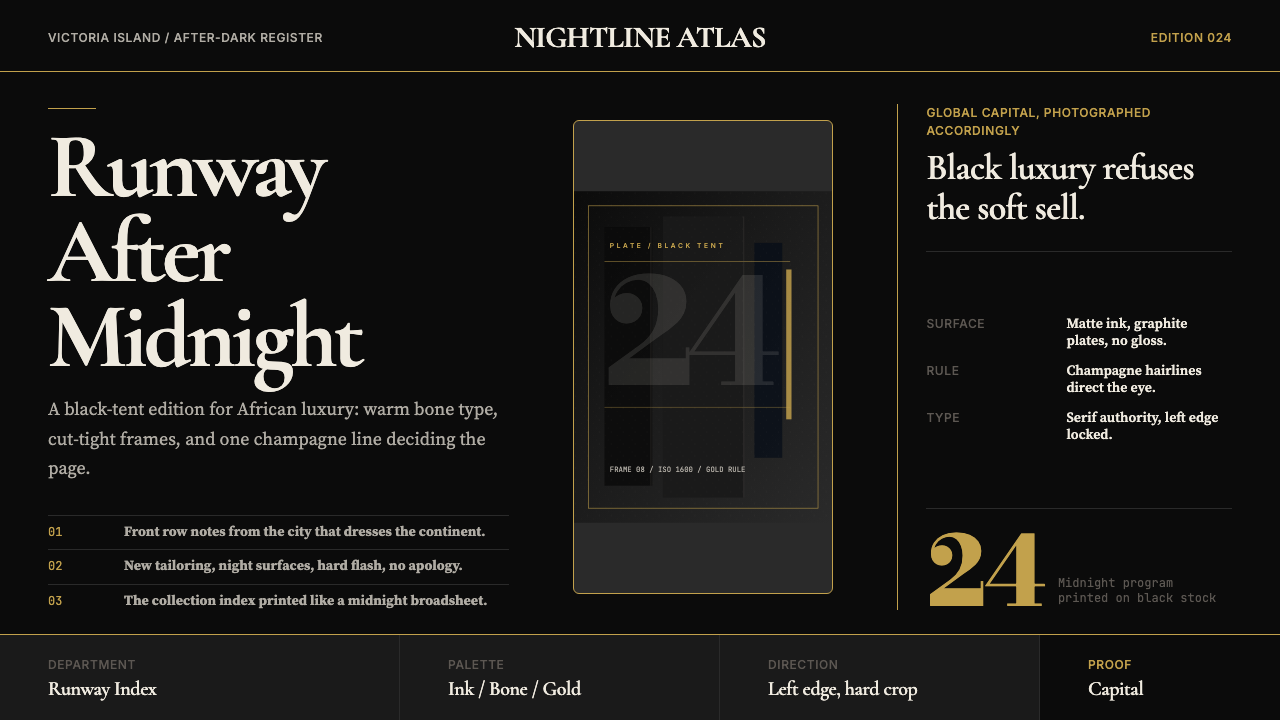
Lagos Fashion Week fuses African luxury and editorial restraint into an ink-black visual language where a single gold hairline says everything ornament never could.
Lagos Fashion Week in brief
Lagos Fashion Week is both an annual fashion event and a fully realized visual identity — a design language that distils the energy of Africa's most closely watched fashion calendar into an editorial register of ink-black surfaces, bone-white text, and brushed champagne-gold hairlines. The aesthetic reads like a luxury broadsheet printed at midnight on Victoria Island: authoritative, tightly cropped, and free of anything that does not earn its place on the page.
The visual system is built on deliberate restraint. Where most fashion-week identities compete for attention through color and spectacle, Lagos Fashion Week operates through contrast and precision. Dark grounds carry warm, legible type. A single metallic accent — drawn as a hairline rather than a filled shape — organizes the eye without decorating the space. Runway photography is cropped hard, foregrounding fabric and silhouette rather than venue atmosphere. The result is a presentation language that treats Lagos as a global capital deserving the same rigorous editorial treatment as Paris or Milan.
Crucially, the style is not simply a dark version of a generic luxury template. It carries a specific cultural posture: confident, unhurried, and aware of its own significance. The warmth of the bone-white text against the matte-black ground avoids the cold sterility of many high-fashion identities. The gold accent is restrained enough to feel earned rather than decorative. This balance — between cool editorial authority and warm human presence — is what distinguishes the Lagos Fashion Week aesthetic from its peers.

Where does Lagos Fashion Week come from?
Lagos Fashion Week was founded in 2011 by Omoyemi Akerele, a fashion entrepreneur and advocate whose central conviction was that West African designers deserved the same international platform as those in London, New York, or Tokyo. In its early years the event operated primarily as a showcase and networking vehicle, bringing together Lagos-based designers, buyers, press, and an emerging class of African fashion consumers who were increasingly looking to their own cities rather than to Europe for style authority. The visual identity of these early editions was relatively conventional — a professional but not yet distinctive presence on the global fashion calendar.
Between 2018 and 2024 the visual identity underwent a sustained consolidation that produced the bold matte-black editorial language the event is now known for. This shift reflected a broader maturation in Lagos creative culture. The city's art, music, and fashion communities — centred on the neighborhoods of Victoria Island, Lekki, and Ikoyi — had developed a self-assured visual vocabulary that no longer needed to borrow from European templates. Diaspora-editorial photography, which staged Nigerian designers' work in the same uncompromising documentary register as global luxury brands, became the dominant visual mode. The decision to anchor the identity in an ink-black ground was itself a statement: luxury in Lagos does not need white space and natural light to assert its credentials.
The event's visual evolution also tracked the rise of post-Afropolitan visual culture — a sensibility that moves past celebrations of African heritage toward a fully contemporary, globally connected urban aesthetic rooted in African cities on their own terms. Where Afropolitanism of the early 2010s often negotiated between African cultural specificity and Western legibility, the post-Afropolitan moment asserts that Lagos, Nairobi, Accra, and Abidjan are themselves the reference points. The Lagos Fashion Week aesthetic embodies this confidence: it does not explain itself or invite translation. It assumes fluency.
The designers who have shown at Lagos Fashion Week over its history have shaped the aesthetic as much as any deliberate identity decision. Kenneth Ize, whose hand-woven aso-oke textiles were later carried by global stockists and worn by international celebrities, brought a commitment to surface depth and material specificity that informed how the event's photography framed fabric and texture. Tokyo James developed a sharp-shouldered, deliberately architectural tailoring that translated into the hard-lined, high-contrast editorial framing the identity now favors. Lisa Folawiyo's jewel-toned Ankara print work established the premise that African textile traditions could support unambiguous luxury positioning. Together, these designers built the visual argument that the identity's graphic language then articulated in print and digital form.
What defines the Lagos Fashion Week look?
Ink-Black Ground
The dominant surface is a deep, matte black — not a near-black or dark navy, but a fully saturated ink tone with no warmth or coolness added to soften it. This ground establishes the editorial register immediately: it reads as deliberate and luxurious rather than simply dark. All other elements are deployed against this ground, and the ground itself is treated as an active compositional element rather than neutral negative space. It absorbs decoration and returns authority.
Gold Hairline Accent
The single most distinctive mark of the visual system is a fine metallic line — drawn at the narrowest weight a medium can reliably reproduce — in a brushed champagne-gold tone. This line never fills shapes or forms backgrounds; it functions solely as a directional or structural device, separating text blocks, underlining headings, or framing a photographic crop. The restraint with which it is used is essential: one hairline carries more authority than a gold field precisely because it costs something compositionally to deploy it.
Bone-White Typography
Body text and supporting copy are set in a warm off-white — closer to bone than to pure white — that prevents the glare and visual fatigue of full-contrast white-on-black reading. Headlines use a high-contrast serif with pronounced stroke variation: thick verticals, thin horizontals, bracketed serifs. These letterforms carry a broadsheet authority that pure sans-serif could not achieve. Alignment is consistently hard left; centered text is absent except in the most formal single-line contexts.
Hard-Cropped Runway Photography
Photography is treated as a primary design element rather than an illustrative supplement. Images are cropped aggressively — often cutting off hands, feet, or background entirely — to isolate the garment's silhouette, textile surface, and construction detail. The editorial framing is close and deliberate, treating runway photography with the same exacting compositional logic applied to a still-life or a sculpture. The dark ground and the photography operate in tension: the image provides warmth and specificity, the ground provides authority and frame.
Restrained Metallic Warmth
The gold accent introduces a temperature into the palette — a warmth that prevents the identity from reading as merely cold or corporate. The specific tone is champagne rather than yellow-gold or rose-gold: desaturated enough to read as metallic and material rather than as a bright color, warm enough to suggest luxury and occasion. This single temperature note does the emotional work that a secondary color might do in a more expansive palette, but it achieves it through restraint rather than addition.
Left-Anchored Editorial Layout
Layouts are organized with a strong left axis: headlines, standfirsts, captions, and credits all root to the same left margin, creating a reading path that the eye follows without instruction. The right side of the composition is used for photographic area or open ground rather than competing text. This hard-left architecture gives the system its broadsheet quality and allows headline type to run large without the composition becoming chaotic. It also communicates confidence: a layout that left-aligns everything trusts its content to hold attention without theatrical framing.
Zero Decorative Ornament
There are no borders, no repeated patterns, no floral or geometric decorative motifs, no textured backgrounds, no watermark graphics. Every element present has a structural or communicative justification. The gold hairline is not decoration — it is punctuation. The matte ground is not a stylistic choice alone — it is a surface that forces the eye to the content. This discipline is harder to maintain than it appears: the temptation in luxury design is always to add, to layer, to signal richness through accumulation. The Lagos Fashion Week aesthetic signals richness through removal.

Who shaped Lagos Fashion Week?
Akerele founded Lagos Fashion Week in 2011 and has served as its creative and strategic director ever since. Her background in fashion business and advocacy — she also founded Style House Files, a fashion business development organization — shaped the event's dual identity as both a commercial platform and a cultural statement. Her conviction that African fashion deserved international parity, not merely international curiosity, is embedded in the editorial seriousness of the visual identity she oversaw. Under her leadership the event grew from a regional showcase to a fixture on the global fashion calendar.
Ize is among the Lagos Fashion Week alumni most associated with the event's international breakthrough. His work centers on hand-woven aso-oke — a traditional West African textile — reimagined in contemporary silhouettes and presented through a visual language that refuses to frame it as craft or folk art. The meticulous surface quality of his textiles, and the way they photograph against dark grounds, directly influenced the identity's emphasis on tight-cropped, texture-focused runway imagery. His later collaborations with international houses and his consistent presence on European fashion media demonstrated that the Lagos Fashion Week platform could generate designers with genuine global footprint.
James built a reputation for architectural tailoring — sharp shoulders, precise construction, an insistence on garments that hold their form without the body inside them. His runway presentations at Lagos Fashion Week were among the most photographically striking, because the strong silhouettes and controlled color work translated directly into the high-contrast editorial framing that became the event's visual signature. His work also demonstrated that Nigerian menswear could carry the same conceptual weight and commercial ambition as tailoring traditions associated with London or Milan.
Folawiyo's label Jewel by Lisa established a new visual grammar for Ankara — the brightly colored wax-print cotton fabric common across West Africa — by pairing it with intricate embellishment, precise tailoring, and a presentation language borrowed from European luxury. Her work was instrumental in shifting the conversation about African textiles away from cultural preservation and toward unambiguous luxury positioning. The visual richness of her textiles, and the restraint with which they were presented against clean, dark grounds in Lagos Fashion Week photography, helped establish the principle that African surface pattern could coexist with editorial cool.
How do you use Lagos Fashion Week today?
Lagos Fashion Week is among the most legible dark-ground editorial styles available to contemporary designers, because its logic is clear and its constraints are productive. Applying it correctly requires understanding what each element is doing: the matte-black ground establishes authority; the bone-white text provides warmth and readability; the gold hairline provides structure without decoration; the tight-cropped photography provides specificity and texture. Remove or dilute any one of these, and the system starts to drift toward generic dark luxury.
For presentation slides, the style works powerfully on both cover and content pages. A cover built in this register should use the full dark ground, set the event or project title in a large serif with strong weight contrast — heavier strokes, lighter crossbars — aligned hard left, with a single gold hairline separating the title from a subtitle or date. Content slides should resist the temptation to add color: hierarchy is established through scale and weight alone. A section heading runs large; supporting text runs small; a hairline separates them. Data slides — bar charts, comparison tables — should treat the chart elements as editorial objects, using the bone-white and gold tones for data marks against the dark ground, with no decorative gridlines beyond those that carry quantitative meaning.
For web dashboards and pricing pages, the style demands discipline. A dark-ground interface built in this register should use the bone-white for all primary copy, reserve the gold exclusively for the single most important interactive or navigational element on any given view — a primary button, an active tab indicator, a pricing tier marker — and use no secondary accent colors. The absence of soft shadows and rounded corners is important: card components should have hard edges or be defined by hairline borders rather than depth simulation. Navigation should be typographic, with generous spacing between items and no icon decoration beyond minimal geometric indicators.
For editorial and marketing applications, the style is most powerful when it trusts negative space. A Lagos Fashion Week-inspired editorial layout gives the headline room to breathe: large, high-contrast serif type against the dark ground, with nothing competing in the same zone. Pull quotes are set in a slightly warmer or lighter weight to differentiate from headlines without introducing a new color. Marketing pages work well when they alternate between a full dark-ground section featuring photography and a lighter section — bone or deep charcoal rather than white — for text-heavy content. The gold hairline recurs as a consistent structural device across both: same weight, same color, same positioning logic.
The most common mistake when applying this style is treating the gold accent as a general highlight color rather than a precision instrument. Once gold appears on more than one or two elements per composition, it loses its authority and starts to feel like gilded decoration rather than editorial punctuation. A related error is choosing a yellow-gold or bright metallic rather than the specific champagne-brushed tone: too warm and it reads as opulent excess; too cool and it reads as silver, which carries an entirely different register. A third failure mode is allowing photography to skew light or colorful: imagery that introduces bright backgrounds or saturated secondary colors will fight the dark ground rather than sit within it.

Lagos Fashion Week — FAQ
Is this style only appropriate for fashion-related projects?
No. The Lagos Fashion Week aesthetic is a visual system built on contrast, restraint, and editorial authority — qualities that transfer readily to finance, technology, culture, and luxury goods. Any project that wants to communicate seriousness, global ambition, and a refusal to court easy approval will find the style well-suited. Where it does not fit is in contexts that require warmth, accessibility, or bright visual energy: consumer-facing applications with broad demographic reach, children's products, and brands whose identity depends on approachability will find the style's authority register alienating rather than reassuring.
How do you introduce warmth without breaking the dark editorial register?
The key is working within the palette's existing warmth rather than adding a new warm color. The bone-white text already carries warmth relative to pure white; the champagne-gold hairline carries warmth relative to silver or cool gray. Within photography, selecting images that feature warm skin tones, natural fabrics, or warm studio lighting introduces human temperature without disrupting the compositional logic. Increasing the weight or size of the bone-white type relative to the dark ground also adds warmth through presence. What breaks the register is adding a tertiary color — any brown, warm red, or terracotta — because it signals a different design system entirely.
Can this style work in a light-background version?
A light inversion is possible but requires significant adjustment. The matte-black ground is not simply a container — it is the source of the aesthetic's authority and its luxury register. On a light ground, that authority must come from different means: strong weight contrast in the typography, hard-edged composition, and a very controlled use of the gold accent on a cream or warm white surface rather than black. The result will be closer to a traditional luxury broadsheet than to the Lagos Fashion Week register specifically. If a light variant is required, it is better to think of it as a complementary system — used for long-form text or print applications — while preserving the dark version as the primary identity expression.
What makes a gold accent feel editorial rather than decorative or ostentatious?
Three factors determine whether gold reads as editorial or as excess. First, the tone: a desaturated, slightly warm metallic — champagne or antique gold — reads as material and considered; a bright or highly saturated gold reads as costume jewelry. Second, the form: a hairline or thin rule reads as punctuation; a filled shape, gradient, or textured gold reads as decoration. Third, the frequency: gold that appears once per composition reads as a decision; gold that appears repeatedly reads as a motif, which shifts the register from editorial to ornamental. Applying all three disciplines — correct tone, linear form, single deployment — is what keeps the accent within the system's logic.
How does this style relate to other African visual aesthetics?
The Lagos Fashion Week visual identity is deliberately not a celebration of African visual heritage in the conventional sense. It does not draw on Adinkra symbols, kente geometry, or the bright color palettes associated with West African textile traditions. Instead, it represents a post-Afropolitan position: a visual language developed by and for a globally connected African urban creative class that takes its own sophistication for granted. This is a significant cultural distinction. The style's relationship to African aesthetics is one of confidence rather than reference — it assumes its audience needs no translation or explanation, just as a Milan-based fashion identity assumes fluency in the conventions of European luxury without citing them.
Related design styles
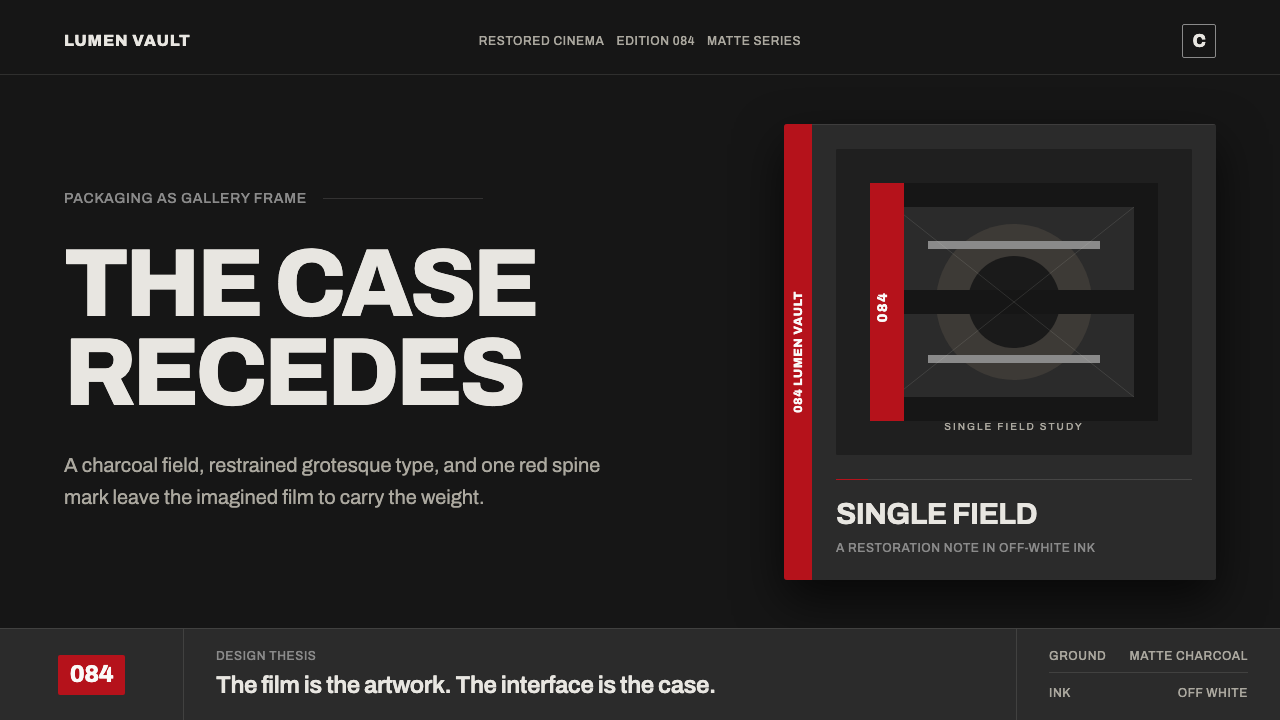 Criterion ArthouseThe case disappears. Charcoal field, off-white Archivo, hairline rules, one r…
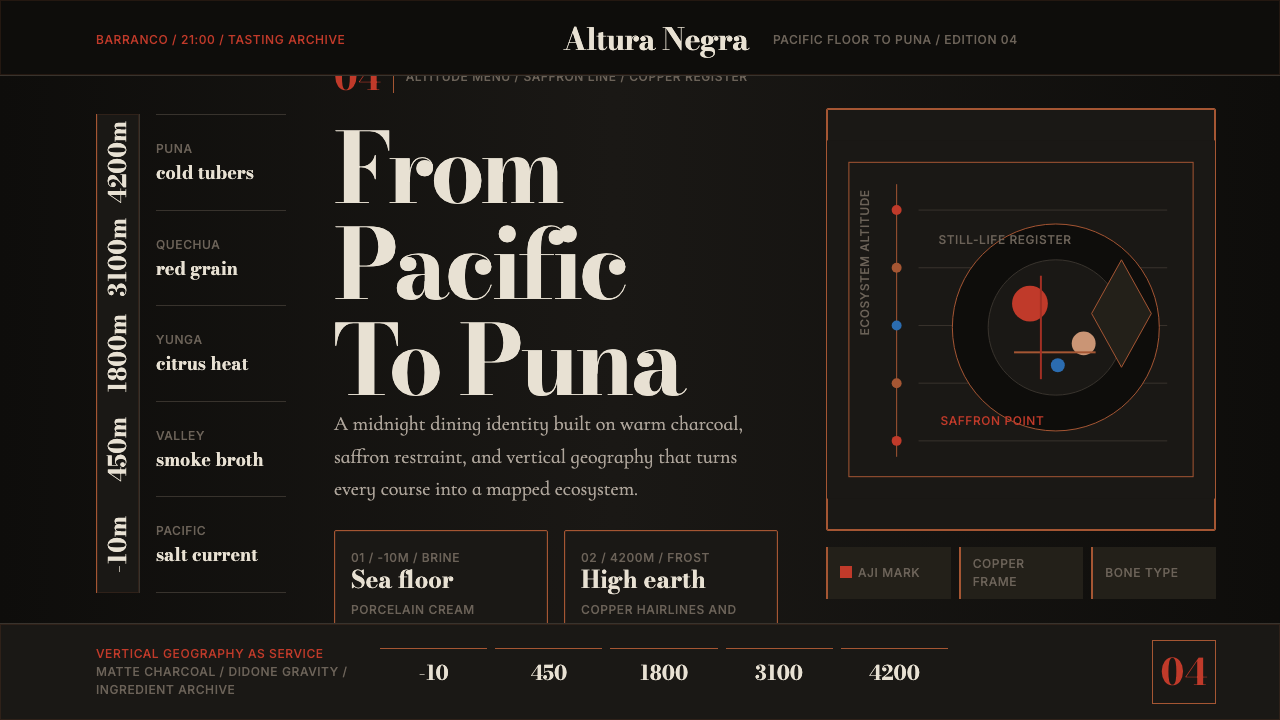 Lima Nuevo Andino CuisineAltitude turns luxurious. Charcoal fields, copper hairlines, and saffron-red…
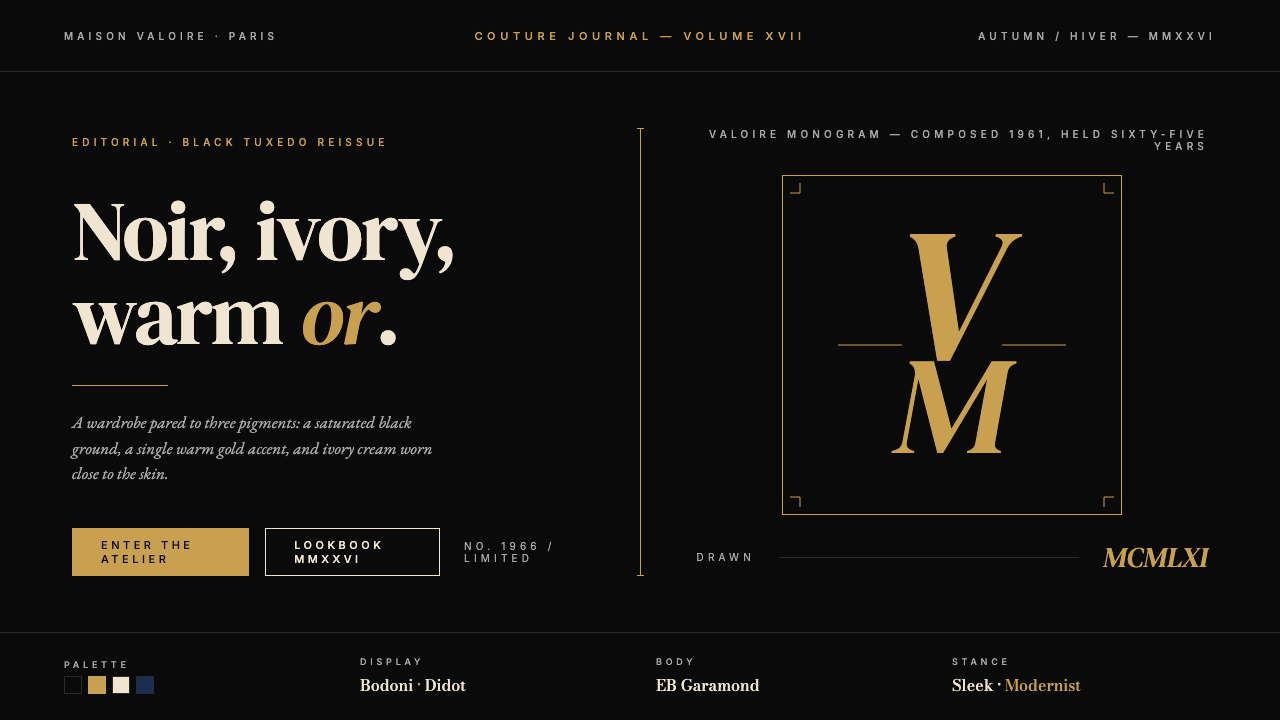 Yves Saint Laurent (YSL)Couture chiaroscuro. Saturated black ground, warm gold accent, Didot serif at…
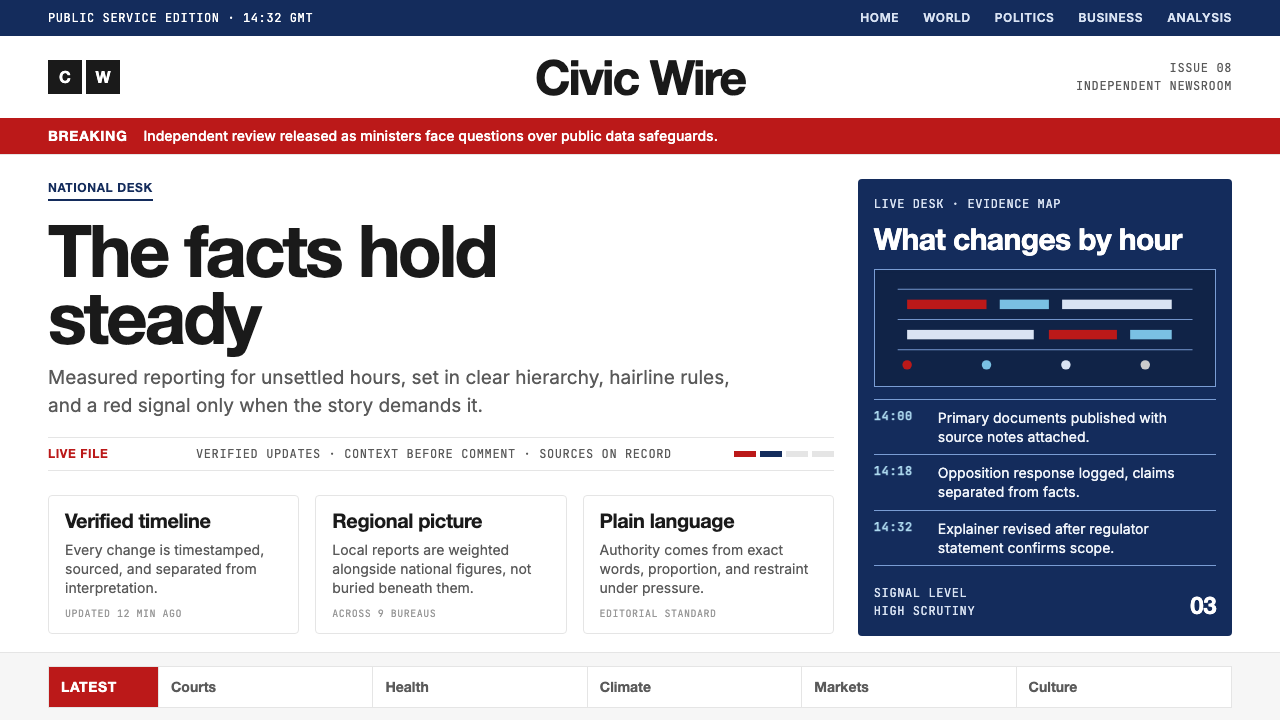 BBC NewsPublic trust, stripped bare. Red alerts, deep navy and hairline grids make ur…
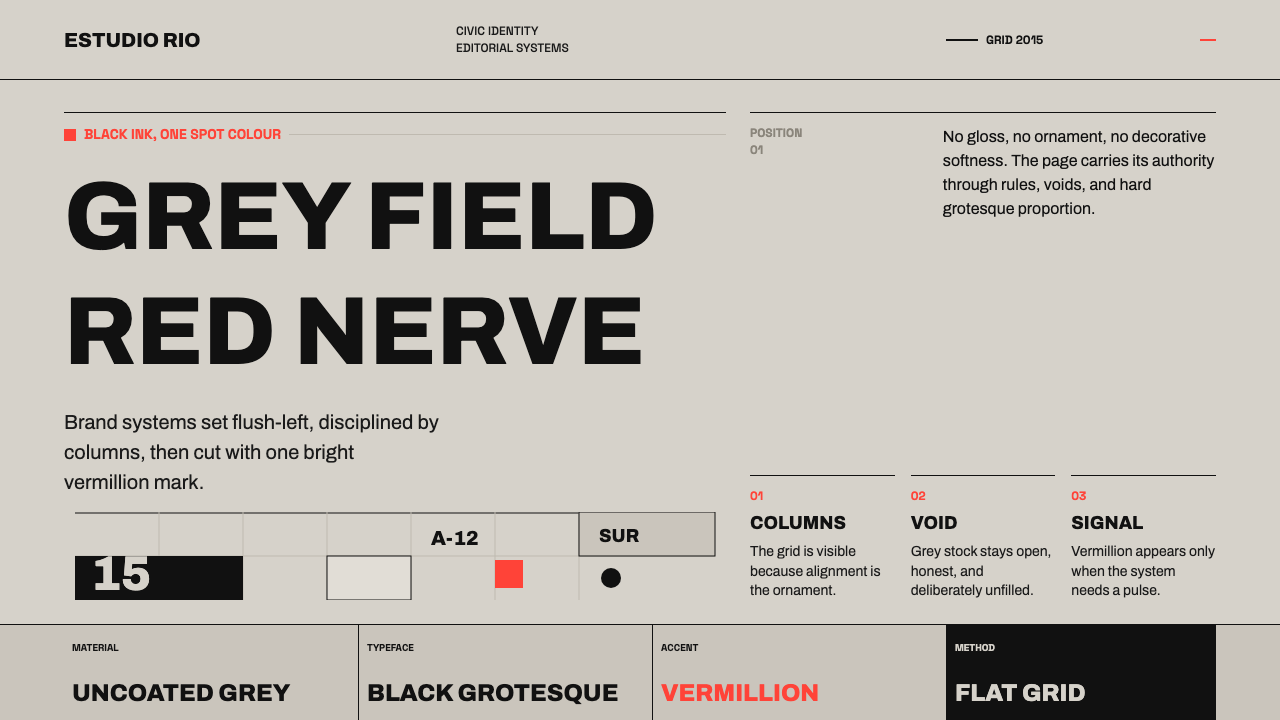 Buenos Aires Branding StudioRigour with nerve. Black grotesque on warm grey, pierced by one vermillion ma…
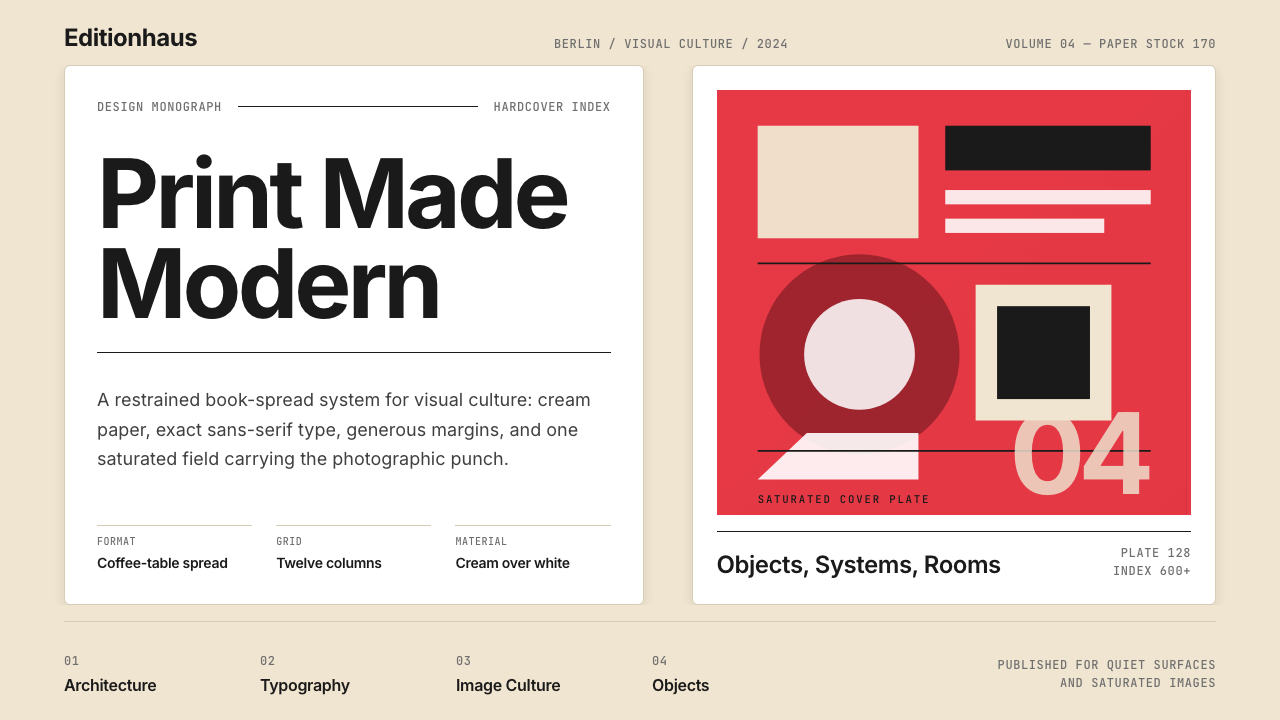 Gestalten Design BookCoffee-table calm. Cream paper, tight sans, one saturated block, and a strict…