What is Real Madrid (Blanco)?
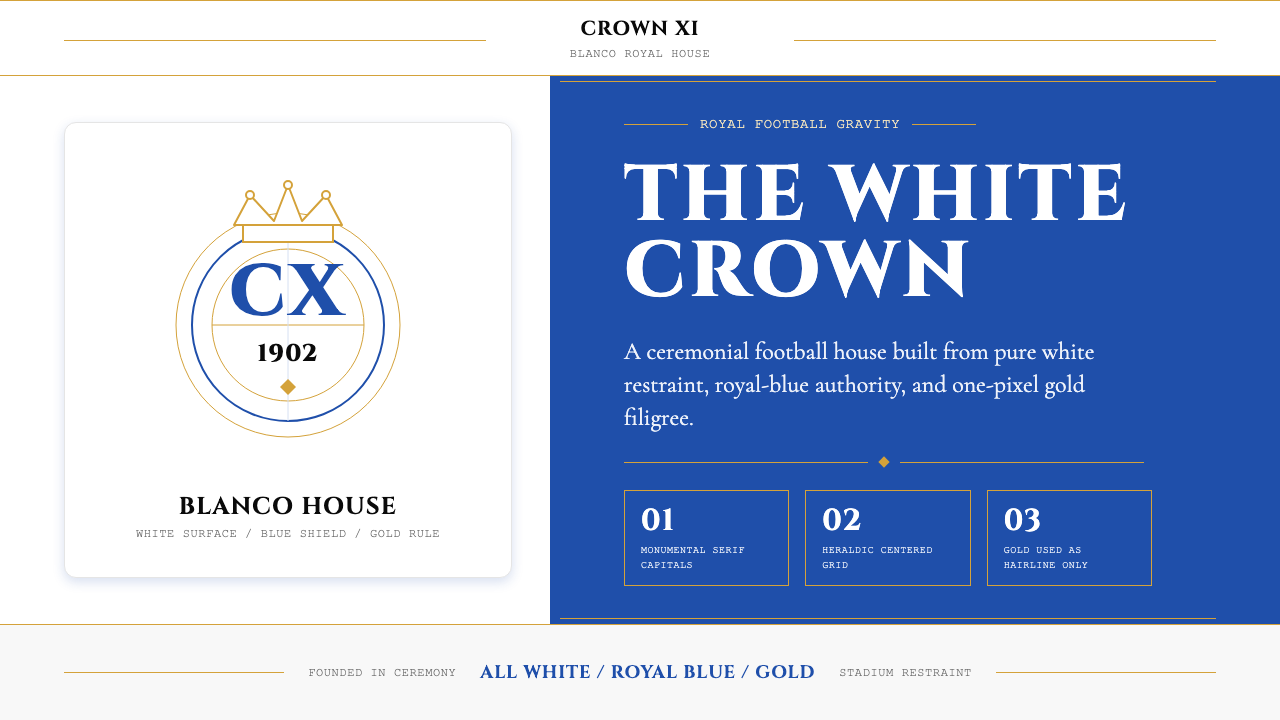
Real Madrid's visual identity is built on one conviction: white does not need to shout to command the room.
Real Madrid (Blanco) in brief
Real Madrid Blanco is the visual design system derived from one of the oldest and most decorated football clubs in the world. Founded in Madrid in 1902, the club received the royal designation 'Real' — meaning 'Royal' — directly from King Alfonso XIII in 1920, an honor that shaped not only its name but its entire visual sensibility. The system is built on three elements that never compete: the all-white field of the famous 'Los Blancos' kit, a deep royal blue deployed as structural panel and accent, and a measured royal gold used for heraldic detail and edge definition.
Unlike most football club brands, which use visual volume as a substitute for authority, Real Madrid operates through restraint. The crowned crest — featuring the royal monogram, the crown of Castile, and the club's initials — functions like a wax seal rather than a commercial logo: it closes a document, it does not advertise one. Serif display type and generous letter-spacing recall the proclamations of a royal court rather than the promotions of a sports franchise. The whole system favors architectural patience over commercial urgency.
What distinguishes Real Madrid Blanco from other sports brand aesthetics is its refusal to modernize on the terms that most clubs accept. Gradient fills, dynamic layered effects, and neon accent colors have swept through football visual identity design over the past two decades; this system has absorbed none of them. Its contemporariness comes not from following trends but from the confidence of a brand that has never needed to.

Where does Real Madrid (Blanco) come from?
The club that would become Real Madrid was founded on 6 March 1902 as Madrid Football Club by a group of mostly young men, many of them British expatriates and Spanish enthusiasts who had encountered association football in England and brought it home. The city of Madrid had no professional football tradition; the club was a social experiment as much as a sporting one. Its early kit — white, from the beginning — was chosen partly for practical reasons and partly in imitation of the Corinthians, the famous English amateur club that had toured Spain in 1902 and made a powerful impression on local players.
The royal patronage of 1920 was not merely ceremonial. Alfonso XIII was a genuine football enthusiast, and the prefix 'Real' carried legal weight: the crown incorporated into the crest and the royal blue that entered the color palette as a secondary accent both reflected the terms of that grant. The visual vocabulary of the club — white ground, royal blue panel, gold heraldic crown — was effectively codified at this moment, more than a century ago, and has remained structurally unchanged despite periodic refinements to the crest's exact form.
Through the mid-twentieth century, the club's visual identity grew in tandem with its sporting success. Under Santiago Bernabéu, who served as club president from 1943 to 1978, Real Madrid won five consecutive European Cups between 1956 and 1960 — a run of continental dominance without precedent. During this era, the white kit became globally legible as a symbol of excellence rather than simply the color of one club. The name 'Los Blancos' entered the football lexicon not as a nickname but as a category: the standard against which other clubs measured themselves.
The contemporary visual expression of Real Madrid Blanco — the version that informs today's digital applications, brand guidelines, and official communications — reflects refinements made through the 2020s. The crest has been periodically simplified for reproducibility at smaller scales and on digital screens, but the structural logic has not changed: white as the primary field, royal blue as secondary structure, royal gold as heraldic accent. Zinedine Zidane's three consecutive UEFA Champions League titles as manager between 2016 and 2018, and Florentino Pérez's stewardship of the club's global commercial expansion, placed the visual system under international scrutiny and demonstrated its resilience: a brand that reads as powerfully on a Tokyo billboard as on the Santiago Bernabéu stadium facade has achieved something very few sports brands manage.
What defines the Real Madrid (Blanco) look?
White as Ground
The dominant field of Real Madrid Blanco is unmodified white — not off-white, not cream, not ivory. This is the most principled decision in the system: white functions as a neutral field that gives every other element maximum legibility and authority. It is also a historical commitment. The club's white kit has been consistent since the earliest days, and the visual identity treats the white ground not as absence but as presence — the visual equivalent of the quiet authority of a royal court.
Royal Blue as Structure
The deep royal blue that entered the palette in 1920 with the royal crest is the system's structural color. It appears as panels, borders, and zone-defining elements — never as the dominant field, always as the frame or the container. This secondary-but-decisive role mirrors the relationship between the crown and the institution it represents: the crown does not occupy the room, it defines it. Blue at this depth also creates a strong tonal contrast with white that holds across different reproduction conditions and screen calibrations.
Gold as Heraldic Accent
Royal gold is used with maximum restraint — thin edge lines, the crown detail in the crest, and selective highlights on typographic marks. It does not fill large areas; its power comes from its precision. Gold at this application weight signals exclusivity and age simultaneously: it is the color of illuminated manuscripts, royal proclamations, and the gilded edges of institutional seals. When gold is overused or broadened into fills and backgrounds, this signal collapses into something closer to sportswear branding.
Heraldic Composition
The compositional logic of Real Madrid Blanco is heraldic rather than modernist. Where a modernist system uses asymmetric grid tension, this system uses centered, anchored, symmetrical arrangements that echo the formal structure of coats of arms, official seals, and royal portraits. This does not mean static — within the heraldic frame, there is room for dynamic type hierarchy, photographic drama, and spatial variation — but the organizing principle is always ceremonial balance rather than designed tension.
Monumental Serif Display
Display type in this system is characterized by monumental scale, deliberate letter-spacing, and the use of serif letterforms that carry weight and institutional gravitas. The approach is closer to stone carving than to digital type design: letters are treated as architectural elements rather than graphic ones. This stands in direct contrast to the sans-serif immediacy that most contemporary sports brands favor, and the contrast is entirely intentional — this is a club that measures its history in centuries.
Surface Restraint
The system deliberately avoids the layered complexity that characterizes most premium sports brand design: no gradients, no glow effects, no textured backgrounds, no photographic color treatments that blend image into brand. Surfaces are clean. Where a photographic element appears, it is presented directly against the white field or within a clearly defined blue panel — not dissolved into the brand color through duotone or color wash treatments. This surface restraint is what gives the system its sense of authority; complexity would dilute it.
Generous Negative Space
One of the most consistent features of Real Madrid's brand communications is the use of space itself as a compositional element. Elements are not crowded together; there is an almost architectural sense of room. This is partly a consequence of the heraldic tradition — coats of arms depend on clear field and clear charge, with the negative space of the shield as important as the symbol it bears — and partly a practical signal: brands that need no space to attract attention are not brands that are desperate for attention.

Who shaped Real Madrid (Blanco)?
Bernabéu served as club president from 1943 until his death in 1978, overseeing the most transformative period in the club's history. His tenure encompassed the five consecutive European Cups between 1956 and 1960, the construction of the stadium that now bears his name, and the transformation of Real Madrid from a leading Spanish club into the world's most recognizable football brand. His insistence on presenting the club with institutional gravitas — long before 'brand strategy' was a recognized discipline — essentially established the visual tone that persists today. He understood that a club bearing a royal title had an obligation to look like one.
Di Stéfano, the Argentine-Spanish forward who arrived at Real Madrid in 1953, is the player most directly responsible for the global recognition of the white kit as a symbol of excellence. His eight consecutive Spanish league titles and central role in the five consecutive European Cups of 1956–1960 made the white jersey the most photographed and televised club shirt of its era. Di Stéfano did not design anything, but the period his performance defined gave the white uniform a resonance that no visual designer could manufacture. He is the reason 'white' and 'footballing excellence' became associated concepts.
Zidane's dual legacy at Real Madrid — first as a player whose elegance on the ball became synonymous with the club's aesthetic ambitions, then as the manager who won three consecutive UEFA Champions League titles between 2016 and 2018 — reinforced the visual brand's global authority at a moment when digital media had fragmented sports attention. As a player in the 2000s, Zidane was the visual face of the Galácticos era, a period when the club's commercial and visual reach expanded dramatically. His managerial trophies in the late 2010s renewed international engagement with the brand at a point when the visual identity needed no alteration: it simply needed to be winning.
Pérez, who has served as club president since 2000 with a brief interruption, oversaw the transformation of Real Madrid into a global media and entertainment brand — the commercial infrastructure that turned the visual identity from a Spanish cultural artifact into an international signifier. Under his tenure, the club developed the brand guidelines, licensing architecture, and stadium renovation plans that gave the visual system consistent global application. The completed Santiago Bernabéu renovation, with its retractable roof and LED facade, represents the most significant architectural extension of the brand's aesthetic — white, structural, and lit with the same economy of means as the visual identity itself.
How do you use Real Madrid (Blanco) today?
Real Madrid Blanco transfers to designed artifacts with unusual directness because its visual logic is architectural rather than decorative: white field, structured blue, precise gold. Understanding what the system is actually doing — building authority through restraint, using negative space as a compositional argument, treating heraldic precision as a functional value — is the prerequisite for applying it well. The failure mode is almost always excess: more blue than the hierarchy requires, gold used as fill rather than as line, type that shouts rather than declares.
For presentation slides, the system works with particular strength on opening and closing frames. A cover composed of a full white field with the title in large spaced serif capitals, a narrow royal blue band anchoring the bottom edge, and a single gold line above it reads as authoritative without any additional visual elements. Content slides should maintain the white-dominant field, use blue to define data containers or section zones, and keep type hierarchy to two levels — a primary heading and body — both sized for legibility rather than drama. Data slides benefit from treating chart elements as geometric objects within clearly defined blue containers: bars and zones carry meaning through position and proportion, not through gradient fills or shadow.
For web interfaces, Real Madrid Blanco is especially well-suited to premium product pages, high-stakes SaaS dashboards, and any context where the brand promise is institutional rather than playful. The approach: a white or near-white background field, blue used strictly for navigation panels, active states, and structural separators, gold reserved for the single most important call-to-action or tier marker. Card components should have defined borders rather than soft shadows; interaction states should shift from blue to a slightly deeper blue rather than introducing third colors. Typography should lean toward the architectural — wider tracking on headings, consistent baseline rhythm in body text.
For editorial and marketing applications, the system supports both formal and dynamic treatments. A formal editorial layout uses a generous white margin, title set large in tracked serif capitals, body text in a single comfortable measure, and section breaks defined by a thin blue or gold rule rather than decorative ornament. Marketing materials — whether digital banners, out-of-home formats, or printed collateral — work best when a single hero image, treated without color manipulation, sits against the white field at substantial scale, with typographic elements maintaining their formal distance. The poster tradition of football communications licenses bold scale relationships: a player figure at near full-bleed with the crest and title in restrained type is more powerful than a complex composed layout.
The most common mistake when applying Real Madrid Blanco is treating it as a sports aesthetic rather than a heraldic one — adding motion effects, using the blue at high saturation across large fields, or reaching for additional accent colors to create energy. The system already contains energy; it is stored in the restraint. Similarly, replacing the serif display type with contemporary sans-serifs undermines the institutional logic entirely: the serif is not a style choice, it is a structural argument about what kind of institution this is. When the system is applied correctly, there should be a slight formality that makes the viewer feel they are in the presence of something that has existed for a long time and will continue to do so.

Real Madrid (Blanco) — FAQ
Why does Real Madrid Blanco use serif type when most sports brands use sans-serif?
The choice is institutional, not stylistic. Sans-serif type became dominant in sports branding because it reads as modern, energetic, and accessible — values that most clubs actively want to communicate. Real Madrid does not need to communicate modernity; its modernity is implied by its continued global relevance over 120 years. Serif type carries associations with permanence, authority, and inscription — the qualities of institutions that have outlasted their critics. Using sans-serif type for Real Madrid Blanco would be a category error: it would make the brand look like it was trying to be contemporary, which is the one thing a genuinely historic brand should never appear to be doing.
Can this system work for a dark-mode interface?
A dark inversion is possible but requires significant care, because the system's authority depends on the white field. On a dark ground, the visual hierarchy inverts in ways that are difficult to control: gold, which functions as a precision accent on white, can become visually dominant on dark grounds; blue, which reads as structural on white, risks looking merely decorative on black. If a dark variant is necessary — for a dashboard context, say, where screen environments favor dark backgrounds — the most defensible approach is to preserve the white field for primary content areas and confine the dark ground to secondary zones, rather than inverting the entire composition. A fully dark Real Madrid Blanco risks losing the heraldic logic that makes the system coherent.
How does Real Madrid Blanco differ from other prestigious club brands like Juventus or Barcelona?
Juventus — after its 2017 rebrand — moved toward a stripped modernist identity: a wordmark that functions almost like a fashion house logo, a black-and-white palette with no heraldic reference, and a clean geometric system that prioritizes contemporary brand recognition over institutional history. Barcelona's visual identity is warmer and more figurative, retaining the full complexity of its crest as a primary element, using maroon and blue as co-equal partners, and communicating cultural identity alongside sporting achievement. Real Madrid Blanco sits in a different position from both: it retains full heraldic complexity, insists on the royal associations of blue and gold, and uses whiteness itself as the primary communicative act. Where Juventus abandoned heritage for modernity and Barcelona balances both, Real Madrid treats heritage and authority as the same thing.
What is the biggest risk when adapting this style for a non-sports brand?
The biggest risk is imposing the aesthetic without earning the authority it implies. Real Madrid Blanco reads as powerful because the institution behind it has 120 years of sporting achievement, a royal title, and global name recognition. The same visual system applied to a product or company that lacks that credibility can produce the opposite effect: it reads as pretentious rather than authoritative, as affectation rather than confidence. The system works best when the product genuinely embodies the qualities the visual language claims — longevity, precision, restraint, institutional seriousness. Applying it to a startup, a consumer brand with playful values, or any context that calls for warmth and approachability will produce friction rather than authority. The honest question before applying any heraldic system is: does the institution deserve the crest?
How should gold be used without looking luxurious or gaudy?
The discipline is in the application weight, not the color itself. Gold reads as gaudy when it fills large areas, when it is combined with high-contrast backgrounds at wide coverage, or when it appears alongside multiple other accent colors competing for attention. In Real Madrid Blanco, gold is used at line weight — the finest strokes, the smallest details, the edge of a border rather than the face of a panel. At this application weight, gold functions as precision and age rather than luxury and display. The historical reference is illuminated manuscripts and royal seals, not jewelry or interior decoration. Keeping gold strictly at accent weight — visible when the eye finds it, not visible before it does — is the single most important discipline in applying this element correctly.
Related design styles
 Ferrari Rosso Corsa (1947)Speed becomes architecture. Racing red, warm ivory, and carbon-black panels.
 Akhal-Teke Golden HorseGold that behaves like light. Specular sheen glowing from a stable-dark groun…
 Estonian Song FestivalCivic monumentality sings. Blue-black-white bands meet a concrete arch.
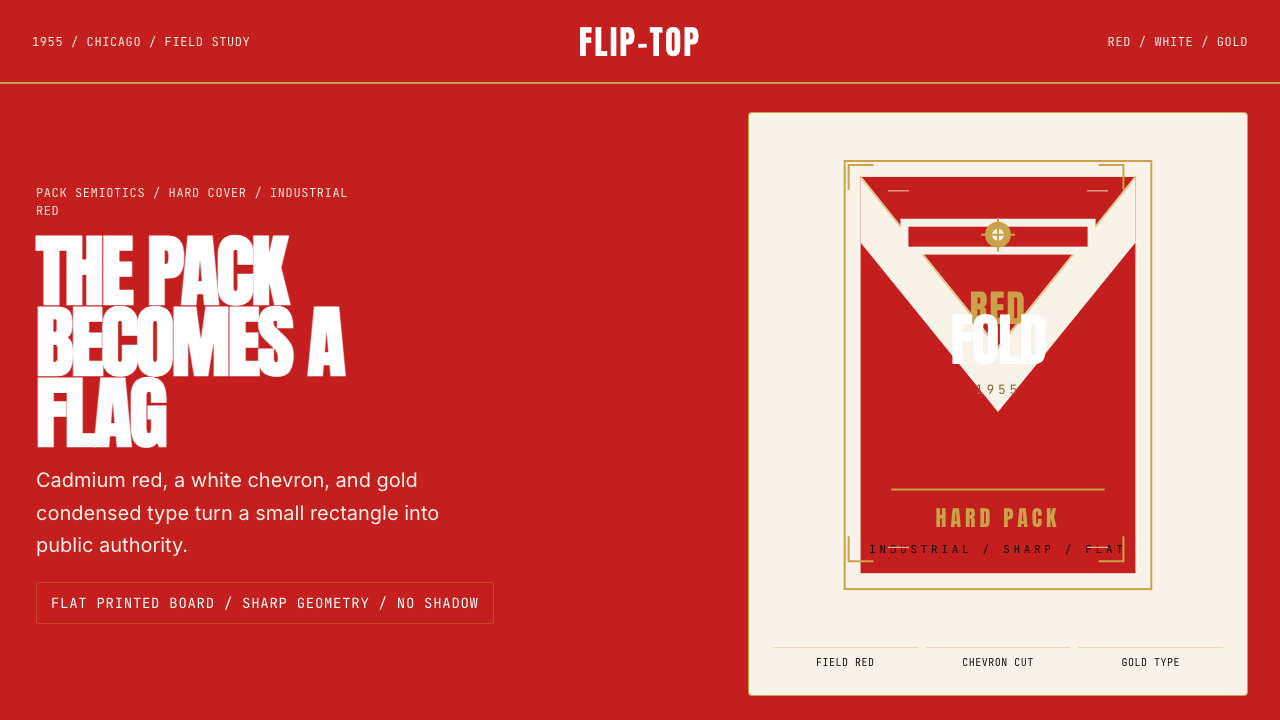 Marlboro Red Flip-Top (1955)Authority in one fold. Cadmium red, white chevron, and gold type read like a…
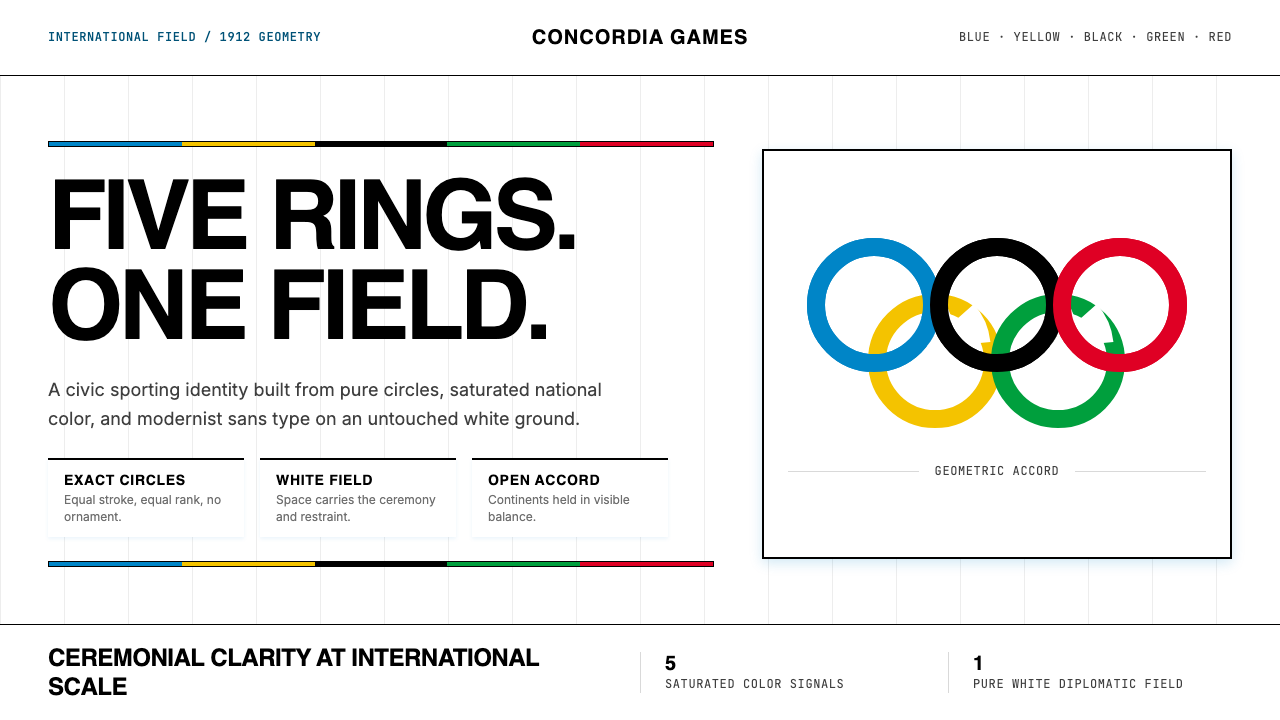 Olympics Five Rings (1912)Ceremony without noise. Saturated five-ring color on pure white, locked to a…
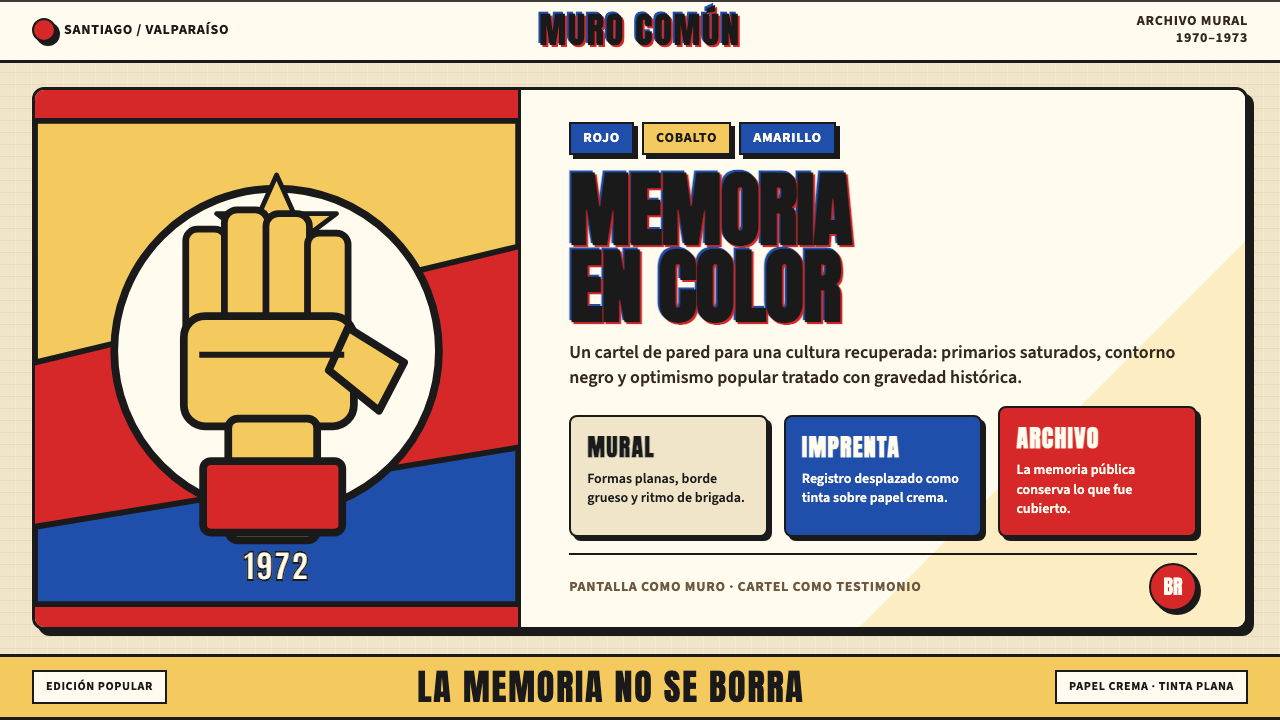 Chilean Allende-Era Propaganda (1972)Solemn revolution. Red, cobalt and yellow lock into thick black mural geometr…