What is Marlboro Red Flip-Top (1955)?
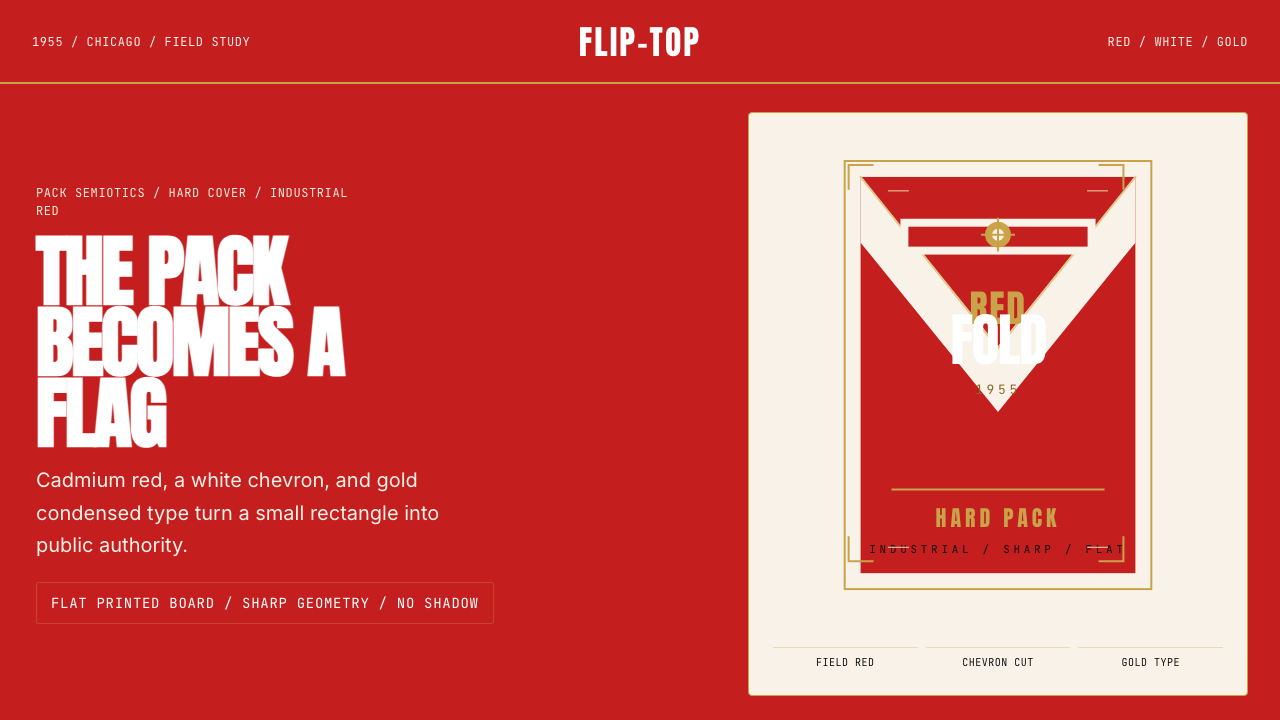
One fold of cadmium red and a white chevron compressed an entire mythology of frontier authority into a palm-sized hard-pack that has not needed to change in seventy years.
Marlboro Red Flip-Top (1955) in brief
The Marlboro Red Flip-Top (1955) is a visual system derived from one of the most studied objects in twentieth-century packaging history: the Philip Morris hard-pack designed by Frank Gianninoto and launched in 1955. Where most consumer packaging of the era relied on illustration, decorative borders, and varied color fields to attract attention, Gianninoto's design did the opposite — it reduced everything to three elements: a single saturated ground color, an inverted-V white chevron, and condensed gold-shadowed lettering. The result was less a package than a flag.
The system's power lies in its asymmetric compression. The chevron — a sharp downward-pointing wedge of white — cuts across the red field from corner to corner, creating a geometric negative space that the eye reads as a rooftop, a mountain peak, or a military insignia depending on cultural context. Above this dividing line sits the brand name in industrial condensed type rendered with a faint gold highlight that gives it dimensionality without softness. Below the chevron, a contrasting white or cream band carries secondary information in a quieter register. Nothing decorates for its own sake; every element is structural.
As a design language, the Marlboro Red system belongs to a tradition of durable-flag packaging — visual identities so geometrically resolved that they function as symbols rather than as graphics. It sits alongside the Coca-Cola contour label and the Campbell's soup band as an example of a commercial object that achieved the visual economy of a national emblem. The characteristics extracted here — the dominant monochromatic ground, the geometric negative space, the industrial condensed letterform, the flat shadow-free materiality — form a transferable vocabulary for any design context that needs to project confident, unapologetic authority.

Where does Marlboro Red Flip-Top (1955) come from?
The story of the 1955 redesign begins with a brand in crisis. Marlboro had existed since 1924, initially marketed as a mild cigarette for women, with filters and an ivory tip designed to hide lipstick stains. By the early 1950s the brand was a minor commercial afterthought. The scientific linking of cigarettes to lung cancer — formalized in the American Cancer Society's 1952 report and Reader's Digest's widely read 1952 article — prompted Philip Morris to reposition Marlboro as a filtered cigarette for men, a category that was growing rapidly as health-anxious smokers sought alternatives to unfiltered brands. The challenge was to make filters, which carried a feminine or hypochondriac stigma, seem rugged instead.
Philip Morris engaged the Leo Burnett agency in Chicago, which conceived the campaign that would become one of advertising history's most studied repositioning efforts. Burnett's creative team developed the Marlboro Man — a series of outdoor archetypes including cowboys, ranchers, and hunters — to associate the filtered cigarette with frontier masculinity. The visual language of the campaign demanded a package that could hold its own against that imagery: something bold enough to read as masculine authority on a drugstore counter, a saloon bar, or a billboard. Frank Gianninoto, a package designer working in the New York commercial design world of the early 1950s, was commissioned to solve this problem.
Gianninoto's solution was the flip-top hard-pack box in saturated red — a form factor that was itself novel in the American market, borrowed from European cigarette packaging conventions. The hard-pack's rectangular geometry gave him a flag-like canvas. His central decision was the white chevron: an inverted V that bisected the face of the pack, creating an immediate visual landmark that could be recognized at a glance across a counter display or from a moving vehicle. The condensed lettering rendered in gold-shadowed capitals filled the upper register with industrial authority. The lower register, white against the red ground, provided contrast and breathing room without compromising the dominant red field. The design launched in 1955 alongside the Marlboro Man campaign and was an immediate commercial success.
The packaging's longevity is remarkable even by the standards of durable brand identities. While competitors have cycled through multiple redesigns responding to regulatory requirements, changing consumer aesthetics, and digital-first packaging strategies, the Marlboro Red hard-pack has maintained its essential geometry from 1955 through the present. Minor refinements — adjustments to the chevron angle, shifts in the gold lettering treatment, updated health warnings occupying increasingly large portions of the pack — have not disturbed the underlying visual system. The pack's continuity through seven decades of social, regulatory, and aesthetic upheaval is itself a design argument: when a visual identity achieves sufficient geometric clarity and symbolic resonance, it does not need to chase change.
What defines the Marlboro Red Flip-Top (1955) look?
Dominant Monochromatic Ground
The system begins and ends with the red ground. Unlike palettes that balance multiple hues, this visual language assigns red an overwhelming share of the visual field — it is not a color choice among equals but a declaration. The red is warm, deeply saturated, and carries the brightness of printed ink rather than the subtlety of a painted surface. Secondary areas — the chevron's white field and the lower band — exist in service of making the red read more intensely, not to compete with it.
The Inverted-V Chevron
The chevron is the system's most distinctive and transferable element. It is a hard-edged geometric wedge pointing downward — neither a decorative flourish nor a gradient transition, but a clean angular division of the picture plane. Its sharpness communicates precision and decisiveness; its symmetry implies stability without the passivity of a horizontal band. In the original packaging context, the chevron reads simultaneously as architectural (a roofline), heraldic (a military rank insignia), and environmental (a mountain peak).
Industrial Condensed Letterforms
The typographic register of this system is narrow, tall, and authoritative. Condensed letterforms — characters whose width is compressed relative to their height — pack more visual mass into a smaller horizontal space while projecting an upright, almost rigid confidence. The original packaging uses condensed display caps with a faint gold highlight that implies a slight raised dimensionality — as though the letters were stamped from metal rather than printed on paper. This typographic quality signals manufacturing precision and institutional permanence.
Gold Accent as Hierarchy Signal
Gold in this system is not used as a field color but as a highlight applied to the primary letterforms — a thin luminous edge or shadow that distinguishes the most important typographic element from the surrounding field. This selective use prevents the system from appearing precious or decorative; the gold reads as a production quality marker rather than an ornamental embellishment. It performs the same function that a deboss or foil stamp performs in premium packaging: signaling that the primary element is worth special attention.
Flat, Shadow-Free Materiality
Despite the gold letterform highlight, the overall surface of this design system is flat and shadow-free. There is no ambient lighting, no drop shadow on the chevron, no gradient softening the red ground. The visual language presents itself as printed cardboard — a surface that reflects light evenly rather than simulating depth through shading. This flatness is what gives the system its poster-like quality and ensures it reads clearly at small scale, under adverse lighting conditions, and across the full range of reproduction contexts from offset print to digital screen.
Two-Register Composition
The chevron functions as a compositional divider that creates two distinct registers: an upper red field carrying the primary brand identity, and a lower contrasting band carrying supporting information. This two-register structure is hierarchical without being complex — it gives every viewer an immediate reading order. The upper register demands attention; the lower register provides context. When applied in presentation slides, web interfaces, or print layouts, this same upper-dominant / lower-supporting structure produces immediately legible compositions with built-in visual priority.
Symbolic Color Connotation
The red in this system is not arbitrary. It carries a dense layer of cultural associations that the 1955 design deliberately activated: urgency, heat, physical vitality, danger courted rather than avoided, and the red of national flags and military insignia. These connotations are not decorative — they are load-bearing. The system asks viewers to project these associations onto the product or communication it frames. This is what distinguishes it from systems that use red as one of several colors: here, red is the argument.

Who shaped Marlboro Red Flip-Top (1955)?
Gianninoto was the New York-based package designer responsible for the 1955 Marlboro hard-pack redesign. Working within the commercial packaging conventions of early-1950s America, he solved a brief that required a package capable of masculinizing a filtered cigarette — a product category associated with femininity — through pure visual means. His decision to use an inverted-V chevron as the organizing element, and to commit the majority of the pack face to a single saturated color, resulted in one of the most geometrically stable commercial identities of the twentieth century. His name is less well known than the object he designed, which itself is part of the package's success: the design reads as inevitable rather than authored.
The Leo Burnett Company — founded in Chicago in 1935 by its eponymous creative director — provided the strategic and campaign context that the 1955 packaging had to serve. Burnett's agency developed the Marlboro Man concept, which established frontier masculinity as the brand's governing mythology. The advertising and the packaging were designed in tandem: the Marlboro Man's visual world needed a pack that could sit in it credibly. Burnett's approach to advertising — building brand identity around archetypal American figures rather than product features — influenced the entire subsequent history of aspirational consumer brand positioning.
Philip Morris — the tobacco company that would later become Altria — made the strategic decision in the early 1950s to transform Marlboro from a women's cigarette into a men's filtered product. This decision required not only a new advertising campaign but a complete visual overhaul: the previous Marlboro packaging, pale and typographically diffuse, could not support the brand myth that Burnett was constructing. Philip Morris's willingness to commit to a radically simple, high-saturation visual identity — at a moment when most consumer packaging was still decoratively complex — was the corporate condition that made Gianninoto's design possible.
The semiotic strategy behind the 1955 Marlboro redesign drew on the applied psychology that Edward Bernays — Freud's nephew — had introduced into American advertising in the 1920s and 1930s. Bernays demonstrated that products could be repositioned by associating them with deeper psychological desires rather than functional attributes. The decision to link filtered cigarettes to frontier masculinity, and to compress that linkage into a geometric visual language, was a direct application of this tradition. The chevron's heraldic reading — authority, rank, military distinction — functions below the level of conscious interpretation, which is precisely what made the redesign so effective.
Though not directly involved in the Marlboro project, Walter Landor — the San Francisco-based brand identity designer who founded Landor Associates in 1941 — represents the professional context in which Gianninoto's work was produced and received. Landor's pioneering research into the psychology of packaging and his insistence that packaging design was a strategic discipline rather than a decorative one helped establish the intellectual framework within which the Marlboro redesign was understood as a landmark achievement. The 1950s and early 1960s were the formative years of the American brand identity profession, and Marlboro's visual transformation was one of the decade's most cited case studies.
How do you use Marlboro Red Flip-Top (1955) today?
The Marlboro Red Flip-Top system is one of the most legible historical design languages available to contemporary practitioners, because its underlying logic is structural rather than ornamental: a dominant color field, a geometric negative space as divider, a condensed typographic register for primary identity, and flat shadow-free surfaces throughout. Applying it effectively requires committing to its core hierarchy — red leads, white separates, gold highlights only the most important element — rather than distributing these functions indiscriminately across a layout.
For presentation slides, the system performs especially well on cover pages. A full-bleed red ground with a white chevron imposed over it and the presentation title set in condensed capitals above the chevron creates an immediately authoritative opening. The two-register logic translates cleanly to content slides: treat the upper portion of each slide as the signal zone — headline, key metric, primary assertion — and the lower portion as the supporting zone for body text, source citations, or secondary data. Data slides benefit from the system's geometric directness: bar charts and tables rendered with flat bars and high-contrast row separators carry the same flag-like clarity as the original pack.
For web interfaces, the system is well suited to dashboards, pricing pages, and product landing pages where hierarchy and instant comprehension are priorities. A red header band with white chevron accent above a white or light content field creates a strong wayfinding anchor. Reserve the red field for the single most important interactive element — a primary call to action, a subscription tier, a status alert — and use the contrasting white or near-white ground for everything else. Navigation should be typographically resolved: condensed labels, no decorative icons. Hard-edged dividers replace soft separator lines; the system does not do subtle.
For editorial and marketing work, the style excels at poster-format communications: product launches, event announcements, promotional headers. The full chevron works best at large scale where its geometric authority is undiluted; at smaller scales, a partial chevron — entering from one corner — maintains the visual logic without requiring the full geometry. Marketing headlines set in condensed caps on red grounds demand attention without requiring decorative support. For print campaigns, the flat shadow-free surface of the system reproduces cleanly across offset, digital, and large-format print, making it practical as well as visually forceful.
A common mistake when applying this system is treating red as one of several equally weighted colors rather than as the total ground. Adding additional saturated hues — orange accents, blue highlights, green status indicators — dissolves the monochromatic authority that makes the system work. A second frequent error is softening the chevron: rounding its point, feathering its edges, or replacing it with a curve produces a decorative element where a structural one was needed. The chevron must be angular and precise to function. A third mistake is using the system's boldness as license for typographic variety — multiple typeface families, mixed weights, competing hierarchies — where the system's actual strength comes from typographic discipline within a single condensed family.

Marlboro Red Flip-Top (1955) — FAQ
Does this system only work with deep red, or can the dominant color be substituted?
The system's logic — a dominant saturated ground, a geometric white divider, a condensed typographic accent — is structurally transferable to other dominant hues. Deep navy, forest green, or near-black can each anchor the same compositional logic. However, the cultural connotations of red — urgency, authority, physical force — are specific to that hue and cannot be imported wholesale by substitution. A deep navy version of this system reads as corporate and institutional rather than frontier-bold; a forest green version reads as environmental or military. The structure travels; the symbolic freight does not.
How do you scale the chevron for different format sizes without losing its impact?
The chevron's impact depends on its angle and on the proportion it occupies relative to the total surface. At large scale — a full-width slide cover or a billboard — the full inverted-V geometry can span the complete width of the format, with the angle set steep enough to create dramatic contrast between the two registers. At smaller scales — a social card, a mobile header, an icon-sized mark — the full chevron becomes too geometrically dense. The solution is to crop it: enter the chevron from one corner, or show only the peak of the inverted V, so the angle and the color contrast remain legible without requiring the complete geometry.
Can this system work in a dark or inverted version?
A dark inversion is possible but requires careful handling. The most structurally honest inversion replaces the red ground with a deep near-black, and inverts the chevron so that it reads in red against the dark field — preserving the role of red as the accent and signal color rather than the ground. A white chevron on dark ground, with red lettering, maintains the two-register logic. What fails is a literal inversion where red becomes white and the chevron becomes red on white — that reduces to a generic logo treatment and loses the monochromatic authority entirely. The dark variant works as long as red continues to perform a signal function.
Is this system appropriate for brands outside tobacco and consumer goods, or does the cultural association limit it?
The cultural associations of the Marlboro system — frontier masculinity, unapologetic boldness, American authority — are strong enough to be assets in some contexts and liabilities in others. The system works well for products and communications that want to project confident authority: financial services, performance automotive, sporting goods, technology platforms positioning themselves as decisive and uncompromising. It is less suitable for contexts requiring warmth, approachability, or cultural nuance — healthcare, community-oriented platforms, children's products, or brands that depend on softness and welcome as their primary emotional register. The geometric clarity and red-flag boldness of the system are powerful enough that any application will carry some of its connotational weight.
What is the difference between applying this system correctly and producing a pastiche?
The difference lies in structural commitment versus surface borrowing. A pastiche takes the surface elements — red, white chevron, condensed type — and applies them decoratively over a layout whose underlying logic belongs to a different system. The result is a layout that looks Marlboro-adjacent but lacks the monochromatic authority, the geometric discipline, and the two-register hierarchy that make the original work. A correct application commits to red as the dominant ground (not one color among several), uses the chevron as a functional compositional divider (not a logo or decorative badge), and maintains typographic discipline within a single condensed family (not a collection of faces that happen to be condensed). The test is whether the design would lose its identity if the red were replaced — if it would, the application is structural. If not, it is cosmetic.
Related design styles
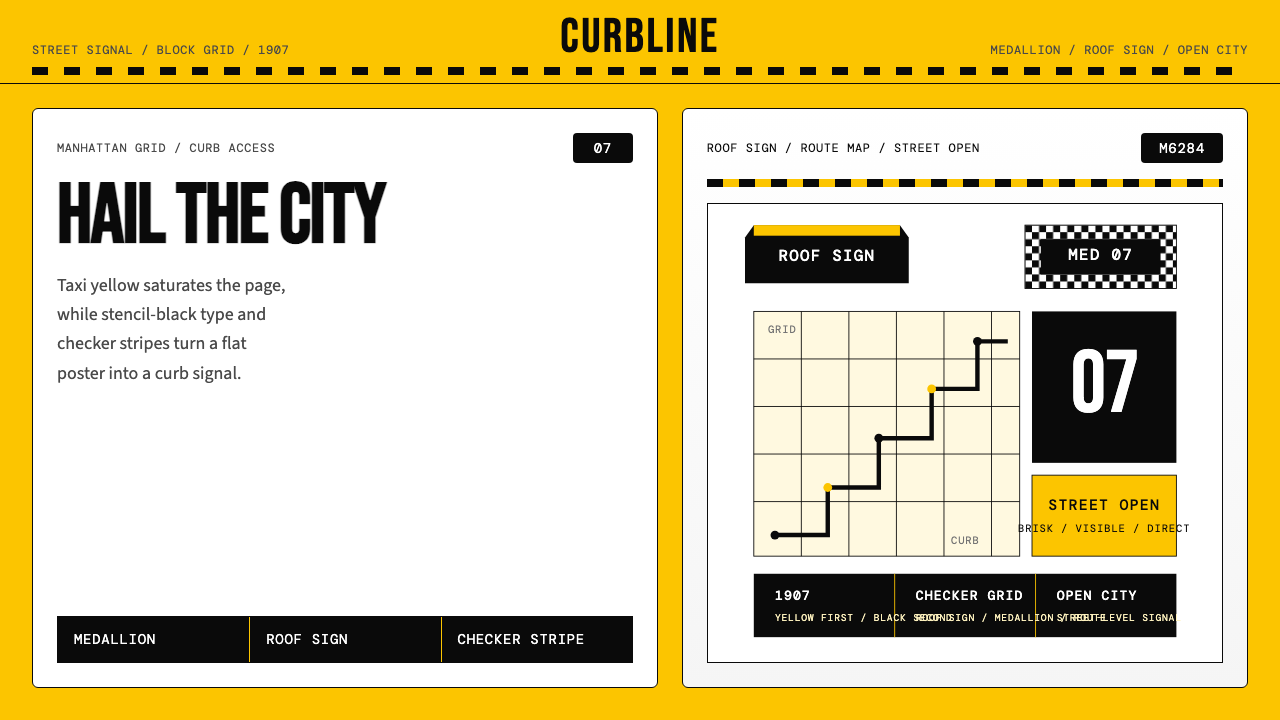 New York Yellow Cab (1907)Visibility is the brand. Taxi yellow, stencil type, checker stripes.
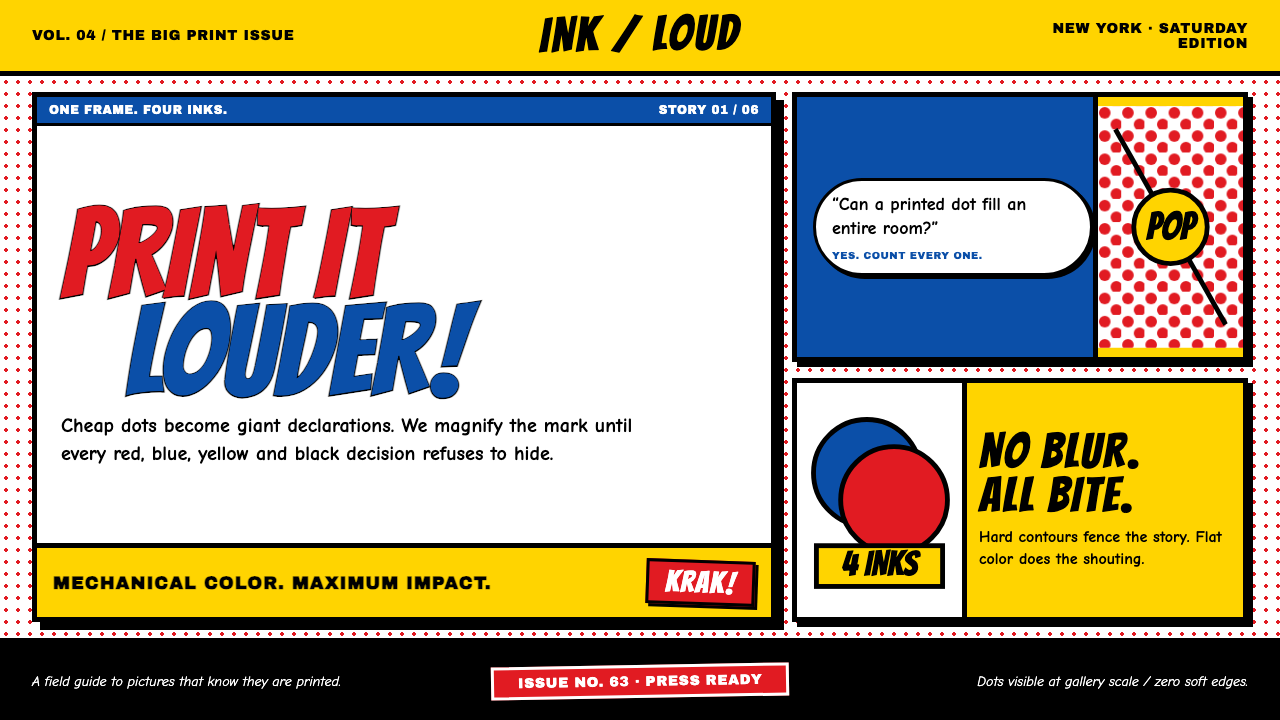 Lichtenstein Ben-Day (1963)Cheap print becomes heroic. Primary inks, giant dots and hard black contours…
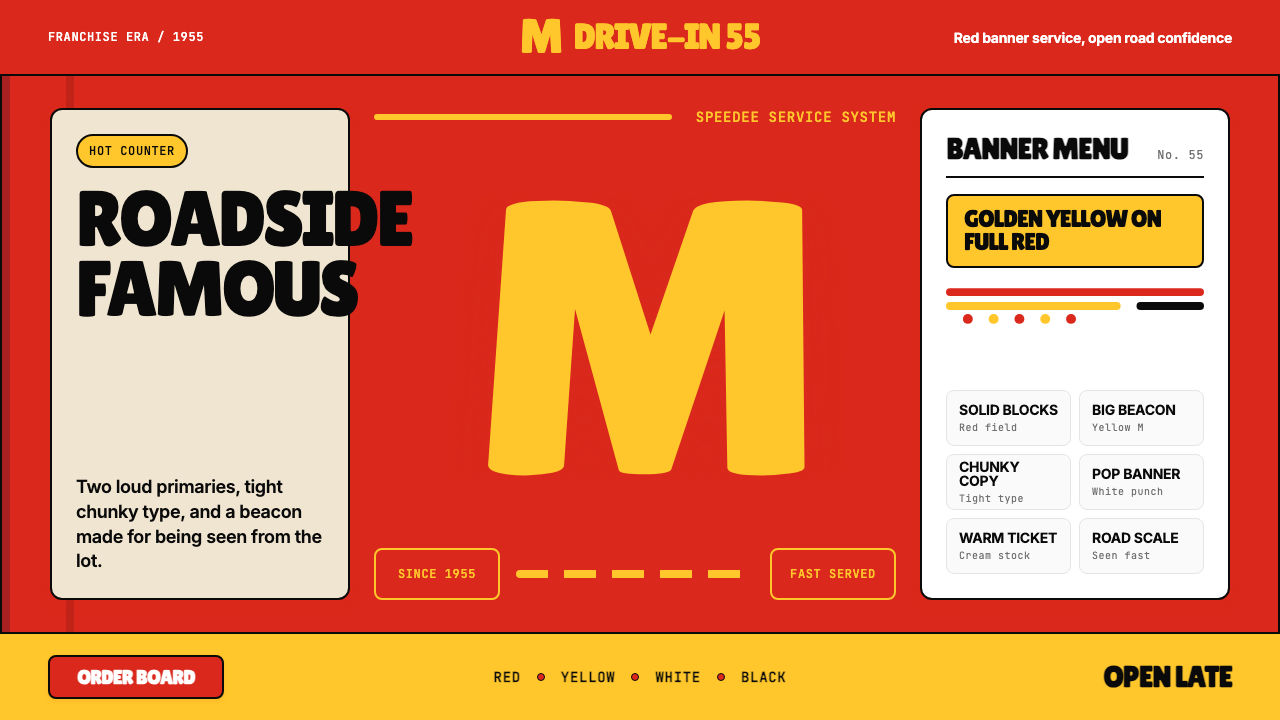 McDonald's Golden ArchesRoadside famous. Saturated red, hot yellow, and chunky type shout from 1955.
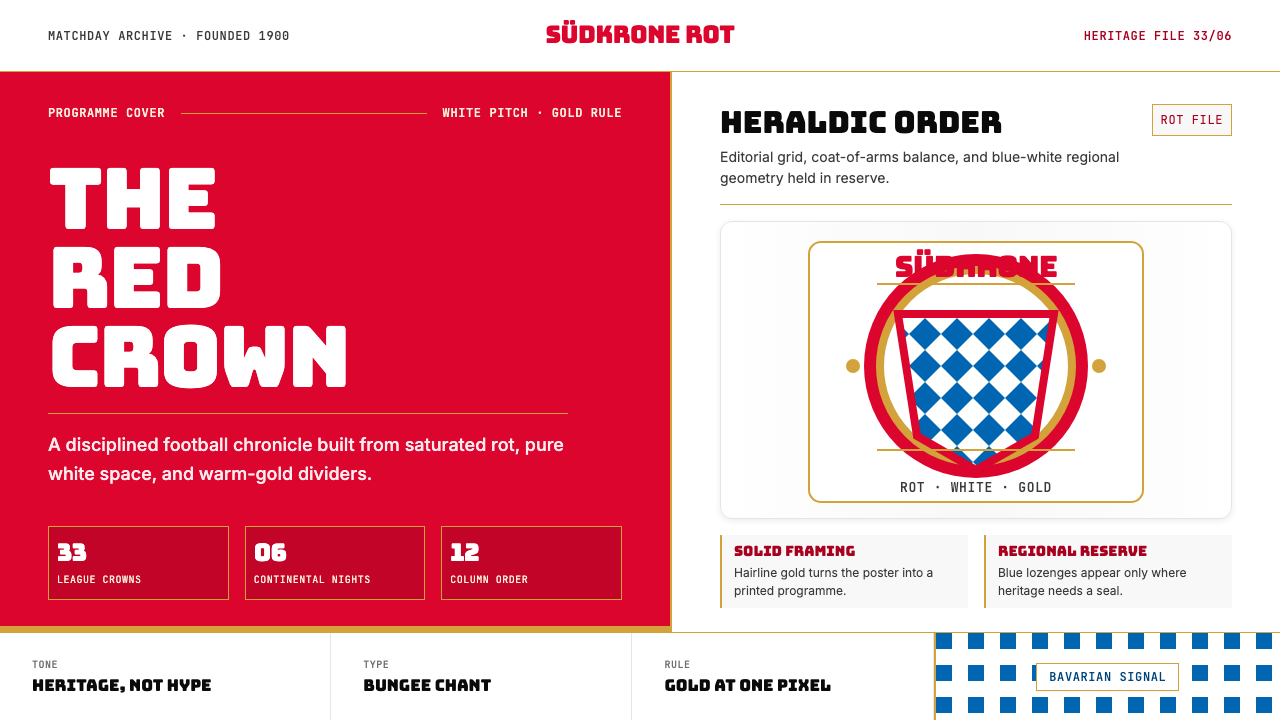 Bayern Munich (Rot)Heritage, not hype. Saturated rot fields, gold rules, and blue lozenges enfor…
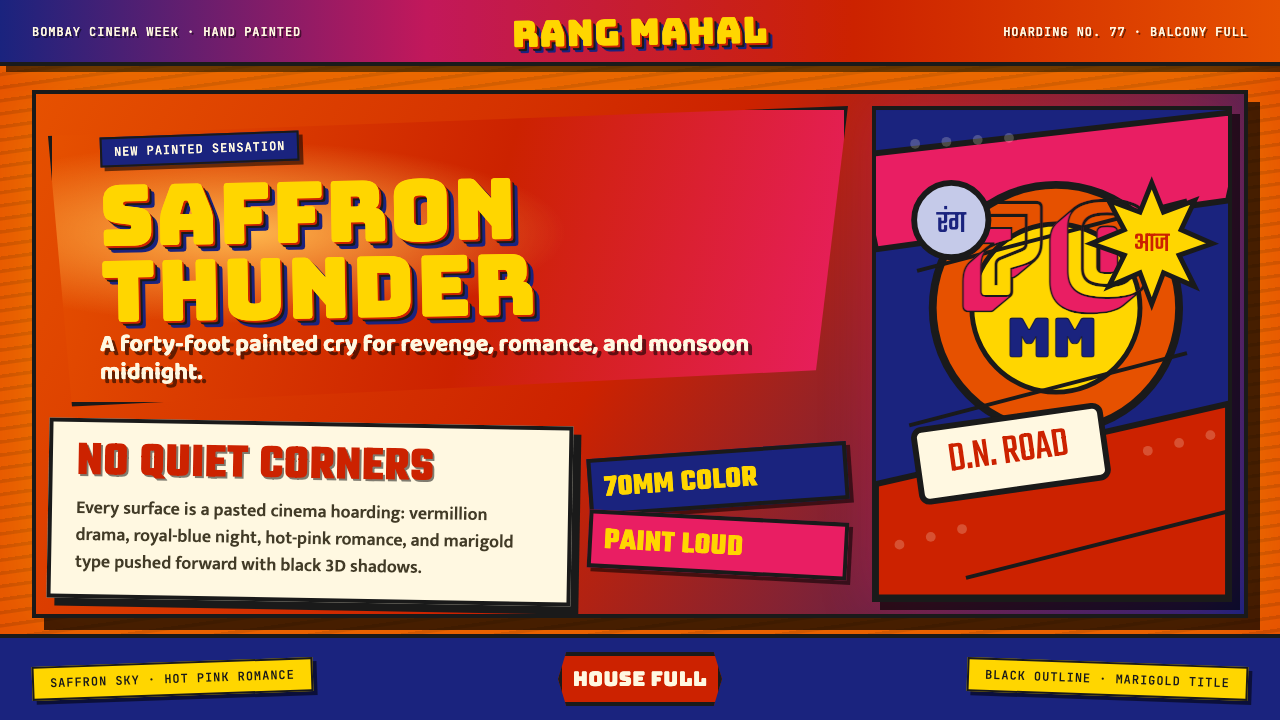 Bollywood Poster Art (1970s)Subtlety is unaffordable. Saffron fields, Bungee shadows, diagonal hoarding d…
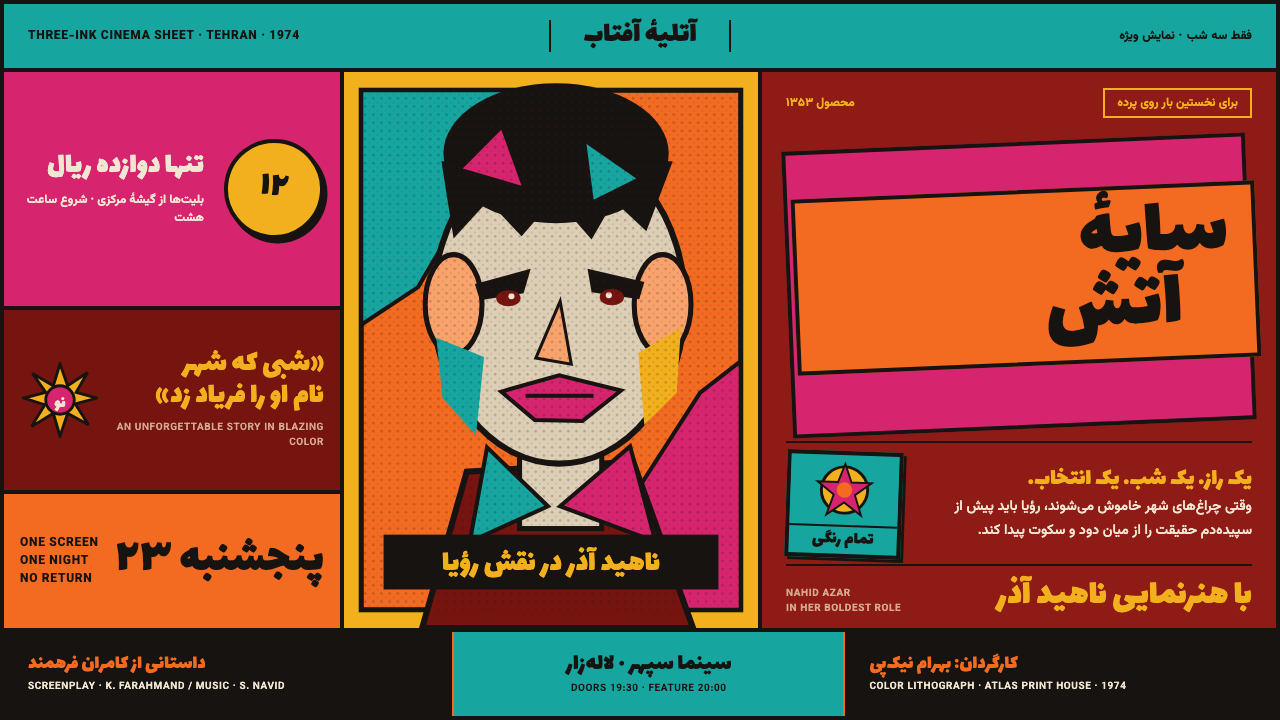 Iranian Film PosterCinema shouts in flat ink. Persian lettering clashes orange, turquoise and ma…