What is New York Yellow Cab (1907)?
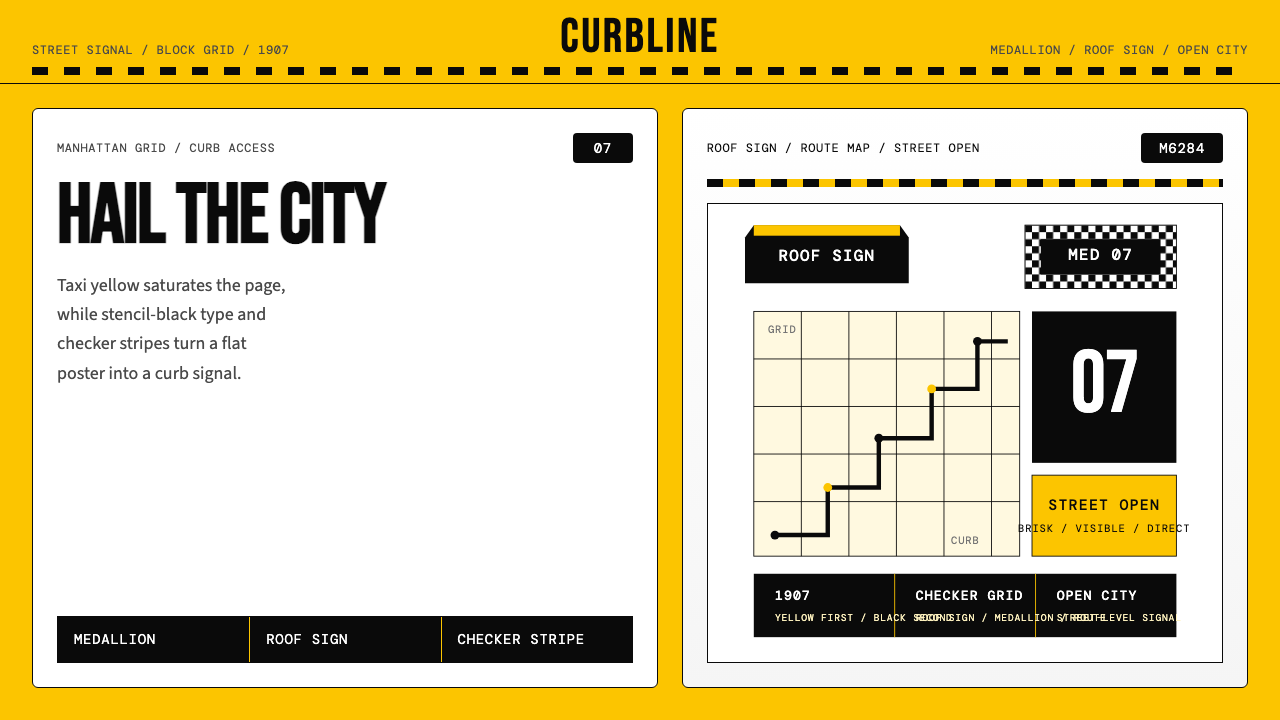
In 1907, a color choice backed by science became the most recognized signal in urban America — taxi yellow, black stencil type, and the checker stripe that turned a car into an institution.
New York Yellow Cab (1907) in brief
The New York Yellow Cab aesthetic is one of the rare instances where a purely functional decision — choosing the most visible color on a city street — crystallized into a complete and enduring visual system. The style is defined by its saturated, attention-commanding yellow ground, black type treated with stencil-like directness, and the checker stripe motif that marks boundaries, rooflines, and the threshold between passenger and driver. Nothing in this system exists for decoration. Every element earns its presence through legibility, contrast, or territorial marking.
As a design language, the Yellow Cab system belongs to the tradition of industrial utility branding: signage that must communicate at speed, at distance, and in competition with urban noise. Its palette is not chosen for harmony or elegance but for physiological impact. The black-on-yellow pairing delivers maximum luminance contrast under virtually all lighting conditions — overcast midday, wet asphalt night, the blue-tinted shadow of a building canyon. Where Bauhaus used primary colors symbolically, the Yellow Cab system uses yellow instrumentally: visibility first, identity second, beauty third.
The checker stripe adds a structural layer distinct from pure color. Repeating equal-sized squares in alternating black and white create a rhythm that the eye catches even at the periphery of vision. Historically this pattern marked Checker Cab Company vehicles, but it evolved into a broader shorthand for taxi identity across the industry. In design application, the stripe functions like a ruled border or a halftone screen — it divides fields, signals edges, and gives hierarchy to a composition without requiring additional typographic elements.

Where does New York Yellow Cab (1907) come from?
The story begins not in New York but in Chicago. In 1907, John D. Hertz — an Austrian immigrant who had built a used-car business — founded the Yellow Cab Company with a fleet of painted automobiles he intended to make instantly recognizable from a block away. According to Hertz's own account, the color choice was not guesswork: he commissioned research from the University of Chicago that concluded yellow was the most visible color at distance, particularly under the overcast skies and variable light conditions of a major American city. Hertz adopted the finding without hesitation. The name and the color were the same decision.
New York's adoption of yellow taxis followed a few years later as the cab industry expanded and the regulatory apparatus around it began to form. The 1930s brought the medallion system, which used metal plates fixed to the hood to license and limit the number of authorized taxis. The medallion number — typically stenciled in black on a yellow ground, or cast onto a metal plate bolted to a field of yellow paint — became the visual grammar of the cab's front end. The Taxi and Limousine Commission, formalized in 1971, standardized the yellow color requirement across the New York fleet, cementing what had been a practical tradition into official regulation.
The Checker Cab Company, founded by Morris Markin in the early 1920s, introduced the checker stripe as a brand identifier for its vehicles. Checker Cabs operated in New York and dozens of other American cities, and the distinctive bodywork — high roof, wide doors, the alternating black-and-white stripe running along the lower body — became so associated with the taxi trade generally that other operators adopted variations of the pattern. The last Checker Cab rolled off the assembly line in 1982, but the stripe survived as cultural memory and visual shorthand, reproduced on livery details, signage, and promotional materials long after the vehicles that originated it disappeared.
The roof sign — the illuminated box mounted above the passenger compartment — added the final element to the Yellow Cab visual vocabulary. Early roof signs were painted boards; by mid-century they were backlit boxes displaying the company name or fleet number in a stencil typeface bold enough to read from across an intersection. The combination of the illuminated yellow box against the larger yellow body of the car created a totemic silhouette: a moving rectangle of pure color with a smaller glowing rectangle above it, both readable in rain, fog, and the amber wash of sodium streetlights. This layered yellow-on-yellow legibility, achieved through material contrast rather than hue difference, is one of the system's most sophisticated visual properties.
What defines the New York Yellow Cab (1907) look?
Saturated Yellow Ground
The defining move of the system is using full-saturation taxi yellow as the dominant background field rather than confining it to accents. This inverts conventional design logic — where high-saturation color is reserved for small, emphatic moments — and instead makes the boldest possible statement the canvas itself. The yellow is warm without being orange, assertive without reading as cautionary or hazardous in context. It is the color of a decision made with total confidence.
Stencil-Weight Black Type
Typography in the Yellow Cab system reads as functional signage rather than refined lettering. Letterforms are broad, open, and spaced for distance legibility — the visual equivalent of shouting across traffic. Stencil-cut letterforms, with their interrupted strokes and slightly crude geometry, are the authentic register for this style. The black against yellow pairing gives every word a physical presence, as if the letters are objects placed on a surface rather than marks drawn on it.
Checker Stripe Rhythm
The alternating black-and-white checker stripe is the system's structural accent. Used as a band or border, it creates immediate visual hierarchy without requiring color contrast — it works equally well separating yellow from black fields or running as a self-contained element. The stripe also signals speed and movement through its repeating pattern, echoing the rhythm of a passing vehicle and lending compositions a kinetic, urban energy.
High-Contrast Silhouette
Objects and figures in this aesthetic are rendered as clean silhouettes — flat black shapes against yellow, or flat yellow shapes against black — with no internal detail or shading. This approach originates in the visual demands of the street: a cab must be identified in a fraction of a second. Silhouette reading, where meaning comes from outline rather than surface detail, is the most efficient form of visual communication at speed and distance. In print and screen applications, the result is bold and graphic.
Utilitarian Flatness
The Yellow Cab system has no interest in dimensionality, shadow, or material simulation. Its surfaces are opaque and unmodulated. This is not a deliberate aesthetic statement in the way Bauhaus flatness is principled — it is the natural output of a system designed for paint on sheet metal, ink on cardboard, and light through a translucent box. The flatness is a side effect of the medium, but it produces a visual clarity that translates well to any flat-rendering context.
Medallion Numerals
Large, isolated numerals — the fleet number, the medallion ID, the door-panel digits — are a recurring typographic feature of the Yellow Cab visual world. Used at scale on a yellow ground, a single numeral functions as both identifier and graphic element, giving compositions an asymmetric anchor similar to how a bold numeral works in editorial design. The numeral's utilitarian origin makes it feel immediate and honest rather than decorative.
Night-Legibility Logic
The Yellow Cab system was optimized for night visibility long before digital interfaces made ambient-glow design fashionable. The illuminated roof sign — a glowing box of warm yellow above a yellow car — demonstrated that luminosity contrast matters as much as color contrast. In design application, this translates to a preference for elements that hold their identity in low-light or high-ambient contexts: heavy strokes, large type, and color choices with intrinsic warmth that survives under cool or colored artificial lighting.

Who shaped New York Yellow Cab (1907)?
Hertz founded the Yellow Cab Company in Chicago in 1907 and made the decision — backed by University of Chicago research — to paint the fleet yellow for maximum distance visibility. His instinct for brand clarity was unusual in an era when most cab operators used unmarked or casually painted vehicles. Hertz later founded the Hertz Corporation car rental business, but his lasting contribution to visual culture is the color system he established for urban taxi fleets, which influenced city transportation design on every continent.
Markin took control of the Checker Cab Manufacturing Company in the early 1920s and built it into the dominant taxi manufacturer in America. His Checker cars were known for their durability, high roof clearance, and — critically for this design system — the alternating checker stripe that ran along the lower body. Markin's vehicles were ubiquitous in New York from the 1930s through the 1970s, and the stripe he standardized became so culturally embedded that it outlasted the company's closure in 1982 to remain a global icon of taxi identity.
Established by the New York City government in 1971, the TLC took the informal tradition of yellow cab color and made it law. By mandating a specific shade of yellow — known officially as Dupont M6284 — for all medallion taxis, the Commission completed the transformation of a practical branding choice into a regulated visual standard. The TLC's decades of consistent enforcement created the visual monoculture that makes the New York yellow cab recognizable worldwide and accounts for the aesthetic's quality of absolute, non-negotiable saturation.
Though not a designer, Lange's documentary photography of New York and American urban life in the mid-twentieth century established the yellow cab as a photographic subject with its own visual grammar. Her generation of street photographers — and their successors in editorial and advertising work — composed around the cab's yellow mass as both background and subject, shaping how the public understood taxi yellow as a signifier of urban modernity, speed, and democratic accessibility. The cab's visual presence in twentieth-century photography influenced how later designers abstracted and applied the system.
The designer behind the 'I Love New York' campaign, Glaser worked in a New York whose visual identity was inseparable from the yellow cab. His broader contribution was demonstrating that New York's vernacular visual culture — the cab, the deli signboard, the subway map — could be elevated into designed artifacts without losing their populist legibility. Glaser's approach to city identity influenced how subsequent designers treated Yellow Cab aesthetics: not as raw material to be refined away, but as a deliberate visual register with its own authority and communicative power.
How do you use New York Yellow Cab (1907) today?
Applying the New York Yellow Cab style correctly requires accepting its most demanding premise: yellow is the ground, not the accent. Designers accustomed to using high-saturation color sparingly will instinctively want to pull back, reducing the yellow to a stripe or header element while returning to a neutral base. That instinct produces a diluted result that reads as a yellow-themed design rather than a Yellow Cab design. Commit to the full-bleed yellow field and build everything else — type, checker accents, silhouette elements — as figures against that ground.
For presentation slides, the Yellow Cab system excels on cover pages and section dividers where boldness and instant recognition are the goals. A cover should establish the yellow field at full strength, set the title in heavy stencil-weight type in black, and use a checker stripe band to anchor the bottom or divide the layout horizontally. Content slides require more restraint: use a white or near-white ground for body text and data, bring the yellow back as a header band, data highlight color, or chart accent. The shift between full-yellow and predominantly white slides creates a visual rhythm that signals structural transitions. Data charts on this system should use yellow for the primary series and black for supporting series, with checker-pattern fills available for categorical distinction.
For web interfaces, the Yellow Cab palette is particularly effective on dashboards, pricing pages, and promotional landing pages where category differentiation and immediate visual impact are valued. Navigation bars work well in full black with yellow hover states or active indicators. Primary call-to-action buttons in yellow-on-black or black-on-yellow carry the system's authority without requiring any other design element. Avoid using yellow for large body-text backgrounds in reading-heavy contexts — extended reading against a saturated yellow field causes visual fatigue. Reserve the full yellow for above-the-fold hero sections, feature callouts, and status indicators where the color's attention-commanding quality is an asset.
For editorial and marketing work, the style supports the kind of poster-logic headlines that need to be read at a glance. Magazine covers, event posters, and campaign key visuals benefit from the yellow ground's ability to compete with complex visual environments — it reads through a cluttered Instagram feed or a busy newsstand. Use large, isolated numerals as typographic anchors, limit the color palette to yellow, black, and white, and introduce the checker stripe as a dividing or framing element rather than an all-over texture. For long-form editorial layouts, alternate between yellow-ground feature openers and white-ground body sections, using the checker stripe as the transition element between modes.
A common mistake is treating the checker stripe as wallpaper — tiling it across a background or using it as a decorative fill for large areas. The stripe's power comes from its use as a border, band, or accent against a solid-color field. When it occupies too much of the composition, it competes with type and silhouette elements rather than supporting them. Similarly, introducing a third color beyond black and white into the checker pattern immediately weakens the system's visual logic. The checker works because it is binary — two values, no gradients, maximum contrast. Any softening of this principle reads as hesitation rather than design.

New York Yellow Cab (1907) — FAQ
Does this style only work with a yellow background, or can it be inverted?
The system can be inverted to a black ground with yellow type and checker accents, and this variant has its own authority — it reads as the nighttime or interior mode of the same visual language. However, an all-white ground with yellow accents is the weakest interpretation: yellow on white loses most of its impact because the contrast is insufficient. The two viable poles are yellow ground with black figures and black ground with yellow figures. A composition that spends time at both poles — alternating sections — captures the full range of the system.
How does the Yellow Cab style differ from general warning-sign or caution aesthetics?
The confusion is understandable — both use black-on-yellow and command attention. The distinction lies in intent and secondary elements. Warning signs pair yellow with hazard iconography, diagonal stripes, and universal symbols designed to communicate danger. The Yellow Cab system pairs yellow with stencil numerals, the checker stripe, and a typographic register that signals commerce and transit rather than caution. The checker stripe, in particular, reads as brand rather than warning. Keeping the type tone transactional and urban — fleet numbers, service names, directional callouts — rather than cautionary maintains the distinction in application.
Can photography be used within this design system?
Photography fits the system best when treated as a flat, high-contrast element rather than a naturalistic window. Black-and-white photography — especially street-level urban photography with strong silhouette qualities — integrates cleanly against yellow fields. Duotone treatments that replace mid-tones with yellow produce a cohesive result. Full-color photography tends to introduce color complexity that competes with the yellow ground and weakens the system's visual simplicity. When a color photograph is necessary, cropping aggressively to isolate a single graphic element, or treating it as a silhouette cutout, will produce a more compatible result than placing it as a rectangular block.
What kind of brands or products is this style a poor fit for?
The Yellow Cab aesthetic carries strong associations with urgency, urban transit, and transactional efficiency — qualities that are assets in some contexts and liabilities in others. Brands that depend on warmth, craftsmanship, or quiet luxury will find the style's aggressive saturation and stencil-grade typography work against their positioning. Health and wellness products, premium hospitality brands, children's educational content, and anything that needs to communicate calm or intimacy are poor matches. The style also struggles in contexts where yellow's cultural associations vary significantly by region — in some markets, saturated yellow carries connotations unrelated to taxi branding, and the checker stripe may not read as the intended reference.
How do you handle the checker stripe at different scales — does it look the same on a large banner as on a business card?
Scale is the chief technical challenge of the checker stripe. At small scales — a business card edge, a thin rule in a presentation deck — the squares must be sized so they remain individually readable rather than blurring into a gray band. At very small sizes, reducing the stripe to a single alternating sequence of black and white rectangles, rather than a multi-row grid, maintains legibility. At large scales — a full-bleed banner or a building wrap — a checker band that is proportionally sized to the composition will read correctly, but the stripe should still occupy a minority of the total surface to retain its role as accent rather than ground. The rule of thumb: the stripe marks a boundary or a band; it should never become the background.
Related design styles
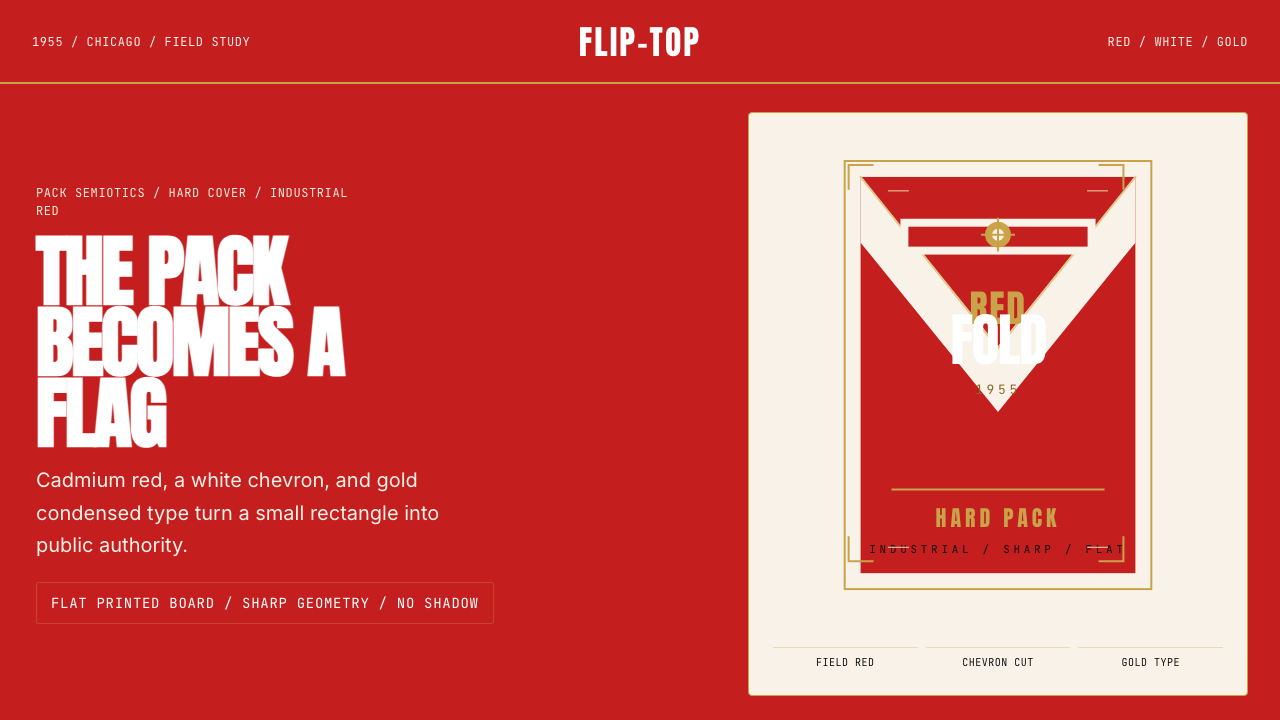 Marlboro Red Flip-Top (1955)Authority in one fold. Cadmium red, white chevron, and gold type read like a…
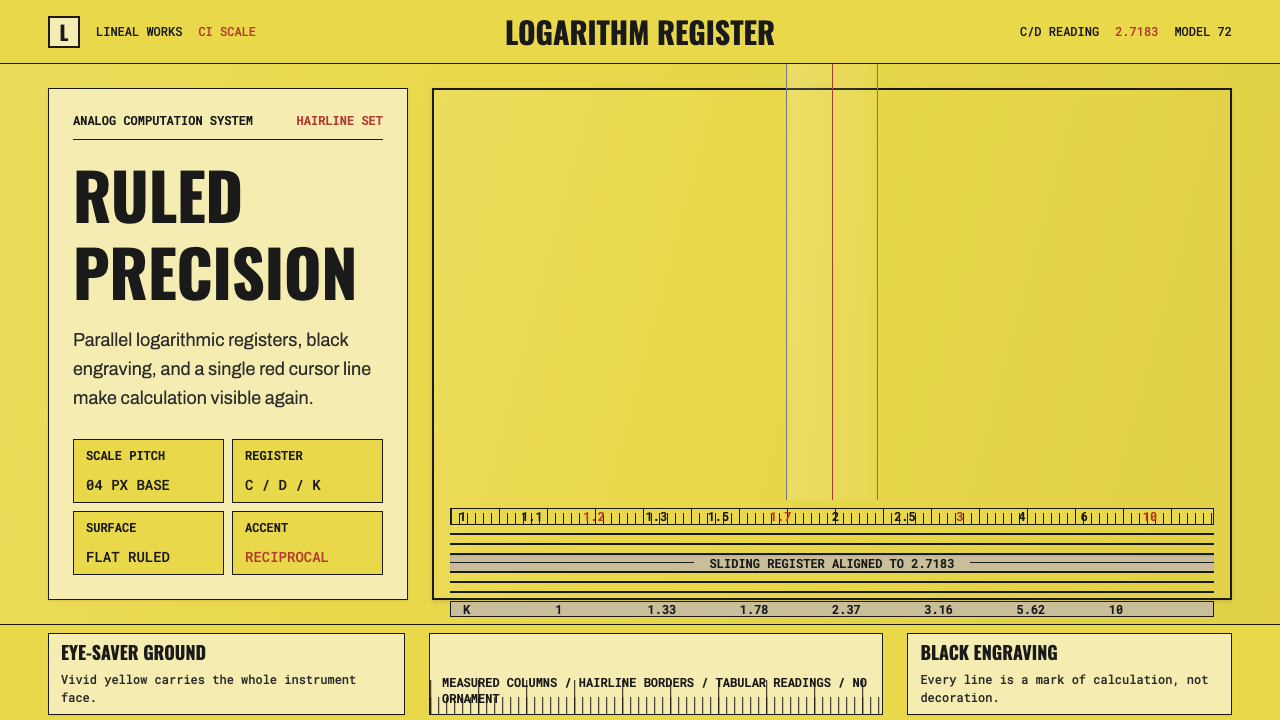 Slide RulePrecision made visible. Eye-saver yellow, black ticks, and one red hairline d…
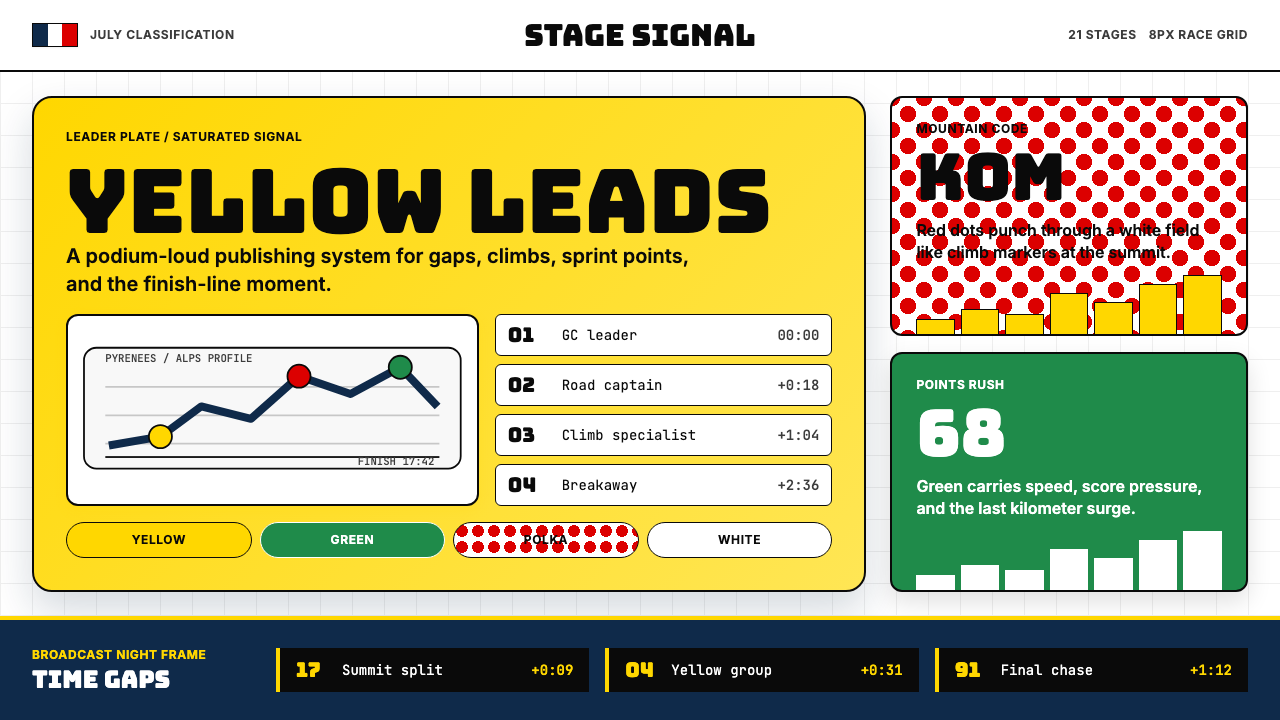 Tour de France (Yellow Jersey)Yellow owns the finish. Bungee type, polka dots, and navy tickers snap to an…
 Aeronautical ChartReads like cockpit data. Magenta-blue airspace rings cut through dense dark-c…
 Amtrak Arrow (1971)Civic authority at speed. Deep navy, Helvetica lockups, and red-blue arrows.
 New York Yankees (Navy-Pinstripe)Navy restraint, not noise. Cream pinstripes and a gold monogram seal do the w…