What is New York Yankees (Navy-Pinstripe)?
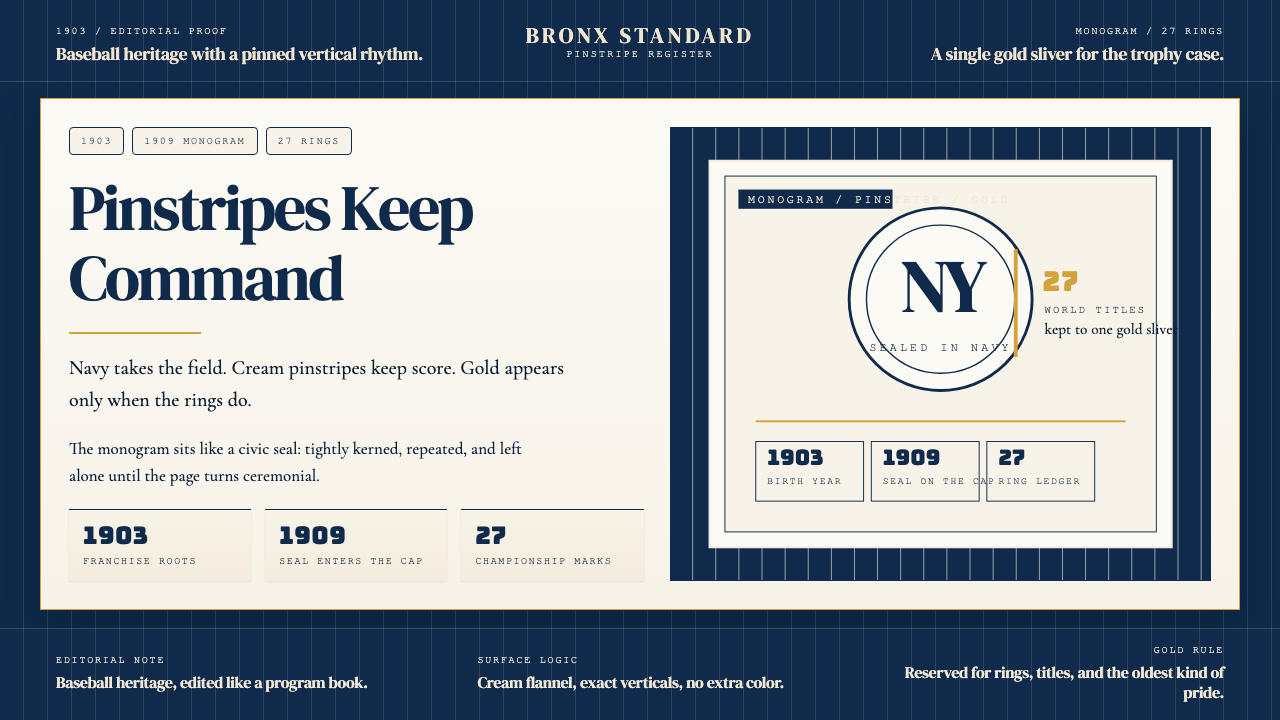
Twenty-seven World Series championships, one interlocking monogram, and a single unbroken rule: restraint is the brand.
New York Yankees (Navy-Pinstripe) in brief
The New York Yankees visual identity is the most recognizable brand in American professional sports — built not on novelty or complexity, but on the disciplined repetition of three elements over more than a century. A saturated navy field. Vertical cream pinstripes. The interlocking NY monogram first rendered by Tiffany and Company in 1909. Everything else is subordinate to these three.
The aesthetic operates on the logic of aristocratic restraint: the fewer the elements, the more each one carries. Navy anchors the palette with a seriousness that borders on severity. The cream pinstripes soften that severity without compromising it — vertical lines that imply height, precision, and uniformity across an entire roster. The interlocking NY sits at the center not as decoration but as a seal, the typographic equivalent of a signet ring. Championship gold appears only where it has been earned: on trophies, retired number plaques, and the rings themselves.
What distinguishes the Yankees visual language from generic sports branding is its refusal to evolve decoratively. While other franchises refresh their logos and add accent colors to chase contemporary taste, the Yankees system has absorbed over a century of cultural change without altering its core grammar. The pinstripe uniform worn today is, in its essential logic, the same garment codified in the early twentieth century. This stability is itself the message: institutions of genuine authority do not need to announce themselves with novelty.

Where does New York Yankees (Navy-Pinstripe) come from?
The franchise that became the New York Yankees was founded in 1901 as the Baltimore Orioles, one of the original eight clubs of the American League. In 1903 the club relocated to New York City, playing initially as the Highlanders — a name derived from their home ground at Hilltop Park in upper Manhattan. The move placed the team in direct competition with the established National League club, the New York Giants, and from the outset the Highlanders' management understood that survival in that market required a distinctive, durable identity.
The pivotal visual moment arrived in 1909, when the club commissioned Tiffany and Company — the Manhattan luxury jeweler whose association with quality and permanence was already well established — to design a logo for a charity medallion. The result was the interlocking NY monogram: two letters fitted together with the precision of a craft object, each character supporting the other structurally. The choice of Tiffany was not incidental. It imported into a baseball context the symbolic vocabulary of institutional refinement, of objects made to last and to signify status across generations. The club adopted the NY mark on its uniform caps that same year.
The team's name changed to the Yankees in 1913, and the navy-pinstripe uniform was established in its characteristic form by 1915. The cream flannel ground with vertical navy pinstripes drew on a widespread convention in early-twentieth-century baseball, but the Yankees' version was distinctive in its restraint: no colored piping, no contrasting yoke, no extra ornament. The pinstripes themselves were allowed to do all the work — spacing, weight, and cream-to-navy ratio calibrated over years until the proportions felt inevitable rather than designed.
The identity crystallized around the players who wore it. Babe Ruth joined the Yankees in 1920 and transformed both the franchise and American popular culture; the pinstripe silhouette became inseparable from his mythology. Lou Gehrig, Joe DiMaggio, Mickey Mantle, and eventually Derek Jeter each carried the visual identity forward into new eras, their individual greatness becoming part of what the uniform meant. By the mid-twentieth century the Yankees had won enough World Series championships — eventually reaching twenty-seven — that the navy-and-cream palette had accumulated a weight of association that no redesign could replicate. George Steinbrenner, who purchased the team in 1973 and presided over its modern era, enforced strict grooming standards for players precisely because he understood the brand as a system: every variable controlled, no inconsistency permitted.
What defines the New York Yankees (Navy-Pinstripe) look?
Color Architecture
The palette is built on a strict hierarchy of three tones: a deep, fully saturated navy that reads as almost black in low light; a warm cream flannel white that carries just enough yellow undertone to feel textile rather than digital; and a reserved championship gold that appears only as accent in trophy and heritage contexts. No bright red, no royal blue, no silver — the system generates its authority precisely by refusing what other brands reach for. Navy dominates; cream structures; gold punctuates.
The Pinstripe
The vertical pinstripe is the system's most distinctive element and its most carefully controlled one. The stripes are narrow — closer to a ruled line than a band — and spaced at intervals that allow each stripe to be read individually without the eye losing track of the whole. The directionality is strictly vertical, implying height and formality. On the cream flannel ground, the navy stripes create a woven, almost textile rhythm that is immediately legible as 'Yankees' even at a distance, even in motion.
The Interlocking NY Monogram
The Tiffany-designed monogram is a logotype rather than a logomark — its power comes from letterform rather than symbol. The N and Y interlock at the crossbar in a way that makes neither letter fully legible in isolation, which is the point: the mark only resolves when seen as a whole. The serifs on both characters are classical, relating the mark to engraved institutional typography rather than to display or sporting vernacular. This typographic register — engraved, permanent, formal — separates the Yankees identity from every other baseball brand.
Typographic Register
Where text accompanies the visual identity — on scorecards, programs, stadium signage, and official communications — the typographic choices consistently draw from classical American serif traditions. The letterforms are readable at large sizes and dignified at small ones; they have the quality of newspaper mastheads and memorial plaques, not of advertising display. This typographic conservatism reinforces the brand's overall message: we are an institution, not a campaign.
Compositional Gravity
Yankees-derived layouts carry a strong sense of downward and vertical gravity — the pinstripe logic extended into composition. Layouts favor tall formats, centered or top-anchored primary elements, and generous vertical breathing space between content tiers. Horizontal rules are used sparingly and carry real structural weight when they appear. The overall feeling is of institutional stationery, not editorial dynamism — which is precisely its strength in contexts requiring gravitas.
Material and Texture Reference
Even in fully digital applications, the Yankees aesthetic carries an implicit reference to physical textile — the woven flannel ground, the stitched pinstripe, the embroidered monogram. This material memory is activated through warm cream tones rather than pure white, through stripe weights that suggest thread rather than vector precision, and through gold accents that evoke embroidery thread and engraved metal rather than flat fills. The style reads as hand-finished even when it is not.
Restraint as System Logic
The defining discipline of the Yankees visual system is not any individual element but the rule that governs all of them: nothing is added unless it earns its place through function or heritage. No seasonal colorway updates, no collaboration overrides, no gradient treatments applied to freshen the mark. The system is closed, and its closure is the source of its power. Every element present has been present long enough to carry genuine historical weight, which means every element absent was genuinely refused.

Who shaped New York Yankees (Navy-Pinstripe)?
The Manhattan jeweler's commission to design the interlocking NY monogram for a charity medallion in 1909 produced the most enduring logo in American sports. By engaging a luxury craft institution rather than a sporting goods supplier, the Yankees' early management made a deliberate statement about the register of identity they were building. The Tiffany provenance attached to the monogram a set of associations — permanence, precision, institutional quality — that no amount of subsequent championship success could have manufactured from scratch.
Ruth joined the Yankees in 1920 and became the first athlete in American history whose visual image — the broad pinstripe silhouette, the distinctive batting stance, the cap pulled low — was reproduced and circulated at a scale comparable to entertainment celebrities. His years with the Yankees (1920–1934) coincided with the team winning four World Series championships and established the pinstripe uniform as a symbol of sporting dominance in the American cultural imagination. Ruth did not design the visual system, but he gave it its first mythology.
Gehrig's association with the Yankees uniform spans the franchise's most aesthetically formative period. Playing alongside Ruth and then carrying the team through the mid-1930s, Gehrig embodied a different register of the pinstripe identity — where Ruth represented flamboyant power, Gehrig represented disciplined consistency, which maps precisely onto the visual system's own values. His retirement speech at Yankee Stadium in 1939, in which he called himself 'the luckiest man on the face of the earth,' became part of the cultural fabric that the uniform now carries.
Jeter served as Yankees captain from 2003 until his retirement in 2014, and his career coincided with a period of intense scrutiny on sports branding and identity in the age of digital media. His consistent, undemonstrative excellence — and his equally consistent adherence to the Yankees' off-field standards of presentation — made him the contemporary embodiment of the brand's core proposition: that authority comes from sustained performance within a disciplined system, not from individual expression. Jeter's number 2 was retired in 2017.
Steinbrenner purchased the Yankees in 1973 and served as principal owner until his death in 2010, presiding over the franchise's modern commercial era and seven World Series championships. His insistence on strict player presentation standards — no facial hair beyond a neat mustache, hair above the collar — was widely reported as personal preference, but functioned as brand management: every player in the uniform was also a representative of the visual system. Steinbrenner understood intuitively that a brand with this level of historical equity could only be damaged by inconsistency, not by rigidity.
How do you use New York Yankees (Navy-Pinstripe) today?
The Yankees Navy-Pinstripe visual system translates into designed artifacts through a disciplined reduction to its core logic: deep navy as the dominant ground or structural color, cream or warm off-white as the content field, vertical stripe patterns used sparingly and only when they contribute structural rhythm, the interlocking-NY or a similarly tight editorial serif monogram as the identity anchor, and championship gold reserved for the single most important accent. Applications that honor this hierarchy feel authoritative; applications that treat navy, cream, and gold as interchangeable accents dilute the system into generic sports-adjacent decoration.
For presentation slides, the Yankees aesthetic works best on covers and section dividers rather than dense content pages. A cover following this logic places the title in a strong editorial serif against a full-bleed navy ground, with a cream or warm-white subtitle directly below and a single gold rule or ornament marking the base. The pinstripe motif, if used, should appear as a background texture at low opacity rather than as a dominant graphic element — it supports the composition without competing with the content hierarchy. Data slides should use navy for primary chart elements, cream for the background field, and gold only for the single most important data point or threshold line.
For web interfaces and dashboards, the system is particularly well suited to platforms that need to convey authority, permanence, and premium positioning — financial reporting tools, sports analytics dashboards, premium subscription interfaces, or any product where the user experience is built around trust in institutional data. The approach: use deep navy as the primary navigation and header background, warm cream or off-white as the content area ground, and reserve gold as the interactive accent for primary calls to action and key metrics. Typography should draw from classical serif traditions for headings and use a clean, legible sans-serif for body and data labels — the contrast between serif authority and sans-serif clarity reinforces the dual register of heritage and modernity.
For editorial and marketing applications, the style supports strong hierarchy and directional reading. A Yankees-derived marketing page treats the full-bleed navy section as the statement moment — white or cream type reversed out of navy carries the primary value proposition, while pinstripe texture at reduced opacity provides subtle depth without decoration. Pricing pages benefit from the system's natural tier logic: the premium tier sits in navy with cream type and gold accent; middle tiers in cream with navy type; entry tiers in lighter grounds. The gold accent should appear on one tier only — the moment it appears on two, the hierarchy collapses. For editorial layouts, use the navy-to-cream contrast to demarcate editorial from advertising, analysis from summary, or featured content from supporting material.
A common mistake when applying this visual language is treating the pinstripe as the leading element and the navy as its background, when the actual hierarchy is reversed: navy is the primary field and the pinstripes are its internal texture. A second frequent error is introducing warm metallic gold too broadly — the more surfaces gold touches, the less it signals championship. The system earns its impact through scarcity: one gold rule, one gold monogram stroke, one gold call-to-action button. A third mistake is substituting a cool white or blue-white for the cream ground, which destroys the textile warmth that separates this identity from generic corporate navy-and-white. The cream is doing aesthetic work that pure white cannot.

New York Yankees (Navy-Pinstripe) — FAQ
How is the Yankees visual identity different from generic navy-and-white corporate design?
Three things separate the Yankees system from generic navy-and-white: the cream warmth of the white (not cool white, not pure white, but a slightly warm off-white with textile connotation), the vertical pinstripe pattern as an internal texture (not a decorative border or graphic device), and the classical serif monogram as the typographic anchor (not a sans-serif wordmark or geometric icon). Remove any one of these three and you have a respectable navy corporate palette. Keep all three with the correct proportions and restraint and you have the Yankees system. The difference is in specificity, not in the general color family.
Can this style work in a light-mode digital interface without feeling like a throwback?
Yes, but it requires translating the aesthetic logic rather than copying its surface elements. In a light-mode interface, the cream ground becomes the default background, navy is used for navigation, headers, and primary type, and gold is reserved for a single interactive accent. The pinstripe, if used at all, should appear only in non-content zones — a sidebar background, a section separator — at very low contrast. The key is keeping the color hierarchy intact: cream as field, navy as structure, gold as signal. Interfaces that do this well feel contemporary rather than retro because the logic is sound and the restraint is consistent.
Why is championship gold used so sparingly, and what happens if it is used more broadly?
Gold in the Yankees system is a scarcity signal — it marks what is superlative within a context that already represents excellence. Its meaning depends entirely on its rarity. When gold appears on one element in a layout, the eye reads that element as the most important thing in the space. When gold appears on three or four elements, the hierarchy collapses and gold becomes merely a warm accent color, indistinguishable from the decorative gold found in any number of luxury-adjacent brands. The rule of thumb is that gold should never appear on more than one element per composition, and ideally that element is the primary call to action, the most important data point, or the identity mark itself.
Is this style appropriate for brands outside sports — technology, finance, or editorial?
The Yankees system is rooted in a specific sporting heritage, but its underlying values — institutional authority, earned permanence, disciplined restraint — translate well to non-sports contexts where those same values are desired. Financial services brands, premium subscription products, and high-end editorial publications can all draw on this visual language without it reading as sports cosplay, provided the surface references to the specific identity (the interlocking NY monogram, the pinstripe as primary texture) are abstracted into their principles: editorial serif monograms replace the interlocking NY, vertical linear texture replaces the specific pinstripe pattern, and the cream-navy-gold hierarchy is maintained without literal baseball connotation. The style struggles in contexts that call for approachability, warmth, or playfulness.
How should the pinstripe be adapted for digital screens, where fine vertical lines can cause visual artifacts?
The pinstripe's original context was physical textile — woven, stitched, seen at arm's length on a moving figure. Translating it to screen requires acknowledging that very fine vertical lines at certain sizes can cause moiré patterns or appear to vibrate at sub-pixel scales. The solution is not to eliminate the pinstripe but to apply it only at scales where it reads clearly — typically as a background texture on large, low-priority surfaces rather than as a dominant graphic element on content areas. Increasing the spacing between stripes slightly beyond the traditional textile proportion also helps; the goal is the rhythm and the directional feel, not a photographic reproduction of the jersey. On high-resolution displays the original proportions work well; on standard screens, a slightly more generous spacing maintains legibility without losing the character.
Related design styles
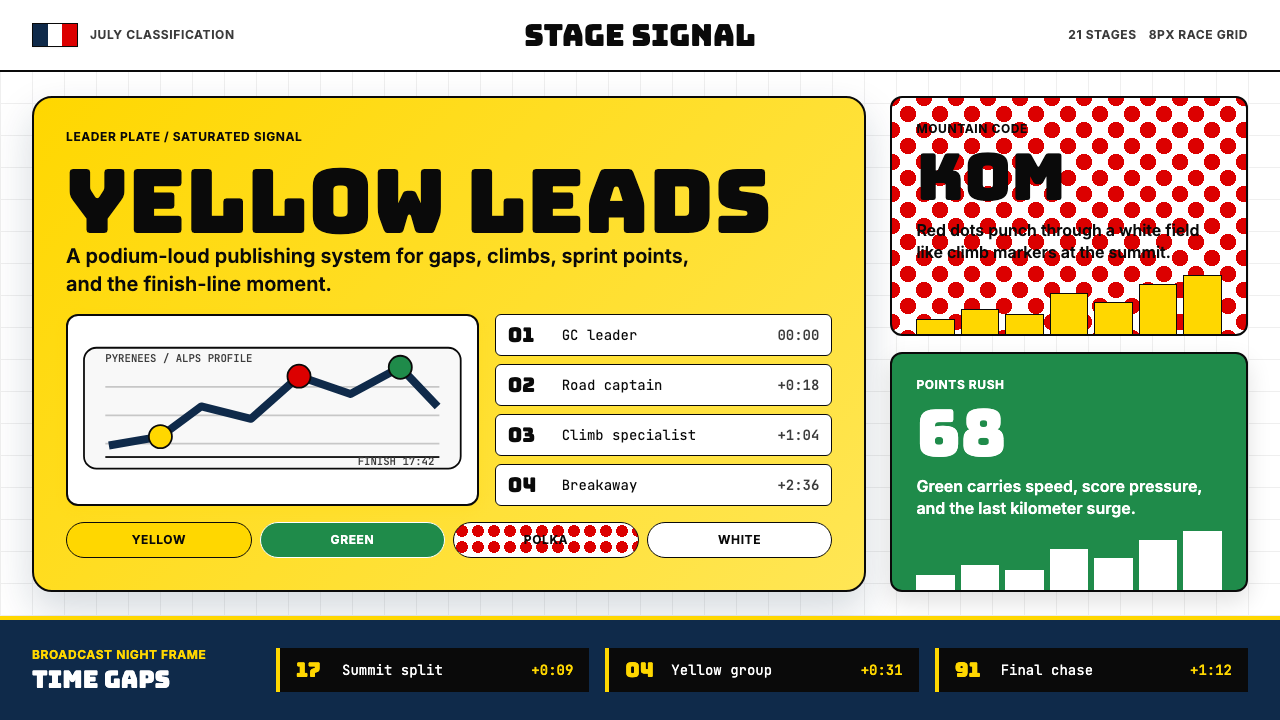 Tour de France (Yellow Jersey)Yellow owns the finish. Bungee type, polka dots, and navy tickers snap to an…
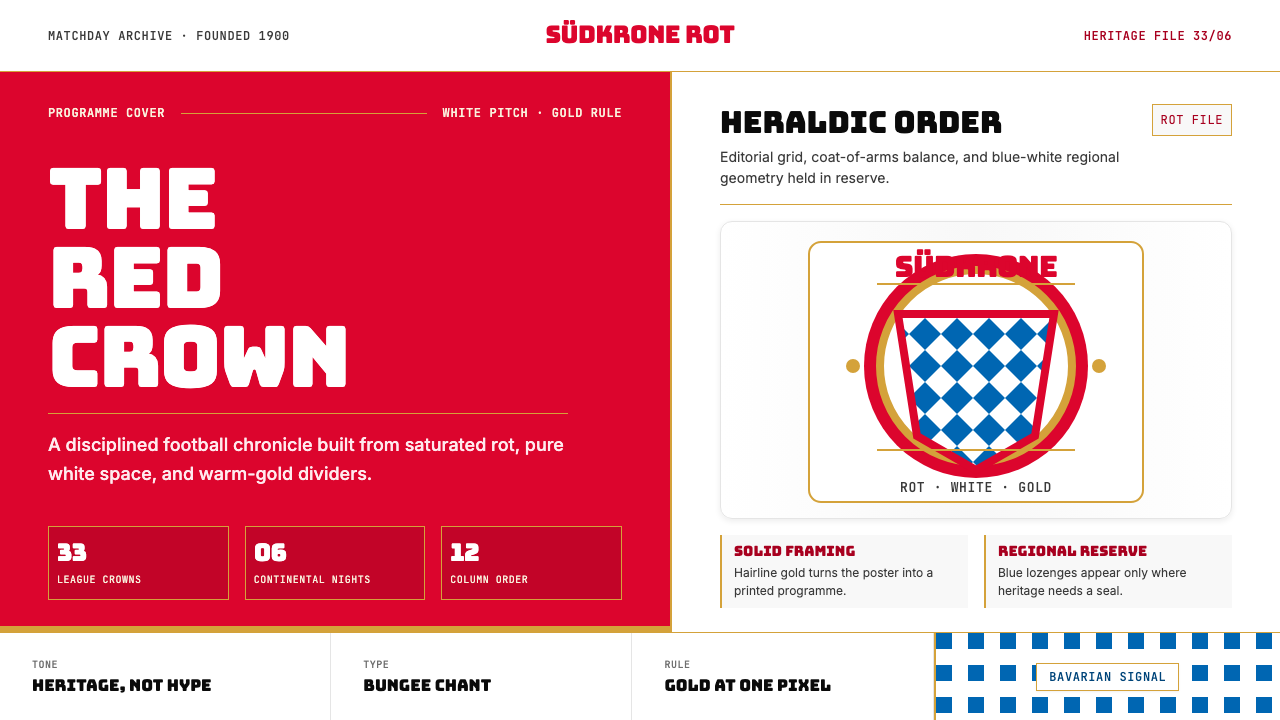 Bayern Munich (Rot)Heritage, not hype. Saturated rot fields, gold rules, and blue lozenges enfor…
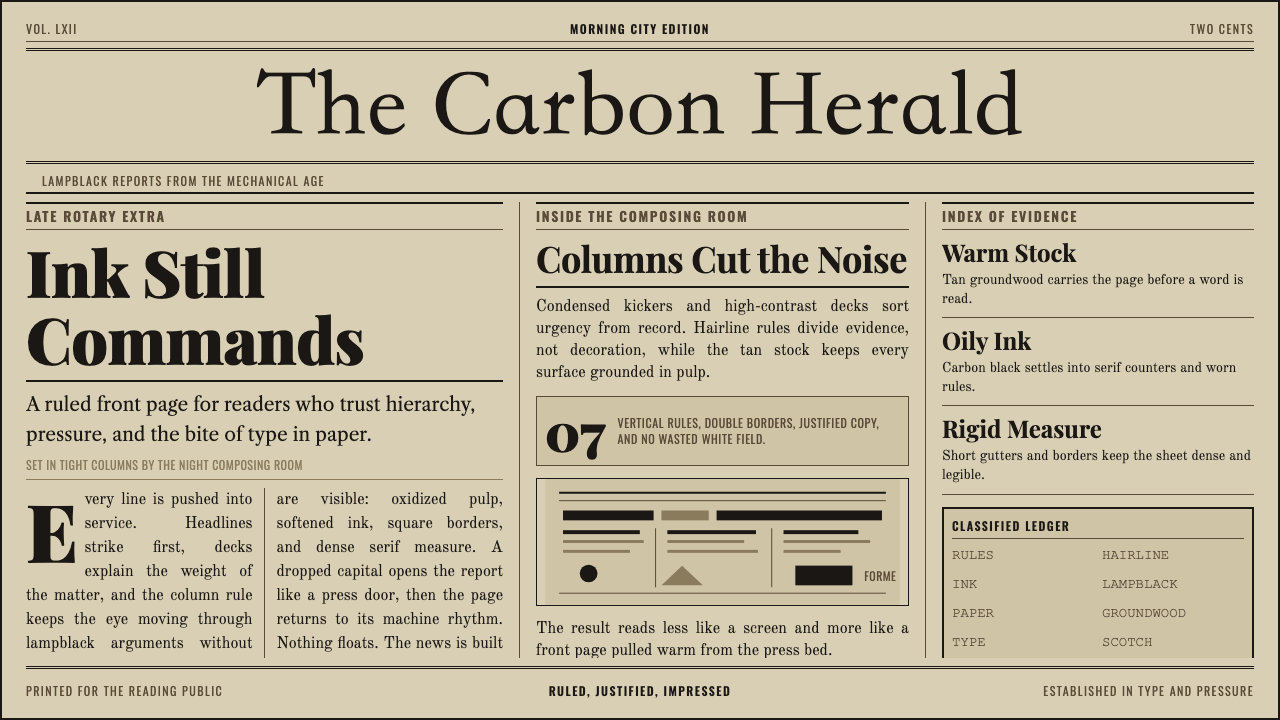 Broadsheet LetterpressAuthority in ink. Lampblack serif decks lock into tan paper with strict ruled…
 Film Noir ChiaroscuroLight is the crime. Silver serif cards, blind stripes, and grain carve drama…
 LIFE Magazine (Red-Banner)Photojournalism stripped bare. One red banner, cream newsprint, stark black p…
 Marlboro Red Flip-Top (1955)Authority in one fold. Cadmium red, white chevron, and gold type read like a…