What is Tour de France (Yellow Jersey)?
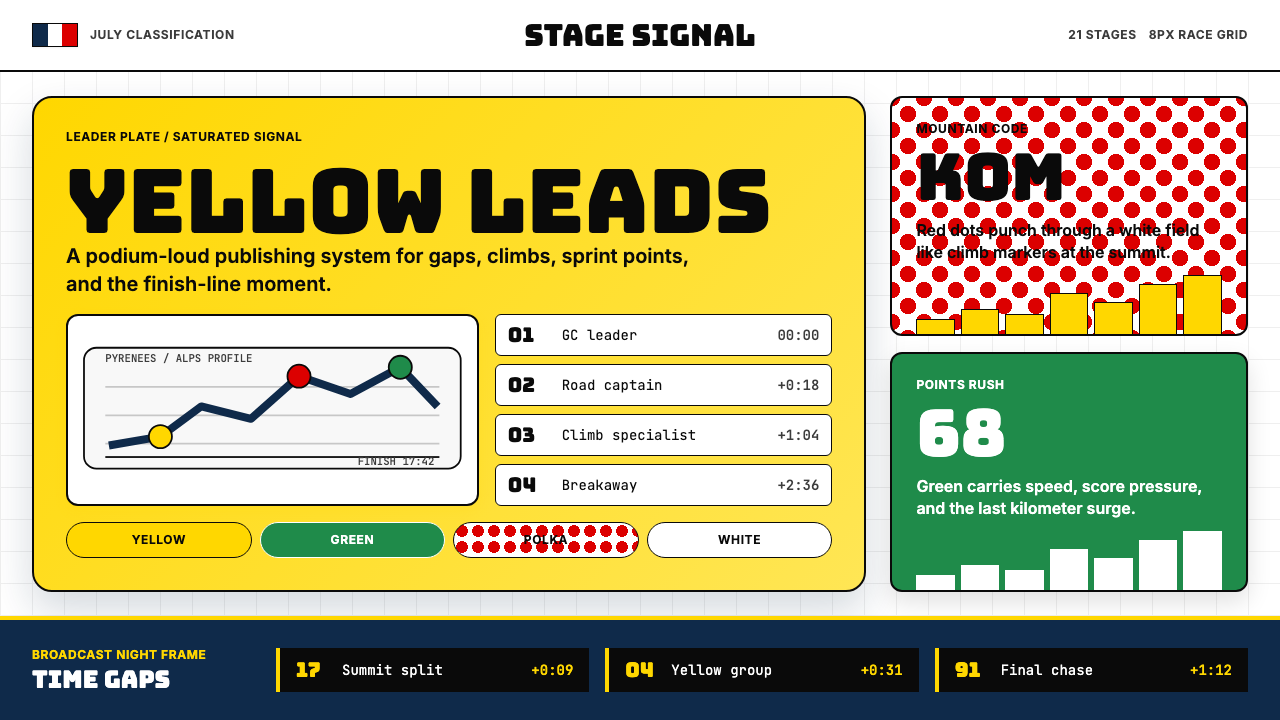
The Yellow Jersey turns a three-week race into an instantly legible color system — saturated, hierarchical, and built for podiums, not whispers.
Tour de France (Yellow Jersey) in brief
The Tour de France Yellow Jersey design language is a sports-broadcast graphic system built around a four-jersey color code: yellow for the overall leader, green for the points classification, red polka dots on white for the mountains classification, and white for the best young rider. Each jersey is a signal, not a decoration — the complete system lets a viewer standing on a mountain pass or watching on a screen identify race hierarchy at a glance, even at speed.
Visually, the style is characterized by extreme color confidence. Saturated cadmium yellow dominates as the primary signal, supported by a vivid sprint green and a bold polka-dot red, all set against a foundation of deep maritime navy that anchors broadcast graphics and timing displays. The palette is deliberately loud and unapologetic — it belongs to finish-line arches, gap-ticker overlays, and mountain summit banners, not to understated sophistication.
Typography in this system is heavy, compressed, and built for legibility at scale. Display letterforms are wide-set and slab-like, capable of holding their own against the visual noise of a peloton photograph or a hillside crowd. Numbers — race times, stage distances, rider rankings — are treated as graphic objects in their own right, set large, often in yellow against navy or white, functioning as both data and visual anchor simultaneously.

Where does Tour de France (Yellow Jersey) come from?
The Tour de France was founded in 1903 by Henri Desgrange, the editor of the French sports newspaper L'Auto, as a publicity stunt to boost circulation against a rival publication. The race covered approximately two and a half thousand kilometers across France in six stages, and sixty cyclists entered. The event was an immediate sensation, cementing a national obsession with road cycling that would shape French sporting culture for more than a century.
The Maillot Jaune — the yellow jersey worn by the overall leader — was introduced in 1919, the race's first post-World War I edition. The color yellow was chosen deliberately to echo the pages of L'Auto, which was printed on yellow newsprint to distinguish it from its competitors. This origin is significant: the yellow jersey began as a branding device tied directly to print media, which may explain why the Tour's visual identity has always had an unusually graphic, almost editorial quality — bold colors, hard contrasts, and strong typographic hierarchy rather than the more illustrative or heraldic approaches seen in other sports.
The broader jersey system developed incrementally over subsequent decades. The green jersey for the points classification was introduced in 1953 to mark the race's fiftieth anniversary and provide a second narrative thread for sprinters. The polka-dot jersey for the King of the Mountains competition came later, formalized in the 1970s following its association with the chocolate brand Chocolat Poulain, whose product packaging featured the same red-dot-on-white pattern. The white jersey for the best young rider was added formally in 1975. By the late twentieth century the four-jersey code had crystallized into one of sport's most coherent graphic systems — a color vocabulary legible across countries, languages, and television generations.
The race's visual identity was further consolidated by the rise of broadcast television in the 1960s and the global expansion of live cycling coverage in the 1980s and 1990s. Riders like Eddy Merckx — who won the yellow jersey five times — and Bernard Hinault — another five-time winner — became international icons partly through the force of that yellow on screen. In the contemporary era, riders such as Tadej Pogačar have continued to give the jersey its status, while digital graphics and streaming have extended the system's reach into real-time data visualization, animated timing graphics, and interactive race trackers that all draw on the original four-color vocabulary.
What defines the Tour de France (Yellow Jersey) look?
Color Hierarchy
Yellow occupies the top of an explicit color hierarchy, functioning as the primary signal across every touchpoint — jersey, banner, ticker, and broadcast overlay. It is never used decoratively or ambiguously; when yellow appears, it means leader. Green and polka-dot red are secondary signals, each with a fixed semantic role. Deep navy serves as the neutral foundation that makes all three accent colors vibrate at maximum intensity without competing with each other. The system's power comes from this discipline: every color has exactly one job.
Polka-Dot Pattern
The red polka-dot motif on a white ground is one of the most recognizable patterns in international sport. The dots are uniform in size and regularly spaced — a geometric repeat that reads as pattern from a distance and as individual marks up close. Used as a texture element in design contexts, the polka-dot carries the full semantic weight of mountain achievement and altitude. It should be handled as a contained pattern field rather than scattered decoration, preserving the original jersey's disciplined repeat logic.
Bold Numeric Typography
Race times, stage distances, and rider numbers are treated as graphic objects, not as incidental data labels. Display numerals are set at extreme scale — often substantially larger than any accompanying text — in compressed, heavy letterforms that maximize presence within a narrow horizontal band. This convention derives from physical timing boards and roadside kilometer markers, where legibility at high speed and from a distance is the primary constraint. The result is a typographic register that communicates urgency and precision simultaneously.
Stage-Finish Spatial Logic
The compositional model for the style is the stage finish: a strong horizontal band of primary color at the top (the arrival arch), a deep field below (the road, the crowd, the mountain slope), and overlaid data in high-contrast type. Layouts built in this tradition organize information in clear horizontal registers — header, primary content zone, supporting data strip — rather than in symmetrical or centered arrangements. The eye is always moving left to right and top to bottom, following the race's own directionality.
Broadcast Legibility
Every element of this visual system was stress-tested by television and now by streaming: jerseys must pop against tarmac, crowd, and sky at any time of day; timing graphics must be readable on small screens; sponsor banners must be legible at speed from helicopter footage. The result is a design language that privileges maximum contrast over subtlety — outlines where they reinforce legibility, color fills at full saturation, type at weights that would be considered heavy in any other context. Restraint is not part of the system's vocabulary.
Jersey as Icon
The four jerseys function as brand marks in their own right — so potent that each can serve as a standalone icon without text. In design applications this translates to a principle of symbolic color use: any block of saturated yellow in the right context will carry race-leadership connotations, any white-and-red-dot field will read as mountain. This iconographic strength means the system rewards restraint: using all four colors simultaneously collapses the hierarchy, while leading with one and supporting with another preserves semantic clarity.
Momentum and Directionality
The style carries an inherent sense of forward motion. Angled elements — diagonal stripes, raked typography, offset number treatments — appear frequently in Tour-derived graphic language because they evoke the lean of a cyclist at speed. Where static design styles might favor stable, horizontal compositions, this system uses angles and asymmetric weight to create visual energy that reads as progress. Data that is moving — improving times, rising rankings, shortening gaps — is presented with this same kinetic sensibility.

Who shaped Tour de France (Yellow Jersey)?
Desgrange founded the Tour de France in 1903 as editor of L'Auto and personally introduced the yellow jersey in 1919. His choice to tie the jersey's color to his newspaper's yellow print stock was the founding act of the entire visual system — a branding decision that proved durable enough to outlast the publication that inspired it by nearly a century. Desgrange shaped the race as a test of endurance and suffering, and that ethos of extreme effort translated directly into the visual language: nothing soft, nothing tentative, everything at maximum.
The Belgian rider Eddy Merckx, known as 'The Cannibal,' won the yellow jersey five times between 1969 and 1974 and dominated the race so thoroughly that his yellow-clad image became the archetype for the jersey as a symbol of total athletic dominance. Merckx's era coincided with the expansion of European cycling television coverage, and his repeated appearances in yellow helped establish the jersey's international visual weight. His name has become virtually synonymous with the garment itself in cycling culture.
French champion Bernard Hinault, 'The Badger,' won five yellow jerseys from 1978 to 1985 and was the last Frenchman to win the race. His victories during the period when the Tour's broadcast reach was expanding globally helped cement the jersey's status as an international symbol rather than a purely French one. Hinault's combative racing style and the intensity of his jersey defenses contributed to the visual drama that the broadcast system was built to communicate — the yellow jersey as contested prize, not ceremonial garment.
The Slovenian rider Tadej Pogačar represents the contemporary era of the yellow jersey, winning multiple editions of the Tour in the 2020s and becoming the face of the race for a streaming-native global audience. In the digital broadcast era, the jersey's visual identity has had to function across social media graphics, animated timing displays, and interactive tracking interfaces — and Pogačar's dominance has driven the proliferation of these formats. His presence in yellow is as much a data-visualization event as a sporting one, with real-time gap numbers and power statistics surrounding the jersey image at all times.
The French confectionery brand Chocolat Poulain is credited with originating the polka-dot jersey's signature pattern. The brand's association with the mountains competition in the 1970s — its product packaging featured red dots on white — led directly to the jersey's distinctive visual identity. This makes Poulain an unusual figure in design history: a commercial sponsor whose packaging graphic was absorbed wholesale into a sporting institution's official color system and has outlasted the sponsorship itself by decades. The polka-dot pattern is now inseparable from the Tour's visual canon regardless of who sponsors the mountains classification.
How do you use Tour de France (Yellow Jersey) today?
The Tour de France Yellow Jersey style is one of the most transferable sports-derived visual systems in contemporary design because its color logic is semantic rather than decorative. Applying it correctly means understanding the hierarchy: yellow is the primary signal — reserved for the most important element on any given surface — while green, polka-dot red, and navy play supporting roles with fixed meanings. Treating all four colors as interchangeable decoration destroys the system's legibility and its power.
For presentation slides, the style works exceptionally well on both cover and stage-summary formats. A cover slide built in this register uses a full-bleed field of saturated yellow or deep navy, with a single bold numeric or title treatment in maximum-weight type — no decorative borders, no gradient backgrounds, no soft shadows. Content slides function best when organized as horizontal data registers: a narrow header band in navy or yellow, a primary content zone in white or near-white, and a bottom data strip for supporting statistics. Charts and race-gap timelines become natural fits; bar widths and gap markers should be rendered in the primary palette, with yellow reserved for the leading element and navy or green for the rest. The polka-dot pattern can be used as a texture accent for a section header or divider, but only in a contained, disciplined repeat — never scattered.
For web user interfaces, the system is especially well suited to dashboards, leaderboards, pricing pages, and competitive comparison tables — anywhere that hierarchy and fast scanning are the primary user needs. The approach: establish a strong typographic skeleton using heavy display numerals for key metrics, keep backgrounds in deep navy or clean white depending on mode, and deploy yellow exclusively for the primary call-to-action or the top-ranked item in any list. Secondary classifications get green or the polka-dot treatment; neutral states stay in mid-tone navy or grey. Hard-edged borders replace soft shadows; the overall visual register should feel like a race-timing graphic, not a consumer app.
For editorial and marketing work, the style supports high-impact, poster-like compositions. An editorial spread in this register alternates full-width color blocks — yellow-on-navy for features, white-on-navy for supporting content — with the polka-dot pattern used as a section-break texture. Marketing pages work well with the style's inherent boldness: a hero module with a saturated yellow background and maximum-weight headline, followed by content sections in alternating navy and white, with green or polka-dot accent elements used to mark key differentiators or achievement milestones. Social cards and event graphics benefit from the system's extreme legibility: a single large number or short phrase in compressed heavy type, set in yellow against navy or navy against yellow, reads instantly at thumbnail scale.
A common mistake when applying this system is treating it as a sports theme — adding cycling imagery, wheel motifs, or literal jersey shapes — rather than as an abstract color and typographic language. The Yellow Jersey style's real value is its semantic color hierarchy and its broadcast-grade legibility, not its association with bicycles. Another frequent error is reaching for all four jersey colors simultaneously at full saturation, which produces visual chaos rather than hierarchy. Authentic application uses one color as the dominant signal, a second as accent, and reserves the remaining two for specific semantic purposes only. Similarly, introducing rounded corners, soft gradients, or playful typefaces imports values from consumer product design that are incompatible with the system's essential character: direct, urgent, and built for maximum readability at speed.

Tour de France (Yellow Jersey) — FAQ
Is this style only appropriate for sports-related content?
No — the Yellow Jersey system's real transferable value is its semantic color hierarchy and broadcast-grade legibility, not its cycling associations. It works well for any context where fast scanning, clear hierarchy, and high contrast are primary requirements: financial dashboards, competitive leaderboards, pricing comparison pages, event timelines, and data-heavy editorial layouts. The cycling connection only becomes limiting if you import literal cycling imagery; if you apply the color logic and typographic system abstractly, the result reads as bold, urgent, and authoritative rather than as sport-themed.
How do I use the polka-dot pattern without it looking kitschy?
Restraint and containment are the keys. The polka-dot pattern works when it occupies a defined zone — a section header band, a sidebar accent, a contained texture block — rather than when it is scattered across a layout. The dots should be uniform in size and consistently spaced, echoing the original jersey's disciplined repeat. Using the pattern at reduced scale as a background texture for a single content block, then keeping all surrounding areas clean and solid, preserves the pattern's iconic quality without overwhelming the composition. Combining the polka-dot with both yellow and green simultaneously will almost always produce visual overload — use it as the sole accent against navy or white.
Can this style work for light and dark modes in a web application?
Yes, and the system transitions cleanly because navy and yellow form a naturally reversible high-contrast pair. In light mode, the canonical arrangement is a near-white or clean white background with navy type, yellow for primary interactive elements, and green or polka-dot red for secondary classifications. In dark mode, navy becomes the dominant background, yellow remains the primary accent, and white takes the role navy played in light mode for typography. The key constraint is that yellow should retain its semantic role as the top-tier signal in both modes — avoid reassigning it to decorative use in dark mode simply because it becomes more visually prominent against a dark ground.
How does this style differ from generic sports branding?
Generic sports branding typically uses high contrast and bold type as emotional amplifiers — to generate excitement without semantic precision. The Yellow Jersey system is different because every color carries a fixed, legible meaning: yellow means leader, green means sprinter, polka-dot means climber. This makes it a semantic system, not just a visual attitude. Applying it well means honoring that semantic precision — using yellow specifically for the most important element, not simply whenever you want visual impact. The discipline is what distinguishes the style from its many imitators, who borrow the color energy without the underlying logic.
What kind of content or brand values are a poor match for this style?
The Yellow Jersey system is fundamentally about hierarchy, competition, and performance at the extreme end of the spectrum. It communicates urgency, dominance, and precision — values that work for competitive tools, high-stakes data platforms, and event-driven experiences. It struggles wherever warmth, approachability, or sensory softness are the primary emotional goals: wellness products, children's experiences, luxury goods positioning around restraint and quiet sophistication, or any brand that wants to seem humble or community-driven. The style's loudness is structural — it cannot be softened into a whisper by using lighter tints or smaller type without losing the quality that makes it distinctive.
Related design styles
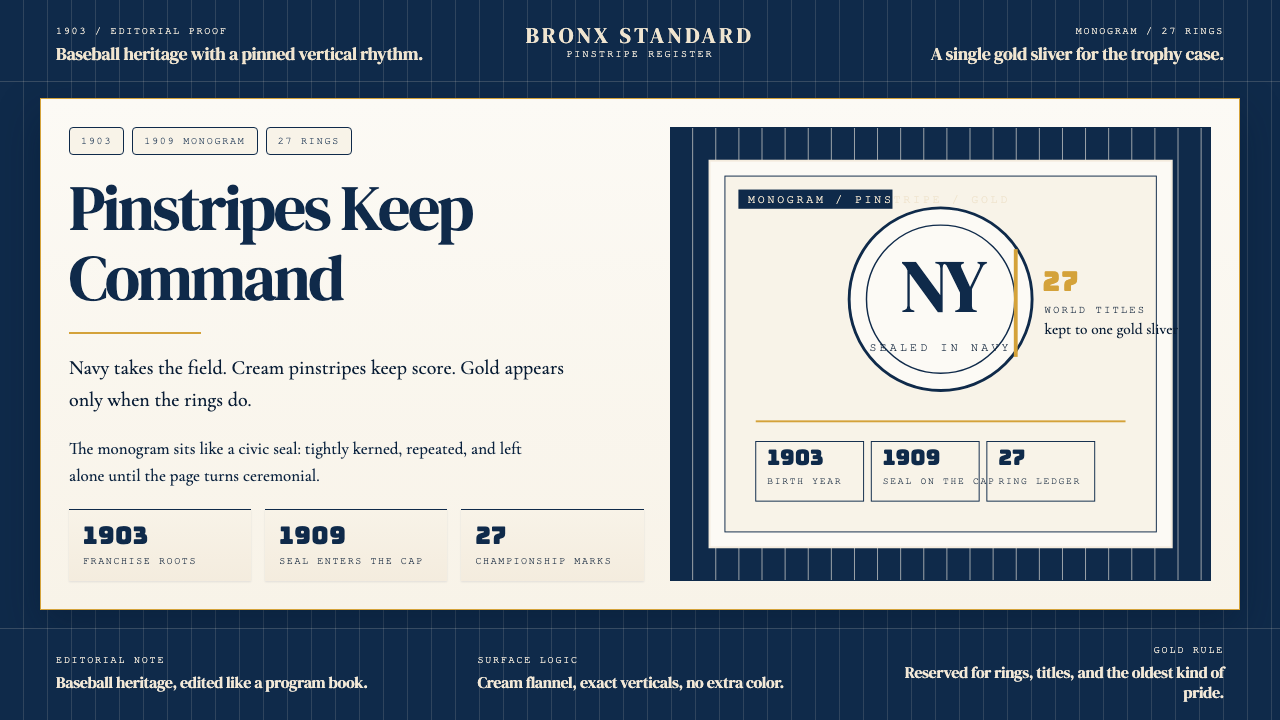 New York Yankees (Navy-Pinstripe)Navy restraint, not noise. Cream pinstripes and a gold monogram seal do the w…
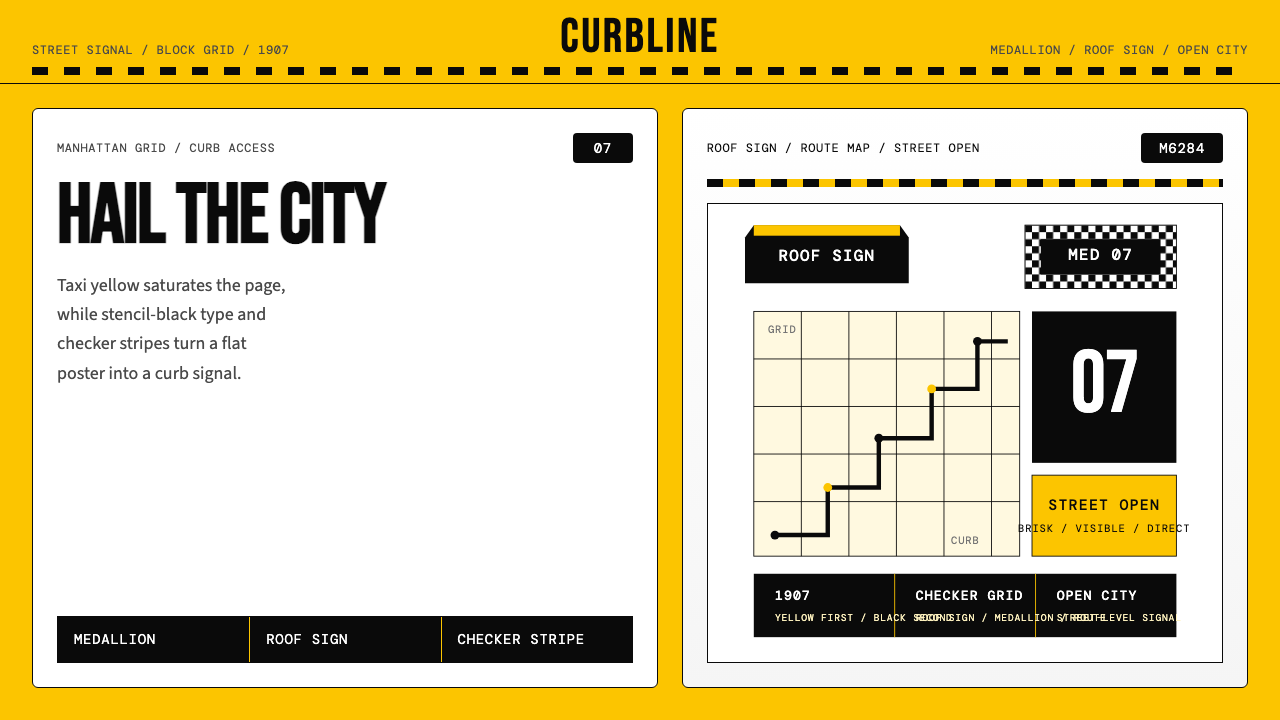 New York Yellow Cab (1907)Visibility is the brand. Taxi yellow, stencil type, checker stripes.
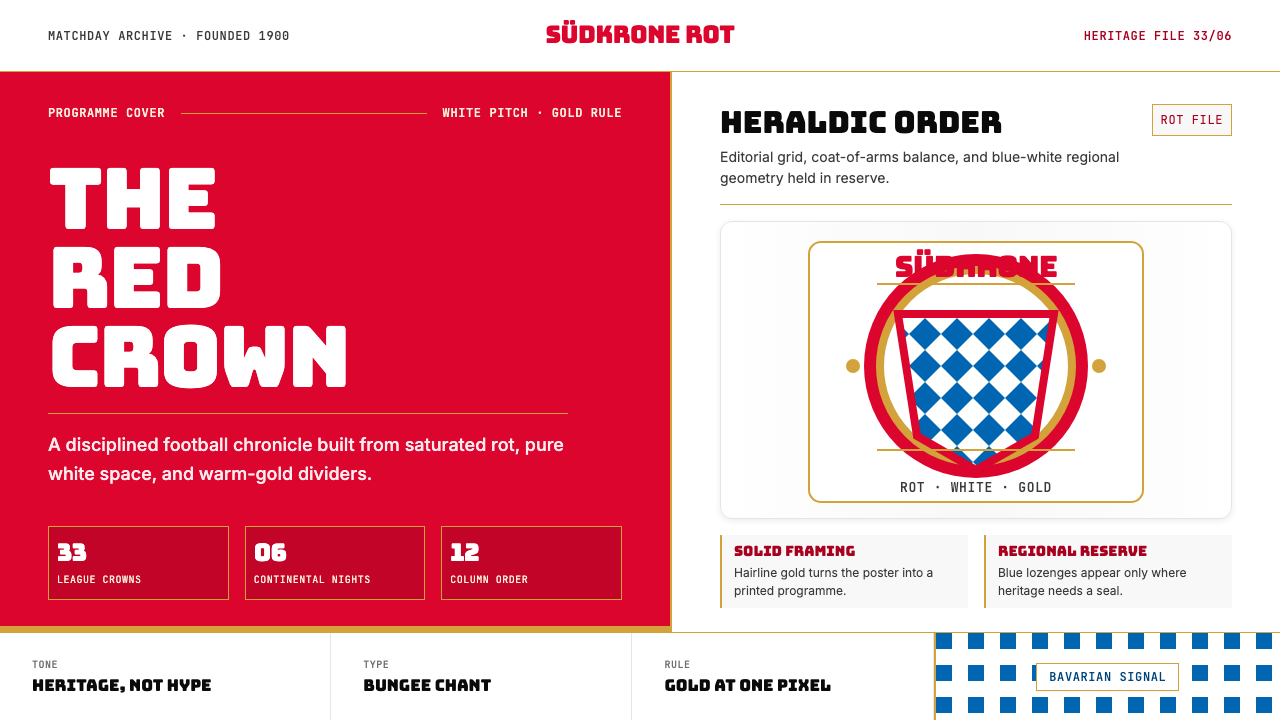 Bayern Munich (Rot)Heritage, not hype. Saturated rot fields, gold rules, and blue lozenges enfor…
 Manchester United (Red Devils)Heritage hits like a chant. Red-black blocks, Bungee type, and gold filigree…
 Meccano Erector SetEngineering becomes tactile. Red perforations and brass bolts lock to a green…
 Medal Ribbon BarDiscipline worn as color. Crimson, sky-blue and gilt bars lock onto black woo…