What is Meccano Erector Set?
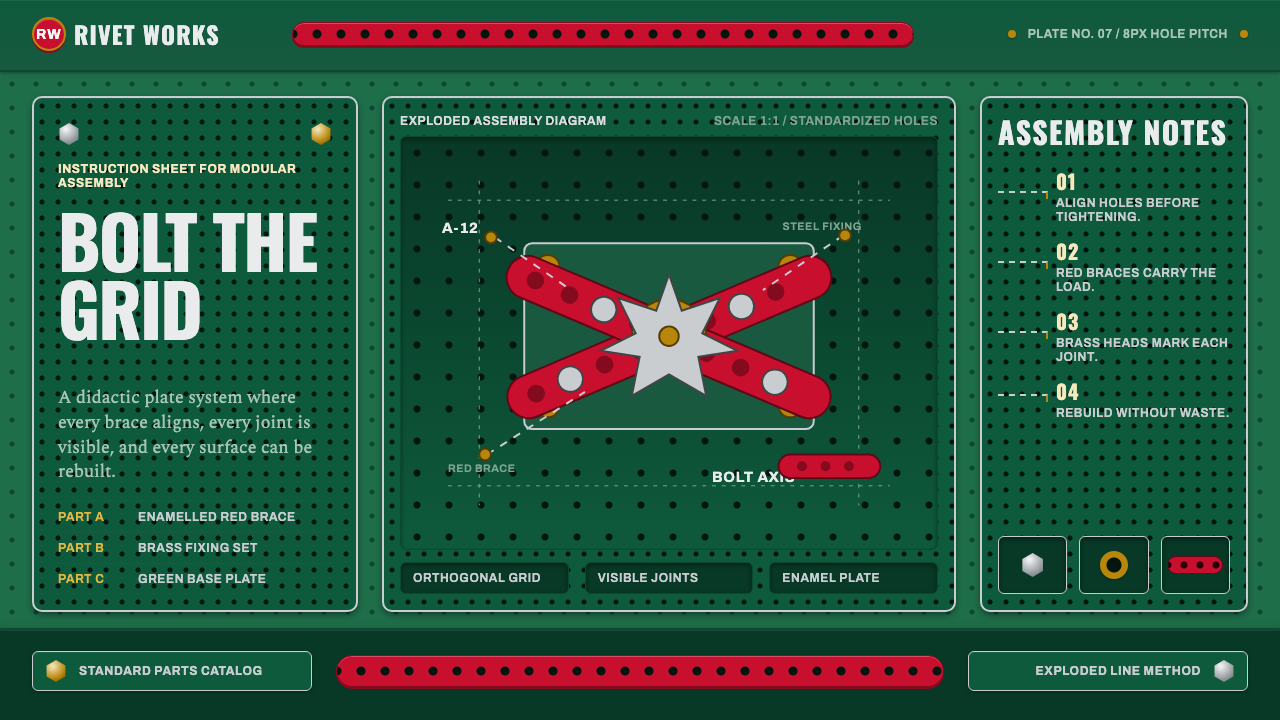
Meccano turned engineering into a toy — perforated red strips, bright steel bolts, and a deep green baseplate that made every joint feel like something a child could take apart and rebuild.
Meccano Erector Set in brief
Meccano Erector Set is the design system built around the world's original construction toy: standardized perforated metal strips, plates, brackets, gears, and pulleys, fastened together with brass nuts and bolts so that a child could assemble a working model — a crane, a bridge, a simple engine — from a box of interchangeable parts. The visual identity translates the toy's physical logic directly: an enamelled red for structural braces and beams, bright unpainted steel for bolts and fasteners, and a deep green for the base plates the whole assembly rests on.
What makes this system distinctive among industrial or mechanical design languages is its didactic intention. Meccano was explicitly conceived as an educational tool, teaching real engineering principles — load, leverage, gear ratios, structural bracing — through play, and its visual identity was never meant to hide its mechanism the way a finished consumer product does. Every strip shows its row of regularly spaced holes; every joint shows its bolt head; nothing is smoothed over or concealed. The design communicates its own construction logic openly, the same way an exploded diagram in an instruction manual shows every part before it's assembled.
This system treats a modern interface as if it were itself a Meccano assembly: holes align along consistent grid intervals, components appear to be joined by visible bolts rather than seamlessly merged, and everything looks like it was meant to be taken apart and rebuilt rather than treated as a sealed, finished object. The aesthetic of visible mechanism — modularity worn openly as a feature rather than hidden as a flaw — is the throughline connecting the physical toy to any digital application of the style.
Where does Meccano Erector Set come from?
Meccano was invented by Frank Hornby, a bookkeeper's clerk in Liverpool, England, who developed the concept around 1898 and patented it in 1901 under the name 'Mechanics Made Easy' before rebranding it as Meccano in 1907. Hornby's original insight, reportedly born from watching his own sons play with makeshift toys, was that a set of standardized, reusable parts — rather than a single fixed model — would let a child build an essentially unlimited range of mechanisms and structures, and would teach real principles of engineering in the process rather than simply providing passive amusement.
The system's core innovation was standardization itself: every strip used the same spacing of holes, every bolt fit every hole, and every gear meshed with every other gear of compatible size, regardless of which specific Meccano set a part came from. This interchangeability meant a child's collection could grow across birthdays and years, always compatible with whatever had come before — an approach that mirrored, in miniature, the standardized-parts manufacturing principles reshaping heavy industry at the same historical moment. Hornby built his company, Meccano Ltd, into a major Liverpool manufacturer, and the toy became one of interwar Britain's most successful export products.
Meccano reached its commercial and cultural peak during the interwar period, the 1920s and 1930s, a moment when engineering itself carried enormous popular prestige — the era of great bridges, ocean liners, and early aviation — and a toy that let children directly emulate that world of visible steel structure resonated powerfully with contemporary values. Meccano sets were marketed explicitly on educational grounds, with instruction manuals that doubled as basic engineering primers, teaching concepts like load distribution and mechanical advantage through guided model-building projects.
Meccano's success also inspired direct transatlantic competition: American inventor A.C. Gilbert launched the Erector Set in 1913 after seeing girder-and-strip construction toys during a trip to England, building a broadly similar system of perforated steel strips and fasteners that became Meccano's dominant American counterpart for much of the twentieth century. The two systems, developed independently but converging on nearly identical visual and mechanical logic, together established 'perforated strip and bolt' as the defining visual vocabulary of construction-toy engineering worldwide, a vocabulary this design system draws on as a shared, internationally recognized language rather than a single national brand's exclusive property.
What defines the Meccano Erector Set look?
Color
The palette is drawn directly from enamelled toy hardware: a saturated enamel red for structural braces and beams, bright unpainted steel-grey for bolts, nuts, and fasteners, and a deep green for base plates and larger structural panels. The combination reads as industrial and toylike at once — bold enough for a child's eye, precise enough to signal genuine mechanism rather than generic decoration.
Perforation
Regularly spaced round perforations run the length of every strip and plate, functioning simultaneously as structural fastening points and as the system's defining visual texture. This perforated rhythm should be treated as a load-bearing design element in its own right — a repeating grid of circles along any structural edge — rather than as incidental surface texture.
Typography
Lettering should read as stamped or stenciled onto metal — the kind of blocky, evenly weighted, slightly industrial character found on toy packaging and instruction-manual labels of the early twentieth century. Numerals and part labels carry the same weight as headline text, reinforcing the instructional, catalog-like feel of the source material.
Visible Fasteners
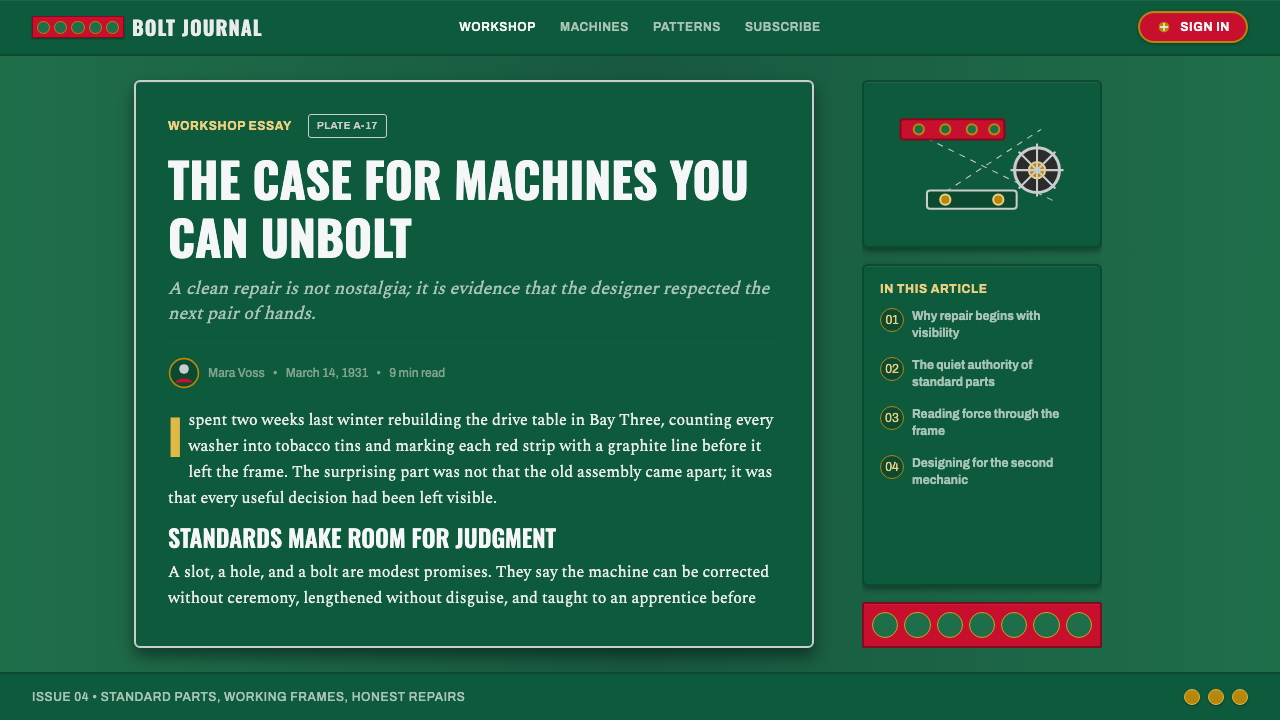
Every joint in the system should look bolted rather than fused or seamless — a visible bolt head, a visible nut, a visible seam where two parts meet. This is the single most important structural principle: components should always look mechanically assembled, never molded as one continuous piece, because the entire aesthetic depends on communicating that everything could be taken apart again.
Exploded-Diagram Logic
Layouts and illustrations should borrow the logic of an instruction manual's exploded diagram — parts shown slightly separated along their assembly axis, with thin guide lines indicating how pieces come together. This didactic, step-by-step visual habit is what gives the system its instructional, almost pedagogical character rather than a purely decorative mechanical look.
Modularity as Feature
Repetition and standardized units are embraced openly rather than disguised — a row of identically sized holes, a repeated bracket shape, a consistent bolt size across every joint. This deliberate visual repetition signals interchangeability and system-thinking, the core educational value the original toy was built to teach, and should never be smoothed into false variety.
Didactic Clarity
Every element should communicate its own function honestly and legibly — a bracket looks like it bears load, a bolt looks like it fastens, a gear looks like it transmits motion. This honesty of construction, borrowed directly from the educational intent of the original toy, distinguishes the system from generic 'steampunk' or 'industrial' pastiche, which often decorates with gears and rivets that serve no structural logic at all.

Who shaped Meccano Erector Set?
Hornby invented the standardized perforated-strip construction system in Liverpool around 1898, patenting it in 1901 as 'Mechanics Made Easy' before rebranding it as Meccano in 1907. His core insight — that interchangeable standardized parts could teach genuine engineering principles through open-ended play — established the toy's enduring educational identity and built his company into a major British manufacturer through the interwar period.
The American inventor launched the Erector Set in 1913 after encountering girder-and-strip construction toys in England, adapting the concept into a broadly parallel American system of perforated steel strips and fasteners. Gilbert's version became Meccano's chief transatlantic competitor and helped establish 'perforated strip and bolt' construction as an internationally recognized toy-engineering vocabulary rather than a single company's proprietary design.
How do you use Meccano Erector Set today?
Meccano Erector Set works best wherever a design needs to communicate hands-on engineering competence, modularity, and honest construction — the opposite of a sealed, glossy, 'finished' consumer product feel. Because its discipline centers on visible mechanism (perforation, bolts, exploded-diagram logic), applying it correctly means letting structure show rather than hiding it behind smooth, seamless surfaces.
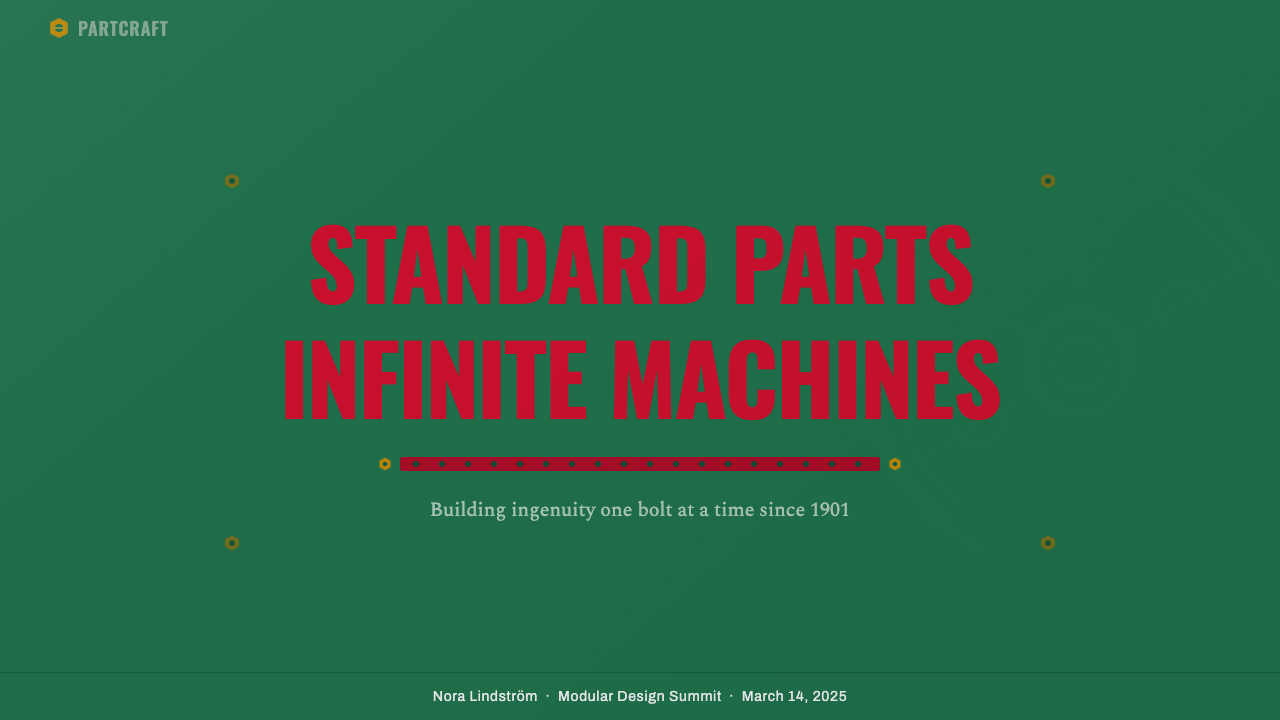
For presentation slides, the system suits a cover page built around a deep green field with a red structural motif — a corner brace, a beam shape — bolted together with visible fastener icons, title type set in the blocky stamped-metal lettering. Content slides should treat data blocks as bolted panels: a red-bordered card joined to its neighbor by a visible bolt icon at the seam, reinforcing the sense that the whole deck is one assembly rather than a set of disconnected pages.
For web interfaces, the palette and visible-joint logic suit builder tools, technical documentation, engineering or maker-culture products, and educational platforms teaching hands-on or STEM subjects. Cards and panels can borrow the perforated-strip motif as a structural border treatment, buttons can look bolted rather than flat, and the green base-plate color works well as a grounding background for dashboards that want to feel like a workbench rather than a sterile screen.
For editorial and marketing work, the system suits brands and stories about craftsmanship, engineering education, DIY culture, or nostalgic technology — anything wanting to evoke the tactile satisfaction of building something with your own hands. Layouts benefit from exploded-diagram illustrations showing components mid-assembly, and headline typography that reads as stamped rather than printed.
A common mistake is treating this system as generic 'steampunk' decoration — piling on gears, rivets, and brass textures that serve no actual structural logic, which betrays the didactic honesty at the heart of the original toy. A second common mistake is smoothing every joint into a seamless, molded look for the sake of a cleaner modern aesthetic; doing so removes the single most important signal of the style — that everything shown could genuinely be bolted apart and rebuilt.
Meccano Erector Set — FAQ
What is the difference between Meccano and Erector Set?
Meccano is the original British system, invented by Frank Hornby around 1898 and patented in 1901. Erector Set is the American parallel system launched by A.C. Gilbert in 1913 after he saw similar construction toys in England. The two systems developed independently but converged on nearly identical visual logic — perforated metal strips, brass fasteners, standardized modular parts — and together they established the shared visual vocabulary this design system draws on, rather than either being a copy of the other in the strict sense.
Why does this style insist on showing visible bolts and joints instead of a smoother, more modern finish?
Because the entire meaning of the original toy depended on visible, functioning mechanism — a child needed to see how pieces connected in order to understand and learn from the construction. Smoothing every joint into a seamless finish for the sake of modern polish removes the exact quality that makes the style recognizable and meaningful: the sense that a structure is honestly built from real, separable parts rather than molded as one sealed unit.
Was Meccano always aimed specifically at teaching engineering, or was it purely a toy?
It was explicitly educational from its origin. Frank Hornby designed and marketed Meccano around the idea that standardized, reusable parts could teach real principles of engineering — load distribution, leverage, gear ratios — through open-ended model building, and instruction manuals doubled as basic engineering primers. This didactic intention is a core reason the visual system emphasizes honest, legible mechanism rather than purely decorative industrial imagery.
Why is green used for base plates specifically, rather than another color?
The deep green base-plate color comes directly from the enamelled finish used on the physical toy's larger structural panels, chosen historically to distinguish the foundational, load-bearing plates from the red braces and bright-steel fasteners that attach to them. In the design system, preserving that same green-for-base, red-for-brace, steel-for-fastener division of labor keeps the color logic legible and consistent with the source material rather than arbitrary.
Is this style suitable for a brand aimed at a sophisticated, adult, premium audience?
It can work well for premium audiences specifically interested in craftsmanship, engineering, or maker culture — the style signals genuine competence and hands-on skill rather than childishness, provided it is applied with restraint rather than treated as a nostalgic toy pastiche. It is less suited to luxury contexts built around softness, glamour, or effortless polish, since the whole point of the aesthetic is visible mechanical effort and honest, unglamorous construction.
Related design styles
 Iridescent Scarab DrawerOrder makes the shimmer read. Jewel scarabs pinned in a grid on black foam, m…
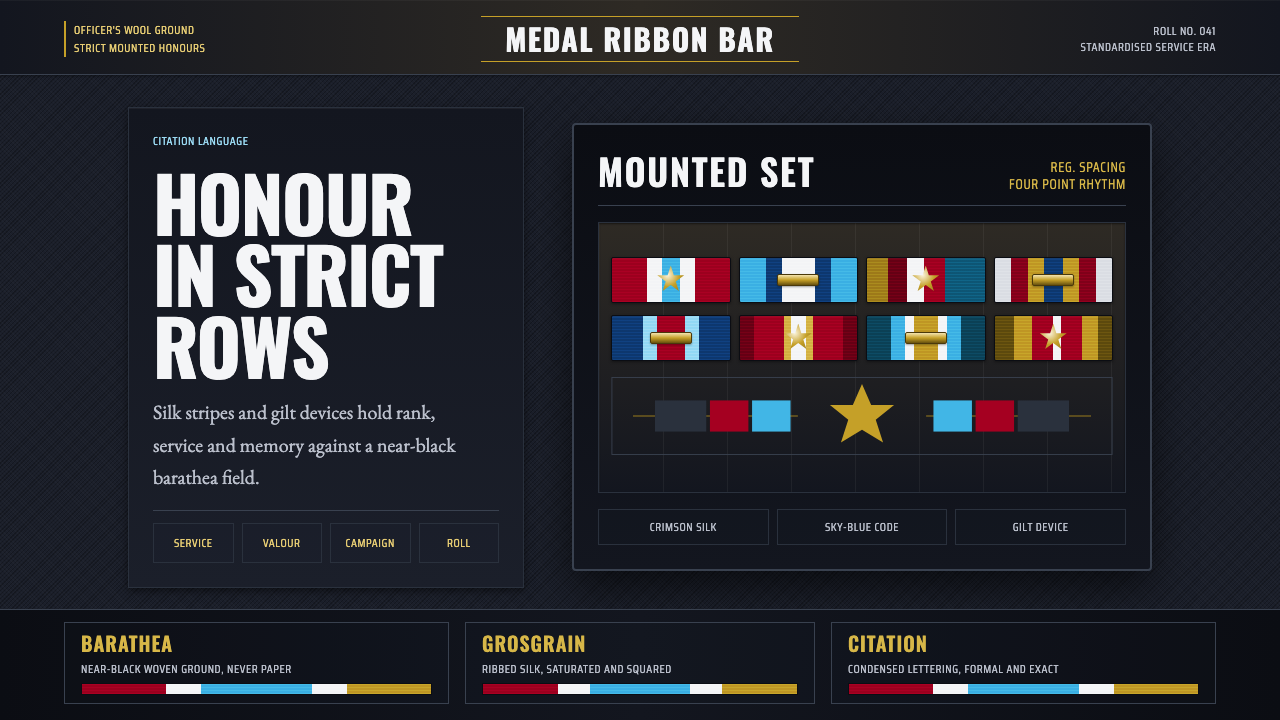 Medal Ribbon BarDiscipline worn as color. Crimson, sky-blue and gilt bars lock onto black woo…
 Office Rubber StampsProcedure made visible. Vermilion Oswald stamps strike a manila logbook grid.
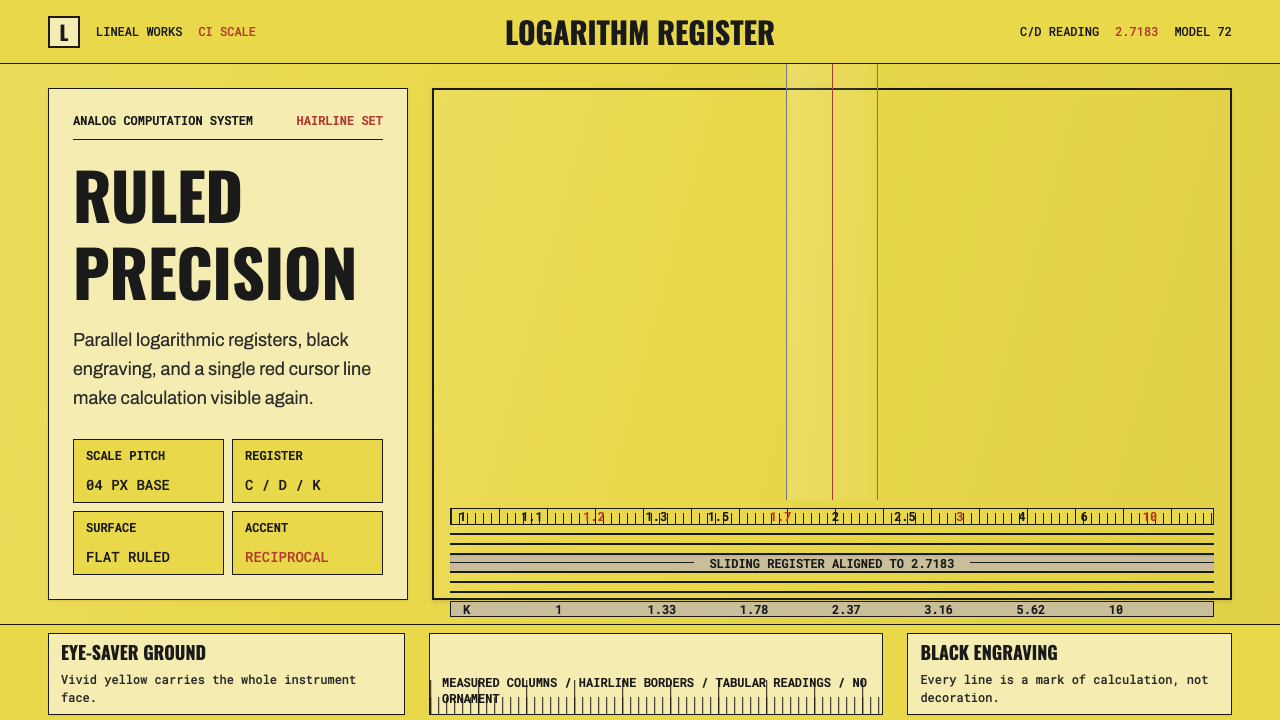 Slide RulePrecision made visible. Eye-saver yellow, black ticks, and one red hairline d…
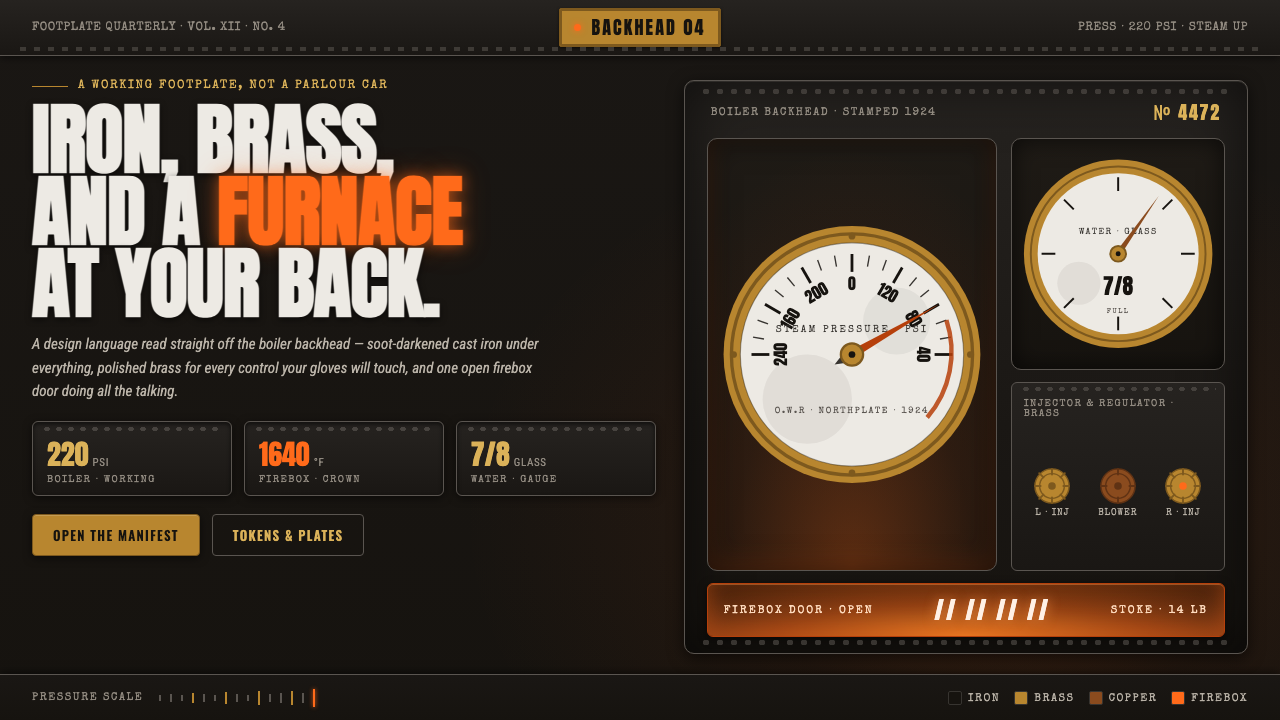 Steam LocomotiveWorking iron, not parlour car. Soot-black cast iron, polished brass gauges, o…
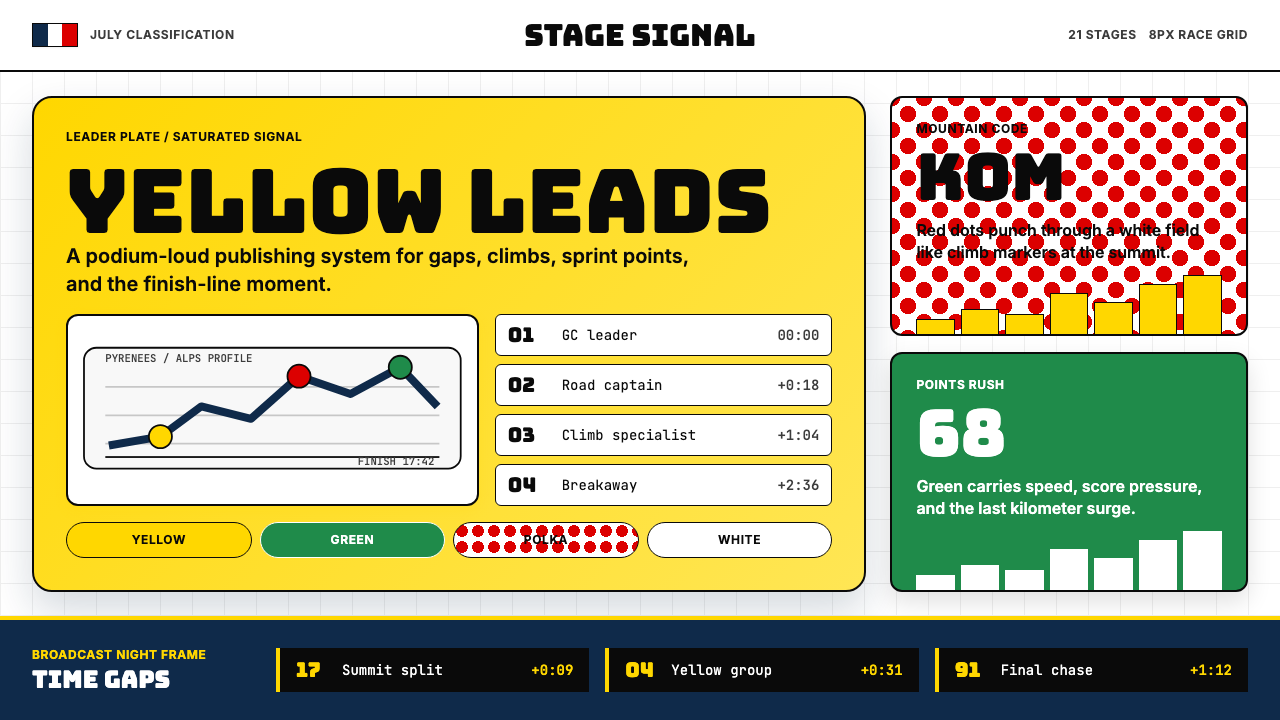 Tour de France (Yellow Jersey)Yellow owns the finish. Bungee type, polka dots, and navy tickers snap to an…