What is Iridescent Scarab Drawer?
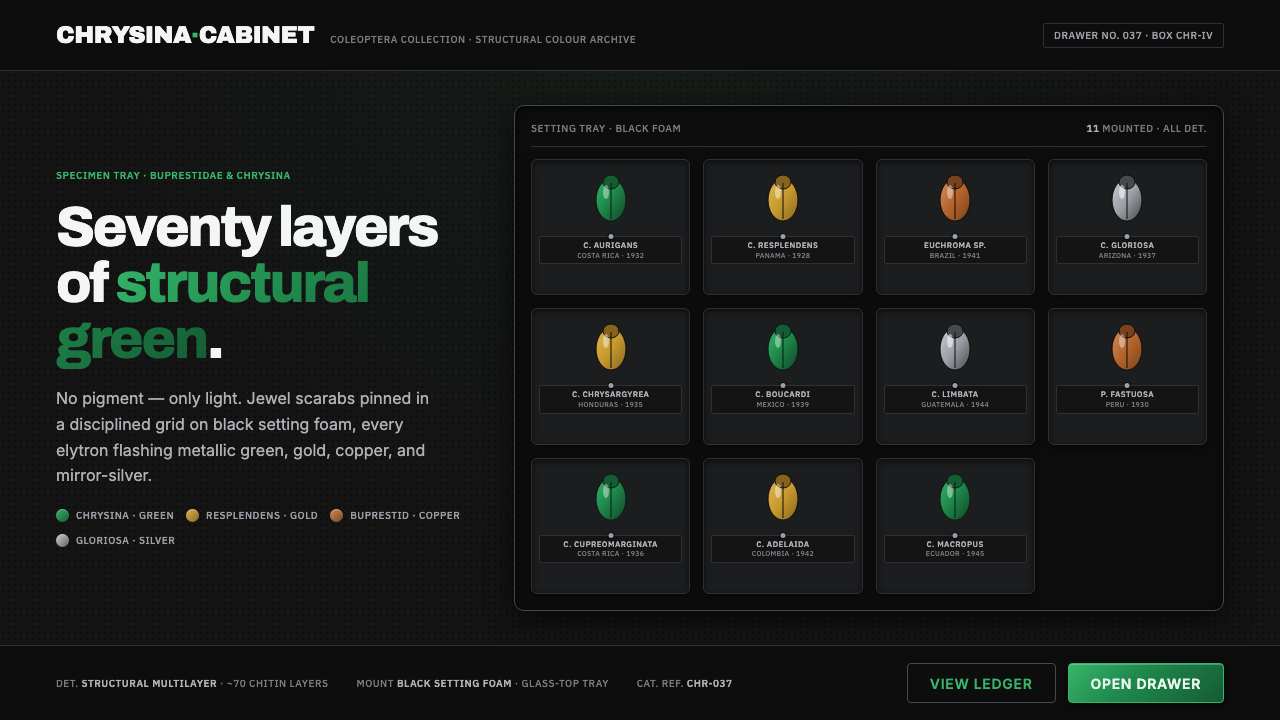
The Iridescent Scarab Drawer makes order the frame for wonder: jewel-green beetles pinned in disciplined rows, where black foam turns every metallic flash into an event.
Iridescent Scarab Drawer in brief
The Iridescent Scarab Drawer distills the glass-topped entomology collection tray into a visual system built from contrast and arrangement. Rows of pinned Chrysina jewel scarabs rest on black setting foam, each specimen accompanied by a small, carefully typeset identification label. The result is neither naturalistic wilderness nor decorative luxury. It is a controlled field of specimens in which every beetle is isolated, named, and given enough darkness around it to become visually precise.
Its color comes from the beetles rather than from a broad decorative palette. Their metallic green is dominant, with gold, copper-red, and mirror-silver appearing as individual flashes among the rows. These colors are structural rather than painted: the beetles produce their iridescence through roughly seventy chitinous layers, so the shimmer changes with the angle of light. The design system therefore treats color as an optical event, not a flat surface tone.
The system is dark, disciplined, and quietly theatrical. Black foam provides the ground; clean grotesque type echoes printed specimen labels; the cabinet grid supplies order; and specular highlights provide movement. Nothing is scattered casually. The visual pleasure comes from the tension between scientific classification and jewel-like surface: a collection drawer is a record, but every recorded object still catches the eye.
Where does Iridescent Scarab Drawer come from?
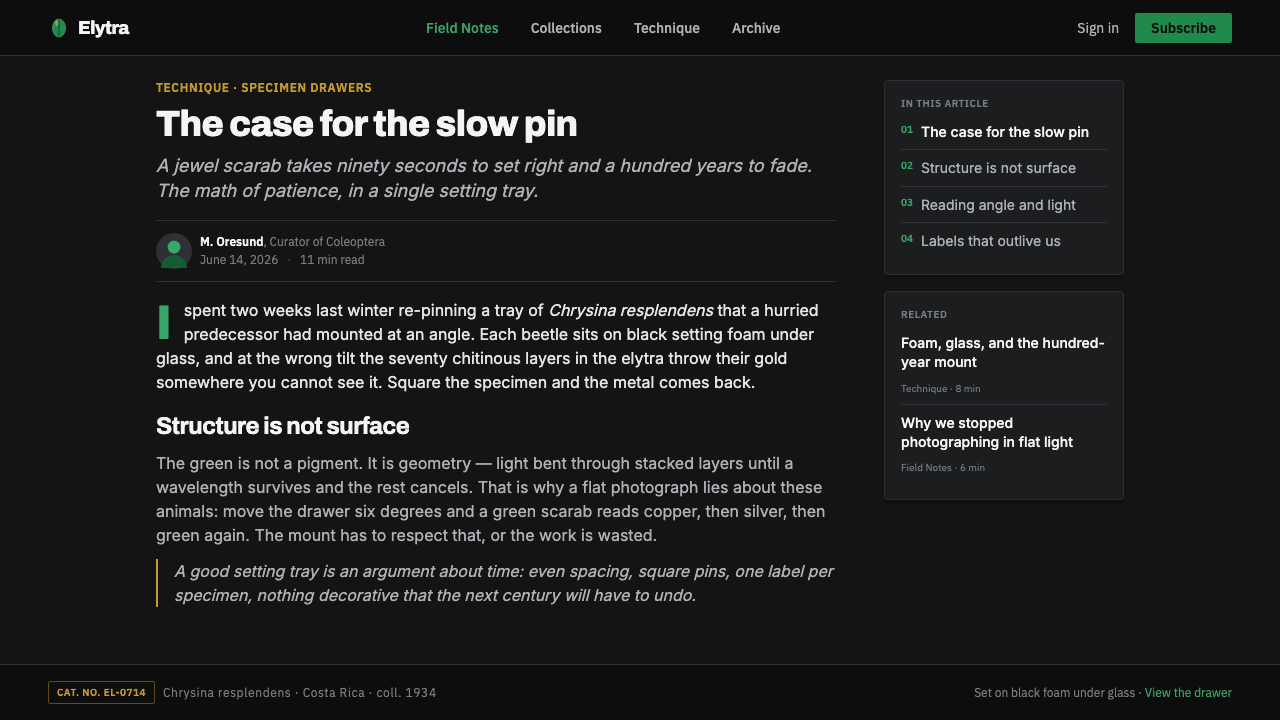
The style draws from the entomological cabinet and collection practice of Western Europe, especially the convention associated with collection drawers from 1900–1950. A glass-topped tray lined with setting foam turns a group of fragile specimens into an ordered visual field. The black ground is practical in appearance and dramatic in effect: it separates the bodies from their surroundings, makes their silhouettes legible, and gives metallic surfaces a deep optical counterweight.
Its historical logic is cataloguing. Chrysina collectors and curators, Buprestidae jewel-scarab specialists, and Coleoptera cabinet curators all belong to a culture in which display and identification are inseparable. The specimen is not merely placed for admiration; it is mounted, grouped, and labelled so that its presence can be understood within a collection. The small ID label is therefore not an accessory. It is part of the visual grammar, balancing the beetle’s intense surface with a controlled act of naming.
The system also comes from the meeting of structural-colour specimen mounting and modern collection cataloguing. A jewel scarab’s metallic appearance is produced by layered chitin rather than by a simple opaque coating, which makes the surface unusually dependent on light and position. The drawer convention contains that variability without suppressing it. Rows and labels establish stability, while the changing highlight keeps each specimen alive. The resulting aesthetic is a disciplined translation of natural iridescence into a cabinet structure that remains the standard mount today.
What defines the Iridescent Scarab Drawer look?
Black Foam Ground
The ground is near-black, matte, and visually absorbent. It suppresses environmental noise so the scarabs appear as discrete objects rather than as part of a continuous image. The darkness also gives metallic green, gold, copper-red, and mirror-silver their apparent depth. It should feel like setting foam in a collection drawer: quiet, practical, and capable of making a small highlight look luminous.
Structural Iridescence
Color behaves like reflected structure, not a uniform fill. Metallic green leads, while gold, copper-red, and mirror-silver appear as specimen-specific variations. Highlights should feel sharp and directional, with a sense that the surface changes as the viewer moves. The palette is therefore gem-like but restrained: brilliance belongs to the specimens, while the surrounding system stays dark and composed.
Cabinet Grid
The layout is organized into repeated rows and columns, recalling a drawer prepared for inspection. Repetition creates calm and makes differences between specimens readable. Alignment matters more than decorative framing: the beetles, labels, and empty intervals should share a common visual order. The grid is not a background motif but the system that allows shimmer to register as variation.
Specimen Labels
Small typeset ID labels sit beneath the specimens, using clean grotesque lettering and a measured, cataloguing tone. Typography should be legible before it is expressive. Short labels create a quiet counter-rhythm to the beetles’ irregular surfaces, turning each row into a sequence of object and record. The text belongs to the collection logic, not to a separate layer of decoration.
Pinned Stillness
The beetles are presented as fixed specimens, not animated illustrations. Their stillness gives the system its authority and its slight tension: each body is preserved, centered, and available for comparison. The pinning should be implied through placement and restraint rather than exaggerated as a theatrical prop. The design feels archival because the objects appear held in a state of careful observation.
Controlled Contrast
The system depends on a narrow relationship between deep matte darkness and concentrated metallic light. Contrast should be strongest where attention is intended: on a beetle’s shell, a label edge, or a clean alignment. Avoid filling every surface with shine. If everything glitters, nothing reads as iridescent. Restraint is what turns the drawer from a luxury pattern into a collection display.
Who shaped Iridescent Scarab Drawer?
These collectors and curators represent the system’s central act of selection: preserving jewel scarabs, arranging them in rows, and presenting each specimen as part of an intelligible collection. Their practice connects visual wonder with the discipline of mounting and identification.
The specialists of Buprestidae bring attention to the jewel-like surface that defines the style. Their subject is not merely a green beetle but a body whose layered chitin produces metallic green, gold, copper-red, and mirror-silver effects under changing light.
Coleoptera cabinet curators embody the grammar of order: setting foam, repeated placement, glass-topped drawers, and printed identification labels. Their contribution is the structure that makes individual specimens comparable without reducing their visual differences.
How do you use Iridescent Scarab Drawer today?
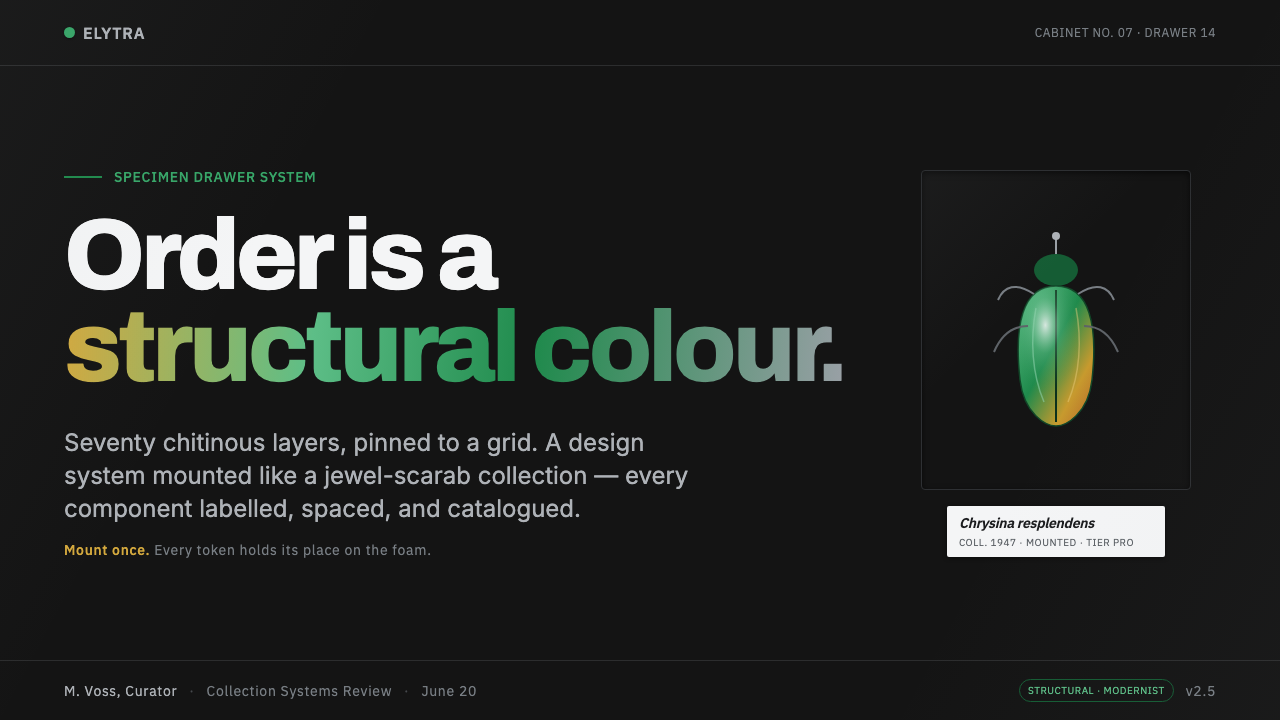
For presentation slides, use the system as a specimen cabinet rather than as a general dark theme. A cover can place a single large scarab-like metallic form or a tightly aligned row against the black ground, leaving the title in clean grotesque type with generous breathing room. Content slides should preserve the drawer logic: restrained specimen-like objects, clear labels, and repeated alignment. Data slides can treat charts as catalogued specimens, with metallic green carrying the main measure and gold, copper-red, or mirror-silver reserved for meaningful distinctions.
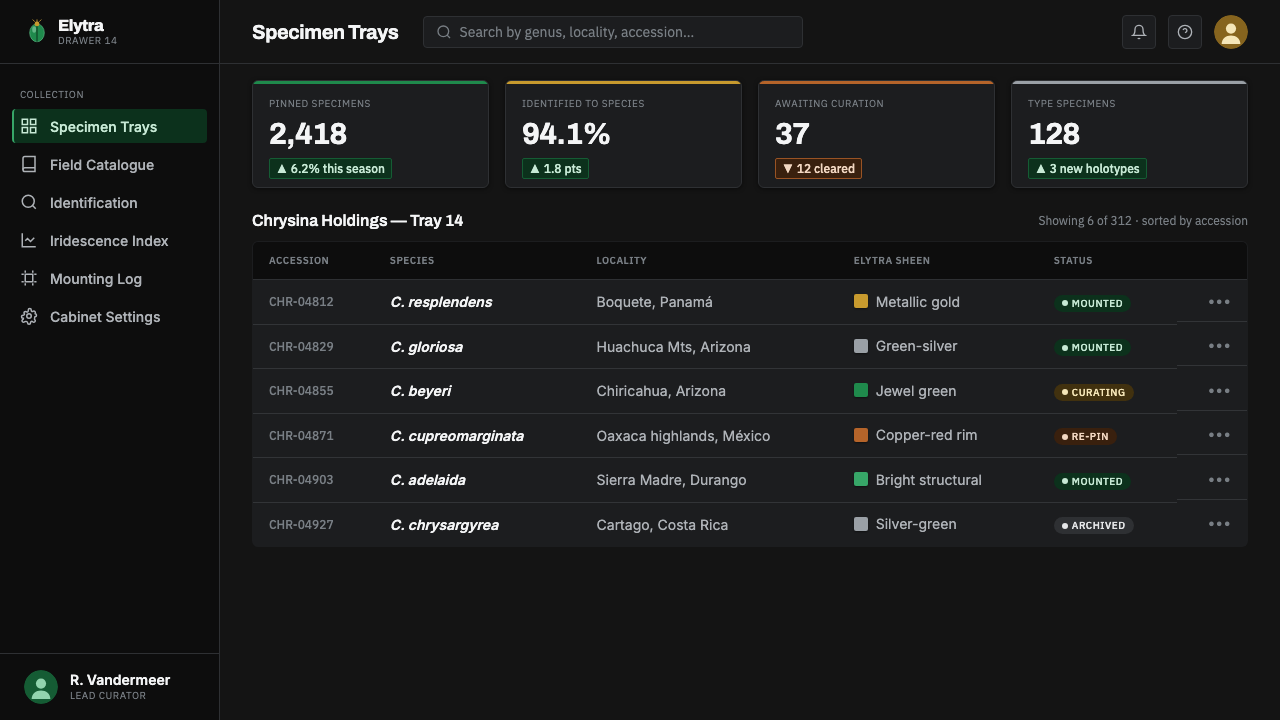
For web interfaces, the Iridescent Scarab Drawer suits dashboards, catalogues, analytical tools, and pricing pages that need authority with a sense of rarity. Keep the interface dark and matte, then use metallic accents for active states, selected plans, key metrics, or moments of confirmation. Cards should feel mounted rather than floating: stable alignment, quiet surfaces, and highlights placed only where attention is needed. Labels should remain compact and legible, so the interface reads as an organized collection rather than a gaming screen or a luxury shop.
For editorial and marketing work, build a strong contrast between archive and jewel. Long-form pages can use a dark reading field, specimen-style captions, narrow text measures, and repeated horizontal bands that recall drawer rows. A feature spread might present one scarab as the visual subject, surrounded by black space and a small identification label, while a campaign page can alternate close metallic details with orderly collection views. The most effective voice is precise and curious: the object is beautiful because it is observed carefully.
For brand systems, the style works best when the collection logic is visible across touchpoints. Product cards, campaign tiles, reports, and navigation should share the same label behavior, alignment discipline, and restrained metallic vocabulary. Use the brightest surface treatment for moments that deserve inspection, not as a constant background effect. The system gains character from repetition: viewers should feel that every screen belongs to the same cabinet, even when the individual specimen or message changes.
The common mistake is to treat iridescence as permission to add shine everywhere. A field of gradients, glowing edges, and many competing jewel colors destroys the very order that makes the reference work. Another mistake is to use the beetles as random decoration while ignoring labels and alignment. Start with the dark ground, establish the cabinet grid, define the cataloguing rhythm, and let metallic color appear selectively. The shimmer should be discovered within structure, not used to replace it.
Iridescent Scarab Drawer — FAQ
Is the Iridescent Scarab Drawer a nature-inspired style or a luxury style?
It is both, but neither in a conventional sense. Nature supplies the beetles’ structural iridescence, while entomological collection practice supplies the grid, labels, and disciplined display. The jewel-like colors suggest rarity, yet the black foam and cataloguing language keep the system observational rather than ornamental. Its defining quality is the tension between scientific order and precious surface.
Why is black foam so important to the style?
The black foam acts as both practical ground and visual instrument. It removes competing context, clarifies the silhouette of each pinned scarab, and gives metallic color a dark field against which to appear deep and reflective. A lighter or more textured ground would weaken the cabinet character and make the specimens feel like decoration rather than carefully mounted objects.
Should every element use metallic color?
No. Metallic color is most effective when it belongs to a specimen, a selected state, or a clearly defined point of attention. The surrounding system should remain dark, matte, and quiet. If every card, label, border, and background glints equally, the viewer loses the distinction between object and setting. Controlled contrast is what makes iridescence legible.
How should typography behave in this system?
Typography should echo printed specimen identification: clean grotesque forms, compact labels, and clear hierarchy. It should feel measured and cataloguing-oriented rather than expressive or ornamental. Let the beetles carry surface drama while the type provides naming, sequence, and orientation. The contrast between restrained text and vivid shell is essential to the style’s character.
Where does this style struggle?
It can struggle where warmth, softness, or abundant visual variety is the main goal. The dark ground, pinned stillness, and archival labels communicate discipline and observation, not spontaneity or casual friendliness. It may also feel excessive if the product has no meaningful relationship to collections, specimens, rarity, or close inspection. The style works best when its order and shimmer support the product’s actual character.
Related design styles
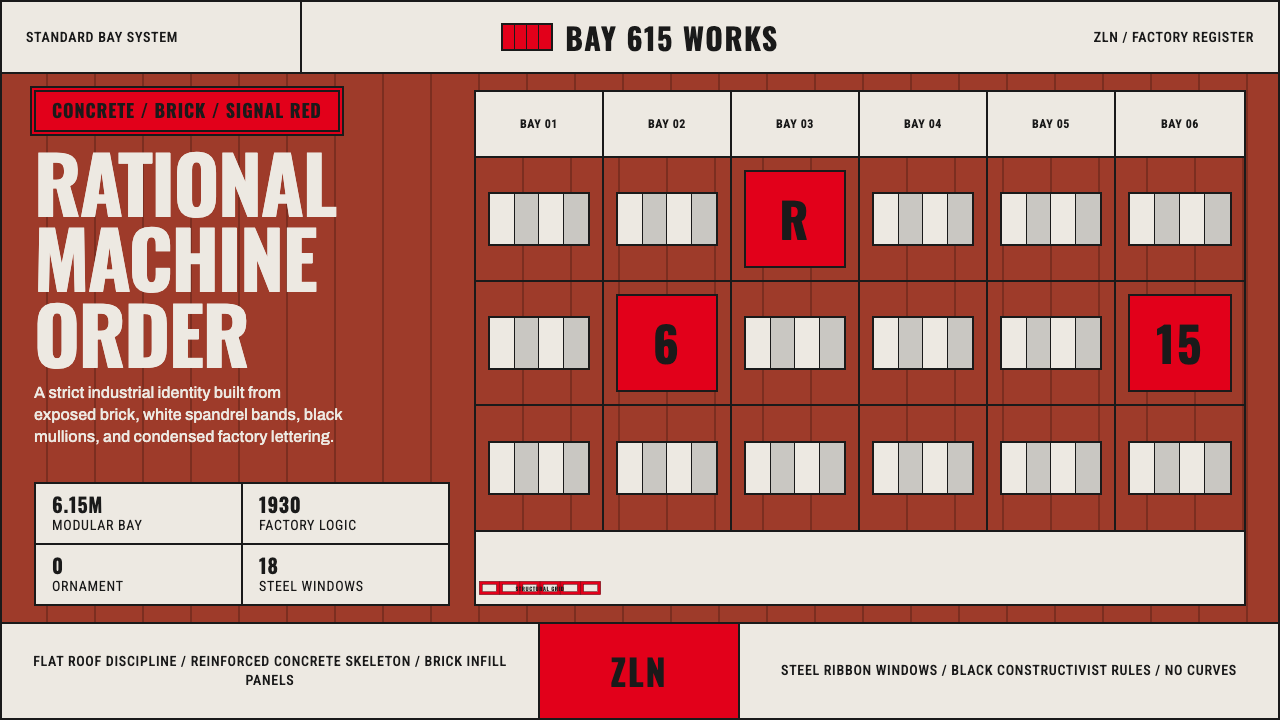 Baťa Zlín Functionalist BrandMachine-age precision. Brick red, concrete bands, and Oswald type lock into a…
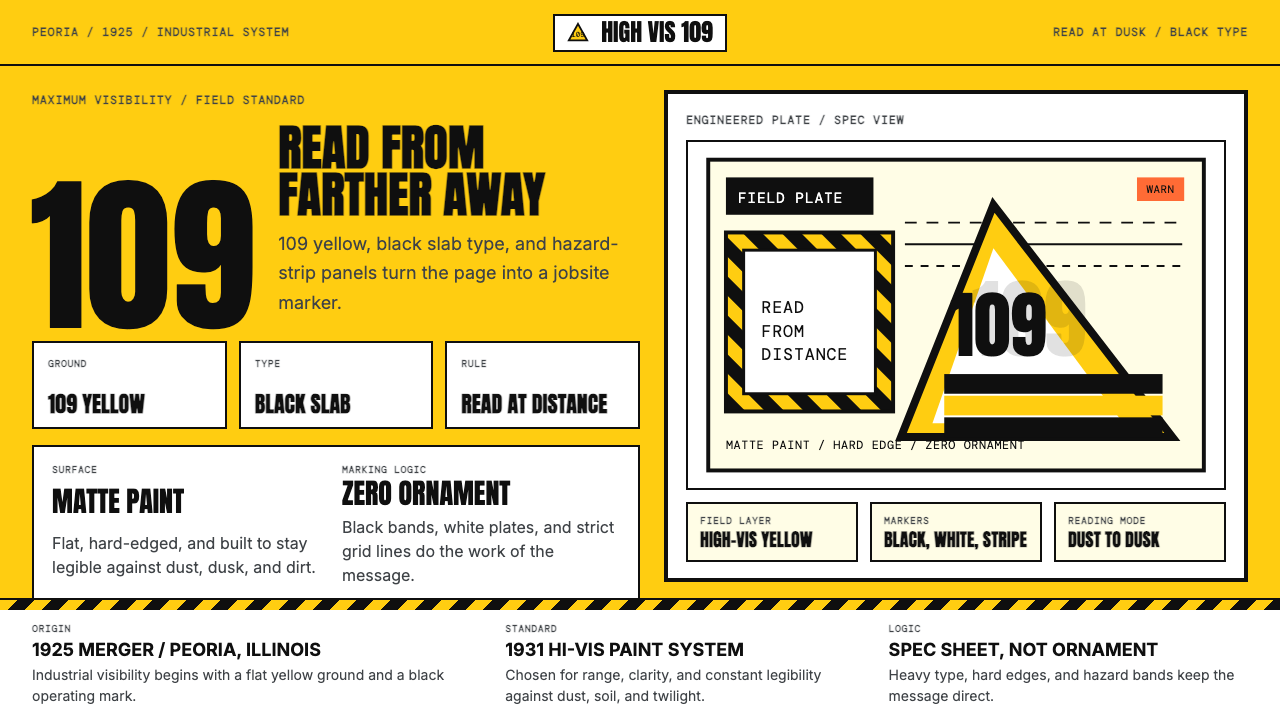 Caterpillar Construction Yellow (1925)Maximum visibility, zero softness. 109 yellow ground and black slab type.
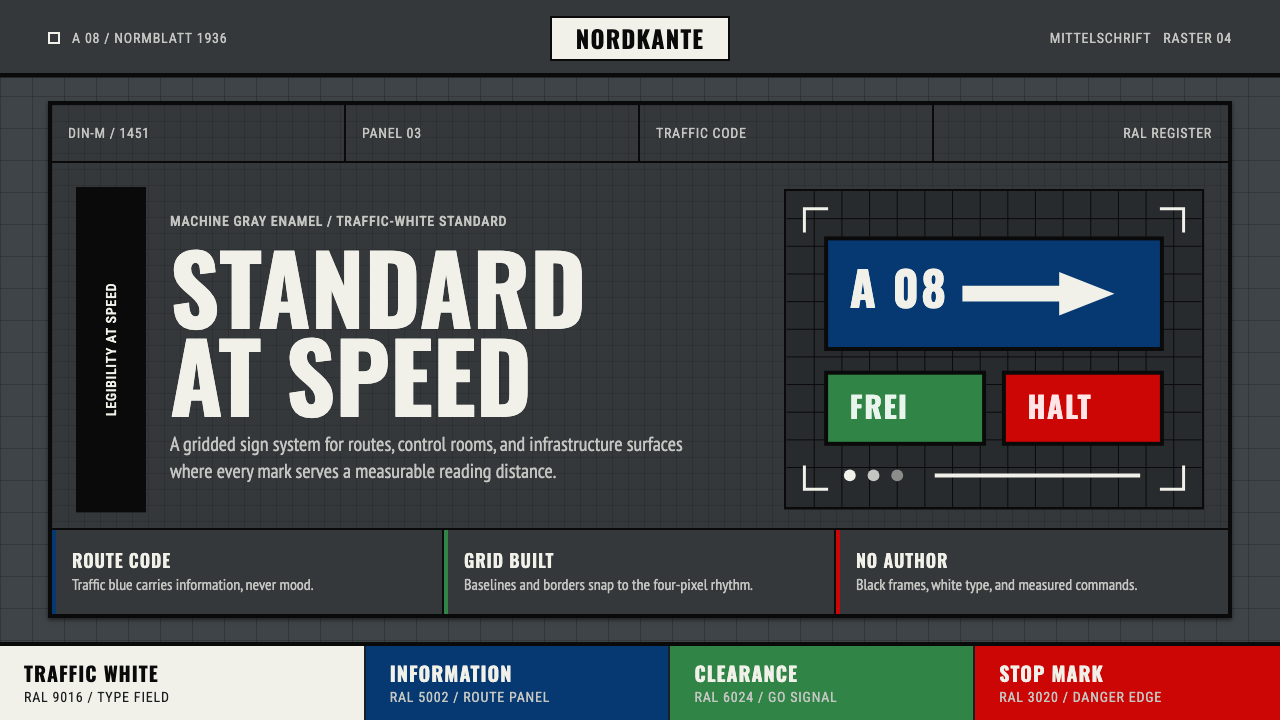 DIN 1451 SignageAuthorless and exact. Enamel gray grid, traffic-white DIN type, and RAL signa…
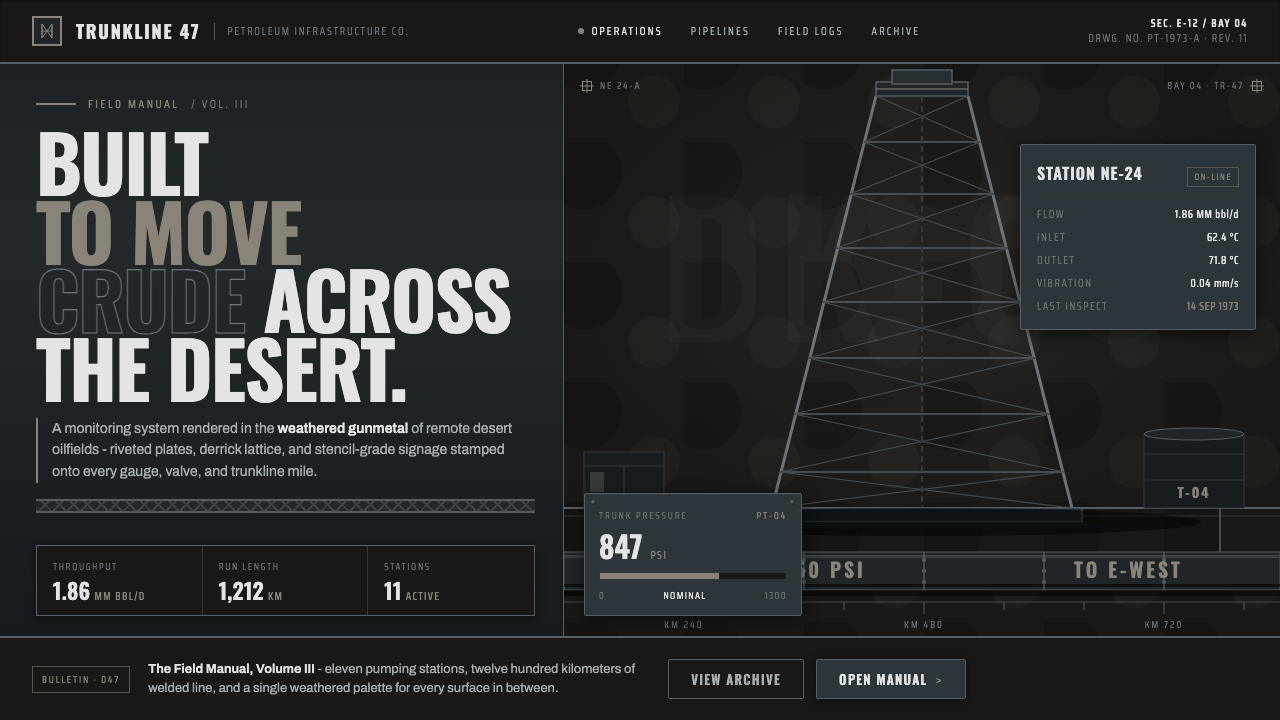 Gulf Oil Derrick IndustrialEngineered, not decorative. Soot-darkened gunmetal, derrick lattice, condense…
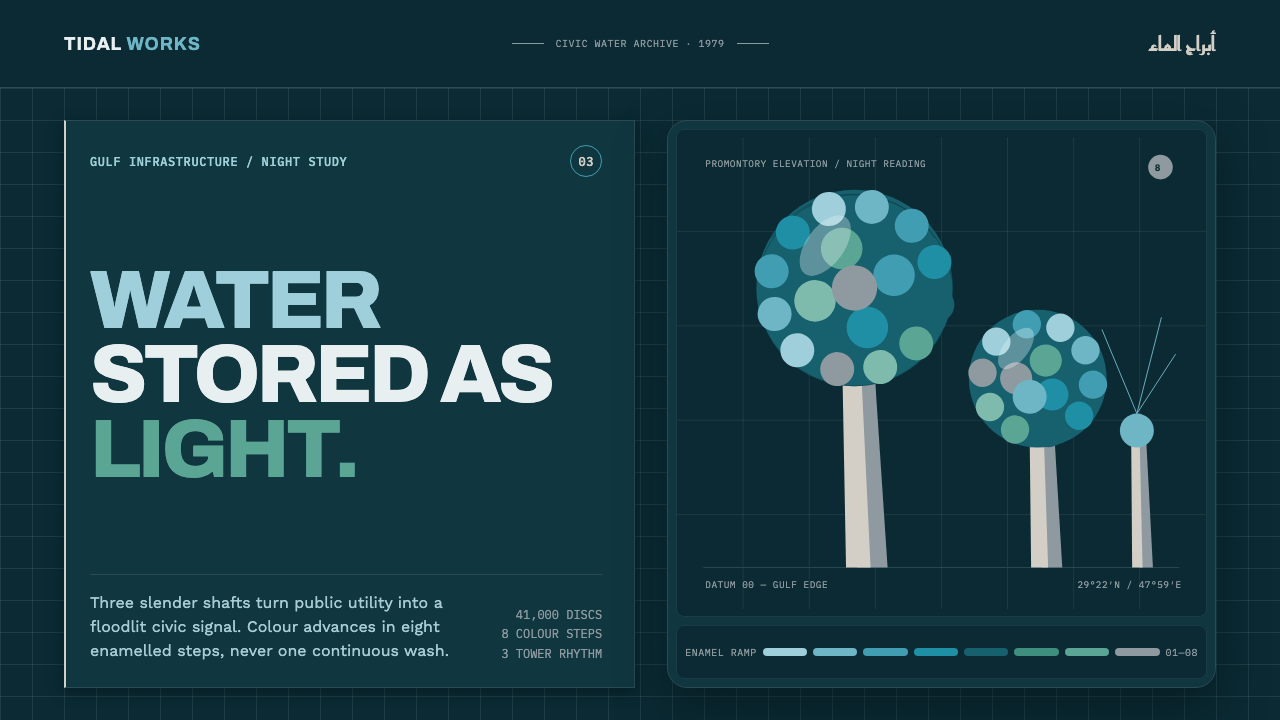 Kuwait Water TowersInfrastructure becomes a night monument. Eight enamel steps spiral across a d…
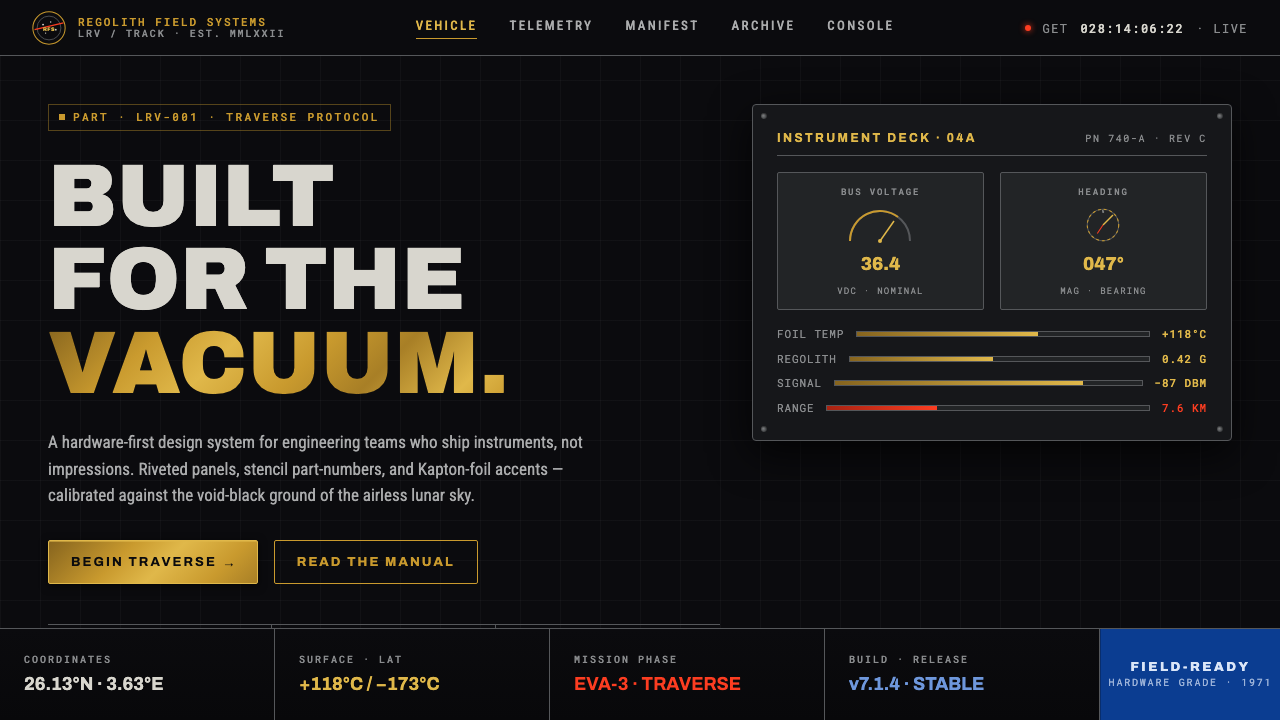 Lunar RoverBuilt for the vacuum. Kapton-gold foil and stencil part-numbers against void-…