What is Slide Rule?
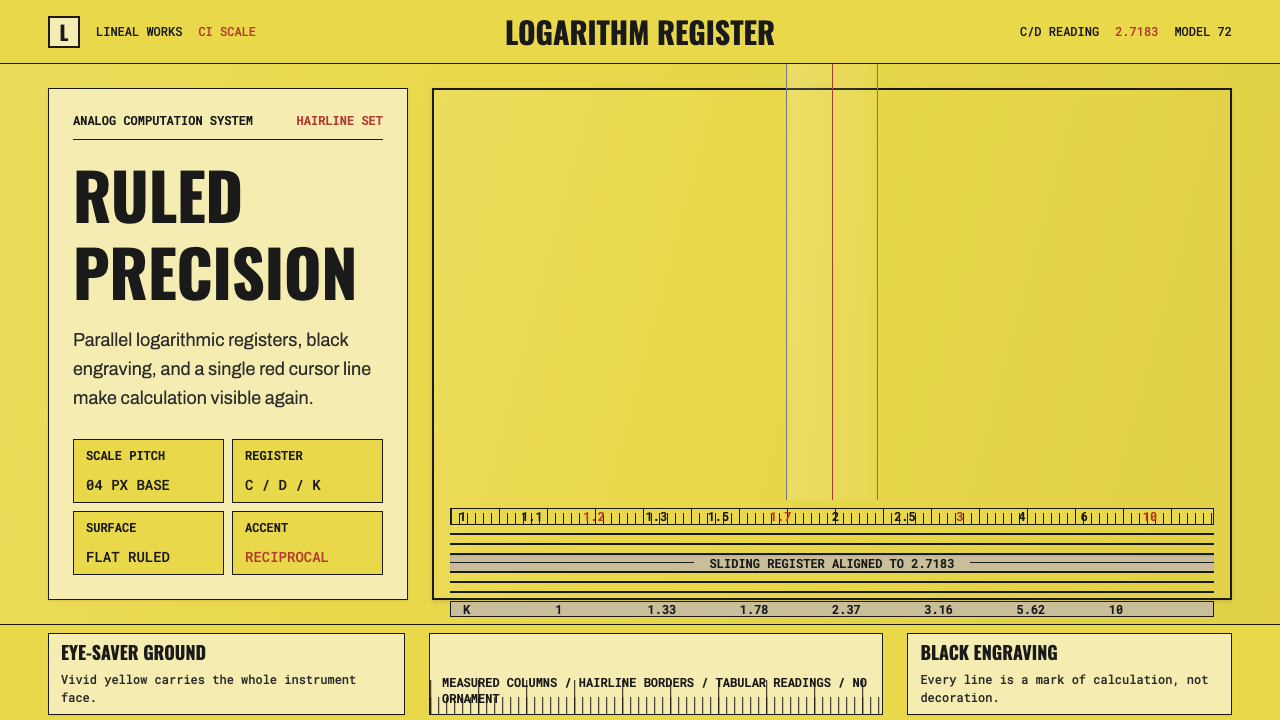
Before the calculator, engineers trusted a sliding strip of numbers — and dressed their precision in a color meant to save the eyes through long nights of work.
Slide Rule in brief
Slide Rule Engineering is a design language drawn directly from the physical analog computing instrument that every engineer, scientist, and student relied on for calculation before the pocket electronic calculator arrived in the early 1970s. A slide rule consists of logarithmic scales — labeled C, D, A, K, L, and others depending on the model — engraved onto a rigid body, traditionally celluloid-faced wood or later plastic, with a sliding central strip and a transparent glass or plastic cursor bearing a single fine hairline used to read values across the scales.
The system translates that instrument's working logic directly into a visual grammar: parallel bands of scale markings, fine graduated tick marks of varying length denoting major and minor values, a sliding register implying motion and comparison rather than a static single value, and a single red hairline cursor mark used sparingly to indicate the one value currently being read. Pickett, one of the best-known American slide rule manufacturers, distinguished its instruments with a vivid, high-visibility yellow body — marketed as 'Eye-Saver Yellow' — designed specifically to reduce eye strain during extended engineering work, and that yellow anchors the entire palette.
The overall effect is precision made visible rather than precision hidden behind a digital display: nothing in the composition is decorative, every mark corresponds to a measured value, and the eye is meant to read the instrument the way an engineer reads a scale — methodically, left to right, tick by tick.

Where does Slide Rule come from?
The slide rule's underlying principle — using logarithms to convert multiplication and division into addition and subtraction of lengths along a scale — was developed by William Oughtred in the early seventeenth century, building on John Napier's invention of logarithms. Oughtred's design, refined over subsequent centuries by many contributors, established the basic architecture of parallel logarithmic scales that every later slide rule, regardless of manufacturer, continued to use.
The instrument reached its peak of ubiquity and manufacturing sophistication in the mid-twentieth century, roughly 1950 to 1990, though its practical dominance ended abruptly with the 1972 introduction of the Hewlett-Packard HP-35, the first pocket scientific calculator, which within a few years made the slide rule functionally obsolete for professional engineering use. In its final decades of dominance, however, the slide rule was the essential tool of engineering education and practice worldwide — no engineering student graduated without mastering one, and it accompanied calculations for bridges, aircraft, and the Apollo program's spaceflight engineering.
American manufacturers Keuffel & Esser, based in New York, and Pickett & Eckel, based in California, were among the most prominent producers of precision slide rules during this peak period, each developing distinct house styles. Keuffel & Esser built its reputation on traditional wood-and-celluloid construction with meticulous engraved scales, favored by many professional engineers for its durability and precision. Pickett distinguished itself with aluminum-bodied rules finished in a bright, proprietary yellow marketed specifically as reducing eye fatigue during long working sessions — an innovation that became so closely associated with the brand that Pickett rules were reportedly carried on NASA's Apollo missions.
Each scale on a slide rule serves a distinct mathematical function: the C and D scales handle basic multiplication and division, the A and K scales handle squares and cubes, and the L scale handles logarithms directly, among others depending on the specific model's complexity. Reading a value required aligning the sliding center strip and then reading the cursor's single hairline against the appropriate scale — a manual, deliberate process that rewarded careful technique and punished carelessness, in sharp contrast to the instantaneous, error-tolerant nature of digital calculation that would eventually replace it.
What defines the Slide Rule look?
Color
Pickett's vivid Eye-Saver Yellow serves as the dominant ground, chosen historically for practical visibility rather than decorative appeal. Black provides all engraved scale markings and structural type, and a single, sparingly used red marks the cursor hairline — the one point in the composition where a value is actively being read.
Parallel Scale Bands
Content and data are organized into parallel horizontal bands echoing a slide rule's stacked C, D, A, K, and L scales, each band reading as an independent register that can be compared against the others by vertical alignment, exactly as a slide rule user compares values across scales.
Graduated Tick Marks
Fine black tick marks of varying length and weight distinguish major, minor, and sub-minor scale values — longer, heavier ticks for round numbers, shorter, finer ticks for intermediate values. This graduated hierarchy should be legible and logically consistent, echoing the precise engineering standard the original instrument was held to.
The Sliding Register
A visually distinct sliding or offset central element — implying that it can move relative to the fixed outer scales — carries the sense of comparison and calculation the original instrument performed. This element should read as mechanically plausible, offset or framed distinctly from the static surrounding scales.
The Single Hairline Cursor
One fine red hairline, echoing the glass cursor's reading mark, indicates the single value or focal point currently under attention. This is the style's most restrained and most important accent — it should never be duplicated or thickened, since its power comes precisely from being the only mark of its kind in the composition.
Engraved Technical Type
Labels and numerals are set in a precise, technical typeface reading as engraved or precision-printed rather than hand-lettered or decorative, matching the manufacturing precision of the original instrument's scale engraving.
Nothing Decorative
Every visual mark in the system should correspond to an actual measured or comparative value — there is no ornament, no gradient fill applied for visual richness, no element present purely for aesthetic balance. This mirrors the instrument's own design ethic: a slide rule has no wasted marks, because every line exists to be read.

Who shaped Slide Rule?
Oughtred developed the slide rule's foundational principle in the early seventeenth century, applying John Napier's newly invented logarithms to convert multiplication into the addition of lengths along a scale. His original design established the architecture of parallel logarithmic scales that every subsequent slide rule, across centuries and manufacturers, continued to build on.
The New York-based manufacturer built its reputation on precision wood-and-celluloid slide rules with meticulously engraved scales, favored by many professional American engineers through the twentieth century for their durability and manufacturing accuracy. The company's house style — precise engraving, restrained color, technical labeling — informs the style's engraved-type and disciplined-mark aesthetic.
The California-based manufacturer distinguished its instruments with aluminum construction and a proprietary bright yellow finish marketed as 'Eye-Saver Yellow,' designed to reduce eye strain during extended engineering sessions. Pickett rules were reportedly carried on NASA's Apollo missions, cementing the brand's association with high-stakes precision engineering — and its yellow remains the style's defining color choice.
How do you use Slide Rule today?
Slide Rule Engineering transfers well to any digital product wanting to signal precision, methodical rigor, and analog craftsmanship rather than slick digital minimalism — engineering and scientific tools, education platforms teaching measurement or mathematics, technical documentation sites, or brands wanting to evoke mid-century American manufacturing precision. Applying it correctly means treating every mark as meaningful; adding purely decorative elements immediately contradicts the instrument's own design logic.
For presentation slides, a cover works well built on the vivid yellow ground with a single black scale band running across it and one red hairline cursor mark positioned over the title, implying the title itself is the value currently being read. Content slides should adopt the parallel-band structure directly: rows of information organized as scale bands, with graduated tick-mark dividers rather than plain rules. Data visualization is a natural fit for this style — bar charts and comparison charts translate directly into the logic of parallel scales with a hairline cursor marking a highlighted value, making data-heavy engineering or scientific content read as native to the aesthetic.
For web interfaces, the style suits technical documentation, engineering tool dashboards, and educational platforms about measurement, physics, or mathematics far better than lifestyle or consumer-facing products. A hero section might use the yellow ground with a black scale-band motif running horizontally and a single red accent marking the primary call-to-action button, echoing the cursor's function of marking the one value worth acting on.
For editorial and marketing work, the style rewards content about engineering history, precision manufacturing, or the analog-to-digital transition in computing and measurement. Pull quotes and captions read well set against a scale-band background, and imagery should favor close, detailed photography of mechanical instruments and engraved scales over generic technology stock photography.
A common mistake is treating the yellow as a generic bright accent color rather than the specific historical Eye-Saver Yellow, losing the connection to Pickett's actual product history. A second common mistake is adding multiple red accents throughout a composition rather than reserving red exclusively for the single cursor hairline — diluting red across many elements destroys the precise, singular-focus reading logic the entire style depends on.

Slide Rule — FAQ
Why is only one red mark allowed in this style?
Because that red mark directly represents the slide rule's cursor hairline — the single reading point through which a user identifies exactly one value at a time. Multiplying red accents throughout a composition would contradict the instrument's own logic, where the cursor's power comes precisely from being the sole point of focused attention on an otherwise busy field of scales.
Is Eye-Saver Yellow just any bright yellow?
No — it references a specific historical product decision by the manufacturer Pickett, who developed the vivid yellow finish specifically to reduce eye fatigue during long engineering sessions, distinguishing their instruments from competitors' natural wood or white finishes. Using the term casually for any bright yellow loses the connection to this documented manufacturing history, which is part of what gives the style its authenticity.
Can this style incorporate curved or organic shapes?
Generally not. The slide rule is an instrument of straight scales, parallel bands, and precise linear tick marks — its entire visual identity is built on rectilinear precision. Introducing curved, organic shapes works against the mechanical, measured logic the style depends on, and is better reserved for styles drawn from organic or natural sources instead.
How does this style handle data visualization?
Unusually well. The parallel scale bands, graduated tick marks, and single hairline cursor translate directly into chart conventions — a bar chart or comparison chart rendered as scale bands with a cursor marking the highlighted value reads as entirely native to the aesthetic, since the source instrument was itself a data-reading device.
Does this style suit playful consumer brands?
It can, but only if the playfulness is expressed through precision rather than against it — the style's charm comes from its earnest technical seriousness, and exaggerating it slightly for a consumer audience (retaining the scale bands and hairline cursor logic while lightening the tone) works better than abandoning the precision-first logic altogether for generic playful decoration.
Related design styles
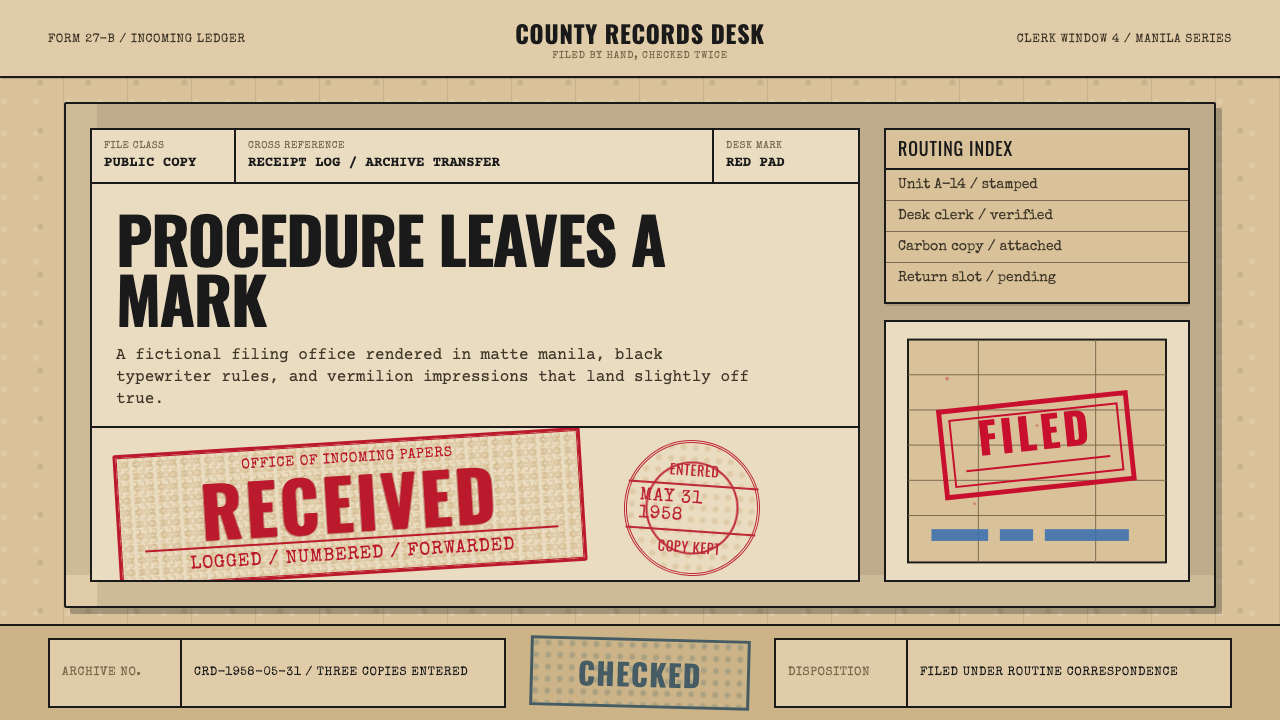 Office Rubber StampsProcedure made visible. Vermilion Oswald stamps strike a manila logbook grid.
 New York Yellow Cab (1907)Visibility is the brand. Taxi yellow, stencil type, checker stripes.
 Aeronautical ChartReads like cockpit data. Magenta-blue airspace rings cut through dense dark-c…
 Air Traffic Control RadarOperational gravity. Phosphor green rings, sweep wedges, and monospace blips…
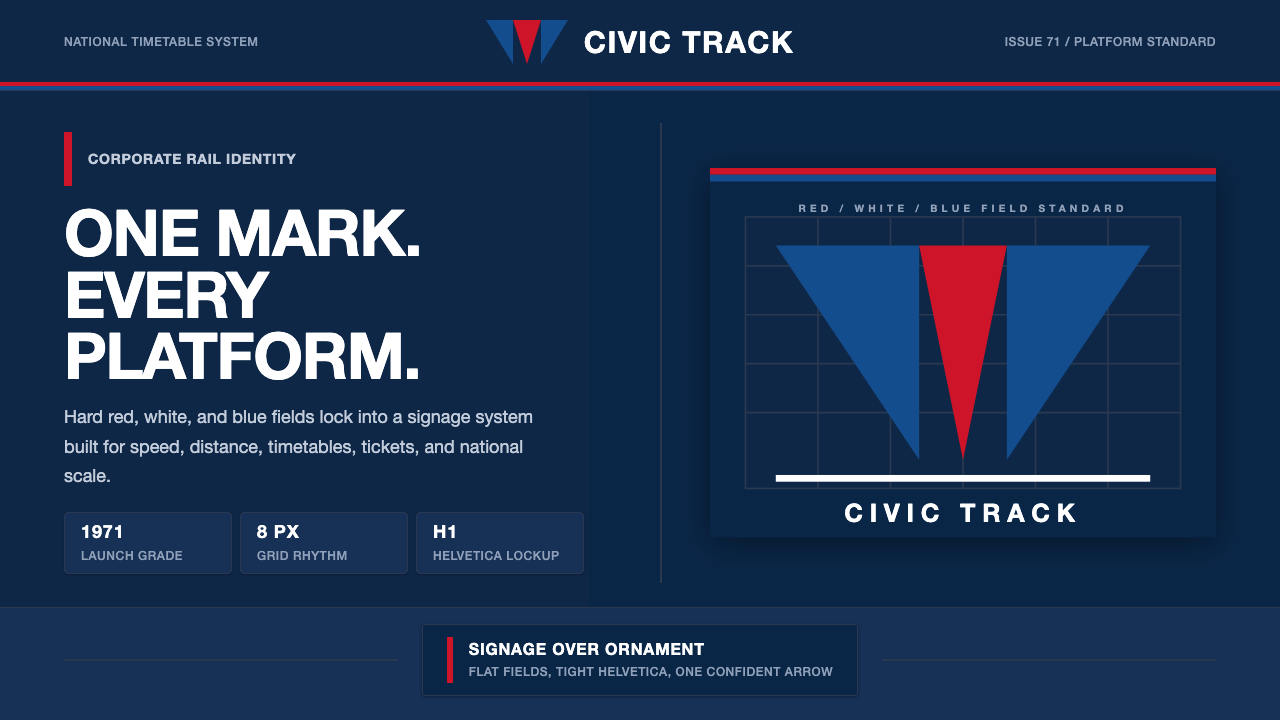 Amtrak Arrow (1971)Civic authority at speed. Deep navy, Helvetica lockups, and red-blue arrows.
 Apollo Flight PlanEvery second has a line. NASA blue rules and monospaced GET stamps discipline…