What is Air Traffic Control Radar?
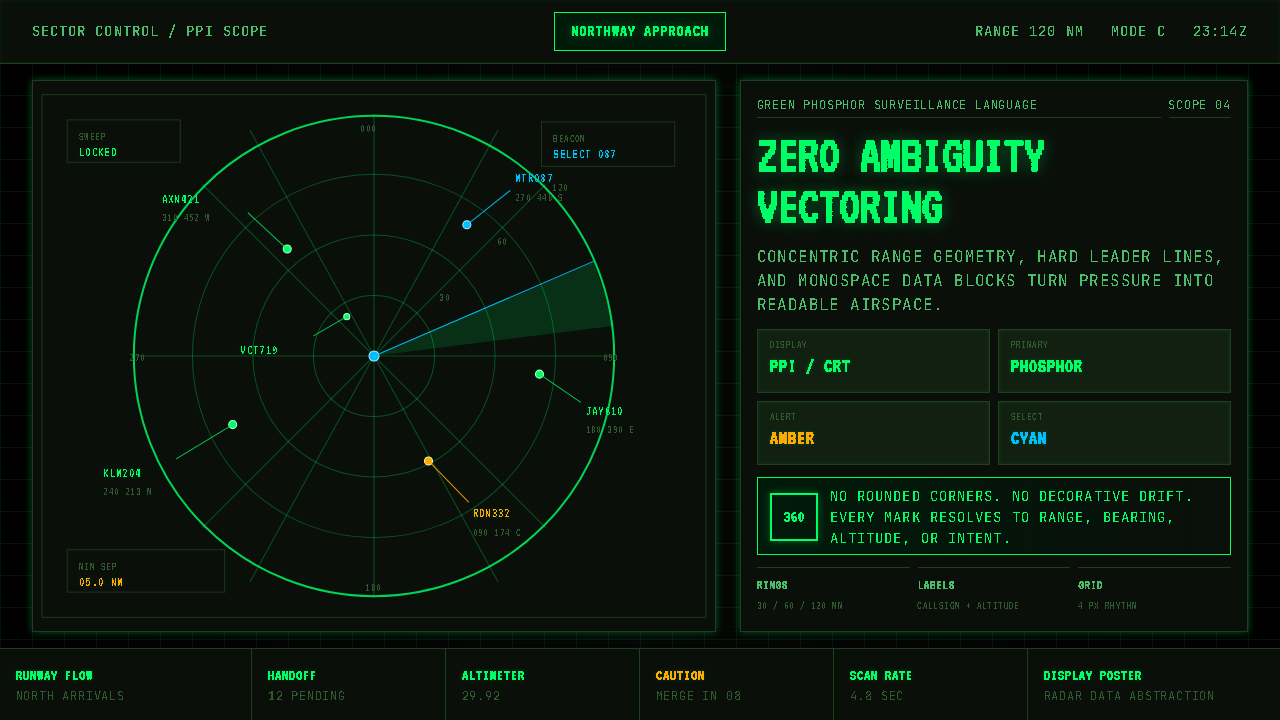
Air Traffic Control Radar turns life-or-death legibility into an aesthetic — phosphor-green blips, sweeping range rings, and monospace callsign tags that have guided aircraft since the 1950s.
Air Traffic Control Radar in brief
Air Traffic Control Radar is a design system distilled from the visual language of Plan Position Indicator displays — the radial-sweep screens found in FAA control towers, military air-defense operations centers, and naval command facilities. Its defining elements are the sweeping beam that clears the screen in a slow, clockwise arc; the concentric range rings marking measured distances from the antenna; and the small, bright target blips that represent individual aircraft. The palette is almost entirely phosphor green on near-black, a chromatic identity burned into cathode-ray tube screens across decades of operational use.
The system is built around a single, non-negotiable requirement: zero-ambiguity legibility under conditions of extreme pressure. A controller tracking dozens of aircraft simultaneously cannot afford visual noise. Every element in the display — blip position, data block, leader line, range ring, velocity vector — carries precise operational meaning. Nothing is present for decoration. The aesthetic consequence of this demand is a kind of militant functionalism that happens to be visually arresting: crisp, glowing geometry suspended in darkness.
In contemporary design, the Air Traffic Control Radar style translates this operational vocabulary into presentations, dashboards, editorial work, and interfaces where authority, precision, and high-stakes clarity are the desired emotional register. It is not a style of warmth or invitation — it is a style of command.

Where does Air Traffic Control Radar come from?
The visual language of radar displays was born from necessity during the Second World War. British physicist Robert Watson-Watt led the Chain Home radar network development in the late 1930s, and the operational requirement to track multiple moving targets against a dark background — without the luxury of color, texture, or illustration — established the fundamental grammar: bright returns on dark fields, range marked by concentric geometry. The Plan Position Indicator format, which sweeps a radial beam and paints a persistent phosphor trace at each detected return, was standardized across Allied air-defense systems by the mid-1940s.
After the war, radar technology moved from military air defense into civil aviation. The United States Federal Aviation Administration and its predecessors began deploying ground-based approach and en-route radar through the 1950s and 1960s. The displays inherited their visual logic directly from wartime systems: green phosphor on black, monospace alphanumeric tags identifying aircraft callsigns and altitudes, and leader lines connecting the target blip to its associated data block. The design was never the result of aesthetic deliberation — it was the direct product of cathode-ray tube physics, air-traffic operational procedure, and the constraint of building reliable systems under Cold War urgency.
The introduction of ARTS (Automated Radar Terminal System) in the 1970s and later STARS (Standard Terminal Automation Replacement System) and ERAM (En Route Automation Modernization) in the 2000s and 2010s brought digital processing to air-traffic radar displays, but the visual conventions remained remarkably stable. Controllers trained on earlier systems needed to read new displays without relearning fundamental symbol vocabularies. The phosphor-green-on-black palette, the concentric range rings, and the monospace data block format survived each generational transition — not out of sentimentality, but because they worked, and any departure from them risked operational error.
The parallel development of military systems by Lockheed Martin, Raytheon, and other defense contractors reinforced these conventions globally. FAA STARS consoles, NATO air-defense displays, and naval combat information centers all converged on a shared visual grammar because interoperability across allied systems demanded legibility at a glance. Luis Walter Alvarez's contributions to airborne radar and ground-controlled approach systems in the 1940s helped establish the technical foundations that later display designers inherited. By the time the aesthetic entered popular culture — through films, television, and eventually video games — its meaning was already fixed: this is how serious systems look when lives depend on readability.
What defines the Air Traffic Control Radar look?
Phosphor Palette
The foundational color relationship is bright green against deep black — a chromatic pair derived directly from the emission spectrum of P31 and P43 phosphor compounds used in cathode-ray tube displays. The green carries an inner luminosity, as though it is self-generated rather than reflected light. Secondary information may appear in softer amber or pale cyan tones, but the dominant contrast is always the hard green-on-black. No warm tones, no neutral grays: the palette communicates that every element present is operationally active.
Concentric Ring Geometry
Range rings — evenly spaced circles radiating from a central point — provide the structural skeleton of every radar composition. In authentic displays these rings represent measured distances from the antenna, spacing adjusted to the controller's selected range scale. As a design motif they create an immediate sense of radial depth and measured space, pulling the viewer's eye toward the center. Their weight is deliberately thin relative to the field they span: they are reference lines, not dominant forms, and the best applications keep them visually subordinate to the live data they frame.
Sweep Wedge and Scan Trail
The rotating sweep beam and its decaying afterglow — a wedge of fading luminosity trailing the active scan line — are the most kinetically charged elements in the visual system. In static design work, the sweep is rendered as a frozen arc or a gradient wedge emanating from center, suggesting clockwise rotation. The afterglow effect, which in real displays represents phosphor persistence, translates visually as a tonal graduation from bright at the leading edge to near-invisible at the trailing edge. This motif immediately signals the temporal dimension: this system is alive, scanning, continuously updated.
Monospace Data Blocks
Every tracked target is accompanied by a small rectangular data block — the callsign, altitude readout, and ground speed — set in monospace characters. Monospace is not a stylistic choice but an operational one: equal character width allows controllers to read and compare alphanumeric strings at speed without eye movement adjusting for proportional kerning. Leader lines connect each blip to its data block at a consistent angle. In design applications, this convention translates into a preference for monospace or near-monospace type for all numerical and code-adjacent content, creating visual alignment and a sense that every figure is measured rather than estimated.
Target Blip and Velocity Vector
Aircraft appear as small, bright points — blips — whose position updates with each antenna sweep. In more advanced systems, a short line extends from the blip in the direction of travel, the velocity vector, indicating projected position if current heading and speed are maintained. This is pure operational grammar: position now, heading next. As a design element the blip-and-vector pair is one of the most transferable motifs, suggesting a tracked object in motion through a measured field. It appears naturally in data visualization, mapping interfaces, and any context where entities move through monitored space.
Grid and Sector Lines
Underlying the circular radar field is a sparse orthogonal or radial grid defining airspace sectors, approach corridors, and prohibited zones. These lines are intentionally rendered at low luminosity — thin, barely-there strokes that provide spatial context without competing with live target data. The contrast between the dim structural grid and the bright operational layer is one of the system's most instructive lessons: hierarchy is enforced not by size alone but by luminosity. Background structure exists to orient; foreground data exists to act on.
Functional Severity
The overall character of the style is unapologetically severe. There are no decorative elements, no gradients used for visual richness, no illustrative flourishes. Even the circular forms — which in other aesthetic traditions carry associations of softness or community — read as instruments rather than symbols of inclusion. This severity is the style's honest communication of its origin: a system designed for professionals under pressure, where ambiguity costs lives. Applied to design work, this severity reads as authority. It is most powerful when the content genuinely warrants that register — least convincing when applied to inherently low-stakes contexts.

Who shaped Air Traffic Control Radar?
The Scottish physicist Robert Watson-Watt is widely credited with developing the first practical radar system for air defense, leading the team that built Chain Home — Britain's coastal radar network — in the late 1930s. Chain Home's operational displays established many of the conventions that persisted into civilian air traffic control: bright returns against dark grounds, signal persistence, and the use of multiple coordinated stations to triangulate position. Watson-Watt's insistence on operational reliability over optical elegance set a precedent that the entire lineage of radar display design followed: the display exists to serve the operator, and every design decision is subordinate to that purpose.
American physicist and Nobel laureate Luis Walter Alvarez developed Ground Controlled Approach radar during the Second World War — a system that allowed controllers to guide aircraft to landing in low-visibility conditions using real-time radar data. His work demonstrated that radar display design was not merely a technical problem but a human-factors problem: how information is presented on screen determines whether a controller can act on it accurately under pressure. Alvarez's contributions helped establish the operational conventions for approach radar that later influenced the design of FAA terminal approach systems and, by extension, the visual vocabulary of the Air Traffic Control Radar aesthetic.
The FAA Air Traffic Organization is the operational body responsible for the design and deployment of the United States national airspace system, including the STARS and ERAM display systems that represent the current generation of en-route and terminal radar displays. Through decades of iterative development — always constrained by the requirement that new displays be legible to controllers trained on older systems — the FAA ATO has maintained and refined the visual conventions of radar display design. Its human-factors research and display certification requirements have effectively codified the aesthetic into operational standards that have influenced radar display design globally.
As the prime contractor for STARS — the Standard Terminal Automation Replacement System deployed at major U.S. terminal radar approach control facilities from the 2000s onward — Lockheed Martin was directly responsible for translating decades of established radar display convention into modern digital systems. The challenge was considerable: replacing aging hardware without disrupting the operational visual language that controllers depended on. The resulting STARS displays preserved the essential aesthetic of phosphor-era radar — green-on-black, monospace data blocks, concentric range rings — while adding digital precision, scalable sector displays, and enhanced conflict-alert visualization. This preservation under technological transition is itself a demonstration of how deeply the visual system had become operationally necessary.
How do you use Air Traffic Control Radar today?
The Air Traffic Control Radar style is one of the most precise aesthetic signals available to a designer: it communicates authority, operational precision, and high-stakes seriousness before a single word is read. Applied correctly, it elevates content that genuinely demands that register — data-heavy dashboards, security operations centers, command-and-control interfaces, and presentations where the subject matter is complex systems, infrastructure, or mission-critical operations. Applied incorrectly — to a consumer food brand, a wellness app, or a children's platform — it reads as tonal mismatch, sometimes even as menace.
For presentation slides, the style works at its most powerful on a cover that takes the full-bleed dark field seriously. A cover composition should center or off-center the radar circle motif, allow concentric rings to extend to or past the frame edge, and place the title in a monospace or near-monospace typeface — aligned to the scan geometry rather than floating independently. Subtitle or event information can be treated as a data block: a tight cluster of lines, each a different level of the type hierarchy, set flush to a common left edge. Interior content slides benefit from treating each information panel as a radar sector: bounded, legible, with a clear internal hierarchy between the bright active data and the dimmer structural context. Data visualizations — bar charts, network graphs, timelines — should adopt the glowing-point-on-dark-field aesthetic rather than conventional chart styling.
For web dashboards and operational interfaces, the style is exceptionally well-suited to real-time monitoring contexts: server status, network traffic, fleet tracking, financial market feeds, or security event streams. The approach is to treat the full viewport as a radar field — dark background, luminous active data elements, structural elements kept dim — and to use the sweep-wedge motif sparingly as a loading or refresh indicator rather than a decorative flourish. Pricing pages using this style should employ high contrast between tier cards, with the recommended or active tier rendered in the accent green against the dark field, and all typography set in a consistent monospace or technical sans-serif.
For editorial and marketing work, the style supports a strong, unmistakable visual identity that does not require explanation. A feature article using this aesthetic might open with a full-spread dark illustration built from radar geometry — concentric circles, scan arcs, blip clusters — before transitioning to a lighter ground for body text. Marketing materials benefit from the style's poster-like directness: a single, large radar circle dominates the composition, callout type is set in high-contrast monospace, and supporting information is arranged in tight data-block clusters. The key discipline in editorial and marketing applications is restraint: the radar motifs should frame and elevate the content, not compete with it.
A common and damaging mistake when applying this style is treating the phosphor green as the only color and applying it at full saturation everywhere. In authentic radar displays, the green varies substantially across the field — brighter at active targets, dimmer at structural elements, nearly invisible at range ring subdivisions. A flat, uniform application of the accent color collapses this hierarchy and produces a display that reads as decorative rather than operational. A second common error is using the radar circle as a logo-like graphic and surrounding it with otherwise conventional design — the result is a costume rather than a system. The style works when the entire visual environment commits to the operational logic: dark fields, luminous hierarchy, monospace precision, geometric discipline.

Air Traffic Control Radar — FAQ
Is this style only suited to dark-mode interfaces?
In authentic radar displays, the dark-on-dark-field relationship is not arbitrary — it is the direct product of cathode-ray tube physics, where phosphor emission against a non-emissive black screen produces maximum luminance contrast. The style's entire hierarchy depends on luminosity differences: bright means active, dim means structural, very dim means background. On a light ground, this hierarchy collapses — glowing green reads as an accent color rather than as emitted light, and the operational gravity of the aesthetic is significantly diminished. Light-ground adaptations are possible, but they are closer to an industrial or technical aesthetic than to radar proper. If your context absolutely requires a light background, consider whether a different style — aviation instruments, engineering schematics — better serves the need.
How do I use this style without making everything look like a game or science-fiction prop?
The boundary between operational and cinematic radar is discipline in detail. Real radar displays are extremely restrained: minimal color variation, no lens flares, no animated scan lines beyond the actual sweep, no decorative circuit-board patterns, no glitch effects. The danger zone is reached when designers add visual effects that signal 'this is theatrical radar' rather than 'this is actual instrumentation.' Stick to the core elements — range rings, data blocks, monospace typography, the sweep arc — and apply them with operational restraint. The moment a design choice serves aesthetics rather than legibility, it tips from instrument to prop. In practice: fewer glow effects, not more; tighter spacing in data blocks; and geometric precision in every ring and line.
Can the Air Traffic Control Radar style work for consumer-facing products?
Rarely, and only when the consumer context is itself high-stakes or premium. Flight-tracking applications, marine navigation tools, amateur radio interfaces, or any consumer product where the user is operating in a professional-adjacent mode can carry the style convincingly. Luxury or collector markets — high-end watches, precision instruments, premium audio — can also absorb the aesthetic because their audiences already associate precision instrumentation with quality. Where it fails is any context where the primary emotional register is warmth, playfulness, accessibility, or community. A social platform, a recipe app, a children's education tool — the severity of the radar aesthetic actively works against the user experience these contexts require. The style is not adaptable to friendliness; it is better to choose a different aesthetic entirely than to soften radar conventions to the point where they lose their meaning.
What makes this style different from generic dark-mode or cyberpunk design?
The difference is specificity of reference and discipline of execution. Generic dark-mode design uses dark backgrounds as an interface preference, with blue or purple accent colors, soft glows, and rounded UI components. Cyberpunk design layers in neon color combinations, distressed textures, glitch effects, and Japanese typographic elements — it is explicitly theatrical. Air Traffic Control Radar is neither: it is built from a single documented operational system, its color is operationally specific rather than decoratively varied, and its geometric vocabulary — concentric rings, radial lines, leader-lines to data blocks — derives from a real functional grammar. The test is whether a working air traffic controller would recognize the visual conventions as operationally coherent. Generic dark-mode and cyberpunk both fail that test; authentic radar design passes it.
How should typography be handled in this style?
Typography in Air Traffic Control Radar should be treated as instrumentation rather than expression. Monospace or near-monospace typefaces are the correct starting point for all numerical, code, and data-adjacent content — callsigns, coordinates, timestamps, system labels. The rationale is the same as in actual radar displays: equal character width enables rapid scanning and comparison without the eye compensating for proportional spacing. For longer text — headlines, body paragraphs, descriptive labels — a geometric or technical sans-serif in a regular or medium weight reads correctly within the system. What to avoid: display typefaces with personality, serif types with historical associations, condensed or expanded faces that introduce tension into the geometric regularity. The type should feel measured, not chosen — as though each character has a specific position it was calculated to occupy.
Related design styles
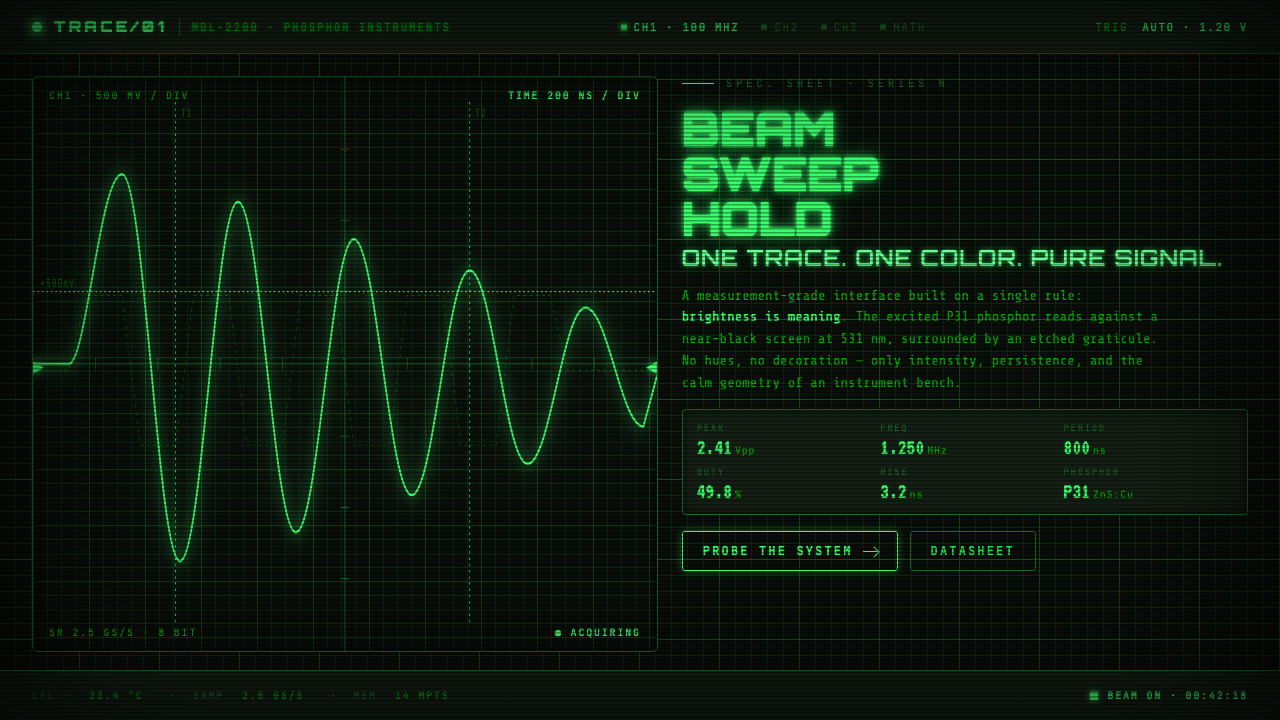 Oscilloscope WaveformBrightness is meaning. One P31 phosphor trace glowing across an etched gratic…
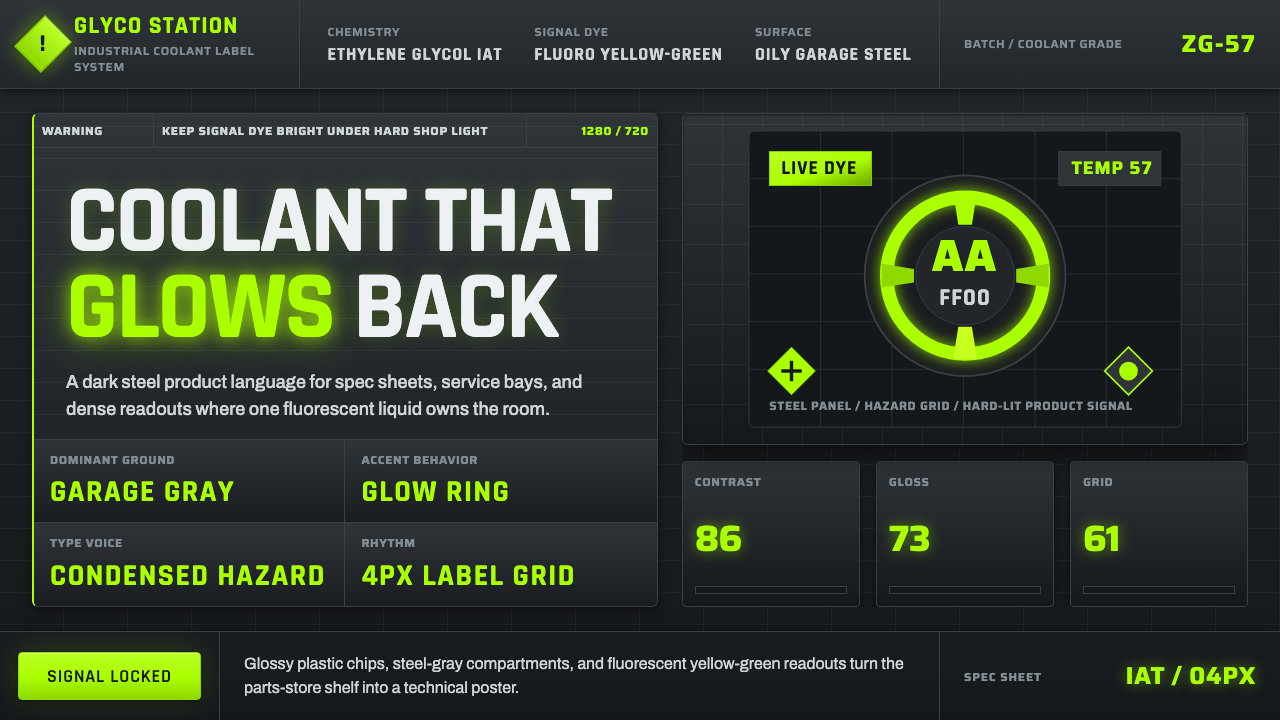 Fluorescent Antifreeze GreenCoolant becomes hazard signal. Fluoro green burns through steel-gray label gr…
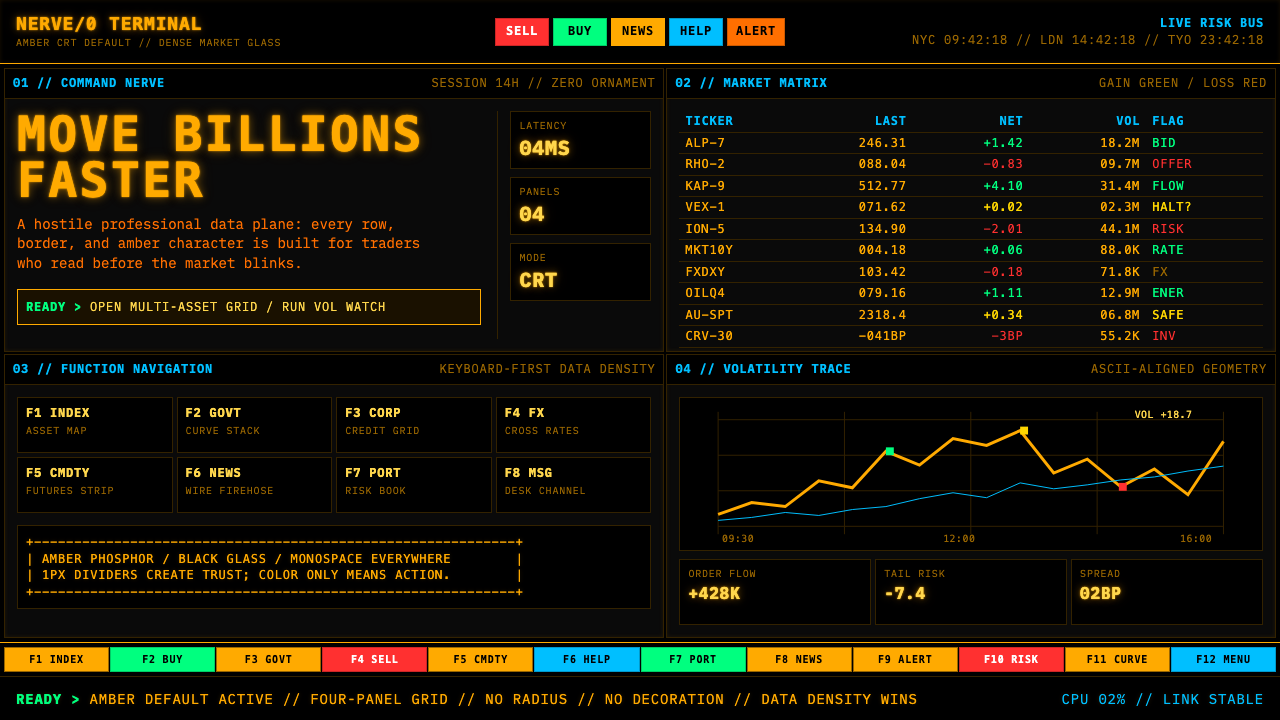 Bloomberg Terminal (Amber CRT)Hostile data authority. Amber mono grids and four hard panels make black glas…
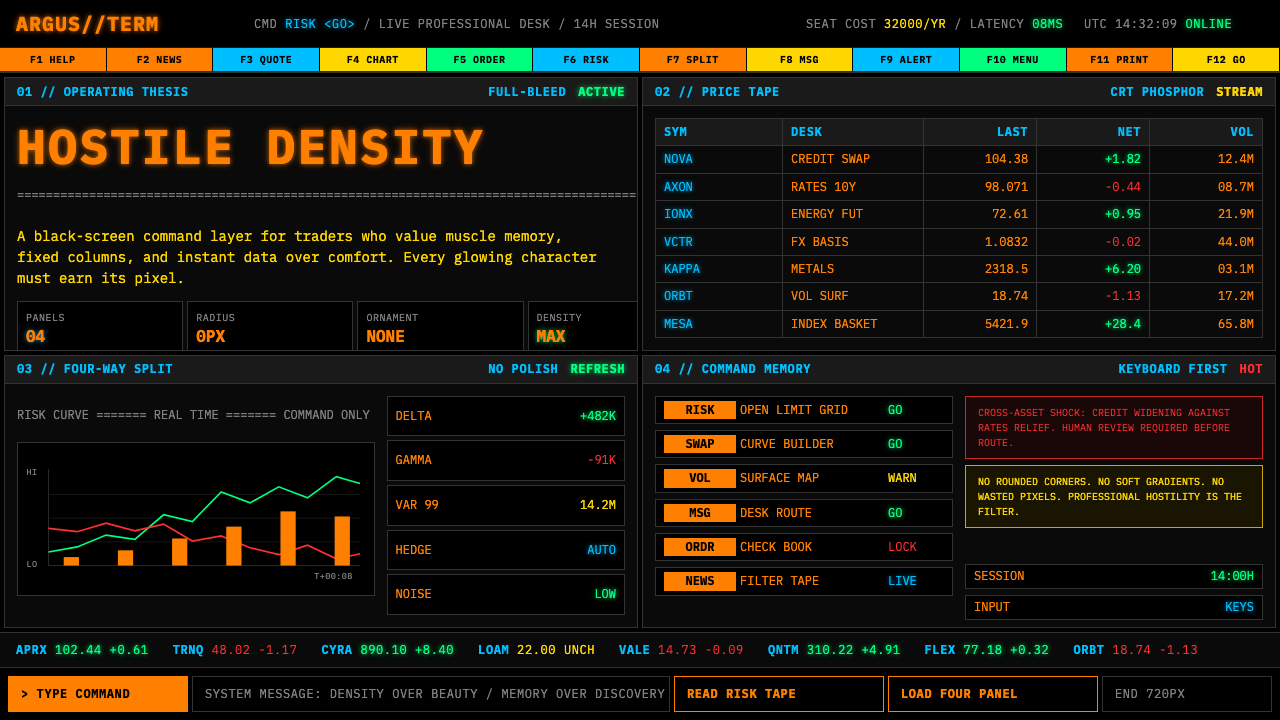 Bloomberg Terminal (CRT Green)Hostile density wins. Orange CRT mono, black grids, and four-panel data walls.
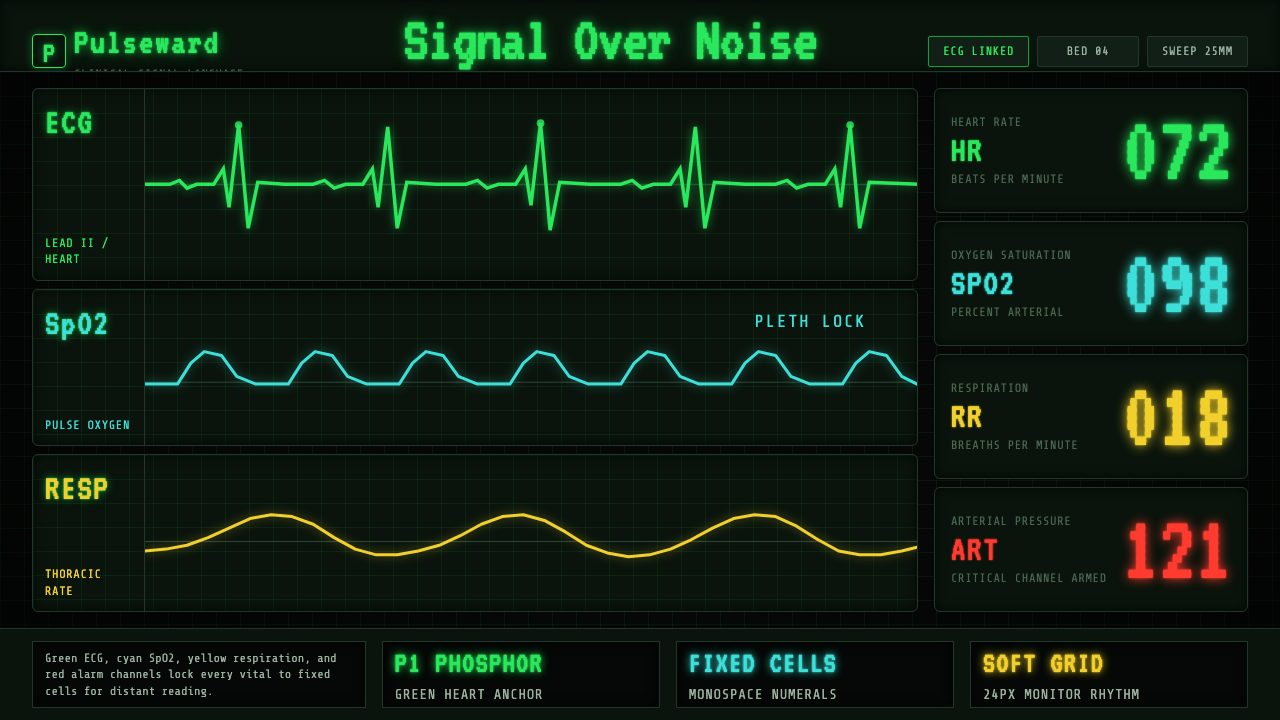 EKG Vital MonitorClinical clarity glows. Phosphor ECG green, cyan and yellow channels lock to…
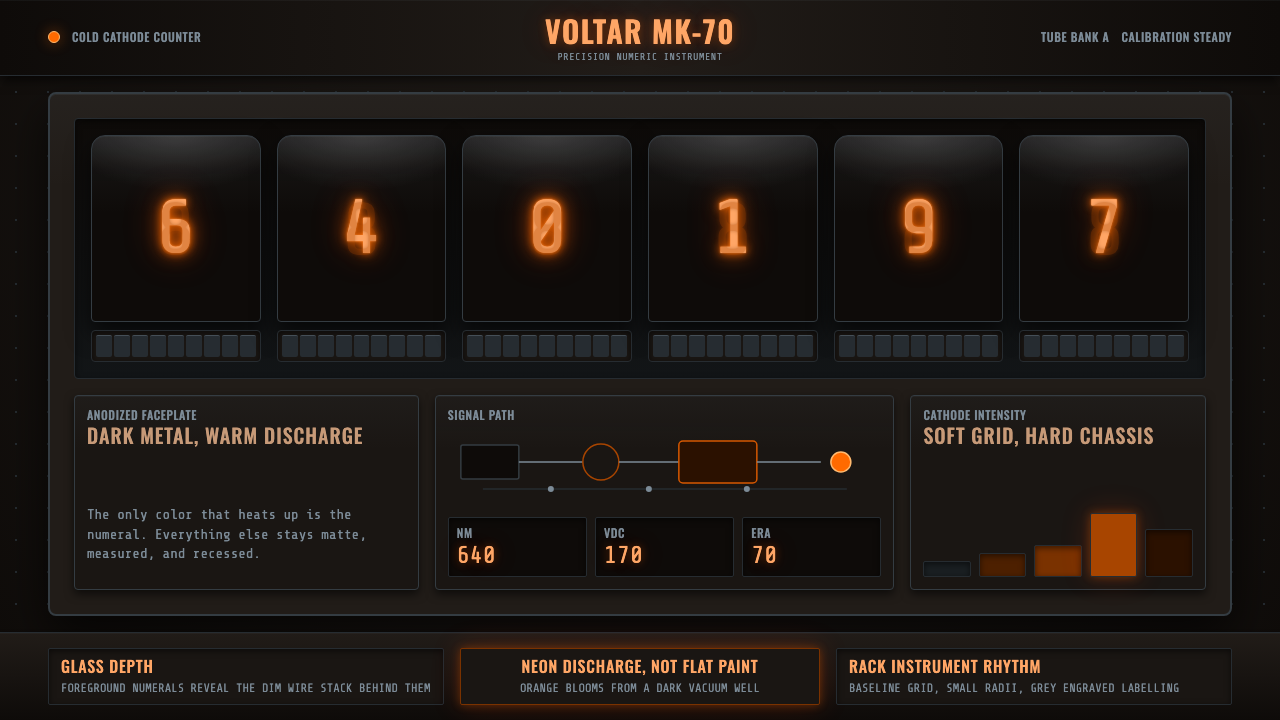 Nixie Tube DisplayHeat inside the machine. Neon-orange digits glow over black metal gridwork.