What is Bloomberg Terminal (Amber CRT)?
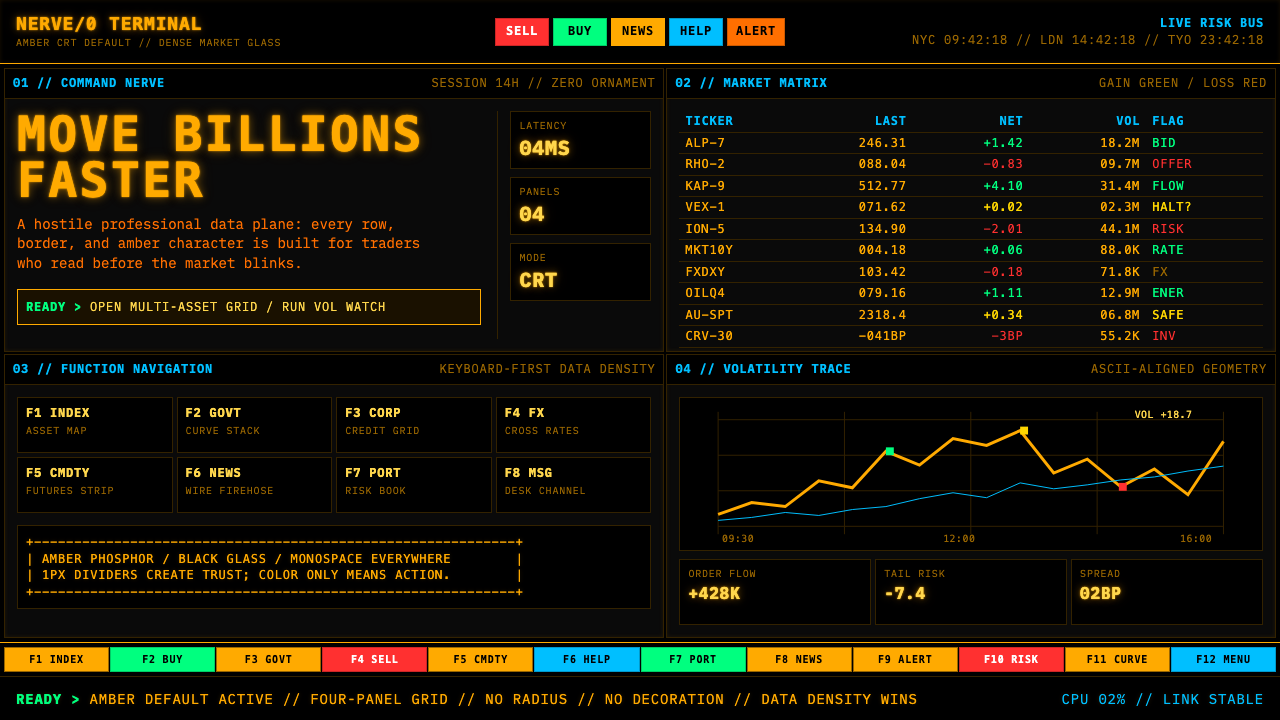
The Bloomberg Terminal's amber-on-black grid is the visual language of financial authority — a deliberately hostile interface that has run unchanged on hundreds of thousands of trading-floor screens since 1982.
Bloomberg Terminal (Amber CRT) in brief
Bloomberg Terminal (Amber CRT) is the design language of the world's most dominant financial data platform, characterized by warm amber or orange-tinted monospaced type set against a deep black ground, rigid four-panel grid layouts, and a total rejection of aesthetic softening. It belongs to the lineage of phosphor cathode-ray tube terminal displays — the same family as the DEC VT100 and IBM 3270 — and has remained the canonical reference for professional financial data visualization for over four decades.
The visual system operates on principles of deliberate density and functional severity. Every pixel of screen space is treated as scarce and valuable. Typographic hierarchy is communicated through color coding — a small set of high-saturation accent tones against the dominant amber and black — rather than through variation in weight or size. Function-key labels, hard rectangular panel borders, and tightly packed data tables define the aesthetic register: this is a tool for professionals who measure their decisions in milliseconds and billions.
The amber CRT aesthetic has since crossed over from operational necessity into cultural shorthand. In contemporary design, reinterpreting this visual language signals competence, data authority, and institutional seriousness. When applied deliberately — rather than naively copied — it communicates that the product it dresses is built for people who understand what the data actually means.

Where does Bloomberg Terminal (Amber CRT) come from?
In 1981, Michael Bloomberg was dismissed from Salomon Brothers after a merger eliminated his position. With his severance, he co-founded Innovative Market Systems — later renamed Bloomberg L.P. — alongside Tom Secunda, Duncan MacMillan, and Charles Zegar. The founding insight was that Wall Street's information advantage was structural: the traders and analysts who had faster, more complete access to financial data consistently outperformed those who did not. Bloomberg set out to build a terminal that would democratize that advantage among institutional subscribers.
The first Bloomberg terminals were delivered to Merrill Lynch in 1982. The hardware constraints of that era — monochrome phosphor displays, limited processing power, keyboard-driven input — shaped the aesthetic decisions that would define the system for decades. Amber phosphor was chosen as the display tone not for its warmth or visual appeal but because it offered superior legibility under the high-ambient-light conditions of trading floors during extended sessions. Green phosphor, the other common choice of the era, produced more eye strain over fourteen-hour shifts. The color was a fatigue-engineering decision.
The four-panel grid that defines the terminal's spatial logic emerged from practical workflow requirements rather than compositional theory. Traders needed to monitor price feeds, news alerts, analytics charts, and messaging simultaneously without switching between screens. Dividing a single monitor into four discrete, hard-bordered panels — each dedicated to a category of information — solved the problem within the hardware limitations of the time. The function-key navigation system, with its red, green, yellow, and orange color assignments, created a tactile and visual shorthand that experienced users could operate by muscle memory alone.
By the 1990s, Bloomberg's system had become so entrenched on trading floors globally that its visual language had acquired cultural weight independent of its technical function. The amber glow and cramped data grids were not just an interface — they were the visual signature of institutional finance itself. When Bloomberg eventually added more graphical capabilities and color options, the amber-on-black default remained the dominant mode, because traders who had built careers reading it resisted change, and because the density it enabled was genuinely superior for data-heavy professional use.
What defines the Bloomberg Terminal (Amber CRT) look?
Amber Phosphor Ground
The defining chromatic signature is warm amber or deep orange type rendered against a near-absolute black background. The amber tone occupies a narrow band of the warm spectrum — neither the yellow of caution signals nor the orange of consumer branding, but something more constrained and purposeful: the color of a phosphor tube pushed to its operational optimum for human visual acuity under sustained use. In contemporary adaptations, this chromatic relationship — warm, saturated foreground against a black field — is the first and most essential element to preserve.
Monospaced Type Grid
All text in the Bloomberg visual system is set in monospaced letterforms — each character occupies an identical horizontal unit of space. This is not an aesthetic choice but a functional one: monospaced type allows columns of numerical data to align perfectly without decimal-point juggling, ensures that formatted table structures render predictably, and enables keyboard-generated layouts to hold their shape across sessions and terminals. The visual effect is a fine, even texture across the entire screen — a tapestry of information where every character has equal standing, and hierarchy is imposed through color rather than spatial privilege.
Four-Panel Hard Grid
The canonical Bloomberg layout divides the screen into four discrete rectangular panels, each bounded by hard, high-contrast borders. These borders are not decorative frame elements — they are structural divisions that communicate absolute separation between information categories. The grid is non-negotiable in its rigidity: panels do not bleed into one another, content does not float outside its assigned region, and whitespace between panel walls is minimal. This spatial discipline creates a density of information that no other layout approach can match while still maintaining legibility, because the categorical boundaries do the cognitive work of organizing what the eye needs to track.
Functional Color Coding
Beyond the primary amber, the system employs a small set of high-saturation accent colors — red for losses or alerts, green for gains or active states, yellow and orange for secondary function keys and classifications. Each color carries a fixed semantic meaning that experienced users internalize as deeply as the keyboard shortcuts themselves. The color set is never used decoratively; introducing a tone that does not correspond to an established semantic category is a violation of the system's logic. In contemporary applications of this style, maintaining strict semantic discipline — green means one thing and one thing only — is what separates a credible adaptation from a pastiche.
Zero Ornament, Maximum Density
The Bloomberg interface contains no decorative elements whatsoever — no gradients, no rounded corners, no shadow effects, no illustrative imagery, no brand motifs beyond the minimal wordmark. Every available unit of screen space that is not occupied by data or structural borders is treated as wasted capacity. This is not minimalism in the contemporary design sense, which accepts generous whitespace as part of the aesthetic; it is the opposite — a maximalism of content with an absolute economy of presentation. The discipline required to reproduce this quality in a contemporary context is significant, because modern design tools and frameworks continuously tempt designers toward softening touches.
Keyboard-First Navigation Logic
The Bloomberg Terminal was designed around a dedicated hardware keyboard, not a mouse or touch interface. Function keys, hotkeys, and sequential command codes are the primary navigation method. In the visual system, this manifests as labels and affordances sized and positioned for keyboard-confidence users: small, dense, and precise, not large and invitation-giving. UI elements do not expand invitingly on hover or pulse to attract attention — they are static, awaiting command. In contemporary adaptations, preserving this keyboard-first grammar means treating interactive affordances as discovered, not advertised, and sizing touch targets for precision rather than forgiveness.
Institutional Legibility Over Aesthetics
Every decision in the Bloomberg visual system prioritizes legibility under operational conditions over aesthetic appeal at a distance. Character spacing is calibrated for dense numerical tables rather than comfortable reading prose. Contrast ratios are set at the extreme end of the scale. Color relationships are not balanced for visual harmony but for the fastest possible discrimination between states — up versus down, live versus stale, alert versus nominal. The result is a visual system that appears hostile to the untrained eye but becomes deeply efficient when internalized. This principle — that the system should optimize for its user's performance, not for a casual observer's approval — is the deepest design value the style embeds.

Who shaped Bloomberg Terminal (Amber CRT)?
Bloomberg founded Innovative Market Systems in 1981 after being dismissed from Salomon Brothers, and his conviction that real-time financial data access was the defining competitive advantage of institutional finance shaped every product decision the company made. He personally championed the terminal's density and speed above all visual polish, establishing the principle that the Bloomberg interface existed to serve professional performance, not to impress casual observers. After stepping down from the company to serve as Mayor of New York City from 2002 to 2013, he returned to Bloomberg L.P. and has continued to oversee a product whose core visual language has remained recognizable for over forty years.
Secunda was Bloomberg's technical co-founder and the primary architect of the terminal's underlying data and software systems. His engineering decisions in the early 1980s — particularly the commitment to a keyboard-driven, character-cell interface over graphical alternatives — locked in the visual language of the platform for decades. Secunda understood that the professional users of the terminal valued speed and data density above all other considerations, and the interface architecture he established reflected that priority absolutely. His technical choices are as responsible for the amber CRT aesthetic as any visual design decision.
MacMillan was a co-founder and early product architect who helped define the informational structure of the Bloomberg Terminal — what data would live in which panel, how news and analytics would relate to price feeds, and how the function-key navigation would be organized. The four-panel grid architecture that became the Bloomberg layout standard bears his influence. MacMillan's contributions are rarely discussed in design contexts, but the spatial logic that makes the Bloomberg Terminal legible under pressure is as much a product design achievement as a software or financial data achievement.
Zegar was the fourth co-founder and contributed significantly to the analytical and computational underpinnings of the platform. His work on the data processing systems that made real-time analytics possible at the scale Bloomberg operated determined the interface requirements the visual system had to accommodate. Because the data volumes were dense and the update frequencies high, the visual language had to be engineered for rapid scanning rather than comfortable reading — a constraint that directly generated the amber CRT aesthetic's characteristic hostility to whitespace and visual softening.
Unlike most canonical design systems, the Bloomberg Terminal's visual language has no single credited designer. Its aesthetic emerged from the collective decisions of engineers solving operational problems under hardware constraints. The amber phosphor choice, the character-cell grid, the function-key color coding — none of these were the product of a design process in the contemporary sense. This anonymous, need-driven origin is itself significant: the Bloomberg aesthetic is what design looks like when it is generated entirely by performance requirements, with no space given to the question of how it looks to an outside observer.
How do you use Bloomberg Terminal (Amber CRT) today?
The Bloomberg Terminal aesthetic is among the most powerful and specific visual registers available to contemporary designers — but also among the most easily misapplied. Its authority derives from the fact that it is not a designed style in the conventional sense: it was generated by operational requirements. When you apply it correctly, the design recedes and the data advances; when you apply it incorrectly, the terminal aesthetic reads as costume, and the disconnect between the theatrical severity of the interface and the lightness of the underlying content is immediately legible to anyone who has spent time on an actual trading floor.
For presentation slides, the Bloomberg aesthetic works with exceptional force on data-heavy content. Cover slides should commit to the fundamental chromatic relationship — warm amber or near-orange type on a black ground — with no softening touches. A title rendered in large, weight-consistent monospaced type against a full black field communicates institutional authority before a single word is read. Content slides should treat the slide area as a terminal panel: dense, bordered sections for different information categories, color used strictly for semantic differentiation rather than visual interest. Data slides — charts, tables, comparisons — become the natural home of this aesthetic; bar charts with amber columns on black grounds, status indicators in functional red and green, data tables with minimal spacing and maximum row density all feel native to the visual language.
For web interfaces and dashboards, the Bloomberg style is particularly well-suited to financial data platforms, analytics tools, trading interfaces, and any product where data density and rapid scanning are the primary user needs. The approach requires committing to a dark ground as the base state, using the amber primary for default data display, and reserving the small functional color set — red, green, and a secondary warm accent — strictly for semantic states. Panel borders should be visible and hard rather than subtle or gradient. Navigation elements should be text-based and compact, not large and icon-dominant. Pricing pages and comparison tables in this style carry a natural weight: the austerity of the visual language signals that the product is priced for serious consideration, not impulse subscription.
For editorial and marketing contexts, the Bloomberg aesthetic requires a lighter hand. A feature story with a Bloomberg-inflected layout might use the amber-on-black palette for section headers and data callouts while softening the body text environment to avoid fatiguing readers. Marketing pages can deploy the style as a hero moment — a full-width dark panel with amber headline type — before transitioning to a more accessible typographic environment for conversion-focused content. Brand campaigns for financial institutions, professional services, and enterprise software regularly borrow from this visual register to signal institutional credibility, using amber and black as accent palette against a lighter base, or reserving the full dark-terminal aesthetic for moments of data drama.
A common and critical mistake is using the Bloomberg aesthetic decoratively — applying the amber color scheme and terminal-style borders to content that has none of the density or operational rigor that justifies them. A single data point in a large amber number on a black card does not reproduce the Bloomberg authority; it reproduces the shell of it. The aesthetic earns its weight from density, and low-density applications read as affectation. Similarly, introducing rounded corners, soft shadows, gentle gradients, or excess whitespace into a Bloomberg-styled layout dissolves the visual grammar that makes it legible as a distinct system. Every softening touch is an argument that the content does not deserve the interface's severity — and if the content genuinely does not, a different visual register is a more honest choice.

Bloomberg Terminal (Amber CRT) — FAQ
Is the Bloomberg Terminal aesthetic actually usable outside of financial contexts?
Yes, but with meaningful constraints. The style's authority comes from its association with data density, professional rigor, and institutional finance — cultural associations that transfer most naturally to products in data analytics, enterprise software, cybersecurity, scientific instrumentation, and any domain where the intended user is a specialist dealing with complex, high-stakes information. It transfers poorly to consumer contexts where warmth, approachability, or sensory pleasure are primary values. A wellness app, a food delivery service, or a children's educational product would not benefit from the Bloomberg register — the severity of the aesthetic would work against the emotional relationship the product needs to establish. The question to ask is whether the product's core value proposition — precision, authority, data mastery — is consonant with what the aesthetic communicates.
How do you adapt the Bloomberg aesthetic for light-background layouts?
The canonical Bloomberg system is dark-ground — amber on black — and light inversions require careful reconstruction rather than simple color reversal. Swapping the palette to dark type on a cream or light gray ground retains the monospaced type grid and high-density layout logic while sacrificing the phosphor glow that is the most distinctive signature of the dark version. In a light adaptation, the defining elements become the monospaced letterforms, the hard panel borders, and the strict semantic color coding — green for positive states, red for alerts, a warm amber or orange used as an accent for highlights and active selections. The result reads as a professional financial data environment without the theatrical darkness of the original; appropriate for contexts where dark mode is not the expected default, such as print materials, light-background web applications, or enterprise dashboards that need to coexist with brighter interface environments.
What distinguishes an authentic Bloomberg Terminal adaptation from a superficial one?
The most reliable distinguishing factor is information density. Authentic adaptations are dense — every element present is justified by data it contains or structure it communicates. Superficial adaptations apply the amber-on-black color scheme and monospaced type to layouts that retain the generous spacing, large whitespace margins, and decorative touches of conventional consumer design. The authentic version is immediately readable to someone who has used the real terminal; it feels operational rather than theatrical. Secondary markers include: whether color is used strictly semantically or also decoratively; whether borders are hard-edged and unforgiving or subtly rounded and softened; whether interactive elements are small and precise or large and inviting; and whether the type density across the screen produces a unified texture or leaves large voids.
Why does the Bloomberg aesthetic feel authoritative rather than just old?
Because the visual language was never driven by fashion — it was driven by function. Most retro aesthetics age in two steps: first they feel dated, then, after enough time passes, they feel nostalgic and intentionally vintage. Bloomberg Terminal aesthetics skipped the dated phase almost entirely because the original system never went away. It is still running, still used by professionals who treat it as the operational standard, and still evolving around its core visual logic. When contemporary designers reinterpret it, they are not reaching backward to a defunct aesthetic; they are referencing an active, living system. The authority the aesthetic carries is not borrowed from nostalgia but from the continued fact of the terminal's dominance in a domain where performance is measured in money and milliseconds.
Can the Bloomberg Terminal style work for consumer-facing products, or is it strictly B2B?
The style is not categorically limited to B2B, but consumer applications require a more selective extraction. Several successful consumer products have borrowed elements of the terminal aesthetic — crypto trading apps, stock-monitoring tools, personal finance dashboards, and some gaming interfaces (particularly in the simulation and strategy genres) have used amber-on-dark palettes, monospaced data displays, and hard-bordered panel structures to signal competence and data authority to users who want to feel like professionals. The key is extracting the semantic color system, the type density, and the hard borders without importing the operational hostility that makes the full Bloomberg terminal experience intimidating to non-specialists. A consumer product can borrow the grammar while adjusting the register — slightly more whitespace, slightly softer borders, the same functional color logic — and still read as belonging to the same visual family.
Related design styles
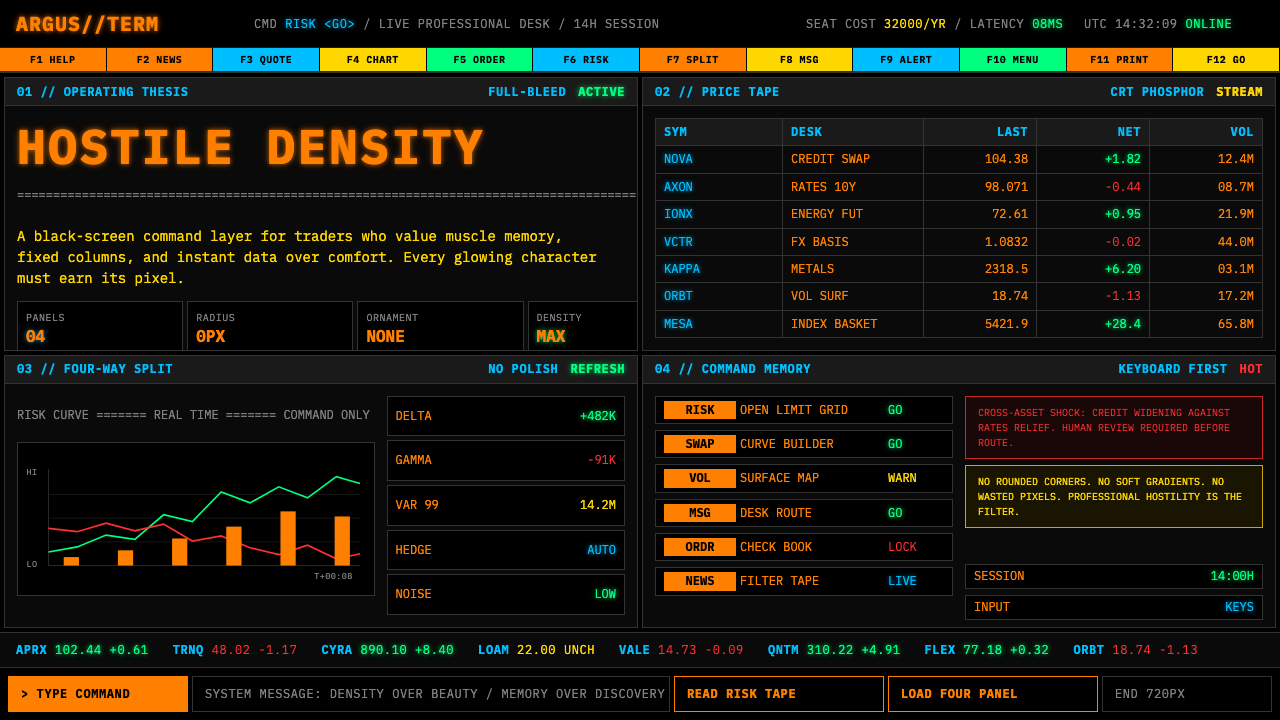 Bloomberg Terminal (CRT Green)Hostile density wins. Orange CRT mono, black grids, and four-panel data walls.
 Air Traffic Control RadarOperational gravity. Phosphor green rings, sweep wedges, and monospace blips…
 EKG Vital MonitorClinical clarity glows. Phosphor ECG green, cyan and yellow channels lock to…
 Oscilloscope WaveformBrightness is meaning. One P31 phosphor trace glowing across an etched gratic…
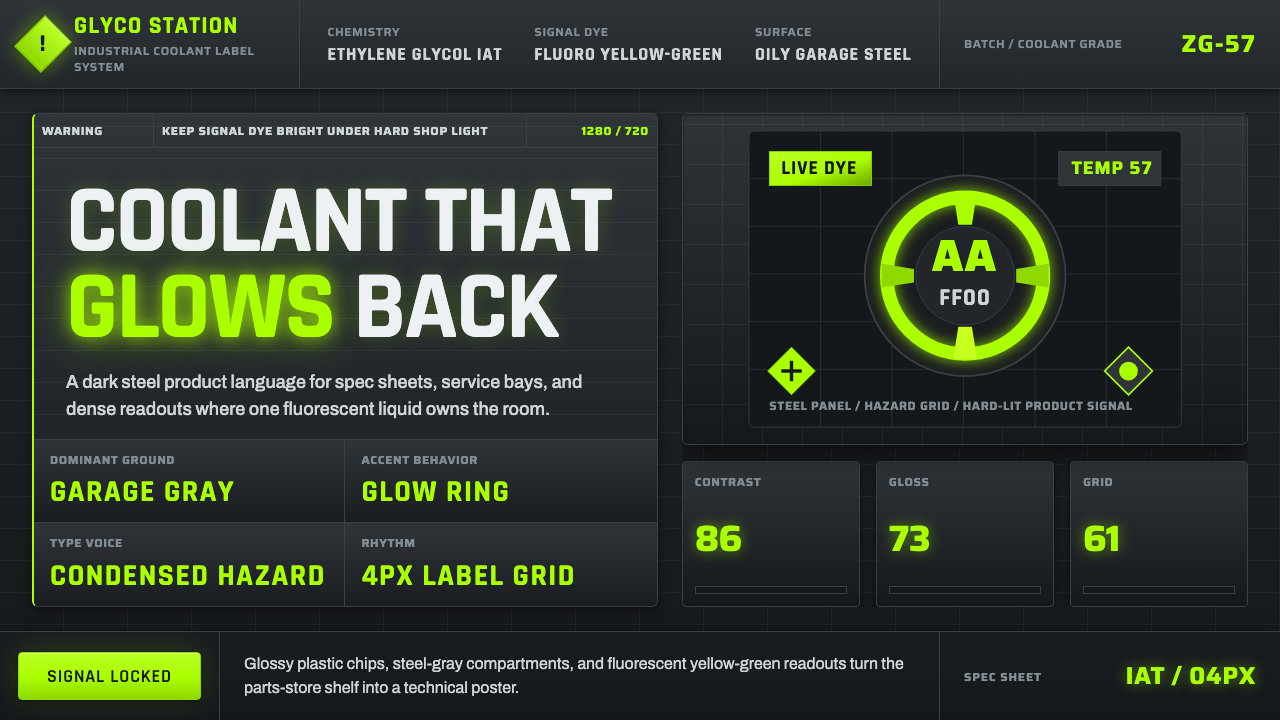 Fluorescent Antifreeze GreenCoolant becomes hazard signal. Fluoro green burns through steel-gray label gr…
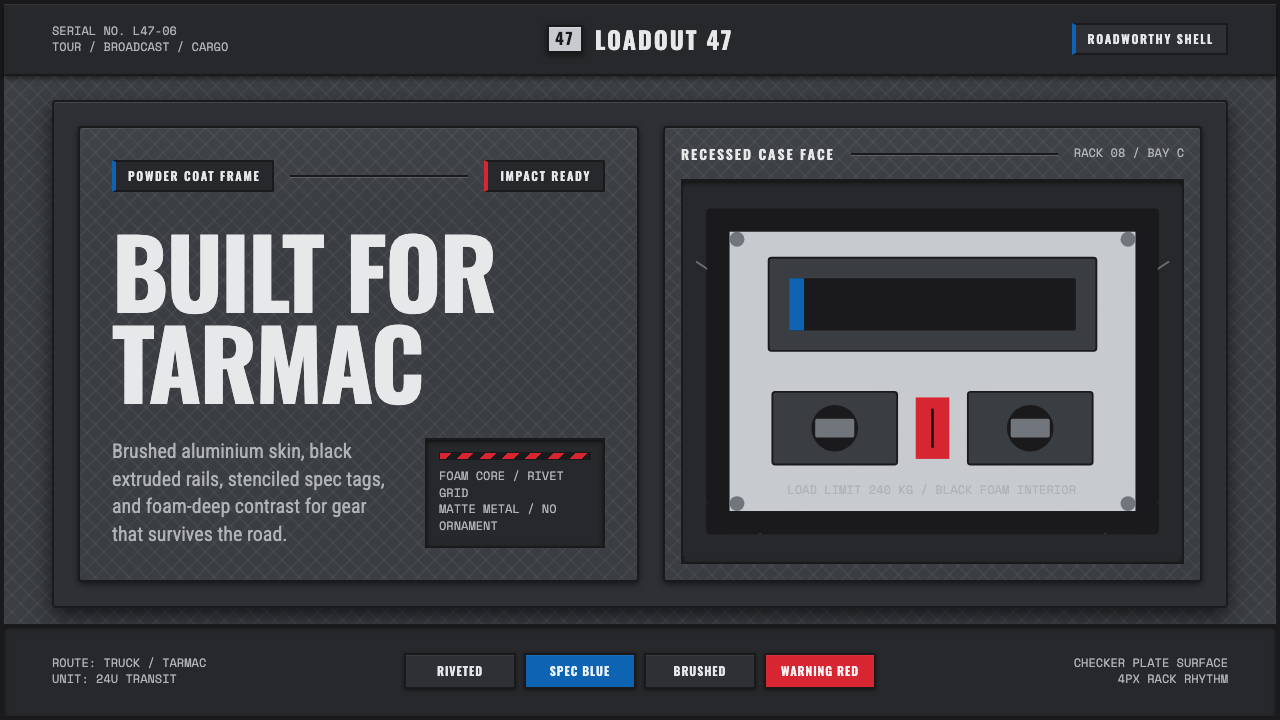 Aluminium Flight CaseRoadproof and exact. Diamond-plate gray, stencil type, black frames, blue-red…