What is Metropolis (Fritz Lang, 1927)?
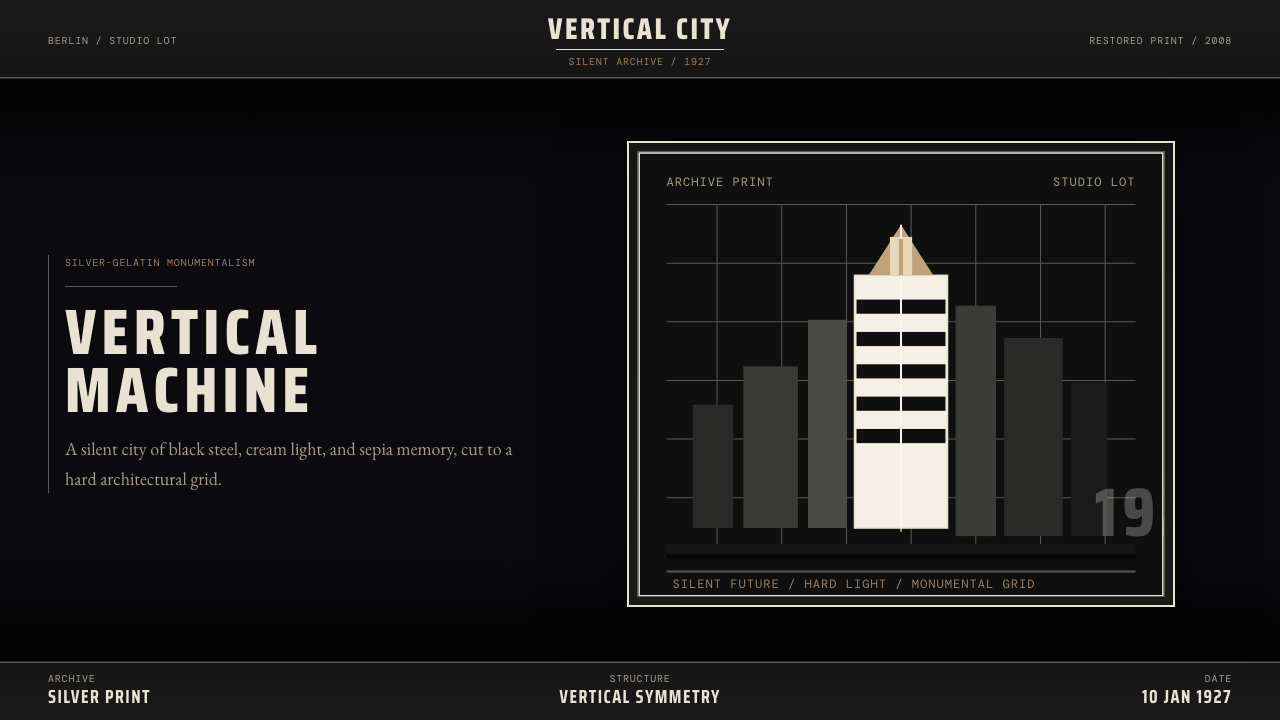
Fritz Lang's Metropolis gave cinema its first visual grammar of the machine city — monumental shadow, vertical megastructure, and the silver-gelatin warmth of nitrate film compressed into a design vocabulary that still defines cinematic dystopia.
Metropolis (Fritz Lang, 1927) in brief
Metropolis is a design language rooted in the visual world of Fritz Lang's 1927 silent film — the same name — produced at UFA Babelsberg Studios in Berlin during the final years of the Weimar Republic. Its palette is the tonal world of the silver-nitrate print: absolute black grounds, warm cream and bone highlights, and sepia-tinted mid-tones that evoke the aged warmth of archival photographic paper. Nothing about this aesthetic is accidental; every visual choice recalls the specific material reality of early cinema and its monumental, shadow-saturated imagery.
The core compositional logic derives from Erich Kettelhut's colossal set designs and Karl Freund's cinematography: towering vertical forms dominate the frame, architectural symmetry gives way to expressionist diagonal shadow-play, and human figures appear dwarfed against machine-scale structures. Typography follows the compressed, high-contrast tradition of Weimar-era film posters — tall, narrow letterforms that echo the soaring verticals of the fictional city's towers. The overall effect is one of controlled grandeur: severe, monumental, and unmistakably of its historical moment.
What distinguishes Metropolis as a design system from mere film-inspired pastiche is its structural coherence. The color restraint, the compositional hierarchy built on vertical thrust, the hard geometric borders functioning as architectural drafting lines — these are not decorative choices but a system with internal logic. Applied thoughtfully, the vocabulary communicates weight, authority, and a particular kind of dark optimism: the conviction, shared by Lang's film, that the future is large, demanding, and worth facing.

Where does Metropolis (Fritz Lang, 1927) come from?
Fritz Lang began developing Metropolis in 1924 after a visit to New York City, where the illuminated Manhattan skyline — viewed from an ocean liner at night — struck him as a vision of a city of the future. Production commenced in earnest in 1925 at the UFA Babelsberg Studios near Berlin, then the largest and most technically sophisticated film studio complex in the world. The screenplay was written by Lang's wife Thea von Harbou, based on her own novel, and the film premiered on January 10, 1927, at the Ufa-Palast am Zoo in Berlin — running at a length that would be drastically cut by American distributors within months.
The visual language of the film was shaped principally by production designer Erich Kettelhut, whose architectural drawings for the upper and lower city of Metropolis drew simultaneously on German Expressionism and emerging Art Deco monumentalism. Kettelhut's designs feature soaring vertical towers, elevated highways threading between skyscrapers, and the dark subterranean world of the workers — a visual opposition between light and shadow, above and below, that became the film's defining formal tension. Sculptor Walter Schulze-Mittendorff created the iconic robot figure, Maria's mechanical double, whose geometric, jointed form is one of cinema's most enduring character designs. Karl Freund served as principal cinematographer, developing lighting strategies that used extreme contrast — brilliant top-lighting against absolute dark — to model the architecture as a character in itself.
The Weimar Republic context is inseparable from the film's aesthetics. Germany in the mid-1920s was simultaneously experiencing intense industrialization, political instability, and a cultural ferment that produced Expressionism, Neue Sachlichkeit, and the Bauhaus in close proximity. The visual grammar of German Expressionist cinema — exaggerated shadow, diagonal composition, architectural distortion — had been established by films like The Cabinet of Dr. Caligari (1920) and Nosferatu (1922). Lang took this grammar and combined it with the ambitions of epic-scale architectural filmmaking, constructing sets that required the largest miniature-work and in-camera compositing that the industry had yet attempted. The Schüfftan process, used extensively in Metropolis, allowed actors to appear integrated into miniature architectural models using mirror reflections — a technical innovation that itself contributed to the seamless, overwhelming scale of the imagery.
The film's immediate reception was complicated. German critics recognized its visual ambition; the narrative's politics were contested from the start, with Siegfried Kracauer famously arguing in From Caligari to Hitler that Metropolis represented a capitulation to authoritarian spectacle. H. G. Wells dismissed the story's logic while acknowledging the imagery. The American distributors at Paramount and Channing Pollock cut approximately a quarter of the film's length before its US release, removing subplots and altering the narrative. For decades, Metropolis existed only in incomplete form. A 2008 discovery in the Museo del Cine in Buenos Aires recovered a near-complete print from a 16mm reduction copy, and the subsequent restoration — premiered at the Berlin Film Festival — finally allowed audiences to encounter something close to Lang's original vision. That restoration also fixed the film's canonical length and restored sequences whose visual logic was essential to understanding the design system as a whole.
What defines the Metropolis (Fritz Lang, 1927) look?
Tonal Palette
The Metropolis palette is built from the tonal range of a silver-nitrate photographic print rather than from hue. Absolute black functions as the primary ground — the void from which architectural forms and typographic elements emerge. Warm cream and aged bone serve as the principal highlight tones, giving text and bright architectural surfaces the quality of light on developed photographic paper. Sepia-range mid-tones bridge the two extremes, providing the visual warmth that distinguishes this palette from cold modern monochrome. Accent tones, when introduced, remain within the amber-ochre-rust family, never veering toward blue or green. The result is a palette that feels simultaneously archival, severe, and warm — the warmth of something old being examined in shadow.
Vertical Monumentalism
Composition in the Metropolis style is organized around the vertical axis. Elements stack and tower rather than spread horizontally; negative space accumulates at the sides while height is exploited to its maximum. This orientation mirrors the film's defining architectural imagery — the soaring towers of the upper city, the vertical shafts of the worker elevators, the Tower of Babel sequence's oppressive upward gaze. In layout terms, this means portrait orientations are preferred, type is set in tall narrow columns rather than wide measures, and heroic single elements — a title, a numeral, an architectural silhouette — are scaled to dominate the full height of the composition. Horizontal elements, when they appear, function as groundlines or architectural sills rather than compositional protagonists.
Expressionist Shadow
Shadow in this system is not a lighting effect but an architectural fact. Hard-edged shadows fall at dramatic angles — steep diagonals that cut across compositions the way theatrical top-lighting cuts across a stage — and are rendered as solid dark shapes rather than graduated tones. These shadows carry the expressive weight that soft shadows cannot: they impose, they divide, they create zones of concealment and zones of revelation. The contrast between lit surface and shadow in Metropolis-style work is rarely intermediate; transitions are abrupt, mimicking the extreme lighting ratios of silent-film cinematography. This commitment to shadow as form — rather than shadow as atmosphere — is the single quality that most separates this system from other dark-palette design languages.
Compressed Weimar Typography
Display type in the Metropolis system follows the visual logic of Weimar-era film poster lettering: letterforms are tall, narrow, and tightly tracked, with stroke contrast that emphasizes the vertical. Headlines carry the same visual weight as architectural elements — they are structures, not descriptions. Body text, by contrast, is set small and tight, concentrated in dense column blocks that function as textured masses within the composition rather than as reading material to be scanned. The hierarchy between display type and text is extreme and unapologetic. Letter-spacing in headlines may be slightly opened to increase the architectural, inscription-like quality; in body text it remains tight, compressing the type into solid rectangles.
Geometric Structure and Borderwork
The Metropolis design system uses thin, precise geometric lines as structural armature — hairline borders, ruled frames, and rectilinear grid overlays that recall both architectural drafting and the intertitle cards of silent film. These lines are never decorative flourishes; they define the edges of information zones the way load-bearing walls define a building's structure. Circles appear as mechanical motifs — gear references, iris references, the circular portal windows of the film's underground — and are used as containing shapes for isolated graphic elements rather than as background decoration. The overall geometry is hard, Cartesian, and industrial: no curves that are not structural, no organic forms, no softened corners.
Archival Texture and Grain
Where texture enters the Metropolis system, it is always the texture of age and photographic process rather than of natural materials. A faint silver-halide grain suggests the emulsion of a nitrate print; a subtle paper tone beneath type suggests archival stock; vignetting toward the edges of a composition recalls the uneven exposure characteristics of early lenses. These textural cues are applied with restraint — the underlying geometric clarity is never compromised — but they are what prevent the system from reading as coldly digital. The aesthetic registers as something that has been preserved rather than manufactured, something that carries the weight of recorded time.
Bilateral Symmetry and Axial Tension
Unlike the deliberate asymmetry of Bauhaus or Swiss International Style, Metropolis-derived design allows and often favors formal symmetry — the bilateral balance of a cathedral facade or a film's title card, with a single dominant axis running through the center of the composition. This symmetry is never passive; it is loaded with tension by placing heavy elements at the extremities, using shadow to break the mirror, or introducing a single off-center disruption — a diagonal line, an asymmetric mechanical form — that the symmetry must contain. The result is monumental equilibrium rather than dynamic imbalance: compositions that feel ceremonial, processional, and weighted with implied significance.

Who shaped Metropolis (Fritz Lang, 1927)?
The film's director, Lang had trained as an architect before turning to cinema, and his spatial imagination — the sense that every frame should be designed as a three-dimensional space with defined zones of light and dark — shaped Metropolis from concept to final edit. His visit to New York in 1924 provided the initial visual inspiration; his meticulous control over every aspect of production ensured that inspiration was realized at colossal scale. Lang fled Germany in 1933 when the Nazi government — ironically, great admirers of Metropolis — attempted to recruit him, eventually reaching Hollywood where he directed a further two decades of films. His architectural sensibility never left his work.
Production designer and art director for Metropolis, Kettelhut was responsible for the architectural conception of the film's dual city — the gleaming towers of the ruling class and the subterranean darkness of the workers' underworld. His detailed architectural drawings, many of which survive, demonstrate the extraordinary precision and ambition of the film's visual planning. Kettelhut synthesized influences from Expressionist painting, emerging Art Deco skyscraper culture, and his own spatial imagination to create designs that remained influential in science fiction production design for the remainder of the twentieth century. His Tower of Babel sequence designs are among the most recognized single images in film history.
The sculptor responsible for designing and constructing the iconic robot figure — officially referred to as the Maschinenmensch or Machine-Human — that has since become one of the most widely referenced character designs in the history of popular culture. Schulze-Mittendorff built the costume from a wood and metal armature covered in sculpted plastic wood material, fitted directly onto actress Brigitte Helm. The figure's geometric, jointed, distinctly non-anthropomorphic proportions established a visual language for artificial life that subsequent robot and android character design has never entirely escaped. C-3PO, among many others, is directly descended from Schulze-Mittendorff's design.
Screenwriter and Lang's collaborator and wife during the making of Metropolis, von Harbou wrote both the source novel and the film's screenplay. Her narrative sensibility — drawn to mythological structures, class allegory, and the redemptive power of mediation — gave the film's visual ambition its thematic scaffolding. The industrial dystopia, the messianic worker-hero, the mechanical double of the saintly Maria: these were von Harbou's inventions, and they provided the design system with its essential dramaturgy of opposition — light against dark, machine against flesh, order against chaos. Her contributions to the film's enduring cultural resonance are often understated relative to Lang's directorial vision.
Chief cinematographer on Metropolis, Freund brought to the project a mastery of extreme lighting contrast and mobile camera technique developed across a distinguished career in German silent cinema that included The Last Laugh (1924) and Variety (1925). His approach to lighting the Metropolis sets — using arc lights to create hard, directional top-lighting against near-total darkness — was technically demanding and visually decisive. The resulting imagery defined the tonal language of the film: that quality of forms emerging from black, of light as privilege and shadow as oppression, which became the most cited visual characteristic of the Metropolis aesthetic.
How do you use Metropolis (Fritz Lang, 1927) today?
The Metropolis visual system is one of the strongest historical design languages available for contexts where monumentality, authority, and a sense of historical weight are desired qualities. Because its principles are tonal and compositional rather than purely ornamental, it translates effectively across media — from presentation decks to web interfaces to printed editorial — provided the designer understands what the system is communicating and why. The key discipline is restraint: the vocabulary is powerful precisely because it is sparing, and overuse of any element — too many hairline borders, too aggressive a grain texture, too many competing typographic scales — quickly undermines the monumental dignity the style depends on.
For presentation slides, Metropolis works with particular force on cover pages and section dividers. A cover built in this system places the title in compressed, tall type against an absolute black ground, with a single architectural silhouette or geometric form providing the visual anchor — the composition should feel like a film title card, not a corporate deck. Content slides should be treated as information architecture: a strict column structure, black or near-black grounds, cream or bone type, and data elements rendered as geometric objects in the amber-ochre palette. Section dividers benefit from full-bleed imagery — preferably high-contrast architectural or industrial photography treated in tonal duotone — with title type overlaid at large scale. Data visualization takes on a diagrammatic, technical-drawing quality: axes are hairline, bars are solid and architectural in proportion, and no chart decoration appears beyond what the data itself requires.
For web interfaces, the Metropolis system suits dashboards, analytics platforms, financial tools, and any interface where precision and authority are primary values. The approach: a near-black or absolute-black base, cream or warm-white type for all primary content, a strict column grid with hairline dividers, and amber or ochre used exclusively for interactive states, alerts, or primary calls to action. Card components should use hard geometric borders rather than soft shadows; inputs should be bordered and rectilinear. Navigation benefits from tall, compressed letterforms — the typographic logic of the film's intertitles applied to wayfinding — with no icon decoration beyond simple geometric indicators. The palette's inherent darkness makes it naturally suited to low-ambient-light contexts: trading terminals, monitoring dashboards, and data-heavy tools where screen glare is a real concern.
For editorial and marketing applications, the style delivers maximum impact in contexts where the content itself warrants gravitas — technology launches, institutional publications, cultural events, architecture and film. A Metropolis-derived editorial layout places body text in tight, narrow columns against a dark ground, uses the sepia tonal range for pull-quote backgrounds or callout panels, and reserves the cream highlight for headlines and critical information. Marketing pages work best with full-width compositional blocks that alternate between dark-ground and cream-ground treatments, the vertical axis exploited for scroll-driven impact. Film posters, event materials, and book covers are perhaps the most natural home for this system: the tall format, the monumental single image, the compressed headline at the top or bottom, the hairline border as frame — all are native to the vocabulary.
A common mistake when applying the Metropolis system is mistaking darkness for depth. The system's power comes not from its dark palette alone but from the specific quality of light emerging from that darkness — cream and bone highlights that feel found rather than imposed. Designs that simply set dark backgrounds with white text, without attending to the warm tonal range, the vertical compositional bias, the geometric rigor, and the archival texture that give the system its character, produce something that reads as merely gloomy rather than monumental. Similarly, adding soft glows, gradient backgrounds, or diffuse shadows introduces a digital-era naturalism that is fundamentally at odds with the hard-edged, photographic-process vocabulary of the original system. Authenticity here means committing to edge, contrast, and restraint — not depth-of-field and ambient occlusion.

Metropolis (Fritz Lang, 1927) — FAQ
How is Metropolis different from other dark-palette design systems like noir or cyberpunk?
The critical distinction is warmth and monumentality. Noir visual languages — as developed in 1940s and 1950s American film — are cool and intimate: low-key lighting, angled venetian-blind shadows, a sense of constriction and moral ambiguity. Cyberpunk palettes tend toward neon-saturated electric color against near-black, emphasizing technological luminescence and urban density. Metropolis sits apart from both: its tonal palette is warm, anchored in the sepia-amber range of silver-gelatin photography rather than in cool blue-grey or neon color. Its compositional logic is monumental rather than intimate — forms are large, symmetrical, and architectural. Where noir is claustrophobic and cyberpunk is electric, Metropolis is ceremonial and weighty. The comparison to use internally: Metropolis is to dark palettes what Art Deco is to ornamentation — it uses the dark register to express authority and scale, not anxiety or energy.
Can the Metropolis system work effectively in a light or white-background context?
A fully light-ground Metropolis is possible but uncommon, and it requires significant adaptation. The system's essential qualities — the sense of forms emerging from darkness, the drama of extreme tonal contrast, the archival warmth of sepia mid-tones — are all structured around the dark ground. On a white or cream background, the system reduces to its typographic and compositional logic: compressed tall type, strict vertical organization, geometric borderwork, and the amber-ochre accent palette. This lighter variant works well for printed editorial contexts — institutional publications, program booklets, architectural monographs — where the full dark palette might feel too heavy for sustained reading. The key is retaining the vertical orientation, the hairline geometric borders, and the compressed typographic hierarchy; without these, the design loses its connection to the system entirely.
What makes the Metropolis system distinct from Bauhaus, which was produced in the same historical period and place?
Metropolis and Bauhaus share a Weimar German cultural context, but their visual philosophies diverge significantly. Bauhaus is rationalist — it pursues clarity, function, and the elimination of everything that does not serve a structural or communicative purpose. Its palette is light, its geometry is purely abstract, and its commitment to asymmetry is ideologically grounded in opposition to classical authority. Metropolis is expressionist — it pursues emotional impact, drama, and the communication of power through visual means. Its palette is dark and warm, its geometry serves narrative rather than function, and its use of symmetry is explicitly monumental and ceremonial. Bauhaus removes ornament on principle; Metropolis uses everything — shadow, texture, grain, border, architectural silhouette — as expressive material in the service of a totalizing effect. They are, in a sense, opposites: one built on restraint and the other built on controlled excess.
Is the Metropolis system appropriate for consumer-facing products or should it be limited to B2B and institutional contexts?
The system's inherent severity means it is not universally appropriate for consumer contexts, but the distinction is more nuanced than B2B versus B2C. The relevant question is what emotional register the product needs to occupy. Consumer products that benefit from authority, prestige, or a sense of exclusive gravitas — premium hardware, luxury technology, collector editions, high-end audio equipment — can carry the Metropolis vocabulary very effectively. Cultural and entertainment contexts — film, music, architecture, fashion — are particularly well-suited because the system's cinematic origins give it cultural legitimacy in those domains. The system struggles in contexts that require approachability, warmth, playfulness, or sensory comfort: food and beverage, children's products, health and wellness, and social applications where human connection is the primary value. In those contexts, the monumental severity reads as cold or alienating rather than authoritative.
How should photographic imagery be treated when used within the Metropolis system?
Photography in the Metropolis system is always treated as tonal material rather than as naturalistic representation. The standard approach is high-contrast duotone — the image rendered in two tones that fall within the system's palette, typically a near-black shadow tone and a warm cream or amber highlight tone. This treatment absorbs the photograph into the palette, ensuring that full-color imagery does not disrupt the tonal coherence. Alternatively, high-contrast black-and-white conversion works well when the image has strong geometric or architectural content — industrial structures, urban landscapes, mechanical forms — because the contrast treatment draws out the visual qualities that align with the system's vocabulary. Natural, atmospheric, or colorfully organic photography — food, portraiture with warm skin tones, landscape with green or blue — is difficult to integrate without tonal treatment and should generally be avoided. When in doubt, reduce, contrast, and warm: every photographic element should feel like it could have come from a silver-nitrate print.
Related design styles
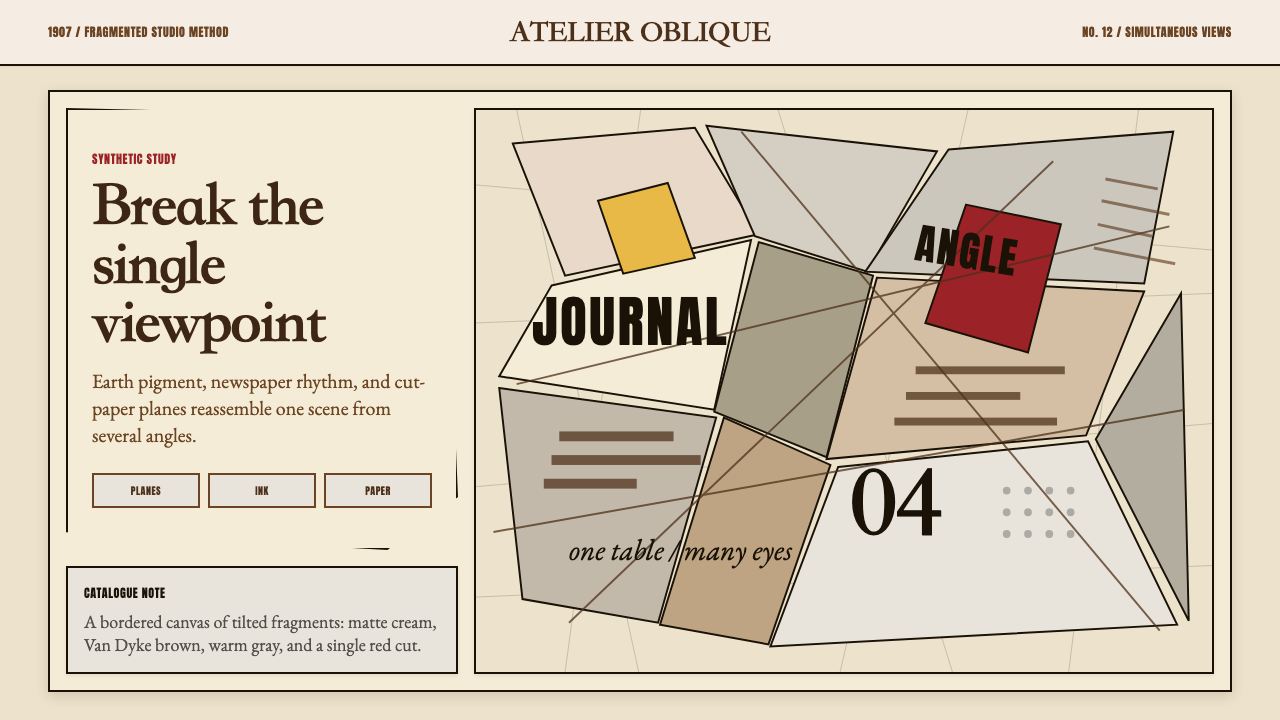 Picasso CubismSingle sight is shattered. Cream collage paper fractures brown-gray planes wi…
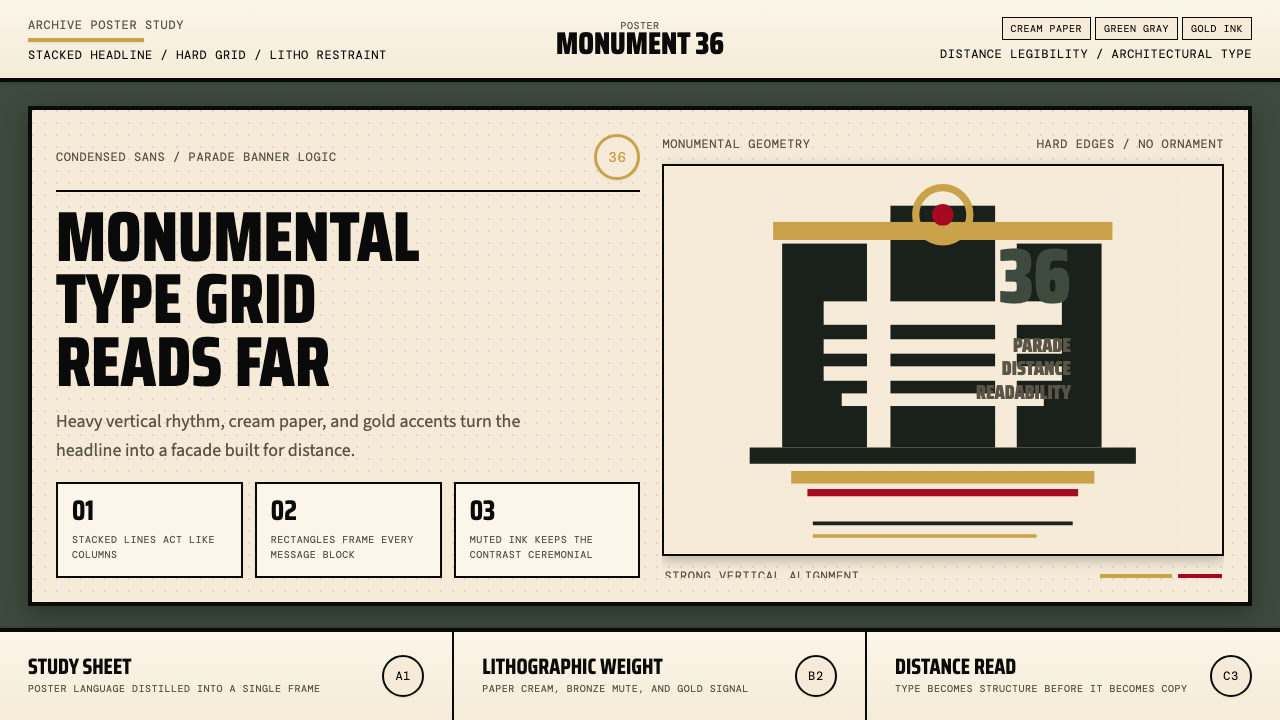 Olympic Poster Berlin (1936)Monumental and legible. Green-gray, cream, and gold turn type into architectu…
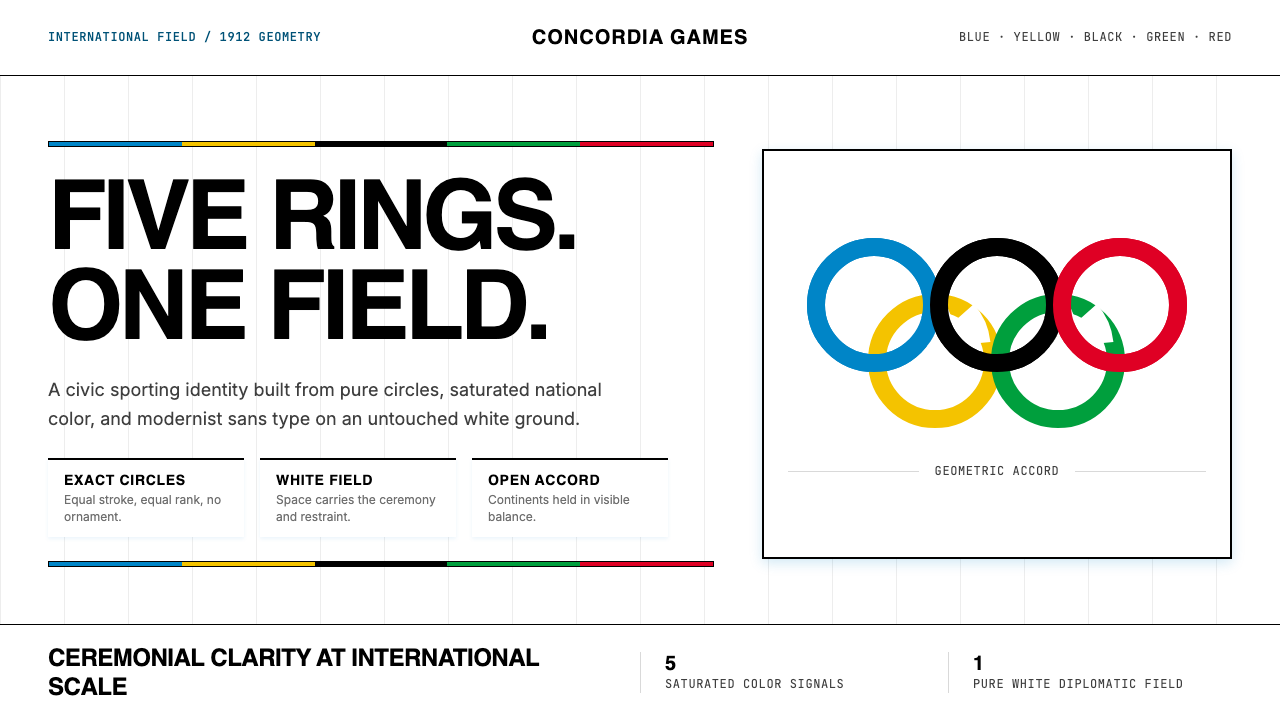 Olympics Five Rings (1912)Ceremony without noise. Saturated five-ring color on pure white, locked to a…
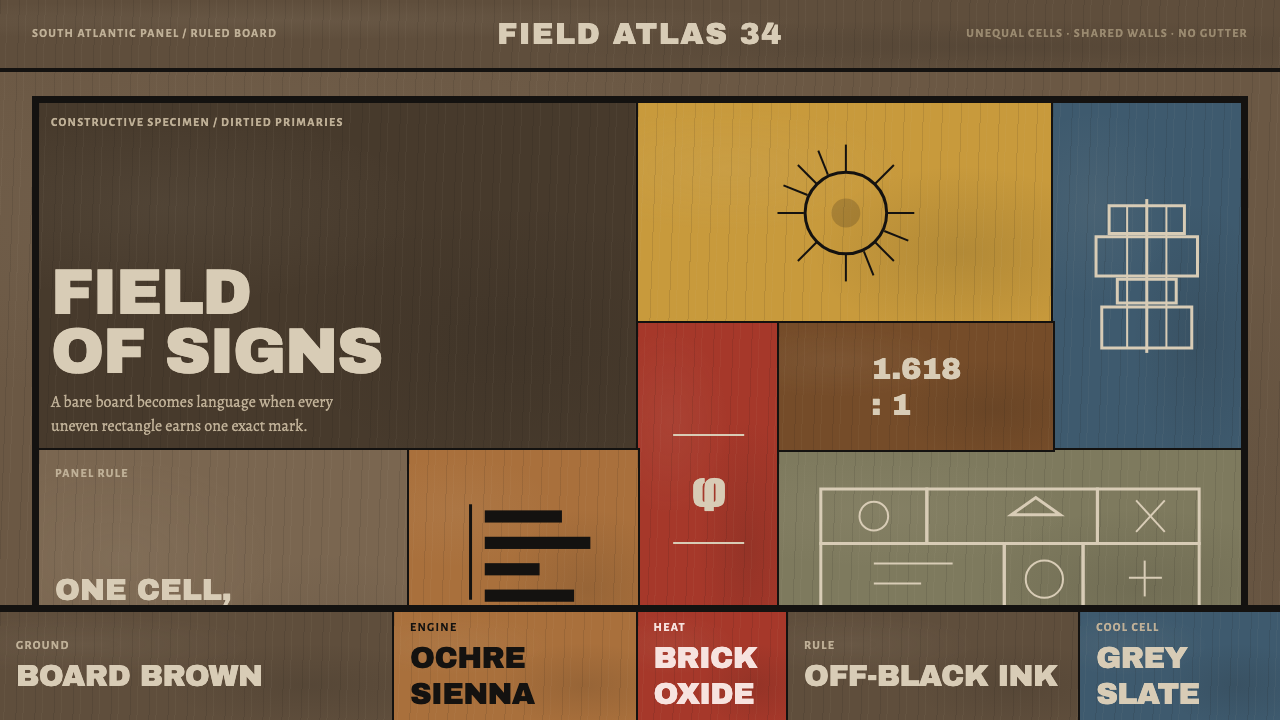 Torres-García UniversalismoGlyphs become structure. Dirtied primaries sit in unequal ruled cells on boar…
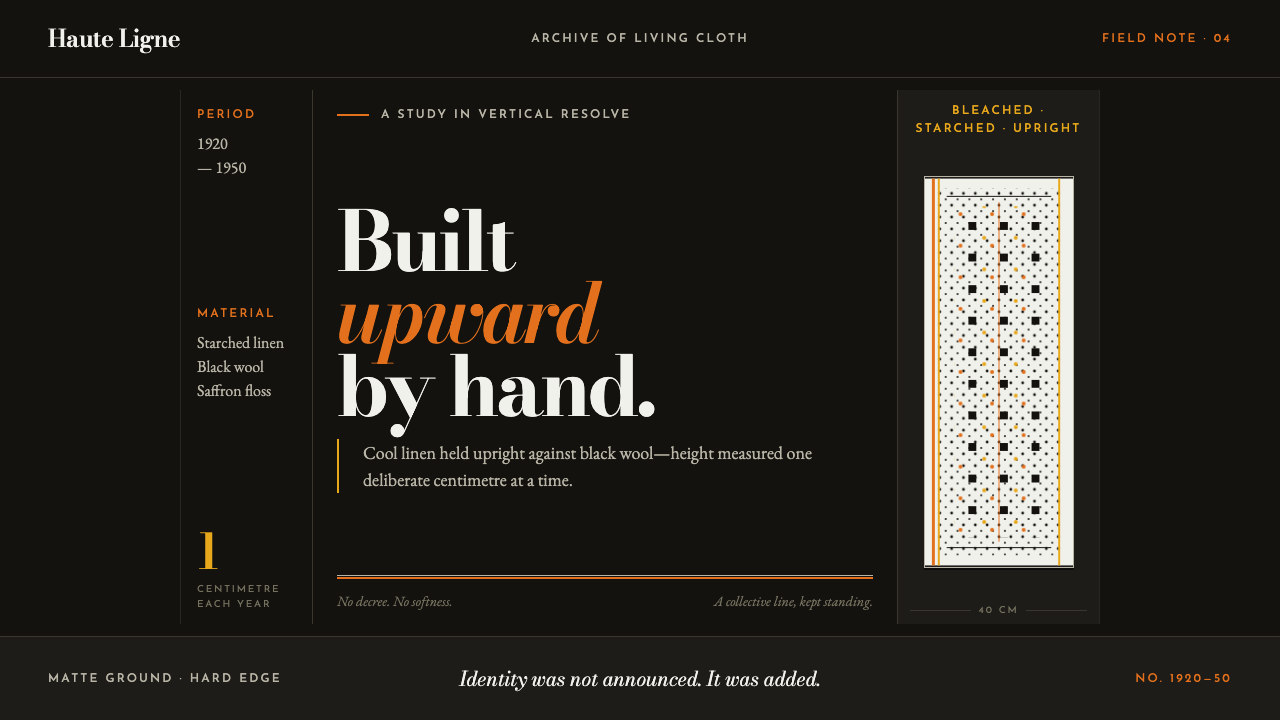 Bigouden CoiffeIdentity stands tall. Starched linen rises over matte black, edged in saffron…
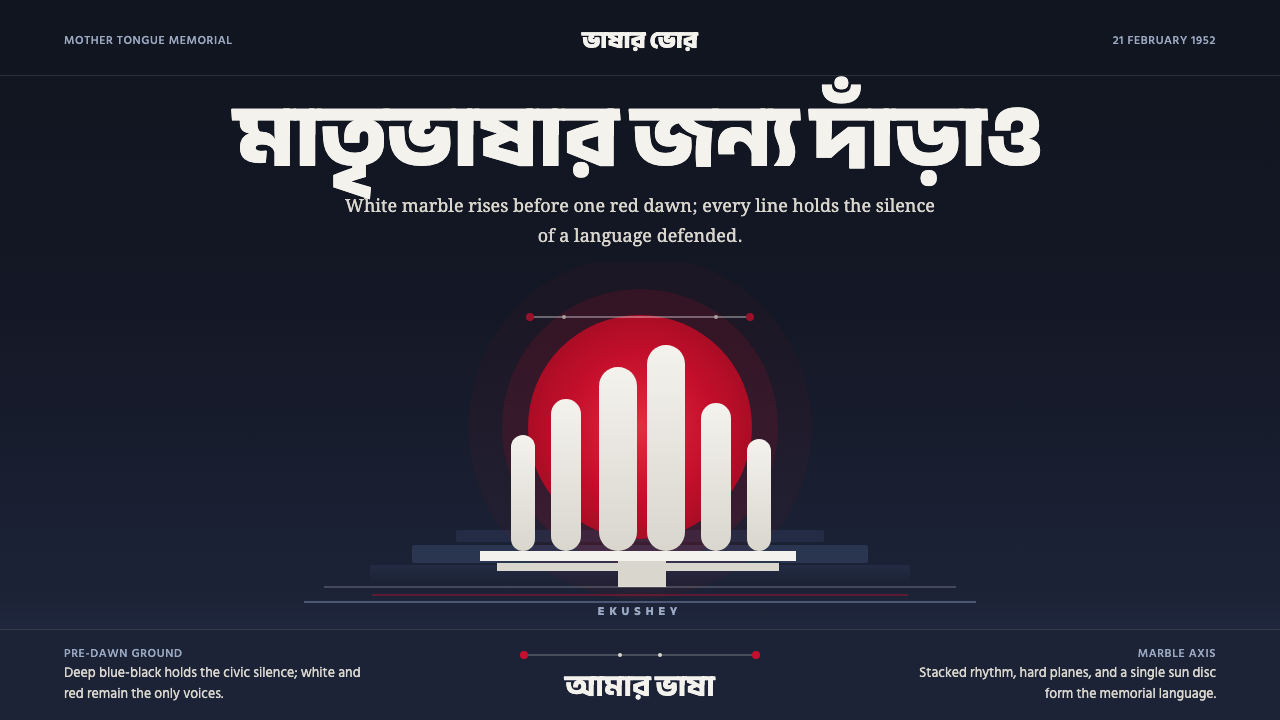 Dhaka Shaheed MinarSolemn before dawn. Marble columns and one red sun hold the page in civic sil…