What is Hong Kong Handover 1997 Poster?
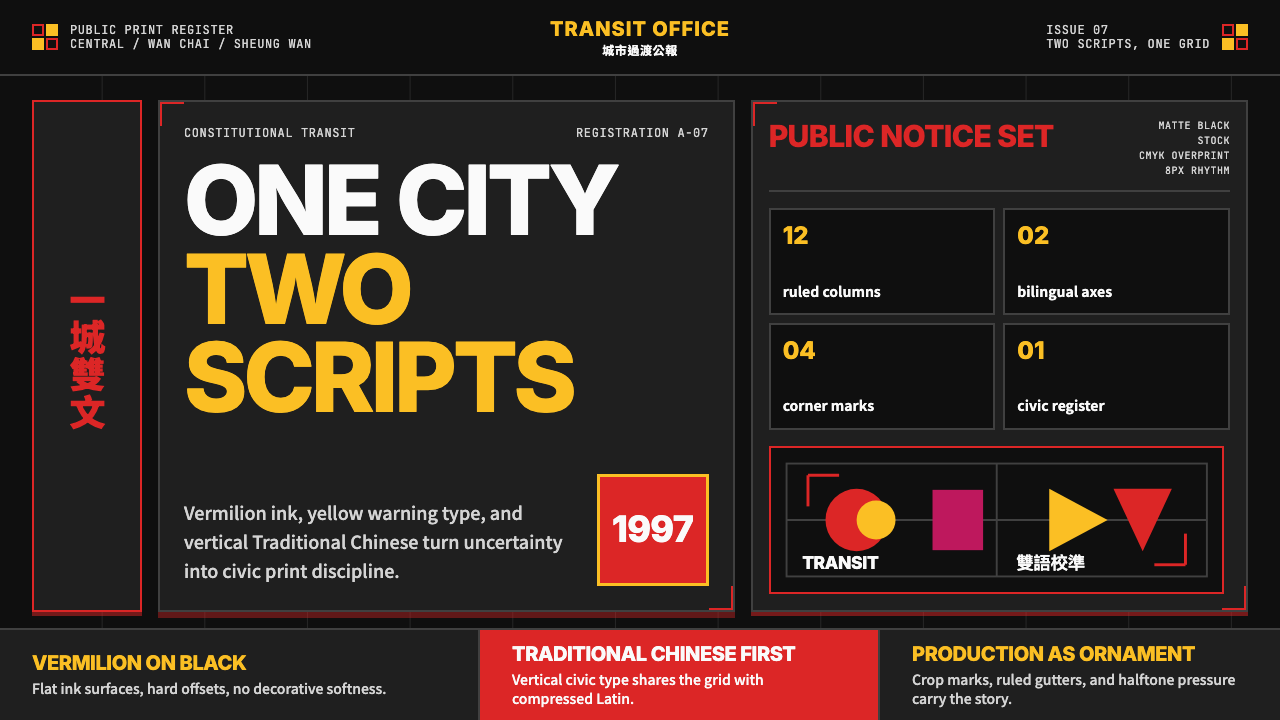
A city holding its breath printed that breath in vermilion and screaming yellow — the Hong Kong Handover poster school turned constitutional anxiety into one of the most distinctive bilingual graphic languages ever produced.
Hong Kong Handover 1997 Poster in brief
The Hong Kong Handover 1997 Poster style is the civic visual language that emerged from Hong Kong's design studios during the period bracketed by the 1984 Sino-British Joint Declaration and the years immediately following the 1997 transfer of sovereignty. It is a distinct idiom: government information posters, MTR station graphics, public ceremony collateral, and cultural institution materials all bearing the angular bilingual precision of what became known as the Henry Steiner and Kan Tai-keung school of Hong Kong graphic design.
At its core, the style is defined by the productive tension between two typographic traditions forced to coexist on the same printed surface. Traditional Chinese characters — set vertically, dense with strokes, carrying centuries of calligraphic memory — are placed in direct dialogue with Latin letterforms from the modernist European tradition. The result is not a compromise but a negotiation: each script occupies its own grid logic while the overall composition holds them in balance through shared structural elements, color, and geometric anchoring.
The palette is deliberate and charged with symbolic weight. Vermilion on black — a combination borrowed from ceremonial lacquer and official seals — conveys authority and occasion. A sharp, saturated yellow signals urgency and public information, functioning as a visual alarm rather than a decorative choice. These are not decorative colors applied for aesthetic pleasure; they are civic signals, inherited from a print culture that had to communicate clearly across language barriers and under political pressure.
Where does Hong Kong Handover 1997 Poster come from?
The story begins not in 1997 but in 1984, when the Joint Declaration formalized what residents had long suspected: that the territory's constitutional status would change within living memory. The design response to this knowledge was gradual but cumulative. Hong Kong's commercial print culture — already sophisticated from decades of serving both British colonial administration and a dense Chinese-speaking population — began to develop a distinctive hybrid register that was neither purely Western modernist nor purely traditional Chinese.
Henry Steiner, an American-trained graphic designer who arrived in Hong Kong in 1961, is often credited as the foundational figure of the professional design scene. Steiner's approach — rigorously modernist in structure but deeply attentive to Chinese visual culture — established a template that later designers would inherit and adapt. His corporate identity work for institutions like the Hongkong and Shanghai Banking Corporation demonstrated that Traditional Chinese letterforms could be integrated into a global modernist graphic system without being reduced to decoration or exoticized.
Kan Tai-keung, who began practicing in the 1960s and rose to international recognition in the 1970s and 1980s, brought a different emphasis: a sustained engagement with ink painting, seal-carving traditions, and the expressive potential of the brush stroke within a modernist compositional framework. His work did not merely coexist with Western graphic conventions — it engaged them dialectically, using the visual weight of Chinese calligraphic forms to anchor compositions that also contained ruled lines and geometric type arrangements. Freeman Lau and Alan Chan, working in the decades surrounding the Handover, extended this vocabulary into advertising, packaging, and cultural event graphics.
The 1997 Handover ceremony itself generated an enormous quantity of printed matter — stamps, programs, signage, commemorative publications — and the aesthetic pressure of that single event crystallized the style's characteristic elements. The bilingual mandate was absolute: every piece of public communication required both Chinese and English of equal standing. The solution that evolved was not to simply run two parallel versions but to build compositions in which the two scripts were structurally interdependent, with the visual weight of Chinese characters balanced against the column density of Latin type through shared color fields and geometric framing devices.
What defines the Hong Kong Handover 1997 Poster look?
Bilingual Grid Architecture
The fundamental organizational principle of this style is a grid system designed to hold two typographic traditions simultaneously. Rather than treating Chinese and English as separate layers stacked in sequence, the grid integrates them through shared horizontal baselines and vertical axis alignments. Chinese characters set in a column may align to the same baseline as a Latin headline set horizontally; the two scripts create visual rhythm together, not in isolation. This bilingual grid architecture is the technical heart of what makes this style legible across language communities.
Vermilion and Black Ground
The dominant color relationship in this style is vermilion applied to a coated black surface. The black ground draws from both ink culture and the printing conventions of official announcement — notice boards, government gazettes, public signage. Vermilion carries ceremonial authority: it is the color of official seals, of lucky envelopes, of inscriptions on temple tablets. Applied to a printed surface, the combination reads simultaneously as festive and official, which is precisely the emotional register required for a political transition that was both celebratory and weighted with uncertainty.
High-Tension Yellow Accent
Where vermilion carries ceremony, a sharp, saturated yellow carries urgency and public information. In MTR wayfinding, government announcements, and civic posters of this era, yellow functions as a visual alert register — the color that demands immediate reading. It is applied to display type, to critical information lines, and to the most urgent directional elements. The yellow used here is not warm or approachable but sharp and demanding; it has the visual character of a public address system rendered in color.
Traditional Chinese Verticality
Traditional Chinese characters bring an inherent vertical reading orientation to compositions that the style uses as an organizing principle rather than a constraint. Column-set Chinese type creates strong vertical anchors within horizontal Western-format layouts, and the visual density of traditional characters — with their complex stroke counts compared to simplified variants — adds weight precisely where the designer wishes to create emphasis. The style does not simplify or reduce the characters to geometric forms; it honors their calligraphic origins while constraining them within precise grid measurements.
Geometric Structural Framing
The compositional framework that holds the bilingual type system together is built from ruled lines, rectangular color fields, and geometric dividers. These are not decorative additions but structural load-bearing elements: a thick horizontal rule separates Chinese and English register, a colored rectangle creates a field that assigns meaning to everything it contains, a fine ruling grid establishes the underlying measure that both scripts respect. The geometric framing is inherited from the European modernist tradition — particularly the Swiss International Style — but adapted to serve a communicative necessity that has no European equivalent.
Angular Display Typography
Display type in this style — both the Chinese and Latin letterforms selected for headlines and prominent information — tends toward angularity and structural crispness rather than warmth or organic curvature. The Chinese display typefaces favored are those with strong horizontal stroke emphasis and sharp angle terminations. The Latin typefaces are drawn from the grotesque and geometric sans-serif tradition, with tight spacing and high x-heights that match the visual density of the accompanying Chinese characters. Together they read as authoritative and precise.
Civic Restraint
Despite the visual intensity of the color palette and the complexity of the bilingual grid, the overall register of this style is restrained rather than expressionistic. Decoration is minimal to zero. No illustrative flourishes, no ornamental borders, no atmospheric gradients. Every element is justifiable by its function: this line separates these two registers of information; this color field establishes authority; this character size hierarchy communicates priority. The restraint is not aesthetic minimalism but civic discipline — the discipline of a design tradition that serves public information systems and cannot afford ambiguity.
Who shaped Hong Kong Handover 1997 Poster?
Steiner arrived in Hong Kong in 1961 after training in New York and Vienna, and over the following decades built a practice that became the foundational model for professional graphic design in the territory. His work for major financial institutions, airlines, and cultural organizations demonstrated that Western modernist grid structures could be enriched — not compromised — by the integration of Chinese visual thinking. Steiner's particular contribution was the bilingual identity system: communication materials in which Chinese and English were not parallel translations but co-constitutive elements of a single visual argument. His influence on the generation of designers who produced the Handover visual environment is difficult to overstate.
Kan's practice was rooted in a sustained engagement with the classical Chinese visual tradition — ink painting, seal carving, bronze vessel motifs — that he brought into dialogue with contemporary Western graphic conventions. Unlike designers who treated Chinese visual culture as a motif to be borrowed and applied, Kan treated it as a structural resource: the weight distribution of a seal carving, the spatial logic of a landscape composition, the expressive range of a brush stroke loaded with ink. His international recognition — including a fellowship from the Alliance Graphique Internationale — helped establish Hong Kong as a site of genuine graphic innovation rather than mere commercial production.
Lau studied under Kan Tai-keung and became a significant figure in extending the Hong Kong design vocabulary into cultural events, exhibition design, and the commemorative visual materials surrounding the Handover period. His work is notable for maintaining the structural principles of the bilingual grid while pushing the color intensity and compositional drama further than his predecessors. Lau also played an important role in professional design education and the formation of design advocacy organizations in Hong Kong, helping institutionalize the design culture that produced the Handover visual identity.
Chan brought the Handover-era design vocabulary into the commercial and cultural sphere with a distinctive sensibility that drew on both art deco geometry and Chinese decorative traditions. His work for cultural institutions, hospitality brands, and public campaigns demonstrated the commercial viability of the bilingual precision aesthetic and helped carry it beyond government and civic contexts into broader visual culture. Chan's output during the transition years represented the style at its most polished and internationally legible.
How do you use Hong Kong Handover 1997 Poster today?
The Hong Kong Handover 1997 Poster style is highly specific in its cultural and historical referents, which means it rewards deliberate and contextually appropriate application rather than casual deployment. Its primary contemporary use cases are those where bilingual precision, civic authority, and a charged balance between tradition and modernity are desired values: cultural institution materials, retrospective or commemorative publications, diplomatic and ceremonial communications, and any context where the East-West interface is itself part of the message.
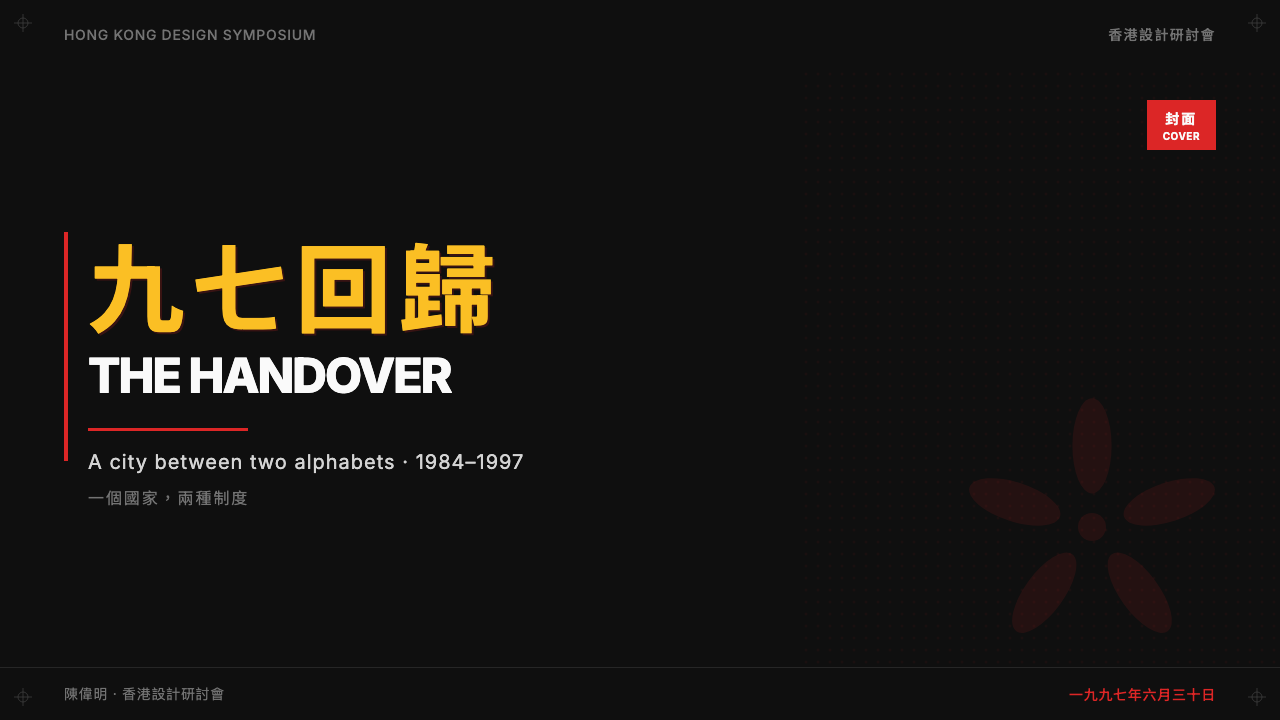
For presentation slides, the style's bilingual grid logic translates directly into a two-register approach to information hierarchy. A cover slide might position a large Chinese display character as a structural anchor on one side, balanced by an angular Latin title treatment on the other, with a vermilion horizontal rule as the dividing and connecting element. Content slides benefit from the style's discipline around color: limit strong color to one or two elements per slide — a highlighted data point, a section identifier — and let the structural lines do the organizational work. The style's angular, high-contrast approach to type makes it particularly well-suited to conference-scale presentations where legibility at distance is paramount.
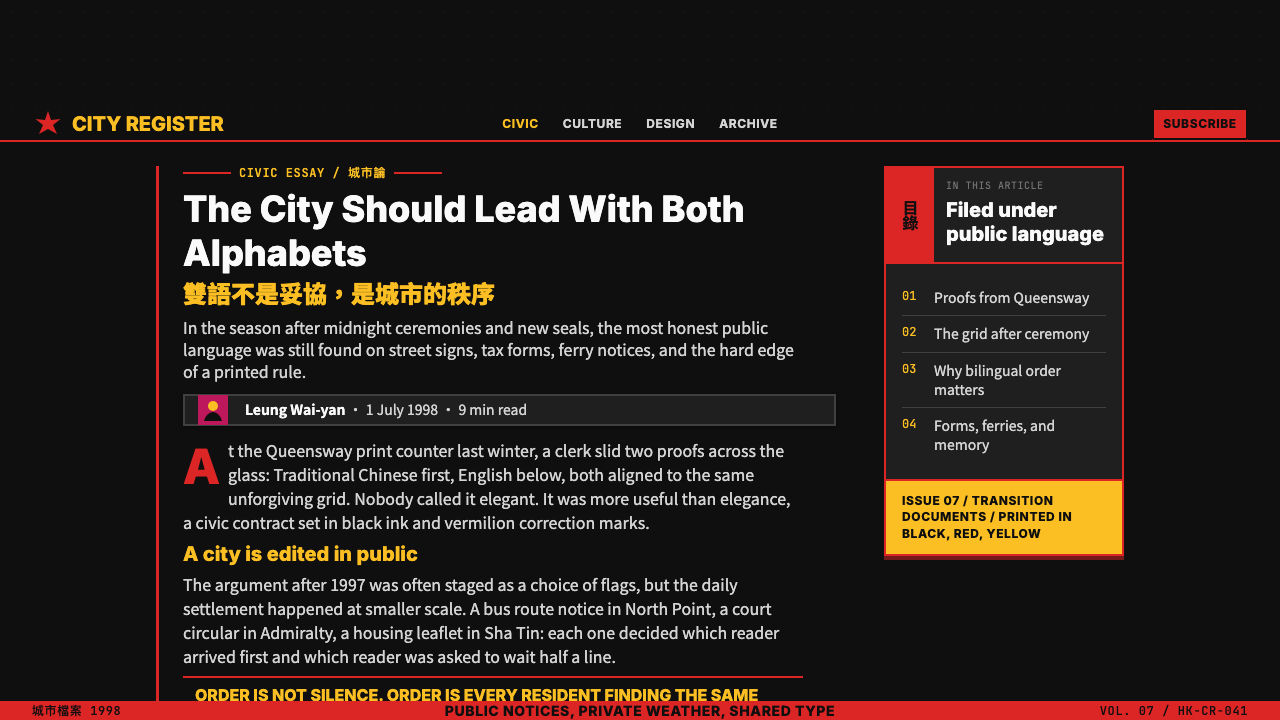
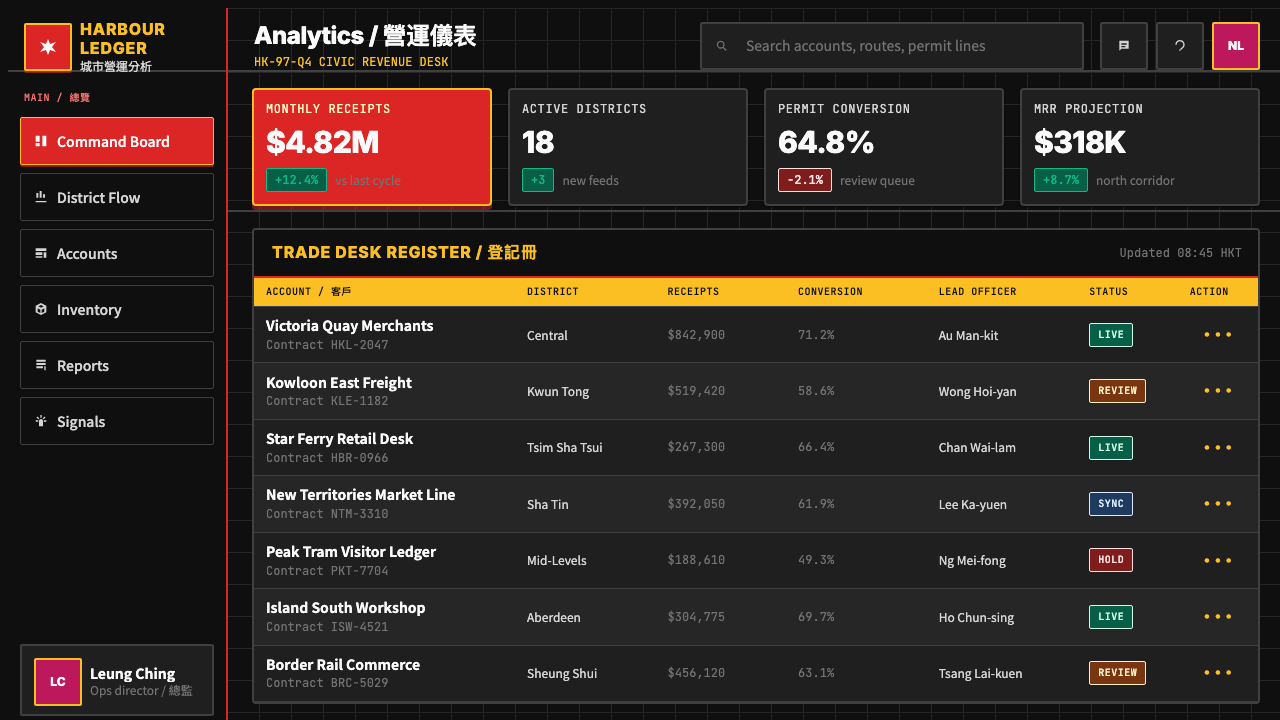
For web interfaces and digital dashboards, the style offers a strong visual hierarchy model. The key is translating the print-derived grid logic into a digital column system without losing the compositional tension that makes the style distinctive. Use deep-toned backgrounds with high-contrast display type for hero sections and navigation; reserve vermilion or sharp yellow for interactive states, badges, and critical alerts. Avoid soft shadows and ambient depth effects — the style's authority comes from flatness, edge precision, and deliberate color deployment. Typography should feel monumental, not conversational.
For editorial and marketing work — event posters, cultural publications, commemorative printed materials — the style is at its most natural. A full-bleed black ground with a vermilion color field housing Chinese vertical type, balanced by a white or cream area for Latin text and supplementary information, is the canonical compositional approach. The geometric framing devices — rules, color blocks, axis alignments — should be visible and structural rather than subtle. Marketing materials for events and institutions concerned with Chinese cultural heritage, cross-cultural exchange, or historical commemoration are particularly well-served by this visual language.
A common mistake when applying this style is treating the bilingual element as optional or ornamental — placing one language in a secondary, smaller, or visually diminished position. The style's defining quality is the equal structural integration of Chinese and Latin type, and reducing either to a caption or subtitle destroys the compositional logic. Similarly, substituting a simplified Chinese typeface for a traditional one changes the visual register significantly: simplified characters carry different stroke weight distributions and different cultural associations, and the result will read as contemporary mainland rather than the specific Hong Kong transitional aesthetic this style encodes.
Hong Kong Handover 1997 Poster — FAQ
Is this style specific to Hong Kong, or can it represent any Chinese-English bilingual context?
It is specific to Hong Kong, and using it to represent other Chinese-English bilingual contexts would be a category error. The style encodes particular conditions: the coexistence of British colonial administrative culture and Cantonese-speaking civic life, the specific print and signage conventions of the MTR and government information systems, the distinctive visual culture of Central and Wan Chai in the 1980s and 1990s, and the charged political atmosphere of the transition period. Mainland Chinese design of the same era has entirely different visual conventions, as does Taiwanese design and Singapore design. The style's cultural specificity is part of its meaning.
How does this style differ from Swiss International Style, which also uses grids and sans-serif type?
Swiss International Style operates within a single typographic tradition — Latin letterforms — and achieves its precision through mathematical grid systems and strictly rationalized type hierarchies. The Hong Kong Handover style inherits the Swiss grid logic but uses it to manage a genuinely different problem: holding two scripts with different structural properties, different reading directions, and different cultural weights in productive tension within the same composition. The color language is also fundamentally different: where Swiss Style uses color sparingly and often functionally, the Hong Kong style uses vermilion and high-intensity yellow as charged symbolic elements carrying ceremonial and civic meaning that has no equivalent in the Swiss tradition.
Can this style work in contexts that are not politically charged or historically commemorative?
Yes, but with an important caveat. The civic authority register — the combination of black ground, vermilion, and geometric structure — reads as official and serious in almost any context, which can be an asset or a liability depending on the application. Cultural institutions, museums, architectural firms, and technology companies presenting themselves as authoritative and historically grounded can use this visual language effectively. It works poorly for products or services that want to project warmth, approachability, or playfulness. The bilingual dimension is optional in contexts where only one language is needed, but removing it eliminates the most distinctive structural logic of the style.
What is the relationship between this style and contemporary Hong Kong design?
Contemporary Hong Kong design has largely moved on from the Handover-era visual language, engaging with global digital design trends much as designers elsewhere do. The Handover style is now a period aesthetic — associated specifically with the late colonial and early post-handover decades — rather than an ongoing active tradition. However, it retains strong cultural resonance as a marker of a particular historical moment, and designers working with themes of Hong Kong cultural identity, historical memory, or the complexity of the transition period frequently return to its conventions as deliberate cultural citations. It occupies a position somewhat analogous to the Stile Liberty in Italian design or the Arts and Crafts movement in British design: a historically specific moment whose visual language has achieved canonical status.
Does this style require actual bilingual content, or can it be applied monolingually?
The style can be applied monolingually, but the bilingual grid architecture is its most distinctive feature, and a monolingual application will read as an echo of the style rather than a full expression of it. If you are working in a single-language context, the elements that remain fully transferable are the color language — vermilion on black, high-intensity yellow accents — the geometric structural framing, the angular display typography, and the overall civic restraint. What you will lose is the productive tension between two scripts that gives the style its characteristic visual energy. A monolingual version is a useful reference but should be understood as a derived form, not the original.
Related design styles
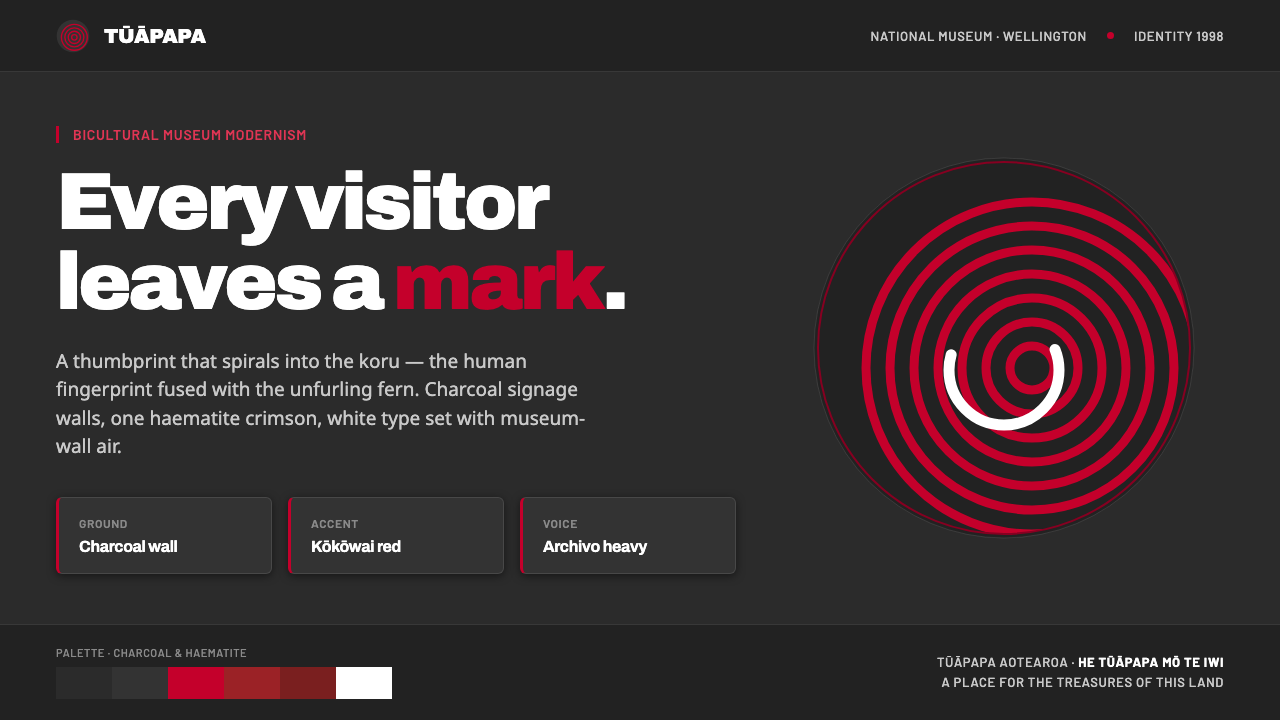 Te Papa Aotearoa ModernEvery visitor leaves a mark. Charcoal museum walls, one haematite crimson, a…
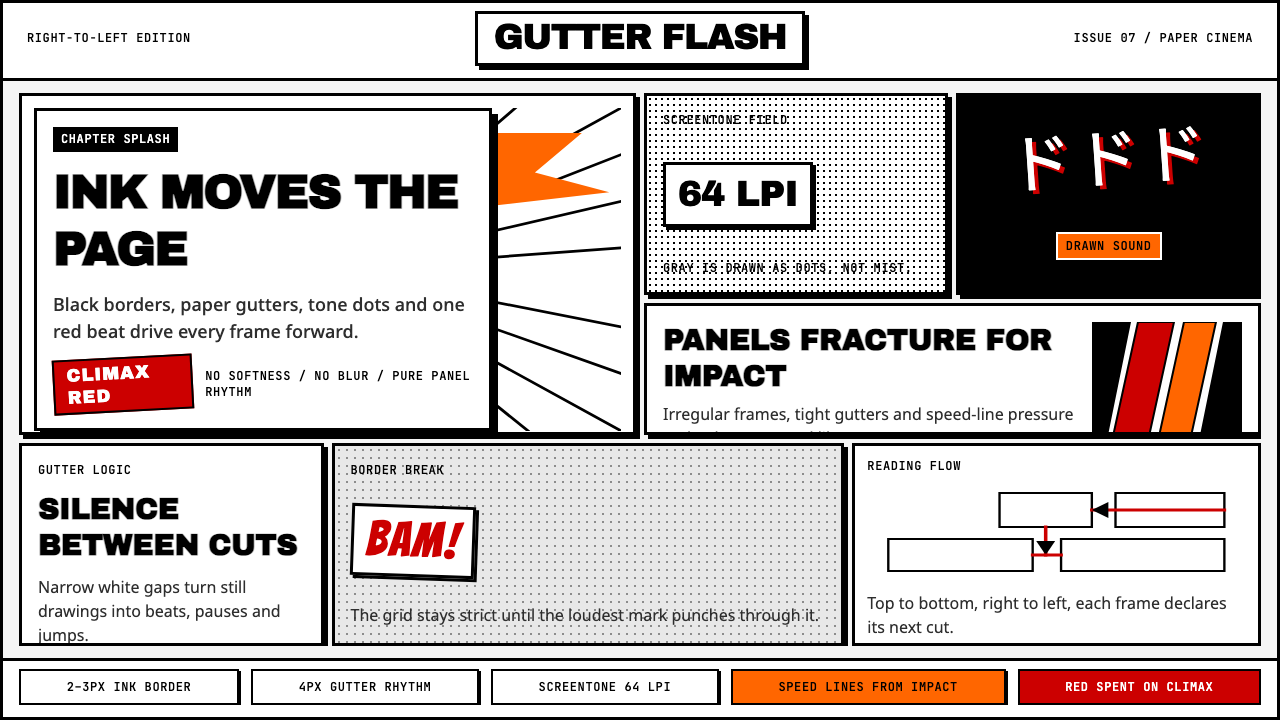 Manga Panel LayoutCinema in ink. Black panels, screentone dots, speed lines, and one red strike.
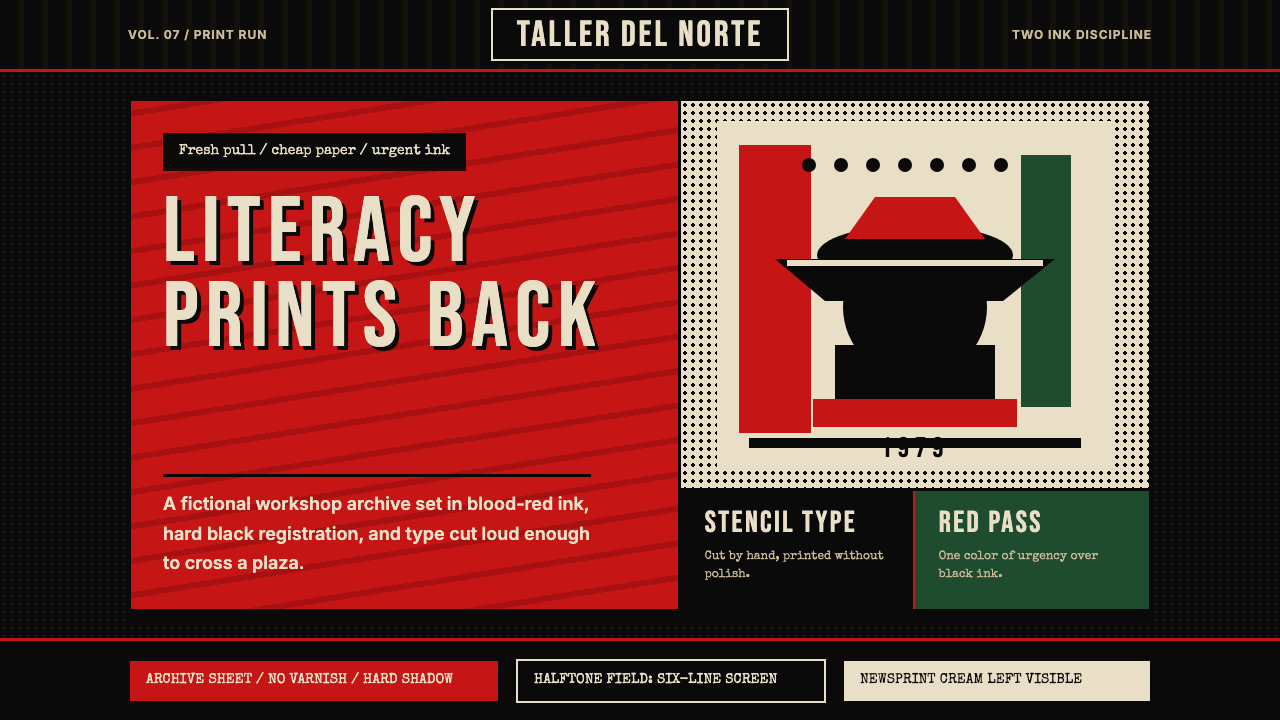 Nicaraguan Sandinista FSLN 1979Urgency in two inks. Blood red, jet black, halftone dots, and cut-stencil typ…
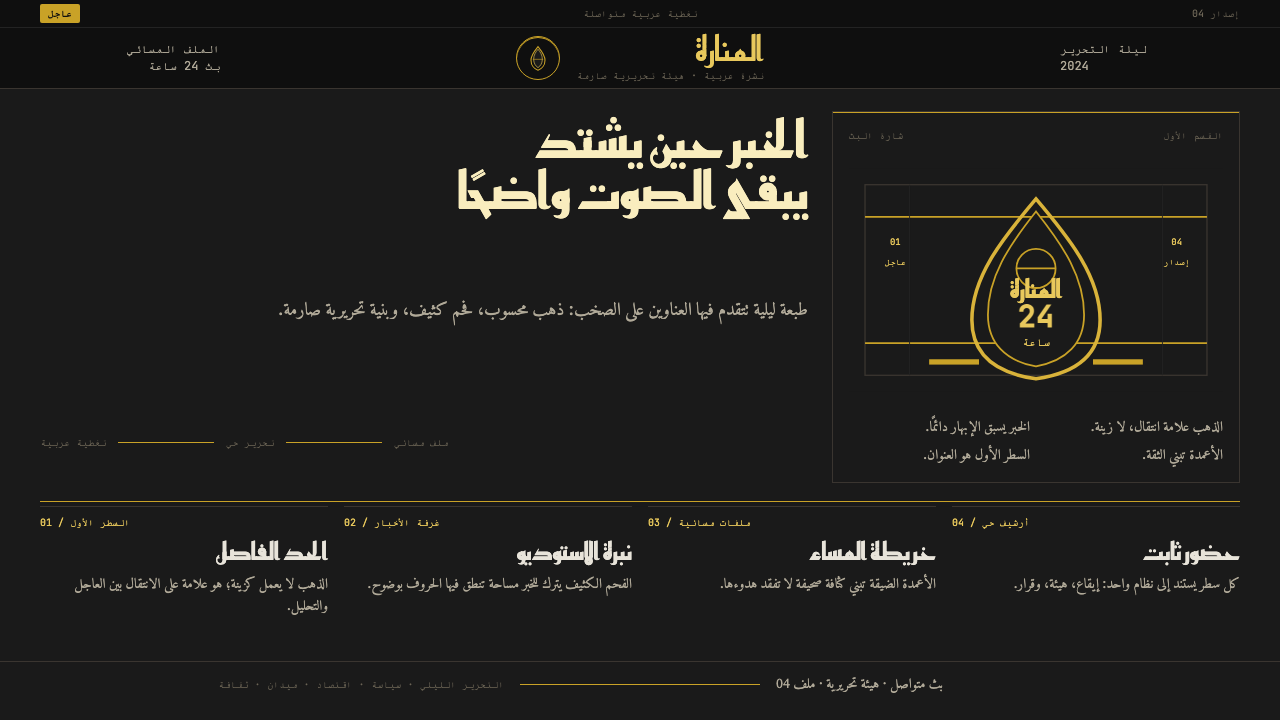 Al Jazeera Arabic NewsAuthority, stripped bare. Gold seal, dense Arabic type, matte charcoal.
 Attack on Titan (2013)Dread becomes duty. Stone-gray bands, engraved caps and one steel-blue crest…
 Bengali Art-House CinemaLight becomes restraint. Near-black ground, silver serif, and Bengali script…