What is Spomenik Yugoslav Monument (1960)?
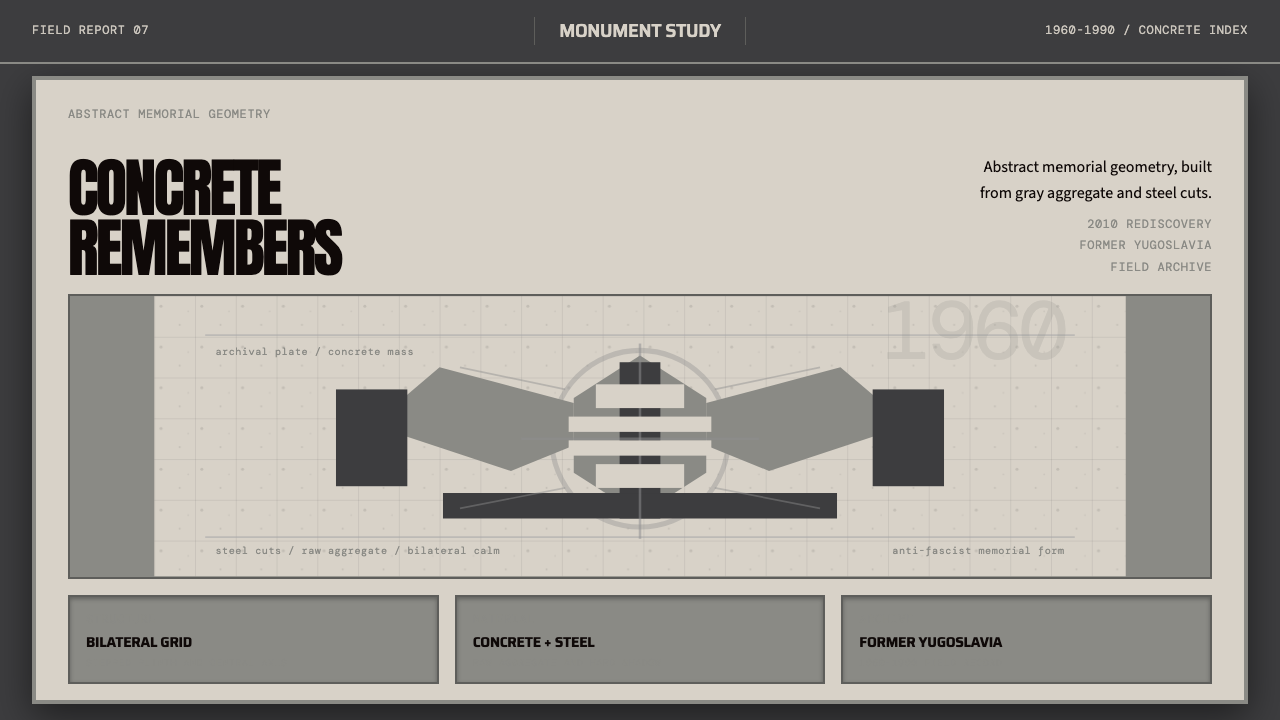
Concrete raised as conscience — the Yugoslav spomenici transformed anti-fascist grief into soaring geometric abstraction that still haunts the hillsides of the former Yugoslavia.
Spomenik Yugoslav Monument (1960) in brief
Spomenik (the Serbo-Croatian word for 'monument') refers to the extraordinary body of abstract memorial sculptures and architectural monuments commissioned by socialist Yugoslavia between 1960 and 1990. These structures were built across Croatia, Bosnia-Herzegovina, Serbia, Montenegro, Slovenia, and North Macedonia to honor Partisan fighters and the civilian victims of Nazi and collaborationist atrocities during the Second World War. Unlike conventional war memorials, the spomenici refused figurative representation entirely — no soldiers, no mothers in mourning, no heroic reliefs. In their place stood crystalline polyhedra, biomorphic concrete cantilevers, colossal star-shaped voids, and vast winged forms that seemed to reach toward the sky with something between triumph and lamentation.
The design language of the monuments draws on a specific visual vocabulary: raw aggregate concrete surfaces whose gray tonality ranges from pale ash to near-black, monumental scale that dwarfs the human figure, geometric forms derived from natural crystals or abstracted from organic life, and a studied asymmetry that keeps the compositions from collapsing into static authority. Some structures recall the petals of a flower frozen at the moment of opening; others are more architectural, reading as gutted shells or pierced slabs. All of them share the quality of dwelling in historical weight — they do not celebrate so much as they hold.
The wider world largely forgot these monuments during the political upheavals of the 1990s, when Yugoslavia fragmented and many structures fell into disrepair. They were rediscovered internationally after photographer Jan Kempenaers published his 2010 photography book documenting neglected specimens across the former Yugoslav republics. Kempenaers's images — shot in wide-angle isolation against dramatic sky — made the formal qualities of the structures unmistakable and sparked a global appreciation for what was soon labeled brutalist-modernist aesthetics. Since then the monuments have influenced graphic design, fashion, video game environments, and album art, entering the visual vocabulary of contemporary design far beyond their original geographic and political context.

Where does Spomenik Yugoslav Monument (1960) come from?
The political and cultural context that produced the spomenici is inseparable from the specific character of Yugoslav socialism. Josip Broz Tito's partisan movement had liberated Yugoslavia from Nazi occupation largely through its own military effort rather than through Soviet liberation, a fact that gave the new regime a degree of national legitimacy and ideological independence unusual among Eastern Bloc states. When Tito broke with Stalin in 1948 and charted a course of 'non-aligned' socialism, Yugoslavia became a site of genuine cultural experimentation, maintaining open borders with the West, hosting international art exhibitions, and encouraging avant-garde architecture and design as demonstrations of a sophisticated, humanist socialism distinct from Soviet orthodoxy.
The monument-building program grew out of this ideological climate. Beginning in the late 1950s and accelerating through the 1960s and 1970s, municipalities, regional governments, and federal ministries commissioned memorials at the sites of mass killings, liberated towns, and Partisan strongholds. The mandate given to architects was unusually open: the monuments were to commemorate suffering and resistance without resorting to the monumental figurative sculpture associated with Stalinist socialist realism. This created an extraordinary opportunity for avant-garde architects and sculptors who were simultaneously studying developments in international modernism — from Henry Moore's biomorphic forms to the crystalline geometries of postwar German and Austrian concrete sculpture — and translating them into a distinctly Yugoslav idiom.
Among the key figures who defined the visual language of the monuments, Bogdan Bogdanović stands out for the lyrical, almost mystical quality of his memorial landscapes. His Jasenovac memorial (1966), built at the site of the largest concentration camp in wartime Yugoslavia, takes the form of a stone flower — a colossal blossom whose petals reach skyward from a low earthwork setting. The flower motif was deliberately chosen to suggest life emerging from death rather than triumph over an enemy. Dušan Džamonja, working primarily in steel and cast concrete, produced forms of aggressive geometric tension — spiked spheres and corrugated slabs that carry a sense of compressed energy on the edge of release. Vojin Bakić brought a more architectural sensibility, his aluminum-clad forms catching and fragmenting light across their faceted surfaces. Miodrag Živković's Tjentište memorial in the Sutjeska canyon combines massive abstract stone wings with a landscape intervention, turning the entire valley into a spatial memorial.
The monuments also reflect the Yugoslav state's specific understanding of collective memory and national unity. Yugoslavia was a federation of multiple ethnic and religious groups whose wartime history included not only resistance to Nazi occupation but also fratricidal violence among Serbs, Croats, and Bosniaks. The abstract, non-ethnic language of the monuments was partly a political calculation: a geometric form cannot belong to one ethnicity the way a figurative heroic relief can. The decision to commission modernist abstraction was therefore simultaneously an aesthetic avant-garde move and a pragmatic effort to create shared memorial space across a fractured historical memory. When Yugoslavia dissolved, many of these structures — no longer maintained by any state or community — became ruins, returning to the landscape with an unintended second life as monuments to the fragility of political formations themselves.
What defines the Spomenik Yugoslav Monument (1960) look?
Monochromatic Concrete Palette
The dominant material is raw aggregate concrete whose surface color spans a narrow but expressive range from pale silver-gray through mid-gray to near-black, depending on aggregate composition, weathering, and the presence of patina or lichen. This palette is essentially achromatic — color enters the system only through the natural variation of the stone itself, the oxidation of embedded steel elements, or the moss and lichen that colonize aged surfaces. Against this gray ground, the sky and surrounding landscape become the only chromatic elements, sharpening the geometric silhouettes of the forms.
Crystalline and Biomorphic Geometry
The formal vocabulary of the monuments oscillates between two poles: the crystalline and the biomorphic. Crystalline forms — faceted polyhedra, star-burst configurations, prismatic shards — evoke the molecular structure of minerals and the cold precision of the natural world at a sub-visible scale. Biomorphic forms — winged cantilevers, petal-like volumes, tentacle-shaped extensions — draw on the language of organic life, suggesting growth, opening, and the cycle of death and renewal. Many individual monuments inhabit both poles simultaneously, their overall mass reading as crystalline while individual components carry organic curvature.
Monumental Scale and Landscape Integration
The monuments are conceived at a scale that overwhelms rather than accommodates the individual visitor. Approach paths, earthwork platforms, and landscaped terraces are typically integral to the design, so that the experience of arriving at the structure is itself choreographed. The human figure, when present, registers as an accent against the massing — a device that forces confrontation with historical weight rather than offering a comfortable relationship with the memorial. This relationship between built form and natural landscape is crucial: several monuments are sited in deep gorges, on exposed hilltops, or at the edges of forests, and the relationship between the concrete form and its natural surround is compositionally deliberate.
Textured Surface Without Ornament
The surfaces of the monuments are textural rather than decorative. Formwork marks, aggregate exposure, intentional roughening of the concrete skin, and the slow accretion of environmental staining all contribute to a surface condition that feels aged and material rather than applied and finished. No surface treatment exists for its own sake — the texture is a consequence of making rather than a layer added to a neutral form. Over decades, lichen and oxidation deepen this quality, so that the most weathered examples achieve a near-geological presence that was always latent in the concrete's gray palette.
Non-Hierarchical Composition
Unlike classical memorial architecture — which typically establishes a clear axial approach, a dominant vertical element, and a prescribed frontal reading — the Yugoslav monuments frequently resist compositional hierarchy. Many can be read from multiple angles without any single viewpoint resolving as the 'correct' one. Some are radially symmetric and present the same face in every direction; others are intentionally asymmetric, so that the monument changes character as the visitor moves around it. This resistance to a fixed viewpoint is ideologically significant: the monuments refuse to stage their visitors as a unified crowd facing a central authority.
Weight and Cantilever as Emotional Language
The monuments exploit structural extremes to generate emotional affect. Cantilevers that appear impossibly large reach into space without visible support, creating a suspended tension that reads as simultaneously defiant and vulnerable. Massive geometric solids settle into the earth with an immovable heaviness that suggests permanence and grief. The interplay between these two structural logics — the reaching and the grounding — is one of the most consistent emotional signatures of the style and accounts for much of the visceral response that even photographs of the monuments provoke in viewers unfamiliar with their historical context.
Absence of Inscription and Figuration
Many of the monuments are notably free of text, names, and figurative relief — the very elements that traditional memorial practice uses to anchor meaning. Where inscriptions exist, they tend to be minimal, set flush into the concrete surface, and subordinated to the geometric form rather than dominating it. This restraint forces the formal and material qualities of the structure to carry the entire memorial burden. The absence of figuration also means the monuments cannot be read as portraits of particular victims or celebratory portraits of particular heroes — they remain open, collective, and formally abstract in a way that resists easy political appropriation.

Who shaped Spomenik Yugoslav Monument (1960)?
Bogdanović was the architect most closely identified with the humanist and lyrical register of the Yugoslav monument tradition. Over a career spanning several decades he created more than twenty memorial complexes, each with a distinct formal language rooted in symbolic imagery — flowers, labyrinths, abstract alphabets — drawn from pre-Slavic Mediterranean cultures. His Jasenovac Stone Flower memorial (1966) and the Partisan Memorial Cemetery in Mostar (1965) are widely regarded as the most formally accomplished works in the Yugoslav memorialist canon. After opposing Milošević's Belgrade policies in the early 1990s, Bogdanović went into exile in Vienna, where he continued writing and working until his death in 2010.
Džamonja approached the memorial commission as a sculptor whose instincts were fundamentally materialist and tactile. Working primarily in cast iron, steel, and concrete, he developed a vocabulary of spiked, corrugated, and fractured forms that communicated violence absorbed and survived rather than transcended. His Jasenovac Spiky Ball memorial and the Kozara monument are among the most formally aggressive in the Yugoslav canon — geometrically derived but deeply physical, their surfaces implying force and resistance. Džamonja represented Yugoslavia at several Venice Biennales and maintained an active international exhibition career that extended the influence of his formal approach well beyond the monuments themselves.
Bakić brought a more architecturally refined sensibility to the monument tradition, working extensively with aluminum cladding over concrete structural cores to create forms whose surfaces fragment and redirect light rather than absorbing it. His Petrova Gora monument (begun in 1971, completed in 1981), a massive stainless-steel-clad structure rising from a forested hilltop in Croatia, is among the most architecturally ambitious in the Yugoslav canon — a building-scale object that reads as monument, sculpture, and lookout tower simultaneously. Bakić was also a significant figure in Croatian fine art, and his non-memorial sculpture work, much of it exploring light and reflective surface, shows the consistent formal preoccupations that run through his memorial commissions.
Živković is best known for the Tjentište memorial complex in the Sutjeska National Park in Bosnia-Herzegovina, completed in 1971 to commemorate the Battle of Sutjeska — one of the largest Partisan military engagements of the Second World War. The memorial comprises two massive abstract stone wings rising from a terraced platform set against the mountain landscape, their form suggesting both outstretched arms and the silhouette of a bird in flight. The siting and scale of the work make it one of the most powerful landscape integrations in the Yugoslav memorial tradition, turning the entire valley into a spatial experience of historical memory rather than a monument to be looked at from a fixed point.
Kempenaers is not an architect but a Belgian photographer whose 2010 book Spomenik — the result of multiple expeditions to document neglected monuments across the former Yugoslav republics — was directly responsible for the global rediscovery and aesthetic rehabilitation of the Yugoslav monument tradition. His approach was deliberately de-contextualizing: the photographs frame the structures in wide-angle isolation, removing surrounding urban or rural infrastructure and presenting the monuments against sky and landscape alone. This framing made the formal qualities of the structures immediately legible to audiences with no knowledge of their political or historical context, and the subsequent viral circulation of the images online drove the monuments' adoption into contemporary design vocabularies worldwide.
How do you use Spomenik Yugoslav Monument (1960) today?
The Spomenik aesthetic is among the most atmospheric and conceptually demanding historical styles available to contemporary designers. Applying it well requires understanding what it is actually doing visually: using gray as the dominant structural tone rather than a neutral background, using asymmetric geometric forms to create tension rather than balance, and treating scale and materiality as the primary expressive instruments rather than color or surface decoration. The goal is not to simulate concrete but to capture the quality of weight, gravity, and deliberate formal restraint that defines the monuments.
For presentation slides, the Spomenik aesthetic works most powerfully on cover and section-divider pages. A cover benefits from a single large geometric form — a fractured polygon, a radially symmetric star, or an asymmetric cantilever shape — rendered in deep gray against a near-black ground, with the title set in wide-spaced, sparse type that does not compete with the form. Content slides should lean into the achromatic palette: white text on dark gray, or very dark text on light gray, with structural lines and rules rather than color-coded dividers. Data visualizations in this style become almost architectural — bar charts read as monoliths, network diagrams as crystalline lattices.
For web interfaces and dashboards, the Spomenik aesthetic lends itself to applications that need to project seriousness, permanence, and analytical depth — financial tools, geospatial platforms, security software, and enterprise data products. The approach favors a dark or deep-gray primary background with near-white or pale silver text, sparse layout with generous spacing that emphasizes the isolation of each element, and geometric components with hard edges rather than soft radii. Interactive states can introduce a single accent tone — a cool slate blue, a washed amber, or a faint warm gray — without disrupting the dominant achromatic field. Navigation should be typographic and minimal.
For editorial, poster, and marketing contexts, the style supports a kind of stark gravitas that is unusual among historical design aesthetics. A full-page editorial spread inspired by the monuments might use a large abstract geometric bleed image in gray tones, with body text anchored in a narrow column against a white field — the contrast between the monumental image and the spare text imitating the relationship between the monument and the inscriptions it deliberately subordinates. Marketing applications work best when the product's positioning involves themes of durability, heritage, precision, or solemnity — the aesthetic struggles in contexts calling for warmth, accessibility, or playfulness.
A common mistake when applying this style is confusing it with generic dark-mode minimalism or treating it as simply a monochrome version of brutalist typography. The authentic quality of the Spomenik aesthetic comes from its specific geometric character — the sense that forms are derived from crystalline or organic structure rather than from graphic design conventions — and from its material weight. Flat, clean dark interfaces with sans-serif type and subtle grid lines are not Spomenik unless they carry that quality of geological mass, asymmetric tension, and solemn intentionality. Designers who apply the palette without the formal vocabulary end up with atmospheric dark mode, not with the style's distinctive emotional register.

Spomenik Yugoslav Monument (1960) — FAQ
Is the Spomenik style the same as Brutalism?
They overlap but are not identical. Brutalism as an architectural movement — named for the French béton brut, raw concrete — refers to a global postwar approach to structure in which the materials and structural logic of a building are exposed and celebrated rather than concealed. Many Yugoslav monuments are brutalist in this technical sense: they use raw concrete, expose their structural decisions, and make no attempt to finish or disguise their surfaces. But the monuments go further than most brutalist buildings by combining concrete materiality with an ambition that is closer to abstract sculpture than to architecture. The forms are not derived from program or function; they are derived from commemoration and symbolic intent. This gives the monuments an emotional register — solemn, biomorphic, sometimes nightmarish — that is distinct from the more pragmatic character of brutalist housing blocks or civic buildings.
How should I handle color if the style is essentially gray?
The achromatic quality is a feature, not a limitation. In authentic application, the gray range itself functions as the color system: the distinction between near-black, mid-gray, and pale silver-gray provides all the contrast and hierarchy needed for most design tasks. When a single accent color is introduced — and in many applications it is better not to introduce one — it should be restrained in saturation and cool in temperature, functioning as a signal or structural marker rather than as visual warmth. Cold slate, washed steel blue, and muted olive have historical precedent in the environmental surrounds of the monuments; warm, high-saturation accent colors break the aesthetic entirely and should be avoided.
Can this aesthetic work for consumer-facing products, or is it only for institutional contexts?
The style is not inherently institutional, but it carries a gravity that limits its consumer range. It works well for premium or niche products where severity and seriousness are desirable brand signals — high-end audio equipment, precision tools, architectural materials, dark-academia fashion, independent spirits brands positioning against the mainstream. It does not work well for products whose emotional pitch depends on approachability, warmth, fun, or sensory pleasure: food, children's products, health and wellness, and most mainstream e-commerce. The monuments were built to hold grief, not to sell comfort — and that emotional purpose is encoded in the style's visual language. Designers should ask honestly whether their product is in the business of holding or of inviting before reaching for this aesthetic.
What typefaces work within this aesthetic?
The typographic vocabulary consistent with the Spomenik aesthetic tends toward the spare, architectural, and neutral rather than the expressive or calligraphic. Wide-spaced uppercase settings create the quality of inscription — as though the type were cut into or cast from a material surface rather than printed on one. Condensed grotesques in large scale create the compressed, vertical tension that echoes the monuments' structural logic. Slab serifs with low contrast can introduce a sense of material mass without the period associations of classical Roman letterforms. The key principle across all choices is weight and deliberateness: type in this aesthetic should feel selected for permanence, not for visual variety. Avoid type that reads as playful, hand-drawn, or organically variable — those qualities undercut the solemn intentionality that defines the style.
How do I avoid making the style look like just a dark-mode UI?
The difference between Spomenik and generic dark-mode lies almost entirely in the geometric formal vocabulary and the quality of compositional tension. Dark-mode UIs tend toward symmetry, rounded corners, soft gradients between near-blacks, and evenly distributed element weights. The Spomenik aesthetic requires hard edges, asymmetric or radially abstract compositions, deliberate contrast between large massed elements and sparse open ground, and the quality of geometric forms that feel derived from crystalline or structural logic rather than from UI component conventions. Texture matters too: where dark UIs are typically smooth and even, the Spomenik aesthetic can tolerate and even invite surface variation — fine grain, slight irregularity, the quality of material rather than screen. If the result looks comfortable and navigable, it has probably drifted toward dark-mode UI. The authentic style should feel austere and slightly confrontational.
Related design styles
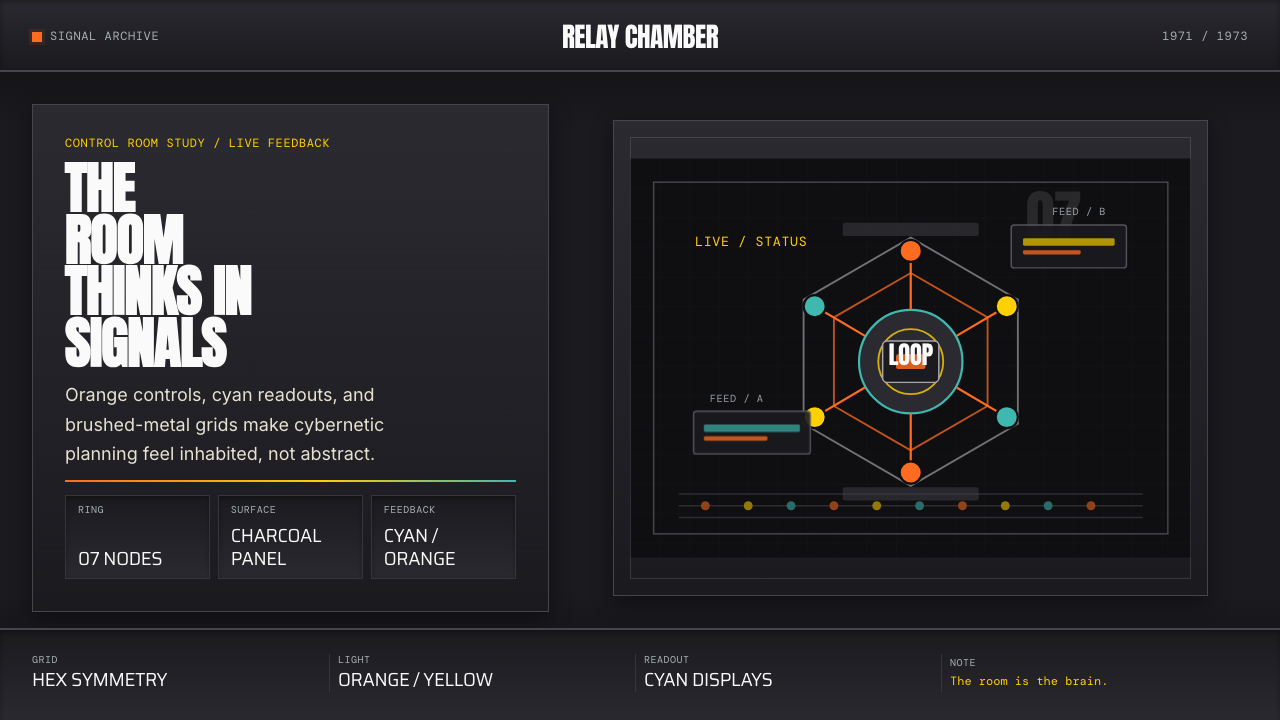 Cybernetic 1968 (Stafford Beer)Mission-control severity. Charcoal panels, orange buttons, cyan readouts, hex…
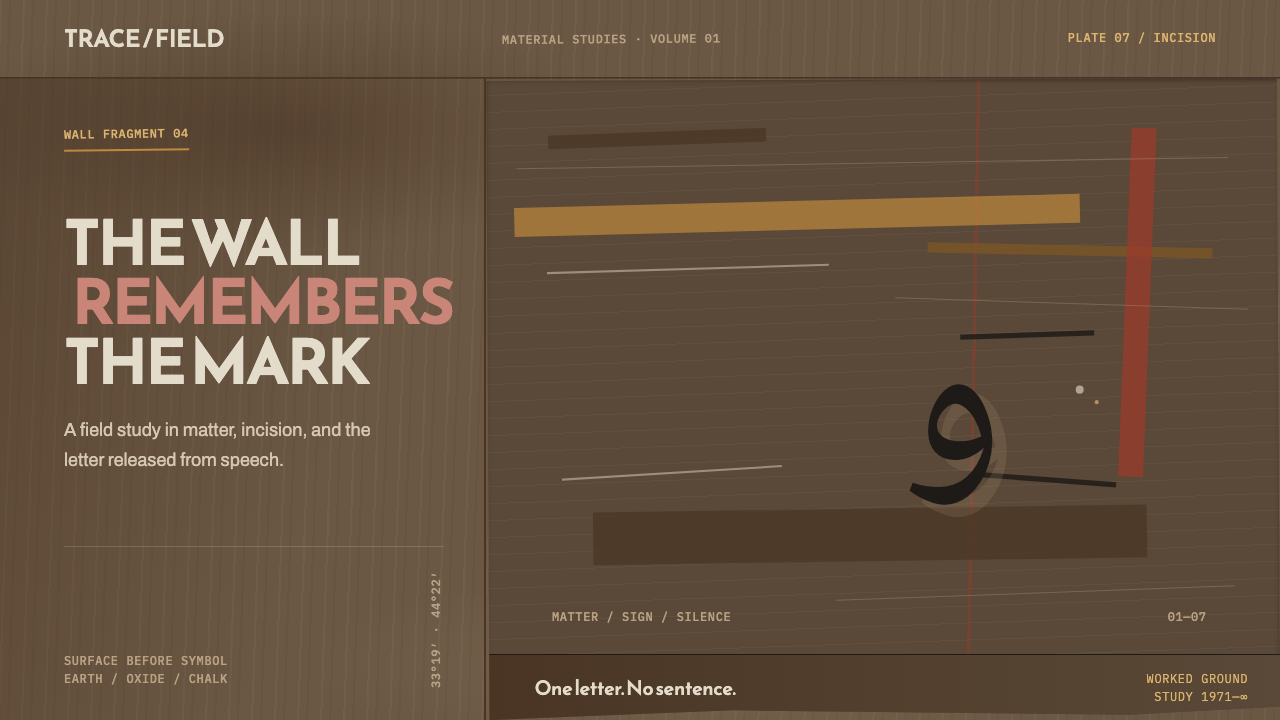 Hurufiyya MovementThe wall carries the meaning. Ochre scars and one off-axis letter break a fie…
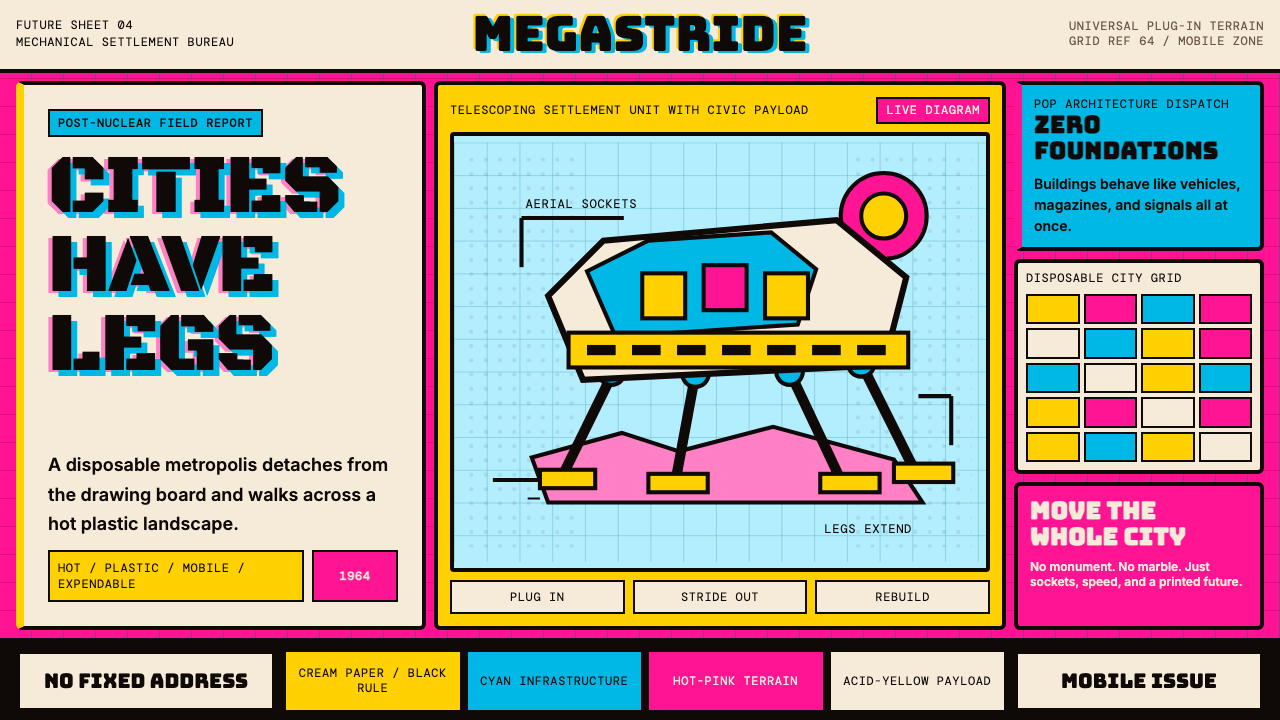 Archigram Walking City (1964)Cities refuse foundations. Hot pink, cyan, and acid yellow lock a bordered co…
 Buzludzha MonumentMonumentality without repair. Stained concrete frames cobalt tesserae, ruby g…
 Czechoslovak New Wave CinemaNoir without nostalgia. Letterbox bars, off-white titling, and 35mm grain do…
 High Life (2018)Institutional dark, one living light. Matte-black hull, hydroponic green, one…